Matthew 20:2
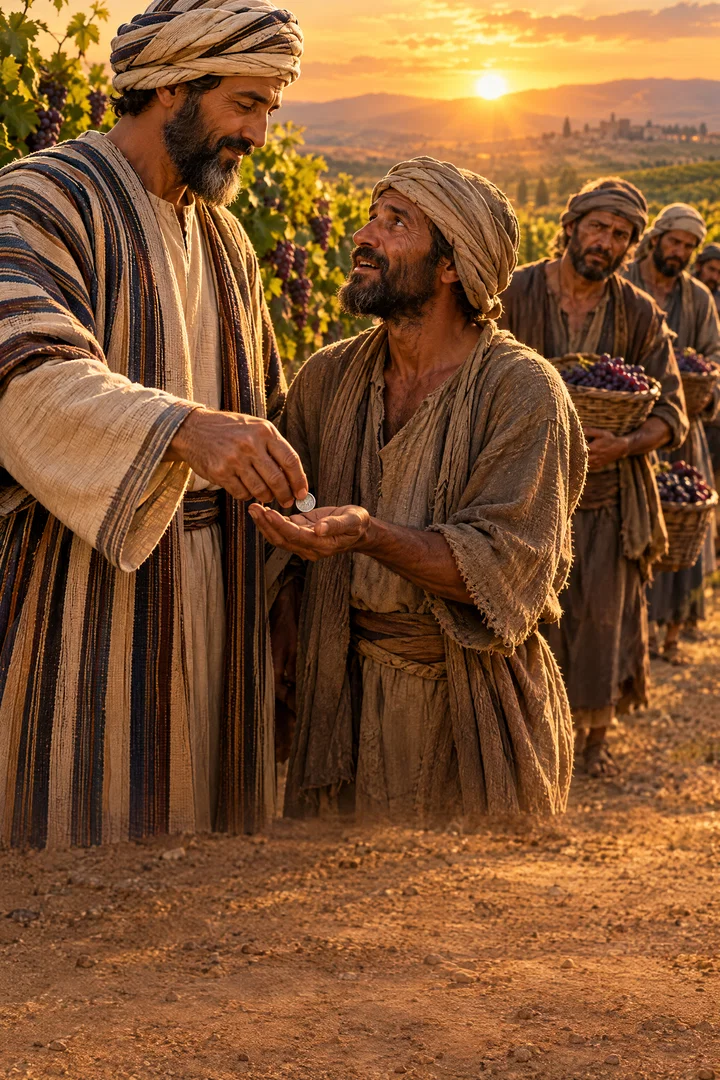
And when he had agreed with the labourers for a penny a day, he sent them into his vineyard.
Translations
American King James Version, Webster Bible
And when he had agreed with the laborers for a penny a day, he sent them into his vineyard.
King James Version, KJV Cambridge Paragraph Bible, Revised Version
And when he had agreed with the labourers for a penny a day, he sent them into his vineyard.
And when he had agreed with the laborers for a shilling a day, he sent them into his vineyard.
and having agreed with the workmen for a denary a day, he sent them into his vineyard.
And having agreed with the workmen for a denarius the day, he sent them into his vineyard.
and, when he had agreed with the labourers for a denary the day, he sent them into his vineyard.
Berean Standard Bible, Majority Standard Bible
He agreed to pay them a denarius for the day and sent them into his vineyard.
When he had agreed with the laborers for a denarius a day, he sent them into his vineyard.
And when he had made an agreement with the workmen for a penny a day, he sent them into his vine-garden.
And he agreed with the labourers for a peny a day, and sent them into his vineyard.
Douay-Rheims (Challoner revision)
And having agreed with the labourers for a penny a day, he sent them into his vineyard.
Pictures
Cross-references
- Matthew 20:6-9
And about the eleventh hour he went out, and found others standing idle, and saith unto them, Why stand ye here all the day idle?
The eleventh-hour laborers are called into the vineyard and receive a penny.
- Matthew 20:8-16
So when even was come, the lord of the vineyard saith unto his steward, Call the labourers, and give them their hire, beginning from the last unto the first.
The householder pays the agreed wage, gives equal reward, and teaches that the first shall be last.
- Matthew 20:9-15
And when they came that were hired about the eleventh hour, they received every man a penny.
Late workers receive the same wage, exposing the first workers’ resentment.
- Matthew 21:28
But what think ye? A certain man had two sons; and he came to the first, and said, Son, go work to day in my vineyard.
Both depict workers being sent to labor in a vineyard.
- Matthew 9:37-38
Then saith he unto his disciples, The harvest truly is plenteous, but the labourers are few;
The Lord’s harvest needs laborers sent to work.
- Matthew 19:30
But many that are first shall be last; and the last shall be first.
The saying that the first shall be last and the last first is illustrated by the parable.
- Matthew 20:13-15
But he answered one of them, and said, Friend, I do thee no wrong: didst not thou agree with me for a penny?
The householder defends keeping the penny agreement while extending generosity to the last workers.
- Matthew 20:12
Saying, These last have wrought but one hour, and thou hast made them equal unto us, which have borne the burden and heat of the day.
The first workers compare their agreed wage with the later workers’ pay.
- Matthew 20:8
So when even was come, the lord of the vineyard saith unto his steward, Call the labourers, and give them their hire, beginning from the last unto the first.
The workday’s reckoning comes at evening.
- Matthew 20:6
And about the eleventh hour he went out, and found others standing idle, and saith unto them, Why stand ye here all the day idle?
Christ's question urging the idle to work
- Matthew 20:15
Is it not lawful for me to do what I will with mine own? Is thine eye evil, because I am good?
The master asserts his right to do as he wills with his own.
- 1 Corinthians 3:9
For we are labourers together with God: ye are God’s husbandry, ye are God’s building.
Vineyard labor is laboring together with God.
- Revelation 22:12
And, behold, I come quickly; and my reward is with me, to give every man according as his work shall be.
Both connect each person’s work with the reward received.
Commentary part 1 of 2
Each commentary is drawn from primary sources: the writings of Ellen G. White and Adventist pioneers and periodicals. Each commentary is separate. Its own words are not a quotation; follow the references to read the source passages.
Ellen G. White
142 sources
Early in the morning the householder agreed with the first laborers for a penny for a day's work and sent them into his vineyard, and they received exactly what had been promised.9T 73.3–74.1Ms 19, 1897, par. 38–41RH Jul 24, 1900 His dealing shows one part of what the kingdom of heaven is like, representing God's dealings with humanity according to His own standard rather than human expectations.Ms 87, 1899, par. 1–3Ms 29, 1911, par. 66RH Jul 24, 1900 The reward is given according to His gracious purpose and is not earned by the amount of work, its visible results, or the length of time spent working, so those who become workers at the eleventh hour share the same eternal reward as those who labored throughout the day.RH Aug 13, 1908ST Jul 13, 1915COL 396.3–397.1Ms 18, 1888, par. 30Ms 52, 1897, par. 26–27 The definite bargain of the first workers illustrates a fixed, merit-based expectation of a stated reward for a stated amount of work, but Christ's servants are not to bargain or insist on stipulated wages, but to trust the owner to do what is right and serve in faith and love without envy or comparison.RH Jul 24, 1900COL 396.3–397.1RH Jul 24, 1900RH Jul 24, 1900Ms 87, 1899, par. 10 The first-called laborers represent the Jews who were called first and believed their long years of service entitled them to greater reward and privilege than others, and they also represent disciples and church members tempted to think service earns salvation and special standing.ST Aug 9, 1899RH Jul 31, 1900COL 399.5–401.1ST Jul 13, 1915Ms 87, 1899, par. 16
Wording and Setting
The householder hired laborers early in the morning, agreed with them for a penny for a day's work, and then sent them into his vineyard.9T 73.3–74.1Ms 19, 1897, par. 38–41RH Jul 24, 1900 That agreed penny was the wage the master promised his workers, and they received exactly what had been agreed to with nothing more added.9T 73.3–74.1Ms 19, 1897, par. 38–41Ms 29, 1911, par. 67 Because they received what had been promised, they had no cause to complain when later workers received the same amount, for the verse establishes both the terms of their service and the householder's obligation to pay what was promised.Ms 19, 1897, par. 38–41RH Jul 24, 1900
The verse shows one part of what the kingdom of heaven is like, with the householder making a definite bargain with the early-morning laborers and sending them into the vineyard.Ms 87, 1899, par. 1–3 In this parable the householder's dealings with the vineyard workers represent God's dealings with the human family and with humanity.Ms 29, 1911, par. 66RH Jul 24, 1900 Christ's kingdom therefore follows God's own standard rather than human expectations or the standards of other householders, and freed from selfishness the first workers would have recognized the fairness of paying the latecomers the same wage instead of resenting generosity toward those hired later.Ms 29, 1911, par. 66RH Jul 24, 1900
The verse opens the parable by a familiar custom in which men wanting work go to the marketplace and stand hoping to be hired while men needing workmen come there to find them, the householder going out early in the morning, agreeing for a penny a day, and sending them into his vineyard.ST Aug 9, 1899 It continues the lesson of the preceding chapter in answer to Peter's question about what those who have forsaken all and followed Christ will have.ST Aug 9, 1899 That lesson was called forth by the disputing of the disciples as to who should be greatest.ST Aug 9, 1899
The calls in the parable extend from early morning until the last hour of the day, beginning with the first laborers agreeing to work for a penny.RH Jul 31, 1900COL 399.1 Long service is not made grounds for claiming greater reward, for God rewards according to the spirit in which the work is done and not according to a worker's estimate of its worth.RH Jul 31, 1900 Those who accept the call only in theory, or who serve with a faultfinding, self-exalting spirit, may be last rather than first.RH Jul 31, 1900 The men hired later had not been present in the morning and had not refused the opportunity, since they were not there then.RH Jul 31, 1900COL 399.1 Therefore those who hear the first call must not neglect it, and the parable does not excuse those who hear the truth and refuse to obey it or who deliberately turn down the first call and presume they can repent later.RH Jul 31, 1900COL 399.1
The Saviour uses the vineyard to represent the world, placing laborers in that vineyard to illustrate work in the world as service in God's field.FE 512.4Ms 99, 1907, par. 3 Service in God's vineyard is work for which Christ promises wages, for the call to labor is a call to serve Jesus and the reward is to be received later.SBAWP 13.2 The penny was given to the laborer who worked in the vineyard and not to the person who merely loitered in the marketplace, so receiving grace and its reward calls for faithful action in the work God has set before us, with the fruit borne showing the character of the work.Ms 132, 1901, par. 17 Workers hired late in the day are still faithful and receive their promised penny even though they enter the work when it has grown harder and people are more hardened.10MR 170.2–3
Reward by Grace
The agreement for a penny a day opens a parable given to correct the idea that God's favor and the reward of the righteous must be earned by works, teaching instead the principles of His free grace in place of a grasping, mercenary approach to worship.COL 390.1 The first and the last share the same eternal reward, so those who become workers with Christ at the eleventh hour receive the same reward as those who labored through the whole day.ST Jul 13, 1915Ms 18, 1888, par. 30 This is illustrated by the dying thief, who turned to Christ at the end of life and yet received salvation through earnest faith, contrition and dependence, showing that saving mercy is not earned by long service.Ms 52, 1897, par. 26–27
God's reward is given according to His gracious purpose and is not earned by the amount of work, its visible results, or the length of time spent working.COL 396.3–397.1COL 397.2–398.1 The first workers agreed to a set wage and received exactly the sum specified, while the later workers also received a penny, showing that value in God's service is measured by the spirit in which it is given rather than by hours worked.RH Aug 13, 19089T 74.2Ms 87, 1899, par. 8–9 Their fixed, merit-based expectation of compensation for a stated amount of work stands in contrast to God's generous purpose, which honors humble trust and gratitude for being accepted with kindness beyond what is felt to be earned.COL 396.3–397.1ST Jul 13, 1915 Even brief work done for God in simple faith and love receives the blessed reward of grace, and service is to be motivated by love rather than eagerness for compensation, picturing the joy and gratitude of an unworthy sinner whom God accepts and honors.COL 397.2–398.19T 74.2
Unlike the first workers who stipulated a wage, the later workers made no bargain but left payment to the owner, trusting him to do what was right.ST Jul 13, 1915Ms 87, 1899, par. 11–12 They were glad to work at any price, with hearts full of thanksgiving and love and with faith shown by asking no questions about reward, and when the householder began with them at the close of day and paid them for a full day's work they were greatly surprised because they knew they had not earned it.Ms 87, 1899, par. 11–12 This pictures the joy, thanksgiving and gratitude of an unworthy sinner who expects very little and is honored beyond what was earned, satisfied with little if only Christ will accept him in service after long neglect.RH Jul 24, 1900Ms 87, 1899, par. 11–12 One who comes humbly, grateful simply to be accepted into Christ's service late, may receive far more than expected, for the householder's generous payment is a gracious gift and not wages earned.RH Jul 24, 1900
Salvation is a gift of grace and not wages owed for service, so no one can claim the reward as a right or boast over another.COL 401.2–402.1 Those who have served longer must welcome rather than begrudge or envy the reward given to others, and freed from selfishness they would recognize the fairness of paying the latecomers the same wage instead of resenting generosity toward those hired later.ST Jul 13, 1915COL 401.2–402.1Ms 29, 1911, par. 66 The Lord values the spirit in which work is done rather than capacity, learning, or how much is accomplished compared with others.Ms 72, 1902, par. 34Lt 24a, 1882, par. 14 He rewards willingness, fidelity, humility, love for fellow workers, self-forgetfulness and pure motives that earnestly seek to glorify Him, and the principles governing the work determine its reward.ST Jul 13, 1915Ms 72, 1902, par. 34 The humblest servant living out faith consistently does labor acceptable to God, for the Lord gives every believer a place in His work with different talents and honors each worker according to faithfulness, which must not depend on being esteemed or appreciated.Lt 31, 1879, par. 4Lt 24a, 1882, par. 14
First Laborers Represent
The first laborers hired after agreeing for a penny a day represent the Jews, who were called first and regarded their long years of service as entitling them to greater reward and privilege than those who worked less, such as the Gentiles.RH Jul 31, 1900COL 399.5–401.1Ms 87, 1899, par. 16 They illustrate the danger of treating service to God as earning a fixed reward, thus representing service as earning salvation.COL 399.5–401.1Ms 87, 1899, par. 16 They stand for all who treat long service, hardship, and sacrifice as grounds for claiming a larger reward and honor above others.COL 399.5–401.1 Such claiming puts the reward ahead of the privilege of serving Christ and reveals self-advancement, distrust of God, jealousy, and lack of loving cooperation with Him.COL 399.5–401.1
The same first-called workers represent disciples tempted to think their service earns them a place or special standing in heaven.COL 399.5–401.1ST Jul 13, 1915 The lesson belonging to them is that salvation and reward are by grace and not grounds for boasting or feeling superior to others.ST Jul 13, 1915 It warns Christ's first-called disciples against the same self-righteousness shown by the Jews.COL 399.5–401.1
The first-hired laborers, with whom the householder agreed for a penny a day and whom he then sent into the vineyard, doing them no wrong by keeping that agreement in giving the penny, represent those who come into the church with an envious, self-righteous spirit, thinking by works they can earn heaven and claiming preference because they were first in the field.ST Aug 9, 1899 They take credit to themselves when they advance, are lifted up with pride, are eager for flattery and to be placed first, feel superior to others, fail to treat the poor and needy rightly, are eager for reward, and think they should receive compensation for everything they do.ST Aug 9, 1899 The lesson reaches down to the present time against that spirit, showing that man judges by appearances but the Lord judges motives, sincerity and fidelity.ST Aug 9, 1899 He measures the humble, childlike spirit of love, self-sacrifice and self-abasement in lowly service to others, making the reward proportionate and putting first those who think little of what they do.ST Aug 9, 1899
Bargaining Spirit Rebuked
The agreement for a penny a day pictures a fixed, merit-based expectation in which service is treated as having a set value that can be stipulated in advance.COL 396.3–397.1RH Jul 24, 1900Ms 87, 1899, par. 10 Those hired first expect a stated reward for a stated amount of work, receive exactly the sum specified, and judge their labor as worth more than that of those who arrive later.COL 396.3–397.1RH Jul 24, 1900Ms 87, 1899, par. 10 This stands in contrast to God's generous purpose, which does not measure reward by the amount of work performed, and in His estimation those who serve for wages are last.COL 396.3–397.1Ms 87, 1899, par. 10
The parable warns servants of Christ not to bargain as though the Master will fail to deal fairly with them.RH Jul 24, 1900Ms 29, 1911, par. 65Ms 87, 1899, par. 15 They are not to insist on a stipulated wage or make their service a bargain for a fixed reward, while the later workers leave payment to the owner trusting him to do what is right.RH Jul 24, 1900Ms 29, 1911, par. 65Ms 87, 1899, par. 15 Faith is to rest on His trustworthiness, recognizing His liberality rather than murmuring over it, for grumbling over His dealings reveals a heart that needs to be changed.Ms 29, 1911, par. 65Ms 87, 1899, par. 15 Service for Christ is not to be driven by wages, self-exaltation, or comparison with others, but by love and dependence on God, and those united with Christ work as God's fellow workers rather than to win human praise.RH Jul 24, 1900RH Jul 31, 1900 The Lord values the spirit in which work is done above focus on wages, so that those who serve in humble trusting faith may be honored ahead of those who began earlier.RH Jul 24, 1900
Those first hired picture those who will not work without the wages they themselves stipulate, making self-chosen pay a condition of service.Ms 87, 1899, par. 10Lt 93, 1899, par. 14Ms 142, 1903, par. 90 Such agreement shows a self-serving, bargaining spirit opposite to true, self-sacrificing, faithful work done with God's angels.Lt 93, 1899, par. 14 By holding to their own terms instead of denying self and taking up the cross daily to follow Christ, they fix their own destiny and are made last at the close of the day.Ms 87, 1899, par. 10Lt 93, 1899, par. 14Ms 142, 1903, par. 90 Being found last pictures the low place given in the end to such demanding, self-seeking workers, fixing them as candidates for hell rather than heaven.Lt 93, 1899, par. 14Ms 142, 1903, par. 90
Laboring to earn a reward in proportion to effort reflects a hireling spirit that can unfit followers for service.COL 396.1–2 Those who labor whole-heartedly and to the utmost of their ability do not put the highest value on their own services or swell with pride and self-importance.SSP 13.1–2 They do not measure every hour's work exactly, nor study how little they may do to reach the very lowest standard.SSP 13.1–2 They compare their efforts with the Saviour's work and count themselves unprofitable servants, seeking to grasp the fullness of Christ so they may do much for Him.SSP 13.1–2
Vineyard Means God's Work
The vineyard is the Lord's work of bringing people out of darkness and error and establishing them in truth, and to be sent into it is to be appointed to save souls by sowing the seed of truth through willing sacrifice and earnest, faithful missionary labor.SBAWP 10.3–11.1AA 186.2–3TBC1872 97.1 That labor is not for ministers alone but for everyone in His service, for every church member has a part as God's agent communicating heaven's light to the world, and no one should remain idle or ask to be excused.SBAWP 10.3–11.14T 75.4Ms 42, 1890, par. 31–32 The call is to devoted, self-sacrificing workers who will carry truth to those in spiritual darkness, especially in the cities to win souls, since Christ paid an infinite price to redeem people and they must not be left to perish through selfish ease.4T 75.4ST Oct 31, 1911TBC1872 97.1 Every convert who takes a stand for the gospel must be shown the necessity of entering this vineyard and be given practical instruction how to labor in it unselfishly, earnestly, and perseveringly for fellow men, as with men of promise and ability like Timothy, so that faith increases and holds firm even when teachers leave for another place.AA 186.2–3
Christ comes through the ages calling people to labor in His vineyard, and the call is especially urgent near the close of earth's history.15MR 81.1 To be sent into the vineyard now means everyone that loves Jesus giving active help in the Lord's work of giving the last message of mercy to the lost while probation is fast closing, with no idlers left unused. Faithful labor then includes not robbing God but bringing the tithes and offerings needed to sustain His cause, and those who labor in word and doctrine fulfill this sending by fully improving their charge to preach, teach, reprove, rebuke, and exhort.
Christ has no place for idlers, for everyone is required to work for time and eternity and to watch for and use opportunities to do good, with those serving at an important post carrying its burdens and supporting God's work with self-sacrificing effort.4T 518.1–2CH 583.2 Each member of the household of faith has a task and a portion of the work to do, under individual responsibility to join in the Lord's work rather than wait for others to help.4T 454.1ST May 24, 1883 The vineyard is a place of labor where those who do not take up their work are idle in it, while those who unite with the Saviour become valuable workers in His vineyard winning souls to Christ.7T 231.52T 114.2–4
Being sent into the vineyard is a present day of trust and opportunity, followed by a day of reckoning when accounts will show how each stands.Lt 8, 1890, par. 35 Obligation in that work is measured by entrusted means, ability, and opportunity, so the heaviest obligation rests on the worker whose means and opportunity are greatest.Lt 8, 1890, par. 35 The Lord expects interest from entrusted talents in proportion to the capital given, holding each responsible for the use or abuse of talent according to ability and opportunity, not requiring the smaller vessel to hold as much as the larger.Lt 8, 1890, par. 35
Those longing for truth, when converted, are agreed with and sent into the Lord's great vineyard, the cause of God in the world, as helpers who serve God intelligently and by faith and works show that the labor put forth for them has not been in vain.Ms 76, 1901, par. 5 God has workers in every part of His vineyard whom He teaches, leads, and guides, serving in different places rather than being bound to one human center, and He knows and watches over them.Ms 46, 1903, par. 27Lt 180, 1901, par. 5–6 Laborers should therefore be sent into the field with sympathy and opportunities so their interest and growth do not flag.Ms 46, 1903, par. 27
Christ calls even the men and women who cause discouragement to take a place in His vineyard, for He sees qualifications for work in them.CH 26.17T 271.1 He calls people from different occupations, from fields, vineyards, and workshops, to help carry the gospel message in its closing work, and lack of education or seeming inexperience does not prevent service.GW 36.2–3ST Jul 19, 1905 If they give their hearts to the work and will constantly be learners, His providence will fit them for work not beyond their capabilities, and through the impartation of the Holy Spirit He will give them power of utterance to labor for Him.CH 26.17T 271.1ST Jul 19, 1905
Labor in Every Field
All Christians, men and women, are to be awake, zealous, devoted workers in the vineyard, laboring for the salvation of others in step with God's people, gathering experience and keeping unity rather than sitting idle, crowding out others, or leaving the work undone for pleasure.3T 202.1GW92 47.3MYP 206.2–207.15T 386.1CT 507.1–2 Following Christ's example of self-denial, sacrifice, and faithful earnest effort, each is to give self wholly to sharing truth, serving wherever needed to the fullest ability without seeking the place of most enjoyment or gain.3T 202.1GW92 47.3MYP 206.2–207.15T 386.1CT 507.1–2 No genuine believer is idle, for every member is to be a working member instrumental in saving souls, taking deep interest in each soul and finding something for each convert to do, united as links in a golden chain binding hearts to one another and to God to enlighten the world, each responsible for the health and spiritual strength and growth of the church.Lt 32, 1890, par. 7–9
The vineyard summons calls ministers to earnest, persevering labor for souls that enlarges the circle of effort until it encircles the world, reaching new fields and winning sinners rather than remaining where churches already have much light and many advantages.7T 255.2–36T 411.2Ms 3, 1899, par. 39–40RH Aug 19, 1902Ms 6, 1902, par. 2 They are to sow beside all waters, visit place after place, raise up churches, set every member to work, educate rather than only preach, and select and train worthy young men as co-laborers, using every resource to enlarge the kingdom.RH Aug 19, 1902Ms 6, 1902, par. 2 That ministry of the Word in its various lines is the highest of all work and no work more blessed, not to be belittled or treated as inferior, and the call is directed to large-hearted, large-minded young men with deep love for Christ and truth who must not be deterred nor drawn by glowing representations out of the path where God bids them walk, including being turned aside to medical lines when they ought to prepare for the ministry, to strengthen outposts and stand as faithful sentinels in every part of the world.6T 411.2Ms 3, 1899, par. 39–40
The vineyard workers represent those called to labor for souls in the cities with courage, zeal, and persistence until the work is thorough, and in neglected parts including the destitute Southern field.RH Apr 7, 1910RH Sep 28, 1905Ms 49, 1910, par. 4Lt 219, 1899, par. 1–2 Laborers sent into that Southern field depend on men in responsible positions to heed appeals and prepare the way, and when stewards neglect that responsibility and close their senses, workers who understand the necessities have a perfect right to go anywhere, bring their case directly before the people, ask for help without means passing through any office or society, and devise and plan to prepare their own way so the work at places like Nashville is not left undone.RH Sep 28, 1905Lt 219, 1899, par. 1–2
Laborers handling sacred things in publishing work for the salvation of souls belong to one vineyard and one work, called to earnest prayer in faith, unselfish purpose, full consecration with affections and hopes centered in God, and warning the careless without treating the work as common labor.3T 191.2STPW91 15.1TBC1872 20.25T 417.2 Treating it as ordinary labor and engaging in trifling frivolities grieves angels and makes one a fruitless cumberer of the ground, while workers in different houses must not be jealous or feel superior to those at another house but work without selfish aims for the good of the whole cause to save the lost.3T 191.2STPW91 15.1TBC1872 20.25T 417.2 To labor in the vineyard includes gospel canvassing with books that express faith and give light to purchasers, bearing the burden of souls and daily learning how to win people to truth and gaining fitness for ministry.MC 40.3–4Ms 19, 1908, par. 3–5 Those who use powers for selfish interests and sell books and pictures that do not express faith because financial prospects are more flattering refuse to labor in the vineyard, forgetting what they owe to the Lord who gave His life, and lose time and opportunities, whereas young people gain practical preparation for service through selling books and bringing their message to people.MC 40.3–4Ms 19, 1908, par. 3–5
Consecrated youth, students, and children are to be educated, disciplined, and trained in mind, common branches, prophecy, and present truth so they become earnest, persevering workers and missionaries, with the greatness of the work impressed upon the mind and practical godliness brought into daily experience for fitness for foreign fields.3T 160.2STSE 27.1–28.1FE 45.1–2CE 46.1LSEGW 375.3–376.1 That fitting requires disciplining the mind, developing its powers and directing them understandingly, including lectures upon the prophecies and instruction in God's word for this time, through home training, schools, and Bible-school training.3T 160.2FE 45.1–2CE 46.1 The church is to recognize the work required for youth and children and actively labor in that spiritual work.HCSSP 18.1
The vineyard includes the home, where younger children needing instruction are to be cultivated by older family members patiently helping them, using abilities to share what they know, keeping spiritual lessons fresh and learning alongside them to make study pleasant and profitable.RH Jun 2, 1910 A mother with an unbelieving husband who makes training hard has her appointed labor in her own home and should not leave her family to find other religious work, but should stay, endure poverty and wounds of soul, train her children, and counteract the godless father's influence under Satan's control rather than give them up.Lt 28, 1890, par. 23–24 The same image applies to women engaging in missionary work by distributing literature and sharing truth, which educates them as workers for God, and to medical missionaries saving souls, and to every department under Christ the employer.RH Dec 10, 1914Lt 60, 1888, par. 13Lt 233, 1905, par. 40–42 The shepherd of the flock is to lead and guide in that work, and every servant employed is expected to be like Jesus in mind, thoughts, words, and actions, doing duty carefully and intelligently, working wisely and exercising powers without destroying or overwearying nature so as not to be unfitted for good work.Lt 60, 1888, par. 13Lt 233, 1905, par. 40–42
The Lord's vineyard is the whole worldwide work, and He who sees all that must be done, where memorials should stand, and which fields are unworked and destitute of facilities, sends workers into every part and requires equity and just judgment so a large amount of means is not absorbed in one place.YGBCOEP 39.3–40.211MR 45.3–46.18T 138.2–3Lt 43, 1900, par. 6 Every building is to be erected with reference to other places needing similar buildings, workers spread among many places rather than concentrated in one center, and destitute regions without culture and facilities placed on a proper basis, rather than blocking advance by selfishly using in one place or one line all means secured or concentrating resources and influence at Battle Creek in one's own interests.YGBCOEP 39.3–40.211MR 45.3–46.18T 138.2–3Lt 43, 1900, par. 6 Those sent are stewards of His treasury answerable to Him, to labor for all portions at the same time while working in one part, planning for the whole field, with sanctified ability making the work proportionate, for unfaithful disproportionate stewardship will stand exposed before the universe of heaven.8T 138.2–3Lt 43, 1900, par. 6
Vineyard work is not limited to regular lines or public preaching but is to be taken up where one is, at home and among neighbors and friends, in so-called irregular lines of self-sacrificing effort, with each taking up work right where they are instead of waiting for a regular process or going elsewhere for preparation.OEWP 36.1–37.1RCOC 114.5Ms 42, 1894, par. 4–5Lt 109, 1901, par. 12Ms 10a, 1895, par. 101–102 Those who are idle should be given a share, and if they make mistakes be corrected and set to work again, for people learn to use abilities by putting them to work, and by such stepping out of regular lines laborers learn by experience what it means to be laborers together with God and win souls.OEWP 36.1–37.1RCOC 114.5Lt 109, 1901, par. 12 People of every age should take part according to ability, using the present opportunity of probation in service for God rather than self-indulgence.Ms 62, 1894, par. 3Ms 144, 1897, par. 11–13Ms 10a, 1895, par. 101–102
Entrusted means, powers, and time are not to be used selfishly as unsanctified desire dictates but exercised wholly in God's service to advance the cause beyond the home, felt outside and beyond it, with every family member educated to work for the Master.3T 121.1–2TCBMP 156.1Ms 144, 1897, par. 11–13 Daily work passes beyond recall and hour by hour decides destiny, so workers must be in touch with divinity, cherish a missionary spirit, and use day-by-day opportunities to speak truth, hand a tract, present a book, and make known the unsearchable riches of Christ, treating time as a precious talent not to be squandered.Ms 144, 1897, par. 11–13 Faithful labor includes bringing tithes and offerings to sustain the cause and its workers in word and doctrine as they preach, teach, reprove, rebuke, and exhort to give the last message of mercy while probation fast closes, and gifts offered to Christ can help others go out to bring to God those for whom Jesus died.21MR 223.3–6 Each child of God has an assigned responsibility to develop abilities for effective service.Lt 12a, 1893, par. 32
Service rests on a sacred mutual agreement about wages to be conducted fairly and truly on right principles, with those employed having a voice as in ordinary trade.Ms 109, 1907, par. 39–4117MR 248.3–5Ms 142, 1903, par. 65–66 Wages are not to be cut without consent and without understanding the situation, but when lack of means presses the true situation is to be openly set forth and workers asked if they can do with less, for unilateral cutting brings families into straits, want, and oppression, tempts and discourages and drives them from the field, revealing selfishness, injustice, and unrighteousness.Ms 142, 1903, par. 65–66 Labor is to be valued by the self-denial of Jesus the Pattern, not by a high price upon one's own labors, for setting higher and still higher wages misrepresents Christ, spoils spirituality, and makes associates on lower wages feel wronged, and those starting new work must set an example of self-denial in wages from the beginning.Ms 109, 1907, par. 39–41 Ministers illustrate the hiring by laboring for souls and producing fruit rather than merely receiving support without useful work, with fair dealing so faithful workers are not given little while those producing nothing receive much.17MR 248.3–5
The eleventh-hour laborers who receive their penny include many who will come out of the world and the churches, even the Catholic church, in the final crisis, whose zeal will far exceed those long in rank and file, seeing the battle over religious liberty coming, giving the trumpet a certain sound, girding on the whole armor of God, exalting His law, adhering to the faith of Jesus, and maintaining religious liberty when calamity comes.Ms 30, 1889, par. 73–79 They also include those who had little opportunity taking the place of those who had great light and failed to value it, devoting abilities and entrusted means to advance the work and declare His whole counsel.Lt 123, 1897, par. 24–28Ms 30, 1889, par. 73–79
Those agreed with and sent are to labor devotedly in unison with God and angels moving on hearts and consciences, staying wide awake and zealous, availing themselves of every opening to press in truth for those in darkness.TCBMP 201.1GW 80.2HSFM 283.5–284.1 True toilers are people of prayer, faith, and self-denial restraining natural appetites and passions, whose lives show the power of the truth they share, obligated to use all abilities in the best service, feeling the burden, carrying the message with power especially to new fields through prayer, holy living, and teaching to raise up Sabbathkeepers, preparing to preach and trusting God to sustain and guide.GW 80.2RH Apr 13, 1905Lt 29, 1877, par. 11Ms 1a, 1859, par. 7–8HSFM 283.5–284.1 Not all are called to give themselves wholly to teaching or travel extensively, for some assist without serving as full-time traveling ministers.Ms 1a, 1859, par. 7–8 The work calls for humility without exalting self or belittling others, examining hearts and relying on God in love and faith.Ms 87, 1899, par. 26–27 Gospel ministers pointing to the Lamb of God who takes away sin do sacred, solemn, important work requiring clean hands and converted hearts, seeing defects of character and experiencing transforming grace carried out in life beyond mere religion of the head.3T 552.1 Children like those of Brother and Sister Lindsay should use abilities and bear burdens rather than leave labor to parents, and new workers beginning a new work are to receive help from the experienced, with no part of the field regarding itself as independent.TCBMP 77.2–3Ms 19, 1911, par. 4
Abilities used in God's service accomplish much good, while turning them toward selfish gain becomes harmful, as seen when W. C. turned qualities that could have done good to selfish ends.TCBMP 164.2–165.23T 126.2–127.2Ms 122, 1899, par. 80–83 Refusing to labor forgets what is owed to the Lord who gave His life, and those in Vermont who believed themselves called yet left heavy family support to the church while themselves eased must give up that belief.MC 40.3–4Lt 21, 1859, par. 3 Neglect of duty makes one like an idle worker when opportunities should be earnestly used.21MR 459.2–4 The vineyard still pictures work that must be done, where hiring means God accepts service when powers of mind are exercised in His service and Scripture study to become intelligent in spiritual knowledge and the kingdom, laboring earnestly and perseveringly while walking in light from one degree of light and strength to another until welcomed into the joy of the Lord when the warfare ends.3T 159.26T 304.2GW92 326.220MR 123.2 Hire is pictured as souls won through persevering labor by those entering promptly, the Master calls and watches over workers in different parts, the church is to help them continue through sympathy and opportunities to grow, spread the invitation of mercy worldwide, and devote time to prayer, Bible study, and labor for others rather than idleness, with members educated and called especially to those who have not heard, including foreigners.RH Jun 2, 19036T 304.2GW92 326.220MR 123.2RH Oct 29, 1914 In that confidence Edson may trust the Master for work that does not sacrifice life, and success in canvassing is not to be made a prerequisite for ministry.RH Jun 2, 1903
Sources