Matthew 20:12
Saying, These last have wrought but one hour, and thou hast made them equal unto us, which have borne the burden and heat of the day.
Translations
Saying, These last have worked but one hour, and you have made them equal to us, which have borne the burden and heat of the day.
Saying, These last have wrought but one hour, and thou hast made them equal unto us, which have borne the burden and heat of the day.
saying, These last have wrought but one hour, and thou hast made them equal unto us, which have borne the burden and heat of the day.
Saying, These last have wrought but one hour, and thou hast made them equal to us, who have borne the burden and heat of the day.
saying, These last have spent but one hour, and thou hast made them equal unto us, which have borne the burden of the day and the scorching heat.
saying, These last have spent but one hour, and thou hast made them equal unto us, who have borne the burden of the day and the scorching heat.
that These, the last, wrought one hour, and thou didst make them equal to us, who were bearing the burden of the day — and the heat.
saying, These last have worked one hour, and thou hast made them equal to us, who have borne the burden of the day and the heat.
These last, one hour, wrought, and thou hast made them, equal unto us, who have borne the burden of the day, and the scorching heat.
Berean Standard Bible, Majority Standard Bible
‘ These men who were hired last worked only one hour,’ they said, ‘ and you have made them equal to us who have borne the burden and the scorching heat of the day.’
saying, ‘ These last have spent one hour, and you have made them equal to us who have borne the burden of the day and the scorching heat!’
Saying, These last have done only one hour's work, and you have made them equal to us, who have undergone the hard work of the day and the burning heat.
Saying, These last haue wrought but one houre, and thou hast made them equall vnto vs, which haue borne the burden and heate of the day.
Douay-Rheims (Challoner revision)
Saying: These last have worked but one hour, and thou hast made them equal to us, that have borne the burden of the day and the heats.
Pictures
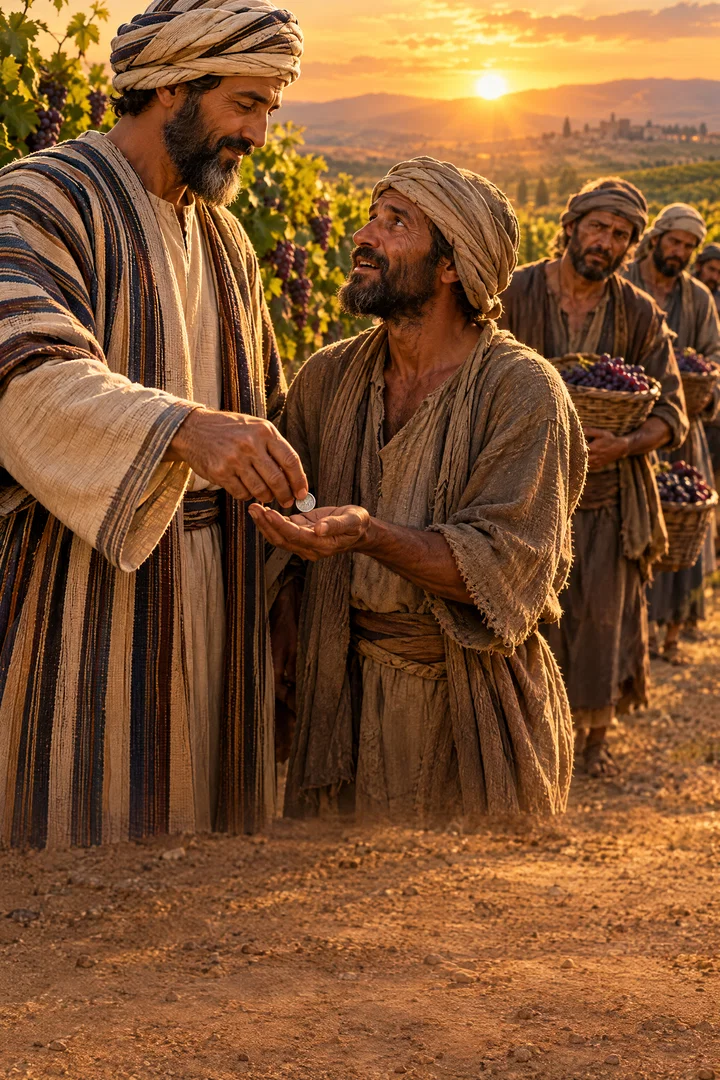
Cross-references
- Matthew 20:6-7
And about the eleventh hour he went out, and found others standing idle, and saith unto them, Why stand ye here all the day idle?
The late-hired workers are called into the vineyard and trust the householder to pay what is right.
- Matthew 19:27-30
Then answered Peter and said unto him, Behold, we have forsaken all, and followed thee; what shall we have therefore?
Jesus answers Peter’s question about reward for following him, then says the first shall be last.
- Matthew 20:16
So the last shall be first, and the first last: for many be called, but few chosen.
The verse summarizes the parable’s reversal of the first workers’ claim to preference.
- Mark 10:29-31
And Jesus answered and said, Verily I say unto you, There is no man that hath left house, or brethren, or sisters, or father, or mother, or wife, or children, or lands, for my sake, and the gospel’s,
Jesus promises reward to those who give up much, then says the first will be last and the last first.
- 1 Samuel 30:24
For who will hearken unto you in this matter? but as his part is that goeth down to the battle, so shall his part be that tarrieth by the stuff: they shall part alike.
David gives those who stayed behind the same share as those who fought.
- John 4:35
Say not ye, There are yet four months, and then cometh harvest? behold, I say unto you, Lift up your eyes, and look on the fields; for they are white already to harvest.
Both picture work in a harvest field ready for reaping.
- Isaiah 55:8-9
For my thoughts are not your thoughts, neither are your ways my ways, saith the LORD.
God’s dealings in the parable exceed human standards of fairness.
- Luke 14:21-23
So that servant came, and shewed his lord these things. Then the master of the house being angry said to his servant, Go out quickly into the streets and lanes of the city, and bring in hither the poor, and the maimed, and the halt, and the blind.
Both describe extending the invitation to those not initially included.
- Matthew 19:30
But many that are first shall be last; and the last shall be first.
same saying frames the laborers' complaint
- Matthew 20:8
So when even was come, the lord of the vineyard saith unto his steward, Call the labourers, and give them their hire, beginning from the last unto the first.
The workers receive their reward at the end of the day.
- Matthew 20:6
And about the eleventh hour he went out, and found others standing idle, and saith unto them, Why stand ye here all the day idle?
The master calls idle workers to labor in the vineyard.
- Matthew 20:4
And said unto them; Go ye also into the vineyard, and whatsoever is right I will give you. And they went their way.
The vineyard workers are promised what is right.
- Luke 15:28-30
And he was angry, and would not go in: therefore came his father out, and intreated him.
The elder brother resents the welcome given to another.
- Luke 17:7-10
But which of you, having a servant plowing or feeding cattle, will say unto him by and by, when he is come from the field, Go and sit down to meat?
Both parables teach that service is duty, not grounds for boasting.
- Matthew 19:29
And every one that hath forsaken houses, or brethren, or sisters, or father, or mother, or wife, or children, or lands, for my name’s sake, shall receive an hundredfold, and shall inherit everlasting life.
The promised reward prompts a dispute over greatness.
- Luke 18:28-30
Then Peter said, Lo, we have left all, and followed thee.
Jesus promises manifold reward and eternal life to those who leave all for the kingdom.
- Romans 4:5
But to him that worketh not, but believeth on him that justifieth the ungodly, his faith is counted for righteousness.
The reward is given by grace, not earned by works.
- Revelation 22:12
And, behold, I come quickly; and my reward is with me, to give every man according as his work shall be.
Christ brings reward according to each person’s work.
- Luke 23:42
And he said unto Jesus, Lord, remember me when thou comest into thy kingdom.
The thief’s last-hour faith receives equal reward.
- Romans 2:6
Who will render to every man according to his deeds:
Both connect God’s reward with a person’s works.
Commentary
Each commentary is drawn from primary sources: the writings of Ellen G. White and Adventist pioneers and periodicals. Each commentary is separate. Its own words are not a quotation; follow the references to read the source passages.
Ellen G. White
127 sources
The verse is the protest of the workers hired first, that those hired last worked only one hour yet were made equal to them who had borne the burden and heat of the day.9T 73.3–74.1COL 390Ms 87, 1899, par. 1–3 Those first workers had agreed to a stated wage and received exactly what was promised, and the householder did no wrong in being generous to the others.9T 73.3–74.1Ms 23, 1908, par. 33–36RH Jul 24, 1900 The reward is not measured by length of time, amount of labor, or visible results, but by the spirit of faith, love, fidelity, willingness, and humility brought to the work.9T 73.3–74.1Ms 87, 1899, par. 8–9ST Jul 13, 1915 The complaint exposes a grasping, mercenary spirit that bargains with God and expects reward in proportion to work, and it rebukes jealousy when longer service sees the same reward given to those who served less.Ms 19, 1897, par. 38–41ST Jul 13, 1915RH Jul 24, 1900COL 399.5–401.1Ms 87, 1899, par. 10 Those who enter service at the eleventh hour, including in the perils of the last days and at the final crisis, if earnest and faithful receive as much as those who entered first.Ms 18, 1888, par. 3010MR 170.2–3Ms 17, 1901, par. 21
Parable Words and Setting
The complaint is raised by the laborers engaged first, that those brought in last toiled only a single hour yet were made equal to themselves, who had carried the burden and heat of the day.9T 73.3–74.1COL 390Ms 87, 1899, par. 1–3Ms 23, 1908, par. 33–36ST Jul 13, 1915 Their words voice a sense of unfairness at equal pay for unequal time, because their own toil had stretched through the full day and through its hottest part.Ms 87, 1899, par. 1–3Ms 87, 1899, par. 4–5COL 399.2–4 The latecomers by contrast had labored only briefly, in the cooler portion of the day, while the first had endured all-day labor through the heat.Ms 87, 1899, par. 4–5COL 399.2–4
Those engaged first had settled upon a stated wage and received exactly what had been promised, with nothing withheld from the bargain.9T 73.3–74.1Ms 23, 1908, par. 33–36RH Jul 24, 1900COL 396.3–397.1ST Aug 9, 1899 The householder remained free to deal generously with the others, and no wrong was done to the first by goodness shown to the last.9T 73.3–74.1Ms 23, 1908, par. 33–36RH Jul 24, 1900COL 396.3–397.1ST Aug 9, 1899 The late-hired had trusted the master to do what was right, and were rewarded according to his generosity rather than the amount of labor performed.Ms 29, 1911, par. 67
The story tells of a householder of a vineyard, likened to the kingdom of heaven, engaging laborers in the early morning and at the third, sixth, ninth, and eleventh hours for a penny a day.ST Aug 9, 1899 It draws upon a custom familiar to all hearers, that those seeking work stand in the marketplace hoping to be employed and those needing workmen come there to hire them.ST Aug 9, 1899 It was spoken to correct the disputing of the disciples over who should be greatest, continuing the lesson of the preceding chapter.ST Aug 9, 1899 There Peter had asked what those who forsook all to follow Christ would receive, and Jesus had promised thrones in the regeneration and a hundredfold with everlasting life, yet added that many first shall be last and the last first.ST Aug 9, 1899
The murmuring arose because the first expected longer service to earn them more than had been agreed, measuring by duration and hardship and setting the highest estimate upon their own services.ST Jul 13, 1915RH Jul 24, 1900 They judged by a human standard of fairness that reward should follow the amount of work, while God deals with humanity according to the principles of His kingdom and not human standards or expectations.Ms 87, 1899, par. 8–9RH Jul 24, 1900ST Jul 13, 1915RH Jul 24, 1900 His ways and thoughts are higher, so He does not reward servants by amount of labor or visible results but by the spirit they bring to the work.Ms 87, 1899, par. 8–9RH Jul 24, 1900RH Jul 24, 1900 The workers called first received what they had agreed to accept, whereas those hired last made no fixed terms but trusted the owner to pay what was right and just.Ms 87, 1899, par. 8–9RH Jul 24, 1900
Reward According to Grace
The complaint measures fairness by hours worked, setting one brief hour against endurance through the burden and heat of the whole day, yet the equal payment stands because the first received exactly what was agreed while the householder remained free to be generous to the rest.9T 73.3–74.1RH Aug 13, 1908COL 396.3–397.1RH Jul 24, 1900 God does not reckon His servants by length of time, amount of labor, or visible results, but by the spirit brought to the work — faith and love, fidelity and willingness, sincerity, humility, and the spirit of Christ.9T 73.3–74.1Ms 87, 1899, par. 8–9ST Jul 13, 1915RH Jul 24, 19009T 74.2 Human observers judge by time and effort and by their own standard of fairness, but His dealings follow the higher principles of His kingdom.Ms 87, 1899, par. 8–9RH Jul 24, 1900 The parable sets ordinary payment according to work against His generous purpose, which gives not by measure of labor but according to His own purpose and kindness.COL 390.1COL 396.3–397.1ST Jul 13, 1915 It therefore confronts the thought that divine favor and the eternal reward must be earned by works, claimed as a right, or made a ground for boasting and superiority, for first and last share the same reward by grace.COL 390.1COL 401.2–402.1ST Jul 13, 1915
Those hired first had fixed terms and received the promised sum, while those hired last made no fixed bargain and simply trusted the owner to do what was right and just.Ms 87, 1899, par. 8–9RH Jul 24, 1900Ms 29, 1911, par. 67 Their full pay rests on kindness rather than earnings, in contrast to a hireling temper that bargains for a stated return, prizes labor because it began earlier, and demands reward in proportion to work as an entitlement.Ms 87, 1899, par. 8–9RH Jul 24, 1900Ms 29, 1911, par. 67 The latecomers are glad merely to be accepted into service, conscious of unworthiness, and they are surprised by generosity far beyond expectation.RH Jul 24, 1900Ms 87, 1899, par. 11–12 Such humble trust and thankful service is what is valued, so that even a sinner coming late may receive far more than was looked for.RH Jul 24, 1900Ms 87, 1899, par. 11–12COL 397.2–398.1 Even the smallest duty done without self-seeking is pleasing, and a short period of humble service through simple faith and love does not bar anyone from the reward of grace, which even the weakest and most lowly may receive.ST Jul 13, 1915ST Jul 13, 1915
Those who begin at the eleventh hour, if earnest and faithful, receive as much as those who entered first, and the penny stands for that equal reward given to faithful late laborers.Ms 18, 1888, par. 3010MR 170.2–3Ms 17, 1901, par. 21 In the perils of the last days and when the final crisis comes, men and women still brought into the fold at the eleventh hour are accepted and wrought through, their minds enlarged as they put on Christ to impart heavenly truth to others.Ms 18, 1888, par. 30Ms 17, 1901, par. 21 Differing hours do not prevent the late-called from being accounted first by grace and faithful presentation of the truth.Lt 36, 1895, par. 30–32 Service offered in response to the invitation is accepted even after time spent in self-serving pursuits, and those who then work for others may share the haven of rest with its commendation and the reward of eternal life.6T 304.2
Rebuke of Jealous Service
The complaint rebukes jealousy and suspicion that flare when those who served longer see the same reward given to those who served less, and instead the first should welcome the last, remembering that all are saved by grace.ST Jul 13, 1915COL 399.5–401.18T 138.2–3 It reveals an eager, grasping, mercenary, hireling spirit that bargains with God to do a set amount for a set sum, regards labor as more valuable because begun earlier, and expects reward in proportion to work.Ms 19, 1897, par. 38–41RH Jul 24, 1900Ms 87, 1899, par. 10Ms 87, 1899, par. 15COL 396.1–2 Those who speak this way keep working only for the pay they receive, and many professed believers still serve in this same way, working only for the wages they hope to receive.Ms 87, 1899, par. 10 Their grievance reflects hearts that have not been purified to recognize the householder's action as generous, and warns servants against bargaining for a fixed reward and against treating goodness and liberality as grounds for complaint.Ms 87, 1899, par. 15
Such a spirit treats service as a way to earn heaven and claim a place and reward, thinking that long service or personal advancement earns standing in the kingdom and makes one superior to others.ST Aug 9, 1899ST Jul 13, 1915 Receiving what was promised does not justify resentment at generosity to others, and such a spirit makes workers unworthy of increased wages or the highest place.Ms 19, 1897, par. 38–41 In God's reckoning they are last, for the reward is by grace, not works, so no one has cause to boast.ST Jul 13, 1915Ms 87, 1899, par. 10 The master wronged no one, for he gave the first workers what they had agreed to receive, and the lesson contrasts pride, jealousy, and taking credit for advancement with humble service motivated by love rather than compensation.ST Aug 9, 1899
The verse exposes pride, self-exaltation, and comparing service with others, measuring worth by duration and hardship while disparaging the work of others and setting the highest estimate on one's own services with exactness.RH Jul 24, 1900RH Jul 31, 1900COL 396.1–2SSP 13.1–2 Workers must not set their own estimate of the value of their labor, for God judges service by its spirit and by what is hidden from human view, not by human rankings or claims to recognition.RH Jul 31, 1900 Those who labor whole-heartedly to the utmost of ability do the opposite: they do not study how little they may do to reach the very lowest standard, but compare their efforts with the Saviour's work, account themselves unprofitable servants, and arouse to grasp the fulness of Christ that they may do much for Him.SSP 13.1–2 Claiming that long service, hardship, and sacrifice entitle workers to greater honor leads to jealousy and resentment when the claim is not recognized.COL 399.2–4COL 399.5–401.1Ms 87, 1899, par. 16 The all-day workers would have remained first if they had served with loving trust, while the late-hired workers were placed first because they trusted the promise to do what was right.RH Jul 24, 1900 The same claim, when it endures years of hardship and trial yet treats work as earning salvation and meriting higher payment than the work of others, becomes unchristlike and untrustworthy.Ms 87, 1899, par. 16
This faultfinding, self-exalting spirit is selfish and unchristlike rather than faith working through love and purifying the soul, and God rewards service according to the spirit in which it is done, not according to a worker's estimate of its worth.RH Jul 31, 1900RH Jul 31, 1900 With purified hearts, workers would have recognized generosity in giving the eleventh-hour workers the same wages as those who had worked longer, for this is how God deals with the human family.Ms 29, 1911, par. 66Ms 87, 1899, par. 15 The underlying need therefore is a changed heart, so that workers do not judge their own or others' work by their own estimate but serve with love and dependence on God, and grumbling over wages merits no sympathy apart from that change.Ms 29, 1911, par. 65Ms 87, 1899, par. 26–27 The parable does not excuse those who hear the truth and refuse to obey it, nor those who deliberately reject the first call and later repent, for the workers hired later had not refused the call, and it is unsafe to trifle with the first call of mercy.RH Jul 31, 1900 Those who will not labor without their own stipulated terms fix their own destiny against heaven and end up last at the close of the day, while every true, self-sacrificing, faithful worker labors in self-denial and daily cross-bearing to warn the world, and angels are sent forth with such workers.Lt 93, 1899, par. 14Ms 142, 1903, par. 90
Late Workers Foretold
The complaint of the first workers pictures the pride of the Jews, who after many years of service expected greater reward and resented the Gentiles being admitted to equal privileges.COL 399.5–401.1RH Jul 31, 1900 It exposes the belief that long service, hardship, and sacrifice entitle workers to greater honor, which turns to jealousy and resentment when the claim is not recognized.COL 399.5–401.1RH Jul 31, 1900 That selfish and unchristlike spirit seeks to earn a place in God's kingdom, while a pure heart would see only the householder's generosity rather than ground for complaint.COL 399.5–401.1RH Jul 31, 1900 It stands as a warning to Christ's first disciples against self-righteousness.COL 399.5–401.1
Those brought into God's work at the eleventh hour are accepted and rewarded for faithful service though they have labored only briefly.Lt 123, 1897, par. 24–28Lt 36, 1895, par. 30–32 Through Christ's grace and faithful presentation of the truth they may be accounted first, for differing hours of service do not prevent God from granting the same reward.Lt 123, 1897, par. 24–28Lt 36, 1895, par. 30–32 Those who received greater light and opportunity but turn away from Christ may lose their place, while faithful latecomers take their place and crown.Lt 123, 1897, par. 24–28 The equal pay for one hour's work is seen in the dying thief, whose asking was in faith, patience, contrition, and earnestness, fully realizing Jesus could save him.Ms 52, 1897, par. 26–27 His hope was mingled with anguish at being eternally lost without salvation, as he cast his helpless dying soul and body on Christ in consciousness of his own sinfulness and entire dependence on the mercy of a dying Saviour.Ms 52, 1897, par. 26–27
In the perils of the last days men and women will still be brought into the fold at the eleventh hour, and if they are in earnest the Lord accepts them and works through them.Ms 17, 1901, par. 21 As they put on Christ their minds are enlarged to give the treasures of heavenly truth to others, and they receive as much as those who first entered the field.Ms 17, 1901, par. 21 The eleventh-hour laborers are many souls still to come out of the ranks of the world and out of the churches, even the Catholic church, when the crisis over religious liberty is upon them and the season of calamity comes.Ms 30, 1889, par. 73–79 Their zeal will far exceed that of those who have stood in rank and file to proclaim the truth heretofore, for many in Protestant and Catholic churches obey the light to the best of their knowledge more truly than many Sabbathkeeping Adventists who do not walk in the light.Ms 30, 1889, par. 73–79 These late workers will see the battle coming and give the trumpet a certain sound, come to the front, gird themselves with the whole armor of God, exalt His law, adhere to the faith of Jesus, and maintain the cause of religious liberty, and for this they will receive their penny.Ms 30, 1889, par. 73–79 The same promise applies to those who learn at the eleventh hour that Christ has forgiven their sins: it is late, but not too late for wrongs to be made right.Ms 48, 1891, par. 55
Christ calls laborers into His service at every hour, and in the closing days of earth's history that call to work in the vineyard remains especially urgent.15MR 81.1 He welcomes workers who enter His service late or begin with little experience, seeing useful abilities and qualities in people who may seem discouraging, unqualified, or overlooked by others.CH 26.17T 271.1GW 36.2–3 As they keep learning, providence, continued learning, and the Holy Spirit fit them for work within their capabilities and for the place and work suited to them.CH 26.17T 271.1GW 36.2–3 Workers serving in irregular lines can win souls through self-sacrificing labor and are not to be discounted because they began outside the regular process.RCOC 114.5 No narrow rules are to be imposed on whom God may call to labor in His vineyard.2MR 62.2
Vineyard Means God's Work
The vineyard is the world, and it is also the Lord's own work of carrying precious truth to those in darkness for the salvation of souls.3T 202.1FE 512.4Ms 99, 1907, par. 3 That work is joined to the call to cultivate the soil and do practical labor in God's service.Ms 99, 1907, par. 3 All who are Christians in the full sense are workers in that vineyard, devoted, self-sacrificing and consecrated, giving themselves without reserve and seizing every opening to press in the truth.3T 202.1TCBMP 201.1 It is to be done wide awake and zealously, in unison with God and angels moving upon hearts and consciences in other nations, following the Saviour's self-denial, sacrifice, and faithful earnest labor.3T 202.1TCBMP 201.1
Labor there is studying the Scriptures, warning sinners, winning souls to Christ, turning sinners and pointing the unbelieving and desponding heavenward.3T 159.2 It is willing sacrifice and faithful earnest labor for souls, with wide-awake zeal, untiring effort, prayerful anxiety and unceasing activity in sowing truth, without consulting inclination or personal ease.AA 186.2–3 Young men whose services God would accept become earnest, persevering, successful laborers when they consecrate themselves unreservedly and exercise powers of mind for God rather than for self and property, growing intelligent in spiritual knowledge and the things of the kingdom and advancing from one degree of light and strength to another.3T 159.2 Though now few do this work when many should, those who labor acceptably will be welcomed when the warfare ends into the joy of their Lord.3T 159.2 Practical instruction belongs to it for all who take their stand for the gospel.AA 186.2–3
There is work for everyone in the Lord's vineyard and none should remain idle, for the preparation of people for Christ's coming calls for devoted unselfish labor and God accepts willing service.SBAWP 10.3–11.13T 64.1–2 Each follower of Christ has an assigned task in the Lord's service, and persevering effort increases usefulness.4T 454.1 Every church member shares responsibility to take part in the Master's vineyard and communicate heaven's light, for the work is not for ministers alone.Ms 42, 1890, par. 31–32 Each is to give self fully to the work set before him, joining Christ and taking individual responsibility rather than waiting for others to provide help.ST May 24, 1883Lt 29, 1877, par. 11 Those able to work should not stand back while others carry the burdens.TCBMP 77.2–3
In many places the verse functions only by this vineyard-worker setting, without further explaining the complaint or the equal reward.7T 255.2–3MYP 206.2–207.1ST Oct 31, 1911RH Jun 2, 1903RH Dec 10, 1914 It evokes the Master's call to labor earnestly and persistently for souls, including opening new fields and warning the world.7T 255.2–3 It evokes God's giving people work to do, with faithful doing of His will in seeking salvation of souls.MYP 206.2–207.1 It evokes the call for servants to enter the cities and win souls.ST Oct 31, 1911 The Master knows and watches over His workers wherever they labor and calls for more laborers, with those in different places all working in His vineyard.RH Jun 2, 1903 Believers become workers through humble prayerful labor for others in the Lord's field of service.RH Dec 10, 1914 Those called feel the weight of the work and carry the message especially to new fields, striving through prayer, holy living, and teaching to raise up Sabbathkeepers.Ms 1a, 1859, par. 7–8 The call is also to proceed in harmony without dependence on one human center.Ms 19, 1911, par. 4
Ministers should give people work in God's vineyard and let them learn by using abilities, correcting mistakes and setting them to work again, as with those found standing idle in the marketplace.OEWP 36.1–37.1 Men of promise and ability when converted, as with Timothy, must be shown the necessity of unselfish earnest persevering labor and be faithfully instructed in the way of the Lord, so faith increases rather than fails and they continue the work, and such careful training brings remarkable success in preaching the gospel in heathen lands.AA 186.2–3 Youth trained to win souls become valuable workers for Christ.7T 231.5 Many more workers need to be trained for missionary service.LSEGW 375.3–376.1 Those beginning new work should receive help from workers with experience, including experience of both failure and success, and no part of the field should act as an independent whole.Ms 19, 1911, par. 4
True laborers are people of prayer, faith, and self-denial who restrain natural appetites and passions, and their lives show the power of the truth they teach so their work is effective.GW 80.2HSFM 283.5–284.1 Work in the Lord's vineyard is not to be chosen for personal enjoyment or gain, but workers are to serve wherever needed and to the full extent of ability.5T 386.1 The time God gives is for laboring for others rather than idleness.GW92 326.2 Even the humblest servant can work for others, and faithful service is measured not by much talking or continual argument but by consistently living faith, with reward in the knowledge of doing right.Lt 31, 1879, par. 4 The penny is given to the laborer, not to the loiterer in the marketplace, and is joined to faithfully doing the given work, whose fruit reveals its character before God, angels, and people.Ms 132, 1901, par. 17 God honors each according to faithfulness rather than capacity, learning, or opportunity, which are no cause for pride, and service must not depend on receiving esteem or appreciation.Lt 24a, 1882, par. 14
All are required to be workers with no idlers, and the heaviest obligation rests on the one whose means and opportunity are greatest.Lt 8, 1890, par. 35 Today is a day of trust and opportunity before a coming reckoning when accounts will show how they stand.Lt 8, 1890, par. 35 The church holds vessels large and small, the Lord does not expect the smaller to hold as much as the larger, but He expects interest from entrusted talents in proportion to capital given, with each responsible according to ability and opportunity for use or abuse of talent.Lt 8, 1890, par. 35 Neglect of duty to help educate the young is like idling, while God's people should work earnestly and make the most of entrusted opportunities and resources.HCSSP 18.121MR 459.2–4 The church is called to work for youth and children in Christ's spiritual vineyard, and the Lord sees who does this work.HCSSP 18.1
The Lord as householder sees the work to be done, the places where memorials for truth should stand, and unworked fields destitute of facilities, and He requires equity and just judgment from all who serve Him.YGBCOEP 39.3–40.2 Means must not be selfishly absorbed in one place or one line to build a larger mammoth institution hard to keep to a high spiritual standard, but every building must be erected with reference to other places needing similar buildings.YGBCOEP 39.3–40.2 Building is to be kept within means so other parts of the vineyard gain facilities, with many small sanitariums, treatment rooms in many cities, and hygienic restaurants teaching health reform, so advance is not blocked and the worldwide work is done.YGBCOEP 39.3–40.2 God's work is one vineyard with servants in different parts of a single field, and selfish feelings and rivalry over respective parts must not divide workers, but they are to work together to warn the careless and save the lost.5T 417.2 Christians should value work in every field and help wherever help is needed rather than favoring only interests they oversee.8T 138.2–3
Feeling wronged over wages is an evil, and demanding higher and still higher wages and setting a high price on one's labor misrepresents the self-denial of Jesus Christ the Pattern.Ms 109, 1907, par. 39–41 Leaders should set a self-denying example in wages from the beginning so associates with lower wages do not feel wronged, because many laborers must be set at work and supported in missionary work.Ms 109, 1907, par. 39–41 Arrangements with those in God's service are a sacred transaction between man and fellow man to be conducted on fair, true, and right principles, with workers having a voice as much as those employed in trade.Ms 142, 1903, par. 65–66 Wages must not be cut without consent and understanding of their situation, for cutting by selfish counsel turns from God, reveals selfish character before heaven and men, brings families into straits and want, tempts and discourages workers, and in some cases drives them from the field.Ms 142, 1903, par. 65–66 When means press, the true situation is to be published and workers asked if they can do with less, not handled as voiceless inanimate objects.Ms 142, 1903, par. 65–66 When those in responsible positions neglect appeals for destitute fields such as the Southern Field and close their senses to needed work, the burden falls on workers there to devise and plan their own way, and those who understand the need have full right to go anywhere in the American field and bring their case directly before the people and solicit means without passing through any office or society.Lt 219, 1899, par. 1–2
Abilities used in God's service, with God-given mental powers and qualities put to active use with the aim to do good and glorify God, do much good, while the same abilities perverted to selfish gain do great harm.3T 126.2–127.2TCBMP 164.2–165.2 Means entrusted to people are to be used to carry forward God's work in the Master's vineyard.TCBMP 156.1 The Lord has a vineyard where all are to labor in gospel work expressing faith, giving light, bearing the burden of souls, and winning people to truth in daily learning of the most successful way.MC 40.3–4 Those who use powers for selfish financial interests and sell what gives no light refuse to labor in the Lord's vineyard, gain no fitness for gospel ministry, lose time and opportunities, turn from convictions of the Spirit, receive a worldly stamp, and forget how much they owe to the Lord who gave His life for them.MC 40.3–4 Those sent to work for God are to labor perseveringly and God rewards the work by bringing many to the truth, with souls received as hire.RH Oct 29, 1914 The call to vineyard labor echoes in bearing the church's burden, with laborers carrying that load to work faithfully and selflessly as sacred service for salvation of souls.TBC1872 20.2Lt 58, 1890, par. 5–6 Christ's servants owe Him service because He bought them with His blood, and are called to work faithfully with entrusted abilities and opportunities.Lt 1, 1883, par. 60–63
Faithful Labor and Care
Bearing the burden and heat of the day describes longtime, aged and experienced workers who carried the work through years of hardship when few shared it, including heavy responsibilities in building up its institutions and in establishing schools, sanitariums and other enterprises.7T 277.1–3Ms 92, 1903, par. 8–1220MR 257.3–4Ms 125, 1903, par. 18–19Ms 139, 1901, par. 8–9 Such faithful longtime workers are to be highly esteemed and honored for their work's sake, receiving justice, appreciation, considerate and generous treatment, encouragement and support.Ms 92, 1903, par. 8–12RH Nov 19, 1903Ms 42, 1890, par. 9–10Lt 173, 1896, par. 13Ms 99, 1909, par. 10–14 Their patient efforts in difficult places deserve due consideration and credit rather than being overlooked or displaced without fair and due regard for what they have borne and accomplished when another is appointed to take charge.7T 277.1–3GW 491.1–3Ms 98, 1902, par. 1–3
Faithful ministers and other servants who have labored long for the cause until overwork, exposure, age, illness or failing health leaves them worn, weakened and unable to continue have a just claim to care and rest through their past self-sacrificing service.GW 426.17T 290.1–3Lt 10, 1911, par. 2–3Ms 26, 1891, par. 25–28Ms 99, 1909, par. 10–14 They are not to be left to struggle in poverty or made to feel like paupers, but are to receive practical help and support.7T 290.1–3Lt 10, 1911, par. 2–3Ms 26, 1891, par. 25–28 Their present frailty does not make aged workers of little service.Lt 10, 1911, par. 2–3 The disappointment and confusion of burden-bearers over changes that did not improve matters is also recognized.Lt 208, 1902, par. 14–15
Their heavy service is to be honored by using their experience to teach younger workers, and as experienced workers leave active service and can no longer carry their responsibilities, younger workers must be prepared to take their places.Ms 92, 1903, par. 8–12RH Mar 20, 1900Lt 22, 1875, par. 8–9 Long service is not a reason to set the aged aside in favor of younger, less experienced workers; they should receive recognition, respect and practical help.Ms 92, 1903, par. 8–12 God accepts workers with good abilities into His vineyard, and those workers owe Him cultivation and improvement of entrusted talents received with existence itself.3T 160.2 Education disciplines the mind, develops its powers and directs them understandingly for usefulness in advancing His glory, so even able workers benefit from schooling in the common branches, the truths of God's word for this time and lectures on prophecy, with even a few months' instruction greatly benefiting them.3T 160.2FE 45.1–2
In publishing and office work, labor in the vineyard means praying earnestly in faith for fellow workers not fully in the truth, feeling the worth of souls, handling sacred things with sacredness rather than as common labor, putting away trifling frivolities, and consecrating the life with affections and hopes centered in God.3T 191.2 Laborers in the vineyard who cannot support themselves must be sustained so they can remain at work.Lt 28, 1895, par. 22
Sources
Pioneers and periodicals
99 sources
The verse gives the grumbling of those hired first, that those hired last toiled only one hour yet were put on their level after they themselves had carried the heavy toil through the hot day.ST Jul 13, 1915RH Sep 4, 1866ST Mar 5, 1902 They complained because they expected longer service to gain them more than the agreed penny for the day.ST Jul 13, 1915ST Aug 9, 1899RH Jul 24, 1900 The equal pay does not mean all the saved receive the same regardless of works, for each is rewarded according to works, but that reward rests not on length of labor or visible results but on willingness, fidelity, and unselfish love, faith, and humility.ST Jul 13, 1915RH Sep 4, 1866RH Apr 8, 1902RH Sep 4, 1866ST Mar 3, 1887 It rests on the householder's kindness beyond what was earned, for the late-called trusted his promise to pay what is right, made no bargain, and were grateful to be accepted.RH Jul 24, 1900ST Feb 26, 1880ST Feb 26, 1880 So the complaint rebukes entitlement, jealousy, and measuring one's service against others, while showing that one who faithfully waited for light and receives the gospel only near the end may share the lifelong Christian's reward, though this gives no excuse to those who heard early and deliberately delay obedience.ST Jul 13, 1915RH Jul 24, 1900RH Jul 31, 1900ST Feb 26, 1880RH Sep 4, 1866
Complaint Words and Setting
The complaint comes from the workers hired first, who grumble that those hired last worked only one hour yet were made equal to them, while they themselves had borne the burden and heat of the day.ST Jul 13, 1915RH Sep 4, 1866ST Mar 5, 1902ST Mar 5, 1902RH Jun 24, 1902 Their sense is of unequal treatment, that the short, late labor received the same pay as the all-day labor under scorching hardship.ST Jul 13, 1915ST Mar 5, 1902ST Mar 5, 1902 The objection rests on the unequal length and hardship of the work, contrasting one hour with endurance through the whole day.ST Jul 13, 1915ST Mar 5, 1902RH Jun 24, 1902 Their murmuring arose because they expected longer service to earn more than the penny they had agreed to accept.ST Jul 13, 1915ST Aug 9, 1899RH Jul 24, 1900 They thought it unfair that equal pay was given, measuring service by time and effort and claiming preference because they began earlier and labored longer.ST Aug 9, 1899RH Jul 24, 1900RH Jul 24, 1900 That human standard measures reward by amount of work, while the householder's purpose was to reward the later workers generously beyond what their labor alone had earned.RH Jul 24, 1900ST Jul 13, 1915
The setting is the kingdom of heaven pictured as a householder hiring laborers for his vineyard at early morning and at the third, sixth, ninth, and eleventh hours for a penny a day.ST Aug 9, 1899 It uses an illustration still familiar, for those seeking work go to the marketplace to stand hoping to be employed, and those needing workmen go there to hire them.ST Aug 9, 1899 The laborers found idle even late in the day show the dependence of workers who have no capital of their own, who can work only when someone hires them and have no place to work without an employer's permission.STST Some remain idle simply because no one has hired them.ST Laboring in God's vineyard is connected with reward, as souls received for hire.
The householder asks those standing idle why they stand all the day idle because he wants to employ all who have a mind to work.RH Aug 5, 1873 He has work enough for all to do and reward enough for all at the close of labor.RH Aug 5, 1873 In this vineyard transaction God speaks as a heavenly friend with love and sympathy, in contrast to man's harsh justice that condemns the unemployed for idleness without giving them work. Where man's question about idleness comes in mockery to convict, the Heavenly Father has a place for everyone willing to labor, carefully searches out and hails every group gathered along the highway, and from early in the morning until the last hour keeps calling every idle man to go also into the vineyard. He is the loving Master who provides a place for each worker and sets each one to labor exactly suited to ability and soul, congenial and never beyond strength, giving power to the faint so there are no failures when work is done according to his directions, for he knows just how many talents each one has and exactly what those talents are. The trouble is that many excuse themselves or prefer to work for others, for the world, for themselves, or even for another master rather than for him, while others who desire to work think there is no opening near them that fits their ability until they are more qualified or find a more convenient sphere.RH Aug 5, 1873
Hours Evening and Sabbath
The workers taken on at the eleventh hour labored only a single hour before the owner paid them when evening came, showing evening as the close of the twelve-hour workday.RH May 26, 1853RH Apr 21, 1851RH Aug 5, 1851ST Feb 4, 1886RH Mar 27, 1856 Counting the first hour from about 6 a.m. places the beginning of the eleventh hour at about 5 p.m. and evening at 6 p.m., completing a twelve-hour day beginning at 6 a.m.RH May 26, 1853RH Apr 21, 1851RH Jun 2, 1851 The day is thus reckoned from a fixed point, with labor dismissed at evening, and the day ending at even at the close of the twelfth hour.RH May 26, 1853RH Jun 2, 1851RH Aug 5, 1851 This reckoning is used to support beginning the biblical day, and therefore the Sabbath, at 6 p.m., with the Sabbath day ending on the same pattern.RH May 26, 1853RH Apr 21, 1851RH Jun 2, 1851RH Aug 5, 1851 The same evening payment shows that workers may be called at different times in life and given what is just, but opportunity to labor ends when life's evening comes, when fellow laborers receive their reward.ST Feb 4, 1886RH Mar 27, 1856
The numbered hours are seasonal portions of the time from sunrise to sunset, not fixed sixty-minute hours.RH Dec 4, 1855RH Dec 4, 1855 The sixth hour is noon and the twelfth hour is sunset, so the eleventh hour does not establish a fixed time of five o'clock nor show that evening always comes at six.RH Dec 4, 1855RH Dec 4, 1855 The one hour worked is one of the twelve parts of the time from sunrise to sunset, whose length varied with the season, and therefore gives no argument against the day beginning at sunset.RH Dec 4, 1855RH Dec 4, 1855
Parable Background and Occasion
Matthew 20:12 belongs to the parable of the laborers in the vineyard in Matthew 20:1-16, which teaches about the kingdom of heaven and God's treatment of those who come to serve at different times.RH Aug 17, 1911ST Jul 15, 1908ST Jun 7, 1877ST Jun 4, 1894 In that parable workers hired late in the day receive the same wage as those who worked through the day, and the vineyard picture is applied to new laborers entering an expanding gospel work whose arrival makes new and broader plans necessary.RH Aug 17, 1911ST Jun 7, 1877 The vineyard means the Lord's work in which ministers are men called of God to labor, and even earnest and sincere Christians so called ruin their prospects and destroy their usefulness by errors, follies, and indiscretions.RH Sep 24, 1872 The same vineyard labor means serving as a missionary and spreading the gospel message, and the parable applies to the time just before the end when church members who remain idle because they have no promise of regular support are urged to enter the work trusting the Lord to provide what is right, including simple food and clothing.RH Aug 17, 1911ST Jun 4, 1894
The complaint records workers who labored through the day objecting that those hired late worked only one hour yet were made equal to them, illustrating that the first may be last and the last first.ST Aug 9, 1899ST Dec 2, 1886RH Sep 4, 1866 It was spoken to correct the disputing of the disciples as to who should be greatest, continuing the lesson of the preceding chapter where Peter asked what those who forsook all to follow Christ would receive.ST Aug 9, 1899 Jesus promised thrones in the regeneration and a hundredfold with everlasting life, but that many that are first shall be last and the last first.ST Aug 9, 1899 The parable presents a householder hiring laborers at early morning and the third, sixth, ninth, and eleventh hours for a penny a day, using an illustration familiar to all, for those seeking work still go to the marketplace to stand hoping to be employed and those needing workmen go there to hire them.ST Aug 9, 1899 Labor is valuable to God not because of how long or hard it is but because of the love and faith that motivate it, summing up the difference between being called and being chosen: some called first to sacrifice do not answer, while others called later sacrifice and make their calling and election sure, so the first may become last and the last first in the present probationary life.ST Dec 2, 1886RH Sep 4, 1866
Matthew 20:1-16 supplies the chronology and duration of the tarrying time, with workers hired at different hours representing successive periods before Christ's personal advent.RH Apr 21, 1868 The workers hired last receive the same wage as those who bore the day's burden, and Matthew 20:12 expresses the earlier workers' complaint that this equal payment is unfair.RH Apr 21, 1868 In this application the chapter provides a prophetic timeline for the wait before Christ's personal advent and a renewed platform of definite time.RH Apr 21, 1868
How God Measures Reward
The equal penny does not mean that all the righteous receive the same reward regardless of what they have done, for that would contradict the plain teaching of Scripture that each person is rewarded according to his works.RH Sep 4, 1866RH Sep 4, 1866ST Mar 3, 1887 The complaint of those who bore the day's burden against those who worked only one hour reflects selfishness and jealousy belonging to this probationary life, not the condition of the world to come where the saved will not murmur against God.RH Sep 4, 1866 Nor does it prove that those who persist in murmuring without sacrifice will be saved, and its vineyard setting joins the Christian call to work with the rule that works of faith and love have value while religious words, sentiments, and intentions without action have little value.RH Sep 4, 1866ST Mar 3, 1887
The reward does not depend on how long or how much a person works, nor on visible results, but on willingness, fidelity, sincere unselfish service, and love, faith, and humility before God.ST Jul 13, 1915RH Aug 13, 1908RH Jul 24, 1900RH Apr 8, 1902 One hour can show the same genuine love as ten hours, for love matters more than length of service and real love expresses itself through service, while entering the vineyard and working remain necessary steps toward receiving the householder's reward.ST Jul 13, 1915RH Apr 8, 1902 The value of service is measured by the spirit in which it is given rather than by time spent, effort seen, or wages expected, so that pride in one's own labor is warned against.RH Aug 13, 1908RH Jul 24, 1900RH Jul 24, 1900 Even a small duty done without self-seeking is pleasing to God, and the all-day workers would have remained first if they had served with loving trust.ST Jul 13, 1915RH Jul 24, 1900
God values the spirit of Christ and the love, zeal, and faithfulness shown in the work more than its amount, so a late-called unselfish servant may be honored above one who served longer with a less noble motive.ST Jul 13, 1915RH Aug 13, 1908ST Dec 2, 1886ST Dec 2, 1886 Labor is valuable to God not because of how long or hard it is but because of the love and faith that motivate it, and the claim to greater reward because of lifelong service exposes a faultfinding, self-exalting spirit rather than faith working through love and purifying the soul.RH Jul 31, 1900ST Dec 2, 1886 God rewards service according to the spirit in which it is done, not according to a worker's own estimate of its worth, and self-exaltation can make those who might have been first last.RH Jul 31, 1900
The latecomers' reward rests on the householder's kindness and generosity beyond what their labor earned, not on what they earned.RH Jul 24, 1900ST Jul 13, 1915ST Feb 26, 1880 They made no terms but trusted his promise to pay what is right and just, and they were grateful simply to be accepted into service and surprised by the generous payment, as a sinner coming to Christ late in awareness of unworthiness may receive far more than expected.RH Jul 24, 1900RH Jul 24, 1900RH Jul 24, 1900 Their lack of earlier work was not their fault, for they had waited in the marketplace for someone to hire them and no one had called them, and the master knew they had waited patiently so that their waiting itself showed willingness to serve.ST Feb 26, 1880 The wages offered are of far greater value than the labors of the shortest life or even the longest, and it belongs to the Master with what he has won to pay even for labor never done.ST Feb 26, 1880
Heavenly equity makes the willing mind the standard rather than the amount of service, while human equity would make the amount of service rendered the measure of esteem.ST Feb 26, 1880ST Feb 26, 1880 Human labor has no intrinsic value with an almighty Lord for fixing reward except as evidence that the one who labors heeds the Master's call, for God prizes love in the worker more than service from the worker.ST Feb 26, 1880 One who proves the same faithfulness without yet having striven furnishes the same proof and must receive the same token of love, so making them equal is equal and just, and the equal penny is the master's just recognition of willing hearts rather than a measure of hours worked.ST Feb 26, 1880ST Feb 26, 1880ST Feb 26, 1880
The householder kept the agreed wage, wronged no one, and is free with his own to be generous.RH Jul 24, 1900ST Aug 9, 1899RH Apr 26, 1870 He gave the first workers what they had agreed to receive, and apart from his supreme right to do as seems good to him with his own, nothing in his word or action gives reason to fear that justice will be shunned in the future.ST Aug 9, 1899ST Feb 26, 1880 He is not a hard or unjust master but a tender, good Father who blesses his servants, and he pays what is right to him who comes when bidden even if morning or noon of life is past.ST Feb 26, 1880RH Apr 26, 1870
God follows the principles of his kingdom rather than human standards of justice and expectation, for his ways and thoughts are higher than ours.RH Jul 24, 1900ST Dec 2, 1886 Those who labor for a future reward honor God less than those who trust him without seeking gain, and no one can claim reward as a right since God gives it by favor.ST Dec 2, 1886 The reward is by grace, not earned by works, pointing to the true motive for every sacrifice in discipleship, so long service or personal advancement gives no cause to boast or to think oneself superior to others.ST Jul 13, 1915ST Mar 5, 1902ST Dec 2, 1886
Envy Entitlement and Warning
The complaint exposes entitlement and pride in those hired first, who measured the worth of service by its duration and hardship and disparaged the work of others because they had borne the day's labor and heat while the last worked only one hour.RH Jul 24, 1900ST Aug 9, 1899RH Jul 24, 1900RH Jul 24, 1900RH Jul 24, 1900 It is a hireling spirit that regards labor as more valuable because it began earlier, expects reward in proportion to work, bargains with God for a stated return, and claims preference for longer service.RH Jul 31, 1900ST Aug 9, 1899RH Jul 24, 1900RH Jul 24, 1900RH Jul 31, 1900 The first received what they had agreed to accept, while the last made no terms but trusted the owner to pay what was right and just, and the householder's answer that he kept the agreed wage and is free to be generous belongs to the lesson against that faultfinding, self-exalting spirit.RH Jul 24, 1900RH Jul 31, 1900ST Aug 9, 1899RH Jul 24, 1900RH Jul 24, 1900
The verse rebukes jealousy, suspicion, faultfinding, self-exaltation, and comparing one's service with fellow workers when those who served longer see the same reward given to those who served less.ST Jul 13, 1915RH Jul 24, 1900RH Jul 31, 1900RH Sep 4, 1866RH Sep 4, 1866 That murmuring reflects selfishness in this probationary life, not the condition of the world to come where the saved will not murmur against God, and it appears when people who respond to a later call are blessed and promoted while some called earlier refuse to sacrifice possessions and strength yet resent the Lord's generosity to their brethren.ST Jul 13, 1915RH Sep 4, 1866RH Sep 4, 1866 The first should instead welcome the last, remembering that all are saved by grace.ST Jul 13, 1915ST Aug 9, 1899 Those who bargain with God must not expect special favors, while those who do good unselfishly without expecting reward and who serve with loving trust are abundantly blessed and would have remained first.RH Jul 24, 1900RH Jun 4, 1908ST Dec 2, 1886
Length of service does not determine honor in God's kingdom, for those who labor for a future reward honor God less than those who trust Him without seeking gain, and a late-called unselfish servant may be honored above one who served longer with a less noble motive because the spirit and zeal give service its value.ST Jul 13, 1915RH Jul 24, 1900ST Dec 2, 1886 The complaint therefore warns against self-righteousness that treats service as a way to earn heaven and claim a reward, boast of advancement, or take credit, in contrast to humble service motivated by love rather than compensation.ST Aug 9, 1899RH Jul 31, 1900ST Jul 13, 1915ST Mar 5, 1902 The reward is by grace, not works, so no one has cause to boast and no one can claim reward as a right, since God gives it by favor.ST Jul 13, 1915ST Mar 5, 1902ST Dec 2, 1886
Workers must not set their own estimate of the value of their labor or judge their service against others' and consider it more deserving, for God rewards according to the spirit in which it is done and by what is hidden from human view, not by human rankings or claims to recognition.RH Jul 31, 1900RH Jul 31, 1900ST Aug 20, 1885 Self-exaltation can make those who might have been first last, and those regarded as last may be made first.RH Jul 31, 1900RH Jul 31, 1900 Nor may Christians live on past experience, past work, and past suffering to imagine past faithfulness earns greater reward while growing weary, laying down work, taking back sacrifices, and denying Him in works, for then all the past avails nothing.RH Jan 16, 1866 They must continue earnestly and faithfully until they have done what the Master requires, accepting the work and trials assigned, remaining content, and faithfully doing their own duties without envying others' work or assuming their burdens are lighter.ST Aug 20, 1885RH Jan 16, 1866
Late Workers and Delay
The equal penny shows that one who has faithfully waited for light and receives the gospel only near the end of life may share the reward of lifelong Christians if he accepts it and proclaims it with what strength he has.ST Feb 26, 1880ST Feb 26, 1880ST Feb 26, 1880 This includes faithful heathen who first meet the truth late, and all who waited patiently in the marketplace because no one had hired them.ST Feb 26, 1880ST Feb 26, 1880RH Sep 22, 1863 Their lack of earlier work was not their fault, for the master knew they had waited, and their waiting itself proved willingness to serve.ST Feb 26, 1880 The equal payment is therefore the master's just recognition of a willing heart, not a measure of hours worked.ST Feb 26, 1880 Those called for the first time at the eleventh hour may hope to be saved because they can truthfully say no one hired them before, for they did not refuse the earlier call but answered when it came though it came late.RH Dec 14, 1905RH Sep 22, 1863
That late mercy does not excuse one who heard the call earlier and delayed obedience.RH Jul 31, 1900ST Feb 26, 1880 It does not apply to those who repeatedly rejected mercy, grieved away the Spirit, deliberately trifled with the first call, and put off repentance, and it gives no assurance that such a one can safely wait until death or the close of probation.RH Jul 31, 1900RH Apr 20, 1876RH Dec 14, 1905 The danger is a repentance driven only by fear when judgment is near.RH Apr 20, 1876 God's mercy reaches even to the eleventh hour, but to delay surrender and service until then is perilous, and the call should be answered when it comes, for the present is the time to serve God.RH Dec 14, 1905
Those in Christian lands who heard in childhood or youth and loitered cannot claim the same honor as one who obeyed promptly when first called, nor as faithful ones who had not known the call sooner.ST Feb 26, 1880ST Feb 26, 1880 Their crown will not compare with the crown they could have received by prompt obedience.ST Feb 26, 1880 It is unsafe to trifle with the first call of mercy, and putting off going until temporal affairs are arranged loses the blessing of today.RH Jul 31, 1900 The laborers hired for the vineyard went to work the same day they were hired, for yesterday is gone and tomorrow brings only its own duties, so today is the only opportunity to hear His voice, leave all, and follow the Master into the work while times are favorable and before the Lord comes.
Being called is not the same as being chosen, for those not chosen are those who refuse the terms of salvation though call and choice are open to all.ST Feb 20, 1901 Some called first to sacrifice do not answer, despite earlier blessing and profession of religion and apparent commandment-keeping, refusing to sacrifice possessions and strength for the cause of truth and murmuring at the Lord's generosity to brethren blessed and promoted on a later call.RH Sep 4, 1866RH Sep 4, 1866 Others called later heed the call, serve and sacrifice, and make their calling and election sure.RH Sep 4, 1866RH Sep 4, 1866 So the first may become last and the last first, and this applies in this present probationary life where the Lord in some respects rewards according to deeds.RH Sep 4, 1866RH Sep 4, 1866RH Sep 4, 1866 Yet the first need not be last if they heed the Saviour's call and labor with zeal, faithfulness, and unselfishness.RH Sep 4, 1866
The complaint of the longer-serving workers reflects the belief that many years of service entitle them to greater reward, a selfish and unchristlike spirit that sees grounds for complaint where a pure heart would see generosity.RH Jul 31, 1900 Those workers correspond to the Jews, who expected greater reward because of their many years of service.RH Jul 31, 1900 The late-hired trusted the householder and were placed first.RH Jul 31, 1900
Closing Call to Labor
The eleventh hour is the closing time of earth's history and the closing gospel work just before the Lord comes, when the work grows harder and faithful workers of varied talents step into places made vacant by unwillingness, death and apostasy.RH Aug 17, 1911RH Oct 8, 1903RH May 16, 1907 They preach the pure gospel of salvation through faith in Christ, bring hidden truth to light, expose perversion of gospel truth, restore gifts belonging to the church, and sweep aside inventions and traditions of men, with openings and facilities provided by the Lord and the co-operation of heavenly intelligences, with converted minds and converted tongues and lips touched with a live coal from the divine altar as they walk humbly with God.RH Oct 8, 1903RH Sep 5, 1907 Believers then give up earthly employment as attorneys, farmers and merchants and consecrate themselves to full service, and their rising up is a sign of the times that the latter rain is falling and God's work will be rapidly completed in the earth, while those who remain idle for lack of promise of regular support are to enter trusting him to provide what is right, even simple food and clothing.RH Aug 17, 1911RH May 16, 1907
Even at the eleventh hour one hour remains to work for the Master and to receive the promised penny and his approval, the late workers being made equal laborers by admission into that closing work.ST Jul 28, 1881RH May 16, 1907RH Apr 16, 1857RH Jun 23, 1863 No one can claim there is no work or that no one has called them, for God calls all to active service or preparation and promises to give what is right, and the remaining time is a chance to join in finishing the work rather than stand idle.RH Dec 2, 1915RH Jun 24, 1902 Though beginning late, those called then may receive the rich reward given to those called earlier, and the work is to be done for Jesus' sake and not from selfish motives.ST Jul 28, 1881RH Apr 16, 1857RH Jun 23, 1863
The vineyard is the Lord's present saving work of gathering souls, soul-winning and proclaiming the gospel, claimed from those he bought with his blood, with work of weeding and fencing and clearing roots, plowing and sowing and gathering fruit, taking foxes and destroying wolves, tending sheep and feeding lambs, gathering the lost and leading the weary.RH May 21, 1914RH Aug 5, 1873RH May 14, 1867 There is place for all ages and ranks and talents because the harvest is great and the laborers are few, and the householder wants to employ all who have a mind to work, having work enough for all to do and reward enough for all at the close of labor.RH May 23, 1912RH Aug 5, 1873RH May 14, 1867ST Apr 14, 1914 All Christians are to be wide-awake workers there in self-denial, sacrifice and earnest effort after the Saviour's example, working in unison with heavenly messengers while God and angels work to impress hearts, laboring earnestly while there is still time and beginning in the morning and working all day while it is day, because bright hours are hastening away and night shadows will forever end laboring time.RH May 23, 1912RH May 14, 1867ST Apr 14, 1914ST Nov 2, 1882
There are to be no idlers in God's work, for heaven has assigned some part of the work to every man, and all who serve are responsible to be fruitful with what God has given them, keeping enlarging their influence and doing more, never less, as the work widens to encircle the world.RH Jan 9, 1913RH Nov 6, 1856RH Oct 7, 1915 Those standing idle are to enter the urgent soul-gathering field without waiting for detailed instructions or negotiating reward or demanding a definite promise of support, trusting the Master to settle with them rightly and to provide what is right, including food and clothing.RH Aug 17, 1911RH May 21, 1914 The trouble is that many excuse themselves or prefer to work for others, for the world, for themselves, or even for Satan rather than for the Master, while others who desire to work think there is no opening near them that fits their ability until they are more qualified or find a more convenient sphere, and refusal from selfish interest or love of ease is done at peril while blessing and power attend everyone who takes part in united action in garnering the harvest.RH Aug 5, 1873RH Oct 7, 1915
The call presses especially upon neglected fields and urgent methods, above all work in the neglected South and earnest entry into the cities to win souls.ST Oct 31, 1911RH May 21, 1914RH Aug 18, 1910 It urges action while there is still time by circulating religious literature, selling books and helping pay institutional debts as a test of loyalty, canvassing, and supporting missions by prayer, sympathy and means, with the Master's eye knowing and watching over his workers wherever they labor and calling for more laborers in different places all working in his vineyard.RH Jun 2, 1903RH Jan 28, 1902 Every member is called to take part, and church members must not remain inactive while souls are perishing.RH Jan 9, 1913RH Jan 28, 1902
The equal penny encourages latecomers, new believers in the three messages, Sabbath-keepers at the eleventh hour, youthful and aged workers, and humble supporters, for even brief, small or behind-the-scenes service done for Jesus is not overlooked but shares equally in credit and reward.ST Jan 24, 1911ST Nov 24, 1881ST Nov 9, 1915ST Jun 7, 1877 Workers who serve for only one hour can receive the same as those who bear the day's burden and heat, even if they bring no sheaves, and those who must wait rather than do strenuous work are still loved by God and will receive their reward with the others in God's own time, the penny representing the promised reward.ST Jan 24, 1911ST Nov 24, 1881RH Apr 2, 1901 The reward is not measured by how long a person has run or by the amount of visible labor, but by entering the right way and moving toward the right goal, with patient waiting and trust in his way, and with earnest work and contributed means in the remaining time, while the long sacrifices of earlier workers are still recognized and the work's burdens are to be borne equally.ST Jan 24, 1911RH Apr 2, 1901ST Jan 19, 1882ST Jun 7, 1877
Bearing the burden and heat of the day pictures long, faithful, self-sacrificing toil through hardship, financial strain, reproach and few helpers, borne at the forefront of the cause of present truth and in preparing for Jesus' return with determination to enter the city.RH May 29, 1856RH Apr 30, 1867 It belongs to pioneers and early workers who persevered when they had few supporters, little money and few publications, to experienced believers who bore the burden of the work, to veteran delegates of many years' service, to longtime ministers, missionaries, publishing workers and aged believers, and to those who endured struggles, discouragements and trials in the Southern publishing work whose later prosperity rewards their labor.RH Feb 15, 1912ST Aug 18, 1881RH Nov 1, 1853RH May 29, 1913 They deserve honor, sympathy, support and just and generous treatment and relief from crushing loads, in contrast to the easier conditions of later workers who have no grounds for discouragement, and none should presume to instruct such experienced servants without first learning the truth and understanding God's work.ST Aug 18, 1881RH Nov 1, 1853
The same burden and heat also pictures general Christian endurance, daily trials, life's toil until evening rest, and Christ's own years of sorrow, with God assigning each person's work, determining how long it lasts and how burdensome it is, and fixing the time of rest.ST Mar 18, 1880RH Apr 12, 1870 Workers are to keep laboring in faith for the promised rest, to bear their work nobly from morning onward, to share one another's loads cheerfully, to lighten others' sorrow by love, and to persevere without murmuring until the Master requires the work done, their loving labor to be repaid by the Lord of the harvest with a heavenly radiance that will never fade.ST Mar 18, 1880RH Apr 12, 1870 The time for labor is short so diligence must increase greatly, with the Holy Spirit giving strength to work in love and reverence in responsibility and sacrifice, in harmony with fellow laborers and by a shared rule, gathering souls from sin unto eternal life, the late call giving renewed zeal to those called late and the earnest labor of heat-bearers in making truth plain serving as their example.ST Jul 28, 1881ST Aug 28, 1898RH Oct 3, 1865
Further points
The idle waiting in the marketplace forms the background to the complaint about working one hour against bearing burden and heat all day.RH May 17, 1864 The marketplace stands for the world, where men may be busy with work and wealth and pleasure and fame yet still stand idle toward salvation.RH May 17, 1864 Such busyness gives no time to the things of everlasting peace, so industry apart from God's service is laborious idleness.RH May 17, 1864
Sources