Translations
American King James Version, King James Version, KJV Cambridge Paragraph Bible, Webster Bible, Revised Version
Master, which is the great commandment in the law?
American Standard Version, Darby Translation
Teacher, which is the great commandment in the law?
'Teacher, which [is] the great command in the Law?'
Teacher! which commandment, is greatest in the law?
Berean Standard Bible, Majority Standard Bible
“ Teacher, which commandment is the greatest in the Law?”
“ Teacher, which is the greatest commandment in the law?”
Master, which is the chief rule in the law?
Master, which is ye great commandement in the Lawe?
Douay-Rheims (Challoner revision)
Master, which is the greatest commandment in the law?
Pictures
Cross-references 20 of 43
- Deuteronomy 6:5
And thou shalt love the LORD thy God with all thine heart, and with all thy soul, and with all thy might.
Gives the command to love God that Jesus identifies as first and greatest.
- Leviticus 19:18
Thou shalt not avenge, nor bear any grudge against the children of thy people, but thou shalt love thy neighbour as thyself: I am the LORD.
Gives the command to love one’s neighbor that Jesus names second.
- James 2:8
If ye fulfil the royal law according to the scripture, Thou shalt love thy neighbour as thyself, ye do well:
Names love of neighbor as the royal law Jesus identifies as the great commandment.
- Romans 13:10
Love worketh no ill to his neighbour: therefore love is the fulfilling of the law.
Love for one’s neighbor fulfills the law.
- Exodus 20:1-17
And God spake all these words, saying,
The Ten Commandments are summarized by love for God and neighbor.
- 1 John 5:3
For this is the love of God, that we keep his commandments: and his commandments are not grievous.
Love for God is shown by keeping his commandments.
- Luke 10:25-28
And, behold, a certain lawyer stood up, and tempted him, saying, Master, what shall I do to inherit eternal life?
The lawyer gives the two commands of love, and Jesus says to do them and live.
- Matthew 19:17
And he said unto him, Why callest thou me good? there is none good but one, that is, God: but if thou wilt enter into life, keep the commandments.
Jesus connects keeping God’s commandments with entering life.
- Romans 13:9
For this, Thou shalt not commit adultery, Thou shalt not kill, Thou shalt not steal, Thou shalt not bear false witness, Thou shalt not covet; and if there be any other commandment, it is briefly comprehended in this saying, namely, Thou shalt love thy neighbour as thyself.
Love of neighbor summarizes the commandments concerning one’s neighbor.
- Matthew 5:17-19
Think not that I am come to destroy the law, or the prophets: I am not come to destroy, but to fulfil.
Jesus affirms the law’s continuing authority and upholds its commandments.
- Mark 12:28-31
And one of the scribes came, and having heard them reasoning together, and perceiving that he had answered them well, asked him, Which is the first commandment of all?
Parallel account of the question and Jesus’ answer.
- Matthew 22:40
On these two commandments hang all the law and the prophets.
The law and prophets depend on the two great commandments.
- Deuteronomy 10:12
And now, Israel, what doth the LORD thy God require of thee, but to fear the LORD thy God, to walk in all his ways, and to love him, and to serve the LORD thy God with all thy heart and with all thy soul,
Calls Israel to love and serve God wholeheartedly.
- Matthew 7:12
Therefore all things whatsoever ye would that men should do to you, do ye even so to them: for this is the law and the prophets.
The Golden Rule expresses love for neighbor as the law and prophets’ principle.
- 1 John 4:20
If a man say, I love God, and hateth his brother, he is a liar: for he that loveth not his brother whom he hath seen, how can he love God whom he hath not seen?
Love for God is shown to be false without love for one’s brother.
- John 15:12
This is my commandment, That ye love one another, as I have loved you.
Jesus makes love for one another his commandment, linking obedience with love.
- 1 John 4:7
Beloved, let us love one another: for love is of God; and every one that loveth is born of God, and knoweth God.
God’s love grounds the command to love one another.
- John 13:34
A new commandment I give unto you, That ye love one another; as I have loved you, that ye also love one another.
Jesus commands His followers to love one another as He loved them.
- Galatians 5:14
For all the law is fulfilled in one word, even in this; Thou shalt love thy neighbour as thyself.
Love of neighbor fulfills the law.
- 1 John 4:11
Beloved, if God so loved us, we ought also to love one another.
God’s love for us calls us to love one another.
Commentary
Each commentary is drawn from primary sources: the writings of Ellen G. White and Adventist pioneers and periodicals. Each commentary is separate. Its own words are not a quotation; follow the references to read the source passages.
Ellen G. White
14 sources
A hostile legal expert asked which commandment outranks the rest, hoping to twist the reply into a charge, at a time when the first four duties were set above the last six as if obedience could be divided.DA 606.3–5Ms 71, 1897, par. 27 He answered with plain authority that wholehearted devotion to God is the first and greatest duty and that caring for one's neighbor as oneself is the like second, and that the entire law and the prophets rest on these two.RH Apr 1, 1915Ms 128a, 1903, par. 19–21Ms 39, 1886, par. 4 Together they hold every principle of the Ten Commandments and the whole duty of fallen humanity, the first four defining duty to God and the last six defining duty to people, so that neither love can be kept while the other is broken.Ms 128a, 1903, par. 19–21ST Apr 25, 18783SP 51.3ST Jan 9, 1912 Love for God is not mere acknowledgment or outward worship but a living principle of willing obedience with the heart's highest affection, which rules out every idol and makes it impossible to claim full love while breaking the Sabbath command at the center of the law.Ms 39, 1886, par. 43MR 66.2–67.2ST Apr 25, 18783SP 51.3 The answer therefore calls every soul away from formalism to practical godliness, to deeds of mercy, tender courtesy to the burdened, and words of hope that reach the ignorant through sympathy, with obedience rendered as children in filial love rather than slavish fear.RH Apr 1, 1915Ms 39, 1886, par. 43MR 66.2–67.2PK 327.1–2PK 326.1–2
Setting and Spoken Answer
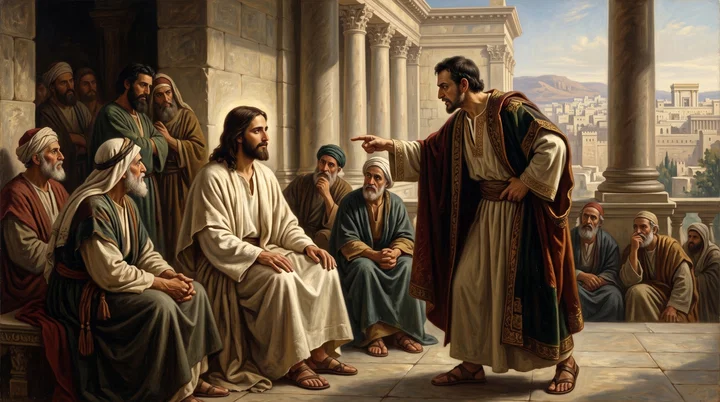
The question was put by a learned lawyer and scribe as part of an artful attempt to entangle Jesus and turn His answer against Him in order to find grounds to accuse Him.DA 606.3–5Ms 71, 1897, par. 27 It arose at a time when the first four commandments were ranked above the last six, treating the commandments as competing and unequal duties rather than as a united whole.DA 606.3–5
Christ met the ensnaring question with a plain and intelligent answer that brought precious light to the people and sowed seeds of truth among them.Ms 71, 1897, par. 27 That plain utterance stands as the voice of God to every soul.PK 327.3Ms 71, 1897, par. 27
He answered that love for the Lord God with all the heart and soul and mind is the first and great commandment, and that love for one's neighbor as oneself is the second like unto it.RH Apr 1, 1915Ms 128a, 1903, par. 19–21Ms 79, 1896, par. 10–12PK 327.1–2PK 326.1–2 On these two commandments hang all the law and the prophets.RH Apr 1, 1915Ms 39, 1886, par. 43MR 66.2–67.2Ms 79, 1896, par. 10–12PK 327.1–2 Together they contain every principle of the Decalogue and the whole duty of fallen humanity.Ms 128a, 1903, par. 19–21
That answer repeated the requirement God had given to Israel centuries before.PK 326.1–2 From age to age He had repeated it by His servants to those in danger of falling into formalism and forgetting mercy.PK 326.1–2
Twofold Love Fulfills Law
The two commandments named in answer to which is greatest together hold every principle of the Ten Commandments and the whole duty of fallen humanity, and supreme love to God with unselfish love to people displays the perfection of human character.Ms 128a, 1903, par. 19–21ST Jan 9, 1912 The Ten Commandments proclaimed at Sinai are the standard of obedience defining that duty.ST Jan 9, 1912 Their first four precepts set forth duty to God and their last six set forth duty to fellow people.ST Apr 25, 18783SP 51.3ST Jan 9, 1912
Every commandment is bound to the others, so to break one is to violate their united principles.ST Apr 25, 1878 Neither of the two great principles can be kept while the other is broken, for love to God cannot live alongside hatred of one's brother.ST Apr 25, 1878 Faithful love to God leads on to keeping the duties owed to others.ST Apr 25, 1878 That love to God is more than acknowledging His power or rendering outward worship; it is a living principle seen in willing obedience to all His requirements and in giving Him the heart's highest affections.ST Apr 25, 18783SP 51.3 As such it shuts out all idolatry, including putting self, the world, or any created thing before Him.ST Apr 25, 1878
The two principles carry the binding force of the whole law and of all the moral precepts in the prophets, so that wherever they are brought into the gospel all that hangs on them is brought into the gospel.Ms 79, 1896, par. 10–12 Belief alone is therefore not enough; a person must be a doer of the law.Ms 79, 1896, par. 10–12 Love to God is shown by obedience to His commandments, and it is impossible to love Him with the whole heart while breaking the fourth commandment.Ms 39, 1886, par. 43MR 66.2–67.2 That precept stands in the center of the Decalogue.Ms 39, 1886, par. 43MR 66.2–67.2
Call to Practical Obedience
The question about which is greatest was answered by love to God with the whole heart and soul and mind as the first and great commandment, and love to neighbor as self as like it, on which hang all the law and the prophets.RH Apr 1, 1915PK 326.1–2 That answer turns people away from formalism toward practical godliness, mercy and love.RH Apr 1, 1915PK 326.1–2 It repeats the requirement given to Israel centuries before and repeated from age to age to those in danger of falling into formalism and forgetting mercy.PK 326.1–2 Its substance is just, merciful, humble, wholehearted love and obedience.PK 326.1–2
As the voice of God to every soul, the answer calls for losing no opportunity to perform deeds of mercy.PK 327.1–2 It calls for tender forethought and Christian courtesy for the burdened and oppressed.PK 327.1–2 It calls for speaking words of courage and hope to those unacquainted with God, who are reached most easily by sympathy and love.PK 327.1–2
Love is the central light of God's commandment, and in the light of that love the gospel is clear.RH Jun 30, 1910 True disciples receive Christ's pure, unselfish love and therefore do not deceive others or act for personal advantage to their distress.RH Jun 30, 1910 Unless minds and hearts are filled with that sanctified love, they are vulnerable to self-deception and Satan's temptations.RH Jun 30, 1910
Love to God is shown by obedience to His commandments, and it is impossible to love God with the whole heart while breaking the fourth commandment, which stands in the center of the Decalogue.Ms 39, 1886, par. 43MR 66.2–67.2 The call is to obedience as a family of obedient children with filial and not slavish fear.Ms 39, 1886, par. 43MR 66.2–67.2 When duty is pointed out the light must be walked in, for probation is given to test willingness, and God will not compel obedience but requires harmonious walking with His requirements.Ms 39, 1886, par. 43MR 66.2–67.2 To claim to love Him without obeying shows His love not perfected in the claimant, and to decree His law not worthy to be kept makes one His enemy.Ms 39, 1886, par. 43MR 66.2–67.2 Obedience fits for eternal life, with reward promised to the obedient and punishment to the disobedient.Ms 39, 1886, par. 43MR 66.2–67.2
Sources
Pioneers and periodicals
95 sources
A lawyer seeking to entrap Jesus asked Him which kind of commandment in the already-given law of Moses is great above the rest.ST Jun 7, 1877ST Oct 25, 1899ST Mar 27, 1901 He answered that supreme love for God with every power of being is the first and great commandment, and that love for neighbor as self is the second, like it, the two together being two joined expressions of one principle on which all the law and the prophets hang.ST Jun 7, 1877ST Oct 17, 1900ST Feb 20, 1907 Those two loves summarize and uphold God's moral law rather than abolish it, with the Ten Commandments as its enduring particulars, the first four expressing duty to God and the last six duty to people.ST Jun 7, 1877RH Dec 1850RH Oct 10, 1854RH Jul 22, 1852 His words make no change or new law but leave the two principles and the ten precepts growing out of them binding, perpetual and unchangeable, to be kept and taught through every dispensation.RH Jul 22, 1852ST Mar 18, 1875RH Aug 15, 1854 They call for inward love and willing obedience rather than outward formalism alone, embracing every commandment including the Sabbath, which belongs to love for God and cannot be set aside while that duty remains.RH Apr 1, 1915ST Dec 8, 1881RH Mar 23, 1852RH Oct 26, 1911
Question's Setting and Wording
The question was put to Jesus by a lawyer to tempt, test, entrap and ensnare Him, not to learn from Him.ST Jun 7, 1877ST Oct 25, 1899ST Mar 27, 1901ST Oct 25, 1899RH Dec 23, 1873 The lawyer spoke for Pharisees gathered together after Jesus had put the Sadducees to silence.ST Jun 7, 1877ST Oct 25, 1899RH Jan 29, 1914 This took place during His final day of teaching in the temple, when He answered questions put to Him and denounced hypocrisy.ST Jun 7, 1877RH Jan 29, 1914 There He disputed every inch of ground, silenced opponents and exposed their folly, yet without seeking controversy, without replying in an evil, bantering spirit, and always ready and able to answer those who sought to entrap Him.ST Mar 27, 1901RH Jan 29, 1914
The wording asks what kind, sort or character the great commandment is and how it should be described, not merely which single rule ranks highest.RH Dec 23, 1873 It concerns the law already given in the Old Testament and the law of Moses, not a request for Jesus to establish a new law, a new constitution, or a new gospel system.ST Mar 10, 1890RH Jul 8, 1852RH Jul 8, 1852 Except in summary it is not about the Ten Commandments themselves but about the great governing principles on which rests the whole government of God among men.RH Mar 15, 1864 To claim the two commands named in the answer formed a new constitution does not establish that Jesus abolished His Father's constitution and replaced it with another.RH Jul 8, 1852RH Jul 8, 1852
The question reflects the habit of treating one law as more important than another and using strict observance of one as cover for breaking another.RH Dec 23, 1873 It was intended to draw Jesus into saying that belief in Himself was the first requirement, into which snare He did not fall.ST Mar 23, 1888 It matches the lawyer's testing question in Luke 10:25 about what to do to inherit eternal life.ST Aug 2, 1899
The setting stands in Matthew 22's account of the marriage where guests are called to the wedding and a man is found there not having on a wedding garment and is bound hand and foot and cast out.RH Jan 31, 1871 The examination of the guests takes place at the marriage in heaven before Christ comes and before the saints are caught up, so the man without the garment cannot be someone caught up by mistake to be bound and cast down to earth again.RH Jan 31, 1871 This proves the marriage is not after the second coming with the church as the bride, because if the church were the bride there would be no guests called to the marriage to be examined and rejected.RH Jan 31, 1871
Twofold Principle of Love
Jesus answered that supreme love for God with all the heart and soul and mind and strength is the first and great commandment, and that love for one's neighbor as oneself is the second, like unto it.RH Apr 1, 1915ST Jun 7, 1877ST Oct 17, 1900ST Oct 25, 1899ST Aug 27, 1912 The two are two expressions of one single principle of love and two joined principles on which all the law and the prophets hang and depend.RH Apr 1, 1915ST Oct 17, 1900ST Feb 20, 1907ST Oct 25, 1899ST Aug 27, 1912 Together they call people away from formalism toward practical godliness, mercy and love.RH Apr 1, 1915
Love is the essence, foundation, sum and substance of all God's commands.ST Oct 17, 1900ST Feb 20, 1907ST Aug 27, 1912 It is the formal expression of God's love reflecting His nature, righteousness, life, holiness, eternal justice and character, embracing both justice and mercy and covering every attribute of God.ST Oct 17, 1900ST Aug 27, 1912ST Apr 20, 1904 It is the basis and fulfillment of God's moral government and of His law, which is holy, just, good, perfect and spiritual, and it continues through the gospel dispensation.ST Apr 20, 1904ST Aug 19, 1886ST Jan 13, 1881 For that reason the two are to be taught and kept constantly before the mind.ST Apr 20, 1904
The first commandment demands the highest possible love with every power of being, the same for fallen people and for sinless beings throughout the universe, which the gospel does not increase nor lessen.ST Jun 6, 1900ST May 12, 1881 It requires a person's first allegiance to God, the warmest and truest affection above all other objects, willing obedience and the heart's highest affections rather than mere acknowledgment of His power or outward worship.ST Apr 25, 1878ST It rules out idolatry, including putting self, the world or any created thing before Him.ST Apr 25, 1878 It forbids other gods and images, forbids taking God's name carelessly on the lips, requires reverence for His name and requires His Sabbath to be kept inviolate.STRH Mar 10, 1868 A person is not truly moral merely by avoiding wrongdoing against others without recognizing and performing this duty to God.
Love means giving oneself in service for the well-being of all, with the Golden Rule as its practical test for love of others.ST Feb 20, 1907RH Mar 10, 1868 Love for others is secondary but like the first, requiring respect for the neighbor's equal rights and liberties.ST Feb 20, 1907ST Sep 21, 1915 It includes parents and even enemies, and encompasses honoring and worshiping God and keeping the Sabbath on the one hand and duty to fellow people on the other.RH Mar 10, 1868ST Jun 19, 1884 It is measured not by words alone but by deeds and truth, for outward obedience without love is only negative virtue, or servility.RH Dec 13, 1906ST Jun 19, 1884 Failing to love God and others is therefore a grave sin of omission, not a minor shortcoming.ST Jun 19, 1884
The two loves cannot be separated.ST Apr 25, 1878RH Oct 7, 1851ST Nov 20, 1901 Faithful love for God leads to keeping duties toward others, and loving God is shown by keeping His commandments, so commandment-keeping means more than outward conformity and requires God's love in the heart, not merely human effort to imitate Christ.ST Apr 25, 1878ST Nov 20, 1901RH Oct 27, 1868RH Aug 21, 1900 Love for God cannot coexist with hatred of one's brother, and neither principle can be kept while the other is broken, since every commandment is bound to the others.ST Apr 25, 1878 The two principles are alike, and keeping the command to love one's neighbor perfectly means keeping the commandments that hang on both.RH Jul 25, 1854RH Oct 7, 1851
Summary of Ten Commandments
The two commands give the sum, concentration and total of God's moral law and endorse it, rather than allowing anyone to disregard it, keep only chosen parts, or treat it as reduced, repealed, replaced or abolished.ST Jun 7, 1877RH Oct 10, 1854ST Aug 27, 1885ST Jun 7, 1877 They preserve its principles, encompass duty to God and duty to others, and comprehend the whole law, and this teaching stands in full agreement with the declaration that Christ came not to destroy the law.ST Jun 7, 1877RH Oct 10, 1854ST Mar 18, 1875ST Aug 27, 1885 The Ten Commandments are the particulars, details, specific precepts and enduring application of that existing law to human conditions, drawn out like fingers attached to hands, with the two tables folding together like a book.RH Dec 1850RH Jul 22, 1852ST Nov 7, 1900RH Aug 15, 1854 The first four commandments express supreme love to God and duty to God, and the last six express love to neighbor and duty to people, so all ten, with not even one fallen off, hang on and are borne up by the two.RH Dec 1850RH Jul 22, 1852ST Nov 7, 1900RH Aug 15, 1854
These are not new precepts limited to Jewish or Christian times but enduring principles of God's moral government for every age, reaching back into the past and forward into the eternal future parallel with the eternity of the divine existence.ST Mar 18, 1875RH Oct 27, 1868RH Aug 15, 1854RH Jul 8, 1852RH Apr 1, 1875 Quoted from Deuteronomy and Leviticus, they had always been greatest and the law and prophets had always rested on them, binding from the beginning so that sin could exist and be counted before Sinai.RH Oct 27, 1868RH Aug 15, 1854RH Jul 8, 1852ST Sep 17, 1874RH Apr 1, 1875 They have existed from the time intelligent beings were governed and will continue while angels and redeemed saints are governed.ST Mar 18, 1875RH Aug 15, 1854RH Apr 1, 1875 The law's commands stated negatively at Sinai are given positively by Jesus as duties of love; love fulfills the law and obedience is love expressed in action.ST Apr 8, 1875ST Apr 3, 1928ST Nov 20, 1901ST Jan 4, 1916ST Oct 7, 1897
God's love for humanity awakens responsive love, restored through atonement, pardon and sanctification by the Spirit, producing obedience to the moral law.ST Apr 25, 1878ST Apr 8, 1875ST Nov 20, 1901 Keeping the Ten from the heart from inward love and willing consent is the evidence and expression of that love, and loving God is shown by keeping His commandments, with love for God and love for others inseparable so that neither principle can be kept while the other is broken.ST Apr 25, 1878ST Apr 3, 1928ST Nov 20, 1901ST Jan 4, 1916ST Oct 7, 1897 The opening statement that the Lord our God is one Lord tells who the Lord is and connects His identity with the commandment, but the actual great and first commandment is the positive injunction to love the Lord, as proved by its parallelism with the second commandment.RH Dec 23, 1873ST Apr 8, 1875RH Dec 23, 1873 The first commandment is therefore not one individual rule elevated above the rest but the inward love covering all duties to God together with the corresponding love covering duties to others.RH Dec 23, 1873ST Apr 8, 1875RH Dec 23, 1873
The question concerns character and kind rather than merely which single rule ranks highest, and the answer gathers up the first four commandments concerning duties to God and secondarily the remaining commandments concerning duties to other people, expressing the law positively where Sinai states it negatively.RH Dec 23, 1873ST Apr 8, 1875RH Dec 23, 1873 Commandment, word and law are synonymous and corresponding terms for this law.RH Dec 1850RH Jul 22, 1852RH Jun 24, 1852RH Oct 7, 1851 The law in view is God's moral law defining what love requires, the law of ten commandments and all the written commandments of God, having nothing to do with the ceremonial ordinances, civil rules, abolished law of ordinances or temporary typical system.RH Dec 1850RH Jul 22, 1852RH Feb 1851 It has nothing to do with the new commandment of the church not given until after the last supper, and because all the law hangs on these commands no commandment is excluded.RH Jun 24, 1852RH Feb 1851
Permanence and Binding Authority
Christ's answer introduces no change, abolition, amendment or new constitution, but restates enduring principles of moral government belonging to no one age alone, neither Jewish nor Christian in particular, but to every age reaching back into the past and forward into the eternal future.RH Jul 22, 1852ST Mar 18, 1875RH Aug 15, 1854RH Mar 23, 1852RH Apr 1, 1875 The two commands to love God with all the heart, soul, mind and strength and to love one's neighbor as oneself, with the ten precepts and the prophets hanging on them, are immutable, perpetual and unchangeable in character, as changeless as the throne of heaven and enduring parallel with God's moral government and the eternity of the divine existence.RH Jul 22, 1852ST Mar 18, 1875RH Aug 15, 1854RH Apr 1, 1875RH Sep 2, 1873 They were required before the conversation and were still in force when spoken, continuing through changes of dispensation from the fall until the close of human probation with not even one precept fallen off.RH Jul 22, 1852ST Mar 18, 1875RH Mar 23, 1852RH Apr 1, 1875RH Oct 21, 1851 The moral law in view defines what love for God and neighbor requires and is not the ceremonial ordinances, civil rules, abolished law of ordinances or temporary typical system, and the first four commandments specify duties to God while the last six specify duties to neighbor, so the ten are the particulars summed up in the two without replacement.RH Jul 22, 1852ST Mar 18, 1875RH Aug 15, 1854RH Mar 23, 1852RH Feb 1851 Ministers are to teach and exalt supreme love to God and love to man with the commandments grounded in that love to all nations to the end of the Christian age.ST Mar 18, 1875RH Apr 1, 1875RH Sep 2, 1873
The ten precepts growing out of the two principles cannot be abolished, changed or amended while those principles remain, since they share their permanence.ST Mar 18, 1875RH Aug 15, 1854RH Mar 23, 1852RH Apr 1, 1875RH Sep 2, 1873 Together they are the summary of moral law, God's unchangeable standard of right and test by which sin is shown.RH Oct 27, 1868ST Sep 21, 1876RH May 27, 1873 Whoever breaks even a least commandment and teaches others to do so is least in the kingdom of heaven, while whoever does and teaches the commandments is great there.RH Dec 30, 1858RH Apr 1, 1875RH Sep 2, 1873 Breaking one precept makes a person guilty of the whole, and people are judged by this royal law of liberty, through which God examines human actions and detects every sin.RH Oct 27, 1868ST Sep 21, 1876RH May 27, 1873RH Feb 1851
The whole law of love summed up in wholehearted love for God and love for neighbor as oneself is God's royal law for His people, applying to all people, with the command to love neighbor as the second part of the same great law and the last six commandments summed in it.RH Jul 22, 1902RH May 27, 1852RH Jun 19, 1856RH Jul 22, 1852 It is the basis of both covenants and the foundation of the gospel, since salvation is from sin and sin is transgression of the law.ST Aug 13, 1885 Jesus acknowledged the binding force of the entire law in its two tables, including the seventh-day Sabbath recognized by the Decalogue, and breaking one precept brings guilt of the whole under this law of liberty by which people are judged, unlike the abolished law of ordinances.RH May 27, 1852RH Jun 19, 1856RH Feb 1851
The exchange does not directly mention or name the Sabbath or any individual commandment among the Ten, and does not present the fourth commandment as the greatest precept, since Christ's own words define love for God as first and greatest and love for neighbor as like it.RH Jul 22, 1852ST Jun 24, 1880RH Dec 9, 1852RH Jun 24, 1852RH Feb 25, 1873 It was spoken before the crucifixion and therefore does not by itself show a re-enactment of the law after the cross.RH Dec 9, 1852 It stands as testimony to the continued existence of the commandments generally, not as direct testimony for or against the Sabbath alone.RH Jul 22, 1852RH Dec 9, 1852
That omission cannot be used as an argument against the Sabbath without applying the same argument to every precept of the Decalogue, because none of the Ten is specifically named there.ST Jun 24, 1880RH Oct 21, 1851ST Jun 24, 1880RH Feb 25, 1873 Since all the law hangs on the two principles, no commandment is excluded or replaced, and the answer draws on Old Testament law rather than a distinct new law.ST Dec 8, 1881RH Oct 21, 1851 Every commandment is holy, just and good and each is to be obeyed, so ranking commandments gives no basis for treating any as unimportant or for excusing breaking even the least one, and dishonoring God by desecrating the Sabbath is inconsistent with complete love for Him.ST Dec 8, 1881RH Oct 21, 1851
All the law hanging on love includes the fourth commandment hanging there with the other nine, still to be kept rather than set aside by love.RH Oct 26, 1911ST Sep 17, 1874 The first four commandments, including the Sabbath and honoring His holy day, express supreme love to God and duty to God, while the last six grow out of and are comprehended in love for neighbor, so the two great commands uphold the whole law including every one of the Ten and the seventh-day Sabbath unchanged in the gospel age.ST Dec 8, 1881RH Mar 23, 1852ST Sep 17, 1874 The Sabbath belongs to the first table summed up by love for God, was part of the first great precept from eternity and drawn out of the eternal basic law into the Decalogue, so it is God's and universally binding rather than Jewish, Christian or gentile, and cannot be removed while that duty remains.RH Mar 23, 1852ST Jun 7, 1877RH May 27, 1852 At that time there was no dispute about which day was the Sabbath, and keeping the seventh day was regarded as a duty to God that would not be neglected by anyone loving God with all the heart, soul and mind, while without love to God no outward form however correct or sincere avails anything.ST Jun 7, 1877RH Oct 26, 1911
Scriptural Connections and Sources
Jesus answers not by making a new law but by quoting commands already given in the Old Testament, in the very words of the law itself.ST Dec 8, 1881RH Jul 8, 1852ST Sep 17, 1874RH Oct 7, 1851RH Feb 25, 1873 The call to love God with all heart, soul, mind and strength comes from Deuteronomy 6:4-5, and the call to love neighbor as self comes from Leviticus 19:18.RH Jul 8, 1852ST Sep 17, 1874RH Oct 7, 1851RH Feb 25, 1873 The answer therefore does not come from Exodus 20, but from Deuteronomy, with its opening declaration that the Lord our God is one Lord identifying who the Lord is while the positive injunction to love Him is itself the great and first commandment, as its parallelism with the second commandment proves.RH Oct 7, 1851RH Feb 25, 1873 They had always been greatest, and the law and the prophets had always rested on them, so He did not enact them then or make them greatest for the first time.RH Jul 8, 1852ST Sep 17, 1874RH Feb 25, 1873 His use of those words shows reliance on the Old Testament and use of its words to teach and to answer challenge.RH Jul 8, 1852ST Sep 17, 1874RH Feb 25, 1873
Those two commands sum up the law and the prophets, meaning all the Holy Scriptures then written.RH Aug 3, 1869ST Nov 20, 1901RH Dec 1850RH Dec 1850 All the law, meaning God's ten commandments and all the written commandments of God, with the first table concerning duty to God summed in love to God and the second table concerning duty to others summed in love to neighbor, the two tables folding together like a book, hangs on and is borne up by these two.RH Aug 3, 1869ST Dec 8, 1881ST Nov 20, 1901RH Dec 1850 Without keeping them prophecies cannot be fulfilled, and ceremonial or judicial laws have no value if the Ten Commandments are given up.RH Aug 3, 1869ST Nov 20, 1901 The commandments form the Bible's constitution, and to destroy them would dissolve its structure.RH Dec 1850RH Dec 1850 If they had been abolished at the crucifixion a few days later, the prophets would have been abolished also, leaving no Old Testament, no Bible, and no law by which to prove sin since the crucifixion.RH Dec 1850RH Dec 1850
The law in view here has nothing to do with the law of Moses as a separate system, nor with ceremonial ordinances, and the new commandment of the church is not included because it was not given until after the last supper.RH Aug 3, 1869RH Dec 1850 The two great commandments are distinguished from the commandments called least in Matthew 5:17-19, yet they do not replace the rest of the law, including the fourth commandment.ST Dec 8, 1881ST Sep 17, 1874RH Feb 17, 1852 James's use of the command to love neighbor illustrates duties toward others and does not mean that supreme love to God or the commandments concerning duty to God have been abolished.RH Feb 17, 1852 The young ruler violated both great precepts through selfishness, loving himself and his property more than God and his neighbors, and so failed to keep the commandments.ST Jul 17, 1884
Obedience and Daily Application
The two commandments turn the hearer from mere formalism to practical godliness, mercy and love.RH Apr 1, 1915 Keeping the commandments is more than outward conformity, for it requires God's love dwelling in the heart, inward love and willing consent rather than mere human effort to imitate Christ.ST Jan 4, 1916ST Nov 29, 1883RH Aug 21, 1900 Without love no outward form, however correct or sincere, avails anything, and outward obedience without love is only negative virtue or servility.RH Oct 26, 1911ST Jun 19, 1884 Love is keeping God's commandments from the heart, more excellent than spiritual gifts, wisdom, prophecy or sacrifice.ST Nov 29, 1883
Supreme love for God with all heart, soul and mind is the first and great commandment and a condition of salvation.ST Jun 6, 1900 The first and highest duty owed is to God, above duty to neighbor and above the use of property, grounding the obligation to honor Him with substance and with the portion He reserves.ST Aug 29, 1895 The same requirement rests on fallen people and on sinless beings throughout the universe.ST Jun 6, 1900 God's requirement has always been the same, nothing less than the perfection and holiness He Himself possesses, embodied in His unchangeable and eternal law of love.ST Oct 1, 1896
The law marks out the whole duty of humanity toward God and fellow beings, a holy, just, good, perfect, spiritual and complete rule.ST Aug 19, 1886RH Aug 4, 1910RH Nov 10, 1874 Obedience to it expresses supreme love for God and unselfish, impartial love for others, so that no one can do more than this.ST Aug 19, 1875RH Nov 10, 1874 Its commandments were given to protect these principles of love to God and love to others, and a mind brought into harmony with them can love God's law and keep it.RH Apr 2, 1867 Through this law God examines human actions and detects every sin.RH May 27, 1873
Neglect of a spiritual duty violates one or both of the two principles on which the whole law depends, so the law reproves and condemns the one who neglects it. Failure to love God and others is a grave sin of omission, not a minor shortcoming, encompassing such duties as honoring and worshiping God, keeping the Sabbath, honoring parents, and loving even enemies.ST Jun 19, 1884 A person is not truly moral merely by avoiding wrongdoing against others, for morality also requires recognizing and performing duty to God as the first and greatest requirement.
Jesus lived the law fully in heart and outward action, perfectly showing the harmonious fulfillment of the two principles working together without conflict.ST Nov 7, 1900ST Sep 12, 1916 His willingness to give up everything for humanity demonstrates this love and constitutes perfect commandment-keeping.RH Sep 4, 1900 He restores the law to its proper honor and place, revealing that obedience to it is not opposed to honoring Him but that honoring the law honors Christ who magnifies it.ST Aug 19, 1886ST Jan 13, 1881 His life embodied its love and revealed its spiritual nature, far-reaching principles and lasting obligation, and in the light of His pure, unselfish love disciples do not deceive others or act for advantage.RH Jul 31, 1900 Unless filled with His sanctified love they remain vulnerable to self-deception and temptation.RH Jul 31, 1900
The answer defines the limits of civil authority, placing religious obligations within a sphere the state must not control.RH Mar 26, 1914 Love of neighbor requires respecting the neighbor's equal rights and liberties, upholding liberty of conscience and equal rights in duties to neighbors and in teaching all nations.ST Sep 21, 1915
Loving God includes obeying the Creator and doing good to others as the neighbor-command requires.RH Aug 19, 1852 Knowing the true God underlies keeping the first three commandments rightly, and the Sabbath commandment is the means of knowing and remembering God through creation.RH Mar 7, 1854 It is therefore the foundation for loving and serving Him in spirit and truth.RH Mar 7, 1854
Salvation gives sinners another opportunity to gain eternal life through keeping God's commandments and the faith of Jesus.ST Jun 7, 1877 Keeping the commandments leads to eternal life and is highly esteemed in heaven, including all ten, so the Sabbath remains binding.RH Jan 1851 The law's requirements are concentrated in the condition for life of loving God wholly and loving neighbor as self.ST Jun 7, 1877 Because all the law and the prophets hang on these two, embracing justice and mercy and covering every attribute of God, with love to God drawn out in the first table and love to neighbor in the six precepts of the second, they are to be taught and kept constantly before the mind.ST Apr 20, 1904 Adam's recognition of God's command showed his admission of God's supreme authority and that there is no God besides Him, as expressed in the first and great principle of supreme love to God in the first four commandments.ST Apr 13, 1915
Sources