Matthew 25:1
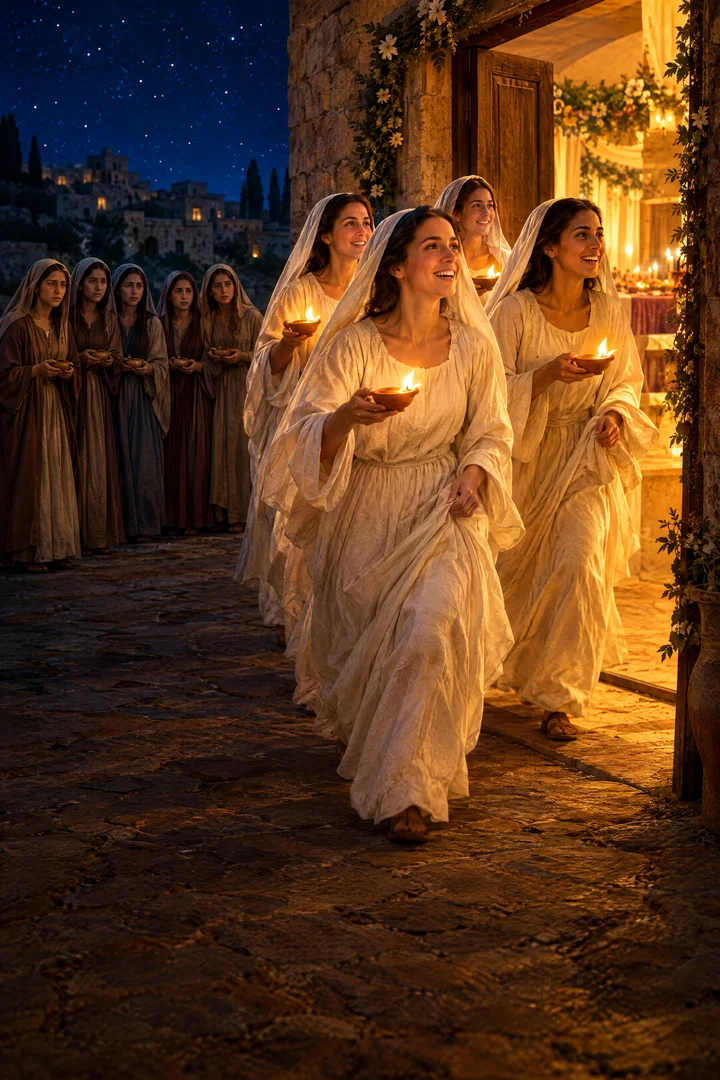
Then shall the kingdom of heaven be likened unto ten virgins, which took their lamps, and went forth to meet the bridegroom.
Translations
Then shall the kingdom of heaven be likened to ten virgins, which took their lamps, and went forth to meet the bridegroom.
King James Version, KJV Cambridge Paragraph Bible, Revised Version
Then shall the kingdom of heaven be likened unto ten virgins, which took their lamps, and went forth to meet the bridegroom.
Then shall the kingdom of heaven be likened to ten virgins, who took their lamps, and went forth to meet the bridegroom.
Then shall the kingdom of heaven be likened unto ten virgins, who took their lamps, and went forth to meet the bridegroom.
'Then shall the reign of the heavens be likened to ten virgins, who, having taken their lamps, went forth to meet the bridegroom;
Then shall the kingdom of the heavens be made like to ten virgins that having taken their torches, went forth to meet the bridegroom.
Then, will the kingdom of the heavens become like unto, ten virgins, who, taking their torches, went forth to meet the bridegroom.
Berean Standard Bible, Majority Standard Bible
“ At that time the kingdom of heaven will be like ten virgins who took their lamps and went out to meet the bridegroom.
“ Then the Kingdom of Heaven will be like ten virgins who took their lamps and went out to meet the bridegroom.
Then the kingdom of heaven will be like ten virgins, the friends of the bride, who took their lights, and went out with the purpose of meeting the husband.
Then the kingdome of heauen shalbe likened vnto tenne virgins, which tooke their lampes, and went foorth to meete the bridegrome.
Douay-Rheims (Challoner revision)
Then shall the kingdom of heaven be like to ten virgins, who taking their lamps went out to meet the bridegroom and the bride.
Pictures
Cross-references 20 of 46
- Matthew 25:6
And at mid night there was a cry made, Behold, the bridegroom cometh; go ye out to meet him.
The midnight cry announces the Bridegroom’s arrival and calls the virgins to meet him.
- Luke 12:35-36
Let your loins be girded about, and your lights burning;
The following context links burning lamps and waiting for the Lord to his return from the wedding.
- Revelation 19:9
And he saith unto me, Write, Blessed are they which are called unto the marriage supper of the Lamb. And he saith unto me, These are the true sayings of God.
bridegroom's feast is the marriage supper of the Lamb
- Matthew 25:10-12
And while they went to buy, the bridegroom came; and they that were ready went in with him to the marriage: and the door was shut.
The ready enter the marriage, while the unprepared arrive too late and are refused.
- Matthew 25:13
Watch therefore, for ye know neither the day nor the hour wherein the Son of man cometh.
The parable concludes by urging watchfulness because the time is unknown.
- Matthew 24:44
Therefore be ye also ready: for in such an hour as ye think not the Son of man cometh.
The parable applies the preceding warning to be ready for the Son of man’s coming.
- 1 Thessalonians 4:16-17
For the Lord himself shall descend from heaven with a shout, with the voice of the archangel, and with the trump of God: and the dead in Christ shall rise first:
Christ descends, the dead rise, and believers meet him.
- Psalms 119:105
Thy word is a lamp unto my feet, and a light unto my path.
The virgins’ lamps represent God’s word, pictured as a lamp for the path.
- Luke 12:37
Blessed are those servants, whom the lord when he cometh shall find watching: verily I say unto you, that he shall gird himself, and make them to sit down to meat, and will come forth and serve them.
Both bless servants found watching when the Lord returns.
- Revelation 21:9-10
And there came unto me one of the seven angels which had the seven vials full of the seven last plagues, and talked with me, saying, Come hither, I will shew thee the bride, the Lamb’s wife.
The Lamb’s bride is identified as the holy city, New Jerusalem.
- John 14:3
And if I go and prepare a place for you, I will come again, and receive you unto myself; that where I am, there ye may be also.
Both promise Christ’s return to receive his people.
- Revelation 21:2
And I John saw the holy city, new Jerusalem, coming down from God out of heaven, prepared as a bride adorned for her husband.
The holy city is prepared as the bride, matching the wedding imagery.
- Luke 13:25
When once the master of the house is risen up, and hath shut to the door, and ye begin to stand without, and to knock at the door, saying, Lord, Lord, open unto us; and he shall answer and say unto you, I know you not whence ye are:
Those shut out knock too late and are denied entry.
- Matthew 25:5
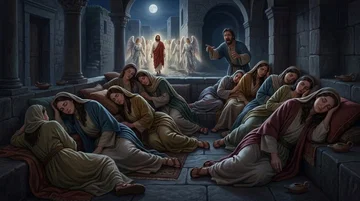
While the bridegroom tarried, they all slumbered and slept.
The virgins sleep while the bridegroom is delayed.
- Mark 13:35-37
Watch ye therefore: for ye know not when the master of the house cometh, at even, or at midnight, or at the cockcrowing, or in the morning:
Both passages urge watchfulness because the Lord may return unexpectedly.
- Luke 19:12
He said therefore, A certain nobleman went into a far country to receive for himself a kingdom, and to return.
The nobleman goes away to receive a kingdom and return, like Christ.
- Matthew 22:1-14
And Jesus answered and spake unto them again by parables, and said,
Both wedding parables portray readiness to join Christ and judgment of the unprepared.
- Luke 12:36
And ye yourselves like unto men that wait for their lord, when he will return from the wedding; that when he cometh and knocketh, they may open unto him immediately.
Followers wait ready for their Lord to return from the wedding.
- Matthew 25:11-12
Afterward came also the other virgins, saying, Lord, Lord, open to us.
The unprepared virgins plead outside, but the bridegroom refuses them entry.
- Matthew 25:7
Then all those virgins arose, and trimmed their lamps.
The virgins trim their lamps as they prepare.
Commentary part 1 of 2
Each commentary is drawn from primary sources: the writings of Ellen G. White and Adventist pioneers and periodicals. Each commentary is separate. Its own words are not a quotation; follow the references to read the source passages.
Ellen G. White
111 sources
The verse pictures an evening wedding custom in which ten bridesmaids with lamps and small vessels of oil wait to meet the bridegroom and escort him by torchlight to his home for the supper and feast.COL 405.1COL 405.2–406.1ST Aug 6, 1894
The ten are the church of professed believers living in the evening of earth's history, watching for the Lord's appearing, and the bridegroom is Christ whom they profess readiness to meet.GC88 393.1–394.1GC 393.2–394.1Ms 79, 1897, par. 3–4
Their lamps are the Bible truth and profession of faith entrusted to them, and the oil is the Holy Spirit and grace of Christ received in the heart to keep the light burning bright.RCOC 123.3RH Sep 17, 1908Ms 186, 1905, par. 3Lt 94, 1898, par. 10–15Ms 77, 1908, par. 8–10
Though all at first appear ready, five are wise who secure the inward supply through study, prayer, obedience and conformity to Christ, and five are foolish who hold the form of truth without conversion and live for self and the world.Ms 92a, 1898, par. 4–6ST Sep 24, 1912COL 408.2–316MR 270.3–271.2
That readiness must be secured daily during probationary time and cannot be borrowed or gained at the last moment, so all must watch, keep their lamps trimmed, and let living faith shine to guide others to the marriage supper of the Lamb.Ms 25, 1908, par. 16ST Nov 20, 1884RH Feb 3, 1903ST Sep 17, 1912ST Sep 17, 1912
Wedding Setting and Symbols
The verse opens an evening wedding custom in which the bridegroom meets the bride at her father's house and brings her by torchlight to his home, where a supper and feast await the guests.COL 405.1ST Aug 6, 1894ST Sep 17, 1912 Ten was the customary number of bridesmaids, young women carrying lamps with small vessels of oil as they wait through the night and go out to join the procession when he comes.ST Aug 6, 1894ST Sep 17, 1912ST Aug 6, 1894 The story was spoken on the Mount of Olives in a prophetic discourse about the second coming, with Christ looking upon such a waiting party as He told of ten virgins taking lamps to meet the bridegroom.COL 405.1COL 405.2–406.1COL 406.2ST Aug 6, 1894 Their waiting, the delay in his arrival, and the torchlit procession to the feast set the lesson of readiness, since five have spare oil to enter and five are shut out.ST Aug 6, 1894ST Sep 17, 1912ST Sep 17, 1912
The ten virgins are the church of professed believers living in the last days in the evening of earth's history, watching for the Lord's appearing and earnestly expecting to be acknowledged as His people.GC88 393.1–394.1GC 393.2–394.1Ms 79, 1897, par. 3–4COL 406.2 The bridegroom is Christ, and their going out with lamps to meet Him is professing readiness for His coming, first proclaimed in the widespread Advent movement announcing that His return was near.GC88 393.1–394.1GC 393.2–394.1COL 404.2 The experience of the ten illustrates the experience of that church just before the second coming, picturing its condition and calling each person to examine whether he is among the wise.Ms 79, 1897, par. 3–4COL 406.2ST Sep 17, 1912 Conduct and conversation reveal that standing, and the entrance of the wise to the wedding shows the outcome of being prepared.COL 404.2ST Sep 17, 1912
The lamps are the Bible and the knowledge of its truth entrusted to the church, the lamp-bearer's Bibles by which to decide to obey the truth.GC88 393.1–394.1GC 393.2–394.1Ms 174, 1905, par. 12 They are also the profession of faith and form of truth, the soul, the light to be kept burning, and the churches themselves bought with blood.RCOC 123.3RH Sep 17, 1908Lt 6a, 1893, par. 12–135T 413.1 The vessels are the heart and inner life that must hold a reserve supply of grace, for staying alight depends on having oil within and not merely a lamp in hand.RCOC 123.3Ms 174, 1905, par. 125T 413.1 Trimming the lamps is arising from sleep, refreshing them, and keeping that light ready, bright, and shining unto the perfect day, lest without oil it grow dim and go out in darkness.Ms 174, 1905, par. 12Lt 6a, 1893, par. 12–13Ms 80, 1905, par. 1–25T 413.1 Those who have received little light but lived faithfully by what they knew may accept full truth at the last hour, while those with great light and privilege who failed to live by it lose their light and fall away.RCOC 123.3
The oil is the Holy Spirit and the grace of Christ, His righteousness and renewing, enlightening, and sanctifying power in the heart.Lt 94, 1898, par. 10–15Ms 77, 1908, par. 8–10Ms 35, 1891, par. 32–33COL 406.3–408.1 It is received through earnest study of Scripture, prayer, obedience, practicing the truth, the ordinances of grace, and Christ's mediation, working by love to purify the soul and make personal faith endure.GC88 393.1–394.1GC 393.2–394.1Lt 94, 1898, par. 10–15Ms 140, 1901, par. 4–13 It is the holy golden oil shown in Zechariah's vision, emptied from the two olive trees and two olive branches through two golden pipes into vessels prepared for it and then into the bowl and lamps that lit the sanctuary.Lt 94, 1898, par. 10–15Ms 140, 1901, par. 4–13COL 406.3–408.1 So the Spirit is imparted from the holy ones standing in God's presence to consecrated human instrumentalities, for the work is accomplished not by might nor by power but by the Spirit of the Lord of hosts.Ms 186, 1905, par. 3COL 406.3–408.1 By that supply the Word is implanted, God's attributes are developed, friction is prevented, wondrous truth is revealed, and the word becomes a lamp to the feet and a light to the path.Lt 94, 1898, par. 10–15COL 406.3–408.1
Advent Fulfillment in History
Going out to meet the bridegroom was fulfilled when the nearness of Christ's coming was proclaimed far and wide under the first and second angels' messages.Ms 92a, 1898, par. 1–34SP 242.3GC88 398.4–400.1 In the summer and autumn of 1844 the midnight cry, Behold the Bridegroom cometh, was heard throughout the land and aroused thousands, searching hearts and calling believers out from the churches.Ms 92a, 1898, par. 1–3GC88 398.4–400.1CET 50.4LSEGW 59.1–21T 53.3–54.3 The announcement that the Bridegroom was coming followed prophetic and sanctuary-type arguments pointing to the time of the advent, and it led those who heard to expect to live to see Christ in the clouds.GC88 398.4–400.1GC 400.1–401.216MR 269.3 The waiting and slumber of the parable came before that coming, and the cry awakened believers to go forth to meet Him.GC 400.1–401.2LSEGW 59.1–21T 53.3–54.3
The tarrying of the bridegroom was the passing of the expected time, with bitter disappointment and delay in which faith was tried.GC 393.2–394.14SP 242.3SG1 141.2 All slumbered, the foolish becoming unconcerned and abandoning faith because their impulse, feeling and excitement rested on no thorough grasp of truth or genuine conversion, while the wise waited for clearer light though their zeal and devotion diminished.GC 393.2–394.1ST Sep 24, 1912 Pardoned people still waited with glad expectation for the joyful event even while the expected deliverance passed and they remained on earth.EW 68.1–69.1SG1 141.2
The coming of the bridegroom to the marriage, which comes before the supper, is Christ's coming in 1844 to the Ancient of Days in the most holy place to cleanse the sanctuary and receive His kingdom, the same as the Son of man's coming to the Ancient of days and the Lord's coming to His temple.GC 425.3–426.1GC 426.2–427.2GC88 426.2–427.2 It is distinct from His second advent to earth to execute judgment, for He rose from His mediatorial throne and went into the holiest as Bridegroom to receive the kingdom rather than then coming to deliver His people.GC 426.2–427.25MR 97.3Lt 3, 1847, par. 6–7 The marriage is His reception of the kingdom with the New Jerusalem as its capital, the bride is the New Jerusalem while the waiting people are guests, and the ready entering with Him is believers following Him by faith into His heavenly work.GC 426.2–427.2GC88 426.2–427.2EW 46.1 This was confirmed on the tenth day of the seventh month and by visions in December 1844 and February 1845, settling believers in the shut-door teaching.5MR 97.3Lt 3, 1847, par. 6–7
The delay expresses Christ's long-suffering patience, His unwillingness that any should perish, giving time to repent and receive eternal life during the short probation before the end.10MR 266.2Lt 21, 1886, par. 28–295T 485.1 Because many who went forth under the first and second messages refused the last testing message, the third angel's message had to be proclaimed so that light would warn the world and the message would go to every nation, kindred, tongue and people.16MR 269.3 If all who claimed to believe had acted their part as wise virgins walking in the light that had come, the work would ere this have been finished.16MR 269.3
Two Classes Contrasted
At first all ten have lamps and vessels, a name and a call, knowledge of Scripture and confident expectation of Christ's near appearing, so that for a time no difference is seen between them.COL 408.2–3ST Jul 20, 1915 They represent either wise or foolish persons, yet human beings cannot reliably read hearts or separate the closely resembling wheat and tares beforehand, for some hold truth unrighteously and look outwardly like the wise.16MR 270.3–271.2Ms 92a, 1898, par. 14–18 Character is shown without error by fruits, which angels know and by which they will distinguish the faithful from those opposed to God's word when the door is shut.16MR 270.3–271.2Ms 92a, 1898, par. 14–18
The wise anticipate disappointment, delay and waiting, and make provision with oil in their vessels so the trimmed and burning lamp continues through the trial.Ms 92a, 1898, par. 4–6COL 408.2–3 That oil is unseen principle, open communion with God, the oil of grace and righteousness of Christ, received by depending on God every hour and drawing nourishment daily as a branch grafted into the living Vine.Ms 72, 1895, par. 1–2Ms 9, 1891, par. 38–39 They are real Christians with spiritual life in themselves, doers of the Word who walk in the light of justification by faith and imputed righteousness, search the Scriptures, remember and repent, overcome, keep garments undefiled, remain at Jesus' feet, learn His ways, are conformed to His image, bear living testimony in words to the glory of God, speak of Jesus and heaven and eternal realities, impart to others what they receive and gain more light, letting light burn in good works and showing by works whom the Lord knows.Ms 72, 1895, par. 1–2Ms 9, 1891, par. 38–39ASCOP 23.1Ms 47, 1895, par. 1–3Ms 11, 1893, par. 9 Mere theory is not enough, for lamps need the oil of grace to burn and shine so the world takes knowledge they have been with Jesus, with minds guarded lest Satan take an unguarded moment, neither ignorant of his devices nor overpowered by them.Ms 47, 1895, par. 1–3Ms 11, 1893, par. 9
The foolish have the outward appearance of the wise and a real interest in the gospel, knowing the perfect standard of righteousness and the theory of truth, even the theory of the third angel's message, yet without thorough grasp, genuine conversion, or living connection with God.ST Sep 24, 1912ST Feb 17, 1890 They are careless, idle, self-satisfied, cold and backslidden professors, moved by impulse, feeling and excitement, trusting feelings and self-wisdom, living to please and glorify themselves in self-love, blindness and weak faith, treating life-giving truth as unessential.ST Sep 24, 1912ST Aug 13, 1894ST Sep 24, 1912 They keep godliness apart from character, live for self and the world, suit men who do not want light, handle strange fire, neglect Scripture and prayer, cherish hidden sin, criticize and complain, and fall into skepticism, unbelief, unstable experience on uncertain principles, and vulnerability to deception.ST Sep 24, 1912ST Aug 13, 1894ST Aug 13, 1894 Their lamps lack the oil of grace, and without the Spirit knowledge of the word cannot quicken the soul, sanctify the heart, transform character, or enable men to distinguish truth from error and stand against temptation.COL 408.2–3
The division is five wise and five foolish, half ready and half wanting, five true and five false, showing that many with great light, opportunities and privileges will not be ready.Lt 86, 1895, par. 216MR 274.2Ms 92a, 1898, par. 33–35 Mere profession, church membership, human birth, descent from Abraham, baptism, confidence in promises, outward works, or assent to doctrine do not make anyone ready, for knowing truth alone without doing the Word, living as Christ enjoined, and keeping His commandments leaves the professor crying peace when there is no peace.Lt 86, 1895, par. 216MR 274.2Ms 144, 1898, par. 5Ms 92a, 1898, par. 33–35 Readiness requires fellowship with Christ in this life through the Spirit, a living faith working by love and purifying the soul, and a transformed character in white robes fitting the heart for heaven's joy.Ms 144, 1898, par. 5ST Jul 20, 1915 Those lacking oil are surprised and dismayed, refused entry and left outside in midnight darkness, gloom, despair and hopelessness, shut out of the wedding banquet and marriage supper of the Lamb with the door closed.Ms 9, 1891, par. 38–3916MR 274.2ST Jul 20, 1915Ms 92a, 1898, par. 33–35
Readiness Secured Daily
Readiness for the bridegroom must be secured before he comes, not begun only when the cry is heard nor gained at the last moment when lamps are going out.ST Sep 17, 1912ST Sep 17, 1912ST Aug 6, 1894 The oil of grace, which is the Holy Spirit and the grace of Christ received through vital connection with the Light of the world, must be secured during probationary time and cannot be obtained when the final emergency comes.RH Feb 3, 1903ST Sep 17, 1912Lt 16, 1895, par. 26 It cannot be borrowed from another or transferred in that hour, for God gives it to those who ask for His Spirit, and the parable gives no evidence that the foolish ever obtained it after the door was shut.RH Feb 3, 1903ST Sep 17, 1912 The wise virgins' supply represents a daily experience nourished by the Spirit, marked by faith, love, and patience, giving character strength to endure the test, while depleted oil shows careless neglect and flickering faith that leave a person unprepared.RH Feb 3, 1903ST Sep 17, 1912ST Aug 6, 1894 Those who neglect the day of salvation seek entrance to the marriage supper too late and find probation past, character unchangeable, and the door shut, left outside in darkness in the blackness of night.ST Sep 17, 191215MR 229.1Lt 16, 1895, par. 26
The parable therefore commands to watch, wait, pray, and keep lamps trimmed and burning, because the time of the Son of man's coming is unknown and his coming upon the unready is as a thief.Ms 9, 1891, par. 45–46ST Apr 21, 1898ST Sep 17, 1912 It presents events connected with Christ's second coming and teaches the duty of being ready, waiting, and watching for it, with continuing vigilance and dependence on His grace.ST Nov 20, 1884ST Sep 17, 1912ST Nov 20, 1884 All sleep during the bridegroom's delay, but only the ready enter the marriage when he comes, and conduct and conversation make manifest whether each is among the wise or the foolish.ST Apr 21, 1898ST Aug 6, 1894 The wise endure the long wait through patient waiting, watching, and active work, refusing to be surfeited and drunken with the cares of this life and having grace today in a living connection with God complete every day.Ms 9, 1891, par. 45–46ST Sep 17, 1912 The foolish think he delays and lack supply to stand the trial, and neglecting to receive the grace of Christ leaves them unprepared and outside the wedding.ST Sep 17, 1912ST Aug 6, 1894
The daily supply is kept by depending on God every hour, drawing sap as a branch in the Vine, living in hourly contact with truth and mercy, and maintaining a living connection with God as the source of spiritual growth so as to be ready for the time of reaping and able to receive added grace in times of special need.AA 55.2Ms 74, 1899, par. 7 Prayerful study of God's Word and willing obedience keep the oil of grace in the vessel, so that the wise are ready to respond to the midnight cry, and having oil in vessels with lamps is the great daily necessity for every soul that cannot safely be neglected because the work is weighty with eternal results.Ms 74, 1899, par. 7Lt 7, 1894, par. 4–8 Keeping the lamps supplied with the oil of grace and trimmed and burning so their light shines now requires time for prayer and searching the Scriptures, attending worship, and assembling for prayer and praise.STE 147.1–149.1HPMMW 13.4 It requires obeying the law, guarding thoughts, words, habits, and little things, feeding on Christ's words, sinking the shaft deeper for truth, and diffusing every ray.Ms 74, 1899, par. 7Ms 82, 1896, par. 6 It blends quiet devotion with earnest warning and service, for the foolish are those not watchful in words nor careful in behavior, and through indifference and failure to use entrusted talents diligently grace is neglected and spiritual light is lost as lamps dim and go out.Ms 74, 1899, par. 7Ms 82, 1896, par. 6
The burning lamp is a living faith that shines in the world's moral darkness to guide sinners, honor the bridegroom, and lighten the path to the Bridegroom's home, to the city of God, to the marriage supper of the Lamb.ST Aug 13, 1894COL 414.1–2 Their spiritual life is renewed as they receive Christ's grace and the Holy Spirit, God's love fills their hearts, their lamps burn steadily, and through the Holy Spirit God's word becomes a light as a transforming power implanting its principles, developing the attributes of God, so that the light of His glory, His character, shines forth in His followers.ST Aug 13, 1894COL 414.1–2 The light burns with undimmed flame through the night of watching, swelling the illumination for the bridegroom's honor, and it is effective only as its light shines on the path of others.ST Mar 17, 1898COL 414.1–2 It grows brighter by receiving and imparting grace, using God-given opportunities, abilities, talents, and means to warn the world, visit neighbors, circulate publications, and labor for souls while today lasts, for belonging to the church does not itself secure entrance and faithful service includes self-denying work to save souls.Ms 25, 1908, par. 165T 276.2 Trimming the lamps means preparing to bear light while waiting for Him, so waiting must include watchfulness and active service and not merely devotion or passivity, guarding against spiritual decline and living ready for the Lord's near return, lest acting as though the Lord delays His coming put a person among hypocrites and unbelievers.LSEGW 425.35T 276.2
Watchful Life and Service
Each one must examine for himself whether oil is in his vessel, for outward readiness with a lamp is not enough when life ends and Christ is to be met.14MR 122.2–123.1Lt 178, 1899, par. 11 The foolish lack inward character formed by His righteousness, having knowledge of truth without being sanctified through it, forgetting the day of trust and the day of reckoning.14MR 122.2–123.1Lt 86, 1895, par. 12 Readiness requires heart preparation and cleansing from sin and selfish purposes, repentance, confession, pardon, new conversion each day, sanctification, and being clothed with Christ's righteousness as the wedding garment and white robe to attend the Lamb's marriage supper.14MR 122.2–123.1 Baptism alone does not save or make ready; the wise remain at Jesus' feet, learn His ways, are conformed to His image, leave old habits, turn from worldly ideas and customs, and let light shine in good works as inward adornment of holy grace sent from heaven, while those who weave the world into character have no oil and cannot stand when He appears.Ms 92a, 1898, par. 1916MR 271.3 Life and works test the two classes, and each has talents and sacred responsibility to bless others by opening truth to those in error, with profession weighed in judgment by words, dress, business, appetite, and obedience lest it be found wanting.Lt 86, 1895, par. 1216MR 271.3
Ministers above all must not rest on lamp, office, privileges, instruction, or eloquence, for lamps without the oil of grace cannot burn and give light.STBk 9.1STOM 7.3ASCOP 24.1 Those who continue year after year without becoming like Christ, proud, unconsecrated, displeased by reproof, failing to absorb truth, cannot impart it and should be removed from sacred work.ASCOP 24.15T 20.2–21.1 Readiness is faith working by love and purifying the soul, Christ's righteousness received inwardly, with humble consecration, heartfelt piety and devotion, and powerful influence for good by good works as well as words and theories.STBk 9.1STOM 7.35T 20.2–21.1 The same charge lies on teachers, physicians, sanitarium and institutional workers, parents, youth, and every steward to keep the soul's lamp supplied, to show a pure, elevating, ennobling example, to practice godly home government and care for children, and to trade talents faithfully rather than merely keep the capital.MYP 387.3EDFCP 25.2 Sanctification is the duty of every Christian, individual responsibility that cannot be laid upon any minister though ministers may help, with each acting a solemn part at home, in family, in church, and in the world as God's great depository of truth, required in the reckoning according to talents and all improvement that might have been made.EDFCP 25.2
Sleep is unreadiness, guilty repose over sacred truth, with lamps but no oil, piety cold, waning and fading despite great light and knowledge.ST2 22.5STA 68.1STBk 68.1STA 77.3–4STOM 54.1 It shows itself in folding the hands in neutral waiting, idleness, bustle without piety, love of world and pleasure, pride, despondency, living only for self-pleasing until sickness or death reveals unfitness to meet the end of life.MYP 387.3 It also shows itself in being led by skepticism, criticism, and deceptive scientific spiritualistic philosophy that takes minds from the present message, so that even strong men precious in God's sight fall under Satan's spell without knowing it, live merely to criticize, associate with those taught by the deceiver, bear the serpent's sting in the heart, and are prepared for unbelief while asleep at their post.3MR 361.2–4 To trim the lamps is to awake now, receive new life and power from above and the Holy Spirit for the coming conflict, be clothed with the whole armor of God, fight darkness, reject sophistry and doubt about present truth, expose Satan's hypnotism, warn the world, turn toward Canaan and not toward Egypt, and take up appointed work in watching and working to save others lest the day overtake them and their light go out.STA 68.1STBk 68.13MR 361.2–4
The wise have grace and the Spirit's power to endure the church's time of conflict, the time of trouble such as was not since there was a nation, and Armageddon.5T 104.4Lt 112, 1890, par. 12–133MR 305.2–38MR 346.4–347.2 Oil in vessels is grace received, living connection with God, vitalizing by the Holy Spirit, without which knowledge of truth is only appearance of light and those supposing themselves wise are wise only in their own sight, without saving faith and without Christ as personal Saviour.Lt 12, 1893, par. 4–7 Condemnation falls not only for revolting crimes and outbreaking sins but for neglecting to do what might and ought to have been done through the moral power Christ placed within reach by clothing divinity with humanity, that fallen man might combine human effort with divine power, labor together with God, look to Jesus, study His life, behold Him and be changed into His likeness by growing in grace and doing His words.Lt 12, 1893, par. 4–7 By that power the obedient discern and accept clear light, remain faithful under reproof, keep the commandments, and are gathered, while the disobedient are separated forever under principles of eternal justice to be revealed when judgment sits and books are opened.5T 104.4Lt 12, 1893, par. 4–7 Now is the time to awake from unreadiness for the trial before them, turn from unimportant things, give themselves to God, and ask Jesus to place His everlasting arms underneath and carry them through amid permitted disaster and destruction, and the long delay will then seem short when the redeemed stand on the sea of glass before eternity.3MR 305.2–3Lt 54, 1906, par. 10
Sources
Pioneers and periodicals
330 sources
Then places this parable at a definite appointed time after the signs of Matthew 24, after the sun, moon and stars and the fig-tree sign and the faithful and evil servants, describing the true church in the tarrying time. RH Jun 9, 1851RH Jun 9, 1853GSAM 148.1RH Jan 8, 1901RH Sep 3, 1872
The kingdom of heaven here is the professed church waiting for Christ at His return, and the ten virgins are its believers going out to meet the Bridegroom, who is Jesus Christ Himself as coming King and High Priest, while the bride is the New Jerusalem given to Him with the kingdom. RH Jun 9, 1851RH Jun 9, 1851RH Nov 12, 1857ST Apr 5, 1877ST Apr 1, 1875
Their lamps are an outward profession of the prophetic word and expectation of His approach kept burning in holy life and service, and the oil in vessels is inward grace through the Holy Spirit in faith, love and character which cannot be borrowed or transferred from another. ST Mar 17, 1898RH May 15, 1900RH Mar 31, 1868ST Mar 18, 1875ST Apr 6, 1888
All alike appear as virgins with lamps and all slumber during delay, but the wise believe and desire His coming and keep grace and discernment while the foolish hold theory without vital connection and are at last shut out by their own unpreparedness, not by arbitrary decree. RH May 15, 1900RH Dec 11, 1855RH Jun 9, 1851RH May 15, 1900
That going forth, tarrying, midnight cry and shutting of the door was fulfilled in the Advent movement of 1840 to 1844, when believers proclaimed His immediate coming, were disappointed in 1843 and the spring of 1844, were reawakened by the midnight cry to October 1844, and then by faith followed Christ from the holy to the most holy place where He began cleansing the sanctuary and receiving the kingdom, so the lesson is to stay awake, keep oil beforehand and be ready before the door is shut. RH Mar 31, 1868RH Jun 9, 1851ST Nov 22, 1899RH Jun 9, 1851RH Jun 9, 1851
Words and Historical Setting
The word Then fixes the parable to a definite appointed period in church history rather than to the kingdom in general after all are gathered.RH Jun 9, 1851RH Jun 9, 1853 It joins Matthew 25 to the connected discourse of Matthew 24 and 25, placing the comparison after the destruction of Jerusalem, the 1260 years of papal persecution, the darkening of sun and moon in 1780 and the falling stars in 1833, after the fig-tree sign and after the faithful servant giving meat in due season and the evil servant saying the Lord delays, smiting fellow servants and eating and drinking.RH Jun 9, 1851 That Then brings the scene into the experience of those connected with the Advent doctrine, describing the true church in the tarrying time when both classes had been united in proclaiming the coming until disappointment, one holding fast and following prophecy to the third angel's warning and the other doubting, giving up the past, falling into the world and saying the Lord delays.GSAM 148.1LDT 165.1–3RH Jun 9, 1851 Its details are applied only after they have become history, when the described period is seen to have begun, as after April 1844.LDT 165.1–3
The verse belongs to Jesus' continued discourse on the Mount of Olives answering the disciples' question about the sign of His coming and the end of the world.RH Jan 8, 1901RH Sep 3, 1872RH Dec 23, 1902 It was spoken privately two days before His death in the last week when His earthly ministry was drawing to a close and the shadow of the cross was over Him.RH Jan 8, 1901RH Apr 15, 1909 The discourse begins with Jerusalem's tribulation but soon passes beyond it to greater events ushering in the end of the world, blending the utter political destruction of the Jewish nation with its civil, political and religious polity and the end of the Christian dispensation, which Jerusalem's fall only symbolizes and does not exhaust.RH Sep 3, 1872ST Apr 22, 1889RH Apr 15, 1909 It spans the whole Christian age from first to second advent, sets forth principles of the kingdom's administration ending in separation of wheat and tares with final destiny of each class, lights the pathway of disciples, warns against false teachers and false doctrines, and gives unmistakable signs by which the generation of His return can be known though not the day or hour.RH Sep 3, 1872RH Sep 24, 1857RH Apr 15, 1909
The verse opens a parable extending through Matthew 25:12, connected with the marriage of the Lamb and the second advent.RH May 27, 1852ST Sep 3, 1912RH Apr 9, 1867 It is one of four parables teaching the importance of watching for the Lord's coming, using scenes from everyday life as the basis for instruction.RH Jan 15, 1901ST Sep 25, 1901 The ten virgins, their lamps, and the bridegroom create a vivid memorable picture that conveys spiritual teaching, even though Scripture nowhere calls it a parable by name.ST Jan 7, 1913
Its setting reflects an Eastern evening wedding custom in which ten, the customary number of bridesmaids, with lamps and small vessels of oil waited to join a torchlit procession to meet the bridegroom.ST Aug 6, 1894ST Sep 17, 1912 The bridegroom met the bride at her father's house and brought her by torchlight to his home where a supper awaited guests, sometimes arriving late at night when one without a ready lamp could not join the procession.ST Sep 17, 1912ST Aug 6, 1894 Bible-era marriages thus involved public ceremony with friends as attendants went out with lamps to meet him.ST May 4, 1904 Those attendants did not create his glory but illuminated glory already there, making the night shine and displaying the splendor of his arrival.ST Sep 14, 1882ST Feb 4, 1889
The kingdom of heaven here is the living people of God, the church and its professed believers waiting for Christ just before and not after the second advent, not the King Himself apart from them, nor the territory, nor all subjects including the resurrected, nor every operation in every age at once.RH Jun 9, 1851RH Nov 12, 1857ST Apr 5, 1877ST Jun 25, 1874 It is a particular part or phase at the time of Christ's return involving those who hear the gospel and may become its subjects, pointing to a specific time when divine grace works on minds and hearts giving an experience like awaiting the bridegroom.ST Apr 5, 1877ST Jun 25, 1874RH Feb 10, 1874 After the signs had been fulfilled and preached, the proclamation of the judgment hour moved believers to take Bibles, cherish hope of soon seeing Christ, and turn from the world's spirit and interests, corresponding to taking lamps and going forth.RH Jun 9, 1851 The comparison concerns events connected with that movement which must have occurred before histories can be compared, so time and people to make the comparison must remain before Christ comes.RH Nov 12, 1857
In that setting the kingdom also means the work of grace and means of grace for salvation, specifically the second-advent movement stirred by God's word and Spirit to call out a people who love His appearing.ST Mar 18, 1875RH Jan 31, 1871RH Feb 1, 1870 It was fulfilled in the great movement of 1840-1844 just prior to the last judgment, when that manifestation of truth and divine power was called the kingdom of heaven and its facts likened to an eastern marriage.RH Feb 1, 1870 The virgins there professed faith in His soon coming on the basis of prophecy and signs, their lamps being God's word and the oil abiding faith formed by word and Spirit in heart and life, possessed by the wise and lacking in those with only theoretical faith.ST Mar 18, 1875RH Jan 31, 1871
The ten virgins represent the church, not the bride.RH Jun 9, 1851ST Nov 22, 1899RH Jun 9, 1851 The bride is the New Jerusalem, the Lamb's wife, the holy city as capital of Christ's kingdom and mother of the saints, given to Him when the Father bestows the kingdom and He is crowned king in heaven just before returning to earth.RH Jun 9, 1851RH May 11, 1869 The wedding takes place in heaven during preparatory scenes before the Son of man comes, so at His coming He returns from the wedding rather than coming to it, after guests are examined and those lacking the wedding garment cast out.RH Jun 9, 1851RH Jun 9, 1851 In that sense believers gathered from the nations are called children of the New Jerusalem to be presented at the marriage supper.RH May 11, 1869
The Bridegroom is Jesus Christ, the Great High Priest and coming King, presented in that relation to those who go out to meet Him.LS 118.2ST Apr 1, 1875RH Jun 10, 1875 His coming to the marriage is His change of position and work in heaven, moving into the Most Holy Place to cleanse the sanctuary, not yet His second appearing on earth.LS 118.2RH Dec 1850 He is surely coming and longed for by a people waiting with burning lamps even while scoffers mock, and hearts must be subdued and prepared to meet Him lest they share the foolish fate.RH May 3, 1864RH Jun 2, 1868
The chapter does not describe the great trial of the dead but the separation of righteous and wicked accomplished by the resurrection of the just, through which Christ acts as executor showing why He has made it rather than as judge conducting the trial.ST Aug 15, 1878RH Feb 8, 1870 Righteous and wicked are judged before recompense and are not summoned from heaven or hell to hear sentence after already receiving reward or punishment.ST Sep 15, 1881RH Apr 21, 1874 Its universal expressions such as all men and every man are limited and must not be made to mean all the wicked in graves judged and rewarded at the second advent, for that sets aside the two resurrections. Use of the chapter as proof that people can be saved without knowledge of Christ is a misapplication.ST Jan 20, 1887
The verse belongs to teaching about the time His earthly kingdom will be established when He comes in glory to sit upon His throne.ST May 7, 1912 Its latter part concerns intensely Jewish expectation about the general judgment, Jerusalem's destruction and the end of the world rather than what is called His non-material spiritual presence and power.ST Aug 4, 1898 Those who held a different application placed its principal fulfillment in the planting and growth of the United States as a government providing an asylum of civil and religious liberty for a gathered remnant.RH Feb 21, 1856
Lamps Oil and Vessels
The lamps are God's prophetic word and Bible, the outward profession and form of truth and expectation of Christ's approach, which produced the movement and was its rule for deciding every question.RH Mar 31, 1868ST Mar 18, 1875RH Jun 9, 1851GSAM 148.2RH Jan 31, 1871 Taking lamps without oil is possessing the Word while rejecting the Holy Spirit and His gifts, leaving no light to remain in the truth.RH May 15, 1900RH Mar 31, 1868ST Mar 18, 1875 The lamps are also readiness itself, each Christian's own light and life-lamp to be trimmed and kept burning steadily, visibly and continually.ST Mar 16, 1904RH Feb 28, 1871ST Mar 11, 1913RH Sep 30, 1915 Its brightness is shown in loving service, humility and willingness to help people in need, holding up the word of life to warn and guide others toward the heavenly home rather than drawing attention to self.ST Mar 17, 1898ST Mar 16, 1904ST Mar 11, 1913 That light is tended in genuine revival and is to be prepared early, so that it can guide those who might otherwise be lost and keep followers from stumbling in darkness.ST Mar 16, 1904RH Sep 30, 1915
The oil that makes the lamp burn is genuine inward grace received as gift through the Holy Spirit, including abiding faith formed by word and Spirit in heart and life, love, patience, regeneration, anointing and fitness for service.RH May 15, 1900RH Mar 31, 1868ST Mar 18, 1875RH Jun 9, 1851RH Jan 31, 1871 It is Christian graces and character with victory over world, flesh and devil, trusting God's promises, acting on them, and being prepared to follow the Lord through to the end.ST Mar 17, 1898RH May 15, 1900RH Mar 31, 1868 Without it the light grows dim and goes out, and mere theology however correct, with prayers, almsgiving, fasts and festal days, is vain.RH May 15, 1900ST Mar 18, 1875RH Jan 31, 1871 Its effectiveness appears as its light shines on the path of others, with a source from which grace can be renewed rather than settling for this world as lasting happiness and peace.ST Mar 17, 1898RH Feb 28, 1871
Oil in vessels with lamps cannot be transferred, borrowed or begged from another, for no one enters heaven through another's merits.ST Apr 6, 1888ST Jan 23, 1896ST Aug 7, 1901RH Jan 15, 1901 It is character formed through long holy living, trial, obedience and experience, and no one can give another the spiritual strength so formed nor receive another's qualities so formed.ST Aug 7, 1901RH Jan 15, 1901ST Jul 2, 1885 Each must personally possess grace through daily love for God and asking, obtain it for self, and develop character after the pattern and principles of Jesus, rather than relying on association.ST Apr 6, 1888ST Jan 23, 1896ST Jul 2, 1885 Readiness therefore cannot be borrowed from others, and those who leave to seek what they lack arrive after the ceremony and are excluded.ST Apr 6, 1888ST Aug 7, 1901RH Jul 31, 1856 The wise show readiness to move forward when called, even at a moment's warning and in darkness, by bringing oil in vessels with their lamps.RH Jan 15, 1901RH Jul 31, 1856
The vessels are means of grace such as ministers, conference meetings, Bible classes, publications and religious associates.RH Using means suited to regard for the Bible tested how deeply professed believers cared about Christ's coming, and lack of oil in the vessels is lack of proper means of grace leading to decline.RH The lamp is also the small, wretched, disagreeable everyday duty that is each person's martyrdom, and the oil is the bravery and steadfastness admired in martyrs who died for truth.ST Jul 8, 1886ST Jan 8, 1902 Doing that little duty holds the oil, while refusing to do it spills the oil and leaves delight over martyrs flat and thin and unilluminated over a self-indulgent life.ST Jul 8, 1886ST Jan 8, 1902
Professed Christians lack oil because they feed on husks instead of putting God's Word in the heart, oppose present truth, and let love of the world extinguish profession.RH Mar 23, 1916RH Feb 19, 1857ST Mar 6, 1884RH Sep 9, 1858 Having the lamp without oil pictures having worldly advantages but lacking grace, a place among God's people without consecration and living godliness, membership with religious profession but without divine grace.RH Feb 19, 1857ST Jun 5, 1879ST Mar 6, 1884RH Sep 9, 1858 Such confidence is false and alarming, for the foolish would have been safer if less confident, failing to recognize hypocrisy and spiritual need as dead professors whose profession is dead like faith without works.ST Jun 5, 1879ST Jul 16, 1885RH Sep 9, 1858 After the last warning and the plagues they will seek the Word not to be saved from sin but from punishment and not find it, with oilless profession flashing up briefly then going out.RH Mar 23, 1916RH Feb 19, 1857ST Mar 6, 1884
Wise and Foolish Classes
The ten virgins picture those taking part in the Advent movement and the professing church awaiting Christ's personal second coming in the evening of earth's history.ST Nov 20, 1884RH May 15, 1900RH Dec 11, 1855RH May 18, 1916RH Apr 14, 1853 All have a call, a name, a lamp and a profession, all go out to meet the Bridegroom and all appear alike in the same work until crisis reveals preparedness.RH May 15, 1900RH Dec 11, 1855RH May 18, 1916 When the midnight voice proclaims that the Bridegroom comes the sleepers are aroused, one part is found prepared for the emergency and the other unready without preparation, and those unready will claim admission by outward fellowship and works yet as strangers to its joy are shut outside the banquet hall.RH May 18, 1916RH Apr 14, 1853 The lamps must be ready and lit when He comes, for those absorbed in worldly pleasures and treasures risk being unprepared as the final hours pass and the heavenly Bridegroom approaches.ST Nov 20, 1884ST May 27, 1875
The equal number of five wise and five foolish does not predict how many will be saved or lost.ST Nov 22, 1899 It shows that some who hear the call will prove unfaithful and that not all who profess to await Christ will be ready or converted when He comes.ST Nov 22, 1899ST Jul 10, 1901 Wise and foolish are present together and both remain until Jesus comes, which does not mean God has no church, and both classes will see Christ at His coming so each must consider readiness.ST Oct 23, 1879RH Aug 12, 1862RH Mar 31, 1863
The wise fully believed and desired His coming and respond when the message announces His approach.ST Aug 13, 1894ST Sep 24, 1912RH Jun 9, 1851 Their spiritual life is replenished by Christ's grace and the Holy Spirit, God's love fills their hearts, discernment remains, affections are set on heavenly things, and their lamps burn steadily and shine in the world's moral darkness in Christ's work of seeking and saving the lost.ST Aug 13, 1894ST Sep 24, 1912ST Jul 20, 1915 Those keeping God's Sabbath seal rather than the counterfeit day are among the wise, for the fourth commandment is God's seal and signature.RH Jun 2, 1868
The foolish only thought He might come or feared it while loving the world too much to give it up for true faith, moved by the proclamation without God's grace and genuine faith.ST Feb 17, 1890RH Jun 9, 1851 They are cold and backslidden, careless, idle, self-satisfied professors who expect heaven yet have not purified their souls through obedience to truth, knowing theory without vital connection, trusting feeling, neglecting Scripture and cherishing hidden sin.ST Sep 24, 1912ST Aug 13, 1894 Their lamps without oil are church membership and outward profession without divine grace in the heart, and no trimming by prayers, almsgiving, churchly efforts, fasts and festal days can make an empty lamp burn.ST Aug 13, 1894ST Feb 17, 1890 Having the outward appearance of the wise but lacking oil, with life-giving truth seeming unessential, their self-love, blindness, ignorance and weak faith leave them vulnerable to deception with unstable experience on uncertain principles, living to please and glorify self.ST Aug 13, 1894ST Feb 17, 1890
The foolish felt as secure in their condition as the wise though their confidence was false, warning that people may remain self-deceived until crisis reveals their true state.RH Oct 7, 1858 Some are spiritually asleep absorbed in worldly interests with no oil of the Holy Spirit in the heart and unready for the Lord's coming.RH Mar 23, 1916 Others shortly before the midnight hour insist the Lord will not come for a long time, and that complacency amid apparent delay is itself a sign of the time.RH Jul 30, 1872 Their trembling lamps can sink out and die before He comes through wilful slumber deepening even as the trumpet sounds nearer, unless awake until dawn with chastening keeping the heart ready and His nearness felt.RH May 25, 1876
Wise and foolish are two classes rather than fixed individuals. A person may belong to one class at one time and help compose the other at another time, so one once wise can be lost and one once foolish can be saved, and those once in neither class can become part of either.
Exclusion is not arbitrary decree or predestination but their own fault for not being ready and wasting probationary time.RH May 15, 1900 While they went to buy oil they could have obtained during the waiting time the Bridegroom came and the door was shut, warning that choices in life's waiting time have eternal consequences.RH May 15, 1900RH Jan 18, 1906RH Mar 19, 1914 They are refused entrance not merely for arriving late but because the Bridegroom does not know them as strangers, showing judgment reveals and classifies according to character developed rather than arbitrarily fixing destiny, with final separation after which righteous and wicked will not again mingle.RH May 15, 1900 Readiness requires obtaining the oil before delay and nightfall and keeping lamps burning with heavenly supply through the night, lest faith tested by delay be caught with empty vessels at the midnight summons to woe and shame.RH May 15, 1900RH Jan 18, 1906
All slumber and sleep during the delay, picturing nominal and genuine Christians hard to distinguish because devotion is weak and profession without readiness will not suffice.ST Dec 10, 1902 That slumbering while the Bridegroom tarries is fulfilled in the last days by blindness of the Protestant churches to the trend of prophecy, their very attitude of not seeing being the predicted sleep, with neglect of the personal pre-millennial advent.ST Feb 17, 1914 What they sleep over is duration and timing, not the fact of His personal return.RH Jun 9, 1851 At the time of His second appearance the church is like ten virgins half wise and half foolish, many of the unwise slumbering, which present condition is itself a sign the end is near with the church slumbering before the Bridegroom came.RH Jul 25, 1854ST May 19, 1881RH Dec 10, 1872 In the last days some neglect to get ready and fail to watch for signs while others grow careless and sleep.RH Nov 12, 1914
Those waiting watchfully with oil in their lamps are pictured as wise virgins prepared for the Lord's coming, as at the Albury conference.ST Aug 15, 1916 The foolish include opposers who still echo the truth they oppose, answering like an echo from a barn so their mocking sounds back a counterpart to prophecy and doubles evidence for what is spoken, throwing weapons into the hands of God's servants against themselves and proving by their presence that the message is proclaimed at the right time.RH Aug 4, 1859 They also include those who hear God's Word with interest yet hold back with false excuses and ask for delay, so putting off receiving truth is being unprepared and the warning is to act at once.RH Apr 21, 1904
Advent Movement Fulfillment
Taking lamps and going forth to meet the Bridegroom was fulfilled as the first distinct point of the great Advent movement of 1840 to 1843, after the signs in sun, moon and stars with the last in 1833, when believers took up Bibles through William Miller's lecturing and others, proclaimed His immediate coming as periods were thought to end, left fallen churches at the second angel's cry, and expected Him at the close of the Jewish year in 1843 and then on the tenth day of the seventh month in 1844.RH Jun 9, 1851RH Jun 9, 1851RH Apr 17, 1879RH Apr 14, 1853RH Jan 13, 1852 The lamps are God's word guiding those looking for the second coming, and the going forth is the 1843 proclamation and judgment-hour message that moved them to study Scripture, cherish hope of soon seeing Christ, and turn from worldly spirit and interests.RH Jun 9, 1851RH Jun 9, 1851RH Apr 14, 1853 The verse therefore applies to the Advent movement following fulfilled and preached signs, not to a movement beginning two centuries earlier, and Miller and his associates in 1844 are those who went out to meet the Bridegroom.ST Aug 7, 1901RH Jun 9, 1851RH Jun 9, 1851
The bridegroom's delay and the virgins' sleep represent the passing of the Jewish year 1843 and the spring of 1844 with disappointment, suspense and waiting for half a year, reckoned as half of the 2300 evening-mornings with midnight as half and a night as half a prophetic day, caused by commencing the vision in spring instead of fall of 457 B.C.RH Mar 31, 1868RH Mar 10, 1868ST Mar 7, 1878 Understanding darkened, faith and zeal waned, devotion cooled, churches closed doors to immediacy, and believers slept on timing not on the fact of His personal return.LS 83.3–84.1RH Mar 31, 1868RH Mar 10, 1868ST Mar 7, 1878ST Feb 21, 1878 The delay was necessary for the foolish lamps to go out and for them to give up faith, just as the earlier passing of 1843 had marked a tarrying time.RH Jun 9, 1851 The waking under the midnight cry began in July, midway through a six-month tarrying period from spring to fall.RH Mar 31, 1868
The midnight cry, Behold the bridegroom cometh, go ye out to meet him, came in July to October 1844 on the tenth day of the seventh Jewish month, midway through the tarrying, when believers left work with scythes and sickles unharvested to preach town to town.RH Mar 31, 1868ST Nov 22, 1899RH Jun 9, 1851RH Jun 9, 1851RH Jun 9, 1851 It reawakened them to search Scripture with repentance, confession and consecration, to trim lamps, manifested the foolish, and showed preparedness in complete faith as if they might die that day.RH Mar 31, 1868RH Jun 9, 1851RH Jun 9, 1851RH Jan 1851 The cry continued until that date passed, its work lasting six months until October 22, and going forth to meet the bridegroom in fall 1844 ending with the shut door is the true Midnight Cry God gave His people disposition to heed.ST Nov 22, 1899RH Jun 9, 1851RH Jun 9, 1851RH Jan 1851
Arising to trim lamps represents the Advent awakening and acceptance of a definite time with deep repentance, humility, prayer and separation from worldly concerns.LS 104.1–105.1RH Aug 27, 1857RH Apr 21, 1868 Those who did not accept the chronological argument from types still saw the widespread awakening as its fulfillment, and nearly all who held Advent faith embraced the definite time.ST Mar 7, 1878RH Apr 21, 1868 The foolish lamps went out because they lacked oil in vessels, while the wise lamps continued to shine and would shine more and more until the perfect day.RH Jun 10, 1852
The true midnight cry came in probationary time when after hearing it virgins could still arise, trim lamps, seek oil and act before He came, so the movement could be God's work though mistaken about a point and disappointed.RH Apr 21, 1868RH Apr 14, 1853RH Later claims to a midnight cry by changing starting points of prophetic periods and calling the 1844 cry false were counterfeit.RH Dec 11, 1855 Renewed time-setting long after is likened to the foolish virgins, with a similar 1854 movement differing chiefly in timing where the foolish took the erroneous time rejecting sanctuary light while the wise held 1844.RH Dec 11, 1855RH Jun 25, 1872 The midnight cry is the final prophetic call before the personal advent waking the virgins, and the seventh-month message in 1844 announced the Bridegroom coming that year and that very month.RH Apr 21, 1868RH Apr 21, 1868
The parable's course did not end in 1844 but continued through the waiting time onward in obedience to God's commandments into the kingdom.RH Jan 20, 1910RH Jan 13, 1852 Its going forth, tarrying, midnight cry, breaking up of the band, falling away and shut door belong to one connected fulfillment during the marriage night in fixed order, not across whole lives.RH Mar 2, 1852RH Mar 2, 1852RH Oct 22, 1857 The going forth is followed by tarrying, then midnight cry, then breaking up, then shut door, and not all who go forth keep faith, light, and enter the kingdom.RH Mar 2, 1852 The cry cannot be made important just before Christ's coming while going forth, tarrying, falling away and shut door are made nothing, and the cry still calls for constant expectation whether the bridegroom has already come in the parable's sense or is yet to come.RH Mar 2, 1852RH
The movement is a heaven-appointed movement preparing for the Second Advent just as John's ministry prepared for the first, belonging at the appointed time of expectation in scriptural sequence.RH Dec 9, 1852RH Mar 2, 1852 Its going forth is the first event in a predicted series fulfilled in order by Providence, a waymark near the end marking change in work and trials, sketching the Advent movement and proving prophecy become history with imminence of judgment.ST Apr 7, 1881RH Mar 2, 1852 Closely connected with the faithful and unfaithful servants in Matthew 24, its fulfillment adds evidence the end is near, and following the long prophetic chain link after link brings believers to the last link and verge of the day of God.ST Apr 7, 1881RH Mar 11, 1875 Going out can represent people who in faith expect judgment near when evils increase and prophets' words appear nearly fulfilled.RH Aug 6, 1857
The marriage and Advent movement remain distinct histories compared with each other; Advent people did not literally fulfill every detail.RH Jun 9, 1851RH Nov 12, 1857RH Jun 9, 1851 A prophetic comparison may describe the time of an event rather than a later outcome, and time and people to make the comparison must remain before Christ comes, with the verse marking when events could be compared because marriage events are now history.LS 118.2RH Nov 12, 1857RH Mar 28, 1907 The comparison concerns events connected with that movement, those events must have occurred before histories can be compared, and the parable therefore illustrates Advent-movement events that are all past.RH Nov 12, 1857
The passage depicts the waiting time after the great disappointment of 1844 when believers understood themselves living in that time expecting His return very near, urged to hold fast faith and expect more light.LS 97.2–100.2GSAM 151.3RH Sep 28, 1916 The ten virgins illustrate those who held fast after the expected time passed and at first concluded probation closed, with the tarrying applying to that period and its teaching helping later believers understand and share that faith.LS 97.2–100.2RH Mar 12, 1867GSAM 151.3 They went forth acting on hope and bore reproach, and are to hold fast confidence firm unto the end without fainting because they will soon reap.RH Sep 2, 1852 The lamps going out warns against being unprepared, applied to believers waiting after 1844 whose faith and patience are tested.RH May 5, 1868
Going forth, tarrying, midnight cry, dispersion of the band and exclusion are definite periods of expectation fulfilled by providence in warning the world when periods were believed to end within the bounds of the 2300 days.RH Mar 1851RH Nov 20, 1860RH May 29, 1855 The verse introduces the parable whose fulfillment placed believers waiting at the 1844 midnight cry after periods ended, portraying those who with one united voice proclaimed Jesus' coming in autumn 1844 and held fast afterward.RH Nov 20, 1860RH May 5, 1868 Without yet seeing light on shut and open door of the heavenly sanctuary, they understood the shut door to mean probation closed at termination of the 2300 days, and the parable had been fulfilled at least as far as shutting of the door.RH Mar 1851RH May 5, 1868 Having oil is being ready through humbly seeking mercy, tearing prejudice from heart, letting light shine in, and trusting God while faith is tried.RH Aug 11, 1859
The virgins are people who leave the world and nominal church because they believe the Bridegroom is coming, representing the generation waiting for the second coming when readiness is tested.RH Aug 1, 1854 They must prove love for truth greater than love for church and obey the call to come out even with suffering and reproach, to be tried, purified and made white without sacrificing principle for ease or human approval.RH Aug 1, 1854RH Mar 17, 1853
Sources