Matthew 4:3
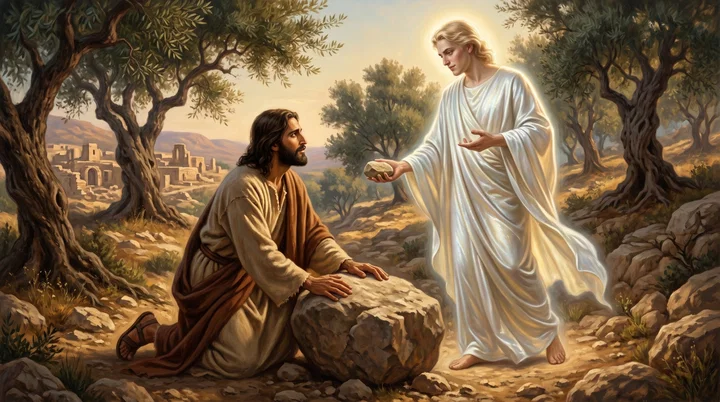
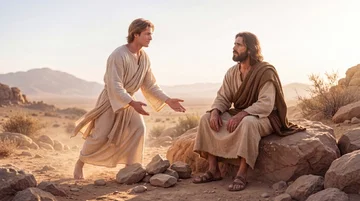
And when the tempter came to him, he said, If thou be the Son of God, command that these stones be made bread.
Translations
And when the tempter came to him, he said, If you be the Son of God, command that these stones be made bread.
King James Version, KJV Cambridge Paragraph Bible
And when the tempter came to him, he said, If thou be the Son of God, command that these stones be made bread.
And when the tempter came to him, he said, If thou art the son of God, command that these stones be made bread.
Revised Version, American Standard Version
And the tempter came and said unto him, If thou art the Son of God, command that these stones become bread.
And the Tempter having come to him said, 'If Son thou art of God — speak that these stones may become loaves.'
And the tempter coming up to him said, If thou be Son of God, speak, that these stones may become loaves of bread.
And, coming near, the tempter said to him,—If thou art God’s, Son, speak! that, these stones, may become, loaves.
Berean Standard Bible, Majority Standard Bible
The tempter came to Him and said, “ If You are the Son of God, tell these stones to become bread.”
The tempter came and said to him, “ If you are the Son of God, command that these stones become bread.”
And the Evil One came and said to him, If you are the Son of God, give the word for these stones to become bread.
Then came to him the tempter, and said, If thou be the Sonne of God, commande that these stones be made bread.
Douay-Rheims (Challoner revision)
And the tempter coming said to him: If thou be the Son of God, command that these stones be made bread.
Pictures

Cross-references 20 of 67
- Hebrews 4:15
For we have not an high priest which can not be touched with the feeling of our infirmities; but was in all points tempted like as we are, yet without sin.
Christ was tempted as humans are, yet remained without sin.
- Genesis 3:6
And when the woman saw that the tree was good for food, and that it was pleasant to the eyes, and a tree to be desired to make one wise, she took of the fruit thereof, and did eat, and gave also unto her husband with her; and he did eat.
Adam fell through appetite, while Christ overcame the corresponding temptation.
- Deuteronomy 8:3
And he humbled thee, and suffered thee to hunger, and fed thee with manna, which thou knewest not, neither did thy fathers know; that he might make thee know that man doth not live by bread only, but by every word that proceedeth out of the mouth of the LORD doth man live.
Jesus answers the bread temptation by citing the lesson that life depends on God’s word.
- Luke 4:3-4
And the devil said unto him, If thou be the Son of God, command this stone that it be made bread.
Luke recounts Satan’s temptation to satisfy Jesus’ hunger and Jesus’ scriptural reply.
- Matthew 3:17
And lo a voice from heaven, saying, This is my beloved Son, in whom I am well pleased.
The Father declares Jesus his beloved Son before the wilderness temptation.
- Hebrews 2:18
For in that he himself hath suffered being tempted, he is able to succour them that are tempted.
Christ suffered when tempted and can help those who are tempted.
- Matthew 4:10
Then saith Jesus unto him, Get thee hence, Satan: for it is written, Thou shalt worship the Lord thy God, and him only shalt thou serve.
Jesus rejects Satan and insists that God alone is to be worshipped.
- Mark 1:12-13
And immediately the Spirit driveth him into the wilderness.
Jesus is led into the wilderness and tempted by Satan for forty days.
- Matthew 4:11
Then the devil leaveth him, and, behold, angels came and ministered unto him.
After Jesus resists the temptation, angels minister to him.
- Deuteronomy 6:16
Ye shall not tempt the LORD your God, as ye tempted him in Massah.
Jesus quotes the command against testing God to resist the wilderness temptation.
- 1 Corinthians 10:13
There hath no temptation taken you but such as is common to man: but God is faithful, who will not suffer you to be tempted above that ye are able; but will with the temptation also make a way to escape, that ye may be able to bear it.
Christ’s victory encourages believers that God provides strength to endure temptation.
- Matthew 4:8-9
Again, the devil taketh him up into an exceeding high mountain, and sheweth him all the kingdoms of the world, and the glory of them;
Satan offers Christ the kingdoms of the world in another wilderness temptation.
- Matthew 4:7
Jesus said unto him, It is written again, Thou shalt not tempt the Lord thy God.
Jesus resists the tempter’s next challenge by answering with Scripture.
- Psalms 91:11-12
For he shall give his angels charge over thee, to keep thee in all thy ways.
Satan later quotes this promise to tempt Jesus to test God’s protection.
- Genesis 3:1
Now the serpent was more subtil than any beast of the field which the LORD God had made. And he said unto the woman, Yea, hath God said, Ye shall not eat of every tree of the garden?
Satan’s question to Eve casts doubt on God’s word, as his challenge to Jesus does.
- Matthew 27:40
And saying, Thou that destroyest the temple, and buildest it in three days, save thyself. If thou be the Son of God, come down from the cross.
The cross-taunt echoes Satan’s challenge to prove Jesus’ sonship.
- James 4:7
Submit yourselves therefore to God. Resist the devil, and he will flee from you.
Both describe resisting the devil’s temptation.
- Numbers 11:4-6
And the mixt multitude that was among them fell a lusting: and the children of Israel also wept again, and said, Who shall give us flesh to eat?
Israel’s craving for food became a temptation in the wilderness, contrasting Christ’s victory.
- Revelation 12:9
And the great dragon was cast out, that old serpent, called the Devil, and Satan, which deceiveth the whole world: he was cast out into the earth, and his angels were cast out with him.
Identifies the tempter as Satan, the old serpent.
- Genesis 3:15
And I will put enmity between thee and the woman, and between thy seed and her seed; it shall bruise thy head, and thou shalt bruise his heel.
The promised conflict between Satan and the woman’s Seed is acted out in Christ’s temptation.
Commentary part 1 of 3
Each commentary is drawn from primary sources: the writings of Ellen G. White and Adventist pioneers and periodicals. Each commentary is separate. Its own words are not a quotation; follow the references to read the source passages.
Ellen G. White
298 sources
After forty days and nights without food Christ was hungry, faint and emaciated alone in the desolate wilderness, when Satan came disguised as an angel of light professing to be a heaven-sent friend and dared Him to prove His sonship by commanding stones that looked like loaves to become bread.RH Jul 22, 1909ST Jul 14, 1887Lt 86, 1908, par. 7–12Ms 188, 1903, par. 32–38Ms 155, 1902, par. 22–25 The opening word if cast doubt on the voice from heaven at His baptism and on the Father's care and faithfulness, taunting His helpless suffering condition to make Him distrust God and depart from obedience.RH Jul 22, 1909Lt 3, 1897, par. 17–20Ms 188, 1903, par. 32–38Ms 113, 1902, par. 10–12ST Dec 3, 1902 Christ recognized the enemy and refused to prove His divinity, to vindicate Himself, or to enter into controversy, but met every suggestion only with It is written, making the Word of God His unfailing defense.Lt 86, 1908, par. 7–12Ms 95, 1908, par. 1–3Lt 3, 1897, par. 17–20Ms 155, 1902, par. 22–25ST Dec 3, 1902 Though He truly had power to do it, He would not work a miracle to relieve His own hunger and escape suffering, for His miracles were all for the good of others and to use divine power for Himself would have taken Him out of His Father's hands and broken the plan of salvation.RH Jul 22, 1909ST Jul 14, 1887Lt 3, 1897, par. 17–20Ms 155, 1902, par. 22–25ST Dec 16, 1880 Assailed as the second Adam on the ground where Adam fell with temptation a hundredfold severer, He won by self-denial and obedience a complete victory that redeemed Adam's failure, broke appetite's power, and gives fallen people moral power to overcome in His name through divine power joined to human effort.Ms 188, 1903, par. 32–38Ms 113, 1902, par. 1–24T 44.2–3ST Dec 16, 1880LC1 171.1
Wilderness Setting and Condition
The tempter came after Jesus had gone from Galilee to Jordan to be baptized by John to fulfil all righteousness, when the heavens were opened and the Spirit of God descended like a dove and rested upon Him and the voice from heaven declared Him God's beloved Son.Ms 95, 1908, par. 1–3Ms 153, 1899, par. 21–262SP 99.2–100.1 Led up by the Spirit into the wilderness to be tempted of the devil, He went there to be alone to contemplate His mission and work, to prepare for His public work and to brace Himself by fasting and prayer for the blood-stained path He must travel, not by any invitation of temptation.Ms 155, 1902, par. 22–25Ms 147, 1906, par. 23–27Ms 141, 1909, par. 1–2DA 114.1–115.1 Satan knew He had gone there and thought it the best time to approach Him, and the coming opened the conflict between the Prince of Light and the leader of darkness with mighty issues for the world at stake.DA 114.1–115.1
It was after forty days and forty nights of eating nothing, about six weeks of fasting and prayer, when He was afterward hungry.Lt 86, 1908, par. 7–12Lt 11, 1904, par. 34–37Ms 95, 1908, par. 1–3Ms 147, 1906, par. 23–27Ms 49, 1894, par. 6–8 It was shortly before He presented Himself at Nazareth, at the start of His public work in a threefold test on behalf of those He came to redeem.RH Jul 22, 1909ST Jul 14, 1887Lt 86, 1908, par. 7–12Lt 11, 1904, par. 34–37Lt 3, 1897, par. 17–20 He had fasted the long fast and endured severe conflict, which left Him as if dying on a battlefield before angels ministered to Him.Ms 141, 1909, par. 1–2
He was then hungry, faint, weak, pale, emaciated, haggard and worn with mental agony, physical suffering and distress.ST Jul 14, 1887Lt 3, 1897, par. 17–20SG4 150.1Ms 155, 1902, par. 22–25Ms 153, 1899, par. 5–9 He was left alone in a desolate foodless wilderness never trodden by man, with wild beasts, without food, companions or comfort, bearing the weight and guilt of the world's sins though He knew no sin.RH Jul 22, 1909ST Jul 14, 1887Lt 86, 1908, par. 7–12Lt 11, 1904, par. 34–37Lt 3, 1897, par. 17–20 His human nature had been weakened by hunger after the long fast, making the temptation especially severe.ST Jul 14, 1887Lt 86, 1908, par. 7–12Lt 3, 1897, par. 17–20
He entered this condition after close communion with God when the heavens opened and the Spirit rested on Him, showing that even after receiving a rich blessing and clear revelation of God's presence a person may face severe trial.Lt 159, 1903, par. 16–17Lt 1b, 1873, par. 321MR 10.5–11.3 Great blessing, revelation and communion may be followed immediately by severe, fierce and lonely trial and humiliation that leaves marks afterward.Lt 159, 1903, par. 16–1721MR 10.5–11.32SP 99.2–100.1 The conflict was fierce and lonely, bringing humiliation and great physical and mental distress that left Him emaciated and bearing marks of suffering and agony on His countenance afterward, which He wished no human eye to behold and no human heart to pity.2SP 99.2–100.1
The verse is the first temptation in the wilderness on the point of appetite, the first of Christ's three temptations and the first of three great leading temptations that assail man and will beset mankind to the close of time.Ms 153, 1899, par. 5–9Ms 49, 1894, par. 6–8LC1 107.14T 44.2–3ST Dec 16, 1880 Those three are appetite, love of the world with presumption, and love of honor and display, and Satan's manifold temptations grow out of these three great leading points.Ms 49, 1894, par. 6–84T 44.2–3 Satan has overcome his millions by tempting them to indulgence of appetite, the same point where Adam fell and the means by which he brought about the first Adam's fall.SG4 150.1Ms 153, 1899, par. 5–94T 44.2–3
Tempter's Disguise and Challenge
The one who came was Satan himself, the arch-enemy and adversary of souls and prince of the power of darkness, once Lucifer the covering cherub next to Christ in majesty and glory in the heavenly courts.Ms 52, 1897, par. 11–162SP 179.2–180.216MR 180.1–3 He had coveted Christ's place as one with the infinite God, become jealous when it was not given him, originated sin by secrecy and falsehood, sought to change God's government and fix his own seal upon its rules, warred in heaven and was expelled.16MR 180.1–3 He was the same evil spirit who later confronted Jesus through the demon-possessed in the synagogue and at Capernaum and in the country of the Gadarenes, working through different forms and devices while remaining the same spirit pursuing the same aim.2SP 179.2–180.23RED 43.1 He had renewed his attack when Christ came to earth, meeting Him in weakness and suffering to gain advantage, and he personally conducted the warfare because the issues were too great to entrust to confederate angels.2SP 179.2–180.2
He concealed his true character and came not as a hideous monster but disguised as an angel of light, as a beautiful young man more like a monarch than a fallen angel, with brightness like an exalted angel, in angel robes and livery of heaven.Ms 188, 1903, par. 32–38Ms 99a, 1908, par. 3–5 He professed to be a heaven-sent friend and benefactor and messenger of mercy from God's presence, even claiming to be one of the angels from the throne sent on an errand of mercy to sympathize with suffering and relieve it.Ms 155, 1902, par. 22–25MYP 58.1ST Jun 25, 1874 With Scripture in his mouth he spoke as if in answer to prayer, claiming commission and authority from heaven to declare the long fast at an end and that starvation should be prevented.Ms 155, 1902, par. 22–25Ms 99a, 1908, par. 3–5 In that guise he suggested God had forsaken Christ and was cruelly withholding food, did not will Him to endure suffering and self-denial but only to show willingness, as with Abraham who had only to show willingness and need not travel the blood-stained path.Lt 107, 1903, par. 10–12COS 47.3–48.2ST Jun 25, 1874 He even claimed to be the angel who stayed Abraham's hand when the knife was raised over Isaac, now come to save Christ's life and share the work of salvation for the fallen race.DA 117.4–120.1ST Jun 25, 1874
The opening condition If thou be the Son of God betrays the arch-deceiver and carries insinuation of distrust, unbelief, utter incredulity and bitter incredulity.RH Jul 22, 1909Ms 113, 1902, par. 10–12Ms 155, 1902, par. 22–25 The word if cast doubt on His sonship and identity, on the heavenly testimony at baptism, and on the Father's care, love, truthfulness, compassion and faithfulness, seeking under despondency and extreme hunger to make Him lose faith, distrust God, and depart from obedience and allegiance.Lt 3, 1897, par. 17–20Ms 155, 1902, par. 22–2521MR 9.1–4 It attacked the voice from heaven declaring the beloved Son, which was Christ's assurance of His divine mission and connection with heaven while living as man among men.DA 117.4–120.11RED 48.1–49.1 It repeated the artful approach used with Eve in Eden by casting contempt and doubt on God's word.DA 117.4–120.1
It taunted His humble circumstances, apparent helplessness, wretched emaciated suffering state and unfavorable appearance as forsaken of God and man.Ms 113, 1902, par. 10–12Ms 153, 1899, par. 21–26MYP 58.1 It questioned whether God would treat His own Son so as to leave Him in the desert with wild beasts without food, without companions, without comfort, implying God never meant His Son to be in such a state.Ms 113, 1902, par. 10–12ST Dec 3, 1902 It set this against Satan's own beauty, light, strength and glory in insulting contrast, implying God would not leave His own Son hungry and humiliated, and even suggested He must be a fallen angel exiled to the world.Lt 3, 1897, par. 21–222SP 90.3–92.2ST Jun 25, 1874 The challenge treated the desolate conditions and lack of food as evidence against sonship and standing, using poverty and hardship to cast doubt on God's care.Lt 3, 1897, par. 21–22Ms 199, 1899, par. 1–4
The demand was to prove sonship, divinity, authority and power by a miracle, commanding desert stones that looked exactly like loaves of bread, even the stone at His feet, to become bread to relieve pressing hunger and deliver Himself from emergency.Lt 3, 1897, par. 17–20Ms 153, 1899, par. 5–9Ms 49, 1897, par. 18–20 It urged Him to use divine power and creative power for His own relief instead of enduring suffering as humans must and waiting for God's time in obedience.Lt 11, 1904, par. 34–37Ms 113, 1902, par. 10–12COS 47.3–48.2 Satan knew God's word had power to supply bread as it had fed Israel in the wilderness and could supply Christ's need, had told his angels he could overcome Christ on appetite in His weakness, knowing victory there would give victory in every temptation, and dared Him to contend while joined to humanity's weakness, boasting superior strength.Ms 153, 1899, par. 5–9ST Apr 4, 1900 The temptation was adapted to circumstances of extreme hunger and almost overpowering, on the same point where Adam had been overcome and gained almost entire control of the world.Ms 153, 1899, par. 5–9ST Jun 25, 1874
He pressed the demand with manifold, ingenious, fierce and subtle temptations, with flattering inducements and most enticing words to bribe Christ to yield integrity, bend His mind from allegiance, compel His mind to yield and gain control of His mind.Ms 113, 1902, par. 10–12ST Dec 3, 1902ST Aug 13, 1874 He hoped under despondency and extreme hunger Christ would lose faith in the Father and work a miracle in His own behalf, and if confidence in God could be shaken he would gain victory in the whole controversy.Ms 155, 1902, par. 22–25Lt 319, 1905, par. 8 He falsely made disobedience appear necessary and good to preserve life, urging use of power to preserve life by turning stones into bread.Lt 107, 1903, par. 10–12 He claimed direct authority from heaven to require the evidence, arguing if Christ were equal with God He should relieve His own hunger, and promised that if Christ turned stone to bread he would yield his claims to superiority, no longer resist His authority, leave Him undisputed right to govern the world, and end the contest forever.2SP 90.3–92.21RED 48.1–49.1
That promise was joined to appeal to ambition for worldly power, wealth, earthly advantage and triumph by yielding integrity and worshiping Satan, spreading the world before Christ in the most attractive light and promising to yield all claims to its kingdoms without suffering if Christ would worship him.18MR 113.32RED 28.2 He assails in the time of greatest physical weakness after fasting, by policy attacking when strength fails and will and faith weaken, thinking by that policy to prevail as he had gained victory over men.DA 120.2PK 173.3Lt 255, 1903, par. 13 As he still attacks people when encompassed with clouds, perplexed by circumstances, poor, distressed or afflicted, arraying weakness and infirmities before the soul to shake confidence in God's love, tempt distrust, discourage the soul and break its hold on God, so he attacked Christ's weak point to make sure of his prey.DA 120.2Ms 102, 1903, par. 18Ms 199, 1899, par. 1–4 Meeting him as Jesus did escapes many a defeat, while parleying gives him advantage.DA 120.2
He knows how to quote Scripture expertly with his own interpretation, perverting greatness and power given him to present enchanting elevating ideas that appear noble, and using truth mixed with falsehood and misleading statements in place of God's word.Ms 60, 1886, par. 10–11CE 73.112MR 117.3–118.3 He hides temptation under appearance of goodness so he is believed to be friend rather than enemy, making indulgence appear justified, so that a truthful element does not make a whole message trustworthy.CE 73.1ST Apr 19, 1883ST Sep 17, 1874 He can use Scripture to make indulgence seem justified, as in the temptation to turn stones into bread, and the same appeal to appetite and pleasure can lead professed followers into temptation.ST Apr 19, 1883ST Sep 17, 1874FE 176.1
Christ's Refusal and Answer
Christ recognized in the insinuation the enemy whose power He had come to resist, and rested in His Father's love and in the word spoken from heaven as sufficient to sustain Him.Lt 159, 1903, par. 8–11Ms 99a, 1908, par. 3–5 He refused to prove His divinity and sonship to Satan, to explain His humiliation, to vindicate Himself, or to enter into controversy, argument, reasoning or parley with even the devil.ST Dec 3, 1902Ms 93, 1907, par. 15–24Lt 159, 1903, par. 8–11 Rebellion would not be broken by evidence, for Satan already had sufficient evidence.Ms 155, 1902, par. 22–25 Doing what was suggested would have accepted the doubt, and Satan hoped that under despondency and extreme hunger Christ would lose faith in His Father and work a miracle in His own behalf to shake His confidence in God and gain victory in the whole controversy.Ms 155, 1902, par. 22–25
Not without a struggle He listened in silence and would not be moved.Ms 155, 1902, par. 22–25Ms 99a, 1908, par. 3–5 He would not take the presumptuous dare built on if, gave the tempter no word to exploit and found no opening, but stood firmly to the affirmative principle of obedience to God by every word that proceeds from the mouth of God.Ms 185, 1907, par. 1–3Ms 188, 1903, par. 32–38Ms 99a, 1908, par. 3–5 His will remained submitted to His Father's will in perfect obedience at every moment, and He did not waver or compromise.Lt 222, 1908, par. 4–5Lt 1, 1858, par. 2–5 His answer shows how to meet temptation by reliance on God's Word rather than yielding, raising a standard against it.Lt 222, 1908, par. 4–5
He met every temptation only with Scripture, making the Word of God the weapon, sword of the Spirit and unfailing defense of His warfare.Ms 155, 1902, par. 22–25ST Dec 3, 1902 He answered It is written and Thus saith the Lord in humble dependence, without His own words, carnal weapons, railing, repeating the tempter's argument or attacking theories, keeping to affirmative truth so Satan could misinterpret nothing and closing the door against Satan on that point.Ms 188, 1903, par. 32–38ST Dec 3, 1902 The temptation urged Him to act outside the Father's appointed way, and His answer affirmed that life depends on every word from God, not bread alone.Lt 86, 1908, par. 7–12Ms 95, 1908, par. 1–3 Firm reliance on what God has said is greater than all miracles and is a sign that cannot be controverted, so that so long as He held that position the tempter could gain no advantage.ST Dec 3, 1902ST Aug 2, 1905 Its failure to change hearts is due to human disobedience, not lack of power in the Word.Ms 15, 1908, par. 3–5Ms 22, 1905, par. 10–11
Though He truly possessed power to do what was asked, as later shown in feeding five thousand with five loaves and two fishes and providing pure unfermented drink at Cana, and in His humanity had both power and freedom to comply, He refused to use divine power or work a miracle to satisfy His own hunger, supply His own necessities and relieve His own volunteered suffering.ST Dec 16, 18802RED 39.1–41.2ST Jun 25, 1874 If He had resisted by divine power He would have been tempted as God rather than as a man, for He faced temptation in His human nature and overcame on our behalf.Ms 29, 1887, par. 25 He did not use divine power to ease His own suffering or prove His divinity, but as humanity's representative endured temptation as a man and trusted His Father, showing obedience mattered more than relief.ST Dec 16, 1880ST Sep 30, 1889 Working such a miracle for His own benefit and self-proof would have taken Him out of His Father's hands, acted independently outside the appointed way, departed from the plan of salvation and broken that plan.Ms 155, 1902, par. 22–25Lt 159, 1903, par. 8–1121MR 9.1–4 Producing bread for His own need would have shown distrust of God, in contrast to using miracle power at Cana to express sympathy with and approval of others.Lt 3, 1897, par. 17–20LC1 48.1–49.1
He refused to yield or compromise integrity on a single point and gained a complete victory leaving Satan a conquered foe unable to lead Him into sin, discourage Him or turn Him aside, which filled heaven with joy.ST Oct 24, 1878ST Aug 13, 1874 Heavenly angels stayed within prescribed bounds on guard ready to act should Satan pass his prescribed limit, then ministered food, strength and divine consolation to Him fainting as one dead on a battlefield after the terrible strain, and His Father's blessing rested on Him.Ms 141, 1909, par. 1–216MR 86.2–88.2 He was tempted as a true human being and as a man relying on God rather than any special power unavailable to humanity, having laid aside power and glory and joined Himself to human infirmity, degeneracy and a body like ours.ST Apr 10, 18932RED 53.1–2 With human nature shrinking from suffering yet living to do His Father's will, He stood as humanity's representative and overcame through obedience to God, and His obedience is the obedience required of people.ST Apr 10, 1893Lt 156, 1897, par. 7–10ST Jun 17, 1897
It was a real test in which He could have yielded and not a farce, meeting temptation in fallen but uncorrupted human nature joined to divine nature without sinful corrupt propensities.16MR 182.2–183.1Ms 57, 1890, par. 10–11 Having the same free will Adam had in Eden He could have yielded as Adam did just as Adam could have resisted as Christ did, keeping His will ever on the side of God's will in perfect obedience and refusing to act for Himself.Ms 48, 1899, par. 3–4 To deny He could yield degrades His humanity with sinful propensities on one hand and on the other robs His humiliation of its force, for His victory as man proves human nature united with divine nature by faith can be strong and withstand Satan.16MR 182.2–183.1 His temptations were as real as human temptations and He was tempted in all points like human beings and bore in every respect what man will suffer and very much more, yet remained wholly free of evil inclination and without sin.8T 209.1Ms 53, 1901, par. 3 Giving the tempter no word to use against Him and standing firm to the end, He met the temptations that beset humanity and did not fall at any point, and Satan was defeated and left the field conquered.Ms 94, 1893, par. 1Ms 109, 1906, par. 5–7Ms 24, 1895, par. 10–11
Obedience Trust and Mission
Having taken humanity under covenant made in heaven, He was not to work miracles in His own behalf to escape difficulty, suffering or hunger that people must face, but to stand as a man among men and be tested fairly without supernatural advantage, accepting human suffering as part of His mission as Redeemer, substitute and human example.ST Jul 14, 1887Ms 185, 1907, par. 1–3Lt 11, 1904, par. 34–37Ms 188, 1903, par. 32–38 Though He could have performed the miracle after the long fast, using divine power for His own benefit was not part of His mission, and through His whole life He refused to do it while angels took oversight of Him.ST Jul 14, 1887SG4 150.1Ms 188, 1903, par. 32–38 He would have broken His promise if He had used divine power to escape such difficulty, for firm reliance on God's word was a greater sign of divinity than a miracle, and while He held to that reliance the tempter gained no advantage.Ms 185, 1907, par. 1–3 He held firmly to the affirmative principle of obedience to God rather than yielding to the challenge to prove sonship by commanding stones to be made bread.Ms 185, 1907, par. 1–3Lt 11, 1904, par. 34–37
His miracles throughout earthly life were all for the good of others and to relieve suffering, not for Himself.ST Jul 14, 1887Ms 17, 1893, par. 8–9DA 117.4–120.1COS 47.3–48.22SP 90.3–92.2 Miraculous power is not given to gratify demands, satisfy unbelief and pride, or vindicate self, as He also refused Herod and Pilate, and the gospel's true sign is God's power freeing people from Satan and transforming hearts and lives.Ms 17, 1893, par. 8–9 He would not use His power to provide for Himself or act merely to meet Satan's challenge, but endured hunger and put obedience to God's word above obtaining food.Ms 17, 1893, par. 8–9COS 48.3–49.4 To exert miraculous power for His own benefit and take Himself out of the Father's hands would have violated the divine plan, for no part of His mission as man's Redeemer was to exercise divine power for Himself.DA 117.4–120.1COS 47.3–48.22SP 90.3–92.2
Doing what Satan suggested would have accepted the doubt carried in If thou be the Son of God, which insinuated distrust of His identity, of the heavenly testimony, and of God's care.RH Jul 22, 1909Lt 3, 1897, par. 17–20Ms 155, 1902, par. 22–25Lt 159, 1903, par. 8–1121MR 9.1–4 Producing bread for His own need would have shown distrust of God and loss of faith in the Father, taking Him out of the Father's hands and acting independently outside the appointed way.Lt 3, 1897, par. 17–20Ms 155, 1902, par. 22–25Lt 159, 1903, par. 8–11 Had He done so the plan of salvation would have been broken, giving Satan victory in the whole controversy, causing the plan to fail, leaving mankind in hopeless misery and humanity bound by appetite.Ms 155, 1902, par. 22–25LC1 48.1–49.1Lt 159, 1903, par. 8–1121MR 9.1–4DA 117.4–120.1 The temptation tested whether He would satisfy bodily need by acting independently of God, pressing Him under despondency and extreme hunger when hunger had weakened His human nature after the forty-day fast.Lt 3, 1897, par. 17–20Ms 155, 1902, par. 22–25LC1 48.1–49.1
In refusing He practiced the lesson He Himself had taught Israel more than fourteen hundred years before, when with all means of sustenance failing God humbled them, suffered them to hunger, and fed them with manna from heaven with sufficient and constant supply to teach that while they trusted in God and walked in His ways He would not forsake them.ST Dec 3, 1902 By the same word succor would be given to Jesus, so He awaited God's time to bring relief, being in the wilderness in obedience to God and refusing to obtain food by following Satan's suggestions.ST Dec 3, 1902 He thus testified in the presence of the witnessing universe that it is a less calamity to suffer whatever may befall than to depart in any manner from the will of God.Ms 113, 1902, par. 10–12ST Dec 3, 1902
God's words spoken at Sinai are the conditions of life, and obedience to them restores access to the tree of life which humanity forfeited through disobedience.SG4 150.1 Obedience to God's requirements is more essential to prolonging life than temporal food, and providing needed food is less important than obeying God's word with promise of all things needed for the present life and the future life to those who obey.LC1 48.1–49.1Ms 38, 1890, par. 13–17COS 47.3–48.21RED 48.1–49.1 To deviate even in the smallest degree from God's purposes is worse than hunger or death, and relief must not be sought by disobeying God.LC1 48.1–49.1Ms 38, 1890, par. 13–171RED 48.1–49.1 To suffer whatever may befall is less calamity than to depart in any manner from the will of God.Ms 113, 1902, par. 10–12ST Dec 3, 1902
The verse presents this temptation as the first of three temptations in the wilderness and as a test of trust and obedience under hunger.LC1 48.1–49.1Ms 38, 1890, par. 13–17LC1 107.1 It belongs to the account of conflict at the beginning of His ministry in which Satan's kingdom stands opposed to the kingdom of God.Lt 14, 1906, par. 15–16 It shows Satan tempting Christ to act against the divine will, illustrating the conflict between the Saviour's active energy and the destroyer's and Satan's effort to lead Christ and people away from God and away from God's will.Lt 14, 1906, par. 15–16Ms 7, 1900, par. 20–22
His self-denial and submission to His Father's will defeated Satan's attempt to turn Him from His mission, and His victory over temptation was part of the conflict He ultimately won through His death, opening salvation and freedom from evil to humanity.3SP 76.2–78.121MR 402.4Ms 176, 1899, par. 4 He did not fail or yield but firmly resisted temptation and continued His mission to seek and save the lost, continuing on the path of rescue.21MR 402.4Ms 13, 1873, par. 5–6Ms 176, 1899, par. 4 He bore the test brought against Him in the wilderness as the beloved Son of God, gaining victory on behalf of the human race, showing He knows the trials of the tempted and can deliver them, and showing people can overcome Satan's seductive snares by making Him their trust.3SP 76.2–78.121MR 12.1Lt 32, 1878, par. 6–7Ms 13, 1873, par. 5–6
Representative Victory and Stakes
Christ's wilderness trial over appetite is where the work of redemption had to begin, because ruin began when Adam indulged appetite, and He had to retrace the ground where Adam failed and overcome by denial.ST Dec 16, 1880DA 117.4–120.12RED 49.3–50.2 He endured it not in beautiful Eden where Adam stood but in a place seared by the powers of darkness, after forty days and forty nights without food until faint with hunger, weak and emaciated.Ms 188, 1903, par. 32–38DA 117.4–120.12RED 49.3–50.2 He met it as a man, having taken human nature with all its possibilities, in the weaknesses, infirmities and liabilities of fallen humanity, standing in Adam's place as humanity's representative, surety, substitute and example.Ms 113, 1902, par. 1–2MYP 58.12RED 49.3–50.2 His enduring this temptation means there is nothing to endure that He has not endured.Ms 113, 1902, par. 1–2
He was tested on the ground where Adam fell as the second Adam, assailed with the same temptations used against Adam and Eve, to redeem Adam's disgraceful fall and failure.Ms 16, 1886, par. 3–4Lt 148a, 1897, par. 3–4Ms 16, 1893, par. 3–4Ms 177, 1897, par. 89–91 His victory placed the human family on vantage ground with God, proved people need not follow Adam's example but can learn from His life, and showed their only hope is in Him through abundant grace and the merits of the crucified and risen Saviour with imputed righteousness for those who receive Him, although unworthy and undeserving.Lt 49, 1887, par. 5Lt 148a, 1897, par. 3–4Ms 16, 1893, par. 3–4Ms 177, 1897, par. 89–91 Beginning the work of redemption on the point of appetite just where ruin began, He suffered so humanity could receive divine strength to conquer appetite and every unholy passion, including the liquor question and tobacco habit which pervert the senses so people cannot discern good and evil, the sacred and the common.Lt 49, 1887, par. 55MR 64.3Ms 177, 1897, par. 89–91
He met the test after about four thousand years of Satan resisting humanity, when the race had departed from original purity, wisdom and knowledge and was physically, mentally and morally degenerated in size, physical strength and moral worth.RH Jul 28, 1874ST Dec 3, 19028MR 40.1–2 Separated from God's presence and single-handed in the gloomy wilderness, He bore the sins, infirmities and weaknesses of the race as they existed when He came, in a world disloyal to God and seared and marred by the curse of rebellion where men were corrupted by Satan's inventions.RH Jul 28, 18748MR 40.1–2Ms 177, 1907, par. 33 He came as a poor man without the ease or privilege of heavenly attendants, so none can claim He did not know poverty or temptation, and He sympathizes with fallen weakness and can help people gain victory over established appetites.ST Oct 31, 1878Ms 177, 1907, par. 33 Christ took upon Him the infirmities of degenerate humanity in order to rescue man from the lowest depths of degradation and reach him where he was to elevate him.RH Jul 28, 1874ST Dec 3, 1902
The temptation was a hundredfold severer than Adam's and than any ever brought or ever to be brought upon the race, fought under every trying circumstance in far less favorable conditions.Ms 20, 1898, par. 4–55MR 112.28MR 40.1–2 Adam was assailed with none of the effects of sin upon him, standing without taint of sin in perfection with all faculties equally developed, in perfect manhood with full vigor of body and mind, surrounded by everything his heart could wish with no sin or decay, amid the glories of Eden in daily communion with heavenly beings.DA 117.1–3RH Jul 28, 1874ST Dec 3, 1902 Christ met the tempter after four thousand years of decreasing physical strength, mental power and moral worth, with the guilt and pressing weight of the sins of the world upon Him though He knew no sin and was made sin for man, passing through mental anguish, grief and torture of mind.STSE 46.1–47.1DA 117.1–316MR 180.4–181.2 Satan's personal contact was of most determined character with darts aimed at so strong a mark as never before, prepared for the circumstances and the exalted character he had to deal with, knowing if he could gain victory in this first temptation he would secure Him on all the rest, whose depth and force can be taken in only partly unless the Lord opens the scenes by revelation.16MR 180.4–181.25MR 112.2
His victory by denial, self-denial, self-control and temperance was won single-handed in the wilderness against the wily subtle foe on humanity's behalf through divine power joined with humanity.4T 44.2–32RED 67.1–2LC1 171.1 It redeemed Adam's failure, showed the sinfulness of indulgence, broke appetite's power, showed appetite can be resisted, raised humanity's moral standing and value before God, and placed the race on vantage ground with God with advantage over Adam.ST Oct 24, 18782RED 67.1–2ST Oct 24, 1878LC1 171.13T 161.3 Through gratification of taste the nervous system becomes excited and brain power enfeebled so calm rational thought becomes impossible, the mind unbalanced and its higher nobler faculties perverted to serve animal lust while sacred eternal interests are disregarded, and when this is gained Satan finds ready access with presumption and love of the world, his manifold temptations growing out of these three great leading points.4T 44.2–3 As Adam fell through intemperate appetite and lost blissful Eden, the children of Adam may through Christ overcome appetite and through temperance in all things regain Eden.3T 161.3
His victory testifies to fallen humanity and to all unfallen worlds that man can keep the commandments of God through heavenly divine power granted from heaven, exposing as false Satan's claim that no man can keep God's law and that God's law is unjust and cannot be kept.ST Apr 10, 1893Ms 1, 1892, par. 2–3 He met the temptation stronger than any ever brought upon the race as a man standing in man's place in the sinner's stead, resisting in the same manner every tempted soul may use by relying solely on the word of God with It is written, humbling Himself to show how to overcome and binding His interests with humanity by closest ties.ST Apr 10, 1893Ms 1, 1892, par. 2–3 By enduring and overcoming on man's behalf He worked out a righteous character man could not work out, rescued man from lowest degradation, and gave positive assurance that none will be tempted above what they are able, for with the temptation a way of escape is made.STSE 46.1–47.1Ms 1, 1892, par. 2–3ST Mar 7, 1878
The coming of the tempter opened the conflict between the Prince of Light and the leader of the kingdom of darkness with mighty issues for the world at stake.DA 114.1–115.1Ms 97, 1902, par. 4–5Ms 31, 1889, par. 70–73 After tempting man to sin Satan claimed the earth as his as prince of this world and held dominion through control of men, and Christ had come in human form as Son of man to stand loyal to God, dispute Satan's almost supreme authority and sovereignty, disprove that claim and show Satan had not gained complete control.DA 114.1–115.1Ms 97, 1902, par. 4–5Ms 31, 1889, par. 70–73 He came to remove false impressions of God, come close to the fallen race, through divine power break Satan's hold, meet and prove false Satan's misrepresentations by which Satan claimed mercy, goodness and truth for himself while attributing his own attributes to God, set free all who desired deliverance, recover the dominion Adam lost through sin, and save the world opening hope for all who come to Him as personal Saviour.DA 114.1–115.1Ms 31, 1889, par. 70–738MR 40.1–2
Satan regarded success in tempting Christ as victory over the entire human race and a way to establish his own life, kingdom and rule over the world, knowing everything depended on overcoming Christ.LC1 174.22RED 53.1–2ST Jan 21, 1889 He hoped to make Jesus depart from God's will as he had led Adam and Eve to do, thereby defeat the work of redemption and preserve his own rule and receive the kingdoms, while failure would leave his own case hopeless, break his power, carry out salvation to fulfillment and make his destruction certain.16MR 86.2–88.22RED 53.1–2ST Jan 21, 1889 He knew all his claims to the kingdoms of the world were false and could not be sustained unless he overcame Christ, for if Christ bore Adam's test the plan of salvation would be carried out to its fulfillment.ST Oct 29, 1902Ms 65, 1894, par. 416MR 180.4–181.2
The conflict was a contest between two great generals in which the destiny, welfare and salvation of the race, Satan's dominion and power over the world, and the plan of salvation were at stake.LC1 132.2ST Jan 20, 1914ST Aug 1, 1878RH Mar 3, 1874 All heaven watched with intense interest with angels standing on guard ready to act in Christ's behalf should Satan pass his prescribed limit, burning with love as they beheld their Commander apparently in the power of His foe, and for four thousand years since the declaration that the seed of the woman should bruise the serpent's head Satan had been planning his manner of attack with strongest efforts on appetite while Christ endured keenest pangs of hunger.16MR 86.2–88.2ST Feb 25, 1875ST Apr 5, 1883 The wilderness victory secured redemption, qualified the Redeemer for His special work of reaching the very depths of human woe by experiencing the strength of Satan's temptation and human sufferings and infirmities, and was designed not only to set an example to those fallen under appetite but to show appetite need not rule human nature.ST Feb 25, 1875ST Aug 1, 1878
Satan himself personally conducted the warfare as part of a lifelong war from the time Jesus was a babe in Bethlehem, for in Satan's councils it was determined He should be overcome.Ms 86, 1894, par. 6Ms 197, 1903, par. 5–7 The issues were too great to entrust to confederate angels, so Satan must personally conduct the warfare, rallying all the energies of apostasy and making Christ the mark of every weapon of hell, following Christ at every step determined to overthrow Him, weary God's patience for the family and ruin everyone.Ms 86, 1894, par. 616MR 180.4–181.2Ms 197, 1903, par. 5–7 All the heavenly universe looked on to see which would triumph in this battle between the prince of life and the powers of darkness over humanity possessed by demons, in which Christ was sent to demonstrate before the world and dispute Satan's authority.Ms 86, 1894, par. 6
Satan's aim was to gain control of Christ's mind, to make Him swerve a hair's breadth from allegiance to God so the world would pass under Satan's control and hinder the work God designed for Jesus to accomplish.Lt 319, 1905, par. 8Ms 79, 1909, par. 10–11ST Dec 3, 1902 The temptation was one effort in every possible way to prevent a perfect childhood, faultless manhood, holy ministry and unblemished sacrifice, to lead Jesus into sin, discourage Him and drive Him from the work He came to earth to do.Ms 197, 1903, par. 5–7 The same foe later tempted Him to turn from His appointed course to Jerusalem and save Himself, but He did not yield or change His course because the Father's will governed His life and He went forward to give His life for humanity, for had He yielded Satan's agencies would have triumphed and the world would have been lost.DA 486.1–3RH Oct 30, 1913
The verse means Christ in compassionate humiliation in behalf of fallen humanity was brought into contact with the prince of darkness and subjected to degradation by a fallen foe.16MR 86.2–88.2 Satan questioned the dignity of the spotless Son of God, disputed His authority, assailed His allegiance to His heavenly Father, sought to show superiority over Him and sought from Christ the homage he could not win in heaven where dissatisfied he could not be first and highest equal with the Father and exalted above Christ.16MR 86.2–88.2 Yet Christ gave evidence that all Satan's taunts could not call Him from allegiance to His Father, though the very purity of His principles was assailed, and He asserted superior power baffling him so Satan turned to winning from the human race the honor refused him in heaven and by Jesus on earth.16MR 86.2–88.2
His enduring this temptation means there is nothing to endure that He has not endured, He truly suffered real hunger, and He can succor those struggling with temptation, including those weakened by gluttony, drunkenness, wrongdoing and long-established appetite who seek the Lord.Ms 113, 1902, par. 1–2ST Feb 11, 1875LC1 176.2–177.1ST Apr 4, 1900CTBH 205.1–2 The experience was in God's order to prepare Him through hunger and want to understand, sympathize with and help hungry, needy and tempted people, setting an example for those struggling against appetite and teaching followers by example how to resist Satan where temptation offers an apparent good.ST Feb 11, 1875CTBH 205.1–2LC1 183.4–184.1 His endurance of severer temptation than Adam's enables Him to reach fallen people where they are and lift them, and His victory gives people ground to overcome as He did.ST Apr 4, 1900RH Jul 28, 1874
Because man in human strength could not resist and cannot overcome in his own strength, Jesus volunteered to bear the burden for man and overcome the power of appetite in his behalf, treading temptation alone with none to help, comfort or uphold Him while wrestling the powers of darkness.ST Jun 25, 1874ST Oct 29, 1902Ms 65, 1894, par. 4 He clothed His divinity with humanity to reach man with a human arm while with a divine arm He grasped the throne of the Infinite, resting wholly upon the power of God at great cost, standing the most powerful test on appetite to show self-denial, perseverance and firmness paramount to hunger's pangs and control stronger than hunger and even death.ST Jun 25, 1874Ms 65, 1894, par. 4 His victory conquers the foe for man, His merits elevate and ennoble humanity and link it to the Infinite so through His name, grace and exalted divine nature man can overcome degradation, follow His perfect example with help only in God, with positive assurance none is tempted beyond ability for a way of escape is made, living an absolutely stainless life in our behalf.Ms 1, 1892, par. 2–3Ms 65, 1894, par. 421MR 8.3Ms 65, 1894, par. 1
Victory in the conflict with sin is impossible in human strength and is not gained without suffering or by feeble efforts, for Christ came in person from the throne of glory, lived a life of obedience acquainted with human necessities and weakness, bore the sins of the whole world, and endured reproach, mockery, insult and shameful death that men might have eternal life, suffering as men will never be called to suffer.ST Oct 29, 1902 The destiny of the human race was at stake in this wilderness conflict which He conquered, in a lifelong struggle against Satan faced more fiercely than any other person, yet His life remained free from evil and sin and He continued the work He came to do.DA 687.1–2DA 759.3–4DA 71.3 Satan was defeated and left the field conquered, suffering his first manifest defeat fulfilling the prophecy of enmity between Christ and Satan, in which the Prince of life gained victory in behalf of the race and all heaven rejoiced.Ms 197, 1903, par. 5–7Ms 24, 1895, par. 10–11Ms 110, 1897, par. 1–5 From the desert to Calvary the storm of Satan's wrath beat upon Him, but the more mercilessly it fell the more firmly the Son of God clung to His Father's hand and pressed on in the bloodstained path, and all efforts only brought out His spotless character in purer light, while enraged Satan determined to bring sorrow upon Christ by striking John since the One he could not entice to sin he would cause to suffer.Ms 197, 1903, par. 5–73SP 183.2DA 223.4–224.3
Links to Other Scripture
This is one assault in the battle in the wilderness between Christ and Satan, part of the account in which He withstands Satan and overcomes so that people may overcome temptation and be restored to fellowship with God.COS 49.5–50.3Ms 113, 1902, par. 1–2DA 114 He met it as a man, having taken human nature with all its possibilities, to prove to angels and to men that man may overcome and that in every emergency the powers of heaven are ready to help.Ms 113, 1902, par. 1–2 His enduring this temptation means there is nothing to endure that He has not endured.Ms 113, 1902, par. 1–2
Satan urged Jesus in the wilderness to use His divine power to make bread for Himself and gain a following, and that same suggestion was repeated when the multitude fed from five loaves and two fishes wanted to take Him by force and make Him an earthly king.Lt 47, 1891, par. 17–22 That pressure was a real temptation with real conflict in His mind, joined by the excitement of the disciples and the disappointment and disaffection worked by Satan through Judas.Lt 47, 1891, par. 17–22 Jesus promptly and decisively refused the honor, constrained His disciples to leave by ship and dismissed the multitude and went alone into the mountain to pray, which was saying Get thee behind Me, Satan.Lt 47, 1891, par. 17–22
The same challenge to prove sonship and divinity by using divine power for Himself and to save Himself was repeated at the cross.Lt 12, 1911, par. 12–15Lt 132, 1910, par. 10–13DA 746.2–3ST Jan 27, 1914EW 145.2 There Satan and his angels worked through the mockers, the religious leaders and the mob to urge Jesus to prove He was the Son of God by saving Himself and coming down.Ms 52, 1897, par. 11–16DA 746.2–3ST Jan 27, 1914EW 145.2 The taunt If thou be the Son of God came from the same tempter, Lucifer the covering cherub who had rebelled and become foremost in leading religious bigotry and cruelty.Ms 52, 1897, par. 11–16EW 145.2 He could have used His power to escape and come down from the cross, but He refused; by not saving Himself He made pardon and favor with God possible for sinners so they could have hope.Lt 12, 1911, par. 12–15Lt 132, 1910, par. 10–13ST Jan 27, 1914 The angels wanted to rescue Him but could not, because His mission was not yet accomplished.EW 145.2
The same foe later tempted Him to turn from His appointed course to Jerusalem and save Himself.DA 486.1–3 Jesus did not yield or change His course, for the Father's will governed His life and He went forward to give His life for humanity.DA 486.1–3 Had He yielded, Satan's agencies would have triumphed and the world would have been lost.DA 486.1–3 Enraged by full defeat in the wilderness where Satan trying to entice Jesus to sin failed to overcome Him, Satan determined to bring sorrow upon Christ by striking John with suffering, since the One he could not entice to sin he would cause to suffer.DA 223.4–224.3
Jesus had already met the prince of darkness face to face in the wilderness and conquered him before confronting demons, so His authority over Satan was already settled and proven.2SP 179.2–180.23RED 43.1ST Aug 4, 1914 The tempter there was the arch-enemy himself, and the same evil spirit later confronted Jesus in another form through the demon-possessed man in the synagogue at Capernaum, in the synagogue, in the country of the Gadarenes and through raging demoniacs.2SP 179.2–180.23RED 43.1DA 256.5–257.1ST Feb 22, 1877DA 255.3–256.2 For that reason He does not flee when demon-possessed men rush at Him but stands firm before them raging but helpless, and frees the captives.ST Feb 22, 1877ST Aug 4, 1914 Satan seeks his object by various devices through different forms while remaining the same spirit, and can disguise his purpose with an appearance of piety and learning as among those who rejected Jesus.2SP 179.2–180.2ST Feb 22, 1877
After defeat on the point of appetite Satan was unwilling to cease with all at stake whether he or Christ should be victor, and tried every other means to obtain victory over the Redeemer.Lt 7, 1885, par. 19–201T 341.1–342.1RH Aug 18, 1874 This included carrying Him to Jerusalem and setting Him on a pinnacle of the temple and showing the kingdoms of the world from a high mountain.1T 341.1–342.1RH Aug 18, 1874 The assault begun in the desert in single-handed wrestling with the temptation of the enemy lasted with Satan on His track and all hell leagued against Him in at times most painful conflict from the desert to Calvary and the cross.Ms 140, 1903, par. 29Ms 111, 1897, par. 14–15Ms 24, 1898, par. 26 Step by step Christ advanced in the path of humiliation and self-sacrifice, and all Satan's attempts to inspire Him with his own attributes failed.Ms 111, 1897, par. 14–15 While under that assault Christ sang, knowing angels united with His songs, and through His sacrifice men come into possession of power to meet the wily foe and discern his falsehoods.Ms 111, 1897, par. 14–15Ms 24, 1898, par. 26
The tempter left Him for a season after failing in these fiercest temptations, and Christ's victory left the plan of salvation able to be carried out and redemption secured.SG4 240.25RED 15.1–16.12RED 55.2–56.1SG1 35.11T 294.1–2 Satan then prepared during the three years of Christ's ministry to return for the last fearful conflict in Gethsemane, where everything was at stake for him.5RED 15.1–16.1 His aim was to prevent the Jews from recognizing Him as the Messiah and to retain mastery of the earth, for if he failed there his hope of mastery was lost and the kingdoms of the earth would finally become Christ's, who would bind the strong man Satan and cast him out.5RED 15.1–16.12RED 55.2–56.1 Afterward angels brought Jesus food and strengthened Him, and His Father's blessing rested upon Him, showing temptation was no pretense but a real conflict where humanity faced severe trial with the welfare of the human family at stake and heavenly angels kept Satan from exceeding his bounds.Lt 116, 1899, par. 7–9SG1 35.1
The conflict left Him emaciated and bearing marks of great physical and mental distress.3RED 3.2–4.2ST Apr 8, 1886 His changed appearance showed the fierce struggle He had endured and the high mission before Him.3RED 3.2–4.2 Its marks were still visible when He later met Mary at Cana after His baptism by John.3RED 3.2–4.2ST Apr 8, 1886
The verse affirms that He is the Son of God, while the word if casts doubt on that fact and Jesus does not argue with or repeat the tempter's doubt but answers from Scripture.Ms 115, 1909, par. 15–17 The question whether Christ was truly God's Son and why He came into the world in such humble condition points to His coming as the spotless Son to bear the transgressor's guilt.Ms 11, 1909, par. 18 No lesser sacrifice or life could atone for sin and save the sinner from ruin.Ms 11, 1909, par. 18 He faced Satan's temptations while living as a poor man without the ease or privilege of heavenly attendants, so no one can claim that He did not know poverty or temptation, and He took the form and nature of fallen humanity to understand human trials and succor those who are tempted.Ms 177, 1907, par. 33
Sources