Translations
Which of you by taking thought can add one cubit to his stature?
King James Version, KJV Cambridge Paragraph Bible
Which of you by taking thought can add one cubit unto his stature?
Which of you by anxious care can add one cubit to his stature?
And which of you by being anxious can add one cubit unto his stature?
And which of you by being anxious can add one cubit unto the measure of his life?
'And who of you, being anxious, is able to add to his age one cubit?
But which of you by carefulness can add to his growth one cubit?
But who from among you, being anxious, can add to his stature one cubit?
Berean Standard Bible, Majority Standard Bible
Who of you by worrying can add a single hour to his life?
“ Which of you by being anxious, can add one moment to his lifespan?
And which of you by taking thought is able to make himself a cubit taller?
Which of you by taking care is able to adde one cubite vnto his stature?
Douay-Rheims (Challoner revision)
And which of you by taking thought, can add to his stature by one cubit?
Pictures
Cross-references
- Matthew 6:33
But seek ye first the kingdom of God, and his righteousness; and all these things shall be added unto you.
Freedom from anxiety is joined to seeking God’s kingdom first.
- Luke 12:25
And which of you with taking thought can add to his stature one cubit?
Jesus teaches that worry cannot add to one’s stature.
- 1 Peter 5:7
Casting all your care upon him; for he careth for you.
Both urge trust in God, who cares for us, amid anxiety.
- Matthew 6:34
Take therefore no thought for the morrow: for the morrow shall take thought for the things of itself. Sufficient unto the day is the evil thereof.
Both teach against anxious concern for tomorrow, taking each day’s troubles as they come.
- Matthew 10:29-31
Are not two sparrows sold for a farthing? and one of them shall not fall on the ground without your Father.
God notices even sparrows and cares for people, who are worth more.
- Philippians 4:6
Be careful for nothing; but in every thing by prayer and supplication with thanksgiving let your requests be made known unto God.
Urges freedom from anxious care through prayer and thanksgiving.
- Luke 12:32
Fear not, little flock; for it is your Father’s good pleasure to give you the kingdom.
Both urge fearless trust in the Father’s care.
- Matthew 5:1-12
And seeing the multitudes, he went up into a mountain: and when he was set, his disciples came unto him:
Both texts belong to the same sermon exposition.
- Matthew 10:30
But the very hairs of your head are all numbered.
Both show God’s detailed care for human life.
- Luke 12:27
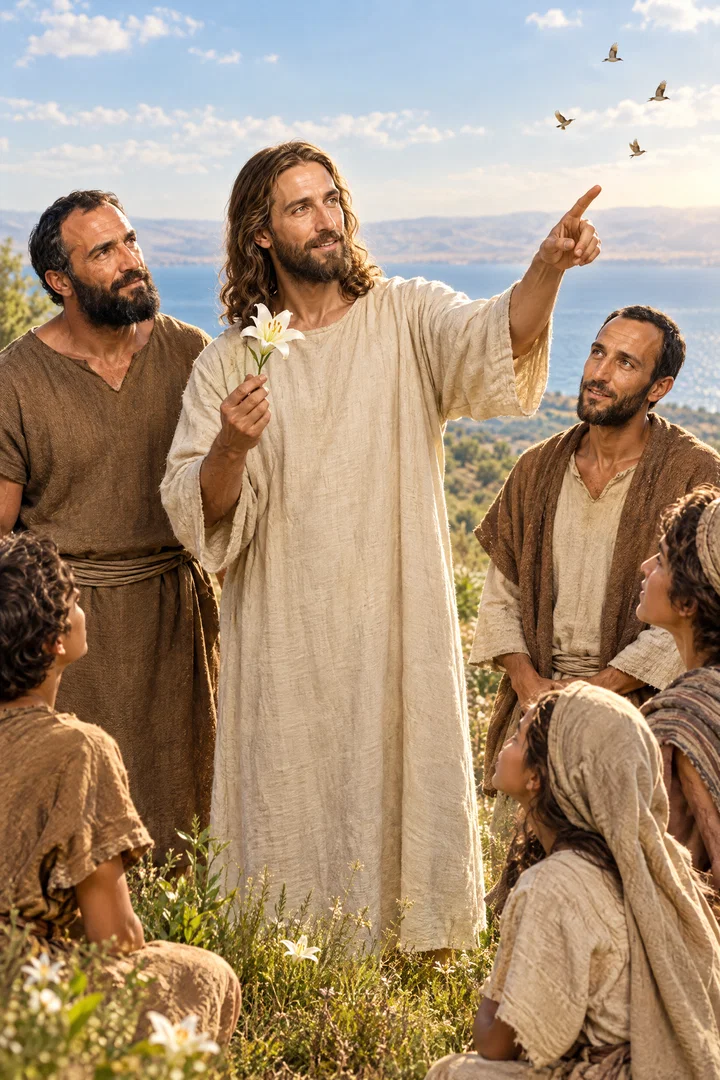
Consider the lilies how they grow: they toil not, they spin not; and yet I say unto you, that Solomon in all his glory was not arrayed like one of these.
Lilies grow without anxious effort, illustrating trust in God’s care.
- Luke 12:24
Consider the ravens: for they neither sow nor reap; which neither have storehouse nor barn; and God feedeth them: how much more are ye better than the fowls?
Both use an illustration to teach against worry.
- Matthew 11:28
Come unto me, all ye that labour and are heavy laden, and I will give you rest.
Christ offers rest to those burdened by anxious care.
- Psalms 37:3
Trust in the LORD, and do good; so shalt thou dwell in the land, and verily thou shalt be fed.
Trust in the LORD and do good rather than dwelling anxiously.
Commentary
Each commentary is drawn from primary sources: the writings of Ellen G. White and Adventist pioneers and periodicals. Each commentary is separate. Its own words are not a quotation; follow the references to read the source passages.
Ellen G. White
73 sources
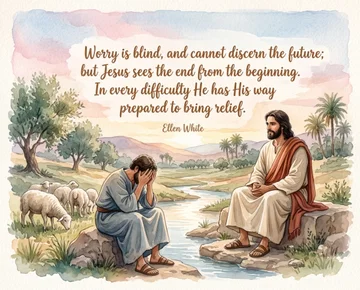
In the Sermon on the Mount Jesus asks who can increase bodily height even a little by anxious, worrying thought, showing that worry is powerless to control physical life or secure its needs of food, drink and clothing.Ms 24, 1895, par. 1513MR 337.2–3Lt 70, 1893, par. 29–33DA 298RH Mar 29, 1870 He points to the birds that neither sow nor reap and to the lilies and grass clothed more gloriously than Solomon, to prove that the heavenly Father feeds and clothes His lower creation.Ms 139, 1897, par. 3–5Lt 79, 1900, par. 23–26Ms 35, 1899, par. 6–8 Because men and women are formed in God's image, are much better than birds and flowers, have every detail of life recorded and even the hairs numbered, that same Father knows their needs and will make His gifts of life and body complete.Ms 94, 1899, par. 25–26Lt 79, 1900, par. 23–26Lt 4, 1896, par. 6–8ST Mar 10, 1909Ms 190, 1903, par. 46–47 Therefore they are to cease anxious self-reliance and distrust, trust the Father's constant sustaining care, and seek first His kingdom and righteousness with the promise that all needed temporal things shall be added.2T 496.213MR 337.2–3Lt 70, 1893, par. 29–33Ms 139, 1897, par. 3–5Lt 79, 1900, par. 23–26 This does not excuse idleness or neglect of self, family and daily duty, but calls for diligent, patient work as God's coworkers without absorbing anxiety.Ms 43a, 1894, par. 36–386T 472.1AFUP 9.1
Words and Immediate Setting
The verse belongs to the Sermon on the Mount, spoken especially to the disciples within hearing of the gathered multitude.DA 298.2–3DA 299.3 That sermon teaches the principles and conditions of God's kingdom.DA 299.3 Its teaching stands against the doctrines of the scribes and Pharisees and presents God not as a stern, unfeeling judge but as a loving Father.FE 309.1 It presents the principles of God's law as far-reaching, requiring the spirit of the law in the heart.Lt 7, 1886, par. 34 It sets the holy standard of character in God's pure gospel and holy law, requiring love to God with the whole heart and love to neighbor as God requires, including right and holy methods in business, refusing to mingle human wisdom with the divine, refusing to gain means unjustly at another's expense, and refusing to divert means from its true object to serve ambitious designs and lust for gain and power, so that failure to meet the standard proves the holy law has not yet been learned and calls for repentance, conversion, and cleansing and purging of the soul temple.Ms 26, 1899, par. 29–30
Its immediate setting warns against laying up treasures on earth and continues that warning through the rest of the chapter, exposing the danger and unbelief of anxious thought about earthly things and teaching the necessity of walking by faith instead of worry.Ms 139, 1897, par. 3–5Ms 73, 1894, par. 1–3 It calls for laying up treasure in heaven rather than on earth, for keeping the eye single so the body is full of light, and for refusing to serve two masters, since no one can serve God and mammon.Ms 139, 1897, par. 3–5 It forbids taking thought for the life, what to eat or drink, and for the body, what to put on, because life is more than meat and the body than raiment.Ms 139, 1897, par. 3–5RH Jul 3, 1900 Worry about bodily needs cannot control or increase what God has given, but belongs to a lesson against serving material concerns and for trusting the heavenly Father for life's needs.RH Jul 3, 1900
Jesus drew the lesson from familiar scenes in nature, the birds of the air and the lilies and flowers of the field in their natural loveliness, to illustrate immortal truth and make divine lessons plain, simple and memorable.RH May 30, 1871Lt 223, 1905, par. 8–10DA 253.6–254.1 The earthly has its place in illustrating the heavenly, and all nature is a lesson book and teacher to everyone willing to learn.Lt 223, 1905, par. 8–10 This shows how open His spirit was to the influences of nature and how He delighted to gather spiritual teaching from the surroundings of daily life, using facts of life and experience familiar to the hearers, with language adapted even to the opening intellect of child-life, bringing hearers into contact with nature that they might listen to the voice speaking in all created things.Lt 223, 1905, par. 8–103MR 333.2–3 His lessons held something to interest every mind and appeal to every heart, linking daily cares with things in nature and ordinary surroundings so they could be remembered amid work and concerns, so that birds and flowers reminded hearers of sacred truths, later sights of nature brought His lessons back to memory, the daily task instead of being mere toil bereft of higher thoughts is brightened and uplifted by constant reminders of the spiritual and unseen, natural objects turn the mind from nature to its Creator and to God, and tender hearts and receptive minds learn to interpret the spiritual teaching of the scenes their eyes rest upon.RH May 30, 1871CE 54.2DA 253.6–254.1Lt 45, 1877, par. 2–33MR 333.2–3
“Taking thought” means anxious, worrying thought about food, clothing and the future.Ms 24, 1895, par. 15RH Mar 29, 1870 “One cubit” means even a small measure of stature or height.Ms 24, 1895, par. 152SP 204.1 The question shows that worry cannot change physical measure, increase height, lengthen life, or gain control over even a small part of physical life and what God alone provides.Ms 24, 1895, par. 15RH Mar 29, 18702SP 204.1 It likewise shows that worry cannot extend, preserve or keep life through continual anxious attention and self-monitoring, since life depends on God's sustaining power.RH Mar 29, 1870ST Feb 2, 1915Lt 42, 1900, par. 1–2 The lesson from the flowers of the field therefore calls for trust in constant care and for bringing burdens to Him rather than letting cares separate from Him.ST Feb 2, 1915
Futility of Anxious Thought
Anxious thought cannot add even a cubit to stature, increase height, change physical measure or alter what has been made, and worry cannot supply food, drink, clothing or other needs of life and the body.Ms 24, 1895, par. 1513MR 337.2–3Lt 70, 1893, par. 29–33Ms 94, 1899, par. 25–26Lt 175, 1896, par. 19–23 Worry about bodily needs is powerless, useless and futile, unable to control even a small measure of bodily growth.13MR 337.2–3Lt 175, 1896, par. 19–23Lt 79, 1900, par. 23–26 The question calls away from anxious self-reliance to simplicity and faith in the Father who knows human needs and cares for His creatures.13MR 337.2–3Lt 70, 1893, par. 29–33 It belongs to the lesson that God cares for creation and will provide for people who are more valuable than animals and grass, bidding them trust Him rather than be anxious about eating, drinking and clothing.Ms 94, 1899, par. 25–26Lt 79, 1900, par. 23–26
Life cannot be produced by human beings, and growth is in Christ's care so that people are not required to take that responsibility upon themselves.Ms 20, 1894, par. 15–19ST Mar 10, 1909 Human skill may copy the graceful forms and delicate hues of plants and flowers, yet no human touch can impart life to even one flower or blade of grass.ST Mar 10, 1909 Every wayside blossom owes its being to the same power that set the starry worlds on high, and through all created things thrills one pulse of life from the great heart of God.ST Mar 10, 1909 The God who gave the greater gifts of life and the body knows the need of food to sustain life and raiment to clothe the body, and will bestow what is needed to make His gift complete.ST Mar 10, 1909
Anxious thought and striving for riches, place, position, honor and recognition cannot add anything to a person.STB 828.2–829.1 True honor is sought in the right way by obedience to the word of truth and honoring Christ at every step, in contentment and yielding of the will to the control of the Holy Spirit.STB 828.2–829.1 That yielding refuses to elbow fellow workers aside to make room for personal plans, puts away strife, hasty temper, cruel speech and unkind thought, and desires most to work in just the place assigned where He can look with approval, revealing the fruits of righteousness in words that bless and encourage.STB 828.2–829.1
As no one can increase physical stature by worry or effort, so no one can produce spiritual growth for another or secure it by personal anxiety and effort.18MR 3.1–3Ms 116, 1898, par. 6–9SC 67.3 All growth in the spiritual life is like growth in the natural world and depends wholly on the Lord.18MR 3.1–3Ms 116, 1898, par. 6–9 Each person must reach his own individual measure by growing up under God's supervision, growing by receiving from Christ what sustains spiritual life as plants and children receive what they need to grow.18MR 3.1–3Ms 116, 1898, par. 6–9SC 67.3
Father's Care for Creation
The heavenly Father feeds the fowls of the air, the birds and ravens and little brown sparrows, which sow not, reap not, nor gather into barns, watching over them so that not one falls without His notice.Ms 139, 1897, par. 3–5Lt 79, 1900, par. 23–26Ms 35, 1899, par. 6–8Ms 230, 1902, par. 24–2617MR 182.3–183.2 He clothes the lilies and flowers of the field, which toil not nor spin, and the grass that today is and tomorrow is cast into the oven, with a beauty more glorious than Solomon in all his glory, Solomon as the greatest king that ever wielded a sceptre.Ms 139, 1897, par. 3–5Lt 79, 1900, par. 23–26Ms 35, 1899, par. 6–8Ms 230, 1902, par. 24–2617MR 182.3–183.2 Since He so feeds and clothes them, He will much more feed and clothe His people of little faith.Ms 139, 1897, par. 3–5Lt 79, 1900, par. 23–26Ms 35, 1899, par. 6–8Ms 230, 1902, par. 24–26Ms 8, 1874, par. 11 Divine attention is proportionate to rank in the scale of creation, and human beings are much better than birds and of greater consequence than birds and flowers.Ms 94, 1899, par. 25–26Lt 79, 1900, par. 23–2617MR 182.3–183.2CE 54.4–55.1CTBH 70.1–2 They were formed in God's image and likeness, with intellect to comprehend higher things and to be led into higher departments of divine truth.Lt 79, 1900, par. 23–26Lt 4, 1896, par. 6–817MR 182.3–183.2 They are His purchased heritage, with names and life histories ever before Him, every particular of history recorded on a page in the book of providence, even the hairs of the head numbered, and His children never absent from His mind.Lt 79, 1900, par. 23–2617MR 182.3–183.2 The God who gave the greater gifts of life and the body knows the need of food to sustain life and raiment to clothe the body, and will bestow what is needed to make His gift complete.ST Mar 10, 1909HL 291.2–293.1Lt 16, 1892, par. 29–30 Human skill may copy the graceful forms and delicate hues of plants and flowers, but no human touch can impart life to even one flower or blade of grass.ST Mar 10, 1909 Every wayside blossom owes its being to the same power that set the starry worlds on high, and through all created things thrills one pulse of life from the great heart of God.ST Mar 10, 1909 He provides for temporal needs, but He cares even more for eternal interests, for the redemption of souls, for purification and a place with Christ, so anxiety over food, drink and clothing is an inferior concern beside eternity.Ms 190, 1903, par. 46–47Lt 16, 1892, par. 29–303SP 48.1 God placed people in the world and continually cares for and sustains everything He has made.Ms 43a, 1894, par. 36–38CE 54.4–55.1SC 85.4–86.1 He watches each person in every circumstance and notices every tear and smile.SC 85.4–86.1 This care, left in His hands, dismisses undue anxiety and brings rest of soul.CE 54.4–55.1SC 85.4–86.1CH 171.1 It gives courage to the afflicted and hope to the downcast, for Jesus is a sympathizing friend to whom all troubles and griefs can be brought, calling for constant trust and bringing burdens to Him rather than letting the cares of life separate from Him.Ms 43a, 1894, par. 36–38SC 85.4–86.1Lt 45, 1877, par. 4ST Feb 2, 1915
Call to Trusting Faith
The question about adding to stature belongs to the teaching against anxious concern for the needs of life, and it shows that worry cannot increase height, change what has been made, or supply what is needed for life and the body.2T 496.213MR 337.2–3Lt 70, 1893, par. 29–33Ms 94, 1899, par. 25–26Lt 175, 1896, par. 19–23 It calls for simplicity and faith in God rather than anxious self-reliance, for ceasing anxious thought about what to eat, drink, and wear, and for trusting the heavenly Father who knows human needs and provides what is necessary for the life He has given.2T 496.213MR 337.2–3Lt 70, 1893, par. 29–33Ms 94, 1899, par. 25–26Lt 175, 1896, par. 19–23 The proof of worry’s uselessness and powerlessness is meant to enlarge views of God’s goodness by bidding people behold the works of His hands, the birds fed without sowing or reaping and the lilies and grass clothed without toiling or spinning with a beauty outvying Solomon’s glory though they wither in a day.Lt 79, 1900, par. 23–26 Since care is proportionate to place in the scale of creation, human beings who are much better than birds, made in God’s image, His purchased heritage with names and life histories ever before Him, will much more be fed and clothed by the hand that upholds the world.Lt 79, 1900, par. 23–26
Anxious thought about eating, drinking, and clothing marks the Gentiles and little faith, and the lesson is to cease such anxiety, grasp God’s love, and trust the heavenly Father who knows all needs.Lt 79, 1900, par. 23–26 The obedience of birds of the air and flowers of the field to the orders of God’s will stands as admonition and reproof for human ingratitude, distrust, unbelief, and disobedience.STB 353.1–3Ms 108, 1905, par. 8–10MWISDAP 10.1–3Ms 137, 1908, par. 11–15 Though gifted with higher and nobler powers than the lower orders of creation, men have departed from God’s plan, lowered themselves to acts that dishonor their Maker, and dishonored Him whom Christ came to reveal, while birds and flowers obey.STB 353.1–3Ms 108, 1905, par. 8–10 That rebuke keenly exposes every phase of distrust and unbelief and calls for unquestioning faith, for revealing pure unselfish love, for becoming through grace partakers of the divine nature and one with Christ and thus one with God, and for casting all care upon Him, since without His help the heavy burdens of life cannot be carried aright.STB 353.1–3Ms 108, 1905, par. 8–10MWISDAP 10.1–3 God makes His will clearly known, gives evidence after evidence of His unwillingness that any should perish, and desires that all through believing and obeying His Word shall have eternal life, with thanksgiving and praise as the fitting response to His greater care for people.Ms 108, 1905, par. 8–10Ms 137, 1908, par. 11–15
Instead of seeking after food, drink, and clothing like the Gentiles, people must seek first the kingdom of God and His righteousness, with the promise that all these things shall be added by the Father who knows all these needs.Ms 139, 1897, par. 3–5Lt 79, 1900, par. 23–26 They are to work for something higher than bodily provisions, to consider the realities of eternity, and to treat anxiety over food, drink, and clothing as an inferior concern compared with eternal interests such as purification and a place with Christ.ST Sep 2, 1875Ms 190, 1903, par. 46–47 They must guard against having more anxiety than faith, and when the time to advance has fully come they must advance rather than hold back from worry over means.Lt 21, 1900, par. 4–6 God has sustained His workers thus far and will continue to work for and through them as they walk by faith, so lack of needed help is no cause for discouragement and overanxiety does not honor Him; they are to recognize the greatness of the trust committed, do their best, and then leave the rest with the heavenly Father, who does not ask for burdens too heavy to carry, is not ignorant of weighing cares, knows the barrenness of the fields and their great need, and can inspire others to work unselfishly and cheerfully so that barren places are filled with trees of righteousness.Lt 18, 1912, par. 10
The teaching does not mean Christians should ignore temporal welfare, refrain from work, live in idleness, or regard caring for self and family as sinful, and to use it to support that extreme view is a misuse of Scripture.AA 348.1 People should be diligent and patient and do what is theirs to do as God’s coworkers, placed in the world and continually cared for by Him, without absorbing anxiety that they must secure everything by their own effort.Ms 43a, 1894, par. 36–38 Concern about worldly needs such as food and clothing should not occupy the mind to the exclusion of serving God with humility and prayer.AFUP 9.1 The lessons of the Sermon on the Mount are to be exemplified in daily life, and living them can make a deeper and more lasting impression on others than spoken sermons.6T 472.1
The sixth chapter of Matthew still holds lessons unlearned, teaching recognition of every gift as coming from God, gratitude for His goodness filling the heart and bringing a heavenly atmosphere around the soul, ordering life by the truth of God found in His word, and diligent study of the Scriptures as the truth of the living God, the foundation of faith and the assurance of hope of eternal life in the kingdom of heaven.STB 823.2–3 Lack of time, the care of children, and busy domestic duties are no excuse for neglecting the study of the Word and God-given responsibilities, for no man lives to himself.Ms 139, 1897, par. 3–5
Daily Life Applications
The verse teaches contentment and yielding of the will to the control of the Holy Spirit, for anxious thought and striving for riches, place, position, honor and recognition cannot add anything to a person.STB 828.2–829.1AFUP 13.3Ms 15, 1912, par. 15–17 True honor is sought in the right way by obedience to the word of truth and by honoring Christ at every step.STB 828.2–829.1Ms 15, 1912, par. 15–17 It forbids elbowing a fellow worker aside to make room for personal plans, and puts away strife for place and position with hasty temper, cruel speech and unkind thought.STB 828.2–829.1AFUP 13.3Ms 15, 1912, par. 15–17 The greatest desire is to work in just the place God has assigned, where He can look with approval, revealing the fruits of righteousness in words that bless and encourage.STB 828.2–829.1AFUP 13.3Ms 15, 1912, par. 15–17
Giving much time, thought and large sums of money to dress and to satisfy the never-ending demands of fashion is reproved as wasted time, since human worry cannot supply the needs of the body.Lt 301, 1904, par. 19–219MR 120.2 Even professed children of God are to dress only neatly, tastefully, modestly and becomingly, leaving off unnecessary trimmings, jewelry and expensive dress, which give no true influence.Lt 301, 1904, par. 19–219MR 120.2 They are to learn self-denial and teach it to children, to value natural beauty above artificial display, and to give God the heart's best affections.Lt 301, 1904, par. 19–21FE 159.2–3CE 172.2–3 The means thus saved are to be laid aside to feed and clothe those suffering hunger and cold and to advance the proclamation of present truth.Lt 301, 1904, par. 19–21 True power with God comes from the ornament of a meek and quiet spirit that results from devotion to the service of Christ, with kindness and forethought for others as qualities precious in heaven to be gained at once.9MR 120.2
The words in Matthew 6:19-34 are given for the enlightenment of parents, who are teachers in the place of God to act out His mind and will in every particular.Ms 151, 1898, par. 45–48Ms 187, 1898, par. 51–54 They are not to scold and fret at their children, nor to be harsh and punish them in anger.Ms 151, 1898, par. 45–48Ms 187, 1898, par. 51–54 They are to bring up their children in habits of strict temperance.Ms 151, 1898, par. 45–48Ms 187, 1898, par. 51–54
In its wider lesson there is no need to worry about food, drink or clothing, but to live simply and trust the heavenly Father's care, who cares more for human beings than for birds and flowers.Ms 85, 1909, par. 7–9Ms 83, 1909, par. 8 Such worries should not fill the mind, and people of little faith should trust God through hardship, remembering that Christ experienced poverty and hardship and that God can provide for those in need through people who have means.Ms 85, 1909, par. 7–9Ms 21, 1897, par. 26 Preparations for the Sabbath, including putting clothing and boots in order beforehand, should be made in good time, because God means what He says about the Sabbath.Ms 21, 1897, par. 26
Pointing children to birds, grass and flowers displays God's creative skill, love and tender fatherly care seeking their happiness, teaching them to trust His care and to value natural beauty above artificial display.FE 159.2–3CE 172.2–3RH May 30, 1871 His hand has made the lofty trees, the grass, the buds and the flowers, and every bud and flower is an expression of His love, while the lesson Christ points to in the lily of the field is simplicity and trust in God.MH 265.3–266.1Lt 223, 1905, par. 8–10 Looking at these wonderful works diverts attention from self to God and uplifts minds from things seen to things unseen.MH 265.3–266.1 The beauty of nature leads thought to the heavenly home, where nothing mars the loveliness, nothing taints or destroys, and nothing causes disease or death.MH 265.3–266.1 When the sick are placed amid beautiful objects of nature to live out of doors in warm sunshine, pure air, beautiful scenery, flowers and trees, orchards and vineyards with outdoor exercise, nature acts as healer so they require less close care and nursing, become less inclined to discontent and repining, have their minds taken away from themselves to delight in God's handiwork, and are made ready to learn of the God of nature and acknowledge His care.Ms 86, 1902, par. 4–6Lt 249, 1905, par. 5–6 This gives opportunity to uplift the God of nature before those seeking restoration of health, to reach their souls, and greatly aids recovery of health without drugs with reason to praise the Lord for providing such advantages.Ms 86, 1902, par. 4–6Lt 249, 1905, par. 5–6
Sources
Pioneers and periodicals
110 sources
Anxious, distrustful worry cannot make a person taller by a cubit or add even a moment to the span of life.RH Jan 22, 1867RH Aug 23, 1864ST Jan 20, 1898ST Feb 27, 1879ST Jan 20, 1898 It cannot secure food, drink, clothing or other necessities, nor control the future or alter what lies beyond human power.RH Apr 21, 1859ST Jan 20, 1898ST Apr 9, 1894RH Aug 12, 1862ST Jul 18, 1911 Life and the body are more than food and clothing and come from God, who feeds the birds and clothes the lilies and grass more beautifully than Solomon, and His children are much dearer to Him, so they are to seek first His kingdom and righteousness trusting the Father who knows their needs.ST Mar 10, 1909ST Sep 2, 1875RH Feb 13, 1879ST May 22, 1884RH Jan 21, 1858 Bodily growth comes not by human will but under conditions supplied by the Creator, and in the same way spiritual growth and holiness come not by worry and looking to self but by receiving God's nourishment and abiding.ST Jan 16, 1893RH Apr 27, 1905RH Dec 12, 1854RH Dec 20, 1870 After doing present duty diligently, believers are to trust God with timing and manner of help and leave tomorrow to Him, for worry is useless and harmful distrust of Providence that wears down body and mind and blinds to present blessings.RH Apr 8, 1909RH Jul 17, 1860ST May 16, 1911ST Jul 5, 1910
Words and Setting
The word rendered thought carries the older sense of anxious, distrustful worry rather than ordinary thinking.ST Jan 20, 1898 The word rendered stature can also mean age, so the saying denies that anxiety can add even a span or a moment to life.RH Jan 22, 1867 The cubit marks how small the impossible addition is, showing that worried thought cannot control or extend human life and growth.RH Nov 21, 1907 Worry cannot increase height by even one cubit and cannot govern bodily growth.ST May 17, 1905 It cannot change even a small measure of stature, which exposes the folly of anxiety about future needs and calls for confidence in faithful providential care amid life's changes.RH Aug 22, 1871 Human limits in this small matter teach trust in care for changing human needs.ST Jun 23, 1909 Anxious thought cannot add even a cubit to stature, belonging to a teaching against worry in which anxiety over what lies ahead exhausts the mind and hinders good work, while work without anxious haste supports health and order.RH Sep 16, 1915
The verse belongs to the sermon recorded in Matthew 5, 6, and 7, to be read in connection with Luke 6:12-49 on the plain.ST Jan 23, 1896 It was spoken on another mount nearly fifteen centuries after Sinai by the same voice that spoke the law amid thunders and lightnings, thick cloud, smoke and fire, with ten thousands of saints, from whose right hand went the fiery law.ST Sep 22, 1909 That first sermon on the mount is retracted in nothing and nullified in no portion of the law, but fulfilled, for till heaven and earth pass not one jot or tittle shall pass from the law, and its gracious words are to be read, meditated upon, and fed upon at leisure.ST Sep 22, 1909 The detailed instructions of Matthew 5-7 fully set forth the character of the spiritual kingdom of Christ, whose interests were to be advocated and whose principles were to be taught contemporaneously with the existence of a government of a different character.ST Apr 9, 1896 The law of the mount stands opposite the law of the market and commercialism, and is the very ideal and law needed for economic problems.RH Jul 24, 1900 Its principles cannot be lived out while deliberately going to war to kill fellow human beings.ST Jun 6, 1900 Its influence should govern public officials, so that favor to the drink trade shows government by another influence than that expressed in this teaching.ST Jan 16, 1901
The lesson is drawn from familiar scenes in nature to make divine truth plain and memorable.RH May 30, 1871 Observing living things teaches care, wisdom, and power, while showing that human effort and worry cannot control even so basic a matter as bodily stature, though nature does not fully reveal the will for human beings.ST Mar 11, 1903 Its lessons are learned more deeply by observing nature and its laws firsthand.RH Aug 6, 1908 Birds and flowers reminded hearers of sacred truths and directed minds from the created world to God, so that later sights of nature could bring the lessons back to memory.RH May 30, 1871 The care shown to sleeping plants through the cold winter teaches children love and care for human beings.RH Dec 22, 1904 Birds, flowers, and grass direct people to see the Creator in the things He has made.ST Feb 5, 1902 The load of care is to be flung aside as useless, and instead blessing is to be sought firsthand beneath the fair sky in the verdant fields in the fresh early morning, from grassy field and running brook, flower and fruit, leaf and tree, sturdy kine and humming bee, singing breeze and sparkling dew, singing larks and twittering sparrows, where love and tender care are given in the open air.ST Jun 6, 1906
Matthew 6 governs the motive that moves a person rather than forbidding visible report.RH Dec 24, 1872 Reporting missionary labor that lets light shine and stirs others to act is right when done for the good of others and for God's glory rather than for personal praise, while refusal to report is often because the right hand does nothing for the left hand to know.RH Dec 24, 1872 The chapter, including this verse on the inability of worry to add to stature, is instruction that all who boast of their own perfection should learn.RH Jan 30, 1908
Worry Accomplishes Nothing
No anxious pondering can add a cubit to bodily stature or make a person taller, and the attempt exposes the folly and powerlessness of worry over what lies beyond human power.RH Aug 23, 1864ST Jan 20, 1898ST Oct 13, 1898RH Nov 24, 1859 The measure is set among Christ's words about food and clothing to show the futility of anxiety over material needs and to support trust in divine care rather than worry.ST Feb 27, 1879 Considering birds and lilies makes plain that anxious thought cannot control or add to life's natural growth.ST Jan 20, 1898ST Oct 13, 1898 Parents are therefore to value their children's eternal life and spiritual preparation above securing their food and clothing, and to seek God's kingdom first.ST Feb 27, 1879 The Father's loving care for His creatures in providing food, drink, and clothing is the reason worry cannot change or provide for the body.
Nor can anxious thought lengthen life, preserve life, change its appointed limits, or add what lies beyond human power, whether height or span of life.RH Mar 29, 1870ST Jun 6, 1900RH Dec 23, 1902ST Jun 6, 1900ST Mar 21, 1911 Worry cannot accomplish what lies beyond human power or secure what God alone provides.RH Mar 29, 1870ST Feb 2, 1915ST Jun 6, 1900 Concern about life's needs cannot secure what God provides, because life and the body are more than food, drink, and clothing.RH Dec 23, 1902 Christ's lesson from the flowers of the field therefore calls for trust in His constant care and for bringing burdens to Him rather than letting the cares of life separate from Him.ST Feb 2, 1915ST Mar 21, 1911
Worry cannot secure food, drink, clothing, or other necessities of life, nor accomplish what it fears is needed.ST Jul 2, 1894RH Apr 21, 1859ST Jan 20, 1898RH Nov 12, 1903 Anxious concern belongs to teaching that calls for confidence in God's providence rather than distrustful worry, for the heavenly Father who feeds birds and clothes grass knows what is needed.ST Jul 2, 1894RH Apr 21, 1859RH Nov 12, 1903 Worry about food, drink, clothing, and feared future events brings needless misery, and after doing what is right people should trust the Father to provide daily needs and seek His kingdom and righteousness first.ST Apr 9, 1894RH Nov 12, 1903 Anxious thought cannot change human limits or secure what is lacking, so the chapter teaches self-denial, trust, and cooperation.ST Apr 9, 1894RH Jan 6, 1910 Little faith leads to worry about food and clothing, yet fear of being denied some good thing should not keep anyone from following the path of duty.ST Jul 2, 1894RH Nov 12, 1903
Anxious care cannot change what God has appointed, what a person is able to accomplish or bear, control the future, alter the course of nature, or secure what lies ahead.RH Aug 12, 1862ST Jul 18, 1911RH Nov 16, 1911RH Sep 8, 1910RH Jan 29, 1867 Troubles come a day at a time, each day's burden being enough to carry without adding yesterday's troubles or tomorrow's worries, so today should not be filled with sorrow about tomorrow.RH Aug 12, 1862ST Nov 25, 1889RH Jan 29, 1867 The lesson is not to borrow trouble from the future or brood over tomorrow's uncertainties, but to trust God's watchful care and leave future, timing, and provision to Him.RH Aug 12, 1862ST Nov 25, 1889 Worry weakens present effort and courage for the future and causes people to miss present joys and blessings, while faith in God's sovereignty, love, grace, and power steadies the heart against anxiety.ST Jul 18, 1911RH Sep 8, 1910 Anxious thought about what lies beyond human control is therefore answered by trust in the God who provides even for the tiniest creature.RH Nov 16, 1911RH Sep 8, 1910
Father's Caring Provision
Life and the body are more than food and clothing, for both come from God, and He who gave the greater gifts knows the need of food to sustain life and raiment to clothe the body and will bestow what is needed to make His gift complete.ST Mar 10, 1909ST Feb 8, 1899ST Oct 3, 1878 Human skill may copy the graceful forms and delicate hues of plants and flowers, yet no human touch can impart life even to one flower or blade of grass, for every wayside blossom owes its being to the same power that set the starry worlds on high, and through all created things thrills one pulse of life from the great heart of God.ST Mar 10, 1909 Concern for food and clothing cannot accomplish what is sought by worrying, since life is received from God and is not to be carried as an anxious burden, but people are to work for something higher than bodily provisions, with trust and prayer as the proper response to care, because life, health, food and clothing depend on God and not on earthly supports which can fail.ST Sep 2, 1875ST Feb 8, 1899ST Oct 3, 1878 Making eating, drinking and dressing the main aim and carrying them to excess turns them into crimes, among the marked sins of the last days and a sign of Christ's soon coming, for time, money and strength belong to the Lord and are entrusted by Him, yet are wasted on needless dress and luxuries for perverted appetite which lessen vitality and bring suffering and decay, so that filling the body continually with corruption and disease by sinful indulgence makes it impossible to present the body a living sacrifice to God.ST Sep 5, 1895
God tenderly cares for His creatures, feeding the fowls of the air and the sparrows, clothing the lilies of the field and the grass and flowers more beautifully than Solomon, and nothing escapes His watchful eye or is too small for His care.RH Feb 13, 1879ST May 22, 1884RH Mar 20, 1856RH Jul 16, 1857 He robes the lilies though they do not spin, He sees each sparrow sold for naught when it falls lifeless to the ground, He guards men, and He cares for even the smallest flowers and creatures, which assures each person wherever they are of the keeping of an infinite Father who is closest kin and does not stand afar.ST May 22, 1884RH Aug 4, 1910RH Dec 4, 1913 Children and believers are much better than birds and grass and are much dearer to Him, so He will much more feed and clothe them because He knows they need all these things, and this gives reason to trust God through poverty, sickness, hardship, hard times and scarcity, with discontent quieted and desires asked only insofar as they are good.RH Feb 13, 1879RH Mar 20, 1856RH Jul 16, 1857 True life is not the drink and food the Gentiles seek, but God who loves all gives all good to the meek.RH Dec 4, 1913
Therefore believers should seek first God's kingdom and His righteousness and trust the Father who knows their needs, rather than seeking like those who do not know God or serving material concerns and making worldly needs and pleasures the chief pursuit.RH Jul 24, 1856ST Oct 22, 1902ST Sep 22, 1898 Anxious thought adds nothing to life and cannot change human limits or provide what is needed, so the command to take no thought for the morrow about what to eat or drink or wear means believers in the last days must not be fearful and trembling but trust their all in God's hands and take Him at His word, continuing to work while putting God's kingdom first.RH Jan 21, 1858RH Feb 7, 1854ST Sep 22, 1898 Believing God is counted for righteousness and puts believers in position to expect temporal supply, for God who feeds beasts and birds and who feeds the sparrows and clothes the lilies is able to add the necessaries of this short life to those who seek first His righteousness and the interests of His kingdom, and God will not leave the trusting one to perish.RH Jan 21, 1858ST Oct 22, 1902ST Oct 22, 1902 Those who lay life at Jesus' pierced feet for His use are to know no anxious care but bear loads with cheerful heart by believing prayer, with no worry lest work be stayed and no hurry lest delay betray into prayerlessness, seeking not praise of men but to be taught God's plan and enabled to do it, having no greed of gain, fleeing to Him for refuge in danger, pleading the name of Jesus, standing before Him to watch His eye and beckoning hand and promptly move at His command, so that life becomes one sweet day lit by heaven's cloudless ray.ST Oct 22, 1902
That trust holds in famine, poverty from persecution, cold, hunger, loss of work and daily wants, for the God who sent ravens to feed Elijah and rained manna from heaven forty years for Israel in the wilderness can supply every want and add necessaries to those who seek Him.RH Jan 21, 1858RH Feb 7, 1854 The earth yields its harvest whether men wake or sleep, so worry cannot secure what God provides, and provision belongs to an unseen heart and hand that is felt but not seen, which has always provided and will always provide, often opening another door wide when one door shuts and redeeming loss with harvest, so that rich fields of grain and surplus corn can still come and buy the hay that was lost, and anxious taking thought cannot save hay, corn, wheat or feed for horse and cattle from storm and rain.RH Aug 5, 1909RH Dec 26, 1912 A person's part is to work early and late, do his very best, keep heart, return to work trusting that labor in the Lord is not in vain, and then rest from worry and only work and trust, enduring cold and hunger with contentment while living for heaven and depending on God's care through every stage of life in daily needs.RH Sep 25, 1900RH May 9, 1912RH Dec 26, 1912RH Jul 1, 1873 The decision to send workers and supply money for their journey where work is according to God's will depends on that same trust in God to provide if it is His will.RH Oct 26, 1911
Belonging to God frees from anxiety about food, clothing, money and the future, because to have God is to have everything God makes and governs, with plenty of food and clothing, ample security for the future, all that is necessary for bodily comfort, and a contented mind, which is all the benefit riches can supply and more without their troubles and burdens of vexing the brain over stocks and notes and shares or fearing calamity that leaves penniless. All the world's wealth needed for present use is supplied, and the rest is held in reserve as an unfailing fund for future wants, put into the hands when the Lord has a call to do good as His disbursing agent, for more delicate dishes would only increase disease, fine clothing would only make humility harder, and a large bank account would make trust in God less likely and expose to the power of wicked men and evil times. Worry cannot secure or lengthen life because God is His people's life and has promised to care for and protect them, yet this trust does not mean neglecting practical responsibilities but exercising care, faithfulness and watchfulness, distinguishing life from property, since God has not made the same promise about possessions which may be entangled with worldly obligations, and doing the will of God simply and lovingly from moment to moment as He makes it known is the secret of happiness.ST Jun 26, 1907
The fixed order of nature can make God seem distant from individual needs, though the wider context of the teaching about human limits and God's care presents Him as a tender parent.ST Oct 2, 1884
Growth Given by God
Bodily growth does not come by human will or deliberate effort, for worry cannot increase height by even a cubit, but takes place under conditions supplied by the Creator's power and wisdom.RH Apr 27, 1905RH Dec 12, 1854RH Dec 20, 1870 No human touch can impart life even to flower or grass, which owes its being to the power that set the stars on high, and poor human might can never wrest even the meanest thing to serve human will, since all power is God's alone, so the right response is to be still and trust and rest.RH Apr 27, 1905RH Dec 20, 1870 Anxious thought and reasoning cannot add to life or change what God has given, so being content within the narrow bound God allows is better than reasoning by which no one grows wiser.RH Dec 12, 1854 God's providence guides with an unerring hand, and a heavenly Father's tender care is shown alike to rich or poor, great or small, watching the sparrow's fall and the overthrow of empires.RH Dec 12, 1854 What mortals deem threatening ills often turn to plenteous blessings, for no tear of grief, throe of pain, trial, or sacrifice is unmarked by God or borne in vain, and each will have its reward when life's hidden scroll is unrolled and heaven's unclouded light unfolds the ways of providence.RH Dec 12, 1854
Worrying and looking to self cannot make a Christian more holy or produce spiritual fruit, any more than worry makes one taller.ST Jan 16, 1893RH Apr 27, 1905 Spiritual growth comes by receiving the nourishment God provides, as a plant grows by receiving from the soil and bears fruit by abiding, and though God expects fruit, worry does not help produce it.ST Jan 16, 1893RH Apr 27, 1905 This human limitation proves lack of control even over self, so no one has power or right to pledge life as surety for an act he may be unable to perform.RH Apr 27, 1905RH Oct 7, 1858 The child of God is not rewarded immediately at death but will be raised from the dead and rewarded when Christ comes.ST Jul 28, 1898 The sudden death of a worker shows the limits of human control over physical life and is met with submission to God's will.RH Sep 3, 1903ST Jul 28, 1898
Harm of Anxious Care
Anxious care is useless and harmful and forbidden, bringing needless misery, unhappiness and wretchedness while blinding the eye to present beauty, joy and blessing.RH Apr 8, 1909RH Oct 8, 1908ST Jul 29, 1913RH Nov 1, 1906 Fretting cannot make the frame taller, cannot lift the load or smooth the road, cannot change what is given or secure what is feared to be needed for life, for the journey, for its uncertain length and coming years.RH Apr 8, 1909RH Oct 8, 1908ST Jul 29, 1913RH Nov 1, 1906 Courage and patient trust take the place of fear, staying close to the Father who cares for His children in great and small troubles, hears the faintest call, remains present through dark days, provides for daily needs, and gives cause to work and live patiently and to rejoice without knowing what the next day will bring.RH Apr 8, 1909RH Oct 8, 1908ST Jul 29, 1913RH Nov 1, 1906
It is not work but worry that wears down, wrinkling the face, graying the hair, dimming the eyes, driving away sleep, draining life, aging the world, exhausting the mind, hindering good work, making the brain feverish and the hand unsteady, and diminishing vitality, beauty and usefulness.ST Mar 27, 1893 Anxiety brings no money to the poor and no food to the hungry, accomplishes nothing beyond human control, solves none of life's needs, and only brings distress.ST Mar 27, 1893 Brooding and mental burdens are therefore to be put away rather than carried through the day and into bed, leaving cares in believing prayer and living peacefully in faith.ST Mar 27, 1893
Such taking thought is distrust toward overruling Providence and forgetfulness of faithfulness, little faith acting as if the Father does not care, weakening faith in heaven and in God's plan.RH Jul 17, 1860RH Apr 21, 1859ST May 8, 1879RH Jul 3, 1860 It burdens the heart, sinks the soul in darkness and discouragement and grief, degrades and weakens the mental and moral powers, withdraws light, and fits the mind to be led downward by Satan and the world and the flesh.RH Jul 17, 1860RH Jul 3, 1860 Continual sorrow and lamentation accomplish nothing, and the way to strength to do the divine will is to keep the heart still, to look away from self and temporal wants, to wait in cheerful hope content with the divine will, to walk through all earthly changes with cheerful yesterdays and confident tomorrows, to trust and confide while diligently doing the duties of the present day and making all temporal matters subservient to truth rather than securing needs by dishonest or selfish means.RH Jul 17, 1860RH Apr 21, 1859ST May 8, 1879RH Jul 3, 1860 Human vision is small and dim, opening only to things nearest to self which are often mere baubles or toys, while the divine vision is boundless and impartial and its improving tasks come through trial.RH Jul 17, 1860
Anxiety over food, clothing, money, reputation and tomorrow turns earthly provision, comfort, display, accumulation and the opinions of others into the chief pursuit, envying possessions and valuing wealth above eternal things.RH Dec 6, 1853ST Feb 2, 1882ST Jun 4, 1874RH Jul 3, 1856RH Feb 6, 1866 Necessary concern for life is proper only within the limits of nature's real needs; when it grows into unnecessary pursuits and imagined desires and covetous accumulation, it distracts the mind from its true good.RH Jul 3, 1856RH Feb 6, 1866ST Feb 6, 1907 Wealth does not measure favor with God nor deserve to be life's object, for unseen eternal things are to be valued above visible earthly things, and even necessary things must be sought with detachment that leaves the soul attentive to its greater lasting needs in daily dependence as taught in the prayer for daily bread.RH Dec 6, 1853ST Feb 2, 1882ST Jun 4, 1874RH Jul 3, 1856ST Feb 6, 1907
Restful faith that trusts the all-loving Father brings peace of mind and is a remedy for illness caused by fretting and anxiety.ST Oct 9, 1901 There are two kinds of people who do not worry, the child of God who does not worry from trust and the child of evil who does not worry from carelessness, and only enduring calm founded on undimmed trust is excellent.ST Oct 9, 1901 Excess in eating, drinking and dress wastes entrusted strength, brings disease and decay, marks last-day sin, and bars presenting the body a living sacrifice.ST Oct 9, 1901
Trusting Action Without Worry
After doing what is right and the simple duty as made known, the part of human beings is to trust God and leave the future and the timing and manner of help to Him.ST Jul 5, 1910ST Apr 8, 1886 Tomorrow's trouble is not to be borrowed, trials are not to be brooded over or lamented or striven to escape, and today is not to be filled with sorrow, but the way is to walk cheerfully, to pray, to watch His eye and to move at His command.ST May 16, 1911ST Jul 5, 1910ST Apr 8, 1886RH Mar 17, 1904 Worry cannot secure life's needs, cannot change stature, cannot control what lies ahead, and cannot add to what human power can accomplish or bear, while God hears the cry for help and provides shelter, clothing, and food.ST May 16, 1911ST Jul 5, 1910ST Apr 8, 1886RH Mar 17, 1904 He knows human weakness and provides shelter and care as He does for the birds and other creatures, He is continually at work in nature to feed and clothe people, and trust in that providence rather than worry is the fitting response to trouble.ST Jul 5, 1910RH Mar 17, 1904 Anxious thought cannot help loved ones when they fail and their cheeks grow pale, cannot buy them fresh fruits and flowers, and cannot decide whether to stay with them sick and alone in working hours or leave them to work, so the toiler's part is to toil and trust a just God who remembers.ST May 13, 1897 God has not gone to some distant star but is in the mill where the toilers are and smiles on every one for the sake of Christ the carpenter's son, and though no other could hear in the noisy mill, God hears a thought, heaven grows still while He measures tears and counts sighs, and He hears the cries of anxious hearts lifted up about their own whom they love.ST May 13, 1897
That trust still makes reasonable effort, works diligently without haste, returns to work, keeps heart and does its best early and late, and goes forward in God's work instead of letting cares and burdens stop it.ST Apr 8, 1886RH Mar 30, 1869 Overburdened cares are to be entrusted to God for peace, small cares and fear of what might happen are to be left aside among the fields, and labor in the Lord is known not to be vain.RH Mar 30, 1869RH Jun 27, 1871ST May 15, 1907 The surrounding teaching promises food and clothing while limiting their use.RH Mar 30, 1869RH Jun 27, 1871
Ministers therefore should trust God to provide necessities rather than spend time scheming to make money, and those who spend time and money sharing faith by tracts need not fear going hungry or lacking clothing but should manage time wisely without neglecting ordinary business.RH Dec 9, 1873RH Mar 24, 1863 Giving in the present with trust for what is coming means needing as little as possible for self, spending nothing on unnecessary things, living frugally on little, using what is allowed for self in a way that also serves the common good, and then doing all possible good with the rest now rather than planning to give only after death.ST Jul 29, 1897 Such present giving brings continued and even increased supply, often coming unexpectedly and unplanned so that nothing is wanted and nothing is lost, while using too much on self or on things of little importance lessens prosperity.ST Jul 29, 1897 Keeping the Sabbath in obedience to all the commandments, even when it appears to cost one day's work every week, is met by God's provision with enough work supplied on other days so that nothing is lost, and that trust continues to the end, applying also to those who give up work to keep the Sabbath in Denmark despite hardship and insufficient food and to those in Austria, Hungary, and the Balkans who fear losing work and being unable to support a family, for the Lord will care for His people and advance His cause and calls for faith rather than worry.RH Jul 14, 1903RH Dec 26, 1854ST Jun 4, 1874
Excessive thought about food, drink, clothing, and worldly conveniences must not take priority over eternal life and time for prayer, Bible reading, and meditation on God's love, and parents especially need to remain free from worry and cheerful when their children's choices distress them.RH Sep 5, 1865RH Oct 17, 1912 Children's eternal life and moral fitness stand above food, clothing, knowing their future, sparing pain, or fearing opinion, while God has provided a home, friends, and warm things and warm clothing, so people should trust His goodness and care for health in daily care without fretting rather than act from fear of others' opinions.RH Sep 5, 1865RH Oct 17, 1912ST Feb 3, 1881 Even in hard times and scarcity spiritual instruction is to be secured.RH Sep 5, 1865
The same instruction not to worry about one's living rules out making definite provision to profit from the deaths of parishioners, as by a price for funeral sermons.RH Oct 17, 1907 It calls believers to give possessions to the poor, to sell to gain heavenly treasure, to follow the homeless Jesus through the gates of the holy city, to risk property, honor, strength, and life under persecution with angels encamped about, to accept trials in resignation, and to be willing to give up position for righteousness under a Sunday-rest law with confidence that God will care for the faithful.RH Oct 17, 1907
Sources