Matthew 8:4
And Jesus saith unto him, See thou tell no man; but go thy way, shew thyself to the priest, and offer the gift that Moses commanded, for a testimony unto them.
Translations
And Jesus says to him, See you tell no man; but go your way, show yourself to the priest, and offer the gift that Moses commanded, for a testimony to them.
King James Version, Revised Version
And Jesus saith unto him, See thou tell no man; but go thy way, shew thyself to the priest, and offer the gift that Moses commanded, for a testimony unto them.
And Jesus saith unto him, See thou tell no man; but go thy way, shew thyself to the priest, and offer the gift that Moses commanded for a testimony unto them.
And Jesus saith to him, See thou tell no man; but go, show thyself to the priest, and offer the gift that Moses commanded, for a testimony to them.
And Jesus saith unto him, See thou tell no man; but go, show thyself to the priest, and offer the gift that Moses commanded, for a testimony unto them.
And Jesus saith to him, 'See, thou mayest tell no one, but go, thyself shew to the priest, and bring the gift that Moses commanded for a testimony to them.'
And Jesus says to him, See thou tell no man, but go, shew thyself to the priest, and offer the gift which Moses ordained, for a testimony to them.
And Jesus saith unto him, Mind! tell, no one,—but withdraw, thyself, shew to the priest, and offer the gift which Moses directed, for a witness unto them.
Berean Standard Bible, Majority Standard Bible
Then Jesus instructed him, “ See that you don’ t tell anyone. But go, show yourself to the priest and offer the gift prescribed by Moses, as a testimony to them.”
Jesus said to him, “ See that you tell nobody; but go, show yourself to the priest, and offer the gift that Moses commanded, as a testimony to them.”
And Jesus said to him, See that you say nothing about this to anyone; but go and let the priest see you and make the offering which was ordered by Moses, for a witness to them.
Then Iesus saide vnto him, See thou tell no man, but goe, and shewe thy selfe vnto the Priest, and offer the gift that Moses commanded, for a witnesse to them.
Douay-Rheims (Challoner revision)
And Jesus saith to him: See thou tell no man: but go, shew thyself to the priest, and offer the gift which Moses commanded for a testimony unto them.
Pictures
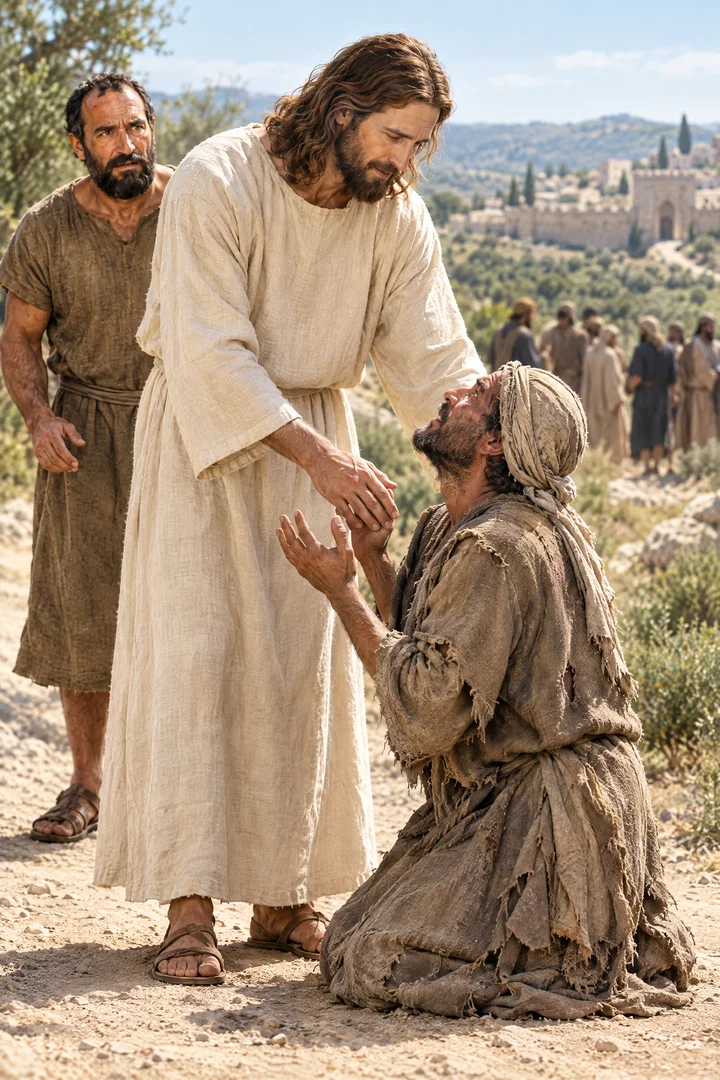
Cross-references
- Leviticus 14:2-32
This shall be the law of the leper in the day of his cleansing: He shall be brought unto the priest:
Prescribes the priestly examination and offerings for a cleansed leper.
- Mark 1:44
And saith unto him, See thou say nothing to any man: but go thy way, shew thyself to the priest, and offer for thy cleansing those things which Moses commanded, for a testimony unto them.
Jesus commands the healed man to show himself to the priest and offer what Moses commanded.
- Luke 5:14
And he charged him to tell no man: but go, and shew thyself to the priest, and offer for thy cleansing, according as Moses commanded, for a testimony unto them.
Jesus gives the healed leper the same instruction to show himself to the priest and offer as Moses commanded.
- Leviticus 13:45-46
And the leper in whom the plague is, his clothes shall be rent, and his head bare, and he shall put a covering upon his upper lip, and shall cry, Unclean, unclean.
Describes the leper’s warning cry and isolation under the law.
- Mark 1:45
But he went out, and began to publish it much, and to blaze abroad the matter, insomuch that Jesus could no more openly enter into the city, but was without in desert places: and they came to him from every quarter.
The healed leper spreads the news, drawing crowds that force Jesus to withdraw.
- Hebrews 8:3-4
For every high priest is ordained to offer gifts and sacrifices: wherefore it is of necessity that this man have somewhat also to offer.
Earthly priests were appointed to offer gifts under the law.
- Luke 5:17-26
And it came to pass on a certain day, as he was teaching, that there were Pharisees and doctors of the law sitting by, which were come out of every town of Galilee, and Judæa, and Jerusalem: and the power of the Lord was present to heal them.
Both recount Jesus healing a man with a skin disease or paralysis.
- Matthew 5:17
Think not that I am come to destroy the law, or the prophets: I am not come to destroy, but to fulfil.
Connects obedience to the law and prophets with Jesus’ teaching.
- Isaiah 35:5-6
Then the eyes of the blind shall be opened, and the ears of the deaf shall be unstopped.
Predicts wonders that Jesus performs.
Commentary
Each commentary is drawn from primary sources: the writings of Ellen G. White and Adventist pioneers and periodicals. Each commentary is separate. Its own words are not a quotation; follow the references to read the source passages.
Ellen G. White
20 sources
After healing a man judged incurably leprous and banished from home and society, Jesus told him to tell no one but to go at once to the priest with the offering Moses required.3RED 49.3–50.2Ms 31a, 1898, par. 33Ms 65b, 1898, par. 4DA 262.1–33RED 47.2 The priestly inspection was to certify publicly that he was clean so the same authority that condemned him could restore him to family and community life.3RED 49.3–50.2DA 262.1–3DA 262.4–264.2 Going promptly and quietly was to secure an impartial verdict and to prevent crowds, outcry over contamination, and charges of breaking the ritual law from disrupting His preaching work.DA 262.4–264.2MH 69.5–72SP 231.1–2DA 264.3–265.4Lt 53, 1904, par. 6–8 Honoring the Mosaic requirement upheld the law and made the cure a standing witness to the priests of His healing power, meant to disarm prejudice though they refused Him.3RED 49.3–50.2DA 262.4–264.22SP 229.3–230.1 The healed man, overjoyed at restored vigor and unable to refrain from praise, misunderstood the restriction and proclaimed the cure abroad, creating commotion that forced Jesus to withdraw from the city.ST Apr 26, 18832SP 230.23RED 50.3
Leprosy Setting and Instruction
Leprosy was the most fearful and loathsome disease of the East, dreaded for its contagious character and horrible effect upon its victim, so that great precautions were taken to prevent its spread.DA 262.1–3ST Apr 26, 18833RED 47.1 With the Hebrews one pronounced unclean was isolated from family, restricted from society, and cut off from the congregation of Israel, barred from entering cities and villages and doomed to associate only with fellow sufferers.DA 262.1–3ST Apr 26, 18833RED 47.1 He was obliged to publish his own calamity, to rend his garment, to sound the alarm, and to cry Unclean, Unclean as a signal heard with fear and abhorrence, bearing the curse away from friends and kindred with no affectionate hands to soothe his pain.ST Apr 26, 1883 Many such sufferers were in the region of Christ's ministry, and though debarred from city and village where His chief work lay among the populace, news of the great Healer reached them in their isolation and raised hope that coming into His presence might bring relief.ST Apr 26, 18833RED 47.1
The law laid upon the priests the duty to examine a suspected leper, to judge the severity of the disease, and to pronounce clean or unclean.DA 262.1–33RED 47.2 In this account that examination had already taken place and had resulted in a verdict of incurable leprosy, with separation from society and from Israel's congregation.DA 262.1–33RED 47.2
After cleansing the leper Jesus commanded him to tell no man of the healing, but to go promptly, even to the temple, to show himself to the priest, and to offer the gift commanded by Moses.3RED 49.3–50.2Ms 31a, 1898, par. 33Ms 65b, 1898, par. 4MH 69.5–72SP 229.3–230.1 The charge to keep silent and to act promptly before rumors of the healing reached the priests was to secure an impartial decision.DA 262.4–264.2MH 69.5–7 The priestly examination and offering were to establish publicly that the man was free of leprosy, so that he could be formally judged clean and restored to home, family, and ordinary community life.3RED 49.3–50.2DA 262.1–3DA 262.4–264.2MH 69.5–72SP 229.3–230.1
Purposes of the Command
The priestly examination and offering were to certify publicly that the man was free of leprosy, so that he could be formally judged clean and restored to home, family, and ordinary community life.3RED 49.3–50.2DA 262.1–3DA 262.4–264.2MH 69.5–72SP 229.3–230.1 The very priests who had condemned him to banishment were thus made to certify his cure.MH 69.5–7 Going promptly, before rumors of the healing reached the priests, helped secure an impartial decision and kept hostility toward Jesus from influencing it.DA 262.4–264.2MH 69.5–7
The command to keep silent avoided display and commotion and protected the preaching work from disruption.2SP 231.1–2DA 264.3–265.4 It prevented the healing from drawing crowds of lepers seeking escape from their doom without faith or principle and without desire to use health to honor God.2SP 231.1–2 It also prevented raising an outcry about contamination of the people by contact with leprosy, and prevented giving enemies opportunity to accuse and condemn Him for breaking ritual law, to limit His work, and to turn the people away from Him.2SP 231.1–2DA 264.3–265.4 His work was thus carried forward without theatrical display, in contrast to those who sought praise and honor from men.2SP 231.1–2Lt 53, 1904, par. 6–8
Directing the offering and priestly procedure showed respect for the law given through Moses, sanctioned it, and refuted the charge that His teaching opposed it.3RED 49.3–50.2DA 262.4–264.22SP 229.3–230.1LC1 73.1–2ST Apr 26, 1883 It made the cure a public testimony and standing witness to the priests of His healing power and His respect for the law.3RED 49.3–50.22SP 229.3–230.1LC1 73.1–22SP 231.1–2DA 264.3–265.4 It was meant to reach leaders shut in by prejudice, to disarm prejudice, and to convince minds open to conviction.2SP 231.1–2DA 264.3–265.4 Yet though the examination confirmed the cure and gave compelling evidence of divine power, they refused to acknowledge Him as Messiah.3RED 49.3–50.22SP 229.3–230.1LC1 73.1–2ST Apr 26, 1883
By giving this direction He sanctioned the law requiring offerings as remaining in force until His death, when their types met fulfillment.ST Apr 15, 1875
Disobedience and Ministry Example
The cleansed man disobeyed the charge to tell no one and proclaimed the cure abroad.2SP 230.23RED 50.3 He took the restriction to come only from retiring modesty.2SP 230.23RED 50.3 He did not understand that each new manifestation of divine power made the chief priests and elders more determined to destroy Jesus.2SP 230.23RED 50.3
To him health was very precious, with pure blood coursing through his veins and quickening his whole being with new and delightful life.2SP 230.2 He rejoiced in the full vigor of manhood and in restoration to family and society.2SP 230.2 He felt it impossible to refrain from giving full glory to the Physician who had made him whole.2SP 230.2 His publicizing of the cure helped create such commotion that Jesus had to withdraw from the city.ST Apr 26, 1883
The verse belongs to a chapter that joins the ministry of the Word with medical missionary healing and gives the example of His healing ministry and methods.Ms 62, 1904, par. 17 It stands among His acts of healing bodily disease while preaching and ministering to sin-sick souls.ST Apr 26, 1883 He first relieved the poor, suffering body before ministering to the darkened mind.ST Apr 26, 1883 When present misery was removed, thoughts could better be directed into light and truth.ST Apr 26, 1883
It shows meeting one defiled by sin with humility, tenderness, care, sympathy, and love.12MR 289.1–2 Self-confidence and self-righteousness must be put away.12MR 289.1–2 Even those who have not honored the cause of God and whose lives and character reveal the deformity of sin must be borne with, because the wicked and sinful are still borne with.12MR 289.1–2
Sources
Pioneers and periodicals
27 sources
Jesus at once cleansed a leper, the most dreaded and isolating disease of the East, by his touch and word in response to a suffering man who trusted his power but doubted his willingness.ST Jul 28, 1914ST Apr 26, 1883ST Jan 14, 1889ST Jun 28, 1905 He charged him to tell no man, so that his work would not be mistaken for seeking popularity or self-advertising, setting an example of modesty and humility.ST Nov 5, 1912ST Sep 13, 1905 The healed man was to go promptly to the priest for examination and declaration of cleansing, which would certify his cure and restore him to family and community with thankful offering.ST Apr 26, 1883ST Jul 28, 1914RH Oct 7, 1915 This required obedience to Leviticus 14 while the Levitical law was still valid, and stood as a testimony to the priests that Jesus honored the law and possessed divine power and mission, though they still refused him.ST Apr 26, 1883STSTST Jul 3, 1884 His sanction of the offering shows the ceremonial requirements remained in force until his death met their fulfillment, and his powerful word to cleanse the body gives hope that he can cleanse sinners whose hearts no human remedy can heal.ST Apr 15, 1875RH Aug 17, 1916ST Jun 28, 1905ST Aug 9, 1905ST Jun 3, 1880
Setting and Instruction
This healing is one of three healings immediately after the Sermon on the Mount.RH Dec 9, 1852 It records a miracle at Capernaum on the Sea of Galilee, belonging to a large series of miracles that fills much of the Gospels, counted as thirty-six distinct miracles with sixty-seven reports because half are repeated in more than one Gospel, besides many noticed but not recorded in detail.ST Jan 16, 1896
The disease cleansed was leprosy, the most fearful and loathsome disease of the East, dreaded for its contagious character and horrible effect upon its victim, with great precautions taken to prevent its spread.ST Apr 26, 1883 Among the Hebrews the leper was pronounced unclean, isolated from family, restricted from society, cut off from the congregation of Israel and doomed to associate only with fellow sufferers.ST Apr 26, 1883ST Jan 14, 1889 He was obliged to publish his calamity, to rend his garment, to sound the alarm and to cry Unclean! Unclean! as a signal heard with fear and abhorrence.ST Apr 26, 1883 Many such sufferers were in the region of Christ's ministry, and news of the great Healer reached them in their isolation and raised hope of relief, though they were debarred from city and village where his chief work lay among the populace.ST Apr 26, 1883ST Jan 14, 1889
Jesus cleansed the leper at once by his touch and word.ST Jun 28, 1905 He walked amid the filth of earth without partaking of his surroundings, so that a current of life swept through his being and cast disease from the leprous man.ST Jul 12, 1899 The leper overcame the isolation imposed by his disease to approach Jesus, trusting his power but doubting his willingness to help.ST Jul 28, 1914ST Jun 28, 1905 His faith grew as he saw Jesus heal others, and his hope was fixed on receiving healing.ST Jul 28, 1914 Jesus responded with pity and willingness, and the man was cleansed, one of the good works by which he helped others and spread an influence leading people to believe in him.ST Jun 28, 1905
The command to tell no man meant not to publicize the healing, so that his actions would not be mistaken for pursuit of popularity or for advertising himself.ST Nov 5, 1912ST Sep 13, 1905 This contrasted with the Pharisees' public displays of piety, and it set an example of modesty and humility.ST Nov 5, 1912 He often forbade people to spread news of his miracles.ST Sep 13, 1905
That charge to keep quiet was also given to keep the facts of the healing from the priests, because their hatred might lead them to render a dishonest sentence about the man's cleansing.
The healed man was to go promptly to the temple, to present himself to the priest and to bring the offering Moses commanded before rumors spread.ST Apr 26, 1883ST Jul 28, 1914 The priest's examination and declaration that he was free of disease would certify his cleansing.ST Apr 26, 1883ST Jul 28, 1914 Even the priests who had sent him into banishment would thereby testify to his cure.ST Jul 28, 1914 He would thus be restored to home and society and to family and community, and he went on his way to show himself and offered the gift thankfully as a testimony to the priests.ST Apr 26, 1883ST Jul 28, 1914RH Oct 7, 1915
The leper disregarded the warning and through praise of God made the healing known.ST Nov 5, 1912 By publicizing the cure he helped create such a commotion that Jesus had to withdraw from the city.ST Apr 26, 1883
Testimony Law and Application
After cleansing the leper Jesus told him not to publicize the healing but to go promptly to present himself to the priest and offer the gift Moses commanded, requiring compliance with the law.STST That direction followed the instructions in Leviticus 14 for the cleansed person.ST While he was carrying out his ministry he still recognized the Levitical law as valid, and told the healed person to present himself to the priests and bring the offering Moses had required.ST Jul 3, 1884
The obedience and offering were to serve as a testimony to the priests that Jesus honored the law and did not dishonor it as his accusers claimed, and that he had power and a divine mission.STST The priest's examination and declaration that the man was free of disease would certify his cleansing and allow him to return to family and community.ST Apr 26, 1883 Through compliance with the law the priests could know that God had power to heal.ST Sep 13, 1905 Following the Mosaic requirement gave the priests compelling evidence of his divine power, though they still refused to acknowledge him as the Messiah.ST Apr 26, 1883
By referring to the cleansed person's offering as commanded by Moses and directing the healed man to follow it and bring the prescribed offering, Jesus recognized the Mosaic authorship of the laws recorded in Leviticus and the Pentateuch.ST Oct 21, 1930ST Feb 15, 1883 By giving that instruction he sanctioned the law requiring offerings.ST Apr 15, 1875 These ceremonial requirements remained in force until his death, when their types met their fulfillment.ST Apr 15, 1875 During his earthly ministry he directed those who came to him to present the gifts required by the law to the earthly priests, which demonstrates that the law's earthly priestly service was still in operation while he prepared for his heavenly work.RH Aug 17, 1916 He qualified for that priestly position through his death, resurrection, and appearance in heaven on humanity's behalf.RH Aug 17, 1916 The Mosaic law and its rites were still recognized as valid then even as the gospel was being preached, so the two dispensations overlapped during a period of transition.ST Jun 3, 1880
The works of the chapter, including healing the sick, confirm his divine mission and fulfill the prediction that the Messiah would display wonderful works among the people.RH Nov 18, 1862 His command to the healed man and his directions to show himself to the priest and offer the prescribed gift illustrate simplicity in prayer as a plain, direct example rather than an eloquent display.RH Dec 16, 1873 His instruction reflects his refusal to seek praise or advertise his works.RH Dec 8, 1868RH Apr 2, 1901 His example teaches his followers to give God the glory rather than claim personal merit, and to fulfill the law and the prophets where it is their duty.RH Dec 8, 1868 That silence about the miracle stands in contrast to the public promotion of apparent miracles.RH Apr 2, 1901
The cleansing of the leper by his powerful word was not done to advertise himself, but was recorded to give hope to sinners.ST Jun 28, 1905ST Aug 9, 1905 As leprosy destroys the body, so sin corrupts the heart, motives, and conscience and leads to death, and no human remedy can cure it.ST Jun 28, 1905 Yet his powerful word can cleanse people from sin and gives hope to those afflicted by it.ST Aug 9, 1905 He walked amid the filth of earth without partaking of his surroundings, so that a current of life swept through his being that cast disease from the leprous man and sin from the hardened heart.ST Jul 12, 1899 The same cleansing stream of life would flow through a pure system of teaching rooted in heaven, making corrupt governments, vile society, poverty and degradation, and vice and turmoil impossibilities for the nation.ST Jul 12, 1899 He did not refuse healing to those whose illness they had brought upon themselves.ST Jun 30, 1914
Sources