Nehemiah 4:17
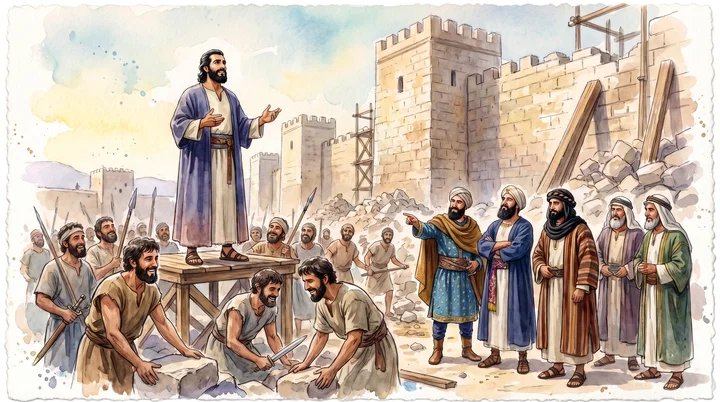
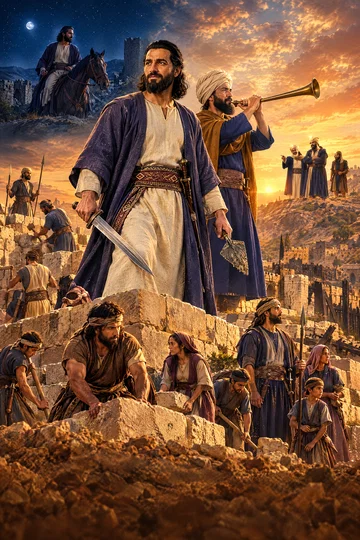
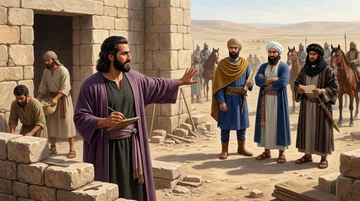
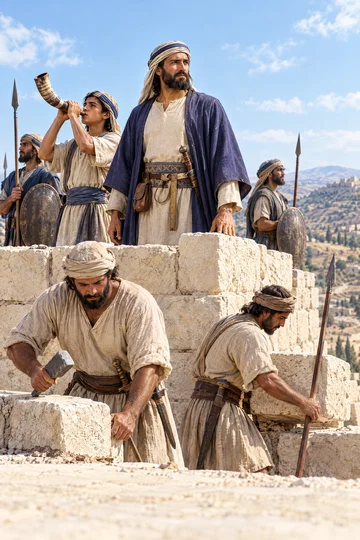
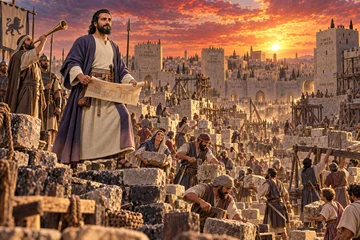
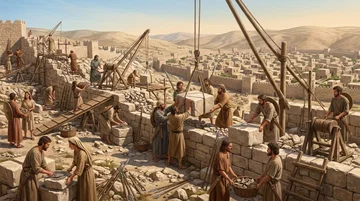
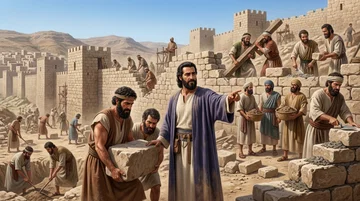
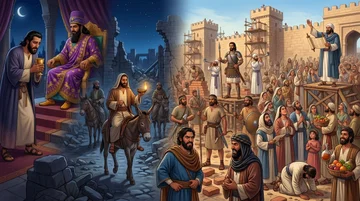
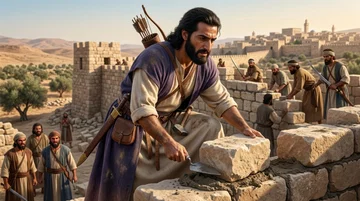
They which builded on the wall, and they that bare burdens, with those that laded, every one with one of his hands wrought in the work, and with the other hand held a weapon.
Translations
They which built on the wall, and they that bore burdens, with those that laded, every one with one of his hands worked in the work, and with the other hand held a weapon.
King James Version, KJV Cambridge Paragraph Bible
They which builded on the wall, and they that bare burdens, with those that laded, every one with one of his hands wrought in the work, and with the other hand held a weapon.
They who built on the wall, and they that bore burdens, with those that laded, every one with one of his hands wrought in the work, and with the other hand held a weapon.
They that builded the wall and they that bare burdens laded themselves, every one with one of his hands wrought in the work, and with the other held his weapon;
They that builded the wall and they that bare burdens laded themselves; every one with one of his hands wrought in the work, and with the other held his weapon;
The builders on the wall, and the bearers of the burden, those lading, [each] with one of his hands is working in the business, and one is laying hold of the missile.
They that built on the wall, and they that bore burdens, with those that loaded, wrought in the work with one hand, and with the other they held a weapon.
They who were building at the wall and they who were carrying burdens, they who were lifting, [each man], with his one hand, was working at the work, and, with the other, was grasping the weapon.
Berean Standard Bible, Majority Standard Bible
who were rebuilding the wall. The laborers who carried materials worked with one hand and held a weapon with the other.
Those who built the wall, and those who bore burdens loaded themselves; everyone with one of his hands did the work, and with the other held his weapon.
Those who were building the wall and those who were moving material did their part, everyone working with one hand, with his spear in the other;
They that buylded on the wall, and they that bare burdens, and they that laded, did the worke with one hand, and with the other helde the sworde.
Douay-Rheims (Challoner revision)
Of them that built on the wall and that carried burdens, and that laded: with one of his hands he did the work, and with the other he held a sword.
Pictures
Cross-references
- Daniel 9:25
Know therefore and understand, that from the going forth of the commandment to restore and to build Jerusalem unto the Messiah the Prince shall be seven weeks, and threescore and two weeks: the street shall be built again, and the wall, even in troublous times.
The wall is rebuilt in troublous times, as foretold.
- Nehemiah 4:6
So built we the wall; and all the wall was joined together unto the half thereof: for the people had a mind to work.
The people were united in their determination to rebuild the wall.
- Zechariah 2:5
For I, saith the LORD, will be unto her a wall of fire round about, and will be the glory in the midst of her.
God promises to protect Jerusalem as a wall of fire around it.
- Nehemiah 4:7-8
But it came to pass, that when Sanballat, and Tobiah, and the Arabians, and the Ammonites, and the Ashdodites, heard that the walls of Jerusalem were made up, and that the breaches began to be stopped, then they were very wroth,
Neighboring groups conspire to attack the builders.
- Nehemiah 2:17-18
Then said I unto them, Ye see the distress that we are in, how Jerusalem lieth waste, and the gates thereof are burned with fire: come, and let us build up the wall of Jerusalem, that we be no more a reproach.
Nehemiah calls the people to arise and build.
- Nehemiah 4:21
So we laboured in the work: and half of them held the spears from the rising of the morning till the stars appeared.
Workers labor through the same wall-building effort.
- Nehemiah 4:10
And Judah said, The strength of the bearers of burdens is decayed, and there is much rubbish; so that we are not able to build the wall.
Judah says the builders are too weak to continue.
- Nehemiah 3
Then Eliashib the high priest rose up with his brethren the priests, and they builded the sheep gate; they sanctified it, and set up the doors of it; even unto the tower of Meah they sanctified it, unto the tower of Hananeel.
all Israel labored on the wall
- Nehemiah 2:19-20
But when Sanballat the Horonite, and Tobiah the servant, the Ammonite, and Geshem the Arabian, heard it, they laughed us to scorn, and despised us, and said, What is this thing that ye do? will ye rebel against the king?
Sanballat, Tobiah, and Geshem oppose Nehemiah’s rebuilding plans.
- Nehemiah 1:3
And they said unto me, The remnant that are left of the captivity there in the province are in great affliction and reproach: the wall of Jerusalem also is broken down, and the gates thereof are burned with fire.
Nehemiah’s account begins with Jerusalem’s broken wall, later restored during his time.
- Nehemiah 2:3-12
And said unto the king, Let the king live for ever: why should not my countenance be sad, when the city, the place of my fathers’ sepulchres, lieth waste, and the gates thereof are consumed with fire?
Nehemiah surveyed the ruined wall and organized its rebuilding.
- Nehemiah 6:9
For they all made us afraid, saying, Their hands shall be weakened from the work, that it be not done. Now therefore, O God, strengthen my hands.
Nehemiah asks God to strengthen his hands as he presses on with the work.
- Nehemiah 6:15
So the wall was finished in the twenty and fifth day of the month Elul, in fifty and two days.
wall finished in fifty-two days as God's work
- Nehemiah 4:23
So neither I, nor my brethren, nor my servants, nor the men of the guard which followed me, none of us put off our clothes, saving that every one put them off for washing.
The workers’ sustained readiness shows their intense commitment.
- Nehemiah 4:9
Nevertheless we made our prayer unto our God, and set a watch against them day and night, because of them.
The people prayed to God and kept watch against their enemies.
Commentary
Each commentary is drawn from primary sources: the writings of Ellen G. White and Adventist pioneers and periodicals. Each commentary is separate. Its own words are not a quotation; follow the references to read the source passages.
Ellen G. White
8 sources
The verse belongs to the rebuilding of Jerusalem's wall amid opposition from nearby leaders, Sanballat, Tobiah, and Geshem, who tried to thwart the plans and hinder the work.PK 635.1 The builders, the burden-bearers, and those carrying or loading materials each worked with one hand and held a weapon in the other, combining labor with readiness to defend themselves.ST Dec 13, 1883PK 643.3Lt 30, 1888, par. 24–2618MR 329.2–3 They carried on in this way while working under threat, danger, and possible attack.ST Dec 13, 1883AA 596.3–597.2Lt 30, 1888, par. 24–26
For builders of Christ's church and temple, working with one hand and holding a weapon with the other means building up true converts while tearing down false foundations and the enemy's strongholds through God's power.SLP 156.38RED 79.1–3 It is done while contending with bigotry, prejudice, violence, hindrance, and persecution.SLP 156.38RED 79.1–3 The verse illustrates how the apostles and other workers built the church amid the opposition, hatred, and persecution of its enemies, pressing on despite the threat of imprisonment, torture, and death.AA 596.3–597.2
Even when noble builders fall at their work by the hand of the enemy, as Stephen, James, Paul, Peter, and John did, stone after stone is still added.8RED 79.1–3 The church increases in the midst of terrible persecution, and new workers on the wall take the place of the fallen.8RED 79.1–3 Work for Christ's kingdom faces continual opposition and difficulty, so workers must keep building and defending the truth rather than give up when discouraged.Lt 30, 1888, par. 24–2618MR 329.2–3 God's workers must not give way to unbelief, for this difficult work of advancing Christ's kingdom involves sharing in Christ's sufferings.18MR 329.2–3
Sources
Pioneers and periodicals
30 sources
They who built on the wall and they who bore burdens and loaded materials kept at their labor with one hand while holding a weapon in the other, so that working and watching went on together under threat and danger.ST Dec 13, 1883ST Dec 20, 1899ST Feb 6, 1893 The work was ordered for defense against Sanballat, Tobiah, the Arabians, the Ammonites, the Ashdodites and Geshem, by prayer to God, by setting a watch day and night, by posting families with swords, spears and bows, and by dividing the force so that half wrought while half held weapons, with the builders girded with swords and laboring from daylight till night.ST Oct 25, 1899ST Oct 25, 1899RH Jul 2, 1908 It belongs to the restoration of Jerusalem under Nehemiah as governor and Ezra as teacher and scribe in the reign of Artaxerxes Longimanus, when the wall was examined by night, divided among people of every sort, and finished together despite bitter opposition, in troublous times that fulfilled prophecy.RH Dec 24, 1914ST Oct 25, 1899ST Aug 23, 1910ST Mar 18, 1889RH Nov 13, 1856 It shows willing, united, cooperative service in which small and great labor together and those who furnish material are as important as the builders, proving that true men of God are not above manual labor, and it gives the pattern for builders of the Christian church and spiritual Jerusalem to keep building, praying, guarding and fighting in union without abandoning the task or compromising until the wall is complete.ST Jun 2, 1914RH Dec 24, 1914RH Sep 21, 1916RH Nov 12, 1901RH May 14, 1914 It pictures the Christian life as continual struggle requiring both trowel and sword, serving human need with one hand while holding fast the sword of the Spirit, yet those who held it teach that Nehemiah's armed civil work under Persian authority does not make the use of weapons a model for advancing the gospel, which is spiritual work carried forward by God's Spirit and not by civil law or force.RH Apr 3, 1855RH Feb 10, 1859ST Jan 23, 1893ST Jan 23, 1893RH Aug 21, 1856
Armed Work Under Threat
Those who built on the wall and those who bore burdens and loaded materials kept working while ready to defend themselves, each working with one hand and holding a weapon in the other, so that labor and vigilance went on together under threat and danger.ST Dec 13, 1883ST Jun 2, 1914ST Dec 20, 1899ST Feb 6, 1893RH Nov 12, 1901 The wall was rebuilt despite threats and danger, with builders and carriers combining work with readiness to defend themselves.ST Dec 13, 1883ST Dec 20, 1899ST Mar 18, 1889 Their example shows builders carrying on amid opposition from enemies.ST Jun 2, 1914RH Nov 12, 1901ST Mar 18, 1889
The rebuilding went forward as armed work under conspiracy by Sanballat, Tobiah, the Arabians, the Ammonites and the Ashdodites to come and fight against Jerusalem and stop the work, met by prayer to God and setting a watch day and night.ST Oct 25, 1899 The defense was organized by posting people by families with swords, spears and bows, and by girding swords on the builders.ST Oct 25, 1899 The force was divided so half wrought and half held spears, shields, bows and coats of mail, with the rulers behind all the house of Judah.ST Oct 25, 1899 Nehemiah divided his own servants so half worked and half watched, while the rest worked in armor, laboring from daylight until night and keeping watch through the night in trust in God for protection without abandoning the work.ST Oct 25, 1899RH Jul 2, 1908 The opposition included Sanballat, Tobiah and Geshem the Arabian, and trying to do good amid such adversaries brings a hard time that is met with glorious victory as Nehemiah gained.ST Aug 17, 1915
The verse belongs to the whole account of rebuilding the wall in Nehemiah 2:11 to 7:73, especially chapter 4.ST Oct 25, 1899 It takes place while Artaxerxes Longimanus was still emperor of Persia, Nehemiah was governor of Judah, and Ezra was religious teacher and scribe, as part of the fulfillment of Nehemiah's praying after God moved the king to grant his request.ST Oct 25, 1899 That history covers the journey to Jerusalem, opposition from Sanballat the Horonite, Tobiah the Ammonite and Geshem the Arabian, examination of the wall by night, meeting with the rulers with the plan, and division of the work among people of every sort and condition and its progress.ST Oct 25, 1899 It was an organized rebuilding effort in which the whole wall was covered by workers cooperating together and the work was completed together.RH Dec 24, 1914 The restoration under Nehemiah faced bitter opposition but prospered, from the same class of adversaries who had hindered the earlier rebuilding work in Jerusalem.ST Apr 19, 1883 The wall was not permanently restored until Nehemiah's time, seventy-three years after Zechariah's vision, when the returned Jews were surrounded by enemies and God's promised protection was conditional on their faithfulness.ST Apr 19, 1883
Jerusalem's wall was rebuilt in troubled and troublous times, amid opposition and danger.ST Mar 18, 1889RH Nov 13, 1856 That rebuilding fulfilled prophecy about its restoration.RH Nov 13, 1856 The troubles the Jews faced while rebuilding made God's promise of a peaceful, thriving city seem marvelous to them.ST Jun 21, 1883
Principle and Present Application
The rebuilding pictures willing, united, cooperative service in which the whole wall was covered because all labored together and the work was completed together.RH Dec 24, 1914RH Sep 21, 1916 Small and great worked side by side, one hand upon the labor and the other holding a weapon, ready against danger while still building or bearing burdens.RH Sep 21, 1916ST Oct 22, 1894 The finishing of the Lord's work now is pictured in the same way, constantly calling for more mortar and for both workers and means.RH May 14, 1914 Those who furnish the material with which to build are as important to the work as the builders themselves, and it is a privilege to be partners with the Lord in finishing His work, for the time has come and He will supply what is needed.RH May 14, 1914
True men of God were not above manual labor, and earnest, faithful, honest labor wherever duty calls is the Spirit of God, for God never has lazy children.ST Oct 22, 1894 Even humble, practical tasks done in earnest are acceptable service, as the builders and burden-bearers showed when each used one hand for labor and the other to hold a weapon while remaining ready to defend the work.RH Nov 12, 1901 Workers for others in need must likewise keep their Bibles and spiritual defenses with them while they serve.RH Nov 12, 1901 The long hours with arms girded called for sacrifice and tested loyalty, and by faithfully doing that hard building work the people were made ready to follow the Lord's plan for supporting His work and for evangelizing the world.RH Apr 22, 1902
The builders continuing at the wall with one hand working and the other holding a weapon illustrate how builders of the Christian church carried on amid opposition from the enemies of Christ.ST Jun 2, 1914RH Nov 12, 1901 The lesson is to keep building, praying, guarding, and fighting in union without abandoning the task or compromising, using sword and tools until the wall is complete, whether for spiritual Jerusalem or for God's organized church.RH Nov 19, 1861RH Feb 10, 1859RH Apr 15, 1909 United working, praying, and fighting with vigilance in the good fight of faith gave success to Nehemiah and his fellows when half watched while the rest worked in armor, and the same united working, praying, and fighting will give success today, but only by following God's plan.ST Oct 25, 1899 That example warns against hindering the building and calls God's people to stand in complete union with His present Nehemiahs and Ezras as an army in which officers and host sustain each other and press on to gain new recruits.RH Nov 19, 1861
The Christian life is continual struggle requiring both sword and trowel, with conflict in every condition and no duty free from wrestling.RH Aug 21, 1856 Laboring with one hand and holding a weapon with the other therefore applies to spreading neglected Bible truths amid difficulties and resistance.RH Apr 3, 1855 It means serving people in need while holding fast to the sword of the Spirit and keeping the Bible and spiritual defenses at hand.RH Nov 12, 1901 The same simultaneous building and watching against opposition was the pattern at Nimes, where workers prayed, built, and guarded against those who threatened to disrupt them.ST Aug 12, 1886 Trying to be good brings a hard time, as in the awful time Nehemiah had with Sanballat, Tobiah, and Geshem the Arabian, so those having a hard time while trying to be good need not be surprised, but by saturating the mind with this book they learn exactly how to deal with modern Sanballats, Tobiahs, and Geshams and gain glorious victory as Nehemiah did.ST Aug 17, 1915 Teachers and students in missionary training-schools likewise hold instruments of labor in one hand and books in the other, doing much building by unpaid student labor with meager facilities.RH Aug 21, 1856RH Nov 12, 1901
The armed labor nevertheless belonged to a civil building project, in which workers built Jerusalem's material wall while armed against material enemies, using means appropriate to that work and setting.ST Jan 23, 1893ST Jan 23, 1893 It was Nehemiah's civil work as governor performed under authority of the Persian king.ST Jan 23, 1893 His use of weapons therefore does not make civil force a model for advancing the gospel, which is spiritual work to be carried forward by God's Spirit and spiritual power, not by civil law or force.ST Jan 23, 1893ST Jan 23, 1893
Sources