Nehemiah 2:17
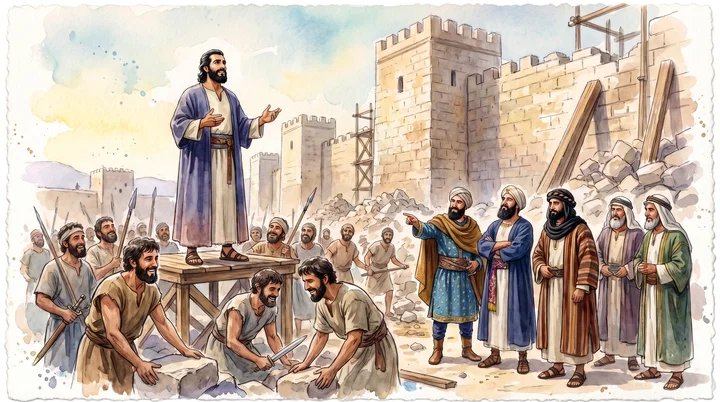
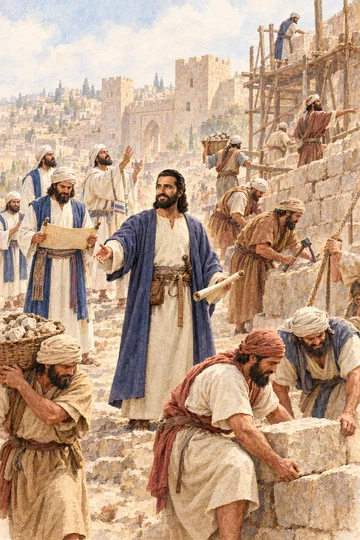
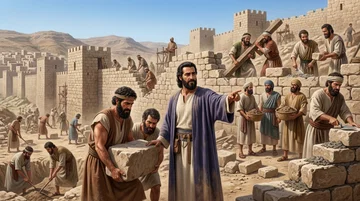
Then said I unto them, Ye see the distress that we are in, how Jerusalem lieth waste, and the gates thereof are burned with fire: come, and let us build up the wall of Jerusalem, that we be no more a reproach.
Translations
Then said I to them, You see the distress that we are in, how Jerusalem lies waste, and the gates thereof are burned with fire: come, and let us build up the wall of Jerusalem, that we be no more a reproach.
Then said I unto them, Ye see the distress that we are in, how Jerusalem lieth waste, and the gates thereof are burned with fire: come, and let us build up the wall of Jerusalem, that we be no more a reproach.
Then said I unto them, Ye see the distress that we are in, how Jerusalem lieth waste, and the gates thereof are burnt with fire: come, and let us build up the wall of Jerusalem, that we be no more a reproach.
Then said I to them, Ye see the distress that we are in, how Jerusalem lieth waste, and its gates are burned with fire: come, and let us build up the wall of Jerusalem, that we may be no more a reproach.
Then said I unto them, Ye see the evil case that we are in, how Jerusalem lieth waste, and the gates thereof are burned with fire: come and let us build up the wall of Jerusalem, that we be no more a reproach.
Then said I unto them, Ye see the evil case that we are in, how Jerusalem lieth waste, and the gates thereof are burned with fire: come, and let us build up the wall of Jerusalem, that we be no more a reproach.
and I say unto them, 'Ye are seeing the evil that we are in, in that Jerusalem [is] waste, and its gates have been burnt with fire; come and we build the wall of Jerusalem, and we are not any more a reproach.'
And I said to them, Ye see the distress that we are in, that Jerusalem lies waste, and its gates are burned with fire. Come, and let us build up the wall of Jerusalem, that we be no more a reproach.
So I said unto them, Ye, can see the misfortune that, we, are in, how that, Jerusalem, lieth waste, and, the gates thereof, are burned with fire: Come, and let us build the wall of Jerusalem, that we may remain, no longer, a reproach.
Berean Standard Bible, Majority Standard Bible
Then I said to them, “ You see the trouble we are in. Jerusalem lies in ruins, and its gates have been burned down. Come, let us rebuild the wall of Jerusalem, so that we will no longer be a disgrace.”
Then I said to them, “ You see the bad situation that we are in, how Jerusalem lies waste, and its gates are burned with fire. Come, let’s build up the wall of Jerusalem, that we won’t be disgraced.”
Then I said to them, You see what a bad condition we are in; how Jerusalem is a waste, and its doorways burned with fire: come, let us get to work, building up the wall of Jerusalem, so that we may no longer be put to shame.
Afterward I said vnto them, Ye see the miserie that we are in, how Ierusalem lyeth waste, and the gates thereof are burnt with fire: come and let vs buylde the wall of Ierusalem, that we be no more a reproche.
Douay-Rheims (Challoner revision)
Then I said to them: You know the affliction wherein we are, because Jerusalem is desolate, and the gates thereof are consumed with fire: come, and let us build up the walls of Jerusalem, and let us be no longer a reproach.
Pictures

Cross-references 20 of 21
- Daniel 9:25
Know therefore and understand, that from the going forth of the commandment to restore and to build Jerusalem unto the Messiah the Prince shall be seven weeks, and threescore and two weeks: the street shall be built again, and the wall, even in troublous times.
The prophecy dates its period from the command to restore and build Jerusalem.
- Nehemiah 6:15
So the wall was finished in the twenty and fifth day of the month Elul, in fifty and two days.
Records the completion of Jerusalem’s wall in fifty-two days.
- Nehemiah 1:3
And they said unto me, The remnant that are left of the captivity there in the province are in great affliction and reproach: the wall of Jerusalem also is broken down, and the gates thereof are burned with fire.
Reports the ruined wall and burned gates that prompt Nehemiah’s appeal.
- Nehemiah 2:7-8
Moreover I said unto the king, If it please the king, let letters be given me to the governors beyond the river, that they may convey me over till I come into Judah;
The king grants Nehemiah permission and materials to rebuild Jerusalem.
- Ezra 7:21-26
And I, even I Artaxerxes the king, do make a decree to all the treasurers which are beyond the river, that whatsoever Ezra the priest, the scribe of the law of the God of heaven, shall require of you, it be done speedily,
Artaxerxes’ decree authorizes restoration of the Jewish community.
- Nehemiah 3:10
And next unto them repaired Jedaiah the son of Harumaph, even over against his house. And next unto him repaired Hattush the son of Hashabniah.
Jedaiah repairs the wall opposite his house.
- Nehemiah 1:4-11
And it came to pass, when I heard these words, that I sat down and wept, and mourned certain days, and fasted, and prayed before the God of heaven,
Nehemiah’s prayer and confession precede the rebuilding.
- Nehemiah 4:6
So built we the wall; and all the wall was joined together unto the half thereof: for the people had a mind to work.
The people work together to rebuild Jerusalem’s wall.
- Ezra 1:1-3
Now in the first year of Cyrus king of Persia, that the word of the LORD by the mouth of Jeremiah might be fulfilled, the LORD stirred up the spirit of Cyrus king of Persia, that he made a proclamation throughout all his kingdom, and put it also in writing, saying,
Cyrus’s decree invites the exiles to return and rebuild in Jerusalem.
- Ezra 9:9
For we were bondmen; yet our God hath not forsaken us in our bondage, but hath extended mercy unto us in the sight of the kings of Persia, to give us a reviving, to set up the house of our God, and to repair the desolations thereof, and to give us a wall in Judah and in Jerusalem.
Both describe Jerusalem’s restoration and rebuilding its wall.
- Nehemiah 6:3
And I sent messengers unto them, saying, I am doing a great work, so that I cannot come down: why should the work cease, whilst I leave it, and come down to you?
Nehemiah resolutely refuses to stop rebuilding despite opposition.
- Nehemiah 2:10
When Sanballat the Horonite, and Tobiah the servant, the Ammonite, heard of it, it grieved them exceedingly that there was come a man to seek the welfare of the children of Israel.
Nehemiah’s arrival to seek Israel’s welfare grieved Sanballat and Tobiah.
- 2 Chronicles 36:19
And they burnt the house of God, and brake down the wall of Jerusalem, and burnt all the palaces thereof with fire, and destroyed all the goodly vessels thereof.
Jerusalem’s wall and buildings were destroyed because of sin.
- Zechariah 2:4-5
And said unto him, Run, speak to this young man, saying, Jerusalem shall be inhabited as towns without walls for the multitude of men and cattle therein:
Promises Jerusalem’s growth and God’s protection before its rebuilding.
- Ezra 4:21-23
Give ye now commandment to cause these men to cease, and that this city be not builded, until another commandment shall be given from me.
Opposition led to the rebuilding of Jerusalem’s walls being stopped.
- Nehemiah 4:7-8
But it came to pass, that when Sanballat, and Tobiah, and the Arabians, and the Ammonites, and the Ashdodites, heard that the walls of Jerusalem were made up, and that the breaches began to be stopped, then they were very wroth,
Arabians, Ammonites, Ashdodites conspired to fight
- Nehemiah 4:21
So we laboured in the work: and half of them held the spears from the rising of the morning till the stars appeared.
The people labor together on rebuilding the wall.
- Nehemiah 4:10
And Judah said, The strength of the bearers of burdens is decayed, and there is much rubbish; so that we are not able to build the wall.
Judah said we are not able to build
- Nehemiah 4:17
They which builded on the wall, and they that bare burdens, with those that laded, every one with one of his hands wrought in the work, and with the other hand held a weapon.
sword in one hand, tool in the other
- Luke 19:43-44
For the days shall come upon thee, that thine enemies shall cast a trench about thee, and compass thee round, and keep thee in on every side,
Jerusalem’s destruction is presented as judgment for its people’s sin.
Commentary
Each commentary is drawn from primary sources: the writings of Ellen G. White and Adventist pioneers and periodicals. Each commentary is separate. Its own words are not a quotation; follow the references to read the source passages.
Ellen G. White
15 sources
Nehemiah points to the broken walls and burned gates of Jerusalem as a shared distress and public disgrace, with the returned exiles living in affliction and reproach that hindered restoration, disturbed worship, kept the people in alarm, and dishonored their religion and their God before the surrounding heathen.PK 628.2PK 637.3–638.2ST Dec 6, 1883 Having first viewed the ruin himself on a secret midnight circuit, he describes it with firsthand accuracy to awaken the people to their condition and calls them to join together in rebuilding the wall so they will suffer reproach no longer.PK 635PK 628ST Dec 6, 1883PK 637.1–2 He lays before them how affliction heard in a distant land led to prayer, to a purpose formed in prayer to ask the king for leave to help, and to an answer showing the plan to be of the Lord, so the work rests on the combined authority of the God of Israel and the Persian king and the question is whether they will seize the favorable opportunity and arise and build.PK 637.3–638.2ST Dec 6, 1883 Though bearing a royal commission, he does not depend on authority but seeks to gain their confidence and sympathy and to awaken dormant energy, because unity of purpose and union of hearts as well as of hands are essential to the work.ST Dec 6, 1883PK 637.1–2 The call teaches that in advancing God's cause His people may ask those in authority for help, and that rebuilding requires persevering, loyal, united effort in God's strength against repeated hindrance, trusting that adversaries cannot stop the work and that the enemy gains entry only if those within open the way.Ms 47, 1907, par. 5ST Dec 13, 1883
Ruin, Reproach, and Setting
Nehemiah's call to rebuild came after a safe journey to Jerusalem under the power of the Persian king.PK 635.1 Royal letters to the provincial governors secured for him honorable reception and prompt assistance, and a military escort marked his coming as an important mission.PK 635.1 His arrival stirred jealousy and close, critical watching by the heathen tribes near the city.PK 635.1 Foremost among them were Sanballat the Horonite, Tobiah the Ammonite, and Geshem the Arabian, who endeavored to thwart his plans and hinder the work.PK 635.1
The distress of which he spoke was the condition of the returned exiles, living in affliction and reproach while much of the city wall lay in ruins.PK 628.2 The broken walls hindered restoration, disturbed the temple services, and kept the people in alarm.PK 628.2 The wasted city, ruined walls, and burned gates were a shared distress and a public disgrace before the surrounding heathen.PK 637.3–638.2ST Dec 6, 1883 To be a reproach among those nations meant that the people's religion was dishonored and their God was blasphemed.PK 637.3–638.2ST Dec 6, 1883
The appeal itself was made in the morning, after a secret midnight circuit of the walls that had not been told to the people.PK 637.1–2 Because the city had been seen firsthand, its condition could be described with an accuracy and minuteness that astonished the hearers.PK 637.1–2 The impression left by Jerusalem's weakness and degradation gave earnestness and power to the words.PK 637.1–2
Call to Arise and Build
The verse holds up Jerusalem's ruin and shame as the reason to act, calling the people to see their condition and join together in rebuilding the wall so they will suffer reproach no longer.PK 635PK 628ST Dec 6, 1883ST Dec 6, 1883ST Dec 13, 1883 Its ruined walls and burned gates are presented as a shared distress and public disgrace, and the call is to recognize that distress and to work together to remove it.PK 635PK 628ST Dec 6, 1883ST Dec 6, 1883
Before that wider appeal, the call was first shared privately with a few men known to be worthy of confidence.ST Dec 6, 1883PK 636.2 To them were told the circumstances that had led to coming to Jerusalem, the object to be accomplished, and the plans proposed to follow, and by that disclosure their interest was enlisted and their assistance secured for building up the wall.ST Dec 6, 1883PK 636.2
The appeal then set before the people that affliction heard of in a distant land had led to entreating Heaven's favor on their behalf.PK 637.3–638.2ST Dec 6, 1883 While praying the purpose had been formed to ask permission from the king to come to their assistance, with the further request that authority be granted and needed help be given for the work, and the answer came in a manner showing the plan was of the Lord.PK 637.3–638.2ST Dec 6, 1883 Thus sustained by the combined authority of the God of Israel and the Persian king, the people were asked directly whether they would take the favorable opportunity and arise and build.PK 637.3–638.2ST Dec 6, 1883 The thought of how Heaven's favor had been manifested put fear to shame, so that with new courage they answered with one voice to rise up and build.PK 637.3–638.2
That course teaches that in advancing God's cause His people may ask those in authority for help, as shown by asking the king for assistance to carry the work forward.Ms 47, 1907, par. 5 Although holding a royal commission requiring the inhabitants to cooperate, the appeal did not depend on authority.ST Dec 6, 1883PK 637.1–2 It sought instead to gain the confidence and sympathy of the people and to awaken dormant energy and unite scattered numbers, because unity of purpose and union of hearts as well as of hands and shared effort were essential to the work.ST Dec 6, 1883PK 637.1–2
The call to rebuild looks to persevering, loyal, united effort in God's strength against repeated hindrance, with the resolve that adversaries will not stop the work.ST Dec 13, 1883 The enemy can gain entry only if those within open the way, so opposition should lead God's people to rely on Him more firmly and to work more determinedly.ST Dec 13, 1883 The rebuilding in fact met repeated hindrances and was at times nearly stopped, but prayers were heard and the way was opened for the work to continue.ST Dec 13, 1883Lt 139, 1903, par. 5–6 The same pattern applies to later difficulties such as those faced in moving the publishing work from Battle Creek.Lt 139, 1903, par. 5–6
The ruined defenses also picture the church's spiritual condition.ST Dec 6, 1883 As with Jerusalem's walls, those who see its evils with clear spiritual vision should recognize the need to remedy them rather than grow accustomed to them.ST Dec 6, 1883
Sources
Pioneers and periodicals
50 sources
Nehemiah found Jerusalem in distress and waste with its gates burned, a reproach to be removed, and called the people to see the ruin and build up the wall together.RH Apr 8, 1902RH Sep 9, 1902ST May 14, 1902RH Dec 29, 1859 He spoke after three days in the city and a secret survey of the broken wall by night to priests, nobles, rulers and the rest of the people, pointing to the good hand of God upon him and the help granted by the Persian king, and they answered by rising up to build and strengthening their hands for the good work.ST Dec 6, 1883RH Sep 9, 1902ST May 14, 1902ST Oct 25, 1899RH May 20, 1902 The rebuilding was already under way under the decree given to Ezra in 457 B.C., thirteen years before he came, so his personal and verbal permission in the twentieth year of Artaxerxes is a later commission insufficient by itself to begin Daniel's seventy weeks, and the wall he organized was finished in fifty-two days to the twenty-fifth of Elul.ST Nov 1, 1877RH Jul 21, 1863ST Feb 23, 1882RH Jun 4, 1857RH Jul 28, 1863 The work succeeded through unity of purpose and shared effort, each building near his own house and covering the whole wall at once, and through resolute faith amid ridicule, conspiracy and intimidation, finishing with sword in one hand and tool in the other.ST Dec 6, 1883RH Dec 24, 1914ST Sep 11, 1884RH Apr 15, 1909ST May 21, 1896 For this time the call is to build Jerusalem spiritually, a living temple for eternity by preaching the gospel and preparing the way of the Lord, each building Christian character over against his own house and remedying the evils of the church rather than growing accustomed to them.ST Dec 6, 1883RH Sep 9, 1902ST Feb 18, 1886RH Nov 11, 1862ST Feb 17, 1890
Ruined City and Call
Nehemiah's appeal lays open the distress of Jerusalem lying waste, its gates burned with fire, and its ruined condition standing as a reproach, and it summons the people to see that distress and to build up the wall of Jerusalem so they will be no more a reproach.RH Apr 8, 1902RH Dec 29, 1859ST Aug 23, 1910RH Sep 21, 1916 The ruin is presented as a shared distress calling for a collective response, with the rebuilding framed as shared work for the common good rather than leaving the place waste and enduring shame.RH Apr 8, 1902RH Sep 21, 1916RH May 20, 1902 The city's broken state grieved Nehemiah because Jerusalem was the place of his ancestors' tombs.RH Apr 30, 1857 He labored for the good of Jerusalem as God's city and treated its restoration as God's work.ST Aug 23, 1910
The appeal was spoken in Jerusalem after three days there and after secretly going out by night to view the ruined wall, before telling his plan to the rulers.RH Sep 9, 1902ST May 14, 1902ST Oct 25, 1899ST Feb 18, 1886 It was addressed to the priests, nobles, rulers and other people.ST May 14, 1902 In that work Nehemiah acted as governor of Judah while Ezra served as religious teacher and scribe.ST Oct 25, 1899
The call was supported by the evidence of the good hand of God upon Nehemiah and by the authority, words and help granted by the Persian king, with explanation that God had answered his prayer and opened a favorable opportunity under the king's authority.ST Dec 6, 1883RH Sep 9, 1902ST May 14, 1902 Recognizing the need for repair was to lead to united practical effort and not merely complaint.ST Sep 11, 1884 It was answered by rising up to build and strengthening hands for the good work.RH Sep 9, 1902ST May 14, 1902RH May 20, 1902ST Sep 11, 1884ST Feb 18, 1886
History and Prophecy
The twentieth year of Artaxerxes brought the commission to Nehemiah to restore and build Jerusalem, dated 444 B.C., though in one account dated 445 B.C.RH Jan 7, 1858RH Jul 21, 1863RH Jun 4, 1857 It stands as one of four possible acts that might answer Daniel's command to restore and rebuild Jerusalem.RH Jan 7, 1858RH Sep 13, 1870 After the decrees of Cyrus and Darius are set aside as too early in date and limited principally to the temple and its worship rather than the civil state and polity of Jerusalem, it remains with the decree to Ezra as one of the two possible points from which the seventy weeks of years, 490 years in all, are to be dated.RH Jul 21, 1863RH Sep 13, 1870 The command must concern the restoring of Jerusalem's civil state and polity, not merely rebuilding the temple and restoring its worship.RH Jul 21, 1863RH Sep 13, 1870
Rebuilding was already under way when Nehemiah came, under the authority of the earlier decree given to Ezra in 457 B.C., thirteen years before Nehemiah came.ST Nov 1, 1877ST Feb 23, 1882RH Jul 28, 1863RH Sep 13, 1870 Rulers, priests, nobles and people were already engaged in building Jerusalem when he arrived, acting under the decree given to Ezra thirteen years before, and his call joined that ongoing work.ST Feb 23, 1882RH Jul 28, 1863RH Sep 13, 1870 What Nehemiah sought and obtained was only verbal permission pertaining to himself alone to go to Jerusalem, with the king asking how long the journey would take and when he would return.RH Jul 28, 1863RH Sep 13, 1870 He received letters to the governors beyond the river to help him on his way to Judah and an order on the keeper of the king's forest for timber for beams.RH Jul 28, 1863RH Sep 13, 1870 His grant was not the written decree restoring the Jewish state civil and ecclesiastical with unlimited treasure and power to ordain laws and punish even unto death preserved in Ezra 7.RH Jul 28, 1863
The work he came to accomplish he finished in fifty-two days, to the twenty-fifth day of Elul.ST Nov 1, 1877ST Feb 23, 1882RH Jul 28, 1863ST Feb 18, 1886 It was carried forward through division of the work among people of every sort and condition, with everyone building over against his own house and the sections covering the whole wall.ST Oct 25, 1899ST Feb 18, 1886 The whole account of rebuilding runs from Nehemiah 2:11 to Nehemiah 7:73.ST Oct 25, 1899 About a month was fully engaged in pushing the wall forward while warding off enemies' schemes.
Jerusalem's walls and gates had been set up in Ezra's work and rebuilt after the exile but were broken down again and damaged before Nehemiah's time by hostile neighboring peoples.RH Dec 29, 1859ST May 21, 1896 The wall had not been permanently restored before Nehemiah's time, seventy-three years after Zechariah's vision.ST Apr 19, 1883 The rebuilding of the wall belongs to restoring Jerusalem after the exile, and in the restoration timeline the rebuilding began after the decree to restore the city took effect in autumn 457 B.C.GSAM 160.4–5LDT 169.2–170.1
The grant to Nehemiah is treated as a later commission after Ezra's decree and as insufficient by itself to mark the start of Daniel's seventy weeks of 490 years.ST Nov 1, 1877 Counted from Nehemiah's date to 1857 the 2300 years would already have passed.RH Jun 4, 1857 The world of Ezra and Nehemiah in Babylonian life and the ancient lands adjoining Israel that had dealings with Israel is confirmed and illuminated by archaeological discovery.ST Mar 10, 1909 The mountain Jews' ancestors did not return from Babylonian captivity with Ezra and Nehemiah to help rebuild Jerusalem and the temple.RH Apr 4, 1912
United Work Accomplished
Nehemiah's appeal was made to awaken the energy of the people and to unite them, because the work required unity of purpose as well as shared effort.ST Dec 6, 1883 To see the ruin and reproach was to be moved to united practical effort, not to complaint alone, and the answer was to strengthen themselves for the work.ST Sep 11, 1884
The rebuilding was organized so that workers covered the whole wall and its sections were completed about the same time, with each person building near or over against his own house, and the willingness of the people to work made rapid progress possible.RH Dec 24, 1914 The call came after arriving with letters to the governors beyond the river, waiting three days at Jerusalem, and viewing the ruins by night, and it was answered by resolving to rise up and build and strengthening the hands for the good work, with the work divided among the people and the priests and finished on the twenty-fifth day of Elul in fifty-two days.ST Feb 18, 1886 The dwellers in Jerusalem built in earnest over against their own houses with help from brethren from all quarters, for the people had a mind to work despite mockery and a charge of rebellion from three leading opponents, conspiracy of Arabians, Ammonites and Ashdodites to fight and stop it, weakening of Judah saying they were not able to build, and alliance of many nobles to Tobiah the enemy, until they finished with sword in one hand and working tool in the other.ST May 21, 1896 That coordinated cooperation shows the value of carrying out a shared task together.RH Dec 24, 1914
The rebuilding was shared work for the common good, with each person given a part, succeeding as the people worked willingly and God worked for them.RH Sep 21, 1916RH Jun 17, 1902 At a crisis its success depended on earnest prayer and reliance on divine guidance, for the ruined condition and burned gates were God's work to be met by rebuilding the wall. Nehemiah shared his purpose and plans with trusted people and secured their help, explaining that God had answered his prayer and that he had the Persian king's authority and help.ST Dec 6, 1883ST Dec 6, 1883 He urged them to take the favorable opportunity and join him.ST Dec 6, 1883
As a reformer moved by love for God and concern for the people's welfare, his resolve inspired others to join the work and strengthen one another.ST Feb 7, 1911 His earnest appeal and purposeful, zealous and energetic leadership stirred discouraged and divided workers to act together with courage and hope.ST Feb 7, 1911 Success hinges on such strong, hard-working, self-sacrificing leaders who know what ought to be done and how to lead others in doing it, as with Ezra and Zerubbabel to re-establish Israel after the captivity, Moses and Aaron to lead Israel out of Egypt, John the Baptist to herald Christ's first advent, and Paul to lead the world-wide mission of the church, and such leaders are needed now as the complete gospel is to be given to the entire world in a single generation and a spiritual reformation gathers a people who will stand without fault.RH Jun 25, 1914
The work of restoration is laid on all God's people even though those who build were not responsible for the ruin, so none are excused because they did not cause the distress but all are to labor cheerfully and sacrifice that the work may go on.RH May 14, 1901 As they do the Lord blesses, and Jerusalem again stands in her glory to be blessed of heaven and to be a source of blessing, so prayer and giving to restore a debt-suffering institution brings heaven's richest blessing on all who share in it.RH May 14, 1901 The ruined city with burned gates called to rebuild so as to be no more a reproach is therefore set before workers in preparation for a cooperative relief campaign.RH Nov 7, 1912
The call to come and build is a practical lesson on the anointing and work of the Holy Spirit, requiring active labor and willingness to do the work for which the anointing is the preparation.RH Apr 23, 1908 God never puts a premium upon idleness, and the outpouring of the Spirit is given for a purpose, which is the accomplishment of God's work, rather than wanting the preparation without doing the work.RH Apr 23, 1908 The call to arise and build concerned literal realities promised by the prophets, but the people's own long course of sin had hindered the promised rebuilding, so they were called to put away their sins and take up the work.RH Jul 30, 1908 Before the rebuilding could receive God's blessing, the oppression suffered from fellow Jews had to be dealt with by having property and money restored, after which the people made a covenant with God and one another.RH Jul 30, 1908
Opposition and Victory
The call to see the ruined wall and burned gates as distress and disgrace and to rebuild so as to be a reproach no more begins the actual restoration of the city in the face of Sanballat the Horonite, Tobiah the Ammonite, and Geshem the Arabian.RH Apr 8, 1902ST Oct 25, 1899 It was the fulfillment of prayer after God moved King Artaxerxes Longimanus to grant the request, spoken by the governor of Judah while Ezra served as religious teacher and scribe, after the journey to Jerusalem and the secret night examination of the wall, when the plan was told to the rulers and the work was then divided among people of every sort and condition through the whole account from Nehemiah 2:11 to Nehemiah 7:73.ST Oct 25, 1899 It opens the story of ups and downs, battles and conflicts, defeats and victories under the last reformation, a building work meeting every possible effort by adversaries to hinder it, yet carried by God to glorious success notwithstanding all opposition.ST Jun 2, 1909
The call invited opposition from the first because it undertook the great work given by God for the cause of truth, the restoration of the city of the fathers and the relief of the brethren left of the captivity.RH Apr 15, 1909 Heathen opponents in the surrounding territory opposed the restoration of a national center that had been a rebuke and menace to them, and a mixed multitude inside Jerusalem without sympathy for Israel united in intrigue with outside enemies to bring the work into disrepute and frustrate the rebuilding.RH Apr 15, 1909ST May 21, 1896 Opposition came first by ridicule and mockery with a charge of rebellion from the three leading opponents, then by intimidation and conspiracy by Arabians, Ammonites, and Ashdodites to fight and stop the work, then by efforts to effect compromise, delay, and unholy alliance.RH Apr 15, 1909ST May 21, 1896 The walls and gates first set up in Ezra's work had been broken down again, and now dwellers in Jerusalem built in earnest over against their own houses with help from brethren from all quarters, yet Judah weakened and said they were not able to build, and many nobles were allied to Tobiah the enemy.RH Apr 15, 1909ST May 21, 1896 Even so the people had a mind to work, and encouraged by Nehemiah they finished with sword in one hand and working tool in the other.RH Apr 15, 1909ST May 21, 1896 The walls and gates were not completely restored until oppression in the time of dearth was settled, when the poor had mortgaged lands, houses, and vineyards for corn and borrowed money for the king's tribute and sold children into bondage without power to redeem them, by the rich giving back lands and vineyards so equality was more fully established.ST May 21, 1896
Though the work had repeatedly been hindered, the resolve in God's strength was that adversaries would not stop it.ST Dec 13, 1883 There was resolute and unyielding loyalty and faithfulness, with no time for bickering and no place for compromise, delay, or unholy alliance, and God recognized honesty of purpose, steadfastness of endeavor, and consistent zeal and accomplished through it a great work.ST Dec 13, 1883RH Apr 15, 1909 The enemy can gain entry only if people within open the way, so opposition should lead God's people to rely on him more firmly and work more determinedly in loyal, united effort to rebuild and bear reproach no longer.ST Dec 13, 1883
The wall was built amid opposition and intimidation, yet the work must not be abandoned.ST Aug 17, 1915RH Jun 17, 1902 It stands as an example of doing good despite opposition, of facing resistance and gaining victory.ST Aug 17, 1915 For about a month after the coming to Jerusalem the leader was fully engaged in pushing the work on the wall forward and in warding off the schemes of enemies, with no time or opportunity to look into the individual and social conduct and condition of the people.ST May 21, 1902 It was a shared work with each person given a part, succeeding as the people worked willingly and God worked for them.RH Jun 17, 1902
Spiritual Meaning for Today
For this time the call to see the distress of waste Jerusalem with burned gates and to build up its wall so as to be no more a reproach is a call to build Jerusalem spiritually.RH Sep 9, 1902 It is not a dead temple and dead wall with dead material for time, but a living temple with living material for eternity, built by preaching the gospel of the kingdom to all the world and preparing the way for the coming of the Lord.RH Sep 9, 1902 As desolate Jerusalem was then a reproach, so delay in that work now brings reproach upon the name and truth of God.RH Sep 9, 1902 Such delay gives occasion for scoffing about the promise of His coming and for saying that the Lord delays His coming, so the call of the hour is consecrated service in giving the message to all the world that there be no more reproach.RH Sep 9, 1902
The ruined walls and fire-damaged gates also picture the spiritual condition of the church.ST Dec 6, 1883 Those who see its evils with clear spiritual vision should recognize the need to remedy them rather than grow accustomed to them.ST Dec 6, 1883 The desolation of the church likewise calls for active labor, and God's blessing follows right doing.RH Nov 11, 1862
The ruined walls and burned gates as a sign of distress and reproach are applied to the spiritual condition of Protestant churches and Christendom.RH Apr 2, 1857RH Apr 2, 1857 Their members neglect worship and are marked by discord and conduct no different from the world, so rebuilding the walls serves as a call to repair their broken condition.RH Apr 2, 1857 Their worldly extravagance, including ministers' costly carriages, harnesses, chains and watches, reflects spiritual desolation.RH Apr 2, 1857
The call to build up the wall so as to be no more a reproach means that if each one would build up the wall of Christian character over against his own house, troubles in the church would all cease and the work of God would prosper.ST Feb 18, 1886 The distress and desolation are the low tone of public morals, the desolations of Zion with low walls and broken gates, the coldness of the church, the feeble tone of piety, and the indifference of children to religious things.ST Feb 17, 1890 To build is to bring up one's own life to a fair standard, to be faithful in one's own field, to struggle against the worldly spirit, to raise the spirituality of one's own circle, and to keep Christ from being put aside in the home for every other interest and pleasure.ST Feb 17, 1890 Mourning over Zion while leaving the most desolate spot where one stands unrepaired leaves the work undone, for the moral aspect of the world and the church brightens only as each life brightens.ST Feb 17, 1890
Jerusalem's ruined condition as a reproach before the surrounding nations also dishonors its religion and brings blasphemy against its God.ST Dec 6, 1883 The building work that meets every effort of adversaries to hinder it yet is carried by God to glorious success is typical of God's work in other ages, especially in the last days.ST Jun 2, 1909
Sources