Nehemiah 8:17
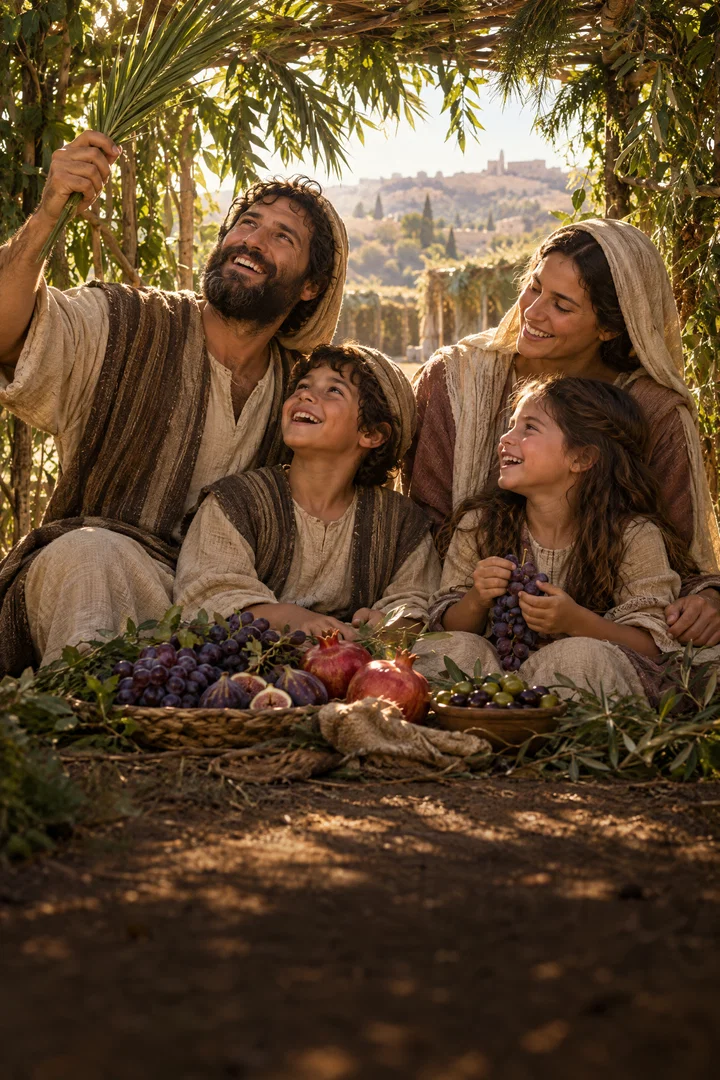
And all the congregation of them that were come again out of the captivity made booths, and sat under the booths: for since the days of Jeshua the son of Nun unto that day had not the children of Israel done so. And there was very great gladness.
Translations
And all the congregation of them that were come again out of the captivity made booths, and sat under the booths: for since the days of Jeshua the son of Nun to that day had not the children of Israel done so. And there was very great gladness.
King James Version, KJV Cambridge Paragraph Bible
And all the congregation of them that were come again out of the captivity made booths, and sat under the booths: for since the days of Jeshua the son of Nun unto that day had not the children of Israel done so. And there was very great gladness.
And all the congregation of them that had returned from the captivity made booths, and sat under the booths: for since the days of Jeshua the son of Nun to that day, had not the children of Israel done so. And there was very great gladness.
And all the congregation of them that were come again out of the captivity made booths, and dwelt in the booths: for since the days of Jeshua the son of Nun unto that day had not the children of Israel done so. And there was very great gladness.
And all the assembly of them that were come again out of the captivity made booths, and dwelt in the booths: for since the days of Jeshua the son of Nun unto that day had not the children of Israel done so. And there was very great gladness.
And they make — all the assembly of the captives of the captivity — booths, and they sit in booths; for the sons of Israel had not done, from the days of Jeshua son of Nun, so unto that day, and there is very great joy.
And all the congregation of them that had come back from the captivity made booths, and dwelt in the booths. For since the days of Jeshua the son of Nun until that day had not the children of Israel done so. And there was very great gladness.
And all the convocation of them who had returned out of the captivity made booths, and dwelt in booths, for, since the days of Jeshua son of Nun, had not the sons of Israel done so, unto that day,—and there was very great rejoicing.
The whole assembly who had returned from exile made booths and lived in them. From the days of Joshua son of Nun until that day, the Israelites had not celebrated like this. And there was great rejoicing.
The whole assembly that had returned from exile made booths and lived in them. From the days of Joshua son of Nun until that day, the Israelites had not celebrated like this. And there was great rejoicing.
All the assembly of those who had come back out of the captivity made temporary shelters and lived in the temporary shelters, for since the days of Joshua the son of Nun to that day the children of Israel had not done so. There was very great gladness.
All the people who had been prisoners and had come back, made tents and were living in them: for from the time of Jeshua, the son of Nun, till that day, the children of Israel had not done so. And there was very great joy.
And all the Congregation of them that were come againe out of the captiuitie made boothes, and sate vnder the boothes: for since the time of Ieshua the sonne of Nun vnto this day, had not the children of Israel done so, and there was very great ioy.
Douay-Rheims (Challoner revision)
And all the assembly of them that were returned from the captivity, made tabernacles, and dwelt in tabernacles: for since the days of Josue the son of Nun the children of Israel had not done so, until that day: and there was exceeding great joy.
Pictures
Cross-references
- Leviticus 23:39-43
Also in the fifteenth day of the seventh month, when ye have gathered in the fruit of the land, ye shall keep a feast unto the LORD seven days: on the first day shall be a sabbath, and on the eighth day shall be a sabbath.
Commands the feast and explains dwelling in booths as a memorial.
- Deuteronomy 16:13-15
Thou shalt observe the feast of tabernacles seven days, after that thou hast gathered in thy corn and thy wine:
Commands the Feast of Tabernacles and calls Israel to rejoice during it.
- John 7:37
In the last day, that great day of the feast, Jesus stood and cried, saying, If any man thirst, let him come unto me, and drink.
Jesus offered living water on the feast’s final day.
- Nehemiah 8:10
Then he said unto them, Go your way, eat the fat, and drink the sweet, and send portions unto them for whom nothing is prepared: for this day is holy unto our Lord: neither be ye sorry; for the joy of the LORD is your strength.
The people’s gladness is linked to the Lord’s joy as their strength.
- John 7:2
Now the Jews’ feast of tabernacles was at hand.
Identifies the feast of tabernacles in Jesus’ time.
- 2 Chronicles 7:8-9
Also at the same time Solomon kept the feast seven days, and all Israel with him, a very great congregation, from the entering in of Hamath unto the river of Egypt.
Records a feast and assembly held during festival observance.
- Ezra 3:4
They kept also the feast of tabernacles, as it is written, and offered the daily burnt offerings by number, according to the custom, as the duty of every day required;
Both accounts describe the returned exiles observing the Feast of Booths.
- 1 Kings 8:65
And at that time Solomon held a feast, and all Israel with him, a great congregation, from the entering in of Hamath unto the river of Egypt, before the LORD our God, seven days and seven days, even fourteen days.
Records Israel’s feast and celebration at the temple dedication.
- 1 Kings 8:2
And all the men of Israel assembled themselves unto king Solomon at the feast in the month Ethanim, which is the seventh month.
Both describe Israel gathering for the Feast of Tabernacles.
- Numbers 29:12-39
And on the fifteenth day of the seventh month ye shall have an holy convocation; ye shall do no servile work, and ye shall keep a feast unto the LORD seven days:
Prescribes offerings for the feast.
- Zechariah 14:16
And it shall come to pass, that every one that is left of all the nations which came against Jerusalem shall even go up from year to year to worship the King, the LORD of hosts, and to keep the feast of tabernacles.
The feast of tabernacles becomes part of the nations’ future worship.
- Luke 9:33
And it came to pass, as they departed from him, Peter said unto Jesus, Master, it is good for us to be here: and let us make three tabernacles; one for thee, and one for Moses, and one for Elias: not knowing what he said.
Peter’s suggestion to build tabernacles recalls the booths made at the Feast of Tabernacles.
- Ezra 7:6
This Ezra went up from Babylon; and he was a ready scribe in the law of Moses, which the LORD God of Israel had given: and the king granted him all his request, according to the hand of the LORD his God upon him.
Ezra brought the law read and kept in Nehemiah.
- Nehemiah 7:73
So the priests, and the Levites, and the porters, and the singers, and some of the people, and the Nethinims, and all Israel, dwelt in their cities; and when the seventh month came, the children of Israel were in their cities.
The restored community is gathered in its cities before the feast.
- Nehemiah 8:1
And all the people gathered themselves together as one man into the street that was before the water gate; and they spake unto Ezra the scribe to bring the book of the law of Moses, which the LORD had commanded to Israel.
same bringing of the Book to the assembly
- Ezra 7:10
For Ezra had prepared his heart to seek the law of the LORD, and to do it, and to teach in Israel statutes and judgments.
Ezra’s purpose to seek, obey, and teach the law is fulfilled in Israel’s observance.
Commentary
Each commentary is drawn from primary sources: the writings of Ellen G. White and Adventist pioneers and periodicals. Each commentary is separate. Its own words are not a quotation; follow the references to read the source passages.
Ellen G. White
7 sources
The verse belongs to the gathering of the congregation come again out of the captivity at Jerusalem at the time of the Feast of Trumpets, after the wall had been rebuilt and the gates set up while much of the city still lay in ruins.PK 661.1–2 The children of the covenant assembled from all the surrounding country before a wooden platform in one of the broadest streets, where the aged Ezra stood with his fellow Levites at his right and left, blessed the Lord, and all the people answered Amen and bowed with their faces to the ground in worship.PK 661.1–2 At that gathering the people heard the law read and explained in language they could understand.PK 661.3 The reading of the law in that time was expected to lead to deep repentance and a return to the Lord.DA 215.3–216.1
The returned congregation kept the Feast of Tabernacles by making booths and living in them during the feast as the law instructed.MH 282.1DA 215.3–216.1MH 283.1–3MH 283.4–284.2PK 665.2 Such an observance on that scale had not occurred since the days of Jeshua son of Nun.PK 665.2 Their obedience in this observance brought very great gladness.MH 282.1DA 215.3–216.1MH 283.1–3MH 283.4–284.2PK 665.2
The account connects the people's understanding of the law with great rejoicing.PK 661.3 The verse illustrates Israel's experience of living according to God's instruction.MH 283.4–284.2
Sources
Pioneers and periodicals
20 sources
After the return from captivity the whole congregation built temporary shelters of branches and lived in them for the feast with very great gladness, which Israel had not done in that manner since the days of Joshua the son of Nun, Jeshua being another form of the name Joshua.ST Feb 25, 1886ST May 21, 1896ST Feb 12, 1885 They kept it from the fifteenth through the twenty-second day of the seventh month, dwelling in the booths for seven days while Ezra read from the book of the law each day.ST Mar 8, 1899 When the command was read distinctly and understood, they obeyed it at once without appealing to the neglect of earlier generations, returning to the law of Moses with attentive hearing, confession and putting away of sin, and worship of God.RH Apr 22, 1902ST Feb 25, 1886ST Feb 12, 1885RH Sep 21, 1916ST May 28, 1902 The feast recalled Israel's dwelling in booths in the wilderness journey and gave national thanksgiving for the harvest, and it points to the day of eternal deliverance in God's final ingathering of His people.ST May 21, 1896RH Jan 14, 1862ST Nov 17, 1898 It belongs to the appointed ceremonial ordinances and feast observances, to be distinguished from the enduring moral law.
Return and Booths Restored
All the congregation of those who had come again out of the captivity made booths and sat under them, keeping the Feast of Booths or Tabernacles with very great gladness.ST May 21, 1896RH Jan 14, 1862 The booths were temporary shelters built from branches, made and lived in for seven days.ST Mar 8, 1899 The feast was kept from the fifteenth through the twenty-second day of the seventh month while Ezra read from the book of the law each day.
Jeshua the son of Nun is another form of the name Joshua.ST Sep 24, 1902 The children of Israel had not kept the feast in this way since his days, marking a revival of this observance after a long interval.ST Feb 25, 1886ST Feb 12, 1885ST Oct 7, 1930 This was the first feast celebrated after Jerusalem's wall was restored.RH Oct 31, 1912 It belonged to the work of rebuilding the city wall, establishing the government, and carrying out needed reforms honoring God's law, especially the Sabbath, in the story of Jerusalem's restoration and reformation.RH Sep 21, 1916ST Jun 2, 1909
The observance belonged to a religious revival and mighty heart reformation in which the people returned to the law of Moses, listened to its reading and teaching, confessed and put away revealed sin, and worshiped God.RH Apr 22, 1902ST Aug 19, 1897RH Jul 2, 1908 The book of the law was read attentively from morning till midday, read distinctly with the sense given so they understood the reading.RH Sep 21, 1916ST Aug 19, 1897 Copies of the sacred books were so rare that all the multitude could hope to do was to hear passages read and expounded, and that privilege brought overwhelming joy.RH Sep 21, 1916ST Aug 19, 1897ST Aug 12, 1897 That work was not done by might nor by army but by the Spirit of God working in connection with the Word.ST Aug 19, 1897
The account shows Ezra's entire success after coming up from Babylon to Jerusalem with the law of Moses, which had fallen into disuse.ST Sep 26, 1895 The making of booths and sitting under them with very great gladness was part of the returned exiles returning to the practice of the laws and forms of worship enjoined by Moses.ST Sep 26, 1895 That return was sealed when the people entered into a solemn covenant to keep the law of Moses which Ezra had brought home, which established the Pentateuch as the canonical and authoritative book.ST Sep 26, 1895 The book of the law contained the whole body of law given through Moses, not only the moral or ceremonial laws.RH Oct 8, 1857
Obedience, Memory, and Hope
When the command to live in booths was read, those who had come back from captivity made booths and lived in them as the law required for the feast of the seventh month.ST Feb 25, 1886ST Feb 12, 1885ST May 28, 1902 Though Israel had not kept it in this way since the days of Joshua, their fathers' failure did not excuse them, for the written command made obedience their duty.ST Feb 25, 1886ST Feb 12, 1885ST May 28, 1902 They acted on what they heard without appealing to past practice, and their obedience was attended by very great gladness.ST Feb 25, 1886ST Feb 12, 1885ST May 28, 1902 Their course illustrates conformity to God's word even when earlier generations had not followed it.ST Feb 25, 1886
The long interval since Joshua proves that in repeated apostasy the people lost the sacredness of the feasts or their leaders neglected to observe them.ST Oct 7, 1930 Centuries could thus pass without keeping the Passover, and the same was true of the other festivals.ST Oct 7, 1930 The record stands as evidence that this seventh-month festival was observed.RH Dec 10, 1861RH Oct 31, 1854 The absence of a recorded observance of the Day of Atonement does not prove that it was neglected.RH Dec 10, 1861RH Oct 31, 1854
The Feast of Tabernacles recalled Israel's dwelling in booths during the wilderness journey.RH Jan 14, 1862ST Nov 17, 1898 It was a national thanksgiving for the harvest, kept with very great joy.RH Jan 14, 1862ST Nov 17, 1898 It is also a type of the day of eternal deliverance.ST May 21, 1896 It points to God's final ingathering of His people.ST Nov 17, 1898
The observance belongs with the appointed feasts to the ceremonial ordinances, to be distinguished from the enduring moral law.
Sources