Nehemiah 9:38
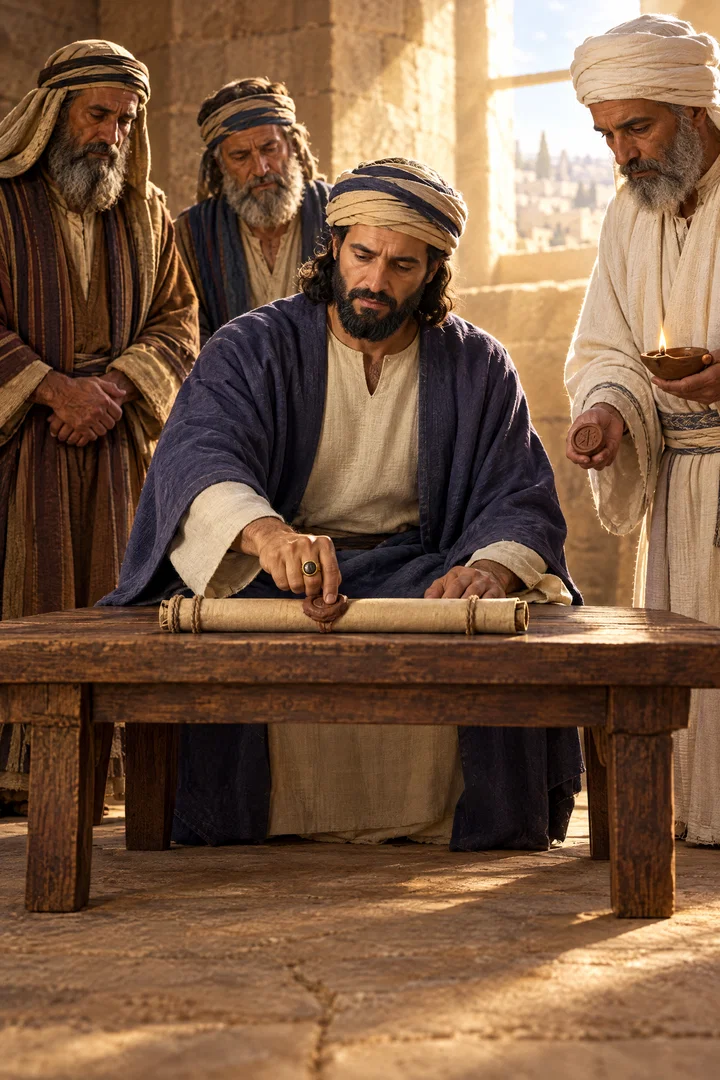
And because of all this we make a sure covenant, and write it; and our princes, Levites, and priests, seal unto it.
Translations
And because of all this we make a sure covenant, and write it; and our princes, Levites, and priests, seal to it.
King James Version, KJV Cambridge Paragraph Bible
And because of all this we make a sure covenant, and write it; and our princes, Levites, and priests, seal unto it.
And because of all this we make a sure covenant, and write it; and our princes, Levites, and priests, set their seals to it.
Revised Version, American Standard Version
And yet for all this we make a sure covenant, and write it; and our princes, our Levites, and our priests, seal unto it.
And for all this we are making a stedfast covenant, and are writing, and over him who is sealed [are] our heads, our Levites, our priests.'
And because of all this we make a sure covenant, and write it; and our princes, our Levites, [and] our priests are at the sealing.
Seeing, therefore, all this, we, are plighting our faith, and putting it in writing,—and, upon the sealed scroll, are our rulers, our Levites, our priests.
Berean Standard Bible, Majority Standard Bible
In view of all this, we make a binding agreement, putting it in writing and sealing it with the names of our leaders, Levites, and priests.”
Yet for all this, we make a sure covenant, and write it; and our princes, our Levites, and our priests, seal it.”
And because of all this we are making an agreement in good faith, and putting it in writing; and our rulers, our Levites, and our priests are putting their names to it.
Now because of all this we make a sure couenant, and write it, and our princes, our Leuites and our Priestes seale vnto it.
Douay-Rheims (Challoner revision)
And because of all this we ourselves make a covenant, and write it, and our princes, our Levites, and our priests sign it.
Pictures
Cross-references
- Nehemiah 10:31
And if the people of the land bring ware or any victuals on the sabbath day to sell, that we would not buy it of them on the sabbath, or on the holy day: and that we would leave the seventh year, and the exaction of every debt.
The covenant pledge includes refusing to buy goods on the Sabbath.
- Nehemiah 8:1-10
And all the people gathered themselves together as one man into the street that was before the water gate; and they spake unto Ezra the scribe to bring the book of the law of Moses, which the LORD had commanded to Israel.
The law was read before the people, leading into their covenant response.
- Nehemiah 10:1
Now those that sealed were, Nehemiah, the Tirshatha, the son of Hachaliah, and Zidkijah,
The next reading continues with the covenant and its signers.
- Nehemiah 10:29-30
They clave to their brethren, their nobles, and entered into a curse, and into an oath, to walk in God’s law, which was given by Moses the servant of God, and to observe and do all the commandments of the LORD our Lord, and his judgments and his statutes;
The people swear to obey God’s law and not intermarry with surrounding peoples.
- Jeremiah 50:5
They shall ask the way to Zion with their faces thitherward, saying, Come, and let us join ourselves to the LORD in a perpetual covenant that shall not be forgotten.
The people join themselves to the Lord in a perpetual covenant.
- Nehemiah 10:32-33
Also we made ordinances for us, to charge ourselves yearly with the third part of a shekel for the service of the house of our God;
Records the annual levy for the service and offerings of the house of God.
- Nehemiah 9:26
Nevertheless they were disobedient, and rebelled against thee, and cast thy law behind their backs, and slew thy prophets which testified against them to turn them to thee, and they wrought great provocations.
The people’s rebellion and need for reformation precede the written covenant.
Commentary
Each commentary is drawn from primary sources: the writings of Ellen G. White and Adventist pioneers and periodicals. Each commentary is separate. Its own words are not a quotation; follow the references to read the source passages.
Ellen G. White
8 sources
The covenant belongs to a public gathering in Jerusalem after the wall had been rebuilt while much of the city still lay in ruins, when the people assembled for the Feast of Trumpets and Ezra led them in blessing and worshiping God.PK 661.1–2 It came as the response to the reading of the law in Nehemiah 8, whose requirements convicted the people of their wrong.Ms 121, 1898, par. 7–8 It belongs to the account of the people hearing and understanding God's law, with deep repentance and return to the Lord as the expected result.PK 661.3Ms 121, 1898, par. 7–8DA 215.3–216.1
Because of all this, the confession behind the covenant recounts God's right judgments, true laws, holy Sabbath, bread from heaven, water from the rock, forty years of sustaining without lack, multiplied children, conquered kingdoms and fat land, readiness to pardon, gracious mercy, pillar of cloud and fire, and many deliverances.Ms 15, 1906, par. 1–9 Set against this are pride, hardened necks, rebellion, the molten calf, casting the law behind their backs, slaying prophets, and repeated evil bringing dominion by enemies and great distress.Ms 15, 1906, par. 1–9 In acknowledging God's just dealings and their own sins, Ezra and Nehemiah humbled themselves, confessing their own sins and the sins of the people and asking pardon as though they themselves were the offenders.PK 666.2PK 675.2 The people thus recognized their condition and that their sins had separated them from God, so that He had let them come under heathen control to show He would not serve with their sins.PK 661.3Ms 121, 1898, par. 7–8PK 666.2
After that acknowledgment the people renewed their commitment to God and entered a covenant to obey His law, making a sure and firm covenant and writing it, with princes, Levites, and priests sealing it.Ms 15, 1906, par. 1–9PK 661.3DA 215.3–216.1PK 666.2Ms 15, 1906, par. 10 The writing and signing preserved it as a lasting record of their obligation, to remind them of their duty and guard them against temptation.PK 666.2
The verse gives a representation to present to the people as occasion requires, to stand boldly in defense of the truth.Ms 15, 1906, par. 1–9 Without a decided reformation among those in positions of influence, the truth will otherwise be perverted more and more into strong representations of evil.Ms 15, 1906, par. 1–9 Its history of disobedience, distress, and repeated mercy is paralleled by Seventh-day Adventists, who have received great truths and favors from God but have not always valued them or returned Him the glory due His name.Ms 15, 1906, par. 10 Yet like Israel they have not been wholly forsaken, with heaven providing help for united medical missionary work and the ministry of the Word.Ms 15, 1906, par. 10
Sources
Pioneers and periodicals
22 sources
Because of all that had been confessed of their sins and failures and of God's dealings and acts, the people made a firm and binding covenant, put it in writing, and had their princes, Levites, priests and leaders formally seal it.RH Apr 22, 1902ST May 28, 1902ST Aug 23, 1910 It was done in a general meeting where all the people spent part of each day reading the book of the law and part in confession and worship.RH Jul 2, 1908 The covenant pledged the whole congregation together to obey God and keep His law, including His commands concerning marriage, Sabbath buying and debts, and specifically to refrain from Sabbath transgression.ST May 28, 1902ST Oct 6, 1914RH Jan 21, 1862 In its larger setting it preserves knowledge of the true seventh day and identifies it to Israel as the Sabbath, made known anew after being reminded of Mount Sinai where God gave the ten words and made known His holy Sabbath.RH Jan 21, 1862RH Dec 1850 What was already known could still be made known, so this was a renewed covenant and renewed making known of the Sabbath after the exodus, not its original giving, just as Moses gave circumcision though it was of the fathers from Abraham and observed before the exodus.RH Oct 15, 1872
Setting and Covenant Act
Because of all that had been confessed before it — their sins and failures, their circumstances, and God's dealings and acts with them — the people made a firm and binding covenant, put it in writing, and had their princes, Levites, priests and leaders formally seal it.RH Apr 22, 1902ST May 28, 1902ST Aug 23, 1910RH Sep 21, 1916ST Jun 2, 1909 It was the response of a general meeting in which all the people gathered, spending part of each day reading the book of the law and part in confession and worship.RH Jul 2, 1908 It was the united prayer of the people after the return from the Babylonish captivity, and that united prayer marked the beginning of a great revival.RH Dec 8, 1904
It took place around 445 B.C. among the remnant that went up to Jerusalem after the seventy years captivity upon their last return to their city, showing their condition and their renewed obedience to God.ST Oct 6, 1914RH Nov 13, 1856 Writing the covenant made it sure and preserved it permanently as a lasting record.ST Feb 7, 1911ST May 20, 1886 Sealing it was an authoritative act that finished, confirmed, and sealed up the writing so it could not be reversed.ST Feb 7, 1911ST May 20, 1886ST Jul 31, 1893
The covenant committed them to obey God's law, including its commands concerning marriage, Sabbath buying, and debts, and specifically included refraining from Sabbath transgression.ST May 28, 1902ST Oct 6, 1914 Grounded in study of God's Word, the commitment included the duty to support worship at the house of God by an annual payment of one-third of a shekel for the showbread, offerings, and other work of the house.RH Jul 9, 1908 Though small individually, that payment provided a substantial yearly sum when paid by all the people.RH Jul 9, 1908
Doctrine, Prophecy, and Application
In its larger setting the passage shows that in obedience and righteousness there is life, while in disobedience and sin there is death, for if Adam and Eve had never sinned they would still be living, as the angels live who do His commandments and hearken to the voice of His word.ST Jan 31, 1906 The whole congregation is seen entering into a solemn covenant to obey God and to keep His law after being reminded of Mount Sinai where He gave the ten words and made known His holy Sabbath, moved by deep impression from the effect of their former disobedience and pledging themselves to one another to keep it.RH Jan 21, 1862 It is part of the biblical record that preserved knowledge of the true seventh day and identified it to Israel as the Sabbath.RH Dec 1850
What took place was a renewed covenant and a making known of the Sabbath after the exodus, not the original giving of the Sabbath, for made known is not the same as first gave and what was already known can still be made known.RH Oct 15, 1872 Just as Moses gave circumcision to Israel even though it was of the fathers from Abraham and was observed before the exodus, so the Sabbath was made known at Sinai though it existed before.RH Oct 15, 1872 The solemn covenant bound the returned exiles to keep the law of Moses that Ezra had brought home with him from Babylon to Jerusalem after it had fallen into disuse, and this act established the Pentateuch as the canonical and authoritative book of the Jews, a position it has held without question ever since.ST Sep 26, 1895
After recounting their sins and the troubles that had come upon them, the people made a firm covenant, put it in writing, and had their leaders seal it, and in that renewal after the Babylonian captivity this covenant-making accompanied a needed reformation from idolatry and sin.ST Jun 11, 1894 It stands in the record of Israel's repeated rebellion and God's patience and mercy toward them, in which on many occasions justice called for punishment but mercy was extended before their eventual exile.RH Feb 4, 1915 It fulfills the promise of Jeremiah 50:4-5 that Israel and Judah would come weeping to seek the Lord and join themselves to Him in a perpetual covenant that shall not be forgotten, made because of remembrance of the sins that led to captivity, and it belongs to the class of promises of return from captivity that have already been fulfilled and do not await a future age.RH Jul 21, 1910
After confessing national sins and acknowledging the justice of God's dealings and punishment, the people understood God's claims and the nature of sin, and those with genuine principle acted on what they understood by covenanting to obey His law.ST Feb 7, 1911ST May 20, 1886 They made the covenant sure by writing it down as a permanent record to preserve it permanently, and the priests, Levites, and princes sealed it.ST Feb 7, 1911ST May 20, 1886 In this God's people are seen making a covenant with God and one another, reflected when believers renew their covenant and new members sign it.ST Apr 27, 1882
Sources