Numbers 19:2
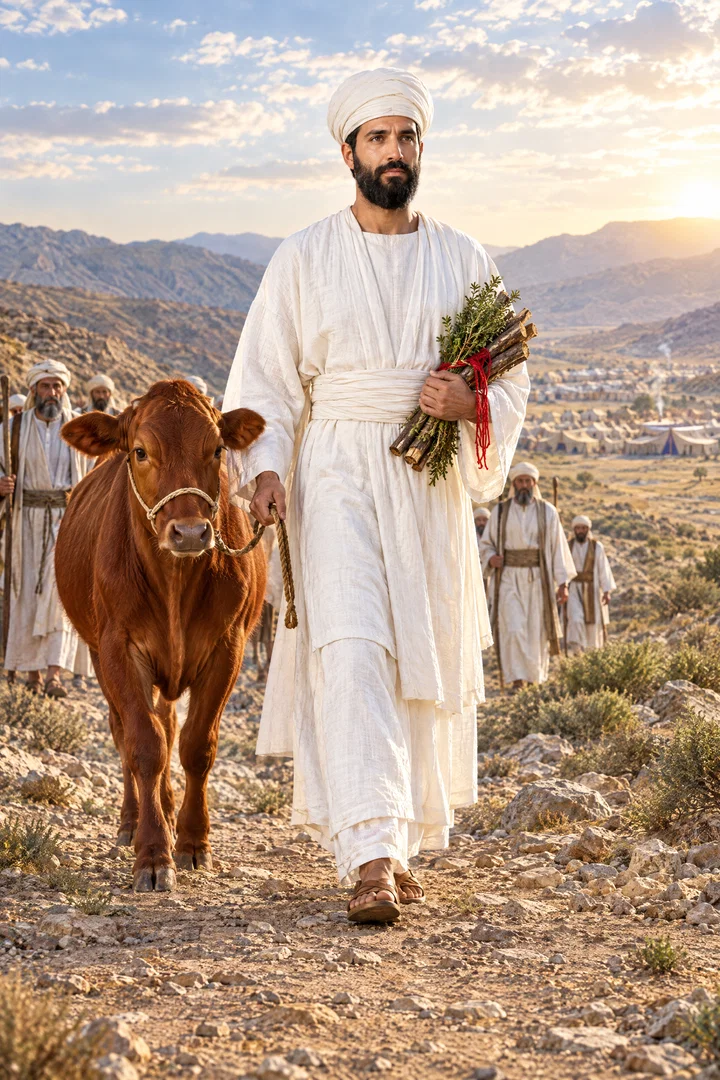
This is the ordinance of the law which the LORD hath commanded, saying, Speak unto the children of Israel, that they bring thee a red heifer without spot, wherein is no blemish, and upon which never came yoke:
Translations
This is the ordinance of the law which the LORD has commanded, saying, Speak to the children of Israel, that they bring you a red heifer without spot, wherein is no blemish, and on which never came yoke:
This is the ordinance of the law which the LORD hath commanded, saying, Speak unto the children of Israel, that they bring thee a red heifer without spot, wherein is no blemish, and upon which never came yoke:
This is the ordinance of the law which the Lord hath commanded, saying, Speak unto the children of Israel, that they bring thee a red heifer without spot, wherein is no blemish, and upon which never came yoke:
This is the ordinance of the law which the LORD hath commanded, saying, Speak to the children of Israel, that they bring thee a red heifer without spot, in which is no blemish, and upon which never came a yoke:
This is the statute of the law which the LORD hath commanded, saying, Speak unto the children of Israel, that they bring thee a red heifer without spot, wherein is no blemish, and upon which never came yoke:
This is the statute of the law which Jehovah hath commanded, saying, Speak unto the children of Israel, that they bring thee a red heifer without spot, wherein is no blemish, and upon which never came yoke.
'This [is] a statute of the law which Jehovah hath commanded, saying, Speak unto the sons of Israel, and they bring unto thee a red cow, a perfect one, in which there is no blemish, on which no yoke hath gone up;
This is the statute of the law which Jehovah hath commanded, saying, Speak unto the children of Israel, that they bring thee a red heifer without blemish, wherein is no defect, and upon which never came yoke;
This, is the statute of the law, which Yahweh hath commanded, saying,—Speak unto the sons of Israel—That they bring unto thee a red heifer, without defect wherein is no blemish, and whereupon hath come no yoke.
Berean Standard Bible, Majority Standard Bible
“ This is the statute of the law that the LORD has commanded: Instruct the Israelites to bring you an unblemished red heifer that has no defect and has never been placed under a yoke.
“ This is the statute of the law which the LORD has commanded. Tell the children of Israel to bring you a red heifer without spot, in which is no defect, and which was never yoked.
This is the rule of the law which the Lord has made, saying, Give orders to the children of Israel to give you a red cow without any mark on her, and on which the yoke has never been put:
This is the ordinance of the lawe, which the Lord hath commanded, saying, Speake vnto the children of Israel that they bring thee a red kow without blemish, wherein is no spot, vpon the which neuer came yoke.
Douay-Rheims (Challoner revision)
This is the observance of the victim, which the Lord hath ordained. Command the children of Israel, that they bring unto thee a red cow of full age, in which there is no blemish, and which hath not carried the yoke:
Pictures
Cross-references
- Hebrews 9:13-14
For if the blood of bulls and of goats, and the ashes of an heifer sprinkling the unclean, sanctifieth to the purifying of the flesh:
The heifer’s ashes cleanse the flesh, while Christ’s blood purges the conscience.
- Hebrews 13:12
Wherefore Jesus also, that he might sanctify the people with his own blood, suffered without the gate.
Jesus suffered outside the gate, as the heifer was taken outside the camp.
- 2 Corinthians 5:21
For he hath made him to be sin for us, who knew no sin; that we might be made the righteousness of God in him.
The spotless heifer prefigures Christ, who knew no sin yet was made sin for us.
- Hebrews 10:22
Let us draw near with a true heart in full assurance of faith, having our hearts sprinkled from an evil conscience, and our bodies washed with pure water.
The sprinkling rite is linked to drawing near with cleansed hearts.
- Hebrews 9:22
And almost all things are by the law purged with blood; and without shedding of blood is no remission.
Numbers 19 gives an exception to purification by blood.
- 1 Peter 1:19
But with the precious blood of Christ, as of a lamb without blemish and without spot:
Redemption comes through Christ’s precious blood, like the spotless offering.
- Hebrews 10:1-10
For the law having a shadow of good things to come, and not the very image of the things, can never with those sacrifices which they offered year by year continually make the comers thereunto perfect.
Sacrifices point to Christ’s work.
- Hebrews 9:23
It was therefore necessary that the patterns of things in the heavens should be purified with these; but the heavenly things themselves with better sacrifices than these.
Earthly cleansing serves as a pattern of the heavenly things’ purification.
- Isaiah 53:6
All we like sheep have gone astray; we have turned every one to his own way; and the LORD hath laid on him the iniquity of us all.
The iniquity of all was laid on Christ.
- Leviticus 17:11
For the life of the flesh is in the blood: and I have given it to you upon the altar to make an atonement for your souls: for it is the blood that maketh an atonement for the soul.
Blood makes atonement by representing life given for life.
- 1 John 3:5
And ye know that he was manifested to take away our sins; and in him is no sin.
Christ was manifested to take away sins and has no sin.
Commentary
Each commentary is drawn from primary sources: the writings of Ellen G. White and Adventist pioneers and periodicals. Each commentary is separate. Its own words are not a quotation; follow the references to read the source passages.
Ellen G. White
4 sources
The ordinance appoints an offering for the congregation's purification from ceremonial defilement, especially the defilement contracted by contact with the dead, which taught that death came because of sin and stood as a representation of sin.4T 120.2–121.1 Its red color symbolized blood, and its freedom from spot and blemish typified Christ as the spotless, sinless Son of God and sacrifice.4T 120.2–121.1Ms 44, 1897, par. 15–20 That spotlessness was proved by enduring every kind of test and provocation without yielding to Satan, without retaliating, and without responding to temptation, so that no sin in Him gave Satan power over Him, and His spotless character and obedience to the Father made Him a living sacrifice for the fallen race.Ms 44, 1897, par. 15–20
Its never having borne a yoke typified that Christ freely undertook the work of atonement and was not compelled by obligation, for unlike the created angels who bear the yoke of duty and obedience, He was one with the Father and above all law.Ms 71, 1901, par. 34T 120.2–121.1 The single heifer pointed to Christ as the one great offering whose suffering and blood purify and redeem the world, and He alone was of sufficient worth to serve as surety for fallen humanity and to make an adequate atonement by taking human sin and bearing iniquity.Ms 71, 1901, par. 34T 120.2–121.1 Its slaying outside the camp pointed to Christ's death outside Jerusalem and showed that He came as Redeemer for all mankind, not only the Hebrews.4T 121.2–122.1
Its blood sprinkled toward the temple prefigured Christ's blood being brought into the holy place to cleanse the sanctuary and to reconcile God to humanity.4T 121.2–122.1 Its body burned to ashes signified a complete and ample sacrifice, and the ashes mixed with running water and used repeatedly typified the ongoing purification of the people from sin.4T 121.2–122.1
Sources
Pioneers and periodicals
18 sources
This is the ordinance of the law commanded by the Lord that the children of Israel bring a red heifer without spot or blemish and upon which never came yoke.RH Apr 11, 1871ST Feb 17, 1890 The animal was chosen from the flock and brought to the priest, then led entirely out of the camp to a rough uncultivated valley where it was slain in his presence, its blood sprinkled seven times toward the sanctuary, and its whole body burned with cedar wood and hyssop and scarlet to make ashes for purification.RH May 16, 1912ST Jun 12, 1901ST Apr 23, 1912 Its red color points to the blood of Christ, its freedom from spot and blemish to his sinless offering of himself without spot who did no sin, and its never having borne yoke to his freedom from disobedience and the bondage of sin in a wholly voluntary offering.RH May 16, 1912ST Jun 12, 1901RH Apr 11, 1871RH May 16, 1912 Its being brought to the priest to be slain outside the camp portrays the Jews bringing Jesus to the high priest and his suffering outside the gate of Jerusalem to sanctify the people, even for the most worthless and outcast.ST Jun 12, 1901ST Apr 23, 1912ST Oct 29, 1912 Though offered once for all for the whole people, its cleansing was not indiscriminate but provided for single individuals to be freed from personal impurity, and its exact requirements of color and perfection and never having been yoked could not be set aside for greater value or convenience.ST Jan 1, 1885ST Jun 12, 1901RH Jun 19, 1856
Ordinance and Ceremony
This is the ordinance of the law commanded by the LORD, directing the children of Israel to bring a red heifer without spot and without blemish and upon which never came yoke.RH Apr 11, 1871ST Feb 17, 1890 The rule for the purification ordinance required a red heifer that had never been yoked and was free from blemish, and it stands as an exception to the general rule that purification under the typical law was by blood.RH Apr 11, 1871ST Feb 17, 1890 The word for heifer is connected with the Hebrew parah, meaning fruitful, while red is connected with adumah and the ruddy color of Adam, distinguishing the second Adam.RH Apr 11, 1871
All the people united in selecting from some flock a perfectly formed animal that had never worked under a yoke and bringing it to the priest.RH May 16, 1912ST Jun 12, 1901 The priest had it led away from the sanctuary and entirely out of the camp to a rough, uncultivated valley rather than to the temple, where it was slain in the priest's presence.RH May 16, 1912ST Jun 12, 1901ST Apr 23, 1912 Elders performed the killing, and the priest sprinkled its blood toward the temple seven times and upon the valley stones.RH May 16, 1912ST Oct 29, 1912 The whole animal, including its blood, was then burned with cedar wood, hyssop, and scarlet cast into the fire to make ashes for purification from sin.RH May 16, 1912ST Apr 23, 1912 That slaying and burning outside the camp prefigured suffering outside the gate, when Christ suffered outside Jerusalem's gate to sanctify the people with His blood, and the leading out to a rough valley with blood sprinkled on its stones portrayed death for the most worthless and outcast and revealed beauty of character and love for sinners.ST Apr 23, 1912ST Oct 29, 1912 When a person was found slain and the killer was unknown, the elders of the nearest city washed their hands over the heifer's body and prayed that innocent blood would not be charged to them.RH May 16, 1912
The ordinance of the red heifer described in Numbers 19:1-10 was used continually even though later Old Testament books do not mention it.RH Aug 3, 1869 Its absence from those books does not show that observance had ceased.RH Aug 3, 1869
Foreshadowing of Christ
The ordinance was designed to demonstrate faith in Christ as the common Saviour for all, pointing to a special phase of His atonement work for men.ST Jun 12, 1901 All the people united in selecting from some flock a perfectly formed animal, which was brought to the priest, who had it led away from the sanctuary and entirely out of the camp where one chosen person slew it in his presence.ST Jun 12, 1901
The redness especially represented Christ's blood and presents Him as seen in Isaiah 63:1-3 and Revelation 19:13.ST Jun 12, 1901RH May 16, 1912 The word heifer is linked to the Hebrew parah, meaning fruitful, while red is linked to adumah and the ruddy color of Adam, distinguishing Christ as the second Adam.RH Apr 11, 1871 Being without spot and without blemish means He offered Himself without spot to God, did no sin, knew no sin, and no guile was found in His mouth.RH May 16, 1912ST Jun 12, 1901RH May 16, 1912 Having never borne a yoke means He never came under the yoke of disobedience to God's law, which is service and bondage to sin, but offered Himself voluntarily under no compulsion, alone free from the law's claims and able to atone for its violation.RH May 16, 1912ST Jun 12, 1901RH May 16, 1912
The command for the children of Israel to bring the heifer to the priest to be slain outside the camp means the Jews brought Jesus to the high priest and He suffered outside the camp and outside Jerusalem's gate to sanctify the people with His blood.ST Jun 12, 1901ST Apr 23, 1912 The heifer led out to a rough, uncultivated valley, with its blood sprinkled on the valley's stones, portrays His death for the most worthless and outcast, and the sanctuary types reveal the beauty of His character and love for sinners.ST Oct 29, 1912 The offering shows two lives in the sin-offering, the innocent life of the victim and the imputed sinful life of the offerer, which explains how the same blood could convey defilement and yet cleanse the sinner.ST Jun 27, 1911 Even the priest who sprinkled the blood was made unclean, and the clean person who gathered the ashes and the one who sprinkled the ashes mingled with water had to wash his clothes and be unclean until evening, while the unclean person was cleansed; so on the cross Christ was made sin and suffered as the vilest of sinners, yet by His own pure life cleansed the thief.ST Jun 27, 1911
The sacrifice was performed once for all for the whole people, yet it did not give indiscriminate purification to the whole house of Israel, but made a provision of which single individuals could avail themselves to be freed from personal impurity.ST Jun 12, 1901 Its sprinkling of ashes took place outside the sanctuary's second apartment as part of the sanctuary service as a whole.RH Nov 11, 1909 The ritual cleansed the flesh, while Christ's sacrifice cleanses the conscience.RH Nov 11, 1909
Purification and Exact Obedience
Numbers 19:2 belongs to the provision for the purification of the unclean.ST Feb 22, 1910 The chapter stands as a record of sin and as God-given object lessons intended to teach Israel the true way. The red heifer offering described in Numbers 19:1-10 is an exception to the other Levitical sacrifices set out in the opening chapters of Leviticus.ST May 19, 1914 It gives the rule for the purification ordinance, that Israel was to bring a red heifer without blemish that had never been yoked, and it is cited as an exception to the general rule that purification under the typical law was by blood.ST Feb 17, 1890
Purification by this ordinance could take place without blood when it concerned physical defilement or misfortune rather than sin.ST Feb 17, 1890 Such purification without blood did not conflict with the rule that sin requires a life to be given for atonement.ST Feb 17, 1890
The red color of the heifer used to make the water of separation was a substantial part of the commanded service, not an incidental detail.ST Jan 1, 1885 A white heifer would not fulfill the command, nor would a red bullock, and to substitute either would be disobedience and self-willed worship.ST Jan 1, 1885 God required exact specifications, that the animal be red, without spot or blemish, and never yoked, so that a different color, an imperfect animal, or one that had borne a yoke would not satisfy the command.RH Jun 19, 1856 Greater value or convenience could not replace obedience to what God specifically required.RH Jun 19, 1856
Sources