Philemon 1:11
Which in time past was to thee unprofitable, but now profitable to thee and to me:
Translations
Which in time past was to you unprofitable, but now profitable to you and to me:
Which in time past was to thee unprofitable, but now profitable to thee and to me:
which in time past was to thee unprofitable, but now profitable to thee and to me:
Who in time past was to thee unprofitable, but now profitable to thee and to me:
who was aforetime unprofitable to thee, but now is profitable to thee and to me:
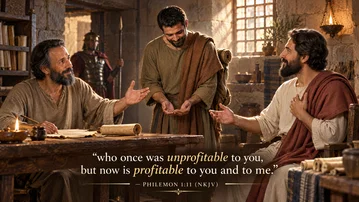
who once was unprofitable to thee, but now is profitable to thee and to me:
who once was to thee unprofitable, and now is profitable to me and to thee,
once unserviceable to thee, but now serviceable to thee and to me:
Him who, at one time, was, unto thee, unserviceable, but, now, unto thee and unto me, serviceable;
Berean Standard Bible, Majority Standard Bible
Formerly he was useless to you, but now he has become useful both to you and to me.
who once was useless to you, but now is useful to you and to me.
Who in the past was of no profit to you, but now is of profit to you and to me:
Which in times past was to thee vnprofitable, but nowe profitable both to thee and to me,
Douay-Rheims (Challoner revision)
Who hath been heretofore unprofitable to thee, but now is profitable both to me and thee,
Pictures


Cross-references
- Philemon 1:16
Not now as a servant, but above a servant, a brother beloved, specially to me, but how much more unto thee, both in the flesh, and in the Lord?
Onesimus, once unprofitable, is now to be received as a beloved brother.
- Colossians 4:9
With Onesimus, a faithful and beloved brother, who is one of you. They shall make known unto you all things which are done here.
Onesimus is sent with Tychicus as a faithful and beloved brother.
- Philemon 1:18-19
If he hath wronged thee, or oweth thee ought, put that on mine account;
Paul offers to repay what Onesimus owed, connecting restitution with his changed usefulness.
- Philemon 1:17
If thou count me therefore a partner, receive him as myself.
Paul asks Philemon to receive Onesimus as he would receive Paul.
- Leviticus 25:39-46
And if thy brother that dwelleth by thee be waxen poor, and be sold unto thee; thou shalt not compel him to serve as a bondservant:
Describes Israelite servitude alongside Onesimus’s bondage.
- Galatians 3:28
There is neither Jew nor Greek, there is neither bond nor free, there is neither male nor female: for ye are all one in Christ Jesus.
It says master and slave are made one in Christ.
Commentary
Each commentary is drawn from primary sources: the writings of Ellen G. White and Adventist pioneers and periodicals. Each commentary is separate. Its own words are not a quotation; follow the references to read the source passages.
Ellen G. White
5 sources
The letter belongs to the gospel's power to change the relation between master and servant, set against Roman slavery as a degrading and often brutally cruel system.RH Dec 14, 1911 The unprofitable one is Onesimus, a pagan slave of Philemon, who was a Christian believer in Colosse.AA 456.1–2 Unprofitable means he had formerly been of no benefit or use to Philemon as a disobedient slave.RH Dec 14, 1911AA 457.2–3AA 456.1–2SLP 286.1–2 His unprofitableness took the form of wronging and robbing Philemon and then escaping to Rome.AA 456.1–2
Profitable means that after his conversion he had become useful to both Philemon and Paul through his changed life and service.RH Dec 14, 1911AA 457.2–3AA 456.1–2SLP 286.1–2 The change came through Paul's labors in Rome, where the aged prisoner of Jesus Christ led him to Christ in prison.AA 457.2–3AA 456.1–2 There he heard the words of life, was brought to confess his sins, and was converted to the faith of Christ, so that Paul calls him his son begotten in his bonds.AA 457.2–3AA 456.1–2 His new profitableness appeared in becoming pious and sincere, tenderly caring for Paul's comfort, being zealous in promoting the work of the gospel, and possessing traits of character that would make him a useful helper in missionary labor.AA 456.1–2
His conversion was proved by returning without delay to Philemon to beg forgiveness and plan for the future.AA 456.1–2 Delivering himself up to the master he had wronged was a severe test.AA 456.1–2 Paul promised to hold himself responsible for the sum stolen and sent him with Tychicus carrying letters to churches in Asia Minor.AA 456.1–2 In view of that conversion, Paul does not urge Philemon's Christian duty but entreats him to receive the repentant slave as his own child and as a beloved brother, not merely as a servant but above a servant.AA 457.2–3SLP 286.1–2 He was to be received with such affection that he would choose to dwell with his former master.AA 457.2–3 Paul desired to retain Onesimus to minister to him in his bonds in Philemon's place, yet he would not keep his services unless Philemon of his own accord set the slave free.AA 457.2–3
Sources
Pioneers and periodicals
15 sources
The name Onesimus means useful, so the contrast is that after his conversion his changed character at last fit his name, having been of no benefit when he ran away but becoming helpful in service to both his master and the apostle.RH Dec 14, 1911ST Dec 9, 1908ST Nov 28, 1911ST Nov 28, 1911ST Oct 27, 1909 He had been Philemon's runaway servant who fled to Rome, where he was converted, and Paul sent him back to his master at Colosse as bearer of a letter commending him.ST Dec 9, 1908ST Jan 9, 1907ST Nov 7, 1900ST Nov 29, 1910 Paul appealed for him to be received no longer merely as a servant but as a Christian brother, with Paul himself promising to pay whatever Onesimus owed from his flight.ST Nov 28, 1911ST Nov 7, 1900ST Oct 27, 1909 Against the background of Roman slavery as a degrading and often brutally cruel system, the change shows how the gospel transforms the relation of master and servant, so that physical bondage did not prevent spiritual freedom and those socially divided became one in Christ.RH Dec 14, 1911ST Jan 9, 1907RH Jul 9, 1914ST Feb 2, 1915 It stands as a lesson in practical Christian fellowship, numbering Onesimus among quiet, zealous believers who were useful and strong in faith without being apostles.ST Nov 7, 1900RH Aug 19, 1862
Setting and Wording
The letter is a short epistle written about A.D. 64 while Paul was a prisoner at Rome.ST Jan 9, 1907 Onesimus bore the message on his return to his master, and at the same time carried Paul's epistle to the church at Colosse, where Philemon resided.ST Jan 9, 1907 Onesimus was Philemon's runaway servant and slave, and Philemon was a devout Christian fellow worker acquainted with Paul.ST Dec 9, 1908ST Nov 7, 1900ST Nov 29, 1910 He had run away from his master's household to Rome, where Paul met him and he was converted and baptized.ST Nov 7, 1900ST Nov 29, 1910 Paul recommended him to Philemon and asked Philemon to favor him for Paul's sake, with believers meeting at the house of Onesimus.ST Dec 9, 1908ST Nov 7, 1900
The wording turns on the name Onesimus, which means profitable or useful.ST Dec 9, 1908ST Nov 28, 1911ST Oct 27, 1909 It explains the contrast between past and present, between lack of benefit to Philemon and present benefit to both Philemon and Paul.ST Dec 9, 1908ST Nov 28, 1911ST Oct 27, 1909 After conversion his changed character fit the meaning of his name.ST Nov 28, 1911ST Oct 27, 1909
In time past he had been of no benefit or use to Philemon, having been harmful or useless when he ran away.RH Dec 14, 1911ST Nov 28, 1911ST Nov 28, 1911 After his conversion he had become useful and helpful through service.RH Dec 14, 1911ST Nov 28, 1911RH Apr 28, 1863 His was a changed relation to both Philemon and Paul, now profitable to thee and to me.RH Dec 14, 1911ST Nov 28, 1911RH Apr 28, 1863RH Apr 28, 1863
Gospel Change and Fellowship
The letter shows how the gospel changes the relation between master and servant, set against Roman slavery as a degrading and often brutally cruel system.RH Dec 14, 1911 The conversion of the escaped slave raises the question why the Lord ever permitted the existence of slavery.ST Jan 9, 1907
Paul advised the runaway to return to his master.ST Mar 4, 1913 He sent him back as bearer of a letter highly commending him as a Christian brother, appealing for him to be received not now as a servant but above a servant, not merely as a slave but as a brother.ST Nov 28, 1911ST Nov 7, 1900ST Oct 27, 1909 Paul, now an aged apostle in prison, gave his promise to pay whatever Onesimus owed from when he ran away.ST Nov 7, 1900
The return is treated as voluntary, and the account does not prove that Onesimus was a chattel slave.RH Apr 28, 1863 The verse itself describes his changed relation to Philemon and Paul, from formerly unprofitable to now useful to both, and describes him as having become useful through his service, though it does not establish that he had been enslaved.RH Apr 28, 1863RH Apr 28, 1863
The example is of one brought to a saving knowledge of the true God, where physical bondage did not prevent spiritual freedom.RH Jul 9, 1914 His changed usefulness after becoming a Christian, to both Philemon and Paul, illustrates that social relationships could remain in place while those involved became one in Christ.ST Feb 2, 1915 The verse is a lesson in practical Christian fellowship in the change from an unprofitable runaway servant to a profitable Christian brother.ST Nov 7, 1900 Onesimus, once unprofitable to Philemon but now become useful, is named among many believers who were quiet, zealous, useful, and strong in faith without being apostles.RH Aug 19, 1862
Sources