Philemon 1:10
I beseech thee for my son Onesimus, whom I have begotten in my bonds:
Translations
I beseech you for my son Onesimus, whom I have begotten in my bonds:
King James Version, KJV Cambridge Paragraph Bible, Webster Bible
I beseech thee for my son Onesimus, whom I have begotten in my bonds:
Revised Version, American Standard Version
I beseech thee for my child, whom I have begotten in my bonds, Onesimus,
I entreat thee concerning my child — whom I did beget in my bonds — Onesimus,
I exhort thee for my child, whom I have begotten in [ my] bonds, Onesimus,
I exhort thee concerning my own child, whom I have begotten in my bonds,—Onesimus:
I appeal to you for my child Onesimus, whose father I became while I was in chains.
I appeal to you for my child Onesimus, whose father I became while I was in my chains.
I appeal to you for my child Onesimus, whom I have become the father of in my chains,
My request is for my child Onesimus, the child of my chains,
I beseeche thee for my sonne Onesimus, whome I haue begotten in my bondes,
Douay-Rheims (Challoner revision)
I beseech thee for my son, whom I have begotten in my bands, Onesimus,
Pictures



Cross-references
- Philemon 1:16
Not now as a servant, but above a servant, a brother beloved, specially to me, but how much more unto thee, both in the flesh, and in the Lord?
Onesimus is to be received as a beloved brother, not merely a servant.
- Philemon 1:17
If thou count me therefore a partner, receive him as myself.
Paul asks Philemon to receive Onesimus as he would receive Paul.
- Colossians 4:9
With Onesimus, a faithful and beloved brother, who is one of you. They shall make known unto you all things which are done here.
Onesimus is identified as a faithful and beloved brother from among them.
- Philemon 1:18-19
If he hath wronged thee, or oweth thee ought, put that on mine account;
Paul offers to repay what Onesimus owes.
- Titus 1:4
To Titus, mine own son after the common faith: Grace, mercy, and peace, from God the Father and the Lord Jesus Christ our Saviour.
both call a convert son in the faith
- Philemon 1:14
But without thy mind would I do nothing; that thy benefit should not be as it were of necessity, but willingly.
Paul will not retain Onesimus without Philemon’s consent, so his benefit may be freely given.
- 2 Timothy 1:2
To Timothy, my dearly beloved son: Grace, mercy, and peace, from God the Father and Christ Jesus our Lord.
both call a convert son in the faith
- 2 Timothy 2:1
Thou therefore, my son, be strong in the grace that is in Christ Jesus.
both call a convert son in the faith
- Acts 28:30
And Paul dwelt two whole years in his own hired house, and received all that came in unto him,
Paul’s Roman imprisonment provides the setting for his prison letters.
Commentary
Each commentary is drawn from primary sources: the writings of Ellen G. White and Adventist pioneers and periodicals. Each commentary is separate. Its own words are not a quotation; follow the references to read the source passages.
Ellen G. White
6 sources
The appeal belongs to Paul's time as a prisoner in Rome, where his sufferings in bonds only endeared him more to the Christians in Italy who had eagerly awaited his visit since receiving his letter.AA 447.2 Its plea concerning master and servant is set against a Roman society where slavery was widespread and often enforced through extreme cruelty.RH Dec 14, 1911 Onesimus was a pagan slave of Philemon, a Christian believer in Colosse, whom he had wronged and robbed and then fled from to Rome, where he was poor, distressed and wretched.AA 456.1–2 In Rome Paul relieved Onesimus in his poverty and distress, taught him the truth, and Onesimus listened to the message of life, confessed his sins, and was converted to faith in Christ.AA 456.1–2
The description of Onesimus as a son begotten in bonds means Paul had become his spiritual father by leading him to conversion while Paul was imprisoned.RH Dec 14, 1911AA 457.2–3AA 456.1–2SLP 286.1–2 In making the appeal Paul chooses entreaty rather than urging duty, presenting himself as aged and as a prisoner of Jesus Christ.AA 457.2–3 The conversion changed Onesimus from unprofitable to useful.RH Dec 14, 1911SLP 286.1–2 After conversion Onesimus was pious and sincere, tenderly cared for Paul's comfort, was zealous in promoting the gospel, and showed traits of character fitting him to be a useful helper in missionary labor.AA 456.1–2
On that basis Paul appeals for Philemon to receive the repentant Onesimus with affection as a child, not merely as a servant but as a beloved brother, with such affection that Onesimus would choose to dwell with his former master.RH Dec 14, 1911AA 457.2–3SLP 286.1–2 Paul desires to retain Onesimus to minister to him in his bonds in Philemon's place, yet only if Philemon of his own accord sets him free, leaving the decision to free him voluntarily with Philemon.AA 457.2–3SLP 286.1–2 The genuineness of the conversion was proved by obedience under a severe test, when Onesimus returned without delay to beg forgiveness and plan for the future and delivered himself up to the master he had wronged, sent back with Tychicus, with Paul holding himself responsible to repay what had been stolen.AA 456.1–2
Sources
Pioneers and periodicals
19 sources
Paul pleads for Onesimus, who became his son in the faith when Paul brought him to the gospel while imprisoned at Rome, with his very name meaning profitable.RH Dec 14, 1911RH Apr 28, 1863ST Dec 9, 1908ST Jan 9, 1907
He sends Onesimus back as the bearer of the letter, asking Philemon to receive him with grace as a beloved Christian brother above a servant and promising to pay whatever he owed.RH Dec 14, 1911RH Apr 28, 1863ST Dec 9, 1908
Onesimus had been Philemon's bondservant who ran away to Rome, while those who held the other teach that he had not been chattel property but a trusted member of the household who betrayed its trust and wrongfully departed.RH Apr 28, 1863ST Dec 9, 1908ST Jan 9, 1907RH Apr 28, 1863
His being begotten shows how sinners are begotten as God's children through the truth, so that even those in physical bondage enter spiritual freedom and stand equally precious and one in Christ with their masters.RH Mar 20, 1856ST Feb 2, 1915RH Jul 9, 1914
Paul therefore acts as a regenerator rather than a reformer, returning the converted and baptized Onesimus instead of seeking change by repeal of unjust laws, and making the appeal a lesson in practical Christian fellowship.ST Nov 29, 1910ST Nov 7, 1900ST Mar 4, 1913
Meaning and Historical Setting
"My son, whom I have begotten in my bonds" means Onesimus had become Paul's spiritual son when Paul brought him to faith through the gospel while Paul was a prisoner, not that he was Paul's natural child.RH Dec 14, 1911RH Apr 28, 1863ST Dec 9, 1908RH Mar 20, 1856ST Nov 29, 1910 This calling of a convert a son is the practice of a minister toward his converts, as with Timothy and Titus, and as Elisha was a son in the faith to Elijah and regarded Elijah as his father.ST Jul 21, 1898 The meeting took place at Rome, where Onesimus had fled and where he met Paul in prison, was converted through him, and became his son in the faith.ST Jan 9, 1907ST Nov 7, 1900
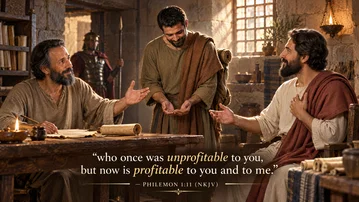
The name Onesimus means profitable, which explains verses 10 and 11, for his conversion changed him from one once unprofitable to Philemon into one useful and profitable.RH Dec 14, 1911ST Dec 9, 1908ST Oct 27, 1909 Paul beseeches and pleads for him, asking Philemon to show him favor for Paul's sake and to receive him with affection and grace as a child, a beloved brother, and a Christian brother above a servant.RH Dec 14, 1911ST Dec 9, 1908ST Nov 28, 1911ST Nov 7, 1900 Paul sent Onesimus back as the bearer of the letter and promised to pay whatever Onesimus owed from running away.ST Jan 9, 1907ST Nov 7, 1900 The letter addresses the relation of master and servant in a society where slavery was widespread and often enforced through extreme cruelty.RH Dec 14, 1911
On the common understanding, Onesimus had been Philemon's slave, servant, and bondman who ran away, fled to Rome, and then returned to his master.ST Jan 9, 1907ST Nov 29, 1910ST Nov 7, 1900ST Mar 4, 1913 After his conversion and baptism, he returned to his master.ST Nov 29, 1910 On another understanding, the verse itself does not establish that Onesimus was enslaved, and there is no proof he had been a chattel slave.RH Apr 28, 1863RH Apr 28, 1863RH Apr 28, 1863 He had held a respectable and advantageous position in Philemon's household, betrayed its trust, and wrongfully departed, so the appeal to receive him is evidence he was not being returned as chattel property.RH Apr 28, 1863 His conversion did not make him believe that he was another person's property or morally obliged to return to chattel slavery, and he could have avoided returning.RH Apr 28, 1863
The same Onesimus is identified as the first student at the school in Monkullu, a Galla slave who was educated in Sweden and became a great help in missionary work.RH Jun 25, 1908
Gospel Teaching and Application
To be begotten in bonds illustrates how people are begotten as God's children through the truth at conversion, while their birth into eternal life remains still future, to take place at the resurrection.RH Mar 20, 1856 Onesimus shows that those held in physical bondage could be brought to spiritual freedom and to a saving knowledge of God, for as Philemon's enslaved servant he came to know God through Paul while Paul was imprisoned.RH Jul 9, 1914 That changed Christian relationship did not necessarily erase his worldly status as a bondman, for Paul sent him back to his master Philemon, who was also a Christian, yet master and servant were both equally precious to God and one in Christ.ST Feb 2, 1915
Paul appealed to Philemon on behalf of Onesimus the runaway slave, calling him son because he had become spiritually new through Paul's ministry while Paul was imprisoned, and advised him to return to his master rather than seeking change through the repeal of unjust laws, acting as a regenerator rather than a reformer.ST Mar 4, 1913 The appeal is a lesson in practical Christian fellowship, grounded in Philemon's standing as a devout Christian, for Paul pleaded for the runaway servant who had fled to Rome, met him in prison, converted him to become his son in the faith, then sent him back to his master as bearer of the letter, commending him as a Christian brother above a servant and promising himself to pay whatever was owed from his running away.ST Nov 7, 1900 In this pleading for the one he had brought to faith while imprisoned, Onesimus stands as one example of a faithful, useful believer who was not an apostle.RH Aug 19, 1862
Sources