Revelation 1:12
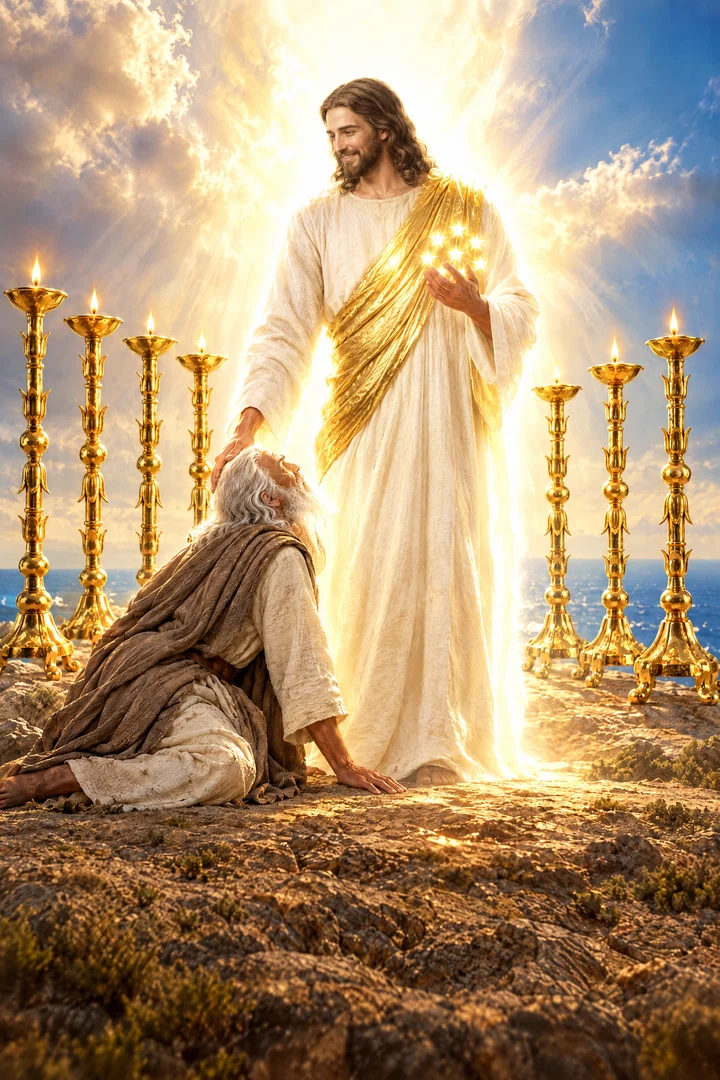
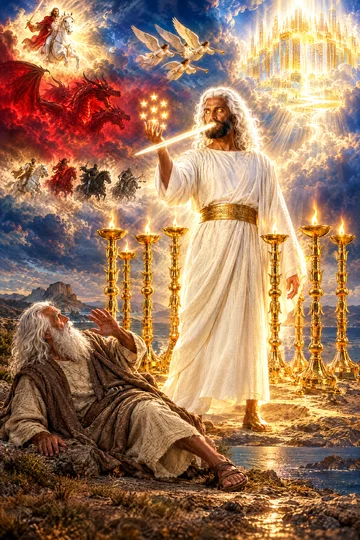
And I turned to see the voice that spake with me. And being turned, I saw seven golden candlesticks;
Translations
And I turned to see the voice that spoke with me. And being turned, I saw seven golden candlesticks;
King James Version, KJV Cambridge Paragraph Bible
And I turned to see the voice that spake with me. And being turned, I saw seven golden candlesticks;
And I turned to see the voice that spoke with me. And having turned, I saw seven golden candlesticks;
And I turned to see the voice which spake with me. And having turned I saw seven golden candlesticks;
And I turned to see the voice that spake with me. And having turned I saw seven golden candlesticks;
And I did turn to see the voice that did speak with me, and having turned, I saw seven golden lamp-stands,
And I turned back to see the voice which spoke with me; and having turned, I saw seven golden lamps,
And I turned round, to see the Voice which was speaking with me, and, having turned, I saw Seven Lamps of gold;
Then I turned to see the voice that was speaking with me. And having turned, I saw seven golden lampstands,
And there I turned to see the voice that was speaking with me. And having turned, I saw seven golden lampstands,
I turned to see the voice that spoke with me. Having turned, I saw seven golden lamp stands.
And turning to see the voice which said these words to me, I saw seven gold vessels with lights burning in them;
Then I turned backe to see the voyce, that spake with me: and when I was turned, I sawe seuen golden candlestickes,
Douay-Rheims (Challoner revision)
And I turned to see the voice that spoke with me. And being turned, I saw seven golden candlesticks:
Pictures
Cross-references 20 of 30
- Revelation 1:20
The mystery of the seven stars which thou sawest in my right hand, and the seven golden candlesticks. The seven stars are the angels of the seven churches: and the seven candlesticks which thou sawest are the seven churches.
The seven candlesticks represent the seven churches.
- Revelation 2:1
Unto the angel of the church of Ephesus write; These things saith he that holdeth the seven stars in his right hand, who walketh in the midst of the seven golden candlesticks;
Christ walks among the seven golden candlesticks and holds the stars.
- Revelation 1:17-18
And when I saw him, I fell at his feet as dead. And he laid his right hand upon me, saying unto me, Fear not; I am the first and the last:
The living Christ reassures John, declaring that he lives forevermore after being dead.
- Revelation 4:5
And out of the throne proceeded lightnings and thunderings and voices: and there were seven lamps of fire burning before the throne, which are the seven Spirits of God.
The seven lamps before the throne are the heavenly counterpart of the sanctuary candlestick.
- Exodus 25:37
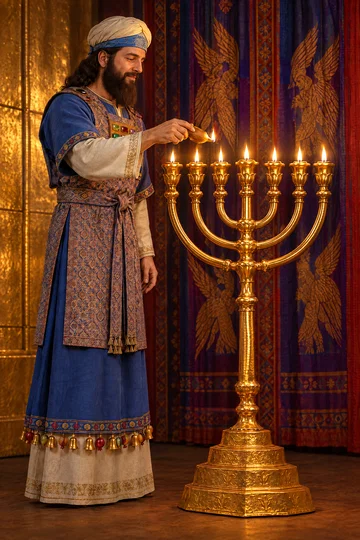
And thou shalt make the seven lamps thereof: and they shall light the lamps thereof, that they may give light over against it.
The sanctuary candlestick had seven lamps, corresponding to the seven golden lampstands.
- Revelation 1:16
And he had in his right hand seven stars: and out of his mouth went a sharp twoedged sword: and his countenance was as the sun shineth in his strength.
Christ holds the stars, representing his church’s ministers, in his right hand.
- Matthew 5:15
Neither do men light a candle, and put it under a bushel, but on a candlestick; and it giveth light unto all that are in the house.
The candlestick holds the light so it can be seen.
- Hebrews 8:5
Who serve unto the example and shadow of heavenly things, as Moses was admonished of God when he was about to make the tabernacle: for, See, saith he, that thou make all things according to the pattern shewed to thee in the mount.
The earthly sanctuary is a pattern of heavenly things.
- Hebrews 9:2
For there was a tabernacle made; the first, where in was the candlestick, and the table, and the shewbread; which is called the sanctuary.
Places the candlestick in the first apartment, the Holy Place.
- Revelation 2:5
Remember therefore from whence thou art fallen, and repent, and do the first works; or else I will come unto thee quickly, and will remove thy candlestick out of his place, except thou repent.
The candlestick can be removed from its place if the church does not repent.
- John 8:12
Then spake Jesus again unto them, saying, I am the light of the world: he that followeth me shall not walk in darkness, but shall have the light of life.
Christ is the light represented by the candlesticks.
- Revelation 1:1-3
The Revelation of Jesus Christ, which God gave unto him, to shew unto his servants things which must shortly come to pass; and he sent and signified it by his angel unto his servant John:
Introduces the revelation John received from Christ.
- Hebrews 8:1-2
Now of the things which we have spoken this is the sum: We have such an high priest, who is set on the right hand of the throne of the Majesty in the heavens;
Identifies Christ’s true Tabernacle as the heavenly sanctuary.
- Hebrews 9:11
But Christ being come an high priest of good things to come, by a greater and more perfect tabernacle, not made with hands, that is to say, not of this building;
Christ ministers as High Priest in the greater, heavenly tabernacle.
- Exodus 40:24
And he put the candlestick in the tent of the congregation, over against the table, on the side of the tabernacle southward.
The earthly sanctuary’s golden candlestick corresponds to John’s vision.
- Exodus 25:40
And look that thou make them after their pattern, which was shewed thee in the mount.
The earthly sanctuary objects followed the heavenly pattern shown to Moses.
- Revelation 1:19
Write the things which thou hast seen, and the things which are, and the things which shall be hereafter;
The vision is framed as revelation of present and future events.
- Revelation 3:1-4
And unto the angel of the church in Sardis write; These things saith he that hath the seven Spirits of God, and the seven stars; I know thy works, that thou hast a name that thou livest, and art dead.
Christ addresses Sardis with correction and a call to spiritual faithfulness.
- Zechariah 4:2
And said unto me, What seest thou? And I said, I have looked, and behold a candlestick all of gold, with a bowl upon the top of it, and his seven lamps thereon, and seven pipes to the seven lamps, which are upon the top thereof:
parallels seven-branched candlestick symbol
- Exodus 30:7-8
And Aaron shall burn thereon sweet incense every morning: when he dresseth the lamps, he shall burn incense upon it.
The high priest tended the lamps; Christ appears among the candlesticks.
Commentary
Each commentary is drawn from primary sources: the writings of Ellen G. White and Adventist pioneers and periodicals. Each commentary is separate. Its own words are not a quotation; follow the references to read the source passages.
Ellen G. White
59 sources
Turning to find the trumpet-like voice speaking behind him, John was shown seven golden lampstands which are the seven churches in Asia and in their perfect number all the churches in the world.ST Feb 4, 1903Ms 161, 1904, par. 17–18Ms 46, 1904, par. 3–6Ms 155, 1902, par. 10–11Lt 110, 1902, par. 9–10 Standing in their midst was the risen Lord Himself in personal, glorified form, robed as priest with white hair, flaming eyes, burnished feet, voice as many waters, seven stars in His right hand and countenance as the sun.AA 581.4–582.2Ms 150, 1899, par. 13–15Ms 161, 1904, par. 17–18Lt 63a, 1893, par. 62–63Lt 63, 1893, par. 65–67 His standing and walking among the lampstands shows His constant communion, wakeful vigilance and sustaining care, supplying oil and light to churches that have no light of their own.RH Nov 19, 1901Ms 78, 1900, par. 46Ms 100, 1893, par. 4EDFCP 3.1–2Lt 32, 1906, par. 2 The sight was given to John in old age in exile on desolate Patmos, in the Spirit on the holy Sabbath, when cut off from companions and labor yet not cut off from God, to open before him the future of the church and the world.Ms 136, 1902, par. 3–5Ms 53, 1890, par. 46–47Lt 91, 1896, par. 2–6Ms 100, 1893, par. 2–35T 752.3 It begins the revelation of Christ as He will appear in power and great glory in the last days, carrying an earnest warning to prepare to meet the Lord and a call to receive His light and pass it on to those in darkness.Ms 161, 1904, par. 17–18Ms 46, 1904, par. 3–6Lt 386, 1904, par. 1STB 404.5–405.1EDFCP 3.1–2
Vision Setting on Patmos
John in old age was banished to the desolate Isle of Patmos for the word of God and the testimony of Jesus and for fidelity to his Saviour.Ms 136, 1902, par. 3–5Lt 91, 1896, par. 2–6Ms 100, 1893, par. 2–3 The banishment came by men moved by Satan to persecute faithful witnesses, at a time of fierce persecution and great darkness when Satan seemed to triumph over God's faithful witnesses and outwardly triumphed in exiling him.Lt 91, 1896, par. 2–6Ms 100, 1893, par. 2–318MR 77.1–2 He was separated from his companions in the faith and cut off from his gospel labors and from the society of brethren, deprived by his exilers yet with God's unseen hand placing him where a more wonderful revelation could be given.Ms 100, 1893, par. 2–318MR 77.1–2 Yet he was not separated from the presence of God and not left without the light and revelation of Christ, so that the desolate place of his exile became to him the gate of heaven and barren Patmos was made a heaven by light shining richly from Christ to His servant.Ms 100, 1893, par. 2–3Ms 94, 1897, par. 38–3918MR 77.1–2 This was more than half a century after leaning on the bosom of his Lord whom he loved and delighted to honor above all others, and there he beheld the glorified person of his Lord in His glorified humanity, Christ as the Lamb slain from the foundation of the world and the Lion of the tribe of Judah soon to ride forth conquering and to conquer.Ms 136, 1902, par. 3–5Ms 53, 1890, par. 46–47
He was in the Spirit on the Lord's day, the holy Sabbath blessed and set apart by God as His own.Ms 150, 1899, par. 13–15Lt 91, 1896, par. 2–6Ms 100, 1893, par. 2–3Ms 193, 1905, par. 1–4 That day is the Sabbath instituted in Eden as a perpetual sign and covenant that the Lord sanctifies His people, which John treasured while claiming God's promises.Ms 150, 1899, par. 13–15 While in that state on the Sabbath he was visited by the heavenly messenger and heard behind him a great voice as of a trumpet.Ms 150, 1899, par. 13–15Lt 91, 1896, par. 2–6Ms 100, 1893, par. 2–3
The voice was that of the One he honored and loved, declaring I am Alpha and Omega, the first and the last.Ms 150, 1899, par. 13–15Ms 53, 1890, par. 46–47Lt 91, 1896, par. 2–6Ms 100, 1893, par. 2–3 It commanded what he saw to be written in a book and sent to the seven churches in Asia — unto Ephesus, and unto Smyrna, and unto Pergamos, and unto Thyatira, and unto Sardis, and unto Philadelphia, and unto Laodicea.ST Feb 4, 1903Ms 150, 1899, par. 13–15Ms 155, 1902, par. 10–11Ms 53, 1890, par. 46–47Ms 100, 1893, par. 2–3 Turning in holy vision to see the voice that spoke with him behind him, he saw seven golden candlesticks, with one like unto the Son of man standing in their midst.ST Feb 4, 1903Ms 150, 1899, par. 13–15Ms 155, 1902, par. 10–11Lt 91, 1896, par. 2–6Ms 100, 1893, par. 2–3
This turning toward the speaker began his impression of his Lord, by which Christ opened to him the future of the church and of the world.Ms 136, 1902, par. 3–5 That vision and command were not for John alone nor for those churches alone, but through those churches the inspired message was to come to God's people with powerful impression in every age to the close of this earth's history.Ms 53, 1890, par. 46–47
Christ Appearing in Glory
Turning, John saw one like the Son of man standing in the midst of the seven golden candlesticks, and this was his encounter on Patmos with the risen, glorified Lord appearing among them in personal form, not as an essence.AA 581.4–582.2Ms 150, 1899, par. 13–15Ms 161, 1904, par. 17–18Ms 131, 1903, par. 11–15Ms 188, 1905, par. 32–34 His coming personally to John is clearly set forth in the first chapter, and His appearance is evidence that He is risen and alive and gives living power to the church.Ms 106, 1897, par. 26–2818MR 78.2Ms 106, 1897, par. 29–30 He appeared in glory clothed with a long priestly garment down to the foot and girt about with a golden girdle.Lt 63a, 1893, par. 62–63Lt 63, 1893, par. 65–67Ms 23, 1903, par. 3–5 His head and hair were white like wool, as white as snow, His eyes as a flame of fire, His feet like fine brass burned in a furnace, and His voice as the sound of many waters.Lt 63a, 1893, par. 62–63Lt 63, 1893, par. 65–67Ms 23, 1903, par. 3–5 Seven stars were in His right hand, a sharp two-edged sword went out of His mouth, and His countenance was as the sun shining in strength.Lt 63a, 1893, par. 62–63Lt 63, 1893, par. 65–67Ms 23, 1903, par. 3–5
He touched John and declared Himself the first and the last, He that lives and was dead and is alive forevermore, having the keys of hell and of death.Lt 63a, 1893, par. 62–63Ms 100, 1893, par. 2–3Lt 63, 1893, par. 65–67 He laid His right hand upon John, saying Fear not, and commanded him to write the things which he had seen, and the things which are, and the things which shall be hereafter.Lt 63a, 1893, par. 62–63Ms 100, 1893, par. 2–3Lt 63, 1893, par. 65–67 The glory was too great for human strength to endure, so that John fell at His feet as dead, but Christ revived and strengthened him to endure the sight.Ms 165, 1904, par. 12–13Ms 169, 1902, par. 12–14 The sight is part of the revelation of Christ to John, a wonderful, dignified, exalted, solemn message received while John was worked by the Holy Spirit, with Christ Himself coming from heaven to tell him what to write.Ms 139, 1903, par. 33–3418MR 37.1 Presenting that message with decided emphasis demands all the talents and capabilities God has given, and every word in the chapter carries weight and deserves careful attention.Ms 139, 1903, par. 33–3418MR 37.1Ms 106, 1897, par. 26–28
The majesty, glory, preciousness, and love of Jesus thus revealed is now dimly seen, little realized, and imperfectly experienced.Ms 143, 1901, par. 53–58Lt 63, 1893, par. 65–67 It must be sought by faith on earth with prayer to be shown His glory, for if the Redeemer's glory is not seen by faith on earth it will never be seen in its fullness in heaven above.Ms 143, 1901, par. 53–58Lt 63, 1893, par. 65–67
Seven Golden Candlesticks
When he turned to see the voice speaking with him, what John saw was seven golden candlesticks, also called seven gold lampstands, and those candlesticks are the seven churches.ST Feb 4, 1903Ms 161, 1904, par. 17–18Ms 46, 1904, par. 3–6Ms 139, 1903, par. 33–34RH Nov 19, 1901 They are the seven churches in Asia to which he was commanded to write what he saw in a book, unto Ephesus, and unto Smyrna, and unto Pergamos, and unto Thyatira, and unto Sardis, and unto Philadelphia, and unto Laodicea.ST Feb 4, 1903Ms 155, 1902, par. 10–11Lt 43, 1905, par. 2–3 The number seven represents a perfect whole, and these seven represent all the churches in the world.Lt 110, 1902, par. 9–10
The sight belongs to a mystery unfolded rather than a sealed book, given to be understood concerning the scenes to take place in the last days of this earth's history.Ms 46, 1904, par. 3–6 It is presented with words of explanation that give what is of greatest importance for the present and reaches from time into eternity.Ms 46, 1904, par. 3–6Ms 175, 1903, par. 10
Christ Walking Among Churches
Christ stands in the midst of the seven golden candlesticks and walks among them, and His walking signifies constant communication, relation and communion with His people as well as untiring wakefulness and unremitting vigilance.RH Nov 19, 1901Ms 78, 1900, par. 46Ms 100, 1893, par. 4AA 586.1–2Ms 50, 1900, par. 19 The candlesticks are His churches, and He goes from church to church, from congregation to congregation, from soul to soul.Ms 100, 1893, par. 4AA 586.1–2ST2 42.3 Though He is High Priest and Mediator in the sanctuary above and amid the glory of the holy sanctuary, He is also present with the churches on earth, so that His divine presence is in churches everywhere and heaven is closely connected with events on earth.Ms 168, 1907, par. 15Ms 100, 1893, par. 4AA 586.1–2Lt 111a, 1904, par. 21–225T 753.3
He knows the true state and condition of each church and observes its order, vigilance, piety and devotion, watching whether the light of any sentinel is burning dim or going out even when under-shepherds sleep or become occupied with lesser matters.Ms 100, 1893, par. 4AA 586.1–2ST2 42.3 As the True Witness He sees their spiritual condition and bears a solemn message, so that the church that leaves its first love must repent and return to its first works or its candlestick will be removed.5MR 51.1–52.2 He is the true Watchman in the Lord's house and the true Warden of the temple courts, whose continued watchcare and sustaining grace are the source of the churches' life and light, for left to mere human care the flickering flame would languish and die.Ms 100, 1893, par. 4AA 586.1–2ST2 42.3
The churches do not shine by their own power, for Christ supplies the oil and kindles their lamps, and all their light comes from Him.EDFCP 3.1–2Ms 1a, 1890, par. 5–6 He is their source of light and spiritual power, takes pleasure in them, and remains among them to help, comfort, support and strengthen them.Lt 32, 1906, par. 2 He holds the seven stars in His right hand and intends His light to shine through them to the world.RH Nov 19, 1901 The stars are His ministers under His special care and protection, known by number and by name and greater in blessing to the church than stars are to the world, who serve as instruments through His grace and the Holy Spirit to make known His will, direct their work as laborers together with Him, and carry the last message of mercy with His abiding presence to the end of the world.Ms 23, 1903, par. 3–5Lt 32, 1906, par. 2
With the following verse the scene presents Christ standing among them as Saviour actively ministering for His people, as the angel stood for Joshua on the day of atonement.Ms 124, 1901, par. 18–19 Clothed with a garment down to the foot and girt about the breast with a golden girdle, He stands as Redeemer against Satan the adversary who accuses His people as transgressors of the law, and His work there is the same as Joshua the high priest's work on the day of atonement in behalf of the children of Israel, ministering as Sin-bearer and Substitute who takes away the sin of the repentant, believing transgressor and cannot Himself be accused.17MR 242.1–2 In Him is seen the mercy, tenderness and love of God blending with holiness, justice and power, so that mercy and truth meet together and righteousness and peace kiss each other, sinners find in Him a Father of whom their sins had made them afraid, and instead of fleeing from God because of sin they flee to His arms for protection and pardon, and the throne terrible in unbelief becomes a place of refuge in repentance.Ms 38, 1905, par. 8 As God's gift endowing human beings with imperishable riches, the mighty Redeemer who belongs to His people by creation and redemption and who is full of love and assurance, He is to be clung to and come to without fear of being cast out, and not dishonored by turning from His promises to seek help from human beings or to trace words of doubt against Him.Ms 5, 1901, par. 5–7
Though the church is enfeebled and defective, it is the object of His supreme regard, and He constantly watches over it with tender solicitude, caring for and working to sanctify and ennoble His followers and strengthening it by His Holy Spirit.Ms 78, 1900, par. 46ST Feb 4, 1903 The vision shows how great is God's care for those who are loyal to Him: the world is not without a ruler, the program of coming events is in the hands of the Lord, and the Majesty of heaven has the destiny of nations as well as the concerns of His church in His own charge, so that God's servants in great emergency are not to trust to themselves.5T 753.3
Prophecy of Last Days
The turning to see the voice opens the revelation of God as He will appear when He comes in the clouds of heaven with power and great glory.Ms 161, 1904, par. 17–18 It belongs to the mystery unfolded, not a sealed book, given to be understood concerning the scenes to take place in the last days of this earth's history, when the enemy will bring in every deceptive design.Ms 46, 1904, par. 3–6 What was seen was a personal being, not an essence, one like the Son of man standing in the midst of seven golden candlesticks, which are the seven churches.Ms 161, 1904, par. 17–18 Christ visited the aged John on the Isle of Patmos to give this revelation of what should be in the last days; John was in the Spirit on the Lord's day and heard behind him a great voice as of a trumpet, declaring Himself Alpha and Omega, the first and the last, and commanding what he saw to be written in a book and sent to the seven churches.Ms 92, 1903, par. 2–7 The same revelation concerns the last days of earth's history.Ms 99, 1909, par. 42–47
It was given just before God opened to John the history of the church for future ages, to assure him of the Saviour's interest and care for His people, with Christ seen as One like unto the Son of man walking among the candlesticks which symbolize the seven churches.5T 752.3 More than half a century after leaning on the bosom of his Lord, while banished to Patmos for fidelity to his Saviour, John turned toward the voice and beheld the glorified person of his Lord, Christ as the Lamb slain from the foundation of the world and the Lion of the tribe of Judah soon to ride forth conquering and to conquer, and this turning began his impression of his Lord by which the future of the church and of the world was opened to him.Ms 136, 1902, par. 3–5 The revelation is light and solemn truth revealed by Jesus Christ for the world, including truths about events before Christ's second coming.SLP 10.1–13.1 In that meeting during exile the vision showed John the future extending to Christ's coming and revealed the glories of the heavenly home.Lt 10, 1879, par. 4–9
The first three chapters in which the turning stands give an earnest warning to prepare to meet the Lord in the clouds of heaven, for He comes with power and great glory, rebuking indifference to the signs foretold by Christ and giving evidence that the end of the world is right upon us.Lt 386, 1904, par. 1 Heeding the message Christ came from heaven to give John is a present duty.STB 404.5–405.1 Those first, second, and third chapters contain the messages to the churches, which give the history of Satan's effort to bring dissension into the church and apply to difficulties that must be met today.Lt 31, 1903, par. 6
What John saw was Christ's second advent beheld in the days of the early Christians, when He came to the Isle of Patmos and revealed Himself in glory to John, distinct from His first advent as an infant at Bethlehem.Ms 169, 1902, par. 12–14 The glory caused John to fall at Christ's feet as dead, but Christ strengthened him to endure the sight, then gave him a message to write to the churches of Asia, whose names describe the characteristics of every church.Ms 169, 1902, par. 12–14 The light of this revelation is for the present time and must be read, understood, and proclaimed with no uncertain sound to warn the world.Ms 169, 1902, par. 12–14 The entire revelation given to John was already rehearsed by Moses in the Exodus and in the plagues brought upon Egypt, with no contradiction in the Word of God, so the verse stands in full harmony with the Exodus account and Scripture can only be tested by Scripture.Ms 132, 1898, par. 1
In this appearance Christ came to reveal heavenly mysteries, and through prayerful study the book gives a final warning message to the world and helps readers understand Christ's position and His relation to God and humanity.Ms 165, 1904, par. 3–5
Assurance and Calling
God's unseen hand placed His servant on lonely Patmos where enemies thought to extinguish the light, that Christ might give him a more wonderful revelation of Himself and His glory to give to the world, preparing him to endure hatred and scorn for the word of God and the testimony of Jesus and turning the effort to silence truth into its bold relief.18MR 77.1–2 He leads His children by a way they know not, yet does not forget or cast off those who trust Him, permitting trials to teach submission, patience and faith, so that by constancy and obedience they are spiritually enriched and their example strengthens others, with the severest trials that make it seem He has forsaken leading closer to Christ to lay burdens at His feet and receive His peace in exchange.18MR 77.1–2PP 129.2
That same Jesus who visited John will visit isolated believers in their own island home, so that though cut off from the world by the broad ocean they are not alone but have with them His all-sufficient and all-powerful presence.Lt 91, 1896, par. 2–6 Light from the Son of God shone upon barren Patmos and made it heaven to the lonely exile, and if believers keep close to Jesus their home will be honored by the divine presence found by all who call upon Him with griefs and troubles large or small.Lt 91, 1896, par. 2–6 Christ still reveals Himself to His chosen ones in prison and is with them even at the stake and in the fire, His appearance to John being evidence that He is risen and gives living power to the church.18MR 78.2Ms 106, 1897, par. 29–30 When dark clouds of oppression surround God's people the most instructive lessons are given and the most brilliant beams of glory are revealed in the deepest gloom, for as stars shine brightest in the darkest night so the beams of the Sun of Righteousness shine most clear and impressive when the sky is darkest.18MR 78.2
The first chapter containing the turning to see the voice and the seven golden lampstands which are the churches with Christ in their midst is to be studied carefully and prayerfully and kept in heart and mind instead of filling the mind with trashy stories and worthless reading.Lt 43, 1905, par. 2–3Lt 110, 1902, par. 9–10Ms 193, 1905, par. 1–4 It is to be taught to those unacquainted with the truth in camp-meetings and to be studied, believed and preached today with its light not hidden, since the number seven denotes a perfect whole and the seven churches represent all the churches in the world.Lt 110, 1902, par. 9–10 Its message helps believers understand how to escape the perils of the last days and where to place dependence, in God and not in human beings, upon wholehearted love for God and love for neighbor on which the law and the prophets depend.Ms 159, 1904, par. 5 Members should allow Him to impress their minds and work through them to His glory, heed and obey the messages He gives to make certain their redemption, and determine to be among those who meet Him with joy at His coming and not among those who shall wail because of Him.ST Feb 4, 1903
The churches do not shine by their own power, for Christ supplies the oil and kindles their lamps and all their light comes from Him.EDFCP 3.1–2Ms 1a, 1890, par. 5–6 The church receives this divine light and must pass that light and glory on to people in darkness, for receiving light without sharing it leaves a person in darkness and makes the church a receptacle of darkness.EDFCP 3.1–2Ms 1a, 1890, par. 5–6 As the True Witness present among the candlesticks He walks among them, sees their spiritual condition and bears a solemn message, and the church that leaves its first love must repent and return to its first works or its candlestick will be removed.5MR 51.1–52.2 He ministers to servants who bear the message of heaven, the truth for this time, so reconverted members are to proclaim that truth with lips touched with a live coal from the divine altar and to help ministers by prayer and faith instead of criticizing and censuring them.Lt 111a, 1904, par. 21–22
Sources
Pioneers and periodicals
94 sources
John turned toward the voice speaking from behind him and on turning saw seven golden lampstands.RH Jun 3, 1862RH Oct 9, 1900ST May 31, 1905 The lampstands are the seven churches of Ephesus, Smyrna, Pergamum, Thyatira, Sardis, Philadelphia, and Laodicea.ST Feb 4, 1903RH Jun 3, 1862RH Oct 9, 1900RH Sep 7, 1911ST Dec 4, 1893 The number seven signifies fullness and completeness, so they represent the entire church through the whole Christian age.ST Nov 19, 1912RH Mar 26, 1861ST Jan 28, 1903 The voice is Jesus Christ, who stands and walks among the lampstands, present with His people to care for, protect, uphold, and searchingly supervise them.RH Nov 19, 1901RH Jun 3, 1862ST Jan 24, 1911RH Nov 17, 1910RH Jan 22, 1857 The churches represent seven successive periods from the apostolic age to the close of probation, portraying the condition and experience of the church to the end of time.ST Nov 18, 1886ST Nov 28, 1895RH Mar 26, 1861 The scene places Christ in priestly garments ministering in the Holy Place of the heavenly sanctuary among His churches as mediator for the world.RH Jun 9, 1851RH May 11, 1869RH Jan 1851
Turning Toward the Voice
John turned toward the voice speaking from behind him to see it, and on turning saw seven golden candlesticks.RH Jun 3, 1862RH Oct 9, 1900ST May 31, 1905ST Nov 22, 1910RH Oct 9, 1900 The voice he turned to see was the voice of Jesus Christ, the Conquering One with right to call and command, the same voice from heaven that spoke to Saul.ST Jan 24, 1911RH Jan 22, 1857 The turning took place on the Isle of Patmos, where John was banished for faithfulness to the Word of God and the testimony of Jesus, in the Spirit on the Lord's day.ST Feb 27, 1912ST May 26, 1914RH Aug 26, 1862
The Lord's day on which the vision came is the seventh day of the week, the Sabbath instituted at creation when God rested and blessed and sanctified it and set it apart as a memorial of creation.ST Feb 27, 1912ST May 13, 1897 John observed it as sacredly on Patmos as he had in Judea, and by the vision Christ honored him for steadfast obedience.ST Feb 27, 1912ST May 13, 1897ST May 26, 1914 Those who held the first day of the week to be the Lord's day taught that John received the church's prophetic history on Patmos on the first day of the week.ST Dec 11, 1901 The vision was given near the close of the first century, about A.D. 96, when John was more than ninety years old and a distinguished prophet, after Christ's heavenly ministration had been in progress for more than sixty years.RH Sep 7, 1911ST Dec 10, 1912RH Jul 14, 1904RH May 21, 1861 The visions came about twenty-six years after the week of confirmation, showing that spiritual gifts and visions continued beyond the founding of the church and were not given only to confirm the covenant.RH Jun 9, 1853
The verse belongs to the first vision, covering Revelation 1-3, which introduces the messages to the seven churches and is part of the disclosure of Jesus Christ as man's Sacrifice and Saviour, Priest, Captain, and everlasting King.RH Mar 26, 1861RH Mar 26, 1861ST Dec 9, 1913ST Dec 16, 1908 It belongs to the opening chapters presenting three series of sevens covering the entire gospel age, including the seven churches, seven seals, and seven trumpets spanning the Christian dispensation and ending in Christ's coming glory and kingdom when He gathers His people.ST May 13, 1880ST Oct 14, 1889 The turning introduces a most glorious description of Christ in divine majesty as He will appear when He returns in glory, matching the man clothed in linen with loins girded with pure gold of Uphaz seen by Daniel by the Hiddekel.RH Dec 11, 1900ST Apr 9, 1912RH Apr 12, 1915
The unveiled glory could not be endured by mortal man because sin and its consequences have separated man from his Creator.ST Aug 25, 1898 John fell at His feet as dead, overcome with terror unable to speak or stir, until Jesus laid His right hand on him saying, Fear not; I am the first and the last, and this giving of God and holy things their just position molds entire worship and keeps from self-display and careless irreverent speech about sacred things.RH Mar 15, 1870RH Jan 22, 1857 By contrast, Paul when smitten to the earth and blinded by the light and glory kept self-control and subjection of his emotions and calmly asked what was wanted of him.RH Jan 22, 1857 The vision was given to reassure the church that she has a living Saviour who was dead and is alive forevermore, repeating the assurance because frail humanity needs reassuring and added instruction.ST Jun 14, 1905ST Jun 26, 1901 The revelation is not sealed but can be studied verse by verse and clearly understood through the Spirit in light of other scriptures and authentic history, for it interprets its own symbols and provides the key for other symbolic prophecies.ST Jun 14, 1905RH Sep 2, 1909ST Feb 7, 1906
It covers the nations from Babylon to the end, including the United States, with events already fulfilled, events now fulfilling, and near future events concerning the present time, and it is to be studied and taught together with Daniel 7 and 8 as the complement of Daniel, giving blessing for those who read, hear, and keep it and giving the one way of salvation by personal faith in a personal Saviour preached from Eden until now.ST Jun 14, 1905ST Feb 7, 1906RH Sep 23, 1902 On Patmos God gave John a glimpse of spiritual realities and unseen things not ordinarily visible, and though imprisoned his visions shone out to surrounding nations as a panorama of heaven, saints and angels, and the final glory of God's city and kingdom.ST Oct 17, 1900RH Jul 24, 1856RH Mar 27, 1856 He was not alone, for angels ministered to God's people, and in solitude God was specially near, showing that personal communion with God may take place in solitude.ST Nov 24, 1887RH Apr 9, 1857 Christ's appearing to John was a personal coming in vision, but it was not a second advent beginning a continuing series of personal appearances to spiritual vision; the second advent is a distinct event still to come.ST Jun 24, 1886
Seven Golden Candlesticks Explained
The seven golden candlesticks are more accurately called lampstands, and they are symbols whose meaning is identified in verse 20 as the seven churches.RH Jun 3, 1862RH Oct 9, 1900RH Sep 7, 1911ST May 31, 1905ST Nov 22, 1910 John turned toward the voice speaking to him and saw the seven golden candlesticks, with the Son of man standing among them, and the vision is the setting in which Christ is seen.RH Jun 3, 1862RH Oct 9, 1900ST May 31, 1905ST Nov 22, 1910RH Oct 9, 1900 The candlesticks are symbols of the seven churches to whom what John sees is to be written in a book and sent.ST Feb 4, 1903RH Oct 9, 1900ST May 31, 1905ST Nov 22, 1910RH Oct 9, 1900
The seven churches are Ephesus, Smyrna, Pergamum or Pergamos, Thyatira, Sardis, Philadelphia, and Laodicea, with one like a son of man standing in their midst.ST Feb 4, 1903ST Dec 4, 1893ST Jun 12, 1901ST Oct 24, 1911 The voice commands what John sees to be written in a book and sent to the seven churches in Asia, unto Ephesus, and unto Smyrna, and unto Pergamos, and unto Thyatira, and unto Sardis, and unto Philadelphia, and unto Laodicea.ST Feb 4, 1903ST Dec 4, 1893ST Jun 12, 1901 Their conditions portray the church's course from the apostolic age to the close of time, with Philadelphia meaning brotherly love as the condition that will meet Christ at His coming.ST Dec 4, 1893ST Jun 12, 1901ST Oct 24, 1911
The number seven signifies fullness, completeness, and perfection, so the seven lampstands represent the entire church and the whole Christian church.ST Nov 19, 1912RH Mar 26, 1861ST Jan 28, 1903ST Dec 16, 1908RH Jan 22, 1857 As a seven-sealed book spans all the records of time, a seven-headed dragon covers all the great historic dynasties, seven spirits mean the one all-pervading Spirit, and seven horns mean the fullness and glory of the Lamb's unconquerable sway, so seven churches fit by history, character, or name to be types of the different stages and characteristics of the entire church from apostolic days till the coming of the Lord.ST Nov 19, 1912RH Mar 26, 1861ST Jan 28, 1903 The seven branches represent God's church, the earthly candlestick was a model of heavenly things, and its beaten-gold form illustrates how God shapes those who belong to His church through trials as His workmanship for good works.ST Nov 19, 1912RH Mar 26, 1861ST Jan 28, 1903 The seven churches represent the church throughout the Christian dispensation, illustrating the Bible's recurring use of the number seven associated with perfection.RH Mar 26, 1861ST Dec 16, 1908RH Jan 22, 1857
There are seven separate candlesticks, not one candlestick in seven positions or placed in seven different places.ST Aug 5, 1875RH Jul 29, 1875RH Mar 19, 1857 As seven trumpets are not one trumpet blown seven times, so seven candlesticks are not one candlestick moved to seven places, for each candlestick is distinct because each church is distinct, called out by different means with a different work to accomplish.ST Aug 5, 1875RH Jul 29, 1875RH Mar 19, 1857 They are not the heavenly counterpart or antitype of the sanctuary candlestick, which was one lampstand with seven branches; its counterpart is the seven lamps of fire before God's throne in Revelation 4:5.ST Aug 5, 1875RH Jul 29, 1875RH Mar 19, 1857
The candlesticks are the seven churches themselves, distinct from the seven stars, which are the angels of the churches.RH Oct 9, 1866ST Jun 9, 1914 The church is spoken of in the third person and the angel addressed in the second person, and each church is represented as having an angel, showing that angels perform certain classes of work throughout Revelation.RH Oct 9, 1866ST Jun 9, 1914 The seven are not seven divisions of the true church, for God's church is a unit, but all the varied conditions of the church to which the Spirit adapts itself in its manifestations and instruction.RH Oct 9, 1866ST Oct 15, 1902ST Jun 9, 1914
A candlestick is not the light but holds what gives the light, so the candlesticks represent Christ and His followers, Christ and His true church, with Christ as the head and source of supply for His body.RH Sep 13, 1864ST Oct 15, 1902 The candlestick holds the candle, representing truth, so it can give light, and believers are to live according to acknowledged truth and let its light shine to the world.RH Sep 13, 1864ST Oct 15, 1902 The lampstand's oil represents the Spirit of God, and its light represents the truth God's people are to show to the world, with the candlestick representing the Spirit of God as the channel through which blessings come to humanity.RH Sep 13, 1864ST Oct 15, 1902 The church is a lamp of burnished gold whose work received from Christ is to lift up and bear His true light from the Word before the nations and over all the earth to shine, as of old.RH Sep 13, 1864ST Sep 26, 1895
Christ Among the Candlesticks
The Son of man stands among the seven golden candlesticks and walks among His churches, and He still walks among them today, ever identifying Himself with His children, His church, and every follower.RH Nov 19, 1901RH Jun 3, 1862RH Nov 17, 1910ST Dec 30, 1913RH Nov 12, 1914 The candlesticks are the seven churches, and His place in their midst shows He is with all His people.RH Jun 3, 1862ST Dec 30, 1913 He is present with them and caring for them, walking among them and upholding His servants, in bright and dark hours.RH Nov 17, 1910RH Nov 12, 1914
His walking among the candlesticks shows His protection and help to the churches, His presence, watchcare, and searching scrutiny of their works, with care for and knowledge of His people and readiness to help them.ST Oct 4, 1877ST Nov 29, 1910 He guides and cares for them, and His presence and guidance are promised to the church to the end of the world.RH May 13, 1909 Each church in its period comprises all the churches of God in that period, and the names of the seven indicate features of those periods from John's time to the end of the world.ST Oct 4, 1877
He holds the seven stars in His right hand, which are the ministers or messengers of the churches, represented as seven bright stars, and He intends His light to shine through them to the world.RH Nov 19, 1901RH May 13, 1909RH Nov 12, 1914 His voice is conspicuous among the candlesticks, bringing encouragement to believers, reassurance to the fearful, forgiveness to repentant sinners, and warning of judgment to the unrepentant.RH Oct 20, 1863 As High Priest among the lampstands He tends the lamps that represent His people, and unlike one who would remove a faint lamp, He revives the weak and nearly dying, breathing life into dim faith to make it strong.ST Feb 20, 1912
As Priest He applies the snuffers to cut off what hinders shining, and as the priest brought the oil vessel with the snuffers, when He removes something loved He gives more oil of the Holy Spirit to make Christians brighter and better, shedding light into hearts by His Spirit and Word so His people are the light of the world.ST May 8, 1901 Under His presence the true character of what is done in the church is revealed, exposing religious amusements and entertainments as harmful to Christianity. Though the church is enfeebled and defective, it is the object of His supreme regard, and He constantly watches over it with tender solicitude and strengthens it by His Holy Spirit.ST Feb 4, 1903
Its members should let Him impress their minds and work through them to His glory, heed and obey His messages to make certain their redemption, and determine to meet Him with joy at His coming and not wail because of Him.ST Feb 4, 1903 The voice John turned to see belongs to the Alpha and Omega, the first and the last, who has the keys of hell and death, knows the works, loves and rebukes and chastens, holds all authority in heaven and earth, lived and died and is alive forevermore, is the root and offspring of David and bright morning star, and testifies He comes quickly.RH Jul 2, 1867 His presence among the candlesticks gives His counsel full weight demanding earnest heed and prompt obedience, and the promises to the churches are made by Him who was tried like humanity and tasted death for every person.ST Mar 11, 1908RH Jul 2, 1867
His appearance to John is evidence He is risen and gives living power, assuring God's people He reveals Himself to His chosen in prison and is with them even at the stake, so that in deepest persecution and gloom the rays of God's glory shine most clearly. Seeing His glory on earth by faith makes people love Him so they will see His fullness in heaven.RH Dec 11, 1900 How dimly His glory is seen and His love experienced rebukes readiness to yield to temptation, irresoluteness, weakness to practice the Word, and feebleness in action, calling for the prayer, Lord, show me thy glory.RH Dec 11, 1900
Heavenly Sanctuary Setting
The seven golden lampstands are seen inside the heavenly sanctuary, the true tabernacle established by God and not by human hands, distinct from heaven itself, where Christ ministers as great High Priest for saints of all ages as they stand in their appointed lot awaiting refreshing and the blotting out of sins.RH Jul 22, 1858RH Jan 1851 With other articles corresponding to earthly furniture, their appearance is evidence that a heavenly sanctuary exists, showing John looking into heaven and beholding its instruments and sacred vessels of which the earthly vessels are patterns and shadows of the heavenly realities shown to Moses.ST Apr 8, 1889RH Oct 2, 1856RH Dec 24, 1908ST May 6, 1897 Christ and the objects seen represent real heavenly things, not necessarily symbols of something unlike themselves, so that Christ Himself, like the heavenly temple, may be represented faithfully rather than treated as symbol.RH Aug 28, 1853
The golden lampstands were always in the holy place, the first apartment, so the vision in A.D. 96 places Christ clothed in priestly garments ministering in the Holy Place of the heavenly sanctuary at the beginning of the gospel dispensation after His ascension, as mediator for the whole world.RH Jun 9, 1851RH May 11, 1869RH Jan 1851RH Jan 1851 Because Christ the Lamb is also seen in the midst of the throne, the throne of God was then located in the holy place where He ministered, and the throne vision of Revelation 4 was in the holy place where He officiated as priest with continuing intercession like the daily service staying judgment and sparing sinners until the sanctuary is cleansed and sin blotted out.RH May 11, 1869RH Aug 23, 1864 Later in prophetic vision at the sounding of the seventh angel He moves aside the second veil and enters the Most Holy Place, and the scene of literal ministry in the Holy Place among literal lampstands before the change at the end of the 2300 days in 1844 is not to be divided into one symbolic and one literal part.RH Jan 1851RH Jun 9, 1851
Those who held the other position taught that the seven separate lampstands symbolizing the churches are not the heavenly counterpart of the sanctuary candlestick, which was one lampstand with seven branches, whose counterpart or antitype is the seven lamps of fire before God's throne in Revelation 4:5.ST Aug 5, 1875RH Jul 29, 1875ST May 8, 1901 The vision corresponds to the golden candlestick in the earthly sanctuary and temple whose seven lamps were kept burning continually, with Christ our High Priest seen among them.ST Nov 19, 1912 Seven signifies completeness so the seven branches represent God's church, the earthly candlestick was a model of heavenly things, and its beaten-gold form illustrates how God shapes His people through trials as His workmanship for good works.ST Nov 19, 1912
Prophetic Church History
The seven golden lampstands belong to the first vision covering Revelation 1–3, and they represent the seven churches understood as seven successive periods of the Christian church from the apostolic age and John’s day to the close of probation and the end of time.ST Nov 18, 1886ST Nov 28, 1895RH Mar 26, 1861RH Mar 26, 1861 They give a complete prophetic view of the condition and experience of the whole Christian church through its successive periods until its final triumph, rather than describing only seven literal churches in John’s time.RH Mar 26, 1861RH Mar 26, 1861RH Mar 26, 1861 The number seven signifies fullness and completeness, so the seven symbolize the entire church, with Christ walking among the candlesticks in protection and help and holding the stars as their ministers in His right hand.RH Mar 26, 1861
There were seven literal churches in literal Asia known by those names, yet the symbol is not confined to them.ST Jan 28, 1903 By history, character, or name they fit as types of the different stages and characteristics of the entire church of God from apostolic days till the coming of the Lord Jesus Christ, each period comprising all of God’s churches in it, and their names indicate features of those periods.ST Jan 28, 1903ST Oct 4, 1877 As with a seven-sealed book spanning all time, a seven-headed dragon covering the great historic dynasties, seven spirits meaning the one all-pervading Spirit, and seven horns meaning the fullness of the Lamb’s sway, the seven shows fullness and completion.ST Jan 28, 1903
The vision was given about A.D. 96, after Christ’s heavenly ministration had been in progress for more than sixty years, to show the church’s experience and historical development and the instruction it would receive over the following eighteen centuries.RH Sep 7, 1911 Christ stands among the candlesticks in presence, watchcare, and searching scrutiny, and He knows the works of these stages of the church.RH Aug 23, 1864ST Oct 4, 1877 Works reveal the condition of the heart, and people are judged according to their works.RH Aug 23, 1864
The conditions of Ephesus, Smyrna, Pergamos, Thyatira, Sardis, Philadelphia, and Laodicea portray the church’s course from the apostolic age to the close of time.ST Oct 24, 1911 Philadelphia means brotherly love, the condition of the church that will meet Christ at His coming, and God calls people out of Sardis and Laodicea into that condition.ST Oct 24, 1911 Historical fulfillment of Revelation 1–3 shows the church is in the Laodicean state, which is to be spewed out.RH Dec 13, 1853 The messages to the seven churches are one of the great prophetic lines of Daniel and Revelation delineating much of world history, all focalizing at the second coming of Christ, and together with the other sequences spanning the Christian age they show the day of God is near and, compared with history and present conditions, proclaim that the closing days of earth’s history have been reached.RH Mar 11, 1875
Light and Faithful Living
The seven golden candlesticks are the seven churches set in a dark world to hold forth the Word of life and let its light shine.RH Sep 13, 1864ST May 8, 1901ST Nov 13, 1901 The candlestick holds the candle so it can give light, and the candle is truth, so believers are to live according to the truth they acknowledge.RH Sep 13, 1864 As the golden candlestick gave light in the ancient sanctuary and temple, Jesus by His Spirit and Word sheds light into hearts, so that those lighted as temples of God are the light of the world.ST May 8, 1901 Their light must be kept burning through attention to God's Word, meditation, and prayer, for neglect dims witness and can harm both themselves and others.ST Nov 13, 1901
John's sight of Jesus in glory and grand array commends veneration in response.RH Mar 15, 1870 To give God and holy things their just and rightful position is glorious, just, and exalting.RH Mar 15, 1870 That veneration gives a molding influence to entire worship.RH Mar 15, 1870 It keeps from displaying self and from speaking of God and sacred things in a careless and irreverent manner, as shown when John fell at His feet as dead and Jesus laid His right hand upon him saying, Fear not; I am the first and the last.RH Mar 15, 1870
The description shows Christ after death living in the spirit world in a spiritual body unlike any body He ever had on earth.RH Feb 25, 1873 That proves people come into possession of their resurrection bodies immediately at death, while their earthly bodies are left on the earth.RH Feb 25, 1873 The chapter describes Christ as having a visible form and further describes His personality.RH Oct 8, 1903 In this first apocalyptic vision He is Lord over all creation, with authority over the whole earth and every world, and He will be visibly exalted and acknowledged by all.RH Nov 6, 1860 The introductory chapter is a disclosure of Jesus Christ as man's Sacrifice and Saviour, Priest, Captain, and everlasting King, whose likeness is borne by the angel in the following vision.ST Mar 28, 1911ST Dec 9, 1913
Seven small gold-covered pillars set above a meeting-house spire misrepresent the seven golden candlesticks.RH Jan 31, 1854 The candlesticks are not ornaments for earthly houses of worship.RH Jan 31, 1854 The Lord will remove them from their place.RH Jan 31, 1854 God's true Tabernacle and the beauty and strength to which believers should look are in heaven.RH Jan 31, 1854
Sources