Romans 13:6
For for this cause pay ye tribute also: for they are God’s ministers, attending continually upon this very thing.
Translations
For for this cause pay you tribute also: for they are God’s ministers, attending continually on this very thing.
For for this cause pay ye tribute also: for they are God’s ministers, attending continually upon this very thing.
For for this cause pay you tribute also: for they are God’s ministers, attending continually upon this very thing.
For, for this cause ye pay tribute also: for they are God's ministers, attending continually upon this very thing.
Revised Version, American Standard Version
For for this cause ye pay tribute also; for they are ministers of God’s service, attending continually upon this very thing.
for because of this also pay ye tribute; for servants of God they are, on this very thing attending continually;
For on this account ye pay tribute also; for they are God's officers, attending continually on this very thing.
For, because of this, are ye paying tribute also,—for, God’s ministers of state, they are, unto this very thing, giving constant attendance.
Berean Standard Bible, Majority Standard Bible
This is also why you pay taxes. For the authorities are God’s servants, who devote themselves to their work.
For this reason you also pay taxes, for they are servants of God’s service, continually doing this very thing.
For the same reason, make payment of taxes; because the authority is God's servant, to take care of such things at all times.
For, for this cause ye pay also tribute: for they are Gods ministers, applying themselues for the same thing.
Douay-Rheims (Challoner revision)
For therefore also you pay tribute. For they are the ministers of God, serving unto this purpose.
Pictures
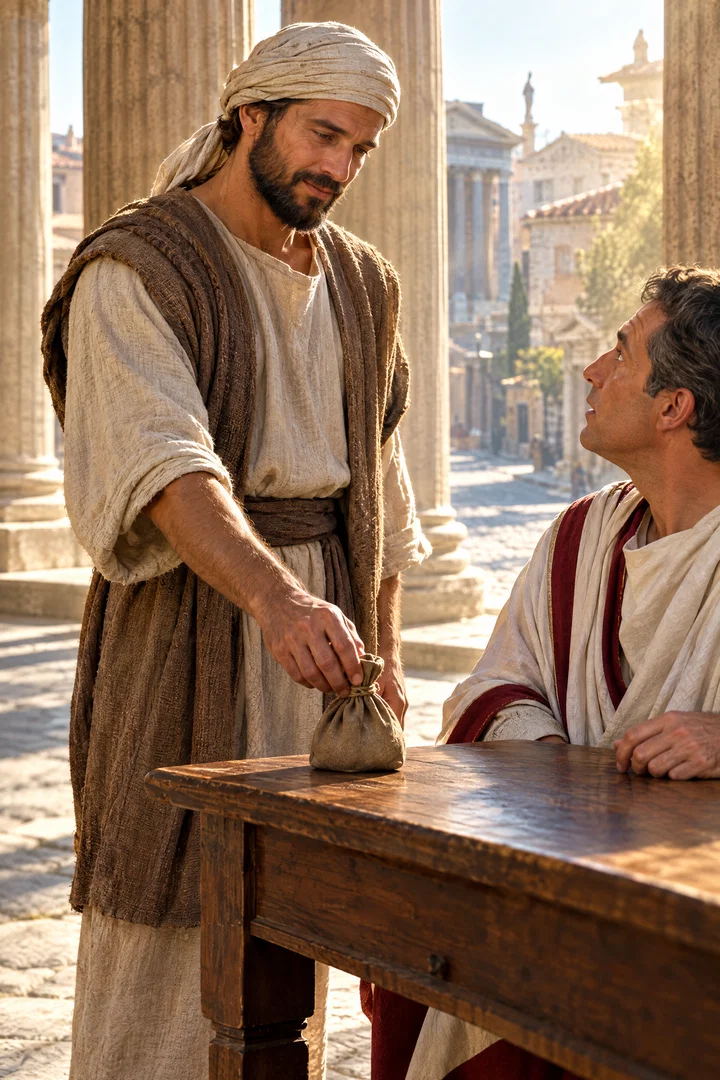
Cross-references
- Matthew 22:21
They say unto him, Cæsar’s. Then saith he unto them, Render therefore unto Cæsar the things which are Cæsar’s; and unto God the things that are God’s.
The call to render Caesar his due echoes Jesus’ teaching about taxes.
- 1 Peter 2:13-14
Submit yourselves to every ordinance of man for the Lord’s sake: whether it be to the king, as supreme;
Both call for submission to civil authorities, who punish wrongdoing.
- Titus 3:1
Put them in mind to be subject to principalities and powers, to obey magistrates, to be ready to every good work,
Both command obedience and submission to civil rulers.
- 1 Timothy 2:1-2
I exhort therefore, that, first of all, supplications, prayers, intercessions, and giving of thanks, be made for all men;
Prayer for rulers supports a quiet and peaceable life.
- Acts 5:29
Then Peter and the other apostles answered and said, We ought to obey God rather than men.
God must be obeyed above human rulers when their commands conflict.
- Romans 13:1
Let every soul be subject unto the higher powers. For there is no power but of God: the powers that be are ordained of God.
Earthly powers are ordained by God, framing the duty to pay tribute.
- Matthew 17:24-27
And when they were come to Capernaum, they that received tribute money came to Peter, and said, Doth not your master pay tribute?
Jesus paid the demanded tribute to avoid giving offense.
- Exodus 22:28
Thou shalt not revile the gods, nor curse the ruler of thy people.
It forbids speaking evil of a ruler.
- 1 Peter 2:14
Or unto governors, as unto them that are sent by him for the punishment of evildoers, and for the praise of them that do well.
Rulers are appointed to punish wrongdoers and praise those who do good.
- John 19:11
Jesus answered, Thou couldest have no power at all against me, except it were given thee from above: therefore he that delivered me unto thee hath the greater sin.
Jesus says Pilate’s authority was given from above.
- 1 Peter 2:17
Honour all men. Love the brotherhood. Fear God. Honour the king.
commands honor to the king
- Acts 4:19
But Peter and John answered and said unto them, Whether it be right in the sight of God to hearken unto you more than unto God, judge ye.
Obedience to God takes precedence when government conflicts with him.
Commentary
Each commentary is drawn from primary sources: the writings of Ellen G. White and Adventist pioneers and periodicals. Each commentary is separate. Its own words are not a quotation; follow the references to read the source passages.
Ellen G. White
10 sources
For this cause tribute is to be paid as part of being subject to the governing authorities, providing the support that civil authority claims, since submission includes tribute, custom, and all dues claimed in the work of government.STA 31.1STOM 25.1STBk 31.1ST Jun 29, 1882 Civil rulers are God's ministers who attend continually upon this very thing, carrying out their assigned work of government.STA 31.1STOM 25.1STBk 31.1 Human government is an ordinance of divine appointment.AA 68.2–69.1 The teaching that civil authorities are God's ministers means people are to submit to their authority rather than reject all civil control.4SP 150.1–2
Obedience to government is a sacred duty within its legitimate sphere.AA 68.2–69.1 This subjection means recognizing that the powers are ordained of God, doing good so as to receive praise rather than fear the sword that is borne against evil, being subject for conscience sake as well as for wrath, and rendering tribute, custom, fear, and honor.STOM 25.1 God's word is the supreme authority above all human legislation, above church and state, and the crown of Christ is to be uplifted above earthly rulers.AA 68.2–69.1 State laws are therefore to be obeyed only when obedience does not conflict with God's law.AA 68.2–69.19T 238.4 When the claims of government conflict with the claims of God, God must be obeyed rather than men, any demand that conflicts with duty to Him must be refused, and loyalty to God must remain firm when human laws oppose His law.STBk 31.1AA 68.2–69.1ST Jun 29, 1882
Submission is to be shown with hearts fully surrendered to God and with nothing done in a defiant spirit.STOM 25.1Lt 1f, 1890, par. 3–4 Believers are not required to defy authorities.AA 68.2–69.1 Words spoken or written are to be carefully considered so as not to appear antagonistic to law and order or unnecessarily to close the way, while still going forward in Christ's name advocating truth even when forbidden by men.AA 68.2–69.1 Respect for lawful authority is to be shown without a defiant spirit even when God's law is made void.STA 31.1STBk 31.1 Submission remains duty in those days, and then the zeal of the true and loyal rises with the emergency and their testimony becomes more steadfast, warm, decided, positive, and unflinching.STA 31.1STOM 25.1Lt 1f, 1890, par. 3–4
Christians must obey princes and civil authority and remain under control and order.GC 191.2–3 Such obedience is not serving God and Belial at once, and does not mean divided allegiance.GC 191.2–3 Denying this duty in the name of divine sanction violates the verse and lets prejudice and passion loose, producing sedition, strife, and bloodshed.GC 191.2–3 Managers and department leaders in institutions are placed in positions of trust by God and are thereby given His respect and honor, and must be respected and honored in return.7T 185.3–186.1 Youth under their care are to submit to their discipline and regulations, since those in charge understand better than others what rules are essential.7T 185.3–186.1 Parents are not to blindly sustain children who refuse submission or insist on their own way in differences with superiors, but are to go directly to those in authority to learn the truth, manifest confidence in their judgment, and teach children respect and honor for them as foundational to loyalty to truth, to fellow beings, and to God.7T 185.3–186.1
Sources
Pioneers and periodicals
72 sources
Tribute means direct taxes and other dues owed to government, including tribute, custom, fear and honor, with just property taxes and legitimate charges such as postage among them.RH Jun 8, 1916RH Oct 2, 1900RH Sep 7, 1905 Being God's ministers attending continually means civil rulers carrying on their assigned public work of governing.ST Oct 18, 1899ST Aug 22, 1911 The verse requires everyone, including Christians, to pay tribute and support civil government because rulers serve God in that work, as part of being subject to civil authority and giving each authority what is due.ST Mar 6, 1907ST Feb 14, 1911RH Aug 13, 1908 That payment is still owed even when demands seem unjust, heavy or costly, even under corrupt or oppressive rule, and even when the money is used for war or soldiers.ST May 22, 1907RH May 9, 1865 Yet the authority of the powers is limited to civil matters such as tribute and duties to one another, and does not extend to worship, conscience, faith or obligations owed to God, so where a human law contradicts God's law obedience to God comes first even at the cost of patiently suffering the consequences.ST Oct 18, 1899ST Mar 6, 1907ST Oct 18, 1899RH Jul 31, 1860RH Dec 16, 1862
Words and Historical Setting
Tribute in the verse means direct taxes and other dues owed to government, spelled out in the next verse as tribute, custom, fear, and honor.RH Jun 8, 1916RH Oct 2, 1900RH Sep 7, 1905ST May 4, 1904 This includes just taxes on property, owed because the city gives protection, keeps good order, and makes general improvements that increase the commercial value of the property, so that refusal to pay is niggardly and mean.RH Jun 8, 1916ST May 4, 1904 It also includes legitimate charges such as postage, which must be paid rather than evaded to deprive the government of revenue.RH Jun 8, 1916RH Sep 7, 1905 Direct taxes are to be paid even when the government uses them to support war, which is distinct from voluntarily giving money to support war.RH Jun 8, 1916RH Oct 2, 1900
God's ministers, attending continually upon this very thing, means that civil rulers continually carry out their assigned public work of governing and maintaining justice.ST Oct 18, 1899ST Aug 22, 1911RH Jul 10, 1856ST Aug 4, 1909 Tribute is therefore owed as part of civil obligation because the authorities constantly give attention to their work of ruling for good and punishing evil.ST Oct 18, 1899ST Aug 22, 1911RH Jul 10, 1856RH Mar 30, 1869 Their authority in this service is limited to civil matters, including tribute and people's duties to one another, and does not extend to obligations owed to God.ST Oct 18, 1899RH Jul 31, 1860ST Jul 17, 1907
The verse belongs to Romans 13:1-7 on subjection to the higher powers, rendering to all their dues — tribute, custom, fear, honor — and owing no one anything.RH Jul 31, 1860ST Mar 19, 1896ST Jul 17, 1907ST Mar 5, 1894 In that setting Paul summarizes duties to other people under love for one's neighbor, which fulfills obligations to fellow people and in turn obligations to civil government, rather than listing every obligation.ST Aug 12, 1886ST Mar 19, 1896ST Jul 17, 1907 The Sabbath is not thereby omitted from the law, for keeping it is included in loving God, and the law's duties are contained in the commands to love God and one's neighbor.ST Aug 12, 1886ST Jul 17, 1907 The ruler's authority is prescribed and limited, and subjects are commanded to honor those in authority, while submission to civil rulers holds unless obeying civil law would require violating God's law.RH Jul 31, 1860ST Mar 19, 1896
The command was given under the Roman imperial government, and Christ and his followers are subject to the governments of earth even though God's kingdom is spiritual and his people are not of the world.ST Mar 19, 1896ST Dec 20, 1905ST Nov 28, 1895 That government claimed ultimate authority over religion as well as civil life.ST Mar 19, 1896ST Jul 4, 1899 Sixty-three years before Christ Julius Caesar had become head of the Roman state religion and director of the worship of the Roman gods, empowered to punish, banish, or put to death those who offended religious law, so that state and church were united and patriotism and religion were one.ST Jul 4, 1899 The Roman Senate could declare the person of Caesar sacred as Caesar the Demi-god and the Invincible Deity, making disrespect to him sacrilege no matter how unworthy his deeds, and refusal to honor the gods was both irreligious and unpatriotic.ST Jul 4, 1899 Under that rule religious liberty was unknown, because the subject was the property and slave of the government in every function, his mental and physical abilities existing only for the ends of the state, and his religious aspirations and reachings out after God owned and directed by the state that owned him.ST Jul 4, 1899 The worship of Jehovah was permitted only because the laws of Rome made the gods of a subject nation part of the deities of the realm, and Palestine was such a nation.ST Jul 4, 1899 True Christians obey God's word by respecting civil government even when it is as oppressive as pagan Rome, bearing its yoke with Christian humility and forbearance and leaving all vengeance for wrongs suffered to the Lord, and such obedience brings greater freedom.ST Mar 19, 1896ST Dec 20, 1905ST Nov 28, 1895
The chapter's precepts are to be applied closely and practiced from the heart, calling for a life shaped by the right Spirit and by words that show that Spirit.RH Mar 27, 1856ST Nov 11, 1930RH Feb 17, 1852 They belong to Paul's teaching about peace and unity with the state and society.RH Mar 27, 1856ST Nov 11, 1930 Faith does not make the law void: faith works through love and fulfills the law, rejecting both self-righteous trust in obedience and the claim that faith permits lawlessness.RH Mar 27, 1856RH Feb 17, 1852 To use Romans 13 as part of a new law said to have been given from the day of Pentecost onward after the whole system of law among the Jews was swept away at the Crucifixion, reenacting nine of the ten precepts of the Decalogue from time to time over fifty days to thirty years, leaves a period with no law, with God abdicated from His throne, with no sin because sin is the transgression of the law, and yet with Christ dying to save men from sins which did not exist, which brings only confusion and chaos.ST Jul 21, 1909
Duty to Pay Tribute
People, including Christians, are to pay tribute and support civil government because rulers serve as God's ministers in continually carrying out their assigned public work of governing.ST Mar 6, 1907ST Feb 14, 1911RH Aug 13, 1908ST Aug 13, 1896 Paying tribute belongs to being subject to civil authority and to giving each authority what is due, for governments may collect support while they protect people's individual rights.ST Mar 6, 1907RH Aug 13, 1908RH Oct 14, 1862 Their continuing work is to restrain wrongdoing, administer justice, maintain order, and protect people's rights in relations with one another, including life, property, and reputation.ST Feb 14, 1911RH Aug 13, 1908ST Aug 13, 1896RH Oct 14, 1862 Civil government is a necessity arising from sin for restraining anarchy and controlling those who do not yield to God's Spirit, and God respects it while it stays within civil bounds but is not responsible for human distortions of it.ST Mar 6, 1907ST Feb 14, 1911
Becoming a subject of God's kingdom does not release a person from civil dues.ST Oct 31, 1895 A debt owed to Caesar cannot be discharged by paying it to God, for a debt owed to one cannot be discharged by paying it to another, so Christians must still render to Caesar what belongs to Caesar rather than withholding it in order to render it to God.ST Oct 31, 1895 Tribute is due even when government duties seem unjust, heavy, or costly, and even under a corrupt or oppressive government.ST May 22, 1907ST Aug 13, 1896 Christ paid tribute and taught his followers to do likewise, and Christians are to remain loyal subjects who obey for conscience's sake only so far as obedience does not conflict with God's law.RH May 9, 1865 Even heavy or unjust taxes do not justify rebellion, for Christians are to live peaceably rather than resist or avenge themselves.ST Aug 13, 1896
Paying tribute does not mean voluntarily giving money to support war or paying others to fight, even if the government chooses to use tax money for soldiers or to support war.RH May 9, 1865RH Oct 2, 1900 Knowingly buying smuggled goods makes a person a partaker in the crime of evading government duties.ST May 22, 1907 Evading legitimate postage charges likewise deprives the government of revenue and violates the duty to pay the tribute owed.RH Sep 7, 1905 Tax revenue properly supports protection from crime and invasion, roads and bridges, schools, and the keeping and defense of property records.RH Oct 28, 1862 Just taxes on property must be paid because the city gives protection, keeps good order, and makes general improvements that increase commercial value, so the one who refuses to pay is niggardly and mean, and paying remains a proper duty even though earthly government is imperfect.RH Oct 28, 1862ST May 4, 1904
Paying tribute and paying what is owed is obedience to God under the great law of love to neighbor that is the basis of the second table of the covenant.RH May 30, 1871 Christians must therefore promptly pay their debts, including small sums owed for periodicals and publications to the publishing association.RH May 30, 1871 Leaving eight thousand dollars in such debts unpaid is unlovely and ought not to happen, and those who hear the word must be doers and pay up.RH May 30, 1871
God-Ordained Work of Rulers
Civil government is ordained by God, and its rulers are his ministers giving constant attention to their appointed work of ruling for good and punishing evil.RH Aug 13, 1908RH Oct 14, 1862RH Dec 16, 1862RH Mar 26, 1914 Tribute is paid to them as part of being subject to civil authority and supporting that service, because they enforce and guard good laws and carry out the continuing work of government within the state's proper sphere.RH Aug 13, 1908RH Oct 14, 1862RH Mar 26, 1914 Their ongoing duty is to restrain wrongdoing, administer justice, maintain civil order, and protect people's rights in relations with one another.RH Aug 13, 1908RH Oct 14, 1862RH Dec 16, 1862RH Mar 26, 1914 That authority is ordained to uphold the principles of God's moral law by preserving order, so righteous laws are to be respected and obeyed, while laws requiring disobedience to God must not be obeyed.RH Dec 16, 1862ST Jul 19, 1905 When justice is perverted, people lose respect for courts and institutions.ST Jul 19, 1905
Civil government is a necessity arising from sin and helps restrain anarchy, ordained as a necessary means of controlling those who do not yield to God's Spirit.ST Feb 14, 1911 God respects it while it stays within civil bounds, but he is not responsible for human distortions of it.ST Feb 14, 1911 Civil authority serves a purpose for people who need external restraint, while the Christian guided by God's Spirit will do what just laws require even without human oversight.ST Feb 14, 1911
God acknowledges no rival dominion and makes nations serve his redeemed in spite of the adversary, invading the usurper's dominion to deliver them and defend them against unjust government.ST Aug 4, 1909 He moves authorities in their favor by the Holy Spirit, angels, and loyal men, and overthrows nations that will no longer respond.ST Aug 4, 1909 When his people depart from him and commit evil, he withdraws his protection and leaves them to the power of government to be punished by the sword.ST Aug 4, 1909
The verse supports the legitimacy of government force, including military power, when exercised in rightful duties to uphold lawful order.RH Sep 23, 1862 Tribute is due because rulers serve God in their continuing work, and the command to support government with money may, when absolutely necessary, include using weapons to enforce the nation's laws.RH Sep 23, 1862RH Oct 14, 1862 Cornelius, a devout and God-accepted centurion, illustrates that military service is not inherently opposed to devotion to God.RH Sep 23, 1862 The law of the land stands in this dispensation in place of the national penalties imposed under the old dispensation.RH Apr 23, 1872 Biblical principles of civil duty apply under different forms of government, for God has a role in the work of lawmakers and rulers in maintaining order, so the taxes due to them should be paid.ST Jul 19, 1905ST Jul 27, 1882
Limits on Civil Authority
The powers described are God's ministers in their continuing public work, and their right extends to tribute and to what people owe one another in civil life.ST Oct 18, 1899ST Mar 6, 1907ST Mar 5, 1894 That authority is confined to the civil sphere of collecting support, protecting individual rights, and ordering relations between people, and it does not reach worship, conscience, faith, or duties owed to God.ST Oct 18, 1899ST Mar 6, 1907ST Jul 17, 1907 What belongs to God must not be required by the state, and the choice to regard a day as holy is accountable to God rather than subject to government control.ST Oct 18, 1899ST Mar 19, 1894 Love for one another fulfills obligations to fellow people and in turn obligations to civil government within its rightful jurisdiction.ST Jul 17, 1907
To use the state to impose religious duties subverts faith and leads people to sin.ST Oct 18, 1899 The recognition of civil government as ordained by God and entitled to honor does not authorize religious legislation or civil enforcement of Sabbath observance.RH Jun 19, 1913 It does not make government responsible for training people in religion or for using civil power to propagate a ruler's faith.ST Nov 13, 1893 Genuine recognition of the distinct purposes ordained for church and state does not join them to advance religion.RH Jun 18, 1908
Submission includes giving each authority what is due and paying tribute because rulers carry out their continuing work of governing.RH Jul 31, 1860 Christ paid tribute and taught his followers to do likewise, and Christians are loyal subjects who obey civil government for conscience's sake only so far as obedience does not conflict with God's law.RH May 9, 1865 Civil rulers are God's ministers when they serve for good by administering justice and punishing evil under principles of the moral law, so righteous laws are to be respected and obeyed, but laws requiring disobedience to God must not be obeyed.RH Dec 16, 1862ST May 4, 1904 Submission to rightful human authority can therefore include disobeying a wrongful command for conscience toward God and patiently suffering the consequences as Christ did.ST Aug 13, 1896 The duty of tribute, honor, respect, and obedience applies to lawful civil order and to laws needed to protect equal natural rights, and it does not require obedience when human commands conflict with Christian duty.ST Nov 19, 1896
To invoke subjection to the powers to obligate Christians to abstain from labor on Sunday is a misapplication arising from too superficial a knowledge of the Bible.ST Feb 25, 1889 Civil rulers supported by tribute as God's ministers are not to protect an institution of the church by a Sunday law.ST Sep 9, 1889 Civil authorities may not establish a legal Sabbath to be obeyed for conscience's sake, and freedom to obey God's law is distinct from coercion by those who claim to enforce it.ST Jan 24, 1900 Submission in civil matters and payment of what is due does not require obeying a human decree that conflicts with God's command, and keeping the Sabbath stands as an example of holding to an unpopular divine command despite inconvenience.ST May 10, 1883
In the setting of prosecutions for Sunday-law violations, the principles of continual public service by God's ministers bear on how a civil official should act, leading a justice of the peace to refuse to hear future cases and to call the procedure unconstitutional.RH Apr 29, 1909 The command to give rulers their due reverence does not require subjects to adopt their princes' religion.ST May 28, 1912
Respectful Christian Citizenship
Christians are included in the command to be subject to the higher powers, to honor secular authorities by subjection, ready obedience and paying of tribute, and to render to all their dues — tribute, custom, fear and honor — including respect, honor and prayer for rulers and obedience to civil laws that do not conflict with God's word.ST Mar 19, 1896ST Oct 31, 1895RH Nov 22, 1864RH May 28, 1867ST Mar 16, 1876 This duty is owed without regard to the religion of the people or the ruler, following Christ who recognized pagan Rome, directed render to Caesar what is Caesar's, and did not resist civil power even to save His life when His arrest and trial were illegal.ST Mar 19, 1896ST Oct 31, 1895 It is reflected in Paul's respectful conduct toward Felix as a governing authority, to be respected even when spoken to plainly.ST Feb 19, 1885
Obedience in lawful civil order is owed out of respect for God and for conscience' sake, not merely from fear of punishment.ST Mar 19, 1896ST Nov 5, 1896ST Aug 13, 1896 Such laws are those needed to protect everyone's equal natural rights, in which rulers acting in their own sphere of civil affairs promote peace among men by being a terror to evil-doers and a praise to them that do well.ST Oct 31, 1895ST Nov 5, 1896 Christians must live peaceably rather than resist, rebel, or avenge themselves, bearing even an oppressive yoke with Christian humility and forbearance and leaving all vengeance for wrongs suffered to the Lord instead of seeking it through other powers.ST Aug 13, 1896ST Nov 28, 1895 Even heavy or unjust taxes do not justify rebellion, whether under pagan Rome or under a government as oppressive as the Turkish government, and such obedience brings greater freedom.ST Aug 13, 1896ST Nov 28, 1895
Christians are to be subject to the powers that be and not to rule other people, for even all the Christians in the world could not construct a Christian nation by earthly government, and undertaking to do so places them in distrust of the government of God, for whom Christians ought to need no other government than that of God for themselves.ST Aug 3, 1904 Civil rulers are representatives of law and order whom Christians must uphold and respect, having no sympathy with anarchy; even when rulers are thought to be wrong they may be warned but must not be hissed, jeered, insulted, or disrespected, and such treatment of magistrates who try to do their duty and preserve order is abounding lawlessness giving no hope for the future.ST Oct 23, 1901 This submission does not make Christians partisan supporters of a government or authorize using Christianity to advance national or political power, since rulers serve a God-appointed public role to which required tribute is paid as part of submission. Nor is the Christian to act as a censor over the ruler's decisions, though rulers are God's ministers with whom paying tribute is connected.ST Feb 15, 1899
When government commands conflict with God's requirements, duty to God takes priority over human law, and people should calmly explain their position rather than willfully resist, and do their duty to God.RH Mar 10, 1863ST Nov 5, 1896 Paying tribute to civil authorities remains a duty because those authorities serve God and continually attend to their assigned work, and this teaching on duty toward government helped show that the believers' position was not dangerous.RH Jan 14, 1909 Lawful civil provisions may be used to advance the cause of truth and meet temporal needs, since civil authority serves under God.RH Aug 28, 1860 Respect for lawful government when it stays within its proper civil sphere supports respect for God's government, for civil government has a God-given role in maintaining law and order.ST Jul 16, 1894 Those who serve in that role are accountable to God, and loyalty to human government in its proper sphere reflects loyalty to God's government and requires a good conscience shaped by God's principles, whose disregard undermines that loyalty.ST Jul 23, 1894ST Jul 16, 1894
Christianity favors government as against anarchy and good government as against bad government, and this true Christian citizenship God approves must be known and told to others.RH Aug 12, 1902 God's plan is to cleanse the heart and make people new in Christ, and those whose hearts are submitted to God will then be good citizens who obey human laws that do not conflict with God's law.ST Jan 30, 1901 Keeping civil law cannot by unaided effort make people able to keep God's law or replace personal salvation with social or national reform.ST Jan 30, 1901 The verse bears on unequal civil treatment of religion, as when city authorities restricted gospel preaching on the Sabbath while tolerating other public speech and unnecessary Sunday work, presented as evidence that the city is under a power hostile to Protestantism.ST Sep 11, 1884 Faith in the Bible as God's Word upholds respect for both the law of God and the binding claim of the law of the land, including payment of tribute because civil rulers serve as God's ministers, while unbelief in the Bible loosens their hold, letting self and selfish aims rule into worldly pleasure, grasping for the things of this world, and all manner of excesses, accounting for decreasing gain in church membership and rising criminality wherever destructive teaching against the Bible spreads.RH Feb 15, 1912
Sources