Matthew 22:21
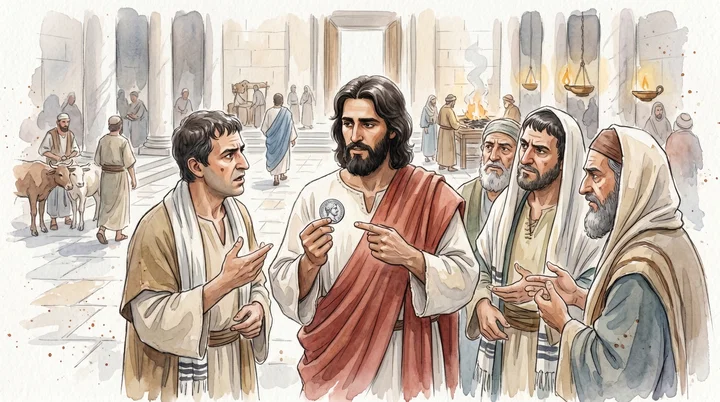
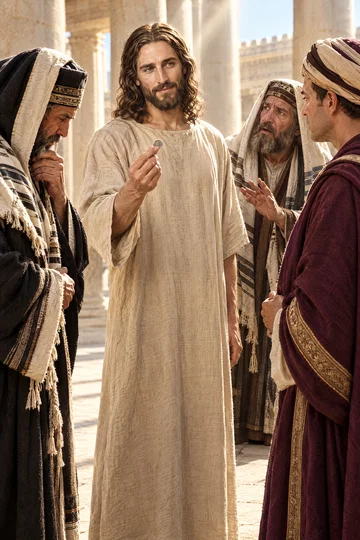
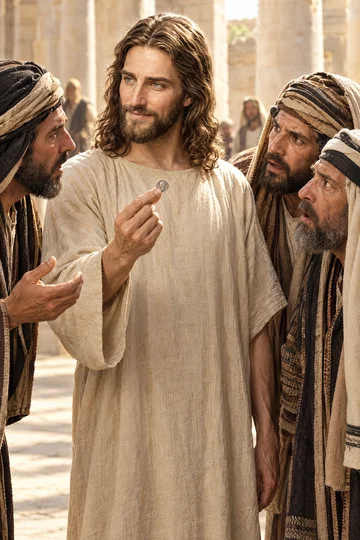
They say unto him, Cæsar’s. Then saith he unto them, Render therefore unto Cæsar the things which are Cæsar’s; and unto God the things that are God’s.
Translations
They say to him, Caesar’s. Then says he to them, Render therefore to Caesar the things which are Caesar’s; and to God the things that are God’s.
They say unto him, Cæsar’s. Then saith he unto them, Render therefore unto Cæsar the things which are Cæsar’s; and unto God the things that are God’s.
They say unto him, Cesar’s. Then saith he unto them, Render therefore unto Cesar the things which are Cesar’s; and unto God the things that are God’s.
They say to him, Cesar's. Then saith he to them, Render therefore to Cesar, the things which are Cesar's; and to God, the things that are God's.
They say unto him, Caesar’s. Then saith he unto them, Render therefore unto Caesar the things that are Caesar’s; and unto God the things that are God’s.
They say unto him, Cæsar’s. Then saith he unto them, Render therefore unto Cæsar the things that are Cæsar’s; and unto God the things that are God’s.
they say to him, 'Caesar's;' then saith he to them, 'Render therefore the things of Caesar to Caesar, and the things of God to God;'
They say to him, Caesar's. Then he says to them, Pay then what is Caesar's to Caesar, and what is God's to God.
They say—Caesar’s. Then, saith he unto them—Render, therefore, the things of Caesar, unto Caesar,—and, the things of God, unto God.
Berean Standard Bible, Majority Standard Bible
“ Caesar’s,” they answered.So Jesus told them, “ Give to Caesar what is Caesar’s, and to God what is God’s.”
They said to him, “ Caesar’s.”Then he said to them, “ Give therefore to Caesar the things that are Caesar’s, and to God the things that are God’s.”
They say to him, Caesar's. Then he said to them, Give to Caesar the things which are Caesar's, and to God the things which are God's.
They sayd vnto him, Cesars. Then sayd he vnto them, Giue therefore to Cesar, the things which are Cesars, and giue vnto God, those things which are Gods.
Douay-Rheims (Challoner revision)
They say to him: Caesar’s. Then he saith to them: Render therefore to Caesar the things that are Caesar’s; and to God, the things that are God’s.
Pictures
Cross-references 20 of 23
- Romans 13:7
Render therefore to all their dues: tribute to whom tribute is due; custom to whom custom; fear to whom fear; honour to whom honour.
Both distinguish what is due to civil rulers from what is due to God.
- Acts 5:29
Then Peter and the other apostles answered and said, We ought to obey God rather than men.
States the principle of obeying God rather than human authorities.
- Mark 12:17
And Jesus answering said unto them, Render to Cæsar the things that are Cæsar’s, and to God the things that are God’s. And they marvelled at him.
Jesus distinguishes what is owed to Caesar from what is owed to God.
- Luke 20:25
And he said unto them, Render therefore unto Cæsar the things which be Cæsar’s, and unto God the things which be God’s.
Jesus distinguishes what is due to Caesar from what is due to God.
- John 18:36
Jesus answered, My kingdom is not of this world: if my kingdom were of this world, then would my servants fight, that I should not be delivered to the Jews: but now is my kingdom not from hence.
Christ’s kingdom is distinct from earthly political power.
- 1 Peter 2:13-14
Submit yourselves to every ordinance of man for the Lord’s sake: whether it be to the king, as supreme;
Commands submission to civil authorities and respect for rulers.
- 1 Timothy 2:1-2
I exhort therefore, that, first of all, supplications, prayers, intercessions, and giving of thanks, be made for all men;
Calls believers to pray for rulers and live quiet and peaceable lives.
- Acts 4:19
But Peter and John answered and said unto them, Whether it be right in the sight of God to hearken unto you more than unto God, judge ye.
Both distinguish duties to human authorities from obedience owed to God.
- Matthew 17:24-27
And when they were come to Capernaum, they that received tribute money came to Peter, and said, Doth not your master pay tribute?
Jesus pays the tribute tax, illustrating duties under earthly government.
- Luke 23:2
And they began to accuse him, saying, We found this fellow perverting the nation, and forbidding to give tribute to Cæsar, saying that he himself is Christ a King.
His accusers falsely claimed he forbade tribute, reversing his teaching to render Caesar’s due.
- Matthew 22:17
Tell us therefore, What thinkest thou? Is it lawful to give tribute unto Caesar, or not?
The question about paying tribute to Caesar leads to Jesus’ distinction.
- Romans 13:5
Wherefore ye must needs be subject, not only for wrath, but also for conscience sake.
Both teach rendering what is due to civil authority as a matter of conscience.
- 1 Corinthians 6:19-20
What? know ye not that your body is the temple of the Holy Ghost which is in you, which ye have of God, and ye are not your own?
Believers belong to God, having been bought with a price.
- Psalms 116:12
What shall I render unto the LORD for all his benefits toward me?
Asks what to give God in response to his benefits.
- 1 Peter 2:17
Honour all men. Love the brotherhood. Fear God. Honour the king.
Commands honor for the king while distinguishing that honor from God’s supreme claim.
- Daniel 3:16-18
Shadrach, Meshach, and Abed-nego, answered and said to the king, O Nebuchadnezzar, we are not careful to answer thee in this matter.
The Hebrews refuse the king’s decree rather than disobey God.
- Jeremiah 27:5-7
I have made the earth, the man and the beast that are upon the ground, by my great power and by my outstretched arm, and have given it unto whom it seemed meet unto me.
God assigns Nebuchadnezzar civil rule over nations.
- Luke 20:26
And they could not take hold of his words before the people: and they marvelled at his answer, and held their peace.
Records the same answer about rendering to Caesar and to God.
- Romans 13:4
For he is the minister of God to thee for good. But if thou do that which is evil, be afraid; for he beareth not the sword in vain: for he is the minister of God, a revenger to execute wrath upon him that doeth evil.
Civil government bears the sword to restrain wrongdoing.
- Titus 3:1
Put them in mind to be subject to principalities and powers, to obey magistrates, to be ready to every good work,
Commands obedience to magistrates.
Commentary part 1 of 2
Each commentary is drawn from primary sources: the writings of Ellen G. White and Adventist pioneers and periodicals. Each commentary is separate. Its own words are not a quotation; follow the references to read the source passages.
Ellen G. White
64 sources
Christ met a joint trap over paying tribute to Rome with a direct and wise answer that gave neither side an advantage and left His questioners marveling with nothing to say.Ms 10, 1906, par. 8–12ST Jun 29, 1882ST Jun 29, 18823SP 42.2ST Feb 8, 1899 The answer sets a clear principle that what properly belongs to civil authority is to be rendered to it, and what belongs to God is to be rendered to God.DA 601.1–602.5ST Feb 8, 18993SP 42.1 People are therefore to remain peaceably subject to lawful rule and meet its just claims so long as they do not conflict with duty to God, while God retains first allegiance and supreme authority over conscience.Ms 8, 1884, par. 1–6DA 601.1–602.53SP 43.1ST Apr 25, 1878GC 90.4–92.2 As the coin bearing Caesar's image and inscription belonged to Caesar, every person bearing God's image at creation belongs to God, and though sin has marred that image its mark remains and God seeks to restore His likeness in righteousness and holiness.COL 194.37T 156.1ST Dec 25, 1893ST What belongs to God — wealth, time, strength, ability, influence, tithes, offerings and pledged gifts — is held only as stewards and must be faithfully returned to Him rather than withheld for self, debt, family claims, or earthly use.SG4 210.12T 518.2ST Mar 22, 18833T 120.1–2ST Jan 29, 1880
Trap and Answer
The question about tribute to Caesar was a joint trap laid by the Pharisees with the Herodians, one of a series of questions designed to entrap Him.Ms 10, 1906, par. 8–12ST Jun 29, 1882Ms 71, 1897, par. 27 Spies were sent with flattering commendation and a pretended desire for wisdom, while the Herodians stood by as witnesses ready to accuse Him for His life.Ms 10, 1906, par. 8–12ST Jun 29, 1882 They hoped to force Him to offend either Jewish law or Roman authority.ST Jun 29, 1882ST Jun 29, 1882
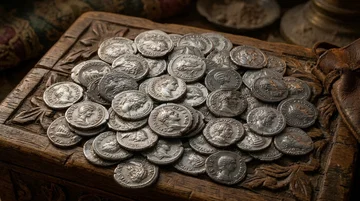
The dilemma was deliberate: if He said tribute was unlawful He would be reported to the Romans as an enemy to civil authority and a rebel stirring sedition, and if He said it was right He would be accused to the Jews and elders as opposed to the law of God.Ms 10, 1906, par. 8–12ST Jun 29, 1882ST Jun 29, 18823SP 42.2 Many Jews held that paying tribute to a foreign power broke Jewish law, which made the snare the more dangerous.ST Jun 29, 18825RED 49.2–50.1 He perceived their wickedness, read their hearts and hidden purposes, called them hypocrites, and was not deceived by their words.Ms 10, 1906, par. 8–12ST Jun 29, 1882ST Jun 29, 1882 He asked to see the tribute money, and they at once produced a Roman coin bearing Caesar's image and superscription and acknowledged it as Caesar's.ST Jun 29, 1882ST Jun 29, 1882
His answer was direct, candid, and wise rather than evasive, giving no advantage to either Roman or Jewish power but meeting the need of the moment.ST Feb 8, 1899ST Jun 29, 1882Ms 78, 1897, par. 17–18 It settled the disputed question for many listeners, left the spies with nothing further to say, baffled and disarranged their plans, and displayed wisdom and divine knowledge of their hidden purpose.ST Jun 29, 18823SP 42.2ST Feb 8, 1899Ms 78, 1897, par. 17–18 The interrogators marveled, left Him and went their way, while His plain, intelligent answers brought light to the people and sowed seeds of truth.ST Jun 29, 1882Ms 71, 1897, par. 27 The same discernment continues today, for He understands the true character of every man, records true motives in His book whatever the profession, and no cover of pretentious righteousness can deceive Him.Ms 10, 1906, par. 8–12
He Himself paid the tribute and pointed to Caesar's image and inscription to teach His disciples to pay it, showing He was not stirring up sedition.3SP 129.3–130.1ST Jul 4, 18785RED 49.2–50.1 His obedience to the ruling power proved He was no leader of sedition even though many Jews rose in tumult against Rome on the claim that tribute broke Jewish law.3SP 129.3–130.15RED 49.2–50.1 The later priestly accusation before Pilate that He perverted the nation and forbade tribute to Caesar was false and the opposite of what He had taught.COS 137.2–138.4ST Jul 4, 18785RED 49.2–50.1
Caesar and God Distinguished
The verse lays down a clear and candid principle that separates what is owed to civil government from what is owed to God, requiring that the civil authority receive what properly belongs to it while God receives what belongs to Him.DA 601.1–602.5ST Feb 8, 18993SP 42.1Ms 78, 1897, par. 17–18 It does this directly and wisely rather than by evasion, settling the question of the Roman tribute by its governing rule.ST Feb 8, 18993SP 42.1Ms 78, 1897, par. 17–18 The Roman coin made the point visible, for its name and image and inscription marked it as belonging to the sphere of Roman rule and illustrated the duty to render to the governing power what belonged to it.3SP 43.1ST Apr 25, 1878ST Feb 8, 18993SP 42.1
Those living under civil authority are to give that authority the support it claims and remain peaceably subject to the laws of the land, meeting legitimate obligations such as the tribute, so long as those obligations do not conflict with a higher duty to God.DA 601.1–602.53SP 43.1ST Apr 25, 1878ST Jun 29, 1882 Such civil obedience does not cancel the duty to give God first allegiance, but at all times His claims are to be answered with obedience.DA 601.1–602.53SP 43.1ST Apr 25, 1878ST Jun 29, 1882
The demand to give God what belongs to God was a severe rebuke to the Jewish leaders, for had they faithfully met their obligations to God they would not have become a broken nation under foreign rule.DA 601.1–602.53SP 43.1ST Apr 25, 18783SP 43.2ST Jun 29, 1882 Their subjection to Rome, with Roman ensigns over Jerusalem and Roman sentinels and governor in the city, and their present payment of tribute, was the penalty and consequence of apostasy and unfaithfulness to God.ST Apr 25, 18783SP 43.2ST Jun 29, 1882
Obedience to Civil Authority
Duties owed to civil authority must be respected alongside duties owed to God.Ms 93, 1902, par. 383SP 43.1ST Apr 25, 1878 The things belonging to Caesar include the State's legal requirements and restrictions, which Christian workers must take into account when organizing their work so that it is not needlessly hampered.Ms 93, 1902, par. 38 Those living under civil authority are to give that authority the support it claims and remain peaceably subject to the laws of the land, meeting its legitimate claims by obedience while at all times answering God's claims with obedience.3SP 43.1ST Apr 25, 1878 This obedience to the civil power holds so long as its claims do not conflict with the higher duty to God.3SP 43.1ST Apr 25, 1878
Civil rulers are supreme within their proper sphere, and citizens must respect and obey magistrates in the just exercise of their authority.Ms 8, 1884, par. 1–6 The same principle of obedience within just limits applies to children toward parents, to wives toward husbands, and to servants toward masters.Ms 8, 1884, par. 1–6 Obedience to a ruler may be refused when the ruler requires what conflicts with God's law as made clear in Scripture, for God alone is supreme over conscience and religious duty.Ms 8, 1884, par. 1–6 Temporal rule belongs to secular powers, while obedience to God takes precedence when human commands conflict with God's law, and Christ's example is one of rejecting worldly rule and honor.Ms 8, 1884, par. 1–6GC 90.4–92.2
Christ did not take up legal or political questions, but taught the principles of His spiritual kingdom.GW 396.2 That kingdom is governed by righteousness, justice, mercy, and love.GW 396.2 In this way temporal and political matters are distinguished from the things owed to God.GW 396.2
Church and State Distinct
Matthew 22:21 sets civil government and religion apart in distinct spheres, with each left to its proper work.DA 837.1–2 Civil authority carries out its God-appointed task of maintaining order and restraining evil, yet it is not to govern religion nor to unite with the church.DA 837.1–2 The church is led by God's life and Word, while the state exercises its rightful jurisdiction in civil affairs.DA 837.1–2
The church therefore has no right to enforce anything of a religious character upon the world, including requiring by law that the Bible be read in public schools.Lt 44, 1893, par. 1–2 Making opposition to such a law prominent puts believers in a wrong light before the world.Lt 44, 1893, par. 1–2 If such a law does go into effect, God will overrule it for good by placing an argument in Sabbathkeepers' hands for standing on the Bible foundation for the Sabbath of the fourth commandment, for the Book thus forced upon public notice will speak and its words will be interpreted just as they read.Lt 44, 1893, par. 1–2 To render to God what belongs to God means each person is responsible to God, so no human being may take God's place by claiming authority over another person's conscience or duty and treating fellow human beings as subjects to be controlled at human will.STMW9 4.3–5.2
Image and Divine Ownership
A coin bears the image and superscription of the reigning power as the mark of ownership and value, so what bears Caesar's image belongs to Caesar.COL 194.37T 156.1 As the coin bears the image of the ruling power, every person at creation bore the image and superscription of God, and this makes every soul God's property and precious in His sight.COL 194.3ST Sin has marred and dimmed God's image in man, yet it has not erased it.COL 194.3ST Even when a life lies among dust and rubbish and is degraded by sin, it remains silver still, and traces of the inscription remain on every soul.COL 194.3ST
Because the soul still bears His mark and is of value, God seeks to recover it in order to retrace upon it His own image in righteousness and holiness.COL 194.3ST As people behold Jesus and His righteousness they desire to become like Him, and through earnest, humble prayer and the Holy Spirit's work Christ's words are made living in the obedient soul emptied of self, so that Christ is formed within as the hope of glory.ST Dec 25, 1893 In this life God's people are to bear God's image and superscription, showing that they belong to Him.MWISDAP 45.1 Christ's grace forms their character, and those who are His are united in love and purpose.MWISDAP 45.1
What bears God's image and superscription belongs to God and must be given to Him, and all who profess belief are to deal in heaven's currency by handling those things upon which God has stamped His image as of infinite value.Lt 16f, 1892, par. 15–1612MR 333.3 Every dollar bears God's image and superscription and therefore belongs to God, with principal and interest the Lord's lent as capital with a place for every talent in His service, so not a farthing is to be hoarded or squandered on selfish indulgence, display, and extravagance.Ms 11, 1892, par. 5–6Lt 90, 1895, par. 31–33 Possessions are God's, and people hold them as stewards accountable to Him for how they use them, with the image and superscription stamped on the entrusted goods marking them as the Lord's.Lt 90, 1895, par. 31–33 Worldly possessions and interests perish, do not bear God's image and superscription, and are not heaven's true currency, so they must not take first place over God and religion, nor be trusted in, and treasure must be laid up in heaven where it will not perish, for where treasure is there the heart will be also.Ms 16, 1890, par. 47–50Lt 16f, 1892, par. 15–16
Worshipers of God need transforming grace to subordinate the world to religion, refusing to make temporal interest first and exhaust soul, body, and spirit to secure temporal advantages.Lt 16f, 1892, par. 15–16 The language of image and inscription applies also to truth and to God's work: writers should use truth, which bears God's image, as the currency of heaven rather than personal hints, insults, or falsehood.7T 156.1 A missionary institution bears God's superscription only by preserving its missionary character in the fullest sense, which requires godliness of life and character in every worker, with success measured by God's word and true success bearing heavenly credentials.HPMMW 46.2
Faithful Stewardship and Giving
What belongs to God must be rendered to Him as He requires, for wealth, property, time, strength, mental ability, influence, and means are entrusted by Him and remain due to Him.2T 518.2ST Mar 22, 18833T 120.1–23T 118.1–52T 651.3–652.1 People hold them as stewards, not owners, having been bought with a price so that they and all they possess are His property, and they are accountable to Him for how they use them, for an account of stewardship must soon be given.3T 118.1–52T 651.3–652.15T 285.1Ms 1, 1878, par. 40–45 Giving to God is therefore a return of what is already His.2T 518.22T 653.1–654.22T 651.3–652.1ST Jun 11, 1894ST Jun 11, 1894
Earthly blessings and possessions test whether people will honor God's claims and obey the truth rather than use worldly interests and cares as an excuse to neglect obedience.ST Mar 22, 18833T 384.1–2ST Apr 22, 1875ST Jun 11, 1894RH Aug 25, 1874 Those who withhold what is entrusted rob God, lose the increase they could have gained, and fail to lay up treasure in heaven.ST Mar 22, 18832T 653.1–654.2 Those whom God has prospered should bring offerings in keeping with the blessings they have received, and using those blessings to cling to possessions and neglect worship and religious duties turns them from gifts into a curse.2T 599.1ST Jun 11, 1894RH Aug 2, 1870
Giving to God does not enrich God, whose treasures are already His, but lays up eternal treasure for the giver, frees those who have abundance from the burden of earthly treasure, and serves the giver's own good.2T 653.1–654.22T 651.3–652.1ST Jun 11, 1894ST Jun 11, 18941T 147.4 Gold and silver offered with humble, grateful obedience show that all a person has and is belongs to God.ST Jun 11, 1894 God accepts such giving not because He needs wealth, but for the good of His servants.2T 651.3–652.1
Duty to God stays binding even while earthly debts remain, and being in debt does not excuse withholding from God.SG4 210.11T 220.2SG4 209.2 Waiting until all debts are paid before giving deceives the giver and withholds what belongs to God.1T 220.2 Everyone must still bring a suitable offering, with those in debt subtracting the amount owed from what they possess and giving a proportion of the remainder, while meeting both obligations to others and to God.SG4 210.11T 220.2SG4 209.2
Tithes, offerings, and solemn pledges for God's work are things that belong to God and must be rendered into the treasury for His cause, including being faithful in tithes and offerings and making one's record right with God.ST Jan 29, 18804T 475.2–33T 409.2–410.2Ms 102, 1893, par. 15–16Ms 103, 1906, par. 13 To withhold, postpone, or keep them back is to rob God, rooted in selfishness and covetousness, and forfeits His commendation; only utter inability to pay excuses failing to meet an obligation promptly.ST Jan 29, 18804T 475.2–33T 409.2–410.2Ms 102, 1893, par. 15–16RH Jan 1, 1875 Pledges should follow God's plan rather than exceed what a person can rightly afford, for pledges that leave families without life's necessities are not required by God.RH Jan 1, 1875 While His people disregard this plan of benevolence, God will not bless them.3T 409.2–410.2
No one else's claims excuse holding back God's tithes and offerings, and duty to God stands first above the felt duty to save a portion for each child or to leave a surplus to children.SG4 210.13T 120.1–21T 220.3 Family obligations may be legitimate, but they do not justify robbing God of a suitable proportion, and children must not be allowed to take for their own use what belongs on God's altar.SG4 210.11T 220.3 Means entrusted to people are God's, and believers should use them in ways that honor God, including advancing His cause, rather than withholding them to leave a surplus to their children.3T 120.1–23T 118.1–5
Believing parents capable of managing their own business must keep control of entrusted property so it can be returned to God by investment in His cause when He requires it, and must not transfer it to unbelieving children to lay off responsibility, because that leaves them unable to give God His own and places His means in the enemy's ranks against Him.2T 674.1–676.11T 528.2 Even transfer to children of the same faith is out of God's order while parents remain capable, because such children seldom have equal devotion, have not learned through adversity to value eternal treasure, and when means not gained by their own exertion comes to them they are tempted to set affection on earth, trust in property, and use it unwisely.1T 528.2 Likewise Bro. L as God's steward must use entrusted means for God's cause while able rather than leaving it unavailable or leaving others to dispose of it after death.2T 674.1–676.1
Faithful giving includes the giver's willingness and motive: those who give sincerely and self-sacrificially for God's glory are rewarded according to their works even when dedicated means are misused, and God is to be given what is His with cheerful hearts and unswerving faithfulness, not unwillingly or grudgingly, with offerings in keeping with blessings received in self-sacrifice and gratitude.2T 518.25T 285.12T 599.1RH Aug 2, 1870 Pure love is necessary for any offering to be acceptable, and obedience is better than sacrifice.2T 651.3–652.1ST Jun 11, 1894
Rendering to God what is His means using entrusted talents of influence, means, time, and talents to advance the cause of truth, help save others, support those who carry truth into entirely new fields at their own charges, circulate publications, give light to relatives and friends, and each act a part in soul-saving.2T 653.1–654.22T 651.3–652.11T 147.4Ms 1, 1878, par. 40–45Ms 103, 1906, par. 13 Those prospered should bring offerings in keeping with blessings received, and ministers at large gatherings must deliver pointed, practical discourses exposing neglect of systematic benevolence to break selfishness and arouse duty, with all laborers faithfully and plainly teaching tithes and offerings so all urge obedience with one mind.2T 599.13T 409.2–410.2Ms 102, 1893, par. 15–16 Rendering to Caesar what is Caesar's and to God what is God's with unflinching fidelity is the mark of one who is pure, divested of selfishness, hiding self in Jesus, and fully imbued with the spirit of truth, in contrast to seeking earthly greatness.Lt 8, 1890, par. 3 Only such righteousness exalts and puts the name in the Lamb's book of life.Lt 8, 1890, par. 3
Sources
Pioneers and periodicals
231 sources
Jesus wisely answered a trap about paying tribute to Caesar by pointing to the coin bearing Caesar's image and requiring that what belongs to Caesar be returned to him and what belongs to God be returned to God.ST Oct 18, 1899ST Sep 3, 1912 What belongs to Caesar is legitimate civil obligation such as tribute, taxes, honor and obedience to properly ordered government for protection and order.ST Jan 23, 1907ST Oct 18, 1899ST Aug 22, 1911 What belongs to God is kept distinct and separate from Caesar's sphere, so civil power has no rightful authority over religion, conscience, worship or duty owed to God.ST Jan 23, 1907ST Oct 18, 1899ST May 28, 1912 Duty to God is first and supreme, so when human law conflicts with divine duty God must be obeyed rather than men.ST Apr 25, 1878ST Jun 29, 1882RH Feb 3, 1910RH Sep 16, 1909RH Feb 1, 1906 What bears God's image and mark belongs to him, which is persons themselves in soul, body and powers, and includes worship and the Sabbath as his holy day that the state must neither impose nor forbid.ST Jul 3, 1907RH Oct 20, 1904RH Jan 9, 1908RH Jan 31, 1856
Trap Setting and Answer
The answer was given with wisdom and discretion to meet a joint trap laid by the Pharisees and Herodians, who sent spies with flattery and a pretended desire for wisdom to ask whether tribute to Caesar was lawful.ST Jun 29, 1882ST Jun 29, 1882ST Oct 18, 1899 They hoped to make Him offend either Jewish law or Roman authority, so that they could accuse Him before the people, hand Him to the governor as a rebel, take His life, or seize Him by His words.ST Jun 29, 1882ST Jun 29, 1882ST Oct 18, 1899 He read their hidden hypocritical motive and called them hypocrites, avoiding both giving grounds for treason by forbidding the tax and giving offense by endorsing it.ST Jun 29, 1882ST Jun 29, 1882ST Feb 8, 1899 He baffled them, left nothing further to say, and they marveled at His candid principle and divine knowledge of their purpose and withdrew in confusion.ST Jun 29, 1882ST Feb 8, 1899ST Oct 18, 1899RH Mar 9, 1869 His reply distinguished what was owed to Caesar from what was owed to God and gave the accusers no hold for seizure.ST Feb 8, 1899ST Oct 18, 1899ST Sep 3, 1912
The question was politically dangerous because Judas of Galilee had led a revolt against the tax imposed by Augustus, crying that tribute to Caesar was unlawful.ST Feb 12, 1902ST Sep 30, 1886 Many Jews still claimed payment violated Jewish law and rose in tumults and insurrections that Rome watched and rigorously suppressed.ST Sep 30, 1886 The scheming priests sought to entrap Him in that watched dispute over obedience to the reigning civil power.ST Feb 12, 1902ST Sep 30, 1886
He settled the question by pointing to the tribute money and asking to see it, when they at once produced a literal Roman penny stamped with Caesar's likeness, image, title, name and superscription.ST Jun 29, 1882ST Sep 30, 1886 Such coins still dug from ruins stand as proof of the account.RH Mar 9, 1869 By His questioners' own rule taught by their teachers, that circulation of a king's money acknowledges him as ruler, its image and superscription decide whose it is and whether it is genuine and current, so it was to be returned to the civil power that gives it value and protection.RH Mar 9, 1869ST Oct 29, 1896 He Himself paid tribute and taught His disciples to do so, proving He did not forbid tribute to a foreign power and was not a leader of sedition against Rome.ST Jul 4, 1878ST Sep 30, 1886 He was seen at Siloe before a great multitude as a friend of the Romans rather than seditious or rebellious, with wisdom beyond the philosophers, and therefore was left free to act, to speak, to assemble and address the people, and to choose disciples without pretorian restraint instead of being arrested and exiled to Pontus.RH Jul 16, 1861 The familiar penny with its two sides also opened lessons on other penny stories.ST Oct 29, 1896
The saying is the only recorded statement He made with reference to the Roman Empire, spoken while the greatest despotism ever known ruled the habitable globe, which He left alone apart from commanding this rendering.ST Mar 4, 1913 It belongs to His temple answers to critics on the day before His final departure from its precincts, in a chapter where the kingdom of heaven is likened unto a certain king who made a marriage for his son.ST Sep 3, 1912RH Apr 15, 1858RH Jan 29, 1914 It gave no advantage to either Roman or Jewish power but met the need of the moment and severely rebuked the Jews, answering those trying to make Him stumble and to make Him contradict His teaching on God's kingdom.ST Jun 29, 1882ST Sep 3, 1912 It exemplified answering a fool according to his folly.ST Jun 29, 1882 By plainly teaching giving Caesar all that was due to him including tribute, it proved false the later charge before Pilate that He was perverting the nation and forbidding tribute to Caesar while claiming to be Christ a King in the political sense His accusers meant.ST Jul 4, 1878ST May 25, 1904
The Jews were subject to Caesar and not ruled by God as a theocracy, proved by their use of coins bearing his image and inscription as evidence that they recognized Caesar's civil authority.ST Apr 25, 1878ST Sep 11, 1893 This rebuked the rulers' claim to civil authority in God's name and showed He did not accept their claim to restore the former theocracy.ST Sep 11, 1893 Their subjection, with Roman ensigns over Jerusalem and Roman sentinels and governors in the city and tribute paid to Caesar, was the penalty of apostasy from God.ST Apr 25, 1878ST Jun 29, 1882 Had they faithfully fulfilled their obligations to God they would not have become a broken nation under Roman rule.ST Apr 25, 1878ST Jun 29, 1882
Duties Owed to Caesar
Properly constituted civil government is legitimate, and what belongs to it must be rendered to it, including tribute, taxes, custom, revenue, postage, honor, reverence, fear, respect, subjection, ready obedience and support.ST Jan 23, 1907ST Oct 18, 1899ST Aug 22, 1911ST Nov 26, 1896ST Nov 5, 1896 This giving leaves no room for defrauding it, evading just obligation, resisting it, or seeking to overthrow it.ST Jan 23, 1907ST Oct 18, 1899ST Aug 22, 1911ST Nov 26, 1896ST Nov 5, 1896 Those who live under its protection and use its currency owe it proportional contribution for benefits received, such as safety, roads, schools, defense, and protection of persons, lives and property.ST Jan 23, 1907ST Oct 18, 1899RH Aug 13, 1872 Christ himself met such claims honestly even when the power was pagan and idolatrous and even when his own arrest and trial were illegal.ST Jan 23, 1907ST Oct 18, 1899RH Aug 13, 1872
Rendering to Caesar includes full citizen duties of studying public questions and candidates, registering, voting, taking active interest in public affairs and the country's welfare, and blessing the country.RH Jan 31, 1865ST Mar 26, 1894RH Mar 3, 1904ST Mar 27, 1907 It includes praying for rulers and administrators that Christians may lead quiet and peaceable lives while serving God.RH Jan 31, 1865RH Mar 3, 1904ST Mar 27, 1907 Paying public taxes does not prevent supporting religious schools by private subscription, and public taxes are not to be withheld on that account.RH Mar 3, 1904ST Mar 27, 1907ST Jul 12, 1905 Patriotic loyalty remains a civil duty even where there is no religion, and being a good citizen who gives civil authority what is due does not require explaining or apologizing for faith.RH Mar 3, 1904ST Mar 27, 1907ST Jul 17, 1907
Those who hold the minority position teach that the duty to Caesar is equal to the duty to God.ST Jul 29, 1897 On that ground they require Christians to vote, perform duty at the polls and attend the primaries.ST Jul 29, 1897 They require taking the pulpit into politics without bringing politics into the pulpit, seeing that right Christian men are in the rings and machines, that Christian men control the world, that Christians do not refuse office, and that officers are in the hands of men who will enforce Sabbath laws.ST Jul 29, 1897
Civil government is ordained and established by God to restrain wrongdoing, maintain order among fallible people, and govern temporal welfare within a limited sphere.ST Nov 26, 1896ST Feb 13, 1907ST Jun 14, 1905ST Jun 14, 1905 Caesar does not possess all power but holds a government of limited powers, limited not only by constitutions but by the law of nature and of nature's God.ST Feb 13, 1907ST Jun 14, 1905ST May 15, 1901 Toward God even a king is only a subject, bound equally with the humblest to render God his due and accountable to God for every abuse of power.ST Jun 14, 1905RH May 10, 1906ST May 15, 1901 Obedience to human law disciplines for obedience to God's law while revolt against it belongs to wider rejection of law, and Christ's freedom from sin does not release disciples from these obligations, which do not make the Sabbath movable at each person's choice.ST Feb 13, 1907ST Jun 14, 1905ST Jun 14, 1905ST May 15, 1901
What is owed turns on actual exercise of civil rule, not legitimate lineage, as shown by coin issuing from Caesar's mint identifying the authority to be recognized.AS May 1887 Those who use its currency and live under its protection, whether native-born citizens or foreign subjects and aliens, owe a proportional contribution from income for benefits received.RH Aug 13, 1872 The state may distinguish citizen from noncitizen in granting political franchise, but it cannot give or withhold rights that do not belong to it nor own persons, since civil rights depend chiefly on how people use the state's possessions entrusted to them and treat others in like circumstances. The nearby fish-coin account concerned temple service not Roman tax and does not show that Jesus used a miracle to ease a personal civil-tax obligation, though he was willing to give Caesar whatever was due him.ST Mar 26, 1896
Rendering what is due remains compatible with refusing to take part in war and bloodshed when doing so conflicts with duties toward enemies and all people.RH May 23, 1865RH Dec 16, 1862 The choice is set between Christ and Caesar, God and Mammon, following the Prince of Peace rather than Mars and Moloch, greed and conquest, wrong and butchery, since war is murder forbidden by the command not to kill.RH May 23, 1865RH Dec 16, 1862 Christ's servants being not of this world do not join the wars of earthly rulers but fight with spiritual not carnal weapons while respecting and obeying just civil laws that uphold justice.RH May 23, 1865RH Dec 16, 1862 Following his counsel to respect civil authority and do good would not have brought the Jews into danger with Rome, whereas seeking Barabbas who had rebelled increased Roman pressure and led to the destruction they feared.RH May 23, 1865ST May 17, 1905RH Dec 16, 1862
Duties Owed to God
The coin is identified as Caesar's by its likeness, image, title, name and inscription upon it, and is therefore to be returned to him, while by the same mark what bears God's mark, image, authority and superscription belongs to God and is to be kept sacred to him.ST Jul 3, 1907ST Mar 19, 1896RH Oct 20, 1904ST Jan 30, 1907 Religious duties such as the Lord's Supper, baptism and the Sabbath bear God's authority in their origin and law, and the Sabbath in particular bears God's image and superscription because it identifies him as Creator, so that reverence for the seventh day belongs specially to God and not to the state.ST Jul 3, 1907RH Oct 20, 1904ST Jan 30, 1907ST Jun 30, 1909 This sets the choice between belonging to the Lamb or to the beast, and genuine belonging is shown when daily life is given to a principle so that even money stamped with Caesar is made in sincere action to seem to bear God.ST Jul 3, 1907ST Mar 19, 1896
Through image and superscription the soul can receive the divine image as people behold Jesus and his righteousness, desire to become like him, pray earnestly and humbly, and let the Spirit make his words living in the self-emptied obedient soul until Christ is formed within as the hope of glory.ST Dec 25, 1893ST Every person bore God's image at creation, sin has marred but not erased its traces, God regards each soul as precious and seeks to restore his image in righteousness and holiness.ST Dec 25, 1893ST Words reveal the heart and reflect the image and superscription within, so what a person says shows what is within and matters before God's judgment. Virtuous appearances do not make self-directed conscience a reliable guide, for right is fixed by God's law and not merely by what a person thinks or feels is right.RH Apr 13, 1876
What belongs to God and must be rendered to him includes persons themselves, because he created and continually sustains them and stamped his image on them, so their first and highest duty is to give themselves to him.RH Jan 31, 1856ST May 30, 1911ST Mar 19, 1896 This giving means whole soul, body, substance, gifts, influence, wealth, abilities and position employed according to his will, as angels use their gifts to minister to the heirs of salvation, with thanksgiving, praise, honor, worship and surrender of self.RH Jan 31, 1856ST May 30, 1911RH Sep 19, 1871 To stamp influence in home and business, influence over friends and servants, wealth, abilities and position with self's own image and superscription and trade with them for self-worship and self-advantage robs God of what is God's and renders to self what belongs to God, a misuse worse than burying the talents, leaving gain of the world with loss of the soul.RH Sep 19, 1871 No one owns even himself much less another, so chattel slavery claiming a fellow human as property robs God, and those whom God has bought, while living peaceably and submitting even to unjust demands without rebellion, are not free to give themselves to a human authority or enter service placing them absolutely under another's control, since a government claiming such supreme authority wrongly treats the state as God.ST Mar 19, 1896 Children too, created in his image, belong to him, and giving them to God means placing them in his care and upbringing so that they may bear his image.RH Jan 9, 1908
What is Caesar's is civility, outward conduct, and civil rights and duties between people as social beings and as men, such as life in society, liberty, property, chastity, honor, home and pursuit of happiness where material injury is involved, governed by civil law with transgression as crime.AS May 1887ST Sep 16, 1889ST Mar 29, 1899 What is God's is religion, the duties men owe to God as Creator and Redeemer by revelation and spiritual truth, such as faith, worship, obedience, Sabbath, baptism, Bible study and study of religion, reaching thoughts as well as words and deeds.AS May 1887AS Aug 14, 1889ST Sep 16, 1889 These belong to the first four commandments and the first table concerning duty to the Creator, answerable to God alone, which may be rendered or not without material injury to another, and which Christ gave disciples and the church to teach and draw men to by forgiveness and persuasion, not governments to impose, mediate, establish, or punish as criminal.AS May 1887AS May 1887AS Aug 14, 1889ST Sep 16, 1889ST Mar 29, 1899
The two renderings summarize the moral law without repealing or setting aside any of its duties, which remain God's unchangeable statute vindicated by Christ.ST Jun 7, 1877 They give the principle for rightly ordering Christian life and directing effort and valuing things rightly by giving what is due to earthly authority and what is due to God.ST Dec 24, 1912ST Nov 28, 1911ST Oct 25, 1910 Observing God's code means respecting the equal rights of others, since infringing those rights is an offense against their divine Author bringing accountability before God.ST Dec 24, 1912 Duty to God has prior and supreme claim over civil obligation, to be rendered with free conscience without human compulsion of belief or worship, and the state has no right to intrude on the personal relation between a person and God, for doing so usurps divine prerogatives and trespasses on holy ground.RH Feb 3, 1910ST Dec 24, 1912ST Nov 28, 1911
Separate Civil Religious Spheres
The verse distinguishes what is owed to civil government from what is owed to God and commands rendering each to its owner, keeping civil and religious duties and the spheres of church, state, conscience, faith, worship and relation to God distinct, separate and independent with each receiving its own.ST Jan 23, 1907ST Oct 18, 1899ST May 28, 1912ST Jul 29, 1897 Civil authority has distinct limited civil jurisdiction over outward temporal duties between people, and has no rightful authority over religion, while what is God's must not be given to Caesar and what is Caesar's need not be withheld from him.ST Jan 23, 1907ST Oct 18, 1899ST May 28, 1912ST Jul 29, 1897ST Jul 3, 1907 Civil government may properly exercise authority only in securing to each individual his inalienable rights through law consented to by choosing to belong to the government, and has nothing whatever to do with religious questions, while church authority is limited to religious matters only and has no authority in civil matters, except as true religion leads to conscientious regard for all civil rights as well as religious.ST Jan 23, 1907ST Jul 29, 1897ST Jul 3, 1907 The state is responsible for secular interests while the church is responsible for spiritual and religious interests, and though they coexist they must remain separate and not be joined.ST May 28, 1912ST Jul 29, 1897ST Jul 3, 1907
The distinction is clear and permanent and intended forever to prevent joining civil and religious power.ST Aug 18, 1887RH Dec 14, 1905ST Sep 12, 1895ST Mar 11, 1913 When Caesar has received his just due he has no right to demand more and it is none of his business how or whether duty to God is rendered, so what is civil is owed to Caesar and what is religious is owed to God rendered to Him direct without any meddling mediumship of Caesar.ST Aug 18, 1887RH Dec 14, 1905 For the state to enforce religious duties, step between person and God, settle heaven's prerogatives in earthly cabinets, or take God's place is to demand for Caesar what is God's, usurp God, extend despotism over faith and act against Christ.ST Aug 18, 1887ST Sep 12, 1895RH Nov 10, 1874 To join or seek to join the religious with the civil power confounds the distinction fixed in Christ, giving temporal things to civil power does not give it right to rule the home of reason or the soul, and people may conform in temporal matters while retaining religious freedom.ST Aug 18, 1887ST Mar 11, 1913 Giving the state what belongs to it means demanding only that every man and woman behave civilly, while giving God what belongs to God means allowing each one to profess and follow whatever religion he wishes, or none at all so far as civil law is concerned, leaving enforcement upon heart and life to churches and ministers and the Holy Spirit.ST Aug 18, 1887RH Dec 14, 1905
The verse forbids using civil power to compel religious belief, practice, worship, conscience or personal accountability to God, to impose Christianity, punish unbelief or sin, decide what Christianity is, define or enforce duty toward God, or require what God has not commanded.ST Aug 22, 1911STRH Oct 23, 1913RH Jun 9, 1910 Religion is voluntary and advances by persuasion, conversion and the Spirit not force, for homage to God is given directly and from love not because the state requires it, and the state's rightful sphere is limited to this present world and does not include control over religion concerning the world to come.ST Aug 22, 1911STRH Oct 23, 1913RH Jun 13, 1912 Government protects people, property and liberty while the church teaches the gospel and seeks conversion through the Holy Spirit, not civil force, and joining religious authority to the state is unauthorized and violates rights in both spheres.STRH Oct 23, 1913RH Jun 9, 1910 Every person should worship according to conviction by free will and not by force, for religion cannot be compelled and one man's religion neither harms nor helps another, Christ judges no unbeliever now but leaves judgment to His word in the last day, His kingdom is not of this world and the church's weapons are not carnal, so seeking earthly power, calling laws of state to aid belief, and using force, corporal punishment, torture and death against heresy lays aside the sword of the Spirit and seizes the sword of civil power, putting humans in God's place as judges of divine law, invading natural rights, and authorizing persecution, and governmental compulsion even to promote Protestantism or correct youth is papal in principle.RH Jun 13, 1912
The state must remain neutral with no hand favoring any religion and none given precedence, putting religion into constitution or civil law breaks the division.RH Jul 25, 1912ST Dec 12, 1916ST Mar 20, 1907RH Feb 16, 1905 It must not enforce church dogmas, whether for Sunday or the true Sabbath, nor compel observance, support religion by taxing time or means, or strengthen God, his law or worship by legislation, and every person must be left free to follow conscience.RH Jul 25, 1912ST Dec 12, 1916ST Mar 20, 1907RH Feb 16, 1905RH May 12, 1910 Religion is to have nothing to do with the state and the state is to have nothing to do with religion, each independent and coordinate and supreme in its own sphere, the church giving itself to spiritual concerns with hands clean and clear of civic activity in its own behalf, in America no church to dominate the state and none to be hindered in spiritual activity.RH Jul 25, 1912 Religion religionizes the state only through its work in the church, and in that way alone exercises force over the state, and the Reformation succeeded without state cooperation to compel observance.RH Jul 25, 1912ST Dec 12, 1916
Civil laws must rest on civil grounds not religious principles or Scripture, and the verse is used to reject the Bible as basis for civil laws.ST Feb 14, 1906ST Oct 23, 1893ST Jan 13, 1881 Matters civil, relating to duty to fellow men and to the state, civil governments may regulate, but matters lying between soul and God are outside their authority, including even duties between man and man when prescribed by God, because God's prescriptions are spiritual and civil governments cannot enforce spiritual law and have no right even to attempt it.ST Feb 14, 1906ST Oct 23, 1893ST Jan 13, 1881 Governments may forbid murder, theft, adultery and injury to reputation, not because God commands it nor as standing in God's place, but because such laws are in the very nature of things an absolute necessity to safety and protection needed even in a government of infidels or Mohammedans.ST Oct 23, 1893ST Jan 13, 1881 Sabbath observance is duty owed to God alone bearing His image and superscription as holiness to the Lord, and since holiness pertains to motives no civil power can compel anyone to keep anything holy, so any earthly attempt to enforce God's commands is utter folly bringing contempt and weakness on government, persecution on the sincerest souls who oppose it, and insult to God, while giving Caesar his due does not mean enforcing religious observance but allows enforcement of civil laws justified by benefits to the people.ST Oct 23, 1893ST Jan 13, 1881
Caesar's things are civil protection of rights, keeping peace, restraining crime and wrongdoing, punishing only overt acts invading another's rights and never punishing on moral or religious grounds.RH Aug 6, 1861RH Apr 3, 1913ST Sep 11, 1901 This is illustrated by prohibiting liquor traffic for destroying home, property, reason and life like other poisons and by just laws on property, weights, buying, borrowing and suing which believers may use, incorporating as a body merely for monetary affairs, taking just benefits and investing what is right on the Lord's side, while religious doctrine must ask no protection from civil power but rely solely on God because human legislation on religion violates the first table of the law.RH Aug 6, 1861RH Apr 3, 1913ST Sep 11, 1901 God's things are each person's inalienable right to conform moral and religious conduct to belief free from coercion, so bringing force for moral or religious reasons invades that right and interferes with God's purposes.RH Apr 3, 1913ST Sep 11, 1901 The state does not exist to advance the gospel, to enforce morals, or to make men moral by law directly or indirectly by removing facilities for immorality, and to make that its business demands union of religion and state, which is union of church and state, putting government under control of ministers and leading to dominance over conscience and religious rights.RH Apr 3, 1913ST Sep 11, 1901
The state may punish crime but cannot take God's place in punishing sin or legislate religion, and giving it authority over religious duties wrongly gives Caesar God's things and leads to abuses such as the Inquisition.ST Jun 3, 1908ST Nov 27, 1893RH Mar 28, 1907ST Nov 1, 1899 It may govern temporal affairs and require outward civility but cannot rightly compel religious obedience, change the heart, produce morality or make a day sacred, so God's commands need no civil uphold and officials may not compel religious duties as they decide.ST Nov 27, 1893RH Mar 28, 1907ST Nov 1, 1899 Civil authority may protect equal rights and restrain or punish violations, but has no right to govern religious duties or relation with God, and laws prescribing religion cannot make people Christians.ST Jun 3, 1908ST Nov 27, 1893 Commands belonging to God do not need civil laws or worldly power to uphold them, and religious beliefs and practices must not be imposed by law.RH Mar 28, 1907ST Nov 1, 1899
Worship is genuine only when freely chosen because God does not compel it, so each may choose a religion or none, and true worship must be free and voluntary not merely outward act compelled by force.ST Jun 30, 1909RH Jun 13, 1912ST Jan 23, 1907ST Jun 25, 1912ST Jul 15, 1897 Christians should live rightly, testify, ask only protection and leave each with God and conscience, and God allows freedom to observe the Sabbath or not without servants condemning before the last day.ST Jun 30, 1909ST Jan 23, 1907ST Jul 15, 1897 Forced observance confesses failure of moral suasion, exasperates and turns non-Christians from churches and the Bible, is not pleasing to God and brings no blessing.ST Jan 23, 1907ST Jul 15, 1897 Freedom does not permit violating another's rights which the state may protect, and keeping the Sabbath and worshiping God do not give worshipers right to demand neighbors stop working, for whether others render to God what is His is not their business.ST Jan 23, 1907AS Nov 6, 1889ST Jul 15, 1897
Respecting the principle provides the basis for civil and religious liberty, prevents governments usurping God's place, and avoids persecution and intolerance.ST Mar 5, 1894ST Nov 8, 1905ST Aug 6, 1894ST Aug 22, 1911 It ordains pure spiritual universal religion and individuality in religion above all, withholding faith, conscience, reason and soul from corporate, monarchical or state regulation, so the Spirit of truth may move in freedom, purity and power.ST Nov 8, 1905ST Aug 6, 1894 It vindicates conscience beginning as one voice against Rome's power in a contest of light and darkness, breaking day for the greatest epoch in human life against all wealth, education, influence and power of the Roman Empire backed by unseen hosts of darkness, between liberty and bondage.ST Aug 6, 1894 It was upheld in the gospel's infancy, lost when Christianity joined the Roman chief and exchanged gospel power for state power, and accepted again when the United States in its Federal Constitution withheld federal power to invade reason, conscience and soul, and it is the scriptural basis for separation not mere toleration, part of the Bible's whole teaching, a principle of true Christianity and Protestantism calling minds from tradition to the word and rejecting civil power in divine things, remaining in force and limiting Caesar to only what is Caesar's.ST Mar 5, 1894ST Nov 8, 1905ST Aug 6, 1894ST Feb 17, 1909
Sources