Matthew 17:24
And when they were come to Capernaum, they that received tribute money came to Peter, and said, Doth not your master pay tribute?
Translations
And when they were come to Capernaum, they that received tribute money came to Peter, and said, Does not your master pay tribute?
King James Version, KJV Cambridge Paragraph Bible
And when they were come to Capernaum, they that received tribute money came to Peter, and said, Doth not your master pay tribute?
And when they had come to Capernaum, they that received tribute - money, came to Peter, and said, Doth not your Master pay tribute?
And when they were come to Capernaum, they that received the half-shekel came to Peter, and said, Doth not your master pay the half-shekel?
And when they were come to Capernaum, they that received the half-shekel came to Peter, and said, Doth not your teacher pay the half-shekel?
And they having come to Capernaum, those receiving the didrachms came near to Peter, and said, 'Your teacher — doth he not pay the didrachms?' He saith, 'Yes.'
And when they came to Capernaum, those who received the didrachmas came to Peter and said, Does your teacher not pay the didrachmas?
And, when they came into Capernaum, they who, the half shekel, were receiving, came near unto Peter, and said, Your teacher, doth he not pay the half shekel?
Berean Standard Bible, Majority Standard Bible
After they had arrived in Capernaum, the collectors of the two-drachma tax came to Peter and asked, “ Does your Teacher pay the two drachmas?”
When they had come to Capernaum, those who collected the didrachma coins came to Peter, and said, “Doesn’ t your teacher pay the didrachma?”
And when they had come to Capernaum, those who took the Temple tax came to Peter and said, Does not your master make payment of the Temple tax?
And when they were come to Capernaum, they that receiued polle money, came to Peter, and sayd, Doeth not your Master pay polle money?
Douay-Rheims (Challoner revision)
And when they were come to Capharnaum, they that received the didrachmas, came to Peter and said to him: Doth not your master pay the didrachmas?
Pictures


Cross-references
- Exodus 30:13-16
This they shall give, every one that passeth among them that are numbered, half a shekel after the shekel of the sanctuary: (a shekel is twenty gerahs:) an half shekel shall be the offering of the LORD.
Prescribes the half-shekel contribution associated with sanctuary service.
- Matthew 22:17-21
Tell us therefore, What thinkest thou? Is it lawful to give tribute unto Caesar, or not?
Jesus answers whether tribute should be paid to Caesar and teaches that it should.
- Luke 20:22-25
Is it lawful for us to give tribute unto Cæsar, or no?
Jesus answers whether tribute should be paid to Caesar.
- Mark 12:14-17
And when they were come, they say unto him, Master, we know that thou art true, and carest for no man: for thou regardest not the person of men, but teachest the way of God in truth: Is it lawful to give tribute to Cæsar, or not?
Jesus answers whether tribute should be paid to Caesar.
- Romans 13:1
Let every soul be subject unto the higher powers. For there is no power but of God: the powers that be are ordained of God.
Supports conforming to the laws of the land.
- Romans 13:7
Render therefore to all their dues: tribute to whom tribute is due; custom to whom custom; fear to whom fear; honour to whom honour.
Calls for tribute and other dues to be paid.
- Matthew 22:21
They say unto him, Cæsar’s. Then saith he unto them, Render therefore unto Cæsar the things which are Cæsar’s; and unto God the things that are God’s.
Jesus distinguishes what is owed to earthly rulers from what is owed to God.
- Romans 13:5
Wherefore ye must needs be subject, not only for wrath, but also for conscience sake.
Both affirm submitting to civil authority for conscience’s sake.
- Titus 3:1
Put them in mind to be subject to principalities and powers, to obey magistrates, to be ready to every good work,
Urges submission to rulers and authorities.
Commentary
Each commentary is drawn from primary sources: the writings of Ellen G. White and Adventist pioneers and periodicals. Each commentary is separate. Its own words are not a quotation; follow the references to read the source passages.
Ellen G. White
7 sources
Jesus had returned to Capernaum after teaching the disciples on the journey through Galilee, and there He stayed quietly in a temporary home and gave Himself to instructing His disciples rather than teaching the crowds.DA 432.1–2 The men who came to Peter were collectors of the annual religious contribution required of Jews for the support of the temple.DA 432.3–433.3 Their question whether His master paid was a trap to discredit Him and cast doubt on His loyalty, for refusal could be portrayed as disloyalty to the temple, while payment could be used to deny His standing as prophet or teacher, since priests, Levites, and prophets were exempt.DA 432.3–433.3 Peter answered hastily without consulting Jesus that He would pay, thereby unintentionally supporting the false idea that Jesus was an ordinary person rather than the Son of God.DA 432.3–433.3
Jesus had no money to pay the sum exacted at Capernaum and obtained the small amount needed by a miracle, showing that He lived in poor circumstances while His life revealed what humanity may become through God's work.Lt 119, 1893, par. 15 He paid the required tribute and taught His disciples to pay it, that is, to pay what was due to the governing authorities.3SP 129.3–130.1ST Jul 4, 1878 His practice of paying contradicted the later false charge that He forbade payment of tribute to Caesar.3SP 129.3–130.1
By submitting to the tribute obligation rather than giving offense, He set an example for His servants in submitting to such demands.Ms 22a, 1895 [Copy 1], par. 35Ms 22b, 1895 [Copy 2], par. 39–40 His servants should willingly pay fines and accept penalties rather than cause offense, even when the authorities have no just right to impose them.Ms 22a, 1895 [Copy 1], par. 35Ms 22b, 1895 [Copy 2], par. 39–40 The example applies to unjust fines and teaches believers to yield their rights in court unless doing so would bring them into conflict with God.Ms 22b, 1895 [Copy 2], par. 39–40
Sources
Pioneers and periodicals
28 sources
When they came to Capernaum the receivers of the tribute money came to Peter and asked whether his Master paid the tribute.ST Jul 12, 1899ST Oct 27, 1881ST Mar 26, 1896 The tribute was the half-shekel didrachma for the support of the temple and its service, required yearly of every Israelite male twenty years old and upward.ST Oct 27, 1881RH Jul 4, 1907ST Jul 12, 1899 Peter at once and too hastily answered yes, forgetting the Sonship he had lately confessed and treating Jesus as under the same obligation as others.RH Jan 7, 1873RH Jul 4, 1907ST Mar 26, 1896 As the Son of God and Lord and owner of the temple to whom the tribute was paid, Jesus was free from it, as earthly kings do not tax their own sons.ST Jul 12, 1899RH Jul 4, 1907ST Jul 12, 1899 Though under no obligation He paid for Himself and Peter by miracle through the stater found in the fish, so as not to offend or hinder His work where no principle was sacrificed, teaching that belonging to God's family does not remove duty to earthly government.ST Jul 12, 1899RH Jul 4, 1907ST Jan 30, 1901
Setting and Temple Tribute
When Jesus and His disciples had come to Capernaum, those who received the tribute money came to Peter and asked whether his Master paid the tribute.ST Jul 12, 1899ST Oct 27, 1881ST Mar 26, 1896 The tribute in question was money for the support of the temple and the sanctuary service, a sacred religious contribution and not a tax levied by or paid to the Roman government or to Caesar.ST Mar 26, 1896RH Jan 7, 1873ST Mar 26, 1896ST Mar 26, 1896ST Mar 26, 1896 It was the half-shekel, called the didrachma or double drachma or two-drachma piece, collected to meet the expenses of the tabernacle and later the temple in addition to tithes.ST Mar 26, 1896ST Mar 26, 1896ST Jul 12, 1899 It was apparently first collected when the people were numbered but had become an annual payment worth about thirty-two cents, required of every Israelite male aged twenty and older, including the poor and Jews living abroad.ST Oct 27, 1881ST Jul 12, 1899RH Jul 4, 1907ST Jul 12, 1899ST Mar 26, 1896
It was treated as a sacred duty and a voluntary offering given to God.ST Oct 27, 1881ST Mar 26, 1896 Those who held that it had recently been made voluntary rather than collected under penalty taught that Jesus paid rather than give cause to complain or reopen needless dispute.RH Jan 7, 1873 Levites were exempt, and prophets were also exempt, while refusal by others was treated as disloyalty to the temple.RH Jul 4, 1907RH Jul 4, 1907 The collectors' question implied that refusal would show such disloyalty to the temple.RH Jul 4, 1907RH Jul 4, 1907 It may have reflected suspicion that Jesus refused to pay because of opposition to Roman rule, or because His enemies had suggested this about Him.ST Oct 27, 1881 Those who held that the collectors viewed Him as a theocratic teacher taught that they likely believed He might regard Himself as exempt.ST Mar 26, 1896
Peter immediately and too quickly answered yes.ST Mar 26, 1896ST Mar 26, 1896 He assumed Jesus customarily and strictly observed such religious duties and paid the taxes, customs, tributes and contributions expected where He lived, knowing Him to be ready to act piously and justly.RH Jan 7, 1873ST Mar 26, 1896ST Mar 26, 1896ST Mar 26, 1896 His answer was rash and unauthorized and forgot the Sonship he had recently confessed.ST Mar 26, 1896ST Mar 26, 1896 It effectively treated Jesus as neither a prophet nor the Son of God.RH Jul 4, 1907
Christ's Freedom and Christian Duty
As Son of God and Lord and owner of the temple to which the tribute was paid, Jesus was entitled to be free from it.ST Jul 12, 1899RH Jul 4, 1907ST Jul 12, 1899ST Oct 27, 1881RH Jul 4, 1907 As earthly kings do not tax their own sons, so the King's children are free, and the tribute that served the sanctuary served those who were strangers to Him.ST Jul 12, 1899ST Jul 12, 1899RH Jul 4, 1907ST Mar 26, 1896ST Mar 26, 1896 Levites and prophets were exempt from the half-shekel, and refusal by others was treated as disloyalty to the temple, yet Peter's quick assurance that Jesus would pay effectively treated Him as neither prophet nor Son of God.RH Jul 4, 1907RH Jul 4, 1907
Though under no obligation, He chose to pay for Himself and Peter so as not to offend and cause to stumble.ST Jul 12, 1899RH Jul 4, 1907ST Jul 12, 1899ST Oct 27, 1881RH Jul 4, 1907 He paid rather than cause misunderstanding or give grounds for accusation, appear to despise the temple and its service, provoke needless controversy and dispute, or give grounds to hinder His work.RH Jul 4, 1907ST Oct 27, 1881RH Jul 4, 1907RH Jan 7, 1873 Yielding in this case sacrificed no principle, so He avoided needless offense rather than provoke those making the demand.ST Jul 12, 1899RH Jul 4, 1907ST Jul 12, 1899RH Jul 4, 1907
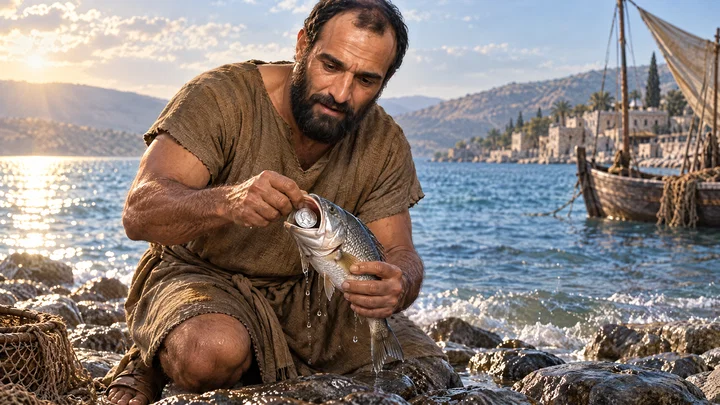
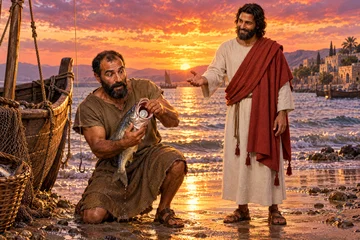
He provided the payment by miracle through a fish, with the stater found by Peter worth one shekel, enough to pay for both Jesus and Peter.ST Jan 30, 1901ST Mar 26, 1896ST Mar 26, 1896RH Apr 15, 1875RH Jan 7, 1873 The miraculous way the coin was produced proved He was the Creator and emphasized His divine Sonship.ST Jan 30, 1901ST Mar 26, 1896 This incident therefore is not evidence that He performed a miracle to pay a civil tax or to make a personal obligation easy for Himself, though His willingness to give Caesar what was due is not in question, and He regularly used miraculous power for the benefit of others rather than Himself.ST Jan 30, 1901ST Mar 26, 1896ST Mar 26, 1896
When the collectors asked, Jesus had no money to pay, so poor that a fish had to furnish the coin, which proves His poor and destitute condition in ministry without covetousness.RH Nov 4, 1873RH Apr 15, 1875 Peter also normally had little silver and gold, with the money supplied by miracle.RH Apr 15, 1875RH Oct 4, 1870 Their lack of money proves their destitute life in ministry.RH Nov 4, 1873RH Apr 15, 1875RH Oct 4, 1870
Belonging to God's family does not remove duty to earthly government, whose powers are of divine institution and whose protection makes religious and personal liberty possible.ST Jan 30, 1901RH Sep 18, 1866RH May 17, 1860 Jesus and His apostles conformed to the laws of the land, paid tribute, and taught disciples to do the same rather than join resistance or rebel to reform national politics.ST Jan 30, 1901RH Sep 18, 1866RH May 17, 1860ST Mar 26, 1896 He paid a tax unjustly required of Him so as not to offend the authorities or give them grounds to hinder His work, illustrating respect for civil authority without compromising truth.ST Jan 30, 1901 Earthly citizenship is subordinate to citizenship in God's kingdom, and civic obligations are to be met cheerfully as duty to God, rendering custom, tribute, fear and honor as fulfilling God's law without neglecting what is owed to God.ST Jan 30, 1901RH Sep 18, 1866 The verse is therefore used to support obeying civil laws, including paying taxes even when they are oppressive, so long as obedience does not conflict with duty to God.ST Mar 26, 1896
Christians should obey God rather than people when principle is at stake, but yield to an unjust or oppressive demand, including oppressive taxes, when doing so sacrifices no principle and avoids needless conflict or offense.RH Jul 4, 1907RH Jul 4, 1907ST Mar 26, 1896 Paying tribute is compatible with refusing to fight and does not require paying others to fight, even though government may use tax money to pay soldiers.ST Mar 26, 1896RH May 9, 1865
Christ's payment shows submission to temporal authority rather than claimed exemption, so one who exempts himself and his clergy from the temporal sword and authority is contrary to Christ and is antichrist.RH Nov 29, 1870RH Dec 12, 1907 In contrast to Christ who paid tribute, the pope takes tribute.RH Apr 15, 1875ST Jun 15, 1904 Peter's poor condition condemns the pope's claim to be Peter's successor while wearing as the fisherman's ring a jeweled ring worth $8,000 and receiving millions in Peter's pence.RH Apr 15, 1875 Those who held it taught from this payment that temporal authority is superior to spiritual authority.RH Dec 12, 1907
The events of Matthew 17, including this incident and the transfiguration, belong to Christ's first advent and therefore cannot be identified as His second coming.RH Jun 18, 1861
Sources