Zechariah 5:10
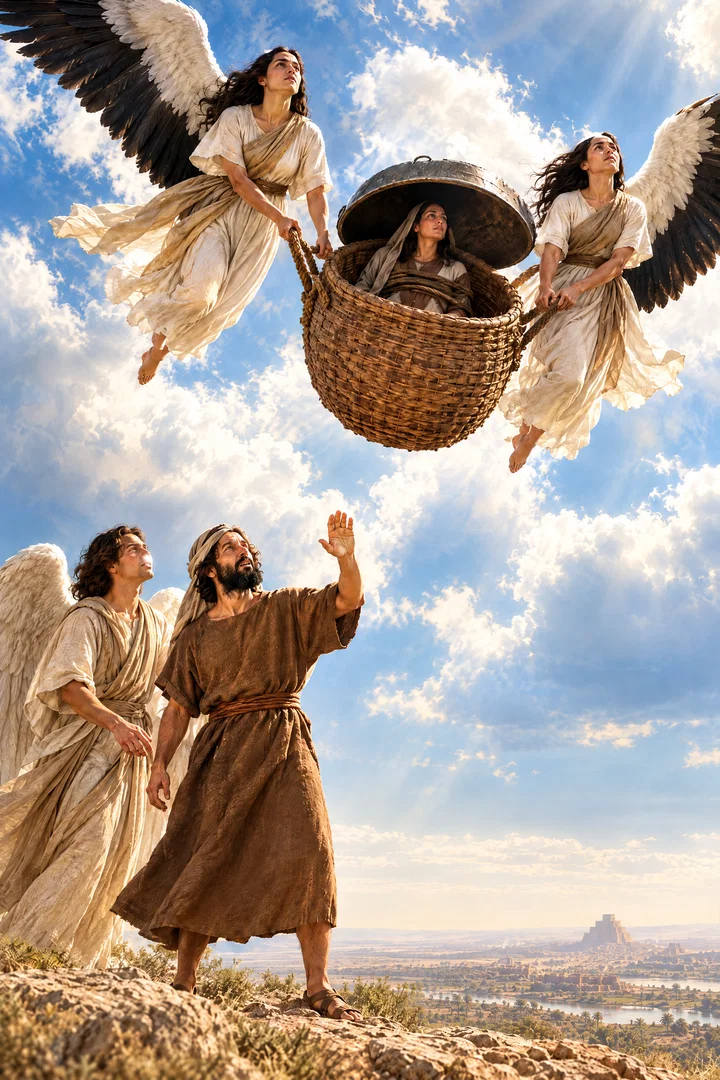
Then said I to the angel that talked with me, Whither do these bear the ephah?
Translations
Then said I to the angel that talked with me, Where do these bear the ephah?
King James Version, KJV Cambridge Paragraph Bible, Webster Bible, Revised Version, American Standard Version
Then said I to the angel that talked with me, Whither do these bear the ephah?
And I say unto the messenger who is speaking with me, 'Whither [are] they causing the ephah to go?'
And I said to the angel that talked with me, Whither do these carry the ephah?
Then said I unto the messenger who was speaking with me,—Whither are they carrying the ephah?
Berean Standard Bible, Majority Standard Bible
“ Where are they taking the basket?” I asked the angel who was speaking with me.
Then I said to the angel who talked with me, “ Where are these carrying the ephah basket?”
And I said to the angel who was talking to me, Where are they taking the ephah?
Then saide I to the Angel that talked with me, Whither doe these beare the Ephah?
Douay-Rheims (Challoner revision)
And I said to the angel that spoke in me: Whither do these carry the vessel?
Pictures
Cross-references
- Zechariah 5:1-4
Then I turned, and lifted up mine eyes, and looked, and behold a flying roll.
The ephah vision supplements the roll’s curse against thieves and false swearers.
- Leviticus 19:35-36
Ye shall do no unrighteousness in judgment, in meteyard, in weight, or in measure.
God commands honest weights and measures.
- Amos 8:5
Saying, When will the new moon be gone, that we may sell corn? and the sabbath, that we may set forth wheat, making the ephah small, and the shekel great, and falsifying the balances by deceit?
It describes dishonest ephahs and weights used to cheat people.
- Ezekiel 45:10
Ye shall have just balances, and a just ephah, and a just bath.
It commands just weights and measures.
Commentary
Each commentary is drawn from primary sources: the writings of Ellen G. White and Adventist pioneers and periodicals. Each commentary is separate. Its own words are not a quotation; follow the references to read the source passages.
Pioneers and periodicals
12 sources
The prophet is asking the angel that talked with him where the bearers are carrying the ephah that holds wickedness and the woman, lifted and borne by two winged women.ST May 24, 1883ST Jul 15, 1913
They are carrying it to the land of Shinar, to Chaldea centered on Babylon where Babylon stood, where a house will be built for it and it will be set and permanently established on its own base.ST May 24, 1883ST Jul 15, 1913
The woman inside is the Jewish nation carried captive to Babylon after Nebuchadnezzar destroyed Jerusalem, and the two women carrying her are the Babylonians and Assyrians united under Nebuchadnezzar to conquer and deport the Jews with the speed, reach, and triumph of conquering nations.ST May 24, 1883ST May 24, 1883ST May 24, 1883
The ephah containing wickedness is a corrupt religious system and false standard of iniquity marked by commercialism and Babylonian idolatry, intended to be perpetuated and permanently established.ST Oct 29, 1902
Its lifting and transport by the winged women is the raising up and establishing of mystic Babylon by a power that makes its continued influence possible, and the wind in their stork-like wings is war, commotion, and strife by which Babylon advances through earthly conflict.
Question and Destination
The prophet asks the angel who is speaking with him where the bearers are carrying the ephah containing wickedness and the woman inside it.ST May 24, 1883ST Jul 15, 1913ST Oct 29, 1902ST Apr 9, 1902 The question concerns the two winged women who lift and bear the ephah, and where those two women are taking it.ST Oct 29, 1902ST Apr 9, 1902ST May 24, 1883 The asking introduces the explanation of its destination and establishment that follows.ST May 24, 1883ST Oct 29, 1902
The answer is to the land of Shinar, which is Chaldea centered on Babylon where Babylon stood.ST May 24, 1883ST Jul 15, 1913ST Oct 29, 1902 There a house is to be built for it, prepared for it, and it is to be set there on its own base and its own place.ST May 24, 1883ST Jul 15, 1913ST Oct 29, 1902ST Oct 29, 1902 There it will be established and permanently established, marking the intended perpetuation and establishment of what the ephah represents.ST Oct 29, 1902ST Apr 9, 1902 Unlike the helpless captive confined in the ephah, her captors bear wings signifying the speed, reach, and triumph of conquering nations in carrying her away, for the winged women are the Babylonian and Assyrian nations united under Nebuchadnezzar to conquer and deport the Jewish nation taken captive after Jerusalem was destroyed.ST May 24, 1883 The measure thus carried to the land of Babylon represents a false standard of iniquity that will be established there.ST Oct 29, 1902
Historical Captivity Meaning
The woman shut inside the ephah is the Jewish nation carried captive to Babylon after Jerusalem was destroyed by Nebuchadnezzar.ST May 24, 1883ST May 24, 1883ST May 24, 1883 When the prophet asks where the bearers are carrying the ephah, the answer is to Shinar, where Babylon stood.ST May 24, 1883ST May 24, 1883ST May 24, 1883 The two women bearing it are the Babylonians and Assyrians united under Nebuchadnezzar to conquer the Jews and deport them.ST May 24, 1883ST May 24, 1883 In contrast to the helpless captive confined in the vessel, her captors have wings, signifying the speed and far reach of conquering nations and their triumph in carrying her away.ST May 24, 1883 The narrow compass of the ephah and the woman crushed beneath the lead show that only a few thousand out of a nation of millions were left to be taken as a diminished remnant, including members of the royal family and the priesthood, while the surviving vessels of the sanctuary were also carried to Babylon.ST May 24, 1883
The vision looks back to the first destruction of Jerusalem and the captivity, and warned against sin so that a later destruction of Jerusalem and dispersion might be avoided.ST May 24, 1883 Because the warning was not heeded, Jerusalem was afterward destroyed and the Jews dispersed by the Romans under Titus in A.D. 70.ST May 24, 1883 The ephah itself is a just measure, like the sanctuary shekel kept as a standard under the priest's care, and as it goes forth it acts as God's eye condemning fraud in weights and measures.ST May 24, 1883 In this it supplements the vision of the roll, for both condemn thieves and false swearers, whose theft and false swearing are accompanied by dishonest measures.ST May 24, 1883
Mystic Babylon Established
The question where the ephah containing wickedness is being carried is answered that it is taken to the land of Shinar, that is Babylon, where a house is built and prepared for it and it is set and established permanently on its own base.ST Oct 29, 1902 The measure so carried is a false standard of iniquity, a corrupt religious system marked by commercialism and Babylonian idolatry, intended to be perpetuated and permanently established.ST Oct 29, 1902 The lifting and transport of the ephah by the winged women carrying it to the land of rebellion, where it will be established, represent a power that raises up and establishes mystic Babylon and makes its continued influence possible.
The wind in their stork-like wings represents war, commotion, and strife, by which Babylon advances through earthly conflict and uses force against those who threaten her through the truth. The ephah is carried between heaven and earth and remains established on a firm base. Babylon had received the light of truth for seventy years but rejected that light, and guilt brought condemnation, while rebellion turned iniquity into an organized religion that enabled people to persist in evil without conscience. This system was established to continue in different outward forms, but it will ultimately be destroyed.
The ephah lifted between heaven and earth belongs to mystic Babylon before the Christian age in connection with Babylonian idolatrous religion, and its name is traced through Egypt to Babylon where it was called pitu, with its destination the land of rebellion. The two women represent corruption of the light and truth given through faithful servants blended with Babylonian idolatry. That pattern is seen in Christianity's blending with paganism in Christ's time and in a future union of Spiritualism and apostate Protestantism, which give the woman power and authority to continue in rebellion.
The ephah is a common measure, about a bushel in ancient times and later about half a bushel, representing a standard of measure sent throughout the earth.ST Oct 29, 1902 The woman symbolizes a church identified as the Roman Catholic Church, which surrounds itself with and spreads a standard different from God's standard represented by the flying roll.ST Oct 29, 1902 The false religious standard is lifted up by Catholics and Protestants as they unite, and they seek to establish it permanently in law, including laws enforcing Sunday observance.ST Oct 29, 1902
Sources