1 Samuel 24:20
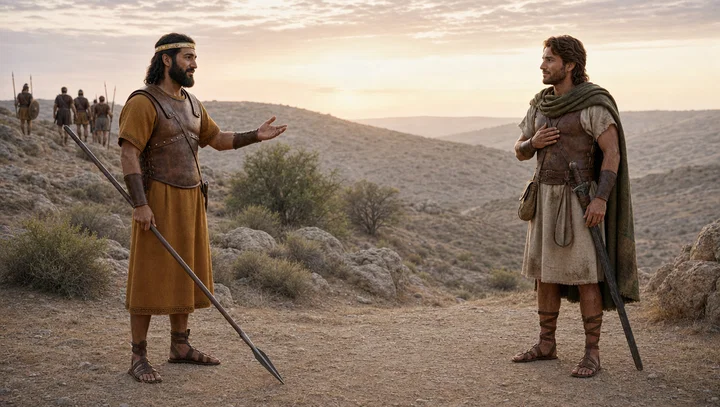
And now, behold, I know well that thou shalt surely be king, and that the kingdom of Israel shall be established in thine hand.
Translations
And now, behold, I know well that you shall surely be king, and that the kingdom of Israel shall be established in your hand.
And now, behold, I know well that thou shalt surely be king, and that the kingdom of Israel shall be established in thine hand.
And now behold, I know well that thou shalt surely be king, and that the kingdom of Israel shall be established in thine hand.
And now, behold, I know well that thou wilt surely be king, and that the kingdom of Israel will be established in thy hand.
And now, behold, I know that thou shalt surely be king, and that the kingdom of Israel shall be established in thine hand.
And now, behold, I know that thou shalt surely be king, and that the kingdom of Israel shall be established in thy hand.
'And, now, lo, I have known that thou dost certainly reign, and the kingdom of Israel hath stood in thy hand;
And now behold, I know that thou shalt certainly be king, and that the kingdom of Israel shall be established in thy hand.
Now, therefore, lo! I know that thou, shalt indeed become king,—and that the kingdom of Israel, shall be established in thy hand.
Now I know for sure that you will be king, and that the kingdom of Israel will be established in your hands.
Now I know for sure that you will be king and that the kingdom of Israel will be established in your hands.
Now, behold, I know that you will surely be king, and that the kingdom of Israel will be established in your hand.
And now I am certain that you will be king, and that the kingdom of Israel will be made strong under your authority.
For who shall finde his enemie, and let him depart free? wherefore the Lord render thee good for that thou hast done vnto me this day.
Douay-Rheims (Challoner revision)
And now as I know that thou shalt surely be king, and have the kingdom of Israel in thy hand:
Pictures
Cross-references
- 1 Samuel 16:13
Then Samuel took the horn of oil, and anointed him in the midst of his brethren: and the Spirit of the LORD came upon David from that day forward. So Samuel rose up, and went to Ramah.
David was anointed king before he possessed the throne.
- 1 Samuel 24:11
Moreover, my father, see, yea, see the skirt of thy robe in my hand: for in that I cut off the skirt of thy robe, and killed thee not, know thou and see that there is neither evil nor transgression in mine hand, and I have not sinned against thee; yet thou huntest my soul to take it.
David shows Saul the robe’s cut edge as proof he spared him.
- 2 Samuel 5:3
So all the elders of Israel came to the king to Hebron; and king David made a league with them in Hebron before the LORD: and they anointed David king over Israel.
David is anointed king over all Israel.
- Luke 1:32-33
He shall be great, and shall be called the Son of the Highest: and the Lord God shall give unto him the throne of his father David:
Jesus receives David’s throne and reigns forever.
- 2 Samuel 2:4
And the men of Judah came, and there they anointed David king over the house of Judah. And they told David, saying, That the men of Jabesh-gilead were they that buried Saul.
David is first crowned king over part of Israel.
- 1 Samuel 16:7
But the LORD said unto Samuel, Look not on his countenance, or on the height of his stature; because I have refused him: for the Lord seeth not as man seeth; for man looketh on the outward appearance, but the LORD looketh on the heart.
God looks on the heart in choosing David as king.
- 1 Samuel 26:21
Then said Saul, I have sinned: return, my son David: for I will no more do thee harm, because my soul was precious in thine eyes this day: behold, I have played the fool, and have erred exceedingly.
Saul acknowledges David’s goodness in sparing him despite Saul’s hostility.
- 2 Samuel 5:4
David was thirty years old when he began to reign, and he reigned forty years.
David's promised kingship is fulfilled in his forty-year reign.
- 1 Samuel 26:12
So David took the spear and the cruse of water from Saul’s bolster; and they gat them away, and no man saw it, nor knew it, neither awaked: for they were all asleep; because a deep sleep from the LORD was fallen upon them.
David spared Saul, though Saul repaid his loyalty with evil.
- 1 Samuel 18:11
And Saul cast the javelin; for he said, I will smite David even to the wall with it. And David avoided out of his presence twice.
Saul's envy moved him to try to kill David.
- 1 Samuel 19:10
And Saul sought to smite David even to the wall with the javelin; but he slipped away out of Saul’s presence, and he smote the javelin into the wall: and David fled, and escaped that night.
Saul’s envy drove him to try to kill David.
Commentary
Each commentary is drawn from primary sources: the writings of Ellen G. White and Adventist pioneers and periodicals. Each commentary is separate. Its own words are not a quotation; follow the references to read the source passages.
Ellen G. White
2 sources
Saul himself conceded to David that he would surely become king and that the kingdom of Israel would be established in his hand.PP 662.1–2 This admission came after David spared his life, when Saul recognized David's righteousness in showing him mercy and affirmed that the Lord would reward David for it.PP 662.1–2 At that time David was only a shepherd youth holding nothing but God's promise of the throne, standing against Saul the reigning monarch who was determined to hold fast his power.ED 254.2–3 Though utterly helpless in himself, David trusted God's word and withstood in Saul the power of the whole world, proving God's word stronger than human power and policy used in support of evil.ED 254.2–3 By that trust he stands in the world's true nobility and royal line.ED 254.2–3
Sources
Pioneers and periodicals
12 sources
The words were spoken after David spared Saul's life in the cave among the rocks of En-gedi, where Saul had come with three thousand chosen men to seek David and, turning weary into the cave to rest, fell asleep where David and his companions were hidden, leaving himself completely in David's power.RH May 3, 1870ST Jul 24, 1884ST Jun 15, 1904 Though his men reminded him that the Lord had promised to deliver Saul into his hands and urged him to slay the king, David would not lay hands on the Lord's anointed but only cut off the skirt or fold of his coat or mantle, and even for that his tender conscience smote him.ST Jul 24, 1884ST Jun 15, 1904 He then called after Saul to show the skirt in his hand as proof that there was neither evil nor transgression in his hand and he had not sinned against Saul, which convinced Saul that David bore him no malice.ST Jul 24, 1884ST Jun 15, 1904 Though persecuted, David did not seek his personal enemy's destruction but remained loyal, refusing to harm the Lord's anointed even when he had the opportunity.ST Feb 17, 1904ST Apr 9, 1912ST Apr 22, 1903
In the verse Saul recognized that David would surely be king as the man God had chosen to succeed him, and that the kingdom of Israel would be established in his hand and under his rule.ST Sep 20, 1883RH May 3, 1870ST Feb 19, 1885RH Dec 6, 1906ST Apr 22, 1903 The confession came with opened eyes and genuine feeling, more than a formal acknowledgment, for Saul lifted up his voice and wept.RH May 3, 1870ST Jun 15, 1904 He declared that David was more righteous than he and superior to him in righteousness, because David had rewarded him good whereas he had rewarded David evil.RH May 3, 1870ST Jul 24, 1884ST Jun 15, 1904
The admission shows noble traits and that good remained in Saul despite a life stained with envy, jealousy, and crime, and if those noble traits had been cultivated and the evil eradicated he might have won the favor of God and man instead of persisting in self-will to ruin.ST Feb 19, 1885 Yet it did not cure him, for in a very short time he was again at the head of three thousand chosen men thirsting for the blood of the man who had saved his life and hunting him like a wild beast, showing how envy blinds fallen man and how strongly the devil holds his victims.RH May 3, 1870 The incident proves David's disposition was not cruel, for it is a remarkable instance of returning good for evil.RH Sep 26, 1871
Though driven into the fastnesses of the mountains for protection, and though his persecutor was at times wholly within his power, he guarded Saul as the anointed of the Lord even though the prophet's anointing oil was already upon his own head.ST Feb 17, 1904ST Jun 15, 1904RH Dec 6, 1906 Brave, determined, cool, yet tender and kind, he formed a worthy purpose and held steadily to it, believing he was Israel's rightful heir and real king while appearing to be an outlaw hunted by Saul and leading a band of outcasts, which illustrates faith as confidence in what is not yet visible.RH Dec 6, 1906RH Sep 14, 1911 By holding to his purpose David became in the prime of life one of the most eminent rulers of all time, bringing for forty long years out of a disorganized confederation of tribes a strong, united kingdom.RH Dec 6, 1906 The verse is a lesson that purpose and mission are the same and that one who can select and hold a worthy purpose possesses the traits that make a good and true missionary, and it gives an example that a soft answer turns away wrath, of loving enemies, overcoming evil with good, and patiently enduring persecution while leaving vengeance to God, teaching that it is safe to commit one's cause to God and remain loyal.ST Apr 9, 1912ST Jul 24, 1884RH Dec 6, 1906 The verse stands in a chapter that is omitted from the shorter course of readings but is important for its lessons, and in which the English word anointed renders the Greek word Christ in the Septuagint version.ST Apr 9, 1912ST Jul 20, 1904
Sources