1 Samuel 18:11
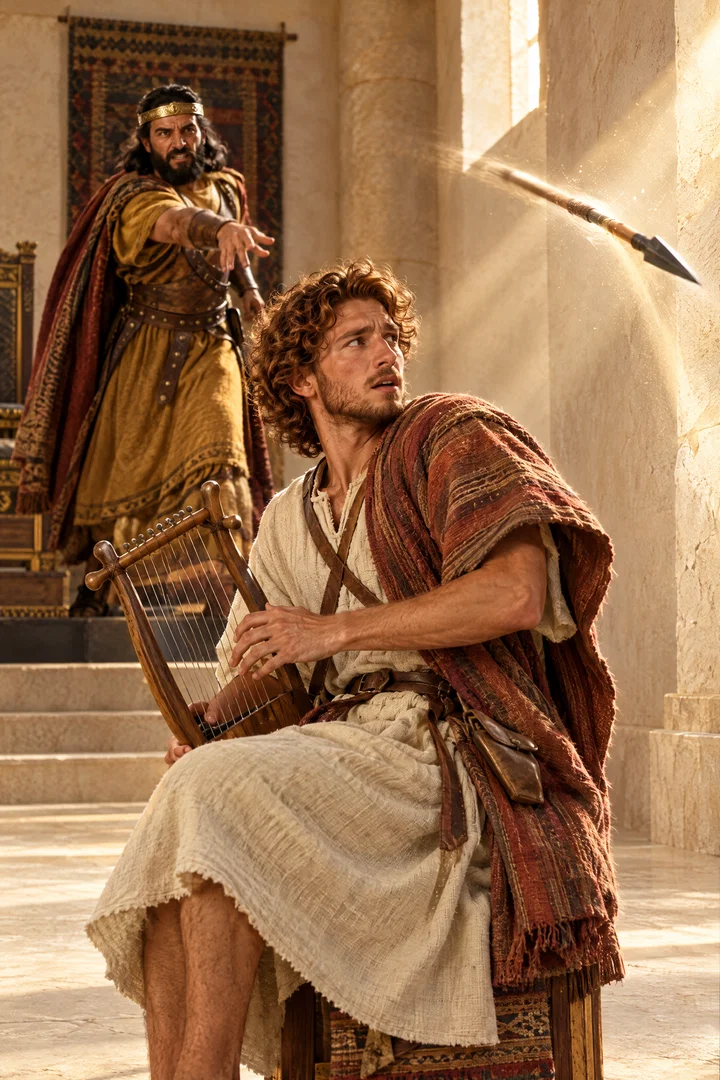
And Saul cast the javelin; for he said, I will smite David even to the wall with it. And David avoided out of his presence twice.
Translations
American King James Version, King James Version, KJV Cambridge Paragraph Bible
And Saul cast the javelin; for he said, I will smite David even to the wall with it. And David avoided out of his presence twice.
And Saul cast the javelin; for he said, I will smite David even to the wall. And David escaped from his presence twice.
Revised Version, American Standard Version
and Saul cast the spear; for he said, I will smite David even to the wall. And David avoided out of his presence twice.
and Saul casteth the javelin, and saith, 'I smite through David, even through the wall;' and David turneth round out of his presence twice.
And Saul cast the spear, and thought, I will smite David and the wall. But David turned away from him twice.
Saul hurled the spear, and said to himself—I will smite David, even to the wall! But David moved round from before him, twice.
Berean Standard Bible, Majority Standard Bible
and he hurled it, thinking, “ I will pin David to the wall.” But David eluded him twice.
and Saul threw the spear, for he said, “ I will pin David to the wall!” David escaped from his presence twice.
And Saul, balancing the spear in his hand, said, I will give David a blow, pinning him to the wall. And David got away from him twice.
And Saul tooke the speare, and sayd, I will smite Dauid through to the wall. But Dauid auoyded twise out of his presence.
Douay-Rheims (Challoner revision)
And threw it, thinking to nail David to the wall: and David stept aside out of his presence twice.
Pictures
Cross-references
- 1 Samuel 19:10
And Saul sought to smite David even to the wall with the javelin; but he slipped away out of Saul’s presence, and he smote the javelin into the wall: and David fled, and escaped that night.
Saul again tries to kill David with a spear, but David escapes.
- 1 Samuel 20:33
And Saul cast a javelin at him to smite him: whereby Jonathan knew that it was determined of his father to slay David.
Saul hurls a javelin at Jonathan after he defends David.
- 1 Samuel 20:1-3
And David fled from Naioth in Ramah, and came and said before Jonathan, What have I done? what is mine iniquity? and what is my sin before thy father, that he seeketh my life?
David flees Saul’s murderous pursuit and tells Jonathan his life is in danger.
- 1 Samuel 18:7
And the women answered one another as they played, and said, Saul hath slain his thousands, and David his ten thousands.
people's greater praise provoked the attack
- 1 Samuel 26:12
So David took the spear and the cruse of water from Saul’s bolster; and they gat them away, and no man saw it, nor knew it, neither awaked: for they were all asleep; because a deep sleep from the LORD was fallen upon them.
David spared Saul when he could have killed him.
- 1 Samuel 19:6
And Saul hearkened unto the voice of Jonathan: and Saul sware, As the LORD liveth, he shall not be slain.
Jonathan persuaded Saul to spare David.
- 1 Samuel 24:11
Moreover, my father, see, yea, see the skirt of thy robe in my hand: for in that I cut off the skirt of thy robe, and killed thee not, know thou and see that there is neither evil nor transgression in mine hand, and I have not sinned against thee; yet thou huntest my soul to take it.
David had Saul in his power but spared him.
- 1 Samuel 26:2
Then Saul arose, and went down to the wilderness of Ziph, having three thousand chosen men of Israel with him, to seek David in the wilderness of Ziph.
Saul later leads men to hunt David down.
- 1 Samuel 18:1-4
And it came to pass, when he had made an end of speaking unto Saul, that the soul of Jonathan was knit with the soul of David, and Jonathan loved him as his own soul.
Jonathan accepts David’s advancement without envy.
- 1 Samuel 31:1-6
Now the Philistines fought against Israel: and the men of Israel fled from before the Philistines, and fell down slain in mount Gilboa.
Saul’s hostility ended with his death in battle.
- 1 Samuel 17:40-54
And he took his staff in his hand, and chose him five smooth stones out of the brook, and put them in a shepherd’s bag which he had, even in a scrip; and his sling was in his hand: and he drew near to the Philistine.
David’s victory over Goliath brought deliverance to Israel.
- 1 Samuel 23:17
And he said unto him, Fear not: for the hand of Saul my father shall not find thee; and thou shalt be king over Israel, and I shall be next unto thee; and that also Saul my father knoweth.
Jonathan recognized David’s calling to succeed Saul.
- 1 Samuel 24:17-20
And he said to David, Thou art more righteous than I: for thou hast rewarded me good, whereas I have rewarded thee evil.
Saul acknowledges David’s goodness and foretells his kingship.
Commentary
Each commentary is drawn from primary sources: the writings of Ellen G. White and Adventist pioneers and periodicals. Each commentary is separate. Its own words are not a quotation; follow the references to read the source passages.
Ellen G. White
6 sources
This moment belongs to David's early life at Saul's court, when he was experiencing success and growing responsibilities alongside his friendship with Jonathan.PP 649.1 At the time David was playing music before Saul to soothe him, and singing praises to God.SG4 82.2–41SP 373.2–3PP 650.4
The act reveals Saul's marked character of strength and weakness combined, with contradictory elements bound up in him; he worked at cross purposes with God, with good and evil ever in collision in him and evil striving for the supremacy.Lt 7, 1894, par. 41–42 Gifts of talent had been bestowed on him, but because he did not consecrate them wholly to God he dishonored himself by his own transgression.Lt 7, 1894, par. 41–42 At times he revealed marked simplicity and tender sympathy toward those who pleased him, and then a jealous and overbearing spirit, becoming unjust and cruel toward his best friends.Lt 7, 1894, par. 41–42
When brought under the influence of sacred vocal music he would catch the spirit of devotion and pour forth impassioned expressions of lofty eloquence in ecstasies of praise and prayer, giving himself no rest day nor night in wild excitement and inordinate zeal until the reaction came and his strength failed in exhaustion.Lt 7, 1894, par. 41–42 When the paroxysm had spent itself he revealed his old disposition, and when his will was crossed he fell into a fury with words and deeds dishonoring to himself and more dishonoring to God.Lt 7, 1894, par. 41–42 His jealousy turned into an attempt to murder David, suddenly hurling his sharp-pointed spear at him with intent to kill him against the wall.SG4 82.2–41SP 373.2–3PP 650.4
David recognized Saul's murderous purpose, sprang aside and escaped unharmed from the maddened king, and the weapon struck the wall where he had been sitting.SG4 82.2–41SP 373.2–3PP 650.4 God preserved David in the attack, with angels protecting him.1SP 373.2–3PP 650.4 David was a righteous man whom God had chosen to save Israel.SG4 83.1
The attack showed Israel that God had left Saul to follow his guilty course, and that a king rebelling against God and ruled by his passions could sink to murder and extreme crime.SG4 83.1
Sources
Pioneers and periodicals
20 sources
While David was faithfully playing as musician before Saul at court after the slaying of Goliath, Saul hurled his javelin twice to pin David to the wall and kill him, but David escaped unharmed without striking back.RH Oct 12, 1869RH May 3, 1870ST Sep 20, 1883ST Nov 28, 1895ST Jul 17, 1884 The attack was driven by long-cherished envy, pride and murderous anger because the people praised David above Saul for slaying his ten thousands, and Saul would not share the kingdom's honors nor submit to God's choice of David as future king.RH Oct 12, 1869ST Sep 20, 1883ST Sep 20, 1883ST Nov 28, 1895ST Jul 17, 1884 God preserved David's life because of the great work he would yet do as anointed king and prophet, and the scene displays Saul's ever-downward course of rashness, rejection and tyranny set against David's ever-rising career.ST Sep 20, 1883ST Apr 11, 1911ST Apr 15, 1913ST Mar 30, 1904ST Sep 2, 1889 The assault began Saul's persecution and gave David painful training before the crown that prepared him to rule without repeating Saul's wickedness, setting the stage for his later sparing of Saul when he repaid evil with good.RH May 3, 1870RH May 3, 1870RH Aug 22, 1865 David's restraint teaches that it is safe to leave one's cause in God's hand rather than retaliate, while Saul's jealous outbreak warns that harboring jealousy leads to destructive deeds and a sad end, standing in striking contrast to Jonathan's noble unselfish generosity.ST Sep 14, 1888ST Apr 11, 1911ST Apr 9, 1912ST Apr 7, 1909
Setting and Attack
After Goliath was slain Saul kept David at his court at Gibeah, where David behaved wisely and gained the friendship of the people and played before Saul as musician as had been his custom.ST Nov 28, 1895ST Jul 17, 1884 While David was thus playing, Saul looked on him with a jealous eye because the people had gone forth to meet the conquerors with songs and dancing, shouting Saul has slain his thousands and David his ten thousands.ST Nov 28, 1895 In a fit of jealous rage over that greater praise given to David, Saul hurled the javelin at the musician performing before him.ST Nov 28, 1895ST Jul 17, 1884
The hurling was driven by envy of David's honor that made Saul wretched, by fierce and unreasonable jealousy, and by long-cherished jealousy, pride and anger.RH Oct 12, 1869ST Sep 2, 1889 Although David had served him faithfully and had done him no wrong, Saul would not share the kingdom's honors with him nor submit to God's choice of David as Israel's future king, and his pride, envy and jealousy allowed an evil spirit to control him and turned into growing tyranny and murderous hatred.ST Sep 20, 1883ST Sep 20, 1883
Saul cast the javelin intending to pin David to the wall and kill him, and he tried twice, but David escaped.RH May 3, 1870ST Jul 17, 1884RH Jun 25, 1901 This was one of three such javelin attacks, the last coming after Saul had recalled David from banishment and reinstated him in his former position.ST Nov 28, 1895 His hostility also extended to Jonathan, whom he attacked with a javelin when Jonathan questioned his decision to kill David.ST Sep 14, 1888
Although David had never lifted his hand against Saul but had ever been loyal to him, having done him no wrong, David avoided out of Saul's presence twice and escaped.RH Oct 12, 1869ST Sep 20, 1883ST Apr 11, 1911ST Apr 9, 1912 He avoided the king rather than retaliating, showing mercy and magnanimity toward his enemy and refusing to strike back or take vengeance into his own hands.ST Apr 11, 1911ST Apr 9, 1912 His upright loyalty continued even when he later had the chance to kill Saul but spared him.RH May 3, 1870
Providence and Lessons
The javelin cast belongs to the closing movement of the larger story that traces the choosing of Saul, the death of Samuel, the waning of the house of Saul and the calling of David, marking Saul's ever-downward course of rashness, weakness, failure and rejection set against David's checkered but ever-rising career.ST Apr 11, 1911ST Apr 15, 1913 It exposes Saul's growing tyranny and murderous hatred in his refusal to submit to God's choice of David as Israel's future king.ST Sep 20, 1883 The same act reveals the contrary features of his character, for he hunted David's life with fiendish ferocity while at other times calmly and lovingly heaping inconsistent favors and smiles upon him.RH Nov 27, 1860
God's providence was shaping and molding national events in this clash while still remembering the promised Seed.ST Apr 11, 1911 David's life was preserved because of the great work he would later accomplish, since he was anointed as Israel's future king and destined to become a great prophet whose words and writings would bring promises, encouragement and wisdom to later generations.ST Mar 30, 1904ST Sep 2, 1889RH Nov 28, 1912 The attempt to cut that future short was an expression of Satan's hostility toward David, seeking to prevent the work God had appointed him to do.RH Nov 28, 1912
The throwing of the javelin began Saul's persecution of David, and the danger, hardship and hatred David endured before he wore the crown gave him painful training that prepared him to rule without repeating Saul's wickedness.RH May 3, 1870RH Aug 22, 1865RH Jun 25, 1901 That persecution set the stage for later tests in which David had the chance to kill Saul but spared him rather than retaliating.RH May 3, 1870RH Jun 25, 1901 Saul himself acknowledged that David had repaid evil with good and recognized that David would become king, yet soon pursued him again in order to take his life.RH May 3, 1870
Saul's jealous outbreak stands in striking contrast to the noble, unselfish generosity of his son Jonathan.ST Apr 7, 1909 It also contrasts with Saul's own earlier humility when he held his peace despite being despised, illustrating the loss of meekness after he turned from obedience to God and allowed pride, jealousy and anger at David's honor to take hold.ST Jul 8, 1889 His hostility extended even to Jonathan, whom he attacked with a javelin when Jonathan questioned his decision to kill David, leaving Jonathan afraid of his father and unable to trust him because he saw that God had departed from him and another spirit had taken hold of him.ST Sep 14, 1888
David's avoidance without retaliation displays his mercy and magnanimity toward his enemy, his hope and trust in God, and his utter refusal to take vengeance into his own hands upon the one pursuing him.ST Apr 11, 1911ST Apr 7, 1909 His restraint teaches that it is safe to leave one's cause in God's hand and to commit one's cause to Him rather than strike back.ST Apr 11, 1911ST Apr 9, 1912 Saul's course warns that long-cherished, fierce and unreasonable jealousy leads to destructive actions and a sad end, for he persistently sought David's life though David had never lifted his hand against him but had ever been loyal to him.ST Apr 9, 1912ST Sep 16, 1889 His later death without comfort or David's help came as a consequence of his own transgressions, when had he not pursued David, David might have helped him, so that a reign that might have been so different ended in enmity and sadness.ST Apr 9, 1912ST Sep 16, 1889
Sources