1 Samuel 24:11
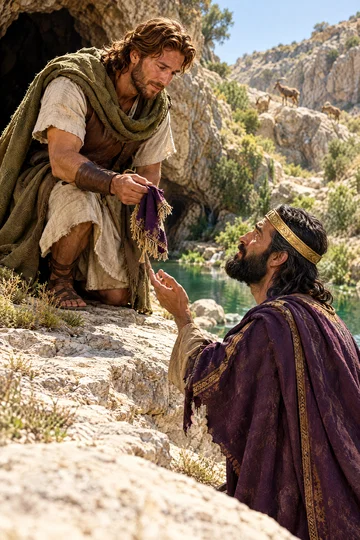
Moreover, my father, see, yea, see the skirt of thy robe in my hand: for in that I cut off the skirt of thy robe, and killed thee not, know thou and see that there is neither evil nor transgression in mine hand, and I have not sinned against thee; yet thou huntest my soul to take it.
Translations
Moreover, my father, see, yes, see the skirt of your robe in my hand: for in that I cut off the skirt of your robe, and killed you not, know you and see that there is neither evil nor transgression in my hand, and I have not sinned against you; yet you hunt my soul to take it.
Moreover, my father, see, yea, see the skirt of thy robe in my hand: for in that I cut off the skirt of thy robe, and killed thee not, know thou and see that there is neither evil nor transgression in mine hand, and I have not sinned against thee; yet thou huntest my soul to take it.
Moreover, my father, see, yea see the skirt of thy robe in my hand: for in that I cut off the skirt of thy robe, and killed thee not, know thou and see that there is neither evil nor transgression in mine hand, and I have not sinned against thee; yet thou huntest my soul to take it.
Moreover, my father, see, yes, see the skirt of thy robe in my hand: for in that I cut off the skirt of thy robe, and killed thee not, know thou and see that there is neither evil nor transgression in my hand, and I have not sinned against thee; yet thou huntest my soul to take it.
Moreover, my father, see, yea, see the skirt of thy robe in my hand: for in that I cut off the skirt of thy robe, and killed thee not, know thou and see that there is neither evil nor transgression in mine hand, and I have not sinned against thee, though thou huntest after my soul to take it.
Moreover, my father, see, yea, see the skirt of thy robe in my hand; for in that I cut off the skirt of thy robe, and killed thee not, know thou and see that there is neither evil nor transgression in my hand, and I have not sinned against thee, though thou huntest after my life to take it.
'And, my father, see, yea see the skirt of thine upper robe in my hand; for by cutting off the skirt of thy upper robe, and I have not slain thee, know and see that there is not in my hand evil and transgression, and I have not sinned against thee, and thou art hunting my soul to take it!
And see, my father, yes, see the skirt of thy robe in my hand. For in that I cut off the skirt of thy robe, and killed thee not, know and see that there is neither evil nor transgression in my hand, and I have not sinned against thee; yet thou liest in wait for my life to take it.
But, my father, see, yea, see, the corner of thy robe in my hand,—for, in that I cut off the corner of thy robe, and yet did not slay thee, know thou, and see, that there is not in my hand either wrong or transgression, neither have I sinned against thee, yet art thou hunting my life, to take it.
See, my father, look at the corner of your robe in my hand. For I cut it off, but I did not kill you. See and know that there is no evil or rebellion in my hands. I have not sinned against you, even though you are hunting me down to take my life.
See, my father, look at the corner of your robe in my hand. For I cut it off, but I did not kill you. Know and see that there is no evil or rebellion in my hands. I have not sinned against you, even though you are hunting me down to take my life.
Moreover, my father, behold, yes, see the skirt of your robe in my hand; for in that I cut off the skirt of your robe and didn’t kill you, know and see that there is neither evil nor disobedience in my hand. I have not sinned against you, though you hunt for my life to take it.
And see, my father, see the skirt of your robe in my hand: for the fact that I took off the skirt of your robe and did not put you to death is witness that I have no evil purpose, and I have done you no wrong, though you are waiting for my life to take it.
Behold, this day thine eyes haue seene, that the Lord had deliuered thee this day into mine hand in the caue, and some bade me kill thee, but I had compassion on thee, and said, I will not lay mine hande on my master: for he is the Lordes Anoynted.
Douay-Rheims (Challoner revision)
Moreover see and know, O my father, the hem of thy robe in my hand, that when I cut, off the hem of thy robe, I would not put out my hand against thee. Reflect, and see, that there is no evil in my hand, nor iniquity, neither have I sinned against thee: but thou liest in wait for my life, to take it away.
Pictures

Cross-references
- 1 Samuel 24:17
And he said to David, Thou art more righteous than I: for thou hast rewarded me good, whereas I have rewarded thee evil.
Saul acknowledges David repaid evil with good and was more righteous than he.
- 1 Samuel 24:6
And he said unto his men, The LORD forbid that I should do this thing unto my master, the LORD’s anointed, to stretch forth mine hand against him, seeing he is the anointed of the LORD.
David refuses to harm Saul because he is the Lord’s anointed.
- 1 Samuel 24:4
And the men of David said unto him, Behold the day of which the LORD said unto thee, Behold, I will deliver thine enemy into thine hand, that thou mayest do to him as it shall seem good unto thee. Then David arose, and cut off the skirt of Saul’s robe privily.
David spares Saul despite the promised opportunity to harm him.
- 1 Samuel 26:11
The LORD forbid that I should stretch forth mine hand against the LORD’s anointed: but, I pray thee, take thou now the spear that is at his bolster, and the cruse of water, and let us go.
second occasion David refused to harm Saul
- 1 Samuel 26:12
So David took the spear and the cruse of water from Saul’s bolster; and they gat them away, and no man saw it, nor knew it, neither awaked: for they were all asleep; because a deep sleep from the LORD was fallen upon them.
David’s second sparing of Saul proves his loyalty.
- 1 Samuel 26:21
Then said Saul, I have sinned: return, my son David: for I will no more do thee harm, because my soul was precious in thine eyes this day: behold, I have played the fool, and have erred exceedingly.
David’s second act of sparing Saul moves Saul to confess his sin.
- Romans 12:20-21
Therefore if thine enemy hunger, feed him; if he thirst, give him drink: for in so doing thou shalt heap coals of fire on his head.
David returned good for evil
- 2 Kings 6:22-23
And he answered, Thou shalt not smite them: wouldest thou smite those whom thou hast taken captive with thy sword and with thy bow? set bread and water before them, that they may eat and drink, and go to their master.
David and Elisha spare enemies and treat them with kindness.
- 1 Samuel 26:2
Then Saul arose, and went down to the wilderness of Ziph, having three thousand chosen men of Israel with him, to seek David in the wilderness of Ziph.
Saul again pursues David in the wilderness.
- 1 Peter 2:19-23
For this is thankworthy, if a man for conscience toward God endure grief, suffering wrongfully.
David endured persecution like Christ
- 1 Samuel 31:1-6
Now the Philistines fought against Israel: and the men of Israel fled from before the Philistines, and fell down slain in mount Gilboa.
shows Saul never stopped hunting David
- Isaiah 53:7
He was oppressed, and he was afflicted, yet he opened not his mouth: he is brought as a lamb to the slaughter, and as a sheep before her shearers is dumb, so he openeth not his mouth.
Jesus likewise remained silent rather than defending his rights.
- Psalms 7:5
Let the enemy persecute my soul, and take it; yea, let him tread down my life upon the earth, and lay mine honour in the dust. Selah.
Both describe an enemy pursuing and seeking to take a person’s soul.
Commentary
Each commentary is drawn from primary sources: the writings of Ellen G. White and Adventist pioneers and periodicals. Each commentary is separate. Its own words are not a quotation; follow the references to read the source passages.
Ellen G. White
3 sources
David was a shepherd lad holding God's promise of the throne, utterly helpless in himself as he stood against Saul the established monarch who was bent on holding fast his power with the strength of the whole world behind him.ED 254.2–3 Saul was pursuing and hunting David to take his life, and David feared for his life.PP 662.1–2SG4 91.1 David had Saul in his power and could have killed him, but he spared him and did not act against him.PP 662.1–2SG4 91.1
He cut off a piece of Saul's robe and displayed it as evidence to prove his innocence and that he would not harm Saul.PP 662.1–2SG4 91.1 He declared that there was neither evil nor transgression in his hand and that he had not sinned against Saul.PP 662.1–2 His address to Saul as father was a respectful way of addressing the king.PP 662.1–2 He afterward regretted even cutting the robe because Saul was the Lord's anointed.SG4 91.1 His stand in trusting God's word proves the power of God's word against human power and policy in support of evil.ED 254.2–3 His stand places him among the world's true nobility and royal line in which the youth of today are called to take their places.ED 254.2–3
Sources
Pioneers and periodicals
23 sources
David held up the cut-off piece of Saul's robe to prove he had Saul in his power in the cave and spared him, declaring himself free of evil or wrong against Saul while Saul kept hunting him to take his life.ST Sep 9, 1889RH Sep 26, 1871ST Feb 17, 1904ST Apr 9, 1912RH Jun 25, 1901 The claim was true, for David had served Saul faithfully and wisely with complete integrity, while Saul pursued him with boundless hatred from envy after departing from God.ST Sep 20, 1883RH May 3, 1870ST Sep 9, 1889 The life Saul hunted to capture and kill was David himself as a living person, showing the whole man to be the soul that can be seized and slain.RH Aug 5, 1862ST Nov 1, 1877RH Sep 12, 1854RH Nov 11, 1858 In sparing his bitterest enemy David returned good for evil and left vengeance to God to judge between them, and his merciful restraint softened Saul to tears and confession that David would surely be king.RH Mar 23, 1916RH Sep 26, 1871ST Apr 11, 1911ST Feb 17, 1904RH Dec 5, 1865
David Proves His Innocence
Saul still held the throne yet pursued David year after year far and near with an army to take his life, at one time going with three thousand chosen men to En-gedi and hunting him like a flea or a partridge and like a wild beast, driving him into the fastnesses of the mountains for protection.RH Jun 25, 1901ST Jul 24, 1884ST Jun 15, 1904RH Dec 6, 1906ST Apr 22, 1903 He had tried to kill David with a javelin, and he made seeking David's life his principal object by pretended friendship and attempted assassination, never desisting till his own death.ST Sep 20, 1883RH Jun 25, 1901 When Saul lay asleep in the cave in David's power, David's own men urged him to kill Saul as the promised deliverance into his hands and as fulfillment of God's promise.RH Jun 25, 1901ST Jul 24, 1884 David would not lay hands on the Lord's anointed or injure or harm him, but guarded him as the anointed of the Lord.ST Feb 17, 1904ST Apr 7, 1909RH Jun 25, 1901ST Jul 24, 1884ST Jun 15, 1904 He only cut off the skirt or fold of Saul's robe or mantle in the darkness, and even that pricked his tender conscience.RH Jun 25, 1901ST Jul 24, 1884ST Jun 15, 1904 He spared Saul a second time as well and refused to seek personal vengeance or the destruction of his persecutor.RH Sep 26, 1871ST Feb 17, 1904
After Saul left, David bowed to the ground and called him father to show humility and respect.RH Jun 25, 1901 He held up the cut piece as evidence that he had power to kill Saul yet spared him when Saul was in his power and within his power.ST Sep 9, 1889ST Apr 9, 1912RH Jun 25, 1901ST Sep 9, 1889RH Dec 5, 1865 By it he declared that there was neither evil nor transgression in his hand and he had not sinned against Saul and bore him no malice, while Saul continued to hunt him in order to kill him and take his life.ST Sep 9, 1889RH Jun 25, 1901RH Dec 5, 1865ST Jul 24, 1884ST Jun 15, 1904 His conduct was humble and faithful in contrast to Saul's pursuit, and it teaches that it is safe to commit one's cause to God.ST Sep 9, 1889ST Apr 9, 1912 The declaration was true, for David was Saul's most faithful and efficient servant, performing every duty committed to him without neglect of anything small, acting wisely so that all his enterprises were successful, fearing God and honoring the king.ST Sep 20, 1883 He was just toward Saul in all words and acts and true toward him in all motives of his heart, with perfect integrity in which no fault could be found, never doing him any injustice, loyal and innocent and upright in intention.ST Sep 20, 1883RH May 3, 1870
Saul knew David was wholly innocent and had no provocation and no excuse, yet hated him with boundless hatred and cherished murder in his heart.ST Sep 20, 1883 The motive was envy, the same base principle that caused the patriarchs to sell Joseph into Egypt and Cain to kill Abel, shown even after God had wrought a mighty deliverance for Israel through David.ST Sep 20, 1883RH May 3, 1870 That envy grew as Saul departed from God, lost tenderness of conscience, accountability, humility and uprightness, and became rash, self-sufficient and tyrannical.ST Sep 20, 1883 David at the same time clearly understood his relation to Saul and clearly recognized his own ultimate right to the kingdom, a conclusion many Israelites had also reached while a provisional court was already gathering about David, and the two men acted on widely different principles.ST Sep 9, 1889 He trusted that God would bring him to the throne in God's own way and time.ST Sep 9, 1889
Soul Means Living Person
In this verse the word soul means David himself, his life or living person.RH Aug 5, 1862RH Sep 12, 1854RH Nov 11, 1858 It is David whom Saul is hunting in order to take by capture and kill.RH Aug 5, 1862RH Sep 12, 1854RH Nov 11, 1858 David declares that he has not wronged Saul when he had the chance to kill him and did not.RH Sep 12, 1854 Hunting, taking, and capture are bodily actions, yet here they are assigned to the soul, proving that the soul shares the attributes of the body.RH Aug 5, 1862ST Nov 1, 1877RH Nov 11, 1858 The whole man is the soul, one single living being subject to capture and death, not a separate compound of soul and body or a separate independently living part.RH Aug 5, 1862ST Nov 1, 1877RH Nov 11, 1858
Returning Good for Evil
The verse is a display of returning good for evil, of loving the enemy and overcoming evil with good through patient endurance under persecution.RH Mar 23, 1916RH Dec 5, 1865ST Jul 24, 1884 When Saul was in determined pursuit to take his life and was delivered helpless into his hand in the cave, David harmed him not but only cut off the skirt of his robe, then held it up as proof that there was neither evil nor transgression in his hand and that he had not sinned against Saul.RH Sep 26, 1871RH Dec 5, 1865ST Jul 24, 1884 To spare the life of his bitterest enemy when he could have killed him proves his disposition was not cruel, and gives a practical illustration of consistent Christian conduct powerful enough to move the heart.RH Sep 26, 1871ST Jul 24, 1884
He refused to take vengeance into his own hands, to seek personal vengeance, to retaliate, or to destroy his persecutor.ST Feb 17, 1904ST Apr 7, 1909ST Jul 24, 1884 Though his own men urged him to kill Saul as the promised deliverance into his hands, and though Saul lay asleep in his power, it was not in his heart to injure him but he guarded him as the Lord's anointed, and even the cutting of the skirt pricked his tender conscience.ST Feb 17, 1904RH Jun 25, 1901ST Jul 24, 1884 He only cut off the skirt in the darkness, then bowed to the ground and called him father to show humility and respect, holding up the cut piece as evidence that he had power to kill yet spared him.RH Jun 25, 1901ST Sep 9, 1889 He left his case for the Lord to judge between them, trusting that God would bring him to the throne in God's own way and time.RH Jun 25, 1901ST Sep 9, 1889 That restraint teaches that it is safe to leave one's cause and commit it to God rather than harm a persecutor within one's power.ST Apr 11, 1911ST Apr 9, 1912ST Apr 7, 1909
That magnanimity and soft, pacific answer quelled murderous animosity, softened the iron purpose of revenge, turned aside wrath, prevented bloodshed, and humbled the bitter adversary to concession and tears.RH Dec 5, 1865ST Jul 24, 1884ST Jun 15, 1904 Saul lifted up his voice and wept and confessed that David was more righteous than he because David had rewarded him good whereas he had rewarded David evil.RH Dec 5, 1865ST Jul 24, 1884ST Jun 15, 1904 The proof was so clear that Saul declared David would surely be king and the kingdom of Israel established in his hand, yet blinded he soon returned to hunting David with three thousand chosen men.RH May 3, 1870 The same power in a soft answer still works today.ST Jul 24, 1884ST Jun 15, 1904
In this David developed a Christlike, noble, merciful and magnanimous character, humble and faithful in contrast to Saul, and his sparing of Saul was a greater victory than killing him.ST Sep 9, 1889RH Jun 25, 1901ST Sep 9, 1889ST Apr 22, 1903 His sparing and forgiving of his persecutor adds honor to character and shows acting wisely while opposing a threat to God's people.ST Dec 12, 1892 It reveals the sterling qualities of heart seen in his choosing to be king, brave, determined, cool, yet tender and kind as a young man, qualities that fitted him through forty long years to bring from a disorganized confederation of tribes a strong united kingdom.RH Dec 6, 1906 Though anointed king and knowing the kingdom was his, he did nothing to wrench it from Saul and suffered himself to be persecuted without retaliating, and believers should imitate that humiliation and submission rather than contend for their own rights.RH Jul 15, 1875ST Apr 22, 1903 Purpose and mission are the same, and one who can select and hold a worthy purpose as David did through disheartening experiences, driven into the fastnesses of the mountains yet refusing to harm his persecutor when wholly within his power, possesses the traits that make a good and true missionary.RH Dec 6, 1906
Sources