2 Corinthians 3:16
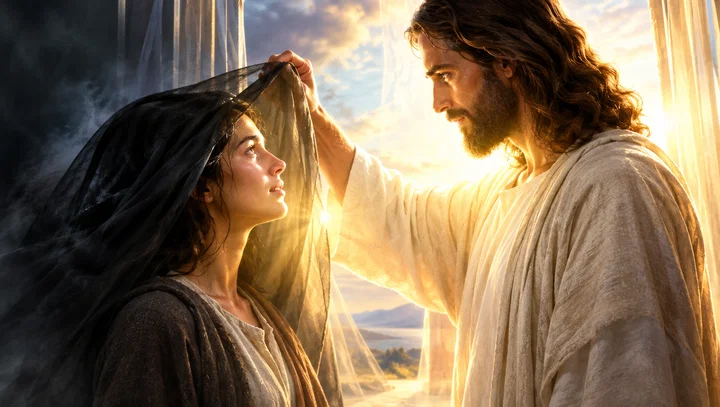
Nevertheless when it shall turn to the Lord, the vail shall be taken away.
Translations
Nevertheless when it shall turn to the Lord, the veil shall be taken away.
King James Version, KJV Cambridge Paragraph Bible
Nevertheless when it shall turn to the Lord, the vail shall be taken away.
Nevertheless, when it shall turn to the Lord, the vail shall be taken away.
Revised Version, American Standard Version
But whensoever it shall turn to the Lord, the veil is taken away.
and whenever they may turn unto the Lord, the vail is taken away.
But when it shall turn to [ the] Lord, the veil is taken away.)
Howbeit, whensoever he turneth unto [the] Lord, he taketh off the veil:
Berean Standard Bible, Majority Standard Bible
But whenever anyone turns to the Lord, the veil is taken away.
But whenever someone turns to the Lord, the veil is taken away.
But when it is turned to the Lord, the veil will be taken away.
Neuertheles when their heart shall be turned to the Lord, the vaile shalbe taken away.
Douay-Rheims (Challoner revision)
But when they shall be converted to the Lord, the veil shall be taken away.
Pictures
Cross-references 20 of 34
- Exodus 34:33-35
And till Moses had done speaking with them, he put a vail on his face.
Moses veiled his shining face after speaking with the Lord.
- 2 Corinthians 3:7-11
But if the ministration of death, written and engraven in stones, was glorious, so that the children of Israel could not stedfastly behold the face of Moses for the glory of his countenance; which glory was to be done away:
Contrasts the passing glory and ministry of death with the surpassing glory of the Spirit’s ministry.
- Jeremiah 31:33
But this shall be the covenant that I will make with the house of Israel; After those days, saith the LORD, I will put my law in their inward parts, and write it in their hearts; and will be their God, and they shall be my people.
The new covenant writes God’s law in the heart, as the veil is taken away.
- Hebrews 8:10
For this is the covenant that I will make with the house of Israel after those days, saith the Lord; I will put my laws into their mind, and write them in their hearts: and I will be to them a God, and they shall be to me a people:
The new covenant writes God’s law in the heart, unlike the veiled old ministration.
- Exodus 33:18-19
And he said, I beseech thee, shew me thy glory.
God reveals his glory to Moses as his goodness and character, contrasting with Israel’s veiled glory.
- 2 Corinthians 3:3
Forasmuch as ye are manifestly declared to be the epistle of Christ ministered by us, written not with ink, but with the Spirit of the living God; not in tables of stone, but in fleshy tables of the heart.
The Spirit writes God’s law on believers’ hearts, unlike on stone tablets.
- Exodus 19:5-8
Now therefore, if ye will obey my voice indeed, and keep my covenant, then ye shall be a peculiar treasure unto me above all people: for all the earth is mine:
God proposes the covenant, and the people agree to obey.
- Exodus 31:18
And he gave unto Moses, when he had made an end of communing with him upon mount Sinai, two tables of testimony, tables of stone, written with the finger of God.
The stone tablets identify the law discussed in 2 Corinthians 3.
- Exodus 34:29
And it came to pass, when Moses came down from mount Sinai with the two tables of testimony in Moses’ hand, when he came down from the mount, that Moses wist not that the skin of his face shone while he talked with him.
Moses’ face shone with glory, which he veiled.
- 2 Corinthians 3:11
For if that which is done away was glorious, much more that which remaineth is glorious.
Contrasts the passing ministration with what remains glorious.
- 2 Corinthians 4:6
For God, who commanded the light to shine out of darkness, hath shined in our hearts, to give the light of the knowledge of the glory of God in the face of Jesus Christ.
God shines the knowledge of his glory in Christ into hearts.
- Hebrews 8:6
But now hath he obtained a more excellent ministry, by how much also he is the mediator of a better covenant, which was established upon better promises.
Christ mediates the better covenant, associated with the more glorious ministration.
- Exodus 34:5-7
And the LORD descended in the cloud, and stood with him there, and proclaimed the name of the LORD.
God proclaims his glory and character, whose glory was veiled on Moses’ face.
- Exodus 20:21
And the people stood afar off, and Moses drew near unto the thick darkness where God was.
The people remain at a distance from God, while Moses draws near as mediator.
- 2 Corinthians 4:4
In whom the god of this world hath blinded the minds of them which believe not, lest the light of the glorious gospel of Christ, who is the image of God, should shine unto them.
Satan’s blinding of unbelievers parallels the veil removed when turning to the Lord.
- Exodus 33:20-23
And he said, Thou canst not see my face: for there shall no man see me, and live.
Moses could not see God’s face and live.
- Isaiah 6:9-10
And he said, Go, and tell this people, Hear ye indeed, but understand not; and see ye indeed, but perceive not.
Foretells the people’s failure to understand and respond.
- Hebrews 8:13
In that he saith, A new covenant, he hath made the first old. Now that which decayeth and waxeth old is ready to vanish away.
Both teach that the old covenant vanishes away.
- 2 Corinthians 3:12
Seeing then that we have such hope, we use great plainness of speech:
contrasts veiled Moses with plain speech
- Exodus 24:8
And Moses took the blood, and sprinkled it on the people, and said, Behold the blood of the covenant, which the LORD hath made with you concerning all these words.
Both refer to the blood of the covenant.
Commentary
Each commentary is drawn from primary sources: the writings of Ellen G. White and Adventist pioneers and periodicals. Each commentary is separate. Its own words are not a quotation; follow the references to read the source passages.
Ellen G. White
20 sources
When the heart turns to the Lord by accepting Christ, the blinding covering on heart and mind in the reading of Moses and the Old Testament is taken away in Him.Lt 52, 1908, par. 9–12Ms 58, 1900, par. 33–36RH Apr 22, 1902 That covering is drawn by unbelievers themselves through stubborn unbelief and blinded minds.Ms 58, 1900, par. 33–36 With it removed, the end of what was abolished is seen to its end, that in Christ's death type met antitype and the typical offerings ceased, while the ceremonial law that ended is distinguished from the moral law that is God's character, unchangeable and still binding.Ms 58, 1900, par. 33–36RH Apr 22, 19027RED 6.1 When the Jews turn, they recognize fulfilled prophecy, receive Jesus as Saviour of the world, and see their nation's great sin in rejecting and crucifying Him.Ms 58, 1900, par. 33–36SG1 106.1–107.1EW 177.2–178.1 The same veil still keeps professed Christians from receiving Christ inwardly when it takes the form of attachment to the world, fog of unbelief and criticizing of brethren, and willful opposition to God's law.6T 146.1Ms 11, 1896, par. 1–4Lt 11, 1892, par. 19–22Lt 7, 1899, par. 2–3Ms 8, 1902, par. 27
Context of Veil and Turning
Paul was writing to settle the minds of the Corinthian church amid trouble and dissension caused by Judaizing teachers who continually set forth the virtues of the law and the ceremonies, exalting them above the gospel of Christ, and who condemned him because he did not press upon the people the ceremonies that typified Christ and had become of no value since His death.10MR 328.1 The veil of which the verse speaks lies upon the heart and mind in the reading of Moses and the Old Testament, blinding spiritual sight so that people cannot see clearly, and it is done away in Christ.Lt 52, 1908, par. 9–12Ms 58, 1900, par. 33–36 That veil is drawn by unbelievers themselves through blinded minds and stubborn unbelief.Ms 58, 1900, par. 33–36
Turning is the heart turning to the Lord by accepting Christ as the righteousness of the law, and when this happens the veil is taken away.Lt 52, 1908, par. 9–12Ms 58, 1900, par. 33–36RH Apr 22, 1902 Unbelief had kept the Jews from seeing that their ceremonies and sacrifices had lost their significance in Christ, and accepting Christ would remove that veil.RH Apr 22, 1902 Many Christians likewise fail to distinguish the ceremonial law, which ended at Christ's death, from the moral law, which remains binding.RH Apr 22, 1902 A heart opposed to God's law cannot receive Christ's saving work, so turning to the Lord includes coming into harmony with His rule.RH Apr 22, 1902
The brightness on Moses' face came both from the sacred, exalted character of the law of God and from the glory of the gospel revealed through Christ, the heavenly light streaming from Calvary which Moses saw prefigured in all the types and symbols of the Jewish age while in the mount.PP 330.2–4 That divine illumination symbolized the glory of the dispensation of which Moses was the visible mediator as representative of the one true Intercessor, and it illustrates the blessings to be received by God's commandment-keeping people through the mediation of Christ.PP 330.2–4 As Israel's intercessor veiled his countenance because the people in guilt and sin could not endure its glory, so Christ the divine Mediator veiled His divinity with humanity when He came to earth in the likeness of sinful flesh.PP 330.2–4 Had He come clothed with the brightness of heaven, men in their sinful state could not have endured His presence nor given Him access, so He humbled Himself to reach the fallen race and lift them up.PP 330.2–4 The closer the communion with God and the clearer the knowledge of His requirements, the more fully believers are conformed to the divine image and made partakers of the divine nature.PP 330.2–4
Truth Seen Without Veil
When the heart turns to the Lord by accepting Christ as the righteousness of the law, the veil is taken away, and then the significance of the sacrifices and offerings is seen and the end of that which was abolished is seen to its end, that in the death of Christ the typical offerings ceased because type had met antitype.Ms 58, 1900, par. 33–36RH Apr 22, 19027RED 6.13SP 295.1–27RED 31.3 The unveiled mind distinguishes the ceremonial law, which ended at Christ's death, from the moral law, which was never a type or shadow but existed before man was created and will continue as long as heaven and earth remain, remaining binding and unchangeable because it is God's character.Ms 58, 1900, par. 33–36RH Apr 22, 1902 Unbelief kept the Jews from seeing that their ceremonies and sacrifices had lost their significance in Christ because they refused Him as Messiah, and many Christians still fail to make this distinction and have the same veil before eyes and heart.Ms 58, 1900, par. 33–36RH Apr 22, 1902
When Jews turn to the Lord the veil is removed from their hearts so they recognize fulfilled prophecy, receive Jesus as the Saviour of the world, and see their nation's great sin in rejecting and crucifying Him.Ms 58, 1900, par. 33–36SG1 106.1–107.1EW 177.2–178.1 Under heavenly illumination the Scriptures Christ had explained stand forth with vivid luster and loveliness as clear and powerful truth, and the object of Christ's mission and the nature of His kingdom are comprehended with perfect clearness.7RED 6.1AA 44.1–2 Stephen illustrates this clear sight, for he understood that what Christ's death abolished had reached its end and that worship was no longer confined to temples made with hands but could take place throughout the world in Spirit and truth.3SP 295.1–27RED 31.3
Turning to the Lord includes coming into harmony with His rule, since a heart opposed to God's law cannot receive Christ's saving work.RH Apr 22, 1902 Turning away from God's plain word places a veil over the face so a person does not see the Invisible, while Scripture itself makes duty and God's requirements clear without needing tradition to explain it.Lt 57, 1901, par. 3–4
Veil in Christian Experience
The same blindness that kept the Jews from receiving Christ keeps professed Christians today from receiving Him into the inner sanctuary of the soul.Lt 11, 1892, par. 19–22 Because of this veil the church is weak, the people are far from walking in the light even though the Lord is coming, and the Holy Spirit is given little room to work.Lt 11, 1892, par. 19–22 The veil may be sympathy with the customs and practices of the world and attachment to worldly things, which hides the Lord's glory.6T 146.1Ms 11, 1896, par. 1–4 Keeping the eyes fixed on God turns attention away from worldly things, and to see His face people must keep their eyes on Him, become Christlike, know Christ as a present personal Saviour, and sever whatever earthly things come between them and God.6T 146.1Ms 11, 1896, par. 1–4
The soul temple is defiled by pride, self-uplifting, pet idols and favorite sins, and unless it is purged it will become entirely corrupted.Lt 11, 1892, par. 19–22 The veil that hides Jesus from sight is a fog brought by unbelief in God and lack of confidence in one another, by suspecting brethren and standing apart as criticizers, which is the work of darkness and keeps the Holy Spirit from working.Lt 7, 1899, par. 2–3 The veil is taken away when the heart is broken before God, self is laid on the altar to be consumed, the habit of criticizing and judging is put away, and there is earnest prayer with free confession, and then great blessing comes.Lt 7, 1899, par. 2–3
Willful blindness keeps the veil over those who fight against God's law, breaking it and teaching others to break it while claiming sanctification and thereby strengthening other sinners.Ms 8, 1902, par. 27 They refuse to open their eyes for fear they would see, keep them shut, and say they cannot see, in a hopeless blindness like that of the Jews who would not recognize Christ as Redeemer, and it remains until they turn to the Lord.Ms 8, 1902, par. 27 Spiritual blindness is a veil of perverted judgment and deception through censurable imprudence and infatuation covering a person so he cannot see his own censurable conduct and course, and the Lord must tear it off so he sees all things clearly.17MR 159.2Ms 2, 1863, par. 24 Hereditary prejudice and mistaken ideas can make people hate the truth and blind the mind, but becoming acquainted with those who know it can help them see error until even anger and spite give way to reconsideration, for those blinded by misconception need the love, pity, and holiness of truth.Ms 70, 1898, par. 3
Sources
Pioneers and periodicals
143 sources
When the heart turns to the Lord Jesus Christ, the veil is taken away.ST Mar 26, 1894ST Mar 26, 1894RH Dec 3, 1914RH Mar 29, 1864 The setting is Moses coming down with the tables of stone with shining face from the Lord's presence, so that he covered his face with a veil when speaking to the people.ST Jun 5, 1879ST Oct 16, 1884ST Oct 10, 1895 That veil remaining over mind and heart is unbelief and carnal enmity to the law, which keeps people from seeing God's righteousness and glory and from discerning Christ and His redemption in the reading of the Old Testament.RH Jul 8, 1852ST Oct 28, 1897ST Sep 12, 1895ST Jan 16, 1907ST Aug 23, 1910 When a person turns by looking to Jesus' blood for pardon, the ministry of condemnation gives way to the ministry of righteousness, the same moral law is written by the Spirit in the fleshly tables of the heart, and believers beholding God's glory in the face of Jesus Christ are changed into the same image from glory to glory.RH Feb 17, 1852ST Oct 23, 1884ST Jun 12, 1879RH Dec 3, 1914ST Nov 21, 1911 What is done away is the ministration of death and condemnation under Moses, not the law itself written and engraven on stones, which is neither changed nor abolished.RH Dec 23, 1851ST Jan 24, 1906RH Nov 2, 1911RH Jan 13, 1852RH Aug 11, 1853
Words and Mosaic Setting
The “it” that turns is the heart, and turning is conviction of sin followed by repentance for remission of sins and the gift of the Holy Ghost, as when hearers pricked in heart for killing the Prince of Life were told to repent and be baptized every one in the name of Jesus Christ and about three thousand souls were added the same day.ST Mar 26, 1894 The Lord to whom the heart turns is Jesus Christ, that Spirit, more glorious than the glory that shone on Moses’ face in the mount, and where the Spirit of the Lord is there is liberty.RH Dec 3, 1914 When hearts turn to the Lord Jesus the veil over the heart is removed so that the Old Testament when read is seen clearly, and the Spirit of God writes God’s law in the mind and heart.ST Mar 26, 1894RH Mar 29, 1864RH May 5, 1851 Having the law only written on tables of stone kept in the ark at the center of the nation brings condemnation and death, but having that same law in the heart of each person of the true holy nation brings righteousness and life and freedom from the law of sin and death through presenting Christ Jesus, with transformation into a new creature having sufficiency of God and not of self, kept in justification with victory over sin and full assurance of acceptance and eternal life.ST Mar 26, 1894RH Dec 3, 1914
The background is Moses coming down from the mountain with the stone tablets with face shining from being in the Lord’s presence, so that the people could not look upon him and he covered his face with a veil when he spoke to them.ST Jun 5, 1879ST Oct 16, 1884 That glory on his face when bearing God’s character written in stone was too bright for the people to bear and had to be veiled that they might look upon it, even as the glory resting above God’s law in the earthly sanctuary was veiled with incense smoke before the high priest could stand in its presence, and as the glory of God was again veiled in the human nature of Christ that men may look upon it.ST Oct 10, 1895 What was veiled and done away was the glory of Moses’ face, representing his ministration and the change in the ministration of the law written on stones, not the tables of stone themselves.ST Mar 26, 1896 The law itself was never said to be glorified and Moses never hung a veil over the law, while the present ministration of that same law on stones that shows the sinner his guilt and points him to Christ for pardon is more glorious than the typical service that required putting willful transgressors to death.ST Mar 26, 1896
The Greek word for the veil over Moses’ face is kalymma, the same word used in verses 13-15, and it differs from katapetasma, the word used for the sanctuary hangings.RH Jul 20, 1876 The veil remains over mind and heart in the reading of the Old Testament and of Moses, so that prophecies and ceremonies are not discerned, and it is removed in Christ only when Israel turns to the Lord.RH Jul 8, 1852RH Feb 17, 1852ST Jan 17, 1884 This blindness keeps men from seeing Christ in what Moses and other Old Testament writers wrote, not blindness caused by reading those scriptures, and it holds for all readers of Moses including professed preachers who rail against Moses and his writings.RH Jun 25, 1914 So the father still reads Moses with the veil upon his heart while the son has had the veil taken away and has learned of Christ the promised Messiah, for accepting the spiritual institution of the gospel removes the obscuring of mind and heart.RH Feb 17, 1852ST May 22, 1879
The chapter belongs to a transitional age calling for radical change in the form of doctrine, setting important contrasts between old and new dispensations, types and antitypes, carnal and spiritual things, and the true and the false.ST Jan 17, 1884 It compares the Jewish and Christian ministrations as successive degrees of light and glory in one plan of salvation, not as opposing plans.RH Jan 20, 1874 Both convey truth and love, with increasing light and glory across the ages in God’s unfolding plan.ST Jul 23, 1874 The glory that rested visibly on Moses at Sinai was a type of God’s glory, which is His righteousness, to be revealed by and through His people in all ages and especially by the remnant.RH Mar 21, 1907 As Moses’ brightness exposed the contrast between his character and ancient and modern Israel, whose sins separated them from God so they feared His presence and turned weeks of work into forty years short of the promised land, so now Christ’s righteousness and the measure of the Holy Spirit will cover His united people to fit them to proclaim the last warning, warn the world, and enter the kingdom, exceeding the glory seen on Moses’ face as the latter temple exceeded the former because of the Saviour’s presence.RH Mar 21, 1907
Two Ministrations Compared
Paul contrasts the ministration of the old covenant under Moses with the ministration of the new covenant under Christ.RH Jan 13, 1852RH Jan 1851RH Aug 27, 1857RH Jun 14, 1870 A law is the constitution necessary for the government of the people, and the ministration is the ordained powers to carry its laws into execution, and what is contrasted and superseded is the ministration, not the law itself.RH Jan 13, 1852RH Apr 12, 1864 The veil taken away when Israel turns to the Lord is not the law of God written on tables of stone but that typical service or ministration of condemnation under the first covenant, whose fading glory is swallowed up in the more excellent and more glorious ministry of Christ in the true sanctuary with forgiveness of sin.RH Jan 1851RH Aug 27, 1857RH Jun 14, 1870 To make the veil mean the law itself would require that God abolished the Ten Commandments at Christ's death and in the same moment re-enacted them to write them in hearts under the new covenant, while a change of ministration does not abolish God's law because a ministration requires a law to be ministered and the civil penalties attached under the Jewish system alone have ceased.RH Jan 1851RH Apr 12, 1864
The former ministration was a ministration of death and condemnation that restrained transgression through temporal punishment without taking away sins or giving life.RH Jun 14, 1864RH Nov 25, 1852RH Oct 7, 1851RH Sep 1, 1868 The present ministration is the ministration of the Spirit, righteousness, mercy and life through pardon and reconciliation by Christ's blood as merciful and faithful High Priest, far more glorious, with open face beholding Jesus.RH Feb 17, 1852RH Nov 25, 1852RH Oct 7, 1851RH Sep 1, 1868 The ministry of condemnation gives way to the ministry of righteousness because Christ's blood brings pardon, not because the holy law that condemns sin engraved in stone has been abolished.RH Feb 17, 1852RH Nov 25, 1852 Through faith in Christ the ministration of death is disannulled in the believer and the ministration of the Spirit takes its place, so that every person alive is under one or the other, death for the sinner and life for the believer.ST Sep 7, 1915
The law at issue is the Ten Commandments, and the new covenant deals with transgression of those same commandments by providing a real atonement that takes away real guilt, whereas the old covenant dealt with transgression only in figure through sacrifices and offerings.RH Jun 14, 1864RH Aug 22, 1907 What the new displaced was the old sacrifices and offerings, not God's law, which remains and under the new covenant God writes in hearts by His Spirit.RH Aug 22, 1907 Under the typical service the ministration of that law that condemns all sinners required the minister to put willful transgressors to death, while in this dispensation the minister shows the sinner his guilt and points him to Christ for pardon, so the present ministration of that same law on stones is more glorious than the typical service. What was done away and covered by the veil was Moses's face, not the tables of stone themselves. The ministration of death for breaking the Sabbath or any other of the Ten Commandments has been done away as entrusted to sinful men, but the law of Ten Commandments still stands, sin is still transgression of that law, the wages of sin is still death, and profaning the Sabbath still brings death, with the difference that God no longer entrusts execution to sinful men but will do the work Himself since only he who is without sin can cast the first stone.ST Nov 16, 1876
Under the old covenant the law written only on stone and kept in the ark at the center of the nation had no converting power and no promise of forgiveness, and Moses as mediator veiled his face to hide a glory Israel could not look upon and did not understand, so that having it only there brings condemnation and death.ST Oct 23, 1884RH Oct 21, 1851ST Mar 26, 1894 Under the new covenant sins are taken away by the blood of the covenant and the carnal mind that is enmity to the law is removed, the same moral law is put in the mind and written in the fleshly tables of the heart by the Spirit of God, past sin is forgiven, and those reconciled behold the glory of God in the face of Jesus Christ and are changed into the same image from glory to glory as partakers of that glory, bringing righteousness and life and freedom from the yoke of bondage and from the law of sin and death.ST Oct 23, 1884RH Oct 21, 1851ST Mar 26, 1894 The new covenant does not replace God's law but writes the same law where it was not written under the former ministration, and this ministration of the Spirit does not mean the Ten Commandments are abolished.RH Apr 7, 1851ST Jul 14, 1914RH Oct 7, 1851 The Ten Commandments are God's covenant commanded to a thousand generations.RH Apr 16, 1861 What passes away is the Sinaitic covenant as an agreement between God and Israel with promises and conditions, that God would make them a peculiar holy nation if they would obey His voice and keep His covenant and the people answered all the Lord had spoken they would do, an arrangement having mediators, blood, ordinances of divine service and a worldly sanctuary.RH Apr 16, 1861 It could not reward those under it because all broke its conditions, the Ten Commandments, and the blood of bulls and goats could not take away sin, hence the need for a better covenant established on better promises embracing forgiveness.RH Apr 16, 1861
The glory that attended Moses' ministration was far inferior to the glory now enshrouding Christ as High Priest pleading His own blood before the ark of God in the heavenly sanctuary and the ministration of the Spirit, and although that earlier glory has passed the law written by His finger remains in its proper place in the ark of His testament.RH Sep 2, 1852RH Jul 30, 1901 The gospel dispensation has a glory that surpasses the glory associated with Ezekiel's sanctuary, whose animal sin-offerings would conflict with Christ's work, and the greater glory of the Spirit's ministration makes that earlier glory disappear, which is the glory found in the gospel rather than under the law.RH Jan 1851ST Apr 8, 1889RH Jul 30, 1901 Both ministrations reveal God's glory in His laws in both their ministration of death and their ministration of righteousness.ST Oct 3, 1895 The ministration of life springs from God's creative act, and the ministration of death springs from the act of sin with latent penal force natural in the attributes of God because His law is uncreated and eternal emanating from the Deity, so the transgressor forfeits all right to life by his own act and the death springing spontaneously from the violated law is just.ST Oct 3, 1895 Turning removes the veil in the contrast between the old system in which the people stood at a distance while priests drew near to God and the gospel through which all may draw near under Christ's intercession.ST Dec 16, 1889
Law Not Abolished
The chapter gives no proof that the law or the Ten Commandments written and engraven on stones are abolished or done away.RH Dec 23, 1851ST Jan 24, 1906RH Jan 13, 1852ST May 20, 1897RH Feb 17, 1852 Joining isolated phrases about the ministration of death written and engraven on stones to be done away and abolished can make it appear to teach abolition, but read in full it is plainer and gives no such teaching.RH Dec 23, 1851ST Jan 24, 1906 The veil concerns the glory on Moses' face which was to pass away in Christ, not a veil over the Decalogue, and turning to the Lord removes the veil from the mind so the matter is seen clearly.ST Jan 24, 1906ST Jan 24, 1906 The verse belongs to Paul's contrast between the ministration of the old covenant under Moses and the ministration of the new covenant under Jesus Christ.RH Jan 13, 1852 A law is the constitution necessary for government, and the ministration is the ordained powers to carry its laws into execution, and what is contrasted and superseded is the ministration, not the law itself, so the change from old covenant to new changes the ministration, not the fundamental moral law, and gives no warrant for transgressing it.RH Jan 13, 1852ST Jan 24, 1906
One ministration with its glory was done away and replaced by a more glorious ministration, while the law itself was neither changed nor abolished.RH Nov 2, 1911RH Aug 11, 1853RH Dec 20, 1853RH Aug 13, 1857RH Sep 1, 1868 The ministration of death can give place to the ministration of the Spirit and be abolished to give way to it without abolishing the law itself.RH Aug 11, 1853RH Dec 20, 1853RH Aug 13, 1857 The language about what is done away concerns the ministration connected with the law on stone tablets and its glory, not the law itself, and the veil over the hearts of Israel concerns that ministration, not the moral law, so turning to the Lord removes that veil without setting aside the commandments.RH Mar 29, 1864RH Sep 1, 1868 The chapter therefore does not prove that the seventh-day Sabbath has been abolished.RH Dec 20, 1853
What is abolished is distinct from the law of God written by His finger on two tables of stone.RH Feb 17, 1852RH Aug 5, 1851 That which is abolished is the law of Moses written by Moses in a book, the ordinances attached to the law, the Mosaic ministration and typical services, and the Levitical ordinances, which gave way to Christian church ordinances.RH Feb 17, 1852RH Aug 5, 1851RH Feb 17, 1852 Something more glorious remains beyond that which is abolished, distinct from and superior to the abolished Mosaic system.RH Aug 5, 1851 The veil over the heart is removed when a person turns to the Lord by accepting Christ, the righteousness of the law, because unbelief kept from seeing that ceremonies and sacrifices had lost significance in Christ and had reached their end in Him.RH Apr 22, 1902RH Aug 27, 1901 Many fail to distinguish the ceremonial law which ended at Christ's death from the moral law which remains binding, and wrongly supposed Gentiles could not share the gospel's privileges equally, but a heart opposed to God's law cannot receive His saving work and turning includes coming into harmony with His rule.RH Apr 22, 1902RH Aug 27, 1901
The chapter does not mention the Lord's Sabbath and contains no plain, direct statement that the seventh-day Sabbath is abolished.RH Mar 21, 1854RH Dec 27, 1853RH Feb 21, 1854RH Apr 11, 1854 Inferences drawn from it to prove abolition should not be allowed where plain and positive inspired testimony is required.RH Feb 21, 1854RH Apr 11, 1854 To use its comparison between the ministry of the law and the ministry of the gospel to break God's law into parts, keeping nine commandments while rejecting the Sabbath as a short-lived Jewish rite or institution, wrongly dashes God's law in pieces and leaves God without a law.RH Sep 20, 1853ST Apr 5, 1883 The Sabbath stands as a universal moral command distinct from Jewish rites abolished at Christ's death.RH Sep 20, 1853
To use the chapter to set aside the Decalogue is a perversion that itself needs justification, for the chapter itself needs none.RH Jul 22, 1852 It does not teach that the ten commandments are abolished in the abstract, with nine abolished yet continuing in force just as if not abolished while the fourth alone is abolished and put to an end, and it does not prove that Christ remodeled the moral constitution of God's system.RH Jul 22, 1852RH Jul 8, 1852RH Jul 22, 1852 The commandments engraved on stone remain distinct from the Levitical ordinances.RH Jul 8, 1852 Christ's teachings exposing covetousness as idolatry and hating a brother as murder did not enlarge a law that before took notice only of the outward act, for the holy, just and perfect law was always exceeding broad and God's eye ever took cognizance of departures of the heart, and the New Testament in stating that fact merely lays open a truth as old as creation.RH Jul 22, 1852
The verse bears on the Sabbath question together with Colossians 2:14-17, Matthew 5:18 on the permanence of the law, and the question of who is Lawgiver, in setting forth the Sabbath and the continuance of the law and teaching about the law of God.RH Sep 11, 1856RH Oct 2, 1856RH Jul 1, 1858RH Oct 7, 1858
Opposing arguments have cited the chapter to claim that what was written on stone, the Ten Commandments, the whole Sinaitic code, the Sabbath, or the ministration of death was abolished.RH Sep 16, 1852RH Jul 8, 1852RH Jan 31, 1854RH Oct 6, 1859 That use presents the whole Sinaitic code as having served its purpose and ceased to bind to give place to the law of faith, the law of the Spirit of life in Christ Jesus, and the perfect law of liberty, not limited to the fourth commandment, and uses the word abolished concerning precepts written and engraved on stones to extend the argument from the Sabbath to all ten.RH Jan 31, 1854RH Oct 6, 1859 It is invoked as a perversion in which the claim that the ministration of death was done away is used as a pretext to dismiss the Sabbath and silence convictions of duty for worldly advantage, and it belongs to a dispute whose opposing interpretation mishandles the passage and argues that God abolished the principles of His moral government including the fourth commandment.RH Jul 8, 1852RH Oct 14, 1852 That use excuses disobedience rather than proving the Sabbath no longer binding, while the royal law remains in force.RH Jul 8, 1852
The taking away of the veil does not replace outward obedience with the Spirit alone and does not abolish the seventh-day Sabbath to commemorate creation and honor the Father and the Son. The Spirit does not do away with form, and keeping Sunday has as much form as keeping Saturday. The law written and engraven on stones means the one law of God written on two tables of stone given to Israel through Moses and embraced in the five books of Moses, not to be divided into two separate laws.RH Aug 5, 1851
Veil as Unbelief
The veil is unbelief upon the heart that separates from God and keeps from seeing His righteousness, character and glory, and when the heart turns not to man but to the Lord that veil is taken away.ST Oct 28, 1897ST Aug 23, 1910ST Jun 19, 1907RH Apr 1, 1858 Turning is looking to the Lord, and then the veil of unbelief is removed so that with unveiled face His glory is beheld and the beholder is changed by the Spirit.ST Oct 28, 1897ST Jan 16, 1907 The law itself is not abolished in this removal; its condemnation comes when it is received only as written letter, while the Spirit writes it on the heart and brings righteousness through Christ.ST Jan 16, 1907ST Jun 19, 1907 Israel showed this unbelief when God came down in love to give the law to do them good, yet they would not believe it and pleaded that God should not speak to them but Moses.ST Aug 23, 1910 The law coming in written form as spoken from Sinai was glorious, but its glory condemns, and turning to the Lord brings sight of the greater glory which justifies and writes the law in the heart, leading to love for God's law as meditation all the day.ST Jan 16, 1907ST Aug 23, 1910
To those clinging to sin the glory of God appears as the glory of condemnation, while to the believer it is the glory of righteousness.ST Jan 14, 1897 The shining of Moses' face was the outshining of God's righteousness within, which Israel in condemnation wanted veiled from sight, though God wanted it received in the heart so that condemnation would become righteousness and sin and condemnation would be abolished by His presence within.ST Jan 14, 1897 Blinded minds reading Scripture see nothing bringing God's righteousness and life until the heart turns to have sin taken away and glory revealed within, when darkness flees and the bond-slave of sin finds freedom in Jesus.ST Jan 14, 1897ST Feb 13, 1901ST Aug 23, 1910 The veil is thus Israel's refusal to look beyond the law's exposure of sin and condemnation to the greater glory of righteousness and life in God's presence, and the same unbelief can keep people from seeing this today.ST Feb 13, 1901ST Aug 23, 1910 God's glory may first condemn, but it is revealed to make sinners righteous, so it must not be turned from but allowed to shine away darkness and sin.ST Jan 14, 1897
The veil is the carnal nature on the heart, enmity to the law, whose deceptive blinding power fills the mind with error as truth so that righteousness by faith is rejected and people cling to salvation by works of the law.ST Sep 12, 1895ST Sep 12, 1895 As long as that carnality remains, a person stays under the ministration of death, which is the abnormal action of the moral law written in stone, not the law itself.ST Sep 12, 1895ST Sep 12, 1895 That old-covenant principle of works came in with sin and will go out with it, belonging to the abnormal operation of the law, while the new-covenant principle belongs to the converted heart and to the normal operation of the law or ministration of righteousness and is eternal.ST Sep 12, 1895 The only remedy is crucifixion of the carnal nature in Christ, and when it is taken away the veil is taken away.ST Sep 12, 1895ST Sep 12, 1895 Then with unveiled face is beheld the glory of the ministration of the Spirit, which is the normal operation of the moral law in righteousness as exemplified in Christ's perfect life, and by beholding there is change into the same image by the Spirit working through the law of the Spirit of life, bringing freedom in Christ Jesus.ST Sep 12, 1895ST Sep 12, 1895
The veil is the ministration of Moses, the outward observances that enforced the Ten Commandments, condemned the transgressor and enforced death without taking away sins or giving life.RH Oct 21, 1851RH May 5, 1851 As long as Moses is read and that service is continued in, it cannot be seen that Christ is the end of those typical services.RH Oct 21, 1851RH Apr 7, 1851RH Jan 13, 1852 When the heart turns to the Lord Jesus by looking to His blood for atonement as the Lamb who takes away sin, the veil is taken away, meaning that ministration is done away in Christ and replaced by the ministration of the Spirit with the law of God put in the mind and written in the heart, where there is liberty from the yoke of bondage.RH Oct 21, 1851RH May 5, 1851RH Apr 7, 1851RH Jan 13, 1852 Turning to Christ through faith revealed by the Spirit thus frees from bondage to death and condemnation under that ministration.RH Apr 7, 1851RH Jan 13, 1852 The veil therefore represents failure to see that salvation and glory are now associated with Christ and the superior ministry rather than with Moses' ministry.RH Dec 12, 1854RH Dec 12, 1854
That blindness kept Israel from recognizing Christ and His higher work, and its removal in Christ clears the obscurity of types, shadows, ceremonies and sacrifices that lost significance in Him.ST Mar 14, 1878RH Jul 30, 1901 Those who turned to the Lord and accepted Christ as the reality represented by the sacrifices could understand that the typical system was to be abolished, whose obscurity was like the veil over Moses' face, while Moses' reflected glory came from the light Christ brought to the world.ST Mar 14, 1878 The veil is the covering Israel in unbelief asked to be put over Moses' face because the glory shining out from his face and heart from converse with God at the giving of the law made them feel condemned.ST May 12, 1909 God wanted that condemnation to lead them to put away sin so He could abolish sin and replace the fading glory of condemnation with the greater abiding glory of justification by placing the law within their hearts so they would love it and no longer be condemned by it, but Israel refused, so the law was to them condemnation only.ST May 12, 1909ST Nov 21, 1911 Turning to the Lord by believing on Jesus takes away that condemnation and its fading glory, not the law itself, so the law points out sin and leads to Christ, who justifies, regenerates, sanctifies and writes the law on the heart so it witnesses to justification instead of condemning.ST May 12, 1909ST Nov 21, 1911ST Feb 13, 1901
The veil also includes prejudice by which minds were veiled so Jesus was not recognized as Messiah but treated as impostor and deceiver.RH Nov 18, 1862 It includes sympathy with the world's customs and practices hiding the Lord's glory, removed as the eyes are kept fixed on God until sight of worldly things is lost.RH Oct 29, 1901 It includes sin and its consequences hanging between man and God, whose removal restores rights and position forfeited in the fall, lifts the mortgage from the birthright inheritance, and brings face to face with the Maker out of rebellion into obedience, variance into harmony, separation into reconciliation, prodigality into sonship, slavery into freedom, poverty into everlasting riches, self into Christ.RH Oct 3, 1912 It includes the veil of tradition over spiritual understanding, torn away when there is turning to God and obedience to what His law requires, as in embracing the Sabbath.RH Aug 11, 1859 The veil Moses wore thus represented glory hidden from understanding: the glory of Christ and Calvary as well as the glory of the law and Sinai, and clear understanding of Christ and Calvary as well as the law would have changed the people's condition.ST Jan 2, 1893ST Jan 2, 1893
Blessings of Turning
When the heart turns to the Lord by looking to Jesus and his blood for atonement, the veil is taken away so that believers behold God's glory with unveiled face.RH Feb 17, 1852ST Oct 23, 1884ST Jun 12, 1879RH Jan 13, 1852 The ministry of condemnation gives way to the ministry of righteousness because Christ's blood brings pardon, not because the holy law that condemns sin has been abolished.RH Feb 17, 1852RH Jan 13, 1852 Under the old covenant the law written only on stone had no converting power and no promise of forgiveness, and Moses as mediator veiled his face to hide from Israel a glory they could not look upon and did not understand.ST Oct 23, 1884 Under the better covenant sins are taken away by the blood of the covenant and the carnal mind that is enmity to the law is removed, the law is written in the fleshly tables of the heart and mind by the Spirit of God, past sin is forgiven, and those reconciled to God and at peace with him behold the glory of God in the face of Jesus Christ and are changed into the same image of the Lord from glory to glory because they are partakers of that same glory.ST Oct 23, 1884ST Jun 12, 1879RH Jan 13, 1852 Turning thus brings freedom from death and condemnation through seeing that life comes through Christ and his atonement, for the veil concerns the ministry of Moses, not the abolition of God's law.RH Feb 17, 1852RH Jan 13, 1852
God meant the condemnation felt from the law to lead sinners to put away sin so that he could abolish sin and replace the fading glory of condemnation with the abiding glory of justification by placing the law within hearts so they would love it and no longer be condemned by it.ST May 12, 1909 Israel in unbelief asked for a covering over Moses' face because the glory shining out from his face and heart from converse with God at the giving of the law made them feel condemned, and refusing that leading they knew the law as condemnation only.ST May 12, 1909 When a person believes on the Lord Jesus Christ that condemnation of the moral law is done away and the veil that keeps from seeing beyond the law's condemnation is removed.ST May 12, 1909ST Nov 21, 1911 Then justification and righteousness given through Christ are seen, for the law points out sin and leads to Christ, who justifies, regenerates, sanctifies, and writes the law on the heart so it witnesses to justification instead of condemning, received in the Spirit rather than serving only its outward letter.ST Nov 21, 1911ST Jan 16, 1907ST Jun 19, 1907
When sin is forgiven and hostility to God's law is removed, the veil of blindness resting on the heart in reading Moses and the Old Testament is taken away in Christ.ST Jun 12, 1879RH Dec 3, 1914 The Lord to whom the heart turns is that Spirit, more glorious than the glory that shone on Moses' face in the mount, and where the Spirit of the Lord is there is liberty.RH Dec 3, 1914 Those who accept Jesus Christ receive a far greater glory than Moses had, the great transformation of being made a new creature with sufficiency of God and not of self.RH Dec 3, 1914 With open unveiled face beholding as in a glass the glory of the Lord, believers meet the Lord through faith, receive the influence of his enduring glory, and are increasingly transformed into his divine image from glory to glory by the Spirit of the Lord, kept in justification with victory over sin and full assurance of acceptance and eternal life.RH Dec 3, 1914ST Sep 16, 1930ST Dec 16, 1913 Unbelief keeps that glory hidden and prevents being changed by the Spirit, while faith in God's promises lets the light of the knowledge of God's glory in Christ shine in the heart and changes people to become like him, so that sin-caused unbelief no longer keeps them from grasping the Saviour as the only way to victory over sin.ST Sep 16, 1930ST Dec 16, 1913
Looking to God's glory reveals sin, but continuing to look to Christ lets his righteousness overcome sin and surpass the glory of condemnation.ST Jan 16, 1907 Its condemnation comes when the law is received only as written letter, while the Spirit writes it on the heart and brings righteousness through Christ, establishing the law in the heart through faith rather than ignoring it.ST Oct 28, 1897ST Jan 16, 1907 The glory of the gospel which justifies is not seen by those who have not experienced the glory of God's law in condemning sin.ST Sep 27, 1910 To those clinging to sin the glory of God is the glory of condemnation, while to the believer it is the glory of righteousness, for the shining of Moses' face was the outshining of God's righteousness within, which Israel in condemnation wanted veiled from sight though God wanted it received in the heart so condemnation would become righteousness.ST Jan 14, 1897 God's glory may first condemn, but it is revealed to make sinners righteous, so it must not be turned from but allowed to shine away darkness and sin, and whenever the heart turns to the Lord to have sin taken away and glory revealed within, the darkness of unbelief flees and the bond-slave of sin finds freedom in Jesus.ST Jan 14, 1897
Moses saw beyond the condemning glory to the justifying glory that writes the law in the heart, and the Corinthian brethren likewise saw it, leading to love for God's law as meditation all the day.ST Aug 23, 1910 The law coming in its written form as spoken from Sinai was glorious, but its glory condemns, while turning not to man but to the Lord brings sight of the greater glory which justifies.ST Aug 23, 1910 When redemption's work is finished and man turns to the Lord, the veil of sin and its consequences hanging between man and God is taken away.RH Oct 3, 1912 Its removal restores the rights and position forfeited in the fall, places the deed to the birthright once more in the hands with the mortgage lifted never again to encumber the inheritance, and brings man to look into the face of him who made him with no intervening veil, out of rebellion into obedience, out of variance into harmony, out of separation into reconciliation, out of prodigality into sonship, out of slavery into freedom, out of poverty into everlasting riches, out of self and into Christ.RH Oct 3, 1912
Seeing Christ and Application
The gospel fills the whole Bible with Christ and his redemption, yet in the Old Testament it lies under a veil while in the New Testament the same gospel lies unveiled so that the glory of the Lord is seen with open face.RH May 21, 1872ST Jan 18, 1877 When the unbelieving heart turns to the Lord the veil over it is removed, for Jews and Christians alike, and what could not before be seen — Christ, free salvation, and the gospel in the Old Testament — becomes visible.RH Oct 17, 1912 That blindness kept Israel from seeing Jesus as deliverer from sin, and the same removal lets readers see Jesus in Scripture, see God's law revealed in Jesus' life, and receive through faith in Jesus power to keep God's commandments.RH Dec 15, 1910 Accepting Christ, the righteousness of the law, takes away the unbelief that hid the ending of ceremonies and sacrifices in him, and since many still confuse the ceremonial law ended at his death with the moral law still binding, turning includes coming into harmony with his rule, for a heart opposed to God's law cannot receive his saving work.RH Apr 22, 1902
In both Testaments the word remains a veiled dead letter to the dead sinner until the heart turns to the Lord.RH Sep 18, 1900 When the sinner believes the gospel and is cleansed from sin by Christ's blood and quickened to life by the handwriting of the Holy Spirit, the veil is taken away and the law is comprehended in the light of the gospel in its spiritual import and purpose.RH Sep 18, 1900 Then the Old Testament kindles luminous like a star lit by the Sun of righteousness, and the shining face of Moses and the mount soften into the milder radiance of Christ and Calvary accessible to the lost sinner.RH Sep 18, 1900 True believers before Christ and Pentecost — Abel, Enoch, Noah, Abraham, Moses, and David — knew this removal in lesser measure, seeing Christ and his day afar off by prophecy and by the typical blood of the Lamb, believing on his name and being cleansed and quickened under the same immutable law of pardon and life, with the law always leading them to Christ and the gospel always giving the tables in Moses' hand their only true divine interpretation.RH Sep 18, 1900 Turning removes the veil from the mind so that the light of God's glory is seen in Jesus Christ and his work of redemption, opening the eyes to the light of Scripture including its witness to the Saviour in the Old Testament.RH Jun 12, 1856
Every Jew is as free as every Gentile to come to Christ and receive the blessings of the gospel, and God will have mercy on any who come, with Jewish believers found in every age though few compared with the multitude of Gentiles.RH May 23, 1854 Yet the veil has to this day remained unremoved from the Jews as a people because when Jesus brought new truth and new light they in self-righteousness found his humble lessons repulsive, rejected the light, crucified the Son of God, and were cast off and became extinct as a nation, wandering in darkness.RH Jan 14, 1873 Israel has a zeal for God and has always longed to be righteous and holy, but being ignorant of God's righteousness it has gone about to establish its own righteousness of soiled garments and has not submitted to the righteousness of God, so the same veil still lies upon their hearts and because of it they come short and do not secure God's righteousness.ST Jan 28, 1897 When they turn to their own Messiah the veil over their hearts is removed and the way opens for them to proclaim him among the nations, for skepticism and rationalism do not lead to Christianity.ST Nov 30, 1882
God sanctifies and blesses by placing his own presence within what he sets apart, so the Sabbath is holy because Christ's presence is in it and its rest is spiritual rest — the rest of Christ's presence — recognized and received by faith alone.STST Mar 10, 1909ST Jan 30, 1896 In connection with the next verse, turning to the Lord removes the veil and brings that presence into view.STST Mar 10, 1909 Under the gospel's greater ministry, which excels the Jewish economy's ministration of condemnation and death, mercy pleads for the Sabbath-breaker through Christ's atoning blood so that the sinner may be spared, turn from sin, receive pardon, and live rather than suffer temporal death.RH Nov 25, 1852RH May 2, 1854
When the heart turns to the Lord the veil is taken away and the Holy Spirit opens the eyes and enlightens the mind, leading out into the glorious light and liberty of the gospel as it is in Christ Jesus.ST Dec 17, 1902 While Moses is read the veil remains upon the heart, so that creed-blinded denominations profaning the seventh-day Sabbath and keeping a man-made Sunday are broken, incomplete, ruined, and unable to see to the end; but there is hope when a people really see they are wrong and seek God with all their hearts.ST Dec 17, 1902 The same turning frees from religious deception and its false covering of popular religion so that truth can be seen, and brings to present truth.RH Jun 7, 1864RH Aug 11, 1859 The veil of unbelief and prejudice is removed through hearing God's word and praying for understanding, making clear the duty to keep the Sabbath, and the veil of tradition that kept souls from seeing what God's law required is torn away when they turn to God and obey the Sabbath truth.RH Jul 29, 1862RH Aug 11, 1859 The Lord's light and grace thus open many hearts to the truth about God's law and the Sabbath.RH Oct 28, 1852
Turning to the Lord removes the veil from the heart in inward preparation for worship.ST Feb 15, 1883ST Aug 25, 1887 A mind crowded with trifles and concern for outward appearance, adornment, and vanity before people is not ready to receive the minister's message.ST Feb 15, 1883ST Aug 25, 1887 The heart should instead be made open and honest before God.ST Feb 15, 1883ST Aug 25, 1887
God alone can cure the blindness that hides him from sight and take the veil away.RH Dec 10, 1861 When a person turns to the Lord the veil is removed, and the Lord and the enlightening Spirit open the eyes, renew views and desires, and enable a true view of present life and the life to come.RH Sep 26, 1871 The veil is only partially withdrawn now, so coming realities are seen dimly as in the shade of the distance, and faith should therefore increase with continual desire for what is coming.RH Mar 21, 1854 In Christian growth darkness gradually disappears and increasing evidence points toward the perfect day, though the veil has not yet been entirely removed.RH Sep 2, 1873
The removal points to the happy hour when believers shall see Jesus face to face.RH Sep 25, 1866 It is renewed spiritual closeness in which the Lord removes the veil and the soul again sees the way to Eden and gives itself fully to the Saviour.ST Sep 16, 1880 When the heart turns, success follows in converted service, as in being converted to the plan of circulating healing literature and heartily engaging in selling the book and soliciting offerings to relieve the burden of debt, for the doers are blessed and in turn are a blessing to others and much more is accomplished when all do this.RH Jun 13, 1912
A veil lies before human eyes keeping men from fully seeing the glory of God in the face of Jesus Christ, and that veil is every man's failure to take Jesus fully into the heart — hearing his invitation and following only a little way, rising slowly, being healed and cleansed from sin only in part and seeing dimly.ST Nov 25, 1930 This veiled imperception hides God's creation and infinity in its small beginnings and alone hinders his purpose growing in the womb of time from being born in perfectness, hinders peace from filling the world, good will from displacing strife, and the glory of God from becoming man's chief aim.ST Nov 25, 1930 Whatever virtue, mercy, service, laughter of children, song of women, and fearlessness of men exists comes by that degree of contact with Christ and partaking of his freely offered spirit, while the world languishes because it has not taken freely.ST Nov 25, 1930 With the veil fully removed there would be transcendent power to heal the nations.ST Nov 25, 1930
Turning removes the veil between fallen man and God so believers can see God in his glory as Moses did and keep the law as God gave it as a law of love.ST Jun 4, 1894 Christ offered at Calvary makes this unveiled seeing possible and gives power to keep the law, because Calvary is a fuller revelation of Sinai, with the same infinite love in giving the Son as in giving the law and not one principle manifest at Calvary that was not uttered at Sinai.ST Jun 4, 1894 To say that preaching Christ crucified was itself the stumbling-block veil through the past dispensation now to be taken away is terrible delusion and moral blindness, unable to discern that the solemnity of the judgment cannot be joined with fun, levity, and the amusing features of a minstrel show, proving professed Christians given over to a mind void of judgment and revealing a nature and tendency toward Spiritualism and toward becoming Spiritualist mediums.ST Dec 4, 1884 The same removal applies where deep ignorance keeps Muslims and others from knowing the truth revealed by Christ, for turning to him brings that knowledge and the blessings of the gospel, as seen where a father still reads Moses with the veil upon his heart while his son has had the veil taken away and has learned of Christ the promised Messiah.ST May 22, 1879RH Sep 22, 1910 The argument about the ministry of the Spirit leads into living for Christ and not for self, and the chapter bears on the disputed question about God's law examined at length in Bible study, supporting that at conversion God's Spirit writes the law in the believer's heart.ST Sep 1, 1909RH Oct 14, 1873ST Jan 16, 1893
Sources