2 Kings 17:6
In the ninth year of Hoshea the king of Assyria took Samaria, and carried Israel away into Assyria, and placed them in Halah and in Habor by the river of Gozan, and in the cities of the Medes.
Translations
American King James Version, King James Version
In the ninth year of Hoshea the king of Assyria took Samaria, and carried Israel away into Assyria, and placed them in Halah and in Habor by the river of Gozan, and in the cities of the Medes.
KJV Cambridge Paragraph Bible, Webster Bible
In the ninth year of Hoshea, the king of Assyria took Samaria, and carried Israel away into Assyria, and placed them in Halah and in Habor by the river of Gozan, and in the cities of the Medes.
In the ninth year of Hoshea, the king of Assyria took Samaria, and carried Israel away unto Assyria, and placed them in Halah, and in Habor, on the river of Gozan, and in the cities of the Medes.
In the ninth year of Hoshea the king of Assyria took Samaria, and carried Israel away unto Assyria, and placed them in Halah, and on the Habor, the river of Gozan, and in the cities of the Medes.
in the ninth year of Hoshea hath the king of Asshur captured Samaria, and removeth Israel to Asshur, and causeth them to dwell in Halah, and in Habor, [by] the river Gozan, and [in] the cities of the Medes.
In the ninth year of Hoshea, the king of Assyria took Samaria, and carried Israel away into Assyria, and placed them in Halah and by the Habor, the river of Gozan, and in the cities of the Medes.
In the ninth year of Hoshea, did the king of Assyria capture Samaria, and carried Israel away captive to Assyria,—and settled them in Halah, and in Habor by the river of Gozan, and the mountains of Media.
Berean Standard Bible, Majority Standard Bible
In the ninth year of Hoshea, the king of Assyria captured Samaria and carried away the Israelites to Assyria, where he settled them in Halah, in Gozan by the Habor River, and in the cities of the Medes.
In the ninth year of Hoshea the king of Assyria took Samaria and carried Israel away to Assyria, and placed them in Halah, and on the Habor, the river of Gozan, and in the cities of the Medes.
In the ninth year of Hoshea, the king of Assyria took Samaria, and took Israel away to Assyria, placing them in Halah and in Habor on the river Gozan, and in the towns of the Medes.
In the ninth yeere of Hoshea, the King of Asshur tooke Samaria, and caryed Israel away vnto Asshur, and put them in Halah, and in Habor by the riuer of Gozan, and in the cities of the Medes.
Douay-Rheims (Challoner revision)
And in the ninth year of Osee, the king of the Assyrians took Samaria, and carried Israel away to Assyria: and he placed them in Hala and Habor by the river of Gozan, in the cities of the Medes.
Pictures
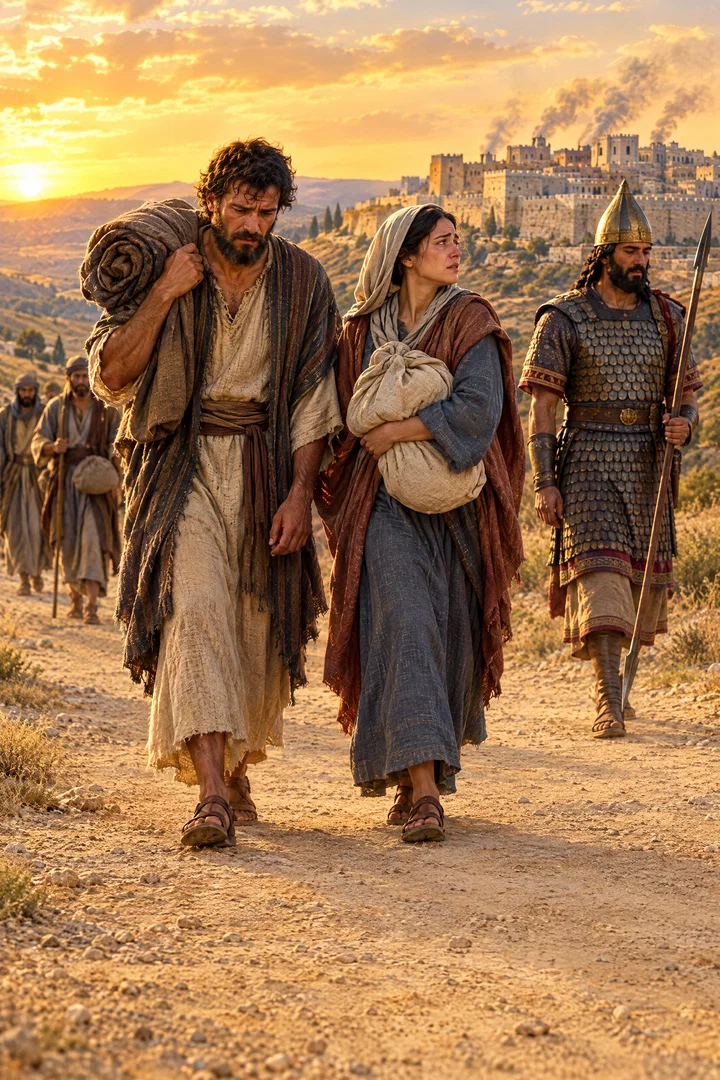
Cross-references
- 2 Kings 17:24
And the king of Assyria brought men from Babylon, and from Cuthah, and from Ava, and from Hamath, and from Sepharvaim, and placed them in the cities of Samaria instead of the children of Israel: and they possessed Samaria, and dwelt in the cities thereof.
Assyria resettled foreign peoples in Samaria after Israel’s deportation.
- Isaiah 10:5-6
O Assyrian, the rod of mine anger, and the staff in their hand is mine indignation.
Assyria is sent as God’s instrument to conquer and punish Israel.
- 2 Kings 18:9-11
And it came to pass in the fourth year of king Hezekiah, which was the seventh year of Hoshea son of Elah king of Israel, that Shalmaneser king of Assyria came up against Samaria, and besieged it.
Describes Samaria’s capture and Israel’s deportation by Assyria.
- 2 Kings 15:29
In the days of Pekah king of Israel came Tiglath-pileser king of Assyria, and took Ijon, and Abel-beth-maachah, and Janoah, and Kedesh, and Hazor, and Gilead, and Galilee, all the land of Naphtali, and carried them captive to Assyria.
Describes an earlier Assyrian deportation from Israel.
- Leviticus 26:33
And I will scatter you among the heathen, and will draw out a sword after you: and your land shall be desolate, and your cities waste.
Foretells Israel’s scattering and removal from the land.
- Psalms 78:61-62
And delivered his strength into captivity, and his glory into the enemy’s hand.
God gives Israel into captivity and judgment.
- 2 Kings 17:23
Until the LORD removed Israel out of his sight, as he had said by all his servants the prophets. So was Israel carried away out of their own land to Assyria unto this day.
Israel’s exile fulfilled the Lord’s word after his patience and covenant mercy.
- Micah 1:6
Therefore I will make Samaria as an heap of the field, and as plantings of a vineyard: and I will pour down the stones thereof into the valley, and I will discover the foundations thereof.
The prophecy of Samaria’s destruction is fulfilled.
- 1 Kings 14:15-16
For the LORD shall smite Israel, as a reed is shaken in the water, and he shall root up Israel out of this good land, which he gave to their fathers, and shall scatter them beyond the river, because they have made their groves, provoking the LORD to anger.
Foretells Israel being uprooted and delivered to its enemies.
- Isaiah 10:10-11
As my hand hath found the kingdoms of the idols, and whose graven images did excel them of Jerusalem and of Samaria;
Records Assyria’s boast that it would treat Jerusalem as it had Samaria.
- Ezra 4:10
And the rest of the nations whom the great and noble Asnappar brought over, and set in the cities of Samaria, and the rest that are on this side the river, and at such a time.
Names peoples settled in Samaria after Israel’s deportation.
- Isaiah 7:8
For the head of Syria is Damascus, and the head of Damascus is Rezin; and within threescore and five years shall Ephraim be broken, that it be not a people.
Isaiah set a limit of sixty-five years for Ephraim’s breaking.
- Amos 6:14
But, behold, I will raise up against you a nation, O house of Israel, saith the LORD the God of hosts; and they shall afflict you from the entering in of Hemath unto the river of the wilderness.
Amos foretells the Assyrian subduing of Israel.
- Ezra 4:2
Then they came to Zerubbabel, and to the chief of the fathers, and said unto them, Let us build with you: for we seek your God, as ye do; and we do sacrifice unto him since the days of Esar-haddon king of Assur, which brought us up hither.
Identifies the people who later offered to help rebuild the temple.
- Zechariah 1:19
And I said unto the angel that talked with me, What be these? And he answered me, These are the horns which have scattered Judah, Israel, and Jerusalem.
The horns represent kingdoms that scattered Israel, including Assyria.
- 2 Kings 19:32-34
Therefore thus saith the LORD concerning the king of Assyria, He shall not come into this city, nor shoot an arrow there, nor come before it with shield, nor cast a bank against it.
Israel was taken by Assyria, while the LORD promised to save Jerusalem.
- John 4:9
Then saith the woman of Samaria unto him, How is it that thou, being a Jew, askest drink of me, which am a woman of Samaria? for the Jews have no dealings with the Samaritans.
The woman is surprised that Jesus, a Jew, asks her for water.
Commentary
Each commentary is drawn from primary sources: the writings of Ellen G. White and Adventist pioneers and periodicals. Each commentary is separate. Its own words are not a quotation; follow the references to read the source passages.
Ellen G. White
6 sources
The hosts of Assyria under Shalmaneser invested Samaria, and in the siege that followed multitudes perished miserably from hunger and disease as well as by the sword until the city and the nation fell.PK 291.2 The broken remnant of the ten tribes of the northern kingdom was carried away captive into exile and scattered among the provinces of the Assyrian realm and among the nations.PK 291.2RH May 20, 1915PK 339.1PK 350.2–351.2RH Mar 4, 1915 That fall came about two years after Hezekiah's Passover invitation.PK 291.2
It had already taken place by the time Hezekiah became king of Judah, only a few years into his reign, in its earlier part, while Jerusalem was being fortified and its defenses strengthened.RH May 20, 1915PK 339.1PK 350.2–351.2 It occurred during the lifetime of Isaiah, who was of the royal line and was called as a young man to the prophetic mission near the close of Uzziah's reign, when Jotham was already bearing many of the burdens of state.RH Mar 4, 1915PK 305.2–3 It came through apostasy and rebellion that invited the judgments of God, hastened by the evils recently denounced by Hosea and Amos, which were also fast corrupting the kingdom of Judah.PK 305.2–3
At a time of peculiar peril, when divine protection was being removed from the southern kingdom and Assyrian forces were threatening Judah and about to overspread the land, the fate of Israel stood as a warning.RH Mar 4, 1915PK 305.2–3 The fall left Judah and Jerusalem close to Assyrian power and exposed them to the danger of another Assyrian invasion and attack.RH May 20, 1915PK 350.2–351.2 The defeat led surrounding peoples to question the power of Israel's God.PK 339.1 The Assyrians' success emboldened the Ninevites to reject Jonah's message and oppose Heaven's purposes.PK 339.1
Sources
Pioneers and periodicals
43 sources
In the ninth year of Hoshea the king of Assyria took Samaria and carried Israel into Assyria, settling them in Halah and in Habor by the river of Gozan and in the cities of the Medes, spread across a wide region of the empire.ST Nov 30, 1904ST May 5, 1909RH Sep 8, 1853 The fall came after a three-year siege that Shalmaneser began but did not live to finish, for Sargon completed the conquest and deportation.ST Nov 30, 1904ST Jul 14, 1887RH Jun 8, 1916 Israel was rejected and removed from God's sight because the people persisted in the evils that had cast out the nations before them, above all the calf-worship Jeroboam set up at Bethel and Dan from which the ten tribes never turned.ST Dec 7, 1904RH Sep 8, 1853ST Jun 13, 1906 The verse records the breaking of Ephraim as a people and nation, leaving only Judah, in fulfillment of Isaiah's prediction that Assyria would spoil and tread down Israel.RH Jan 10, 1856RH Jan 10, 1856RH Jan 10, 1856 That removal marks the starting point of the appointed time of Gentile treading and indignation, reckoned as 2,520 years from 723 B.C. to 1798 A.D.RH Jan 10, 1856RH Jan 10, 1856RH Jan 10, 1856RH Jan 10, 1856
Capture of Samaria
In Hoshea's ninth year the king of Assyria took Samaria and carried Israel away into Assyria, settling them in Halah and in Habor by the river of Gozan and in the cities of the Medes, spread across a wide region of the empire.ST Nov 30, 1904ST May 5, 1909RH Sep 8, 1853ST Sep 3, 1894RH May 21, 1908 The fall followed a three-year siege of Samaria: Shalmaneser began it but died before the city surrendered, and Sargon completed the conquest and deportation.ST Nov 30, 1904ST Jul 14, 1887RH Jun 8, 1916 The weight of the reckoning dates the event to 723 B.C.RH Jan 10, 1856 The conquest brought the kingdom to an end around 721-722 B.C., with many taken captive though a remnant remained in the land.ST May 20, 1908
The capture is also dated to 721 B.C., around which time Assyrians filled the places from which the Israelites were removed.ST Jul 14, 1887ST Aug 3, 1915ST Jul 23, 1885 Those who place it around 730 B.C. understand it as one of successive enslavements and dispersions affecting all Israel.ST Dec 24, 1894 Shalmaneser's invasion and siege are linked to his six-year reign, after which he was succeeded by Sargon in 722 B.C.ST Aug 13, 1885 An earlier Assyrian campaign had already carried away part of the ten tribes before the final fall of Samaria.ST Jul 14, 1887
Sargon's inscriptions report carrying 27,280 inhabitants from Samaria and scattering them across the Tigro-Euphrates valley.RH Jun 8, 1916ST Jan 4, 1916 Those carried away included the leaders and principal people and the larger part of the ten tribes, scattered among provinces of the Assyrian realm.ST May 3, 1910 The captivity came after Israel's 215-year trial, seven full centuries after Israel was established as a nation, when Assyria dominated the world and God's people were divided into two nations.ST Dec 7, 1904ST Aug 3, 1915 The fall had already happened when Hezekiah became king of Judah and occurred only a few years into his reign while Jerusalem was being fortified, leaving Judah and Jerusalem close to Assyrian power and exposed to danger of another invasion.RH May 20, 1915 Later, in 697-696 B.C., Esarhaddon carried away another group, ending the ten tribes' existence as a nation.RH May 21, 1908
Sins Leading to Exile
Israel was rejected and removed from God's sight after a 215-year trial because the people persisted in the same kinds of evil that had caused the nations before them to be cast out, showing that God shows no partiality and that those who persist in breaking His law are eventually cast out.ST Dec 7, 1904 After the ten tribes revolted from the house of David, Jeroboam feared the people would return to Rehoboam king of Judah if they went up to sacrifice at Jerusalem, so he made two calves of gold at Bethel and Dan and told Israel these were the gods that brought them out of Egypt.RH Sep 8, 1853 He made a house of high places and made priests of the lowest of the people who were not of Levi, and this worship became a sin from which Israel never turned.RH Sep 8, 1853
In a very short time after the division of the kingdom the ten tribes went into the deepest idolatry, the fruit of seeds of evil sown when Solomon left God and turned to idolatry.ST Jun 13, 1906 Even the battle on Mount Carmel over the second commandment, where God showed He was the true God, did not turn them back.ST Jun 13, 1906 Israel did not learn Sinai's lessons about obedience to God's law, but mocked God's messengers and sinned exceedingly until there was no remedy.ST Mar 7, 1906 There was downright disobedience, and still worse misinterpretation, perversion, and human additions to the law that caused many to stumble at the law, rendered worship vain, and made void the commandments of God.ST Mar 7, 1906 They forsook the Fountain of living waters for broken cisterns of men's doctrines and traditions.ST Mar 7, 1906
The Lord showed compassion and delayed casting Israel away because of His covenant with Abraham, Isaac, and Jacob.ST Oct 22, 1885 After long persistence in evil and rejection of repeated prophetic warnings and appeals to return to God, He at last removed them from His presence.ST Nov 4, 1897ST Oct 22, 1885 His rule was shown through this consequence, not by compelling the people to serve Him.ST Nov 4, 1897 They never returned to their own land.ST Oct 22, 1885
The captivity followed a time of apostasy, oppression, corruption, and deep involvement in heathen worship, including disregard of the Ten Commandments.ST Sep 24, 1896ST Oct 22, 1894ST Oct 27, 1898 A nation cannot prosper while trying to live without God's commandments.ST Oct 27, 1898 The judgments pronounced by Amos were fulfilled in this captivity and apply also to later generations that repeat those sins.ST Sep 24, 1896 The loss of separate identity was a consequence of departure from God, yet chastisement and reverses were also meant to bring any remaining truth to light through affliction.ST Oct 22, 1894 Their defeat after persisting in evil despite prophetic warnings and instruction is an example of the ruin that follows when people turn from God and His Spirit is withdrawn, and they were never delivered.RH Apr 19, 1870
Prophecy and Appointed Times
The fall recorded here is the breaking of Ephraim, that is the ten tribes called Israel, as a people and nation when the Lord delivered them to their enemies and removed them from the land, leaving only Judah.RH Jan 10, 1856RH Jan 10, 1856 Their government was uprooted and they were held captive in an enemy land.RH Jan 10, 1856 This was the historical fulfillment of Isaiah's prediction that Assyria would be sent to take spoil from Israel and tread the people down and overrun Ephraim and Samaria.RH Jan 10, 1856RH Jan 10, 1856
That removal from the land marks the starting point for reckoning the appointed time of being trodden down by the Gentiles and the period of indignation upon God's people.RH Jan 10, 1856RH Jan 10, 1856 It is distinct from Judah's later captivity under Manasseh, and it rather than that captivity is the true beginning to count from.RH Jan 10, 1856RH Jan 10, 1856 From this starting point run 2,520 years of captivity of God's people and of being trodden down by the Gentiles, dated from 723 B.C. to 1798 A.D.RH Jan 10, 1856RH Jan 10, 1856
The complete subduing of the ten-tribe kingdom by the king of Assyria is what Amos 6:14 refers to.ST Jun 20, 1911 The judgments pronounced by Amos were fulfilled in this captivity after a time of apostasy, oppression, and corruption, and they apply also to later generations that repeat those sins.ST Sep 24, 1896 The deportation to Halah and to Habor by the river of Gozan and to the cities of the Medes was part of the fulfillment of Isaiah's prediction that Ephraim would be broken and cease to be a people, completed when another group was carried away in 697-696 B.C. and the ten tribes' existence as a nation was ended.RH May 21, 1908
Fate of Tribes Afterwards
After this captivity Israel as a nation is lost to sacred history, for the larger part of the ten tribes was carried away and people from other lands were settled in their former territory, so that the ten tribes no longer had a kingdom.ST Aug 3, 1915 The carrying away occurred in 721 B.C., seven full centuries after Israel was established as a nation, when Assyria dominated the world and God's people were divided into two nations.ST Aug 3, 1915 Their destination was known, in the named places in Assyria at Halah and Habor and the cities of the Medes, so the ten tribes were not lost in an unknown land.RH Sep 8, 1853 For this reason they will not later be found to form 120,000 of the 144,000.RH Sep 8, 1853
Their removal after rebellion marked their being cut off from God's presence and no longer counted as His covenant people, while the Israelites who remained faithful and joined Judah to seek the Lord constituted Israel.RH Jul 3, 1856 Being cast off as a nation did not mean every person from those tribes was cast off.ST Nov 19, 1896 Many joined in worshiping God at Jerusalem, and some from the tribes later returned to Judah, so the remnant there included representatives of the tribes of Israel, including its leaders and principal people scattered among the provinces of the empire.ST May 3, 1910ST Nov 19, 1896 Others accepted the Lord through the apostles' preaching, for the Israel that will ultimately be gathered and saved is Israel by faith.ST Nov 19, 1896
The deportation was followed by bringing people from other nations and captives from various tribes and races into Palestine to settle where Israel's permanent inhabitants had been removed, including heathen settlers from near Babylon.ST Sep 3, 1894ST Jun 3, 1913ST Sep 3, 1894ST Aug 25, 1898 Their descendants became the Samaritans, named for Samaria the region's capital, of heathen origin.ST Jun 3, 1913 Their religion mixed worship of the true God with idolatry.ST Sep 3, 1894ST Jun 3, 1913ST Sep 3, 1894 The verse thus marks the end of the ten-tribe kingdom and the northern kingdom, when Assyria captured Samaria, carried the Israelites out of their land, settled them in Assyrian territories, and scattered the ten tribes among provinces of the Assyrian realm and among the nations under Assyrian power.RH Mar 4, 1915 These events occurred during Isaiah's lifetime.RH Mar 4, 1915
After the ten tribes separated from Judah and Benjamin under Jeroboam, they carried with them copies of the books of Moses when taken into exile.RH May 1, 1879 Samaria was conquered by Assyria around 730 B.C. and its people carried into captivity in one of the successive enslavements and dispersions that eventually affected all Israel and its three landed divisions, yet this captivity did not prevent the preservation of the Scriptures.ST Dec 24, 1894 Israel's idolatry led to its captivity, and Judah later followed the same course.ST Jun 3, 1913
Warning and Confirmation
Those who persist in breaking God's law are eventually cast out, for the northern kingdom was rejected after its 215-year trial because it persisted in the same kinds of evil that had caused the nations before them to be cast out, showing that God does not show partiality.ST Dec 7, 1904 Its fall stands as the historic example of a nation's failure when it tries to live without God's commandments, for Israel could not prosper while disregarding the Ten Commandments.ST Oct 27, 1898 The Lord allowed Israel to be taken captive by the Assyrians after the people rejected repeated prophetic warnings and appeals to return to God, and His rule was shown through this consequence, not by compelling the people to serve Him.ST Nov 4, 1897
The removal of the ten tribes by the Assyrians came after Israel had been miraculously delivered and established, and their places were filled by heathen.ST Dec 22, 1898 This was Satan's attack on the seed of Abraham through the force of a national decree to destroy the promised seed, lest God's promise to Abraham and his seed of restoration of the lost territory through Christ be fulfilled, Satan be dethroned, and God's right to the usurped territory be vindicated.ST Dec 22, 1898 As nations in succession gained control of the disputed territory the literal seed of Abraham was constantly harassed, and only by the extended power of God were they kept from being scattered abroad before the divine Seed, Jesus Christ, could be born in the land promised to Him through God's oath to Abraham.ST Dec 22, 1898 Israel's captivity followed its deep involvement in heathen worship, and the loss of its separate identity was a consequence of that departure from God, while chastisement and reverses were also meant to bring any remaining truth to light through affliction.ST Oct 22, 1894 Their fate, the fall of Samaria and scattering of the ten tribes among the nations under Assyrian power during Isaiah's lifetime, stood as a warning while Assyria threatened Judah and the divine protection of the southern kingdom was being removed.RH Mar 4, 1915
The fall of Samaria and the deportation to Assyria were historical events also attested in contemporary records of other peoples and rulers, which sometimes add information to the biblical account.RH Nov 16, 1916 The Assyrian king who carried Israel captive is identified as Sargon, whose existence was once doubted by critics but was later supported by the discovery of his palace, and who completed the siege.RH Nov 16, 1916RH Sep 7, 1905 A bas-relief depicting Sargon II and the capture of Samaria supports the deportation of Israel to Assyria.RH May 13, 1909 Assyrian royal records report that Sargon took 27,280 people from Samaria and scattered them across the Tigro-Euphrates valley, and his account of the capture confirms that the removal described was a historical event and not a scribal error.ST Jan 4, 1916RH Aug 4, 1910
Sources