2 Kings 18:27
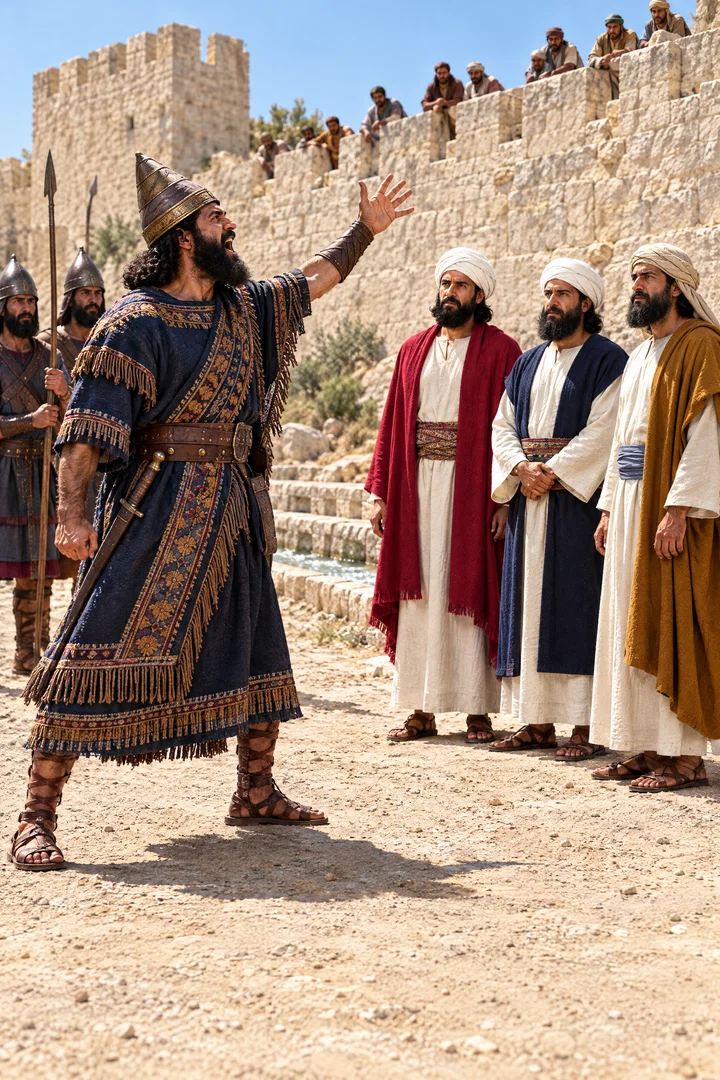
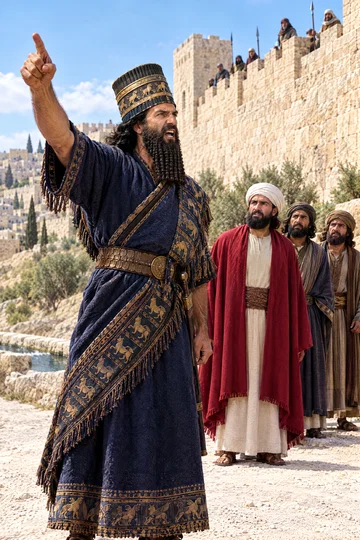
But Rab-shakeh said unto them, Hath my master sent me to thy master, and to thee, to speak these words? hath he not sent me to the men which sit on the wall, that they may eat their own dung, and drink their own piss with you?
Translations
But Rabshakeh said to them, Has my master sent me to your master, and to you, to speak these words? has he not sent me to the men which sit on the wall, that they may eat their own dung, and drink their own urine with you?
King James Version, KJV Cambridge Paragraph Bible
But Rab-shakeh said unto them, Hath my master sent me to thy master, and to thee, to speak these words? hath he not sent me to the men which sit on the wall, that they may eat their own dung, and drink their own piss with you?
But Rab-shakeh said to them, Hath my master sent me to thy master, and to thee, to speak these words? hath he not sent me to the men who sit on the wall, that they may feed on their vilest excretions with you?
But Rabshakeh said unto them, Hath my master sent me to thy master, and to thee, to speak these words? hath he not sent me to the men which sit on the wall, to eat their own dung, and to drink their own water with you?
But Rabshakeh said unto them, Hath my master sent me to thy master, and to thee, to speak these words? hath he not sent me to the men that sit on the wall, to eat their own dung, and to drink their own water with you?
And the chief of the butlers saith unto them, 'For thy lord, and unto thee, hath my lord sent me to speak these words? is it not for the men, those sitting on the wall to eat their own dung and to drink their own water, with you?'
And Rab-shakeh said to them, Is it to thy master and to thee that my master sent me to speak these words? Is it not to the men that sit on the wall, that they may eat their own dung and drink their own urine with you?
But Rab-shakeh said unto them—Is it, concerning thy lord, and concerning thee, that my lord hath sent me to speak these things? Is it not concerning the men who are tarrying upon the wall, that they may eat their own dung and drink their own water with you?
Berean Standard Bible, Majority Standard Bible
But the Rabshakeh replied, “ Has my master sent me to speak these words only to you and your master, and not to the men sitting on the wall, who are destined with you to eat their own dung and drink their own urine?”
But Rabshakeh said to them, “ Has my master sent me to your master and to you, to speak these words? Hasn’t he sent me to the men who sit on the wall, to eat their own dung, and to drink their own urine with you?”
But the Rab-shakeh said to them, Is it to your master or to you that my master has sent me to say these words? has he not sent me to the men seated on the wall? for they are the people who will be short of food with you when the town is shut in.
But Rabshakeh saide vnto them, Hath my master sent me to thy master and to thee to speake these words, and not to the men which sit on the wall, that they may eate their owne doung, and drinke their owne pisse with you?
Douay-Rheims (Challoner revision)
And Rabsaces answered them, saying: Hath my master sent me to thy master and to thee, to speak these words, and not rather to the men that sit upon the wall, that they may eat their own dung, and drink their urine with you?
Pictures
Cross-references
- 2 Chronicles 32:18
Then they cried with a loud voice in the Jews’ speech unto the people of Jerusalem that were on the wall, to affright them, and to trouble them; that they might take the city.
The Assyrians call out to Jerusalem’s defenders to frighten them.
- Isaiah 36:12
But Rabshakeh said, Hath my master sent me to thy master and to thee to speak these words? hath he not sent me to the men that sit upon the wall, that they may eat their own dung, and drink their own piss with you?
Rab-shakeh threatens the people on Jerusalem’s wall during the siege.
- Isaiah 37
And it came to pass, when king Hezekiah heard it, that he rent his clothes, and covered himself with sackcloth, and went into the house of the LORD.
Named as a parallel account of the events involving Jerusalem and Assyria.
- 2 Kings 19:15-19
And Hezekiah prayed before the LORD, and said, O LORD God of Israel, which dwellest between the cherubims, thou art the God, even thou alone, of all the kingdoms of the earth; thou hast made heaven and earth.
Hezekiah's prayer as model for telling troubles
- 2 Kings 19:10-13
Thus shall ye speak to Hezekiah king of Judah, saying, Let not thy God in whom thou trustest deceive thee, saying, Jerusalem shall not be delivered into the hand of the king of Assyria.
threatening letter Hezekiah spread before God
- 2 Kings 19:36-37
So Sennacherib king of Assyria departed, and went and returned, and dwelt at Nineveh.
Cited to show the king returned to his own land and died there.
- 2 Kings 19:7
Behold, I will send a blast upon him, and he shall hear a rumour, and shall return to his own land; and I will cause him to fall by the sword in his own land.
Cited in considering the king of Assyria’s movements.
Commentary
Each commentary is drawn from primary sources: the writings of Ellen G. White and Adventist pioneers and periodicals. Each commentary is separate. Its own words are not a quotation; follow the references to read the source passages.
Pioneers and periodicals
6 sources
The verse belongs to the sad story of transgression, war, strife, defeat, captivity and conspiracy during the reigns of the kings of Israel and Judah.ST May 20, 1908 It stands in the closing eight-chapter record of Kings that hastens from the utter breaking up of the northern kingdom of Samaria in chapter seventeen to the Babylonian captivity of Judah, covering the reigns of Hezekiah, Manasseh, Amon, Josiah, Jehoahaz, Jehoiakim, Jehoiachin and Zedekiah. The chapter belongs to the five chapters given to the two good kings Hezekiah and Josiah, devoted men of God notwithstanding their mistakes.
Hezekiah's mistake exalted man, aroused the cupidity of Babylon and brought captivity upon his own seed, and after his mistake the wicked Manasseh was born, though mercy came even to him. The verse is part of the account of Sennacherib's invasion of Palestine and siege of Jerusalem, an episode also recorded on Sennacherib's cylinder, whose inscription confirms the biblical account. Rabshakeh deliberately directs his words not only to Hezekiah and his officials but to the men defending Jerusalem on the wall, warning that they will share the extremities of a siege with their king in order to frighten and discourage them into surrender.ST Jun 21, 1905RH May 21, 1908
The degrading threat means the besieged inhabitants of Jerusalem would suffer extreme hunger and thirst in a siege, even to eating their own dung and drinking their own urine.ST May 5, 1909RH May 21, 1908 The verse belongs to the story of Hezekiah in trouble, showing that God is a friend to His people in trouble who delivers those who trust Him.RH Nov 14, 1912 Hezekiah's experience teaches spreading troubles before God in prayer, as he spread the threatening letter before the Lord and told God his troubles.RH Nov 14, 1912
Hezekiah's experience warns children to learn faith, self-denial and trust in God now, so they will not be overwhelmed in the coming time of trouble.RH Nov 14, 1912 Read with 2 Kings 19, 2 Chronicles 32 and Isaiah 37, the account of the Assyrian campaign shows that the Assyrian army was not near Jerusalem but was with the king of Assyria at Libnah when the angel slew 185,000 men, so that destruction cannot fulfill the prophecy about Tophet in Isaiah 30:33.RH Jun 15, 1869
Sources