2 Kings 18:28
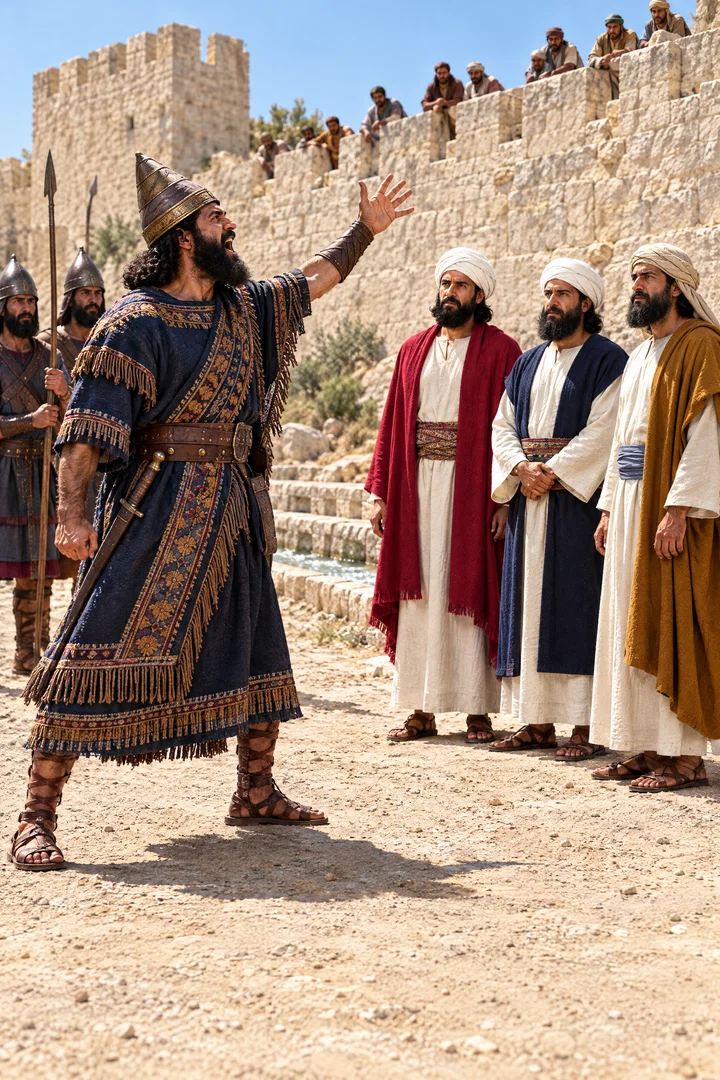
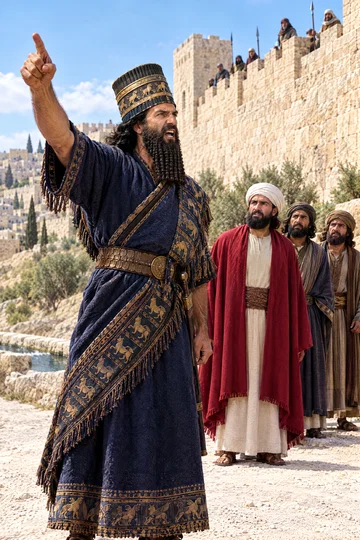
Then Rab-shakeh stood and cried with a loud voice in the Jews’ language, and spake, saying, Hear the word of the great king, the king of Assyria:
Translations
Then Rabshakeh stood and cried with a loud voice in the Jews’ language, and spoke, saying, Hear the word of the great king, the king of Assyria:
King James Version, KJV Cambridge Paragraph Bible
Then Rab-shakeh stood and cried with a loud voice in the Jews’ language, and spake, saying, Hear the word of the great king, the king of Assyria:
Then Rab-shakeh stood and cried with a loud voice in the Jews language, and spoke, saying, Hear the word of the great king, the king of Assyria:
Revised Version, American Standard Version
Then Rabshakeh stood, and cried with a loud voice in the Jews’ language, and spake, saying, Hear ye the word of the great king, the king of Assyria.
And the chief of the butlers standeth and calleth with a great voice [in] Jewish, and speaketh and saith, 'Hear ye a word of the great king, the king of Asshur:
And Rab-shakeh stood and cried with a loud voice in the Jewish [ language], and spoke and said, Hear the word of the great king, the king of Assyria!
So then Rab-shakeh took his stand, and cried out with a loud voice, in, the Jews’, language,—and spake, and said, Hear ye the message of the great king, the king of Assyria:—
Berean Standard Bible, Majority Standard Bible
Then the Rabshakeh stood and called out loudly in Hebrew: “ Hear the word of the great king, the king of Assyria!
Then Rabshakeh stood and cried with a loud voice in the Jews’ language, and spoke, saying, “ Hear the word of the great king, the king of Assyria.
Then the Rab-shakeh got up and said with a loud voice in the Jews' language, Give ear to the words of the great king, the king of Assyria;
So Rabshakeh stoode and cryed with a loude voyce in the Iewes language, and spake, saying, Heare the wordes of the great King, of the king of Asshur.
Douay-Rheims (Challoner revision)
Then Rabsaces stood, and cried out with a loud voice in the Jews’ language, and said: Hear the words of the great king, the king of the Assyrians.
Pictures
Cross-references
- 2 Chronicles 32:18
Then they cried with a loud voice in the Jews’ speech unto the people of Jerusalem that were on the wall, to affright them, and to trouble them; that they might take the city.
The Assyrians shout in the Jews’ language to frighten Jerusalem’s people.
- Isaiah 36:13
Then Rabshakeh stood, and cried with a loud voice in the Jews’ language, and said, Hear ye the words of the great king, the king of Assyria.
Rab-shakeh addresses Jerusalem loudly in the people’s language.
- Isaiah 37:23-35
Whom hast thou reproached and blasphemed? and against whom hast thou exalted thy voice, and lifted up thine eyes on high? even against the Holy One of Israel.
God answers the Assyrian king’s boast and promises to defend Jerusalem.
- 2 Kings 19:10-13
Thus shall ye speak to Hezekiah king of Judah, saying, Let not thy God in whom thou trustest deceive thee, saying, Jerusalem shall not be delivered into the hand of the king of Assyria.
The Assyrian threat continues as Hezekiah faces Jerusalem’s crisis.
- 2 Kings 19:15-19
And Hezekiah prayed before the LORD, and said, O LORD God of Israel, which dwellest between the cherubims, thou art the God, even thou alone, of all the kingdoms of the earth; thou hast made heaven and earth.
Hezekiah spreads the threat before God and prays for deliverance.
- 2 Kings 19:35
And it came to pass that night, that the angel of the LORD went out, and smote in the camp of the Assyrians an hundred fourscore and five thousand: and when they arose early in the morning, behold, they were all dead corpses.
Describes the angel’s destruction of the Assyrian army after the threat.
- 2 Kings 19:36-37
So Sennacherib king of Assyria departed, and went and returned, and dwelt at Nineveh.
Shows the king returned to his land and died there.
- 2 Kings 19:7
Behold, I will send a blast upon him, and he shall hear a rumour, and shall return to his own land; and I will cause him to fall by the sword in his own land.
Cited with the account of the Assyrian king’s campaign.
Commentary
Each commentary is drawn from primary sources: the writings of Ellen G. White and Adventist pioneers and periodicals. Each commentary is separate. Its own words are not a quotation; follow the references to read the source passages.
Pioneers and periodicals
6 sources
The address stands in the history of Judah after the ten tribes had been carried away.ST Dec 9, 1897 It belongs to 2 Kings 17-18, studied with Psalm 143, within the story of transgression, war, strife, defeat, captivity and conspiracy that ends with the complete overthrow of the kingdom of the ten tribes by Shalmaneser IV and Sargon of Assyria in B.C. 721-722.ST May 20, 1908 It is part of 2 Kings 18-20, which continues the history running from 1 Kings 22 through 2 Kings 20.ST May 3, 1910 The books of Kings give a fuller history of Israel than of Judah, while Chronicles give a fuller history of Judah than of Israel.ST May 3, 1910
It belongs to the reign of Hezekiah, one of the good kings of Judah whose devotion to God did not keep him from making mistakes. One mistake exalted man, stirred the desire of Babylon, and brought captivity upon his descendants. It is part of the account of Sennacherib's invasion of Palestine and siege of Jerusalem, an account also reflected on Sennacherib's cylinder. The cylinder omits the loss of 185,000 Assyrian soldiers but mentions a misfortune in his camp.
The speaker is the Assyrian king's envoy and commander, who stood and cried with a loud voice in the Jews' language to deliver the message of the great king of Assyria publicly so the people and defenders on Jerusalem's wall would hear.RH Nov 14, 1912ST Jun 21, 1905RH May 21, 1908 He addressed Jerusalem's defenders directly in their own language to frighten and discourage them into surrendering the city.ST Jun 21, 1905RH May 21, 1908 His message challenged their trust in God, treating the God of Jerusalem as powerless like gods represented by objects made by human hands.RH May 21, 1908 This public threat formed part of the trouble facing Hezekiah and set the occasion for his appeal to God.RH Nov 14, 1912
Sources