Isaiah 36:12
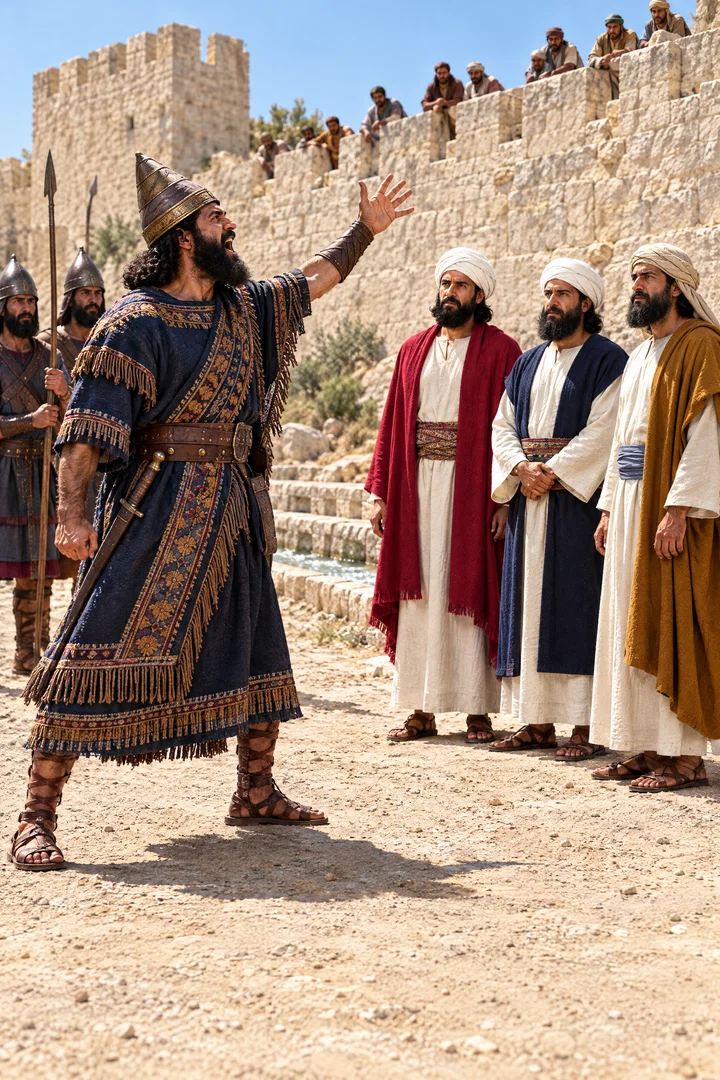
But Rabshakeh said, Hath my master sent me to thy master and to thee to speak these words? hath he not sent me to the men that sit upon the wall, that they may eat their own dung, and drink their own piss with you?
Translations
But Rabshakeh said, Has my master sent me to your master and to you to speak these words? has he not sent me to the men that sit on the wall, that they may eat their own dung, and drink their own urine with you?
King James Version, KJV Cambridge Paragraph Bible
But Rabshakeh said, Hath my master sent me to thy master and to thee to speak these words? hath he not sent me to the men that sit upon the wall, that they may eat their own dung, and drink their own piss with you?
But Rabshakeh said, Hath my master sent me to thy master and to thee to speak these words? hath he not sent me to the men that sit upon the wall, that they may devour their vilest excretions with you?
Revised Version, American Standard Version
But Rabshakeh said, Hath my master sent me to thy master, and to thee, to speak these words? hath he not sent me to the men that sit upon the wall, to eat their own dung, and to drink their own water with you?
And Rabshakeh saith, 'Unto thy lord, and unto thee, hath my lord sent me to speak these words? is it not for the men — those sitting on the wall to eat their own dung and to drink their own water with you?'
And Rab-shakeh said, Is it to thy master and to thee that my master sent me to speak these words? Is it not to the men that sit on the wall, that they may eat their own dung, and drink their own urine with you?
But Rabshakeh said—Is it unto thy lord and unto thee, that my lord hath sent me, to speak these things? Is it not concerning the men who are tarrying upon the wall, that they may eat and drink what cometh from them, with you?
Berean Standard Bible, Majority Standard Bible
But the Rabshakeh replied, “ Has my master sent me to speak these words only to you and your master, and not to the men sitting on the wall, who are destined with you to eat their own dung and drink their own urine?”
But Rabshakeh said, “ Has my master sent me only to your master and to you, to speak these words, and not to the men who sit on the wall, who will eat their own dung and drink their own urine with you?”
But the Rab-shakeh said, Is it to your master or to you that my master has sent me to say these words? has he not sent me to the men seated on the wall? for they are the people who will be short of food with you when the town is shut in.
Then said Rabshakeh, Hath my master sent me to thy master, and to thee to speake these wordes, and not to the men that sit on the wall? that they may eate their owne doung, and drinke their owne pisse with you?
Douay-Rheims (Challoner revision)
And Rabsaces said to them: Hath my master sent me to thy master and to thee, to speak all these words; and not rather to the men that sit on the wall; that they may eat their own dung, and drink their urine with you?
Pictures
Cross-references
- 2 Kings 18:27
But Rab-shakeh said unto them, Hath my master sent me to thy master, and to thee, to speak these words? hath he not sent me to the men which sit on the wall, that they may eat their own dung, and drink their own piss with you?
Rabshakeh taunts the people on the wall with the same threat.
- Isaiah 37:36
Then the angel of the LORD went forth, and smote in the camp of the Assyrians a hundred and fourscore and five thousand: and when they arose early in the morning, behold, they were all dead corpses.
The Lord delivers Jerusalem by destroying the Assyrian army.
- 2 Chronicles 32:18
Then they cried with a loud voice in the Jews’ speech unto the people of Jerusalem that were on the wall, to affright them, and to trouble them; that they might take the city.
The Assyrians loudly threaten Jerusalem’s defenders to frighten them.
- 2 Kings 19:35-37
And it came to pass that night, that the angel of the LORD went out, and smote in the camp of the Assyrians an hundred fourscore and five thousand: and when they arose early in the morning, behold, they were all dead corpses.
Jerusalem is delivered from the Assyrians, and Sennacherib later dies.
- 2 Kings 18:13-17
Now in the fourteenth year of king Hezekiah did Sennacherib king of Assyria come up against all the fenced cities of Judah, and took them.
Records Sennacherib’s campaign against Judah and the Assyrian siege of Lachish.
Commentary
Each commentary is drawn from primary sources: the writings of Ellen G. White and Adventist pioneers and periodicals. Each commentary is separate. Its own words are not a quotation; follow the references to read the source passages.
Pioneers and periodicals
5 sources
Isaiah 36:12 belongs to the threatening campaign of the Assyrian king Sennacherib against Jerusalem and Judah during the reign of Hezekiah.ST Oct 6, 1909ST Oct 6, 1909RH May 21, 1908RH Jun 11, 1857 Rabshakeh's words are a deliberately degrading threat that siege will reduce Jerusalem's defenders and people to extreme famine and thirst, forced to consume their own waste.ST Jun 21, 1905RH May 21, 1908 He directs that threat not only to the king and his officers but to the men sitting upon the city wall, appealing directly to the people in order to frighten and discourage them into surrender.ST Jun 21, 1905RH May 21, 1908
His speech attempts to terrorize Jerusalem's defenders and to undermine their trust in God by treating the God of Jerusalem as powerless, like the handmade gods of the nations.RH May 21, 1908 The crisis was followed by Hezekiah's humility, God's message through the prophet, and the Lord's deliverance of Jerusalem when the Assyrian army was struck down and Sennacherib returned to his own land in shame.ST Oct 6, 1909ST Oct 6, 1909RH May 21, 1908 The history to which the verse belongs, including the siege of Lachish and Sennacherib's demand for tribute, is confirmed by records excavated at Nineveh, which give no further explanation of the verse's specific words.RH Jun 11, 1857
Sources