2 Kings 21:7
And he set a graven image of the grove that he had made in the house, of which the LORD said to David, and to Solomon his son, In this house, and in Jerusalem, which I have chosen out of all tribes of Israel, will I put my name for ever:
Translations
American King James Version, King James Version, Webster Bible
And he set a graven image of the grove that he had made in the house, of which the LORD said to David, and to Solomon his son, In this house, and in Jerusalem, which I have chosen out of all tribes of Israel, will I put my name for ever:
And he set a graven image of the grove that he had made in the house, of which the Lord said to David, and to Solomon his son, In this house, and in Jerusalem, which I have chosen out of all tribes of Israel, will I put my name for ever:
And he set the graven image of Asherah, that he had made, in the house of which the LORD said to David and to Solomon his son, In this house, and in Jerusalem, which I have chosen out of all the tribes of Israel, will I put my name for ever:
And he set the graven image of Asherah, that he had made, in the house of which Jehovah said to David and to Solomon his son, In this house, and in Jerusalem, which I have chosen out of all the tribes of Israel, will I put my name for ever;
And he setteth the graven image of the shrine that he made in the house of which Jehovah said unto David and unto Solomon his son, 'In this house, and in Jerusalem, that I have chosen out of all the tribes of Israel, I put My name — to the age;
And he set the graven image of the Asherah that he had made, in the house of which Jehovah had said to David and to Solomon his son, In this house, and in Jerusalem, which I have chosen out of all the tribes of Israel, will I put my name for ever;
and he set the image of the Sacred Stem which he had made,—in the house, of which Yahweh had said unto David, and unto Solomon his son, In this house, and in Jerusalem which I have chosen out of all the tribes of Israel, will I put my Name, unto times age-abiding;
Berean Standard Bible, Majority Standard Bible
Manasseh even took the carved Asherah pole he had made and set it up in the temple, of which the LORD had said to David and his son Solomon, “ In this temple and in Jerusalem, which I have chosen out of all the tribes of Israel, I will establish My Name forever.
He set the engraved image of Asherah that he had made in the house of which the LORD said to David and to Solomon his son, “ In this house, and in Jerusalem, which I have chosen out of all the tribes of Israel, I will put my name forever;
He put the image of Asherah which he had made in the house of which the Lord had said to David and to Solomon his son, In this house, and in Jerusalem, the town which I have made mine out of all the tribes of Israel, I will put my name for ever.
And he set the image of the groue, that he had made, in the house, whereof ye Lord had saide to Dauid and to Salomon his sonne, In this house and in Ierusalem, which I haue chosen out of all the tribes of Israel, will I put my Name for euer.
Douay-Rheims (Challoner revision)
He set also an idol of the grove, which he had made, in the temple of the Lord: concerning which the Lord said to David, and to Solomon his son: In this temple, and in Jerusalem, which I have chosen out of all the tribes of Israel, I will put my name for ever.
Pictures
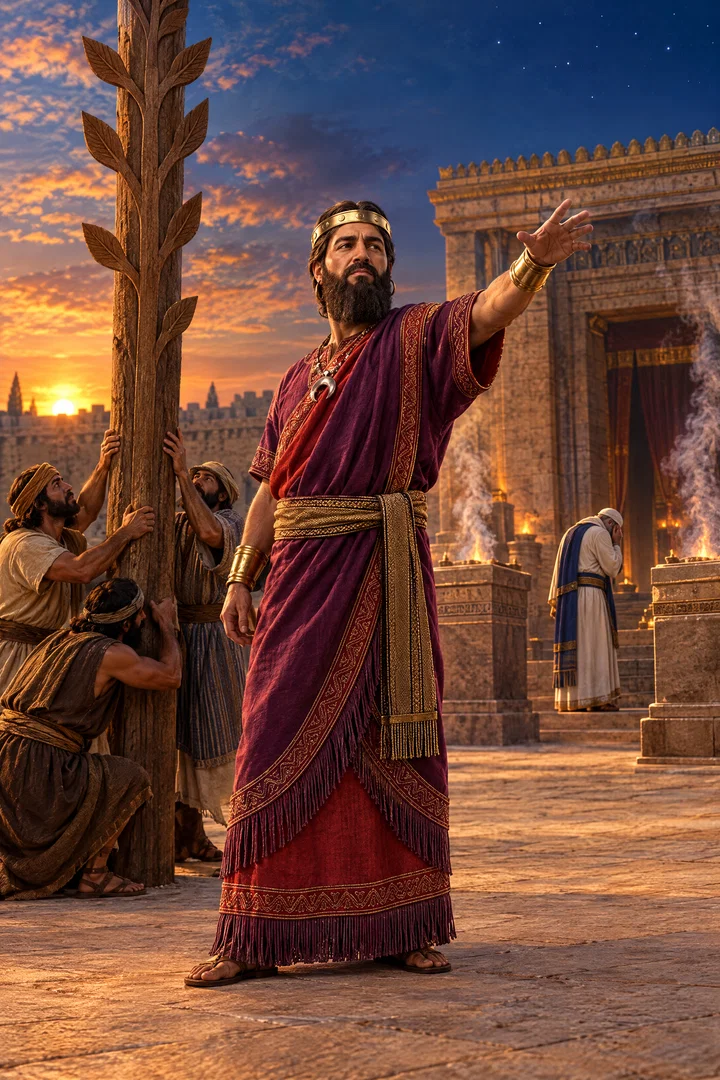
Cross-references
- 2 Kings 23:4-6
And the king commanded Hilkiah the high priest, and the priests of the second order, and the keepers of the door, to bring forth out of the temple of the LORD all the vessels that were made for Baal, and for the grove, and for all the host of heaven: and he burned them without Jerusalem in the fields of Kidron, and carried the ashes of them unto Beth-el.
Josiah removes the grove image and other objects of idolatry from the temple.
- 2 Chronicles 33:15-16
And he took away the strange gods, and the idol out of the house of the LORD, and all the altars that he had built in the mount of the house of the LORD, and in Jerusalem, and cast them out of the city.
After repenting, he removed the idol from the LORD’s house and restored its worship.
- Deuteronomy 4:16
Lest ye corrupt yourselves, and make you a graven image, the similitude of any figure, the likeness of male or female,
Both condemn making graven images for worship.
- 1 Kings 13:2
And he cried against the altar in the word of the LORD, and said, O altar, altar, thus saith the LORD; Behold, a child shall be born unto the house of David, Josiah by name; and upon thee shall he offer the priests of the high places that burn incense upon thee, and men’s bones shall be burnt upon thee.
Josiah, named in the prophecy, later fulfills it.
- 2 Corinthians 6:16
And what agreement hath the temple of God with idols? for ye are the temple of the living God; as God hath said, I will dwell in them, and walk in them; and I will be their God, and they shall be my people.
God’s temple is incompatible with idols.
- Deuteronomy 12:31
Thou shalt not do so unto the LORD thy God: for every abomination to the LORD, which he hateth, have they done unto their gods; for even their sons and their daughters they have burnt in the fire to their gods.
The passage cites the command forbidding Israel to worship the Lord in the manner of idolaters.
- 2 Chronicles 33:11
Wherefore the LORD brought upon them the captains of the host of the king of Assyria, which took Manasseh among the thorns, and bound him with fetters, and carried him to Babylon.
Manasseh’s profanation of the temple is followed by divine punishment.
- Ezekiel 24:21
Speak unto the house of Israel, Thus saith the Lord GOD; Behold, I will profane my sanctuary, the excellency of your strength, the desire of your eyes, and that which your soul pitieth; and your sons and your daughters whom ye have left shall fall by the sword.
God profanes the sanctuary after its pollution.
Commentary
Each commentary is drawn from primary sources: the writings of Ellen G. White and Adventist pioneers and periodicals. Each commentary is separate. Its own words are not a quotation; follow the references to read the source passages.
Ellen G. White
1 source
Manasseh's placing of a carved Asherah image inside the temple itself was a daring repudiation of the statutes recorded by Moses.RH Jul 22, 1915 It set aside in particular the statutes of the book of the covenant in Deuteronomy.RH Jul 22, 1915 Those very statutes, when observed, had made the reign of his father Hezekiah prosperous.RH Jul 22, 1915 The act therefore marked a deliberate break with the law that had brought blessing to the kingdom just before him.RH Jul 22, 1915
During Manasseh's reign the temple copy of the book of the law was lost through careless neglect.RH Jul 22, 1915 For many years afterward the people generally were deprived of its instruction.RH Jul 22, 1915
Sources
Pioneers and periodicals
11 sources
Manasseh set the carved Asherah image he had made in the temple in Jerusalem, the house the Lord had chosen out of all the tribes of Israel to put His name forever.ST May 5, 1909RH Sep 11, 1856ST Nov 5, 1912 It was the wicked reign of Manasseh, son and successor of the good Hezekiah and father of the wicked Amon before the reformer Josiah.RH May 18, 1876ST May 10, 1910ST Jun 3, 1913 In doing this he profaned and polluted the sanctuary dedicated to the true God, turning it into a place of idol worship, and his idolatry became a byword for wickedness.ST May 5, 1909RH Sep 11, 1856ST Nov 5, 1912 The worship was that of the host of heaven, sun and Baal worship in the very courts of the Lord's house, following the same departure that had carried Israel away.ST Oct 18, 1883RH May 18, 1876ST Jun 3, 1913RH Nov 12, 1872 For this a curse came upon the people and God delivered Manasseh into the hands of the king of Babylon, who bound him and carried him beyond the Euphrates in B.C. 677, yet when he humbled himself and repented he was sent back to his dominion and labored to repair his profanations, showing that God hears and shows mercy even after great sin.ST Oct 18, 1883RH May 18, 1876
Act and Historical Setting
Manasseh set in the temple the carved Asherah image of the grove that he had made, in the house in Jerusalem that the Lord had chosen out of all the tribes of Israel as the place to put His name forever.ST May 5, 1909RH Sep 11, 1856ST Nov 5, 1912ST Apr 22, 1889 That house was God's chosen dwelling place, so the setting of the graven image there set an idolatrous act directly against God's designation of the temple for His name.ST May 5, 1909ST Nov 5, 1912ST Apr 22, 1889 The act took place within the history of Judah after the ten tribes had been swept away, in the period covered by 2 Kings 18-25, while the books of Kings as a whole recount the monarchy from Solomon's accession to the Babylonian Captivity.ST Dec 9, 1897
It belongs to the wicked reign of Manasseh, son and successor of Hezekiah, coming after the good Hezekiah with his remarkable experiences and before his wicked son Amon and the good reformer Josiah.RH May 18, 1876ST Jun 3, 1913 It belongs to the closing history in Kings showing the wicked and weak reigns of the kings of Judah, in contrast to the bright reformation conducted under Josiah.ST May 10, 1910 In this it shows Judah following the same sad course of departure from God through idolatry as Israel, a course that led at last to captivity.ST Jun 3, 1913 Under Manasseh the nation was plunged into heathen idolatry and was supported in it by Amon, Josiah's father.ST Jun 3, 1913RH Nov 12, 1872
The idolatry was worship of the host of heaven, set up even in the courts of the Lord's house, and is identified as sun and Baal worship.ST Oct 18, 1883RH May 18, 1876 The people's religion is described as low and sensual, and Manasseh is identified as a wicked king. He dared to set aside the statutes recorded by Moses, especially those in the book of the covenant in Deuteronomy whose observance had made Hezekiah's reign prosperous.RH Jul 22, 1915 During his reign the temple copy of the book of the law became lost through careless neglect, so for many years the people generally were deprived of its instruction.RH Jul 22, 1915
Defilement, Judgment and Mercy
Manasseh profaned the temple by setting in it the carved Asherah image he had made, in the very house in Jerusalem that the Lord had chosen out of all the tribes as the place to put His name forever.ST May 5, 1909RH Sep 11, 1856ST Nov 5, 1912 That act defiled and polluted the sanctuary dedicated to the true God, turning it into a place of idol worship akin to pagan worship.RH Sep 11, 1856ST Nov 5, 1912ST Apr 22, 1889 It stood in direct contrast to God's designation of the temple as His dwelling place.ST May 5, 1909ST Apr 22, 1889
The setting of the image in God's chosen house showed the depth of Manasseh's idolatry, and his reign became a byword for wickedness. The people's religion under him was low and sensual, including sun and Baal worship. He brought sun worship into the temple by setting up idolatrous worship for the host of heaven, with altars to all the host of heaven even in the courts of the Lord's house.ST Oct 18, 1883RH May 18, 1876 For that profanation a curse rested upon the people.ST Oct 18, 1883
For this God delivered Manasseh into the hands of the king of Babylon, who bound him with chains and carried him beyond the Euphrates in B.C. 677.RH May 18, 1876 After humbling himself and repenting of his sins he was sent back to his own dominion and labored to repair the profanations he had committed upon the house of the Lord.RH May 18, 1876 His later humility shows that God heard and showed mercy even after great sin, for even Manasseh received God's mercy. The sun worship he established was the same sun worship practiced by the heathen from before Moses' time and warned against by Moses and Job, and it came through forgetting God by disregarding His Sabbath, which once caused Jerusalem to be destroyed.ST Oct 18, 1883
Sources