2 Kings 25:11
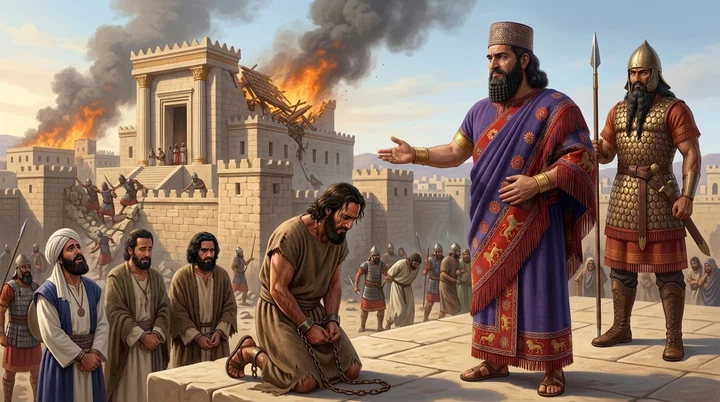
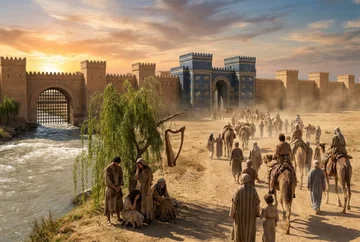
Now the rest of the people that were left in the city, and the fugitives that fell away to the king of Babylon, with the remnant of the multitude, did Nebuzar-adan the captain of the guard carry away.
Translations
Now the rest of the people that were left in the city, and the fugitives that fell away to the king of Babylon, with the remnant of the multitude, did Nebuzaradan the captain of the guard carry away.
King James Version, KJV Cambridge Paragraph Bible, Webster Bible
Now the rest of the people that were left in the city, and the fugitives that fell away to the king of Babylon, with the remnant of the multitude, did Nebuzar-adan the captain of the guard carry away.
Revised Version, American Standard Version
And the residue of the people that were left in the city, and those that fell away, that fell to the king of Babylon, and the residue of the multitude, did Nebuzaradan the captain of the guard carry away captive.
And the rest of the people, those left in the city, and those falling who have fallen to the king of Babylon, and the rest of the multitude, hath Nebuzaradan chief of the executioners removed;
And Nebuzar-adan the captain of the body-guard carried away captive the rest of the people that were left in the city, and the deserters that had deserted to the king of Babylon, and the rest of the multitude.
And, the residue of the people who were left in the city, and the disheartened who fell away unto the king of Babylon, and the residue of the multitude, did Nebuzaradan, chief of the royal executioners, carry away captive.
Berean Standard Bible, Majority Standard Bible
Then Nebuzaradan captain of the guard carried into exile the people who remained in the city, along with the deserters who had defected to the king of Babylon and the rest of the population.
Nebuzaradan the captain of the guard carried away captive the rest of the people who were left in the city and those who had deserted to the king of Babylon— all the rest of the multitude.
And the rest of the people who were still in the town, and all those who had given themselves up to the king of Babylon, and all the rest of the workmen, Nebuzaradan, the captain of the armed men, took away as prisoners;
And the rest of the people that were left in the citie, and those that were fled and fallen to the King of Babel, with the remnant of the multitude, did Nebuzar-adan chiefe steward carie away captiue.
Douay-Rheims (Challoner revision)
And Nabuzardan the commander of the army, carried away the rest of the people that remained in the city, and the fugitives that had gone over to the king of Babylon, and the remnant of the common people.
Pictures
Cross-references
- 2 Chronicles 36:20
And them that had escaped from the sword carried he away to Babylon; where they were servants to him and his sons until the reign of the kingdom of Persia:
Both describe Jerusalem’s survivors being carried away to Babylon.
- 2 Kings 24:14
And he carried away all Jerusalem, and all the princes, and all the mighty men of valour, even ten thousand captives, and all the craftsmen and smiths: none remained, save the poorest sort of the people of the land.
Describes an earlier deportation from Jerusalem, leaving only the poorest people.
- Jeremiah 39:9
Then Nebuzar-adan the captain of the guard carried away captive into Babylon the remnant of the people that remained in the city, and those that fell away, that fell to him, with the rest of the people that remained.
Describes the deportation of Jerusalem’s remaining people by Nebuzar-adan.
- Jeremiah 52
Zedekiah was one and twenty years old when he began to reign, and he reigned eleven years in Jerusalem. And his mother’s name was Hamutal the daughter of Jeremiah of Libnah.
Jeremiah’s account recounts Jerusalem’s fall and the people carried away to Babylon.
- Micah 4:10
Be in pain, and labour to bring forth, O daughter of Zion, like a woman in travail: for now shalt thou go forth out of the city, and thou shalt dwell in the field, and thou shalt go even to Babylon; there shalt thou be delivered; there the LORD shall redeem thee from the hand of thine enemies.
Zion goes into captivity to Babylon.
- Jeremiah 29:10
For thus saith the LORD, That after seventy years be accomplished at Babylon I will visit you, and perform my good word toward you, in causing you to return to this place.
It foretells the return after seventy years of captivity.
- Jeremiah 32:1-5
The word that came to Jeremiah from the LORD in the tenth year of Zedekiah king of Judah, which was the eighteenth year of Nebuchadrezzar.
Places Zedekiah’s imprisonment during the siege.
- 2 Kings 25:22-26
And as for the people that remained in the land of Judah, whom Nebuchadnezzar king of Babylon had left, even over them he made Gedaliah the son of Ahikam, the son of Shaphan, ruler.
Continues the account of those left behind and their flight to Egypt.
- 2 Kings 25:27-30
And it came to pass in the seven and thirtieth year of the captivity of Jehoiachin king of Judah, in the twelfth month, on the seven and twentieth day of the month, that Evil-merodach king of Babylon in the year that he began to reign did lift up the head of Jehoiachin king of Judah out of prison;
continues Jehoiachin's imprisonment and release
- Revelation 18
And after these things I saw another angel come down from heaven, having great power; and the earth was lightened with his glory.
The captivity is placed in a larger account that ends with Babylon’s destruction.
Commentary
Each commentary is drawn from primary sources: the writings of Ellen G. White and Adventist pioneers and periodicals. Each commentary is separate. Its own words are not a quotation; follow the references to read the source passages.
Ellen G. White
1 source
The deportation completed the fall of Jerusalem, with the remnant still in the ruined city together with deserters who had gone over to Babylon and the rest of the population taken into captivity.STB 290.3 That defeat and scattering was judgment for Israel's failure to fulfill its calling as God's missionaries, choosing instead to withdraw and cut itself off from the peoples around it.STB 290.3 Yet the exile was also made redemptive, for through the dispersion of His people God spread the knowledge of His truth to distant lands.STB 290.3 Restoration was assured on condition of character, for if the exiles proved loyal and true and submissive He would bring them back again to their own land.STB 290.3
Sources
Pioneers and periodicals
15 sources
The verse records the final stage of the exile, when Nebuzar-adan the captain of the guard carried to Babylon the rest left in the city, the fugitives who had fallen away to the king of Babylon, and the remnant of the multitude.ST Jan 14, 1886ST Nov 7, 1906 It came when he entered Jerusalem, burned the house of the Lord and the king's house and every great house with fire, broke down the walls, and took away the vessels of gold and silver and brass and the great pillars and sea Solomon had made.ST Jan 14, 1886ST Aug 20, 1885RH Jul 21, 1868 Only a few of the very poor were left to be vinedressers and husbandmen under Gedaliah as governor, and after his murder the remainder fled to Egypt so the land lay desolate.ST Jan 14, 1886ST Aug 20, 1885ST May 12, 1909 The removal was punishment for the wickedness of the later kings, fulfilling God's judgment for their disobedience.ST Jul 23, 1885RH Oct 8, 1861 It shows God's overruling hand in the history of nations, and the captivity and destruction of Jerusalem is typical of events to transpire at the close of this dispensation.ST Feb 11, 1897RH Sep 17, 1872
Jerusalem's Fall and Exile
The verse records the final stage of the exile, when Nebuzar-adan the captain of the guard under the king of Babylon carried away to Babylon the rest of the people left in the city, the fugitives who had fallen away to the king of Babylon, and the remnant of the multitude, scattering the remaining people after the kingdom was overthrown.ST Jan 14, 1886ST Nov 7, 1906 The carrying away occurred when Nebuzar-adan came to Jerusalem on the seventh day of the fifth month, burned the house of the Lord and the king's house and all the houses of Jerusalem and every great man's house with fire, and broke down the walls of Jerusalem.ST Jan 14, 1886ST Aug 20, 1885 He took all the vessels of gold and silver and brass and the two great brass pillars Solomon had made and the brazen sea and the bases, whose brass was without weight.ST Jan 14, 1886 The city was almost totally destroyed and Solomon's temple was buried together with the king's palace.ST Aug 20, 1885RH Jul 21, 1868
The fall came after repeated rebellions against Babylon, including the rebellion of Zedekiah and the final capture of the Jewish nation by Nebuchadnezzar.ST Aug 20, 1885ST May 12, 1909 Zedekiah, the last king of the chosen people, had his eyes put out and was taken to Babylon where he died in captivity, and after this Judah never again had independent government but remained only as a province subservient to the great ruling kingdoms.ST May 12, 1909ST Nov 4, 1897 Jerusalem was conquered in B.C. 606 and the people were all removed to Babylon by B.C. 588.ST Jul 23, 1885 The city then lay desolate for half a century to fulfill the word of the Lord by Jeremiah until the land had enjoyed her Sabbaths for seventy years, and at the close of the seventy years they were permitted to return.ST Jan 14, 1886ST Jul 23, 1885RH Jul 21, 1868 Then Zerubbabel led back 52,000 captives and rebuilt the temple with a portion of the dwellings, seventy-nine years later Ezra conducted a second colony, and thirteen years after that Nehemiah guided the third colony and rebuilt the walls; the Jews were never afterward an independent nation but remained subject to the various ruling monarchies until Jerusalem was totally destroyed by the Romans in A.D. 70, and since then the Jews as a people have had no place on earth.ST Jul 23, 1885RH Jul 21, 1868
Only a few of the very poor of the land were left to be vinedressers and husbandmen, a little company under Gedaliah son of Ahikam as governor, while Zedekiah and many of the people were carried to Babylon.ST Jan 14, 1886ST Aug 20, 1885ST May 12, 1909 After Gedaliah was murdered the remainder fled to Egypt for fear of the Chaldees so the land lay desolate.ST Jan 14, 1886ST Aug 20, 1885 The verse belongs to the third great division of the history of the kings, the history of the remaining kingdom of Judah after the ten tribes had been swept away, covering 2 Kings 18-25; it stands at the Babylonian Captivity, which followed the earlier breaking up of the northern kingdom of Samaria and closes the whole continuous history of the kings from the accession of Solomon related in the books of Kings, counted as one book in the Hebrew canon.ST Dec 9, 1897 It stands in the close of the books that records the wicked and weak reigns of the kings of Judah, and its account of Jerusalem's fall and exile is compared with the concluding chapter of Jeremiah, which is described as an addition to Jeremiah's words and is attributed by some to Ezra.ST May 10, 1910RH Jul 27, 1916 The final carrying away followed Judah and Jerusalem refusing the warning Jeremiah gave through the obedience of the faithful Rechabites, and followed the earlier siege after Jehoiakim died after reigning eleven years.ST Jan 14, 1886 Then Jehoiachin reigned only three months, went out to the king of Babylon with his mother, servants, princes and officers, and was carried captive to Babylon with his family, the treasures of the house of the Lord and all the golden vessels of the temple, the mighty of the land, and the craftsmen and smiths, leaving only the poorest sort in the land; Jehoiachin stayed in prison at Babylon thirty-seven years until the death of Nebuchadnezzar, when Evil-merodach released him, spoke kindly to him, and set his throne above the throne of the kings with him in Babylon for the rest of his life.ST Jan 14, 1886
Divine Judgment and Meaning
The final carrying away of Judah to Babylon was punishment for the wickedness of its later kings.ST Jul 23, 1885 Jerusalem was conquered by Nebuchadnezzar in B.C. 606, and the people were all removed to Babylon by the year B.C. 588.ST Jul 23, 1885 At the close of the seventy years captivity they were permitted to return, but the Jews were never afterward an independent nation, remaining subject to the various ruling monarchies until Jerusalem was totally and finally destroyed by the Romans in A.D. 70, and since then the Jews as a people have had no place on earth.ST Jul 23, 1885 The destruction of Jerusalem and the captivity of its people fulfilled God's judgment on Israel for adopting slavery and disobeying the commands that protected servants' freedom and affirmed human equality.RH Oct 8, 1861 The carrying away stands at the close of the history of the great empires mentioned in the Bible from the confusion of tongues onward, including Shinar, Chaldea, Elam, Karvak, Accad, Babel, Assyria, Egypt and Israel, and shows God's overruling hand in the history of nations.ST Feb 11, 1897
The captivity in Babylon and the final destruction of Jerusalem is typical of events to transpire either under the gospel or at the close of this dispensation.RH Sep 17, 1872 The prophecies relating to that captivity have a double fulfillment, with a sudden transition from type to antitype, so what evidently applies to the antitype must not be applied to the type.RH Sep 17, 1872 The Babylonian captivity is a past historical event and example of truth that met the needs of its time.ST May 11, 1915 It does not by itself reveal the truth needed for later generations' present emergencies.ST May 11, 1915
Sources