2 Samuel 12:6
And he shall restore the lamb fourfold, because he did this thing, and because he had no pity.
Translations
American King James Version, King James Version
And he shall restore the lamb fourfold, because he did this thing, and because he had no pity.
KJV Cambridge Paragraph Bible, Revised Version, American Standard Version, Darby Translation
and he shall restore the lamb fourfold, because he did this thing, and because he had no pity.
And he shall restore the lamb four-fold, because he did this thing, and because he had no pity.
and the ewe-lamb he doth repay fourfold, because that he hath done this thing, and because that he had no pity.'
and, the lamb, shall he pay back sevenfold,—because he did this thing, and, for that he had no pity.
Berean Standard Bible, Majority Standard Bible
Because he has done this thing and has shown no pity, he must pay for the lamb four times over.”
He must restore the lamb fourfold, because he did this thing and because he had no pity!”
And he will have to give back four times the value of the lamb, because he has done this and because he had no pity.
And he shall restore the lambe foure folde, because he did this thing, and had no pitie thereof.
Douay-Rheims (Challoner revision)
He shall restore the ewe fourfold, because he did this thing, and had no pity.
Pictures
Cross-references
- 2 Samuel 11
And it came to pass, after the year was expired, at the time when kings go forth to battle, that David sent Joab, and his servants with him, and all Israel; and they destroyed the children of Ammon, and besieged Rabbah. But David tarried still at Jerusalem.
Records David’s adultery and Uriah’s death, the crimes condemned and punished.
- 2 Samuel 12:10-14
Now therefore the sword shall never depart from thine house; because thou hast despised me, and hast taken the wife of Uriah the Hittite to be thy wife.
David is forgiven, yet still faces consequences for his sin.
- Matthew 7:2
For with what judgment ye judge, ye shall be judged: and with what measure ye mete, it shall be measured to you again.
States the principle of receiving back the measure one gives.
- 2 Samuel 12:13
And David said unto Nathan, I have sinned against the LORD. And Nathan said unto David, The LORD also hath put away thy sin; thou shalt not die.
David confessed his sin, and the LORD forgave him.
- Psalms 32:1-5
Blessed is he whose transgression is forgiven, whose sin is covered.
David’s sin is confessed and forgiven after his wrongdoing.
- Exodus 22:1
If a man shall steal an ox, or a sheep, and kill it, or sell it; he shall restore five oxen for an ox, and four sheep for a sheep.
The law requires fourfold repayment for a stolen sheep.
- Luke 19:8
And Zacchæus stood, and said unto the Lord; Behold, Lord, the half of my goods I give to the poor; and if I have taken any thing from any man by false accusation, I restore him fourfold.
Zacchaeus promises fourfold repayment for fraud.
- 2 Samuel 12:18
And it came to pass on the seventh day, that the child died. And the servants of David feared to tell him that the child was dead: for they said, Behold, while the child was yet alive, we spake unto him, and he would not hearken unto our voice: how will he then vex himself, if we tell him that the child is dead?
David’s infant son dies after Nathan’s judgment.
Commentary
Each commentary is drawn from primary sources: the writings of Ellen G. White and Adventist pioneers and periodicals. Each commentary is separate. Its own words are not a quotation; follow the references to read the source passages.
Ellen G. White
21 sources
David in anger condemned the rich man who spared his own many flocks and took the poor man's single cherished lamb to feed a traveler, declaring that the pitiless act deserved death and required fourfold repayment.Ms 76, 1900, par. 18PP 720.5–721.2SG4 88.2–89.1 In doing so he was blind to his own guilt and unknowingly condemned himself, until Nathan's heaven-given appeal aroused his conscience and directly identified him as the guilty man.Lt 19a, 1875, par. 18–24PP 720.5–721.2ST Aug 12, 1875Lt 57, 1897, par. 13–16Lt 48, 1887, par. 23–24 By his own sentence he was to be judged, with the fourfold restoration meaning that four of his sons must fall for the father's sin of taking Uriah's wife and sending Uriah to death.PP 719.2–31SP 378.1–379.1SG4 86.2–87.1PP 727.1 God did not sanction or excuse the heinous sin but sent sharp reproof, and even after sincere repentance punishment remained, with evils rising from his own house and his sons repeating his wrongdoing, showing that violation of God's law brings retribution.1SP 378.1–379.1SG4 86.2–87.1SG4 88.2–89.121MR 169.1 Awakened at last, David made no excuse like Saul but bowed with remorse, humble confession, and acceptance of just chastisement, and because of that repentance God forgave his sin and spared his life, while genuine reform like Zaccheus's fourfold restitution proves true repentance.Lt 19a, 1875, par. 18–24ST Jun 11, 18961SP 378.1–379.1EDFCP 16.11SP 380.2–381.2
Nathan's Parable and Sentence
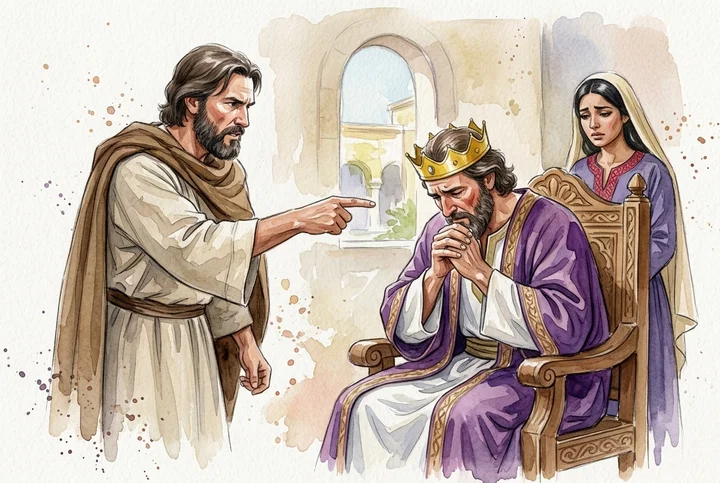
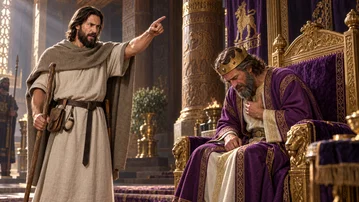
The sentence was spoken by David in anger against the rich man in the story, who had exceeding many flocks and herds yet spared his own flock and herd and took the poor man's single ewe lamb, which he had nourished and which grew up with him and his children, eating of his food and drinking of his cup and lying in his bosom like a daughter, to prepare for a traveler who had come to him.PP 720.5–721.2 Nathan bore that story as God's messenger and as the divinely appointed guardian of the people's rights, to demand redress for wrong and oppression.PP 720.5–721.2Lt 48, 1887, par. 23–24 It was delivered with heaven-born wisdom to engage David's sympathies and arouse his conscience, and Nathan spoke not his own words but God's resolute and sharp message, laying before the king the favors God had bestowed that had been abused and misapplied.PP 720.5–721.2Lt 48, 1887, par. 23–24
Hearing it, David declared that the man who did this thing without pity was worthy to die and must restore the lamb fourfold.Ms 76, 1900, par. 18PP 720.5–721.2SG4 88.2–89.121MR 379.5–6 In passing that judgment he was blind to his own guilt and was unknowingly condemning himself.Lt 19a, 1875, par. 18–24Ms 76, 1900, par. 18ST Aug 12, 1875Lt 57, 1897, par. 13–164MR 185.1–186.2 Nathan's illustration brought him face to face with his wrongdoing and convicted him of his error.ST Aug 12, 1875Lt 57, 1897, par. 13–164MR 185.1–186.2DA 566.4–5 His response showed only flashes of guilt with God's reproof upon his conscience and no heart repentance, until Nathan directly applied the parable to him and identified him as the guilty man, which overwhelmed him.Lt 19a, 1875, par. 18–24Lt 57, 1897, par. 13–16Lt 48, 1887, par. 23–24
The sin behind the parable was David's departure from God, when he yielded himself to the wicked one and for the time became the agent of Satan while still holding the position and authority God had given him.PP 719.2–31SP 378.1–379.1 He used that God-given power contrary to the divine law, stealing Uriah's wife to please himself and thinking only of his pleasure.PP 719.2–31SP 378.1–379.1SG4 86.2–87.1Lt 74, 1886, par. 6 He commanded that Uriah be set in the forefront of the hottest battle, and Joab, whose allegiance was given to the king rather than to God, transgressed God's law because the king had commanded it.PP 719.2–3 The offense thus involved Uriah and Bathsheba and stood exposed as heinous sin that God did not sanction or excuse.1SP 378.1–379.1SG4 86.2–87.1Lt 74, 1886, par. 6
Fourfold Judgment and Fulfillment
The fourfold restoration is the fitting repayment for taking what belonged to another without pity.ST Jun 11, 1896 That standard was later followed when Zaccheus promised to repay fourfold anyone he had defrauded, and his restitution showed genuine repentance and reform.ST Jun 11, 1896 By answering the parable David unwittingly pronounced sentence upon himself and was to be judged by his own sentence.PP 727.1 The fourfold restoration meant that four of his sons must fall, and the loss of each would be a result of the father's sin.PP 727.1
Bitter consequences followed the sin, with evils permitted to rise against him from his own house.1SP 378.1–379.1SG4 88.2–89.1 His sons repeated his wrongdoing, and their crimes brought grief that continually recalled the injustice done to Uriah and Bath-sheba.SG4 88.2–89.1 God did not sanction or excuse the heinous sin but sent reproof with heavy denunciation portraying the offense in living colors.1SP 378.1–379.1SG4 86.2–87.1
Even after repentance and forgiveness punishment remained.1SP 378.1–379.1SG4 86.2–87.1 His life was spared and part of the threatened calamity was averted, yet judgments were inflicted because he had given great occasion to the enemies of the Lord to blaspheme.1SP 378.1–379.1 Violating God's will brings retribution, and David was steadfast while he kept God's Word before him, but turning from its teachings stained his reputation.1SP 378.1–379.121MR 169.1 Past righteousness does not save when the righteous turn from righteousness to do evil, for God does not justify anyone in transgressing His commandments.1SP 378.1–379.1
The guilty course is sin and only sin and is not at all excusable.Lt 74, 1886, par. 6 Responsibility is far greater for those closely connected with the cause of God and entrusted with greater talents of intellect and acquired ability.Lt 74, 1886, par. 6 The offense must not be kept cloaked or left to rest upon the church but must be acted upon.Lt 74, 1886, par. 6 To remain on Satan's ground gives him control to exult and to cause deepest affliction and misery.Lt 74, 1886, par. 6
Conviction, Pardon, and Reform
David had blinded himself to his wrongdoing and excused his own course until the rebuke awakened him to the sense of his sin.1SP 378.1–379.1 Unlike Saul he offered no excuse and did not palliate his guilt, but bowed before the prophet with remorse, sincere grief and humble confession, openly acknowledging his guilt, repenting bitterly and seeking forgiveness from God.1SP 378.1–379.11SP 380.2–381.221MR 379.5–6 He bowed under chastisement as just and merciful rather than resisting reproof, becoming profoundly contrite and humbling himself before God to put his sins away.5T 683.1EDFCP 16.1 He humbly accepted counsel and correction when his true state was faithfully portrayed to him.5T 683.14T 14.3–15.1
Because of that repentance his sin was forgiven, his life was spared, and part of the threatened calamity was averted.1SP 378.1–379.1 He recognized that he had transgressed God's law and relied on the blood of Christ for pardon.Lt 19a, 1875, par. 18–244MR 185.1–186.2 Nathan's faithful exposure helped him recognize his true condition, showing that God's warnings and judgments are meant to lead sinners to repentance and not to despair.5T 683.14T 14.3–15.1
The account shows the deception of sin in hardening the heart, making people quick to see and judge the faults of others while condemning wrongdoing in others and remaining blind to their own, as David condemned the man without pity and declared he must restore the lamb fourfold.Ms 76, 1900, par. 18 Zaccheus followed this instruction by promising to repay fourfold anyone he had defrauded, and his restitution showed genuine repentance and reform as the fitting response to taking what belonged to another without pity.ST Jun 11, 1896 Nathan drew David into judging the rich man who took the poor man's lamb so that David's own sentence exposed his guilt, and in the same way Christ used a parable to lead Simon to judge himself.DA 566.4–5
Sources
Pioneers and periodicals
34 sources
The verse is David's own sentence upon the pitiless rich man in Nathan's parable of the ewe lamb, by which God exposed David's adultery with Bathsheba and murder of Uriah and led David to condemn himself before he knew the story meant him.ST Aug 12, 1875ST Nov 11, 1880RH Jul 1, 1902ST Aug 19, 1880ST Aug 19, 1880 In declaring that the taker must restore the lamb fourfold because he had no pity, David recognized the wrong and named the just penalty he himself deserved to bear.RH Mar 19, 1861RH Apr 3, 1879 That fourfold retribution came upon him through the deaths of four sons, showing that what a man sows he reaps and that his sin against Uriah brought lifelong trouble upon his own house.RH Apr 26, 1870ST Mar 31, 1881ST Nov 29, 1910 God did not excuse David though he was king, but condemned and severely punished him, sparing his life yet leaving the sword and anguish in his house even after he confessed, for forgiveness did not undo the harm set in motion.ST Nov 11, 1880RH Oct 12, 1869RH Jul 1, 1902RH Jul 27, 1869 Brought to humility and heartfelt repentance, David confessed, sought cleansing and a clean heart, and was fully forgiven, so his repentance and the open record of it in Psalm 32 and Psalm 51 remain hope for every sinner, with fitting restitution as in Zaccheus promising fourfold repayment.ST Jun 11, 1896RH Sep 14, 1869ST Sep 10, 1896ST Jul 29, 1889
Parable Setting and Rebuke
The verse belongs to Nathan's parable of the ewe lamb, by which God confronted David over his adultery in the seduction of Bathsheba and his complicity in arranging the death of Uriah.ST Nov 11, 1880ST Apr 29, 1913RH Jul 1, 1902RH Mar 19, 1861 Uriah was a brave and loyal soldier, indeed one of David's most valiant soldiers, whom David plotted to have killed to hide his sin and then had killed, and the parable was given to make David recognize the enormity of that adultery and murder and to show God's abhorrence of those crimes.ST Nov 11, 1880ST May 6, 1897 The full account stands in 2 Samuel 11 and 12, detailing a year of idleness and luxury leading to temptation, the adultery, the plot against Uriah, the carrying out of the plot, reproof by Nathan the Lord's prophet, David's humble repentance, and the Lord's forgiveness.ST Apr 29, 1913 David had been a great sinner who committed a great sin and deserved punishment, and God did not approve, cover, or excuse his conduct but condemned and severely punished it.ST Nov 11, 1880RH Jul 1, 1902RH Mar 19, 1861 God's approval of David applied only to the just and humble things he did, not to this sin, which violated the seventh commandment and was made greater by the far-reaching influence of a king.RH Mar 19, 1861RH Feb 6, 1879ST May 6, 1897 His repentance afterward was bitter and lasting, and he did not afterward return to sin against the marriage law, so his repentance rather than his earlier wrongdoing is the example to follow.RH Feb 6, 1879 The setting belongs to that to which Psalm 51 and Psalm 32 refer, which every sinner may study with profit because all have sinned.
By Nathan's indirect, figurative approach David condemned the rich man in the story for his pitiless offense before realizing the story exposed his own guilt.ST Aug 12, 1875ST Aug 19, 1880ST Aug 19, 1880ST Jun 9, 1881 His response brought his own guilt home to him when Nathan revealed that the story concerned David himself.ST Aug 19, 1880ST Jun 9, 1881RH Apr 1, 1873 The illustration brought David face to face with his wrongdoing and convicted him of his error, bringing the lesson home to his conscience as Jesus did with Simon.ST Aug 12, 1875ST Jun 9, 1881 Thus David passed judgment on himself and on the injustice he had committed without first defending himself.ST Aug 12, 1875ST Aug 19, 1880RH Apr 1, 1873
Nathan plainly and courageously rebuked, reproved, denounced, and warned the king to his face.ST Nov 5, 1885ST Jul 3, 1884RH Apr 23, 1872 That plain rebuke established Nathan as a true prophet.ST Jul 3, 1884 It shows that a holy man or clergy member could denounce wrongdoing by one in power and that the ruler might listen and heed the warning.ST Nov 5, 1885RH Apr 23, 1872
Nathan's rebuke was severe, close, and cutting, yet wisely directed not merely to condemn David but to bring him to see his guilt, save him from ruin, and lead him to genuine repentance.RH Jul 27, 1869RH Dec 22, 1868ST Aug 26, 1875ST May 6, 1897 It brought him to heartfelt repentance and full forgiveness, so that whoever enters heaven will meet David there.ST May 6, 1897 David had fallen far from the tenderness of conscience that once smote him for cutting off a piece of Saul's cloak, for day and night God's hand was heavy upon him until his sin was ever before him.ST May 6, 1897 Pardon requires that heartfelt repentance, proving the plan of salvation cleanses the foulest sinner who repents.ST May 6, 1897 The story still lives nearly three thousand years while David sleeps unconsciously in his grave, repeated by scoffers to bring shame on the Scriptures and held up by faithful teachers to encourage transgressors to hope in God's mercy.ST May 6, 1897
Fourfold Sentence and Retribution
David himself fixed the penalty for the taker of the poor man's lamb, declaring that he must give it back fourfold because he had done this thing and had shown no pity, and in so doing he recognized both the wrong and its just penalty as a sentence he justly deserved and would have to bear in his own case.RH Mar 19, 1861RH Apr 3, 1879RH Jul 27, 1869RH Sep 13, 1906 His judgment on the offender in the parable became a sentence he could justly have faced for his own transgression.RH Apr 3, 1879RH Jul 27, 1869 It was drawn from him by the meaningful figurative story, and he was then spared immediate death but faced trouble and anguish for the rest of his life.RH Apr 3, 1879RH Jul 27, 1869
The fourfold repayment he pronounced fell upon him in the untimely deaths of four sons — the child of Bathsheba, Amnon, Absalom, and Adonijah — showing the severity of the consequence he had pronounced. That sentence of fourfold restitution was thus fulfilled in the loss of four sons.ST Nov 29, 1910
The verse illustrates the law that wrongdoing comes back in its own kind upon the wrongdoer, for what a man sows he reaps and sin pays in its own kind.RH Apr 26, 1870ST Mar 31, 1881 David's wicked conduct toward Uriah brought retribution through all the rest of his life, principally in his own family, seen in the sad history of Amnon and Tamar, in the rebellion and unnatural crimes of Absalom, and even in Adonijah's rebellion and death.RH Apr 26, 1870 He received retribution for his wrongs especially through the troubles in his family, showing that wrongdoing brings consequences like those one has caused others.RH Apr 26, 1870ST Mar 31, 1881
God did not approve, cover up, or excuse David's conduct but condemned and severely punished it.ST Nov 11, 1880RH Oct 12, 1869RH Mar 19, 1861 Although a king and God's chosen instrument, David was a sinful and selfish man, a great sinner subject to the same moral standard and judgment as other people, who committed a great sin and deserved punishment.ST Nov 11, 1880RH Jul 1, 1902ST Mar 11, 1913 By his great wickedness in the case of Uriah he gave great occasion to the enemies of the Lord to blaspheme, and his approval by God applied only to the just and humble things he did, not to this sin.RH Oct 12, 1869RH Mar 19, 1861 The transgression was not hidden but exposed and placed openly on record with a terrible denunciation, and the whole subsequent history shows how completely the judgments that came upon him accomplished it.RH Oct 12, 1869ST Mar 11, 1913
He was declared to face the sword remaining in his house, with the death of the child born from his sin.ST Nov 11, 1880 He was spared immediate death, yet faced trouble and anguish for the rest of his life.ST Nov 11, 1880RH Jul 27, 1869 His sin brought lasting trouble and painful consequences even after he confessed and forsook it, for forgiveness did not erase the harm his evil had set in motion.RH Oct 12, 1869ST Nov 29, 1910
Repentance Forgiveness and Example
The verse stands in the account of David brought to conviction, humility and heartfelt repentance when Nathan's rebuke brought him to see his guilt.RH Sep 14, 1869RH Jul 27, 1869RH Mar 27, 1913 He believed the prophet's word, recognized the enormity of his guilt, humbled himself before God, renounced his sin, confessed it, and turned again to righteousness.RH Sep 14, 1869ST Sep 10, 1896RH Mar 27, 1913 His plea was for mercy, cleansing from sin, a clean heart and renewal by God's Spirit, which belongs to conversion.ST Jul 29, 1889 His great sin was fully forgiven, and afterward he prospered.RH Sep 14, 1869ST Sep 10, 1896
That repentance was bitter, lasting and commendable.RH Feb 6, 1879ST Feb 20, 1879 His willingness to accept reproof and submit to God after flagrant, open wickedness directly contrary to God's command was the test of his loyalty.ST Apr 17, 1907ST Feb 20, 1879 He did not afterward return to sin against the marriage law, so his repentance rather than his earlier wrongdoing is the example to follow.RH Feb 6, 1879
The fourfold repayment is the fitting response to taking what belonged to another without pity.ST Jun 11, 1896 Zaccheus followed this rule when he promised to repay fourfold anyone he had defrauded, and his restitution showed genuine repentance and reform.ST Jun 11, 1896
The transgression was not covered up or excused and the denunciation was placed openly on record rather than hidden.RH Oct 12, 1869ST Mar 11, 1913 David himself placed on record for all future time a most humble confession of his great transgression, confessing to God, publishing it to the world, and praising God for forgiveness received even while still under punishment.RH Oct 12, 1869ST Sep 10, 1896 Although a king and God's chosen instrument, he was a sinful and selfish man subject to the same moral standard and judgment as others, and by his wickedness in the case of Uriah he gave great occasion to the enemies of the Lord to blaspheme.RH Oct 12, 1869ST Mar 11, 1913 The story still lives nearly three thousand years while David sleeps unconsciously in his grave, repeated by scoffers to bring shame on the Scriptures and held up by faithful teachers to encourage transgressors to hope in God's mercy.ST May 6, 1897 It proves the plan of salvation cleanses the foulest sinner who repents with the heartfelt repentance David showed when day and night God's hand was heavy upon him and his sin was ever before him, so that whoever enters heaven will meet David there.ST May 6, 1897
The setting belongs to that to which Psalm 32 and Psalm 51 refer, to be read with the detailed account in 2 Samuel 11 and 12 of idleness and luxury leading to temptation, adultery, plotting to take the life of the brave and loyal Uriah to hide sin, carrying out the plot, reproof, humble repentance and the Lord's forgiveness, together with Nathan's warning and the death of Bathsheba's child.ST Sep 10, 1896 Every sinner may study those psalms with profit because all have sinned. Remembering the yearly atonement ceremonies and their symbols of God's pardoning mercy gave David hope and helped draw him to God in prayer rather than despair.RH Jan 15, 1861 As soon as sin is hated and loathed in the sorrow and disgrace sin brings in Uriah's case, Christ sends the Comforter within to give comfort.ST Apr 10, 1893 By accepting Nathan's rebuke, in which he himself declared the taker of the poor man's lamb must repay fourfold because he acted without pity, David became a more spiritual channel for God's word.RH Sep 13, 1906
Sources