Acts 19:27
So that not only this our craft is in danger to be set at nought; but also that the temple of the great goddess Diana should be despised, and her magnificence should be destroyed, whom all Asia and the world worshippeth.
Translations
So that not only this our craft is in danger to be set at nothing; but also that the temple of the great goddess Diana should be despised, and her magnificence should be destroyed, whom all Asia and the world worships.
So that not only this our craft is in danger to be set at nought; but also that the temple of the great goddess Diana should be despised, and her magnificence should be destroyed, whom all Asia and the world worshippeth.
so that not only this our craft is in danger to be set at nought; but also that the temple of the great goddess Diana should be despised, and her magnificence should be destroyed, whom all Asia and the world worshippeth.
So that not only this our craft is in danger to be set at naught; but also that the temple of the great goddess Diana should be despised, and her magnificence should be destroyed, whom all Asia, and the world worshipeth.
and not only is there danger that this our trade come into disrepute; but also that the temple of the great goddess Diana be made of no account, and that she should even be deposed from her magnificence, whom all Asia and the world worshippeth.
and not only is there danger that this our trade come into disrepute; but also that the temple of the great goddess Diana be made of no account, and that she should even be deposed from her magnificence whom all Asia and the world worshippeth.
and not only is this department in danger for us of coming into disregard, but also, that of the great goddess Artemis the temple is to be reckoned for nothing, and also her greatness is about to be brought down, whom all Asia and the world doth worship.'
Now not only there is danger for us that our business come into discredit, but also that the temple of the great goddess Artemis be counted for nothing, and that her greatness should be destroyed whom the whole of Asia and the world reveres.
And, not only is there danger that this our heritage into ill-repute may come, but even that the temple, of the great Goddess Diana, for nothing, may be counted; also that, even on the point of being pulled down, may be Her Majesty, whom, all Asia and the habitable world, do worship.
Berean Standard Bible, Majority Standard Bible
There is danger not only that our business will fall into disrepute, but also that the temple of the great goddess Artemis will be discredited and her majesty deposed— she who is worshiped by all the province of Asia and the whole world.”
Not only is there danger that this our trade come into disrepute, but also that the temple of the great goddess Artemis will be counted as nothing and her majesty destroyed, whom all Asia and the world worships.”
And there is danger, not only that our trade may be damaged in the opinion of men, but that the holy place of the great goddess Diana may be no longer honoured, and that she to whom all Asia and the world give worship, will be put down from her high position.
So that not onely this thing is dangerous vnto vs, that this our portion shall be reproued, but also that the temple of the great goddesse Diana should be nothing esteemed, and that it would come to passe that her magnificence, which all Asia and the world worshippeth, should be destroyed.
Douay-Rheims (Challoner revision)
So that not only this our craft is in danger to be set at nought, but also the temple of great Diana shall be reputed for nothing; yea, and her majesty shall begin to be destroyed, whom all Asia and the world worshippeth.
Pictures
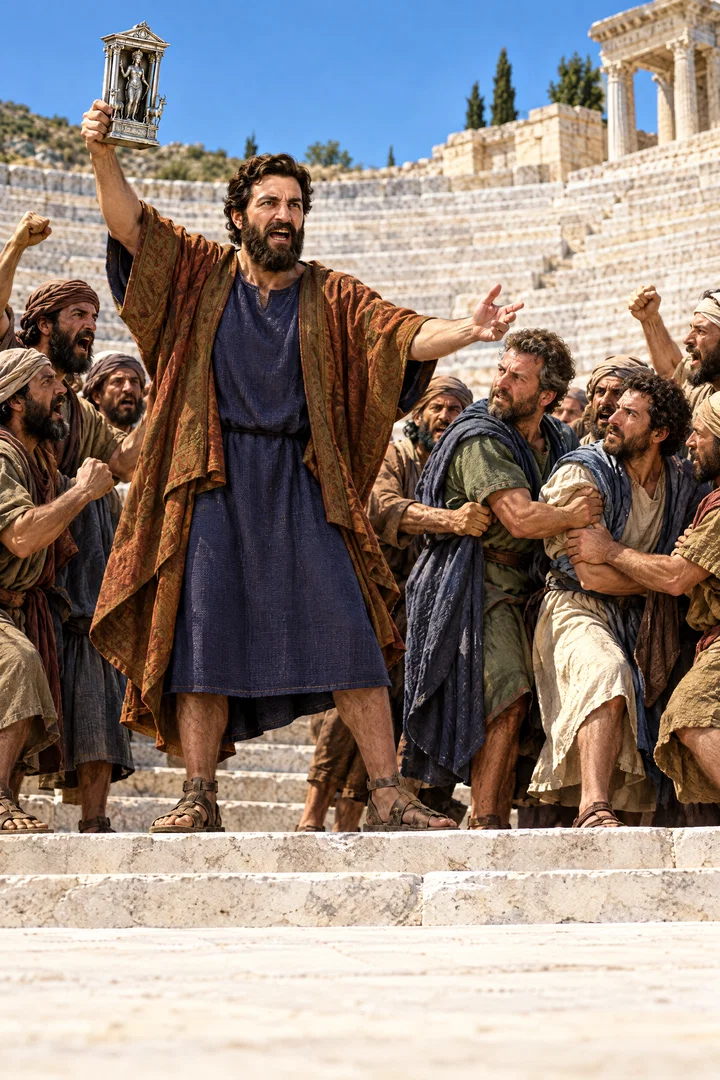
Cross-references
- Acts 19:9-10
But when divers were hardened, and believed not, but spake evil of that way before the multitude, he departed from them, and separated the disciples, disputing daily in the school of one Tyrannus.
Paul’s teaching in Ephesus spread the gospel and challenged Diana worship.
- Acts 19:10
And this continued by the space of two years; so that all they which dwelt in Asia heard the word of the Lord Jesus, both Jews and Greeks.
Paul’s work in Ephesus brought the word throughout Asia.
- Acts 20:1
And after the uproar was ceased, Paul called unto him the disciples, and embraced them, and departed for to go into Macedonia.
Paul left Ephesus after the uproar.
- Acts 19:35
And when the townclerk had appeased the people, he said, Ye men of Ephesus, what man is there that knoweth not how that the city of the Ephesians is a worshipper of the great goddess Diana, and of the image which fell down from Jupiter?
Both mention Diana’s image fallen from Jupiter.
- Revelation 2:1
Unto the angel of the church of Ephesus write; These things saith he that holdeth the seven stars in his right hand, who walketh in the midst of the seven golden candlesticks;
The message is addressed to the church in Ephesus.
- Acts 19:17-20
And this was known to all the Jews and Greeks also dwelling at Ephesus; and fear fell on them all, and the name of the Lord Jesus was magnified.
gospel success threatened shrine trade
- Acts 19:37
For ye have brought hither these men, which are neither robbers of churches, nor yet blasphemers of your goddess.
Paul’s companions neither robbed temples nor blasphemed Diana.
- Acts 19:13-16
Then certain of the vagabond Jews, exorcists, took upon them to call over them which had evil spirits the name of the Lord Jesus, saying, We adjure you by Jesus whom Paul preacheth.
earlier defeat turned back on opponents
- 1 Corinthians 16:8
But I will tarry at Ephesus until Pentecost.
decision to remain in Ephesus until after Pentecost
Commentary
Each commentary is drawn from primary sources: the writings of Ellen G. White and Adventist pioneers and periodicals. Each commentary is separate. Its own words are not a quotation; follow the references to read the source passages.
Ellen G. White
13 sources
Demetrius the silversmith warned his fellow workmen that Paul's teaching that gods made with hands are no gods had turned away many people not only at Ephesus but almost throughout all Asia, putting both their profitable trade in shrines in danger of losing all value and the temple of Diana in danger of being despised and stripped of her magnificence.SLP 142.2RH Sep 14, 1911AA 292.2–3 This came at the close of over three years of work centered in Ephesus that raised up a flourishing church and spread the gospel through the province, just as Paul planned to leave for Macedonia and Jerusalem and Rome, and during the yearly festival of Diana when falling attendance and waning enthusiasm showed that many had lost confidence in the heathen gods.AA 291.1–2AA 291.3–292.1 The threatened loss of wealth from making and selling small shrines and images was the real cause of the uproar, while danger to Diana's temple and worship was the public cause used to rouse the crowd to cry out for Diana of the Ephesians.SLP 146.1RH Sep 14, 1911AA 295.1–2 The craft at stake was the widespread making of portable models of the temple and image to be carried and worshiped, on which the makers' livelihood and honor depended.SLP 141.1SLP 142.1 The temple at stake was the great temple at Ephesus, a wonder of the world for its size and splendor and a source of civic pride and wealth, housing an uncouth wooden idol, whose worship extended through Asia and the wider world and was imitated in grand buildings elsewhere.ST May 18, 1882SLP 134.2–4Lt 109, 1886, par. 2
Setting and Uproar at Ephesus
The saying belongs to the close of more than three years of labor centered at Ephesus, where a flourishing church had been raised up and from which the gospel had spread throughout the province of Asia among both Jews and Gentiles.AA 291.1–2 At that time Paul had purposed in spirit, after passing through Macedonia and Achaia, to go to Jerusalem and afterward to see Rome, and he had sent Timothy and Erastus on into Macedonia while deciding himself to remain at Ephesus until after Pentecost, until an event hastened his departure.AA 291.1–2
The crisis broke during the yearly festival in honor of Diana, which drew great crowds from all parts of the province with utmost pomp and splendor.AA 291.3–292.1 Labor carried on from the school of Tyrannus had given heathen worship a telling blow, producing a perceptible falling off in attendance at the national festival and in the enthusiasm of the worshipers.AA 291.3–292.1 Its influence reached far beyond actual converts, enlightening many who had not openly accepted the new teaching until they lost all confidence in their heathen gods.AA 291.3–292.1 The company of believers thus stood as an inharmonious note in the festive chorus, and the gala season became a trying time of ridicule, reproach, and insult for those newly come to the faith.AA 291.3–292.1
The words are the warning of Demetrius, a maker of silver shrines, to the workmen of his craft, reminding them that their wealth came from this business.AA 292.2–3 An extensive and profitable trade had grown up at Ephesus from making and selling small shrines and images modeled after the temple and the image of Diana, and gains were diminishing because of Paul's labors.SLP 142.2RH Sep 14, 1911AA 292.2–3 Demetrius charged that Paul, by saying that gods made with hands are no gods, had persuaded and turned away much people, not only at Ephesus but almost throughout all Asia.SLP 142.2AA 292.2–3 He warned that not only was their trade in danger of losing all value, but the temple of the great goddess Diana would be despised and her magnificence destroyed, though she was worshiped throughout Asia and the wider world.SLP 142.2RH Sep 14, 1911AA 292.2–3 His words roused the excitable passions of the people to wrath, until they cried out, Great is Diana of the Ephesians.AA 292.2–3
The threatened loss of profit was the real cause of the tumult, while danger to Diana's temple and worship was the public cause invoked.SLP 146.1RH Sep 14, 1911AA 295.1–2 The spread of the gospel threatened the income drawn by image-makers and pagan priests from the profitable making and selling of idols, so the craftsmen stirred bitter opposition against Paul.SLP 146.1RH Sep 14, 1911AA 295.1–2 They would not receive or examine the gospel that could have made them wise unto salvation.SLP 146.1
Craft, Temple, and Worship
The danger to the craft was danger to a widespread livelihood of making and selling portable images and small models of Diana's temple, which were carried in processions and on journeys and treated as objects of worship.SLP 142.1 The makers feared both the loss of their trade and the loss of honor for Diana and her temple, because their income was bound up with preserving her worship and reputation.SLP 141.1SLP 142.1 That fear was sharpened by the breadth of her devotion, which extended throughout Asia and beyond into the wider world, so that any dishonor to her greatness threatened ruin on a large scale.SLP 141.1SLP 142.1 Paul's teaching that gods made with hands are no gods struck directly at this business, persuading people to despise the temple and its splendor.SLP 142.1
The temple in danger of being despised was the great temple of Diana at Ephesus, central to the city and to its civic and national pride.ST May 18, 1882SLP 134.2–4 Its vast size and splendor made it a repository for much of the wealth of Western Asia and caused it to be regarded as one of the wonders of the world.ST May 18, 1882SLP 134.2–4 The city's devotion to Diana and to her temple shaped its reputation.SLP 134.2–4 The idol itself, in contrast to that magnificence, was an uncouth wooden image marked with symbols believed to have magical power.ST May 18, 1882
The magnificence said to be worshiped by all Asia and the world belonged to a grand pre-Christian building devoted to Diana that was imitated in other places.Lt 109, 1886, par. 2 Among those imitations was a large, immense temple of Diana at Nimes, now standing partially torn down.Lt 109, 1886, par. 2 Its worship involved marble statuary and Roman masonry, baths and inscriptions, with statues of the goddess with her family and others set on an island formed by a pure bubbling spring.Lt 109, 1886, par. 2
Sources
Pioneers and periodicals
54 sources
Demetrius warned the craftsmen that Paul's preaching endangered both their idol-making trade and the honor of Diana's temple and greatness, which were in danger of being brought into contempt and destroyed.ST Feb 17, 1898ST Feb 17, 1898ST Aug 12, 1897 Paul had turned away many people in Ephesus and throughout Asia by teaching that gods made with hands are no gods and by proclaiming Christ, thus dethroning idols in hearts and lessening the demand for shrines.ST Feb 17, 1898ST Mar 4, 1903 The real cause of the uproar was threatened profit from making and selling silver shrines, while zeal for Diana's widespread worship was the public plea used to stir the people.RH Sep 14, 1911RH May 12, 1868 The gospel overthrows idolatry wherever it is believed, as believing Ephesians forsook and destroyed their idolatrous possessions, and Diana's famed temple and worship afterward perished while the word of God triumphed and spread through the world.ST Nov 14, 1878ST Jul 7, 1909ST Dec 14, 1904 The same pattern appears when Sabbath truth threatens Sunday, the great goddess of Christendom, and those whose livelihood and influence depend on religious custom oppose it to preserve their craft.RH Mar 31, 1859RH May 12, 1868ST Jun 24, 1889RH Oct 9, 1860RH Jul 28, 1859
Speech and Setting
Demetrius spoke to the assembled craftsmen to warn them of two dangers arising from Paul's preaching: their craft was in danger of coming into disrepute and being set at nought, and the temple of the great goddess Diana was in danger of being made of no account and despised, with Diana herself deposed from her magnificence and destroyed.ST Feb 17, 1898ST Feb 17, 1898ST Aug 12, 1897ST Jun 9, 1898ST Aug 12, 1897 The temple might come to be regarded as worthless, and the goddess's celebrated greatness and magnificence might be brought down and brought into contempt.ST Feb 17, 1898ST Aug 12, 1897ST Jun 9, 1898ST Jan 23, 1907 Their appeal to Diana's honor served to defend their economic interests and to oppose the converts' departure from idolatry.ST Jan 23, 1907
The cause was Paul persuading and turning away much people, not only at Ephesus but almost throughout all Asia, by saying that gods made with hands are no gods.ST Feb 17, 1898ST Mar 4, 1903 He proclaimed Christ as the Way of Life, and that truth dethroned idols in the hearts of the people, reducing the demand for idols and putting the idol-making trade at risk.ST Aug 12, 1897 The claim that Diana was worshiped by all Asia and the world describes the broad reach of her cult, where all Asia means the Roman province of Asia Minor known by that name.ST Mar 4, 1903ST Mar 4, 1903RH Jul 6, 1868ST Aug 12, 1897 The claim presents widespread custom, rather than a reasoned defense of her worship, as support for it.
The craft in danger was making silver shrines of Diana, small models of her temple containing an image of the goddess.ST Jul 24, 1893ST Aug 12, 1897 They were bought by pilgrims to the temple and set up in homes as objects of worship, and were often small enough to be carried on the person as charms believed to avert disease and other dangers.ST Aug 12, 1897 This happened about the time Paul sent Timothy and Erastus into Macedonia while he remained at Ephesus: Demetrius, a silversmith who made the shrines, gathered the trade union of silversmiths and denounced Paul and his religion.ST Jul 24, 1893 Great wrath was aroused, the city was filled with confusion, and all rushed to the theater, most not knowing why, where the town clerk quieted them and told Demetrius to appeal in a regular way to the courts.ST Jul 24, 1893 Paul himself had no direct contention with the craftsmen and was scarcely in danger, although Gaius and Aristarchus were endangered, and the tumult is the setting for his description of his conflict at Ephesus as fighting with beasts, understood metaphorically as fierce pagan opponents rather than literal animals.RH Dec 3, 1867RH Dec 3, 1867
Temple Splendor and Fate
The temple at Ephesus, also called that of Artemis, was famed for splendor and counted among the seven wonders of the ancient world.ST Mar 4, 1903ST Mar 4, 1903ST Nov 29, 1910ST Aug 12, 1897ST Oct 4, 1883 Standing at the head of the harbor, the glittering structure was the first thing that met the mariner's gaze.ST Aug 12, 1897 It was built with contributions from across Asia Minor and drew worshippers from many parts of the earth.ST Oct 4, 1883
It was made of polished marble, beautifully carved, and adorned with expensive statuary and painting, and was said to be more magnificent than anything the sun saw in all his course.ST Mar 4, 1903ST Aug 12, 1897 It was 425 feet long and 200 feet broad, with marble columns 60 feet high, 36 of them magnificently carved.ST Aug 12, 1897 Its porticoes contained 127 columns, each the gift of a king, and its halls were adorned with wonderful statuary and paintings.ST Aug 12, 1897 Donations had made it a storehouse of much of Western Asia's wealth.ST Jun 4, 1885
Its size and magnificence made it a source of civic and national pride, which explains why the temple's reputation and the worship of Diana mattered so greatly in Ephesus.ST May 18, 1882ST Jun 4, 1885 The ruins of the great temple remain as evidence of the city's former power and grandeur.
The image inside was regarded as of peculiar sanctity and was believed to have fallen down from Jupiter.ST Aug 12, 1897 Yet it was an uncouth wooden image marked with symbols believed to have magical power.ST May 18, 1882
Diana's temple and worship later disappeared, while the religion of Jesus spread throughout the world, a contrast showing God's power and the enduring stability of his religion.ST Nov 14, 1878 The word of God triumphed at Ephesus notwithstanding persecution, showing how wonderfully God worked in that place.ST Jul 7, 1909 The temple, a place of great magnificence worshiped by people across Asia and the world, was destroyed during a Gothic naval expedition around A.D. 260.ST Sep 16, 1886 The worship of Diana has since ceased.ST Jul 29, 1897
Selfish Motive for Opposition
The silversmiths' chief anxiety was for their profitable idol-making trade and income, which Paul's teaching that gods made with hands are no gods threatened by turning people away and reducing demand for shrines.RH Sep 14, 1911RH May 12, 1868ST Feb 17, 1898 Concern for Diana's reputation, temple and honor was secondary, raised as a public cause to win the wider people to the attack on Paul.RH Sep 14, 1911ST Feb 17, 1898 Demetrius framed the threat to his own business as a threat to Diana's temple and magnificence, claiming she was worshiped throughout Asia and the world, and his appeal to religious zeal stirred the people against the truth because accepting it would undermine the business that made him money.RH May 12, 1868
The danger to Diana's temple and worship being brought into contempt was the cause invoked in public, but the threatened livelihood of the artisans and pagan priests who made and sold idols was the real cause of the tumult.RH Sep 14, 1911ST Jan 23, 1907 The gospel threatened that income, and this threat produced much of the opposition the apostles faced, for those whose livelihood depended on pagan worship resisted the gospel rather than investigating it, though it could make them wise unto salvation.RH Sep 14, 1911 Their appeal to Diana's honor served to defend economic interests and to oppose the converts' departure from idolatry, so that religious outrage was bound up with the loss of profitable business.ST Jan 23, 1907RH Aug 14, 1866ST Jan 22, 1885
The same selfish motive still opposes truth whenever reform threatens interests.ST Mar 4, 1903ST Mar 4, 1903ST Jan 22, 1885 Demands by professed Christians for Sunday laws rest on fear that those who do not close their places of business will secure some of the trade of those who do, just as the craftsmen opposed Paul because his work interfered with their wealth from making and selling shrines.ST Mar 4, 1903ST Mar 4, 1903 Those who profit from an evil defend it when reform threatens their interests.ST Jan 22, 1885
The verse shows how people whose income depends on religious customs use public devotion and fear of losing those customs to oppose truth.RH Jul 6, 1868RH May 12, 1868RH May 12, 1868 They stir religious zeal against the message because accepting that handmade images are not gods, or accepting the seventh-day Sabbath, would undermine popular religious traditions and the business they support, and calling the first day the Christian Sabbath does not make it the biblical Sabbath.RH May 12, 1868RH May 12, 1868 The threat to the craft was bound up with opposition to the message that challenged Diana's worship and the honor of her temple, whose widespread cult carried great economic and civic importance throughout Asia and the world.RH Jul 6, 1868ST Jul 1, 1880 So general was devotion to Diana that the difficulty of gaining an attentive hearing for the Word among her worshipers compares with the modern world's pursuit of philosophy.RH Feb 22, 1912
Identity of Diana
Diana is the moon goddess, honored widely in Asia and beyond, and is also the goddess of the sun, the sun-god himself.ST Aug 12, 1897ST Sep 2, 1913 Her worship is nature worship and belongs to the great system of sun-worship.ST Aug 12, 1897 The call to bow at the feet of the sun-god went out then as it still goes out now, setting up a continuing conflict between Diana and Christ.ST Sep 2, 1913
The Ephesian Diana is not to be identified with the Grecian Artemis, although the later Greeks clothed her with some of the same attributes.ST Aug 12, 1897 Her worship was accompanied by detestable and lascivious dances in which her devotees strove to madden the multitude into sympathy with an orgiastic worship connected with the vilest debaucheries.ST Aug 12, 1897 She is the patroness of lewdness, obscenity and adultery, whose worshipers rioted in licentiousness and every kindred abomination and whose festivals were dedicated to lasciviousness and uncleanness.ST Aug 12, 1897ST Apr 22, 1889
She belongs to the same cult and character as Semiramis, wife of Nimrod, who was among the early worshiped goddesses, and is one with the queen of heaven, Venus, and the other goddesses of that same worship.ST Mar 4, 1913 She is one name for the one great goddess of sensual love worshiped with entire unanimity by all ancient pagans under many names, as Astarte by Babylonians and Phoenicians, Isis by Egyptians, Aphrodite by Greeks, Venus, Flora and Ceres by Romans, Ashtaroth by Jews and Zidonians, and Eostre or Easter by pagan English ancestors and Saxons.ST Apr 22, 1889 Her Saxon name Easter was adopted by the Roman Church and applied to the Pascha of the early Christians, making that festival pagan in origin and character.ST Apr 22, 1889
Her temple at Ephesus, renowned for cost and magnificence, exemplifies Satan supporting pagan worship with wonders, as he does for Spiritualism, and her altar is one of the religious systems he established through deception.RH Jul 28, 1868RH Jul 28, 1868 Her worship and the Christian gospel are distinct, not partners in religious instruction.RH Jul 30, 1914 Paul’s preaching at Ephesus, seen as a threat to the trade in her images and to her temple and public honor, illustrates his refusal to honor idolatrous faiths alongside Christ and his insistence on exalting Christ alone.RH Jul 30, 1914ST Nov 13, 1893
Gospel Teaching and Doctrine
The gospel overthrows idol worship wherever it is believed, as the believing Ephesians proved by burning their books of magic.ST Dec 14, 1904 True conversion always does the same, causing anyone possessed of idols to give up and destroy idolatrous possessions rather than keep them, gaining by the loss.ST Dec 14, 1904
Paul kept the faith at Ephesus by pointing his hearers away from Diana and to Jesus Christ as their only Saviour.RH Aug 10, 1876 Devotion to Diana was so widespread that her worshippers feared both the loss of their trade and dishonor to her temple and greatness, and that devotion shows how difficult it was for the Word to gain an attentive hearing among them.RH Feb 22, 1912 The same hindrance is compared to the modern world's pursuit of philosophy.RH Feb 22, 1912 The tumult raised over the threatened trade in Diana's shrines and the possible discrediting of the goddess and her temple is the setting for Paul's description of his conflict at Ephesus as fighting with beasts.RH Dec 3, 1867 The beasts are fierce pagan opponents understood metaphorically rather than literal animals.RH Dec 3, 1867
The Ephesian account does not clearly prove that all who were baptized unto John's baptism were rebaptized by the apostles.ST Jun 3, 1880 The men there were an unusual case who answered Paul that they had not so much as heard whether there be any Holy Ghost.ST Jun 3, 1880 They had not been baptized by John himself but by some of his followers, and had not received John's full instruction about Christ and the Holy Ghost, so they were not even well-instructed disciples of John and Paul rightly began with them as novices.ST Jun 3, 1880 Yet the account does prove it is right to rebaptize those whose first baptism did not meet the requirements of the gospel rite.ST Jun 3, 1880 The worship of Diana has since ceased, but lifeless religious formalism is just as bad.ST Jul 29, 1897 Attachment to Diana could persist alongside outward participation in Christian worship, as when young men could attend Christian meetings while thinking about her throughout the service.RH Jun 30, 1863
Present Application
As Demetrius feared that Paul's teaching would bring Diana into contempt, so opposition to Sabbath preaching fears that teaching the Sabbath will bring the church to nothing and make Sunday, the great goddess of Christendom, despised.RH Mar 31, 1859RH May 12, 1868 Public teaching that the Sabbath was not changed and working on Sunday as a workday are taken as threatening Sunday's religious prestige, influence and magnificence, as Paul's gospel threatened Diana's standing and her magnificence destroyed.RH May 12, 1868ST Jun 24, 1889 Calling the first day the Christian Sabbath does not make it the biblical Sabbath, and those who profit from popular religious tradition resist the teaching of the seventh-day Sabbath by appealing to public devotion and fear of losing long-honored custom.RH May 12, 1868
Sunday stands as a rallying center of apostasy drawing people across nations toward a common religious observance, as Diana's temple and magnificence were matters feared to be diminished when her worship was described as worldwide.ST Nov 6, 1893 The message against religious systems, especially the third angel's message, challenges the influence and splendor of organized religious systems as Paul's message threatened Diana, bringing their forms of worship into disrepute and threatening the livelihood of their leaders.ST Nov 6, 1893 Supporters whose livelihood is threatened by that message stir up opposition, following the pattern of Demetrius's protest.
When truth spreads a threatened religious craft is defended, as ministers troubled over Sabbath teaching show concern for professional influence and livelihood.RH Jul 28, 1859RH Mar 11, 1862 A Baptist elder with eight members leaving at once had his ministerial craft in danger, and this explains angry attack on the teaching that the Sabbath began at creation.RH Oct 9, 1860 A pastor concerned that his church was losing members acts from the same fear, and sectarians troubled lest Sabbath preaching undermine their influence warn their congregations against hearing it.RH Feb 14, 1856RH Mar 11, 1862
The unsectarian spirit that seeks success by avoiding offense and softening conviction is the present great goddess Diana, whose interests are threatened when truth is preached openly. Bold, uncompromising preaching exposes and challenges that powerful religious influence.
The modern Demetrius appears where a priest opposes exposure of purgatory and other teachings because it threatens his traffic in souls, as shrine-making was threatened by preaching of truth.RH May 5, 1903 A church party seeking to preserve its religious influence acts as the Ephesian craftsmen did in defending Diana, yet opposition need not prevent a church from being established.RH Jul 30, 1908 Religious commerce crowded around a shrine, as at Loreto, presents the same setting, where a second Paul preaching the simple gospel would provoke an uproar among sellers of religious goods whose trade in images would be undermined and brought into contempt.ST Apr 1, 1886RH May 5, 1903
Worship of Diana meant burning a few grains of incense upon the flame, a small act that rejected Christ and put Diana in His place.ST Sep 2, 1913ST Jan 30, 1896 Her honor throughout Asia and the Roman world, with temple and magnificence regarded as powerful, made refusal to offer even one grain a stand against the religious custom of the crowd.ST Jan 25, 1899ST Sep 2, 1913 A maiden choosing worship of Jesus rather than compromise, even at cost of life, and the pictured test of casting a grain of incense, set loyalty to Christ against loyalty to Diana.ST Jan 25, 1899ST Jan 30, 1896 Only a few then were brave and bold for God's word while pagan Rome killed with flame and sword, and the same call to bow at the feet of the sun-god still goes out now, so the conflict between Diana and Christ goes on until the battle is soon forever won.ST Sep 2, 1913
The picture of widespread devotion to Diana rebukes fallen churches whose desire to attract people through fashion, eloquence and worldly display mirrors Diana's influence.RH Jun 30, 1863 Fear for the honor of Diana's worship and the magnificence of her temple was used to defend the trade connected with her cult, and adoption of heathen worship and imagery in Christian practice repeats that incorporation.RH Jun 30, 1863 A Christian journal's Easter picture resembling Diana is thus the bringing of Diana's worship into nominal Christianity.
Sources