Acts 4:36
And Joses, who by the apostles was surnamed Barnabas, ( which is, being interpreted, The son of consolation,) a Levite, and of the country of Cyprus,
Translations
American King James Version, KJV Cambridge Paragraph Bible, Webster Bible
And Joses, who by the apostles was surnamed Barnabas, (which is, being interpreted, The son of consolation,) a Levite, and of the country of Cyprus,
And Joses, who by the apostles was surnamed Barnabas, ( which is, being interpreted, The son of consolation,) a Levite, and of the country of Cyprus,
Revised Version, American Standard Version
And Joseph, who by the apostles was surnamed Barnabas ( which is, being interpreted, Son of exhortation), a Levite, a man of Cyprus by race,
And Joses, who was surnamed by the apostles Barnabas — which is, having been interpreted, Son of Comfort — a Levite, of Cyprus by birth,
And Joseph, who had been surnamed Barnabas by the apostles ( which is, being interpreted, Son of consolation), a Levite, Cyprian by birth,
And, Joseph, who had been surnamed Barnabas by the Apostles, which is to be translated Son of Exhortation,—a Levite, a Cyprian by nation,
Joseph, a Levite from Cyprus, whom the apostles called Barnabas (meaning Son of Encouragement),
Joses, a Levite from Cyprus, whom the apostles called Barnabas (meaning Son of Encouragement),
Joses, who by the apostles was also called Barnabas ( which is, being interpreted, Son of Encouragement), a Levite, a man of Cyprus by race,
And Joseph, who was given by the Apostles the name of Barnabas ( the sense of which is, Son of comfort), a Levite and a man of Cyprus by birth,
Also Ioses which was called of the Apostles, Barnabas (that is by interpretation the sonne of consolation) being a Leuite, and of the countrey of Cyprus,
Douay-Rheims (Challoner revision)
And Joseph, who, by the apostles, was surnamed Barnabas, ( which is, by interpretation, The son of consolation,) a Levite, a Cyprian born,
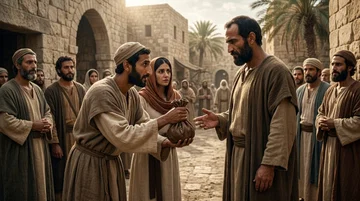
Pictures

Cross-references
- Acts 2:44-45
And all that believed were together, and had all things common;
Believers shared possessions to meet one another’s needs.
- Acts 11:29-30
Then the disciples, every man according to his ability, determined to send relief unto the brethren which dwelt in Judæa:
Barnabas carried relief to believers in Judea during a famine.
- Acts 13:1-2
Now there were in the church that was at Antioch certain prophets and teachers; as Barnabas, and Simeon that was called Niger, and Lucius of Cyrene, and Manaen, which had been brought up with Herod the tetrarch, and Saul.
Barnabas is named among the prophets and teachers, and the Holy Spirit sets him apart for mission.
- Acts 9:27
But Barnabas took him, and brought him to the apostles, and declared unto them how he had seen the Lord in the way, and that he had spoken to him, and how he had preached boldly at Damascus in the name of Jesus.
Barnabas brings Paul to the apostles and testifies for him.
- Acts 5:1-2
But a certain man named Ananias, with Sapphira his wife, sold a possession,
Ananias and Sapphira’s deceptive gift is contrasted with Barnabas’s deed.
- Acts 15:39
And the contention was so sharp between them, that they departed asunder one from the other: and so Barnabas took Mark, and sailed unto Cyprus;
Barnabas separates from Paul and sails to Cyprus with Mark.
- Acts 11:19-20
Now they which were scattered abroad upon the persecution that arose about Stephen travelled as far as Phenice, and Cyprus, and Antioch, preaching the word to none but unto the Jews only.
Believers from Cyprus carried the gospel to Antioch after Stephen’s death.
- Acts 4:32
And the multitude of them that believed were of one heart and of one soul: neither said any of them that ought of the things which he possessed was his own; but they had all things common.
Their shared possessions reflect the believers’ unity of heart.
- Acts 11:22-26
Then tidings of these things came unto the ears of the church which was in Jerusalem: and they sent forth Barnabas, that he should go as far as Antioch.
Barnabas is sent to Antioch, where he seeks Saul and they teach together.
- Acts 13:4
So they, being sent forth by the Holy Ghost, departed unto Seleucia; and from thence they sailed to Cyprus.
Barnabas and the missionary company begin their work on Cyprus.
- 1 Corinthians 9:6
Or I only and Barnabas, have not we power to forbear working?
Barnabas is named as a worker who labored to support himself.
- Acts 5:4
Whiles it remained, was it not thine own? and after it was sold, was it not in thine own power? why hast thou conceived this thing in thine heart? thou hast not lied unto men, but unto God.
Peter says the property and its proceeds remained theirs to give or keep.
- Acts 6:5
And the saying pleased the whole multitude: and they chose Stephen, a man full of faith and of the Holy Ghost, and Philip, and Prochorus, and Nicanor, and Timon, and Parmenas, and Nicolas a proselyte of Antioch:
Barnabas and the seven are named among the early church’s servants.
- Ezra 7:13
I make a decree, that all they of the people of Israel, and of his priests and Levites, in my realm, which are minded of their own freewill to go up to Jerusalem, go with thee.
Artaxerxes’ decree included Levites among those free to return to Jerusalem.
Commentary
Each commentary is drawn from primary sources: the writings of Ellen G. White and Adventist pioneers and periodicals. Each commentary is separate. Its own words are not a quotation; follow the references to read the source passages.
Ellen G. White
11 sources
The verse identifies Joses as a Levite from the country of Cyprus who owned land, whom the apostles surnamed Barnabas, which being interpreted is son of consolation.7RED 19.3–20.1AC1 19.3–20.23SP 283.1–284.1RH Feb 2, 1911 Together with the next verse it presents him as an example of noble benevolence, in that he sold his land and laid the money at the apostles' feet.7RED 19.3–20.1AC1 19.3–20.2RH Feb 2, 1911 That gift was to house and feed the many converts at Jerusalem who had been cut off from family, business, and homes for following Christ, and to meet the needs of believers in need.7RED 19.3–20.1AC1 19.3–20.2RH Feb 2, 1911
His act was the effect of the pouring out of the Spirit of God, which made believers of one heart and soul with one common interest in the success of their mission.7RED 19.3–20.13SP 283.1–284.1RH Feb 2, 1911 It showed a Spirit-filled and Spirit-inspired love for brethren and for Christ and for the cause and gospel mission they had espoused, a love far greater than love for money and possessions and earthly inheritance.7RED 19.3–20.13SP 283.1–284.1RH Feb 2, 1911 In acting out faith in this way they testified that they counted the souls of men of far greater value than any earthly heritage, sacrificing possessions for the needs of others and the work of the mission.7RED 19.3–20.13SP 283.1–284.1
His generous use of his resources to support Christ's cause and work, to help the poor, and to sacrifice possessions for the needs of others and the work of the mission shows him acting in keeping with the name son of consolation.3SP 283.1–284.1SLP 36.23SP 320.3–321.1AC1 52.2 His encouragement of Paul by bringing him to the apostles and affirming his testimony further shows him acting in keeping with that name.3SP 320.3–321.1 Its description of him as a native of Cyprus explains why he and Paul later visited that island on their first missionary journey.AA 166.1–2
The verse belongs to the account of believers giving their property to support the church, showing the contrast between those moved by the Holy Spirit to give all they had and Ananias and Sapphira, who falsely claimed to have given all while keeping part back.Lt 232, 1899, par. 26–28 The title son of consolation means a person who brings comfort and encouragement.Lt 123, 1899, par. 11Ms 187, 1899, par. 4 It applies to workers whose work is to carry a message to the sorrowing, disappointed, and brokenhearted, with God's angels with them.Lt 123, 1899, par. 11Ms 187, 1899, par. 4 The church's work includes such sons of consolation alongside those who bear sharp, strong messages, with different gifts serving its varied work while the third angel's message must still be proclaimed.Ms 187, 1899, par. 4
Sources
Pioneers and periodicals
41 sources
The verse introduces Joses, also called Joseph, a Levite born in Cyprus whom the apostles surnamed Barnabas.RH Feb 20, 1855ST Jan 15, 1885RH Nov 20, 1856 His new name means son of consolation and son of exhortation.RH Feb 20, 1855ST Jan 15, 1885RH Nov 20, 1856 He lived among the believers just after Pentecost when they were of one heart and soul, holding all things in common and laying the price of sold lands and houses at the apostles' feet for distribution to each as needed.RH Feb 10, 1916RH Apr 15, 1909RH Aug 17, 1916ST Jan 21, 1897RH Mar 13, 1900 Barnabas sold his own field and brought the whole price in voluntary, Spirit-prompted love for Christ's cause, in contrast to Ananias and Sapphira who kept back part while pretending to give all.RH Feb 20, 1855RH Nov 20, 1856ST Aug 5, 1889ST Jan 29, 1908 That early liberality spent the resources of the Jerusalem believers and left them poor, so that later relief from other churches became necessary.RH Nov 29, 1864RH Feb 3, 1859RH Jun 9, 1859 His example teaches voluntary stewardship and self-denying liberality for mission, rebuking present coldness and calling believers to give means and self with apostolic earnestness.ST Jan 1, 1885ST Jul 29, 1913RH Aug 19, 1873RH Nov 4, 1873
Names and Homeland
The man is Joses, also called Joseph, a Levite of the country of Cyprus whom the apostles surnamed Barnabas.RH Feb 20, 1855ST Jan 15, 1885RH Nov 20, 1856ST Aug 5, 1889 The naming belongs with the next verse, where having land he sold it and brought the money and laid it at the apostles' feet for distribution to those in need, for the support of the church's shared needs through a common treasury in orderly administration.RH Feb 20, 1855RH Nov 20, 1856ST Aug 5, 1889RH Apr 15, 1909 Barnabas being interpreted is son of consolation, and also son of exhortation.RH Feb 20, 1855ST Jan 15, 1885RH Nov 20, 1856ST Aug 5, 1889 That meaning denotes his excellence as a Christian teacher, so that in a later listing of teachers his name appears before Paul's.ST Jan 15, 1885RH Apr 15, 1909
The name is also rendered son of prophesying, illustrating that prophecy brings consolation to wandering souls in distress.ST Jan 15, 1885RH May 11, 1911 It marks one especially suited to comfort the afflicted, fitting him because he brought consolation to the young Jerusalem church in a crisis.RH Feb 2, 1864ST Jul 16, 1902 It likewise illustrates how one who has suffered and been comforted can cheer others with words that comfort.ST Jan 2, 1901
The name pictures how mourning for sin brings comfort, peace and spiritual joy, as if the soul gives birth to a Barnabas.RH Mar 12, 1857 Through God's mercy a redeemed sinner thus becomes a messenger of mercy and comfort to those within reach.RH Jan 31, 1871
His designation as a Levite shows tribal identity was still known after Christ's resurrection and ascension.RH Aug 26, 1902 It also shows Israelites lived outside their ancestral territories in the New Testament era.ST Mar 26, 1894 His being a native of Cyprus helps explain why the missionary company went first to that island, where he may have had influential acquaintances.ST Mar 6, 1884
Pentecostal Church Setting
Acts 4:36 belongs just after Pentecost, when after putting away all differences and selfishness and continuing in united humble prayer until they became of one accord, the disciples were filled with the Holy Spirit in fullness and in even greater power than at first.RH Feb 10, 1916RH Mar 13, 1900 Then preaching converted thousands, the sick were healed by touch and even by shadow, and believers filled with the Holy Ghost spoke the word of God with boldness, witnessing with great power to the resurrection with great grace upon all.RH Feb 10, 1916RH Mar 13, 1900
The multitude of believers were of one heart and of one soul, holding nothing as their own but having all things common.RH Mar 13, 1900ST Feb 5, 1902ST Jul 7, 1914 Those who had lands, houses, money and property of considerable value sold them and laid the prices at the apostles' feet in a common fund for the church's shared needs.RH Apr 15, 1909RH Aug 17, 1916ST Jan 21, 1897RH Mar 13, 1900ST Feb 5, 1902 From this distribution was made according to each person's need so that none lacked, at a time when some on account of their faith were cast out of their homes and cut off from their means of support.ST Jan 21, 1897RH Mar 13, 1900ST Jul 7, 1914 This willing sale of property showed devotion to God's work, was held in high esteem among the brethren, and helped commend the Christian movement to the public.ST Feb 5, 1902ST Jul 7, 1914
The apostles guided the work and administered this giving through a common treasury for orderly distribution of aid to the gathered believers.RH Apr 15, 1909RH Aug 17, 1916 They had access to the shared funds brought from sold possessions but did not use them to enrich themselves.RH Aug 17, 1916RH Feb 4, 1862 Their use of means for spiritual good shows money used unselfishly in service to God.RH Feb 4, 1862ST Feb 14, 1884
The chapter to which the verse belongs shows what Spirit-filled men can do in speaking and suffering, remaining patient and earnest, bold and kind. God is just as willing to work through consecrated people today, and the name of Jesus is no less powerful.
Barnabas Generous Example
Joses, surnamed Barnabas, meaning son of consolation, was a Levite from Cyprus who owned land, a field and possessions in Cyprus.RH Feb 20, 1855RH Nov 20, 1856ST Aug 5, 1889ST Dec 19, 1878 He sold that land and brought the money and laid it at the apostles' feet for distribution to those in need, for the believers' shared needs and the support of God's work after his conversion.RH Feb 2, 1911RH Feb 20, 1855RH Nov 20, 1856ST Aug 5, 1889ST Dec 19, 1878 His act is the example of believers giving property so the church could distribute help according to need, as a consecration of his possessions.RH Nov 20, 1856ST Aug 5, 1889
His giving was Spirit-inspired benevolence, showing love for fellow believers and Christ's mission greater than love for possessions, money and earthly inheritance.RH Feb 2, 1911 Through prayer the channel of the soul is opened to accept light and to give both heart and means to God for the advancement of Christ's cause, with Barnabas as the example of that surrender joined to prayer that shakes the place and opens stammering lips to speak the word with great power.RH Dec 3, 1903 That voluntary generosity showed devotion to God's work and helped commend the Christian movement to the public, and though God did not require it, as a devoted man he freely gave all he had.ST Feb 5, 1902ST Jul 29, 1913
His deed was praiseworthy, honored and highly esteemed, and as a wealthy giver he was looked up to by the whole company.ST Sep 23, 1913ST Jul 7, 1914ST Jul 29, 1913 Those who thus sacrificed possessions of considerable value and put the proceeds into the common fund, having all things in common for distribution to those cast out of homes and cut off from support for their faith, were held in high esteem by their brethren.ST Jul 7, 1914 He was separated from sin and blessed by God's presence, while Ananias and Sapphira offered only part of their sale price while presenting it as the whole and were identified with sin and slain.ST Jan 29, 1908ST Oct 9, 1901ST Feb 5, 1902
After surrendering his possessions he gave himself to the work of the cause and was sent on a foreign mission, showing the spirit needed whether through prominent leadership or practical financial help.ST Nov 8, 1883ST Feb 27, 1912 His earlier sacrifice in demonstrating faith by giving when Jerusalem's church lacked means helped make him a fitting choice for service in Antioch.ST Apr 23, 1902 His name denotes excellence as a Christian teacher and appears before Paul's in a later listing of teachers, and his example shows how believers who could not go out to preach could spread the gospel through wealth by supporting those who gave their lives to the work.ST Jan 15, 1885RH Dec 1, 1904
Later Poverty and Relief
The sharing of possessions and selling of property in Jerusalem spent the believers' means in God's cause at the very commencement of the work.RH Nov 29, 1864RH Feb 3, 1859RH Jun 9, 1859RH Nov 23, 1869 That early liberality exhausted their resources and reduced that church to poverty, leaving its members poor.RH Nov 29, 1864RH Jun 9, 1859RH Nov 23, 1869 Acts 4:32-37 therefore explains why the believers in Jerusalem later needed help.RH Feb 3, 1859RH Jun 9, 1859
That poverty made relief for the Jerusalem poor from other churches necessary.RH Nov 29, 1864RH Feb 3, 1859RH Nov 23, 1869 Barnabas, identified as a Levite from Cyprus, carried that aid with Paul and was later among those who carried relief to the believers in Judea during a famine.RH Feb 3, 1859RH Jun 9, 1859
Their selling meant letting farms and everything go out of their hands with the prospect of being left poor in this world's goods while trusting God for the blessings of life.RH Nov 4, 1873 They made themselves poor for the sake of the cause, even to sacrificing life itself to spread the light of truth abroad.RH Nov 4, 1873 Such a course would now be called hare-brained and fanatic.RH Nov 4, 1873
Stewardship Doctrine and Call
The selling and laying of the price at the apostles' feet was not commanded or required by God, but was free and voluntary stewardship in which believers may give or keep as they choose, with wisdom given by God to use means rightly.ST Jul 29, 1913 It stands on record as the act of a whole church selling houses and lands and giving away the proceeds, exemplifying a much larger liberality than was required under the old Jewish church.RH Aug 19, 1873 Christians are therefore to make a definite appropriation for God's treasury according to income as God has prospered them, with no fixed tenth or fifth or hundredth prescribed in the New Testament.RH Aug 19, 1873 The example teaches self-denial for the advancement of Christ's cause, even though the same acts are not commanded now, and such devoted giving brought honor among the people.ST Jul 29, 1913RH Aug 19, 1873
Such liberality springs from faith that the work is God's work and from confidence in the integrity of those bearing responsibility, and it keeps God's Spirit with the people.RH May 6, 1873 When sacrificed means are used lavishly and carelessly and thrown into the hands of unconsecrated ministers who love ease, confidence is lost and the sacrificing spirit dries up.RH May 6, 1873 With the spirit of sacrifice lost, God's Spirit will not go with the people, woe comes to prosperity, and the responsibility rests on those who caused the loss of confidence.RH May 6, 1873
The consecration of self and possessions to God shown in Joses surnamed Barnabas can be followed in the nineteenth century by devoting means and abilities to mission work and the salvation of souls.ST Jan 1, 1885 His giving of all proves that the Spirit sometimes leads missionaries to go out in simple faith without making any provision whatsoever.
The zeal that sold farms and everything to forward God's work made its possessors poor for the sake of the cause, letting property go out of their hands with the prospect of being left poor in this world's goods while trusting God for the blessings of life, even to sacrificing life itself to spread truth, though such a man now would be called a hare-brained fanatic.RH Nov 4, 1873 That earnestness exposes present coldness and apathy in the lukewarm Laodicean state and proves that with present faith and the shortness of time there is every reason to be as earnest as the apostles themselves.RH Nov 4, 1873 Believers should be willing to give property to God's cause and to bear stripes, imprisonment, stoning, or crucifixion, because shortly the trump of God will sound and probation will close.RH Nov 4, 1873 Treasure must be transferred to the other world by noble acts of charity and sacrifice to save a world lying in wickedness, lest property and owners be destroyed together if treasure remains here.RH Nov 4, 1873
In the present tarrying time the same sequence that followed the prayer of Acts 4:27-29 must be repeated, when repentant believers are filled with the Holy Ghost and speak the word of God with boldness.RH Mar 13, 1900 With great power they witness to the resurrection of the Lord Jesus with great grace upon them all, becoming of one heart and of one soul, holding nothing as their own but having all things common.RH Mar 13, 1900 They sell lands and houses and lay the prices at the apostles' feet so that distribution is made according to need and none lack, as Joses surnamed Barnabas, meaning the son of consolation, a Levite from Cyprus, did in selling his land and laying the money at the apostles' feet.RH Mar 13, 1900 By believers thus selling what they have, a mighty work is done in a short time.RH Mar 13, 1900
Sources