Ezra 7:13
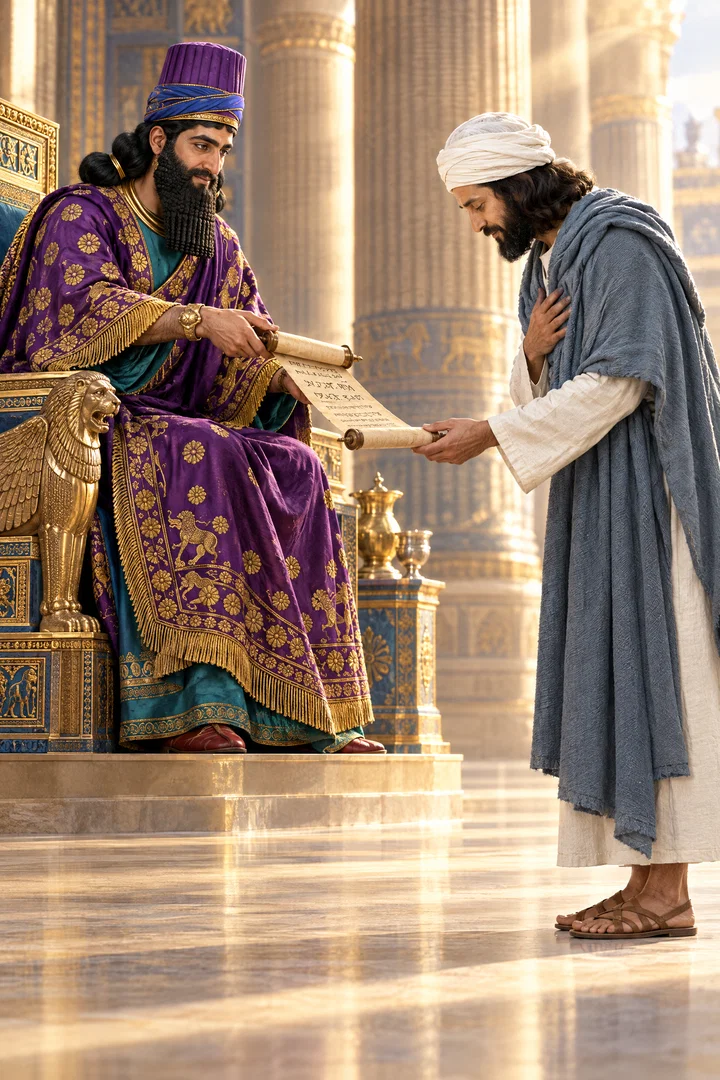
I make a decree, that all they of the people of Israel, and of his priests and Levites, in my realm, which are minded of their own freewill to go up to Jerusalem, go with thee.
Translations
I make a decree, that all they of the people of Israel, and of his priests and Levites, in my realm, which are minded of their own freewill to go up to Jerusalem, go with you.
King James Version, KJV Cambridge Paragraph Bible
I make a decree, that all they of the people of Israel, and of his priests and Levites, in my realm, which are minded of their own freewill to go up to Jerusalem, go with thee.
I make a decree, that all they of the people of Israel, and of his priests and Levites, in my realm, who are disposed of their own free will to go to Jerusalem, go with thee.
I make a decree, that all they of the people of Israel, and their priests and the Levites, in my realm, which are minded of their own free will to go to Jerusalem, go with thee.
I make a decree, that all they of the people of Israel, and their priests and the Levites, in my realm, that are minded of their own free will to go to Jerusalem, go with thee.
By me hath been made a decree that every one who is willing, in my kingdom, of the people of Israel and of its priests and Levites, to go to Jerusalem with thee, doth go;
I have given orders that all they of the people of Israel, and of their priests and the Levites, in my realm, who are disposed to go to Jerusalem, go with thee.
From me, is issued an edict, that, every one in my kingdom, of the people of Israel, and of their priests and the Levites, who is minded of his own freewill to go to Jerusalem, with thee, let him go.
Berean Standard Bible, Majority Standard Bible
I hereby decree that any volunteers among the Israelites in my kingdom, including the priests and Levites, may go up with you to Jerusalem.
I make a decree that all those of the people of Israel and their priests and the Levites in my realm, who intend of their own free will to go to Jerusalem, go with you.
And now it is my order that all those of the people of Israel, and their priests and Levites in my kingdom, who are ready and have a desire to go to Jerusalem, are to go with you.
I haue giuen commandement, that euery one, that is willing in my kingdome of the people of Israel, and of the Priestes, and Leuites to goe to Ierusalem with thee, shall goe.
Douay-Rheims (Challoner revision)
It is decreed by me, that all they of the people of Israel, and of the priests and of the Levites in my realm, that are minded to go into Jerusalem, should go with thee.
Pictures

Cross-references 20 of 38
- Daniel 9:25
Know therefore and understand, that from the going forth of the commandment to restore and to build Jerusalem unto the Messiah the Prince shall be seven weeks, and threescore and two weeks: the street shall be built again, and the wall, even in troublous times.
The decree to restore Jerusalem supplies the starting point for the prophecy’s time period.
- Ezra 1:1-4
Now in the first year of Cyrus king of Persia, that the word of the LORD by the mouth of Jeremiah might be fulfilled, the LORD stirred up the spirit of Cyrus king of Persia, that he made a proclamation throughout all his kingdom, and put it also in writing, saying,
Cyrus’s decree invited willing Jews to return and rebuild the temple.
- Ezra 6:14
And the elders of the Jews builded, and they prospered through the prophesying of Haggai the prophet and Zechariah the son of Iddo. And they builded, and finished it, according to the commandment of the God of Israel, and according to the commandment of Cyrus, and Darius, and Artaxerxes king of Persia.
The temple work is completed according to the commands of Cyrus, Darius, and Artaxerxes.
- Ezra 6:1-12
Then Darius the king made a decree, and search was made in the house of the rolls, where the treasures were laid up in Babylon.
Darius reaffirmed Cyrus’s temple-building decree and funded its completion.
- Ezra 7:8-9
And he came to Jerusalem in the fifth month, which was in the seventh year of the king.
Ezra’s arrival dates the decree’s implementation to Artaxerxes’ seventh year.
- Nehemiah 2:5-8
And I said unto the king, If it please the king, and if thy servant have found favour in thy sight, that thou wouldest send me unto Judah, unto the city of my fathers’ sepulchres, that I may build it.
Nehemiah received permission, letters, and resources to rebuild Jerusalem.
- Isaiah 44:26-28
That confirmeth the word of his servant, and performeth the counsel of his messengers; that saith to Jerusalem, Thou shalt be inhabited; and to the cities of Judah, Ye shall be built, and I will raise up the decayed places thereof:
God foretells Jerusalem’s rebuilding and names Cyrus as the instrument.
- Ezra 7:7
And there went up some of the children of Israel, and of the priests, and the Levites, and the singers, and the porters, and the Nethinims, unto Jerusalem, in the seventh year of Artaxerxes the king.
Dates Ezra’s journey and Artaxerxes’ decree to the king’s seventh year.
- Ezra 9:9
For we were bondmen; yet our God hath not forsaken us in our bondage, but hath extended mercy unto us in the sight of the kings of Persia, to give us a reviving, to set up the house of our God, and to repair the desolations thereof, and to give us a wall in Judah and in Jerusalem.
The decree enables Jerusalem’s restoration, rebuilding, and protection.
- Isaiah 45:13
I have raised him up in righteousness, and I will direct all his ways: he shall build my city, and he shall let go my captives, not for price nor reward, saith the LORD of hosts.
Cyrus is raised up to rebuild Jerusalem and release the exiles.
- Ezra 7:25-26
And thou, Ezra, after the wisdom of thy God, that is in thine hand, set magistrates and judges, which may judge all the people that are beyond the river, all such as know the laws of thy God; and teach ye them that know them not.
The decree authorizes Ezra to appoint judges and enforce the laws.
- Jeremiah 29:10-14
For thus saith the LORD, That after seventy years be accomplished at Babylon I will visit you, and perform my good word toward you, in causing you to return to this place.
The promised return from exile follows seventy years and includes a willing return to Jerusalem.
- Ezra 7:9
For upon the first day of the first month began he to go up from Babylon, and on the first day of the fifth month came he to Jerusalem, according to the good hand of his God upon him.
God's good hand enabled Ezra's journey and the timing of his work at Jerusalem.
- Daniel 9:24
Seventy weeks are determined upon thy people and upon thy holy city, to finish the transgression, and to make an end of sins, and to make reconciliation for iniquity, and to bring in everlasting righteousness, and to seal up the vision and prophecy, and to anoint the most Holy.
Ezra’s decree marks the commencement of the seventy weeks.
- 2 Chronicles 36:23
Thus saith Cyrus king of Persia, All the kingdoms of the earth hath the LORD God of heaven given me; and he hath charged me to build him an house in Jerusalem, which is in Judah. Who is there among you of all his people? The LORD his God be with him, and let him go up.
Cyrus’s decree permits the people to go up to Jerusalem.
- Ezra 7:27-28
Blessed be the LORD God of our fathers, which hath put such a thing as this in the king’s heart, to beautify the house of the LORD which is in Jerusalem:
Ezra thanks God for moving the king and strengthening him to gather people for the journey.
- Ezra 1:3-4
Who is there among you of all his people? his God be with him, and let him go up to Jerusalem, which is in Judah, and build the house of the LORD God of Israel, (he is the God,) which is in Jerusalem.
The decree permits the people to return to Jerusalem and provides help for their journey.
- Ezra 7:1
Now after these things, in the reign of Artaxerxes king of Persia, Ezra the son of Seraiah, the son of Azariah, the son of Hilkiah,
Identifies Artaxerxes, the king who issued the decree.
- Nehemiah 2:1
And it came to pass in the month Nisan, in the twentieth year of Artaxerxes the king, that wine was before him: and I took up the wine, and gave it unto the king. Now I had not been beforetime sad in his presence.
The later decree confirms Artaxerxes’ earlier decree and helps establish its chronology.
- Ezra 1:5
Then rose up the chief of the fathers of Judah and Benjamin, and the priests, and the Levites, with all them whose spirit God had raised, to go up to build the house of the LORD which is in Jerusalem.
Those moved to return went up to Jerusalem.
Commentary
Each commentary is drawn from primary sources: the writings of Ellen G. White and Adventist pioneers and periodicals. Each commentary is separate. Its own words are not a quotation; follow the references to read the source passages.
Ellen G. White
19 sources
Artaxerxes decrees that any of the people of Israel with his priests and Levites in his realm who are freely willing to go up to Jerusalem may go with Ezra.RH Feb 6, 1908ST May 2, 1878GC 325.2–326.3 It is the third decree issued for restoring and building Jerusalem since the close of the seventy years' captivity, completing what Cyrus began and Darius continued so that together they stand as one decree.RH Feb 6, 1908PK 610.1–611.14SP 494.2–3 In its completed form it was issued in 457 B.C., in the king's seventh year near the close of the year in autumn, and it is the commandment to restore and build Jerusalem.GC 325.2–326.3GC88 326.2GC88 681.1–682.1 Its date marks the beginning of the 2,300 years of Daniel 8:14 and of the seventy weeks, from which the periods of Daniel's prophecy are traced.LS 48.4–5ST May 2, 1878CET 49.2 Reckoned from the autumn of 457 the 2,300 years reach to the autumn of 1844 rather than 1843, and measured from that same starting point the seventy weeks are fulfilled to A.D. 34 when the apostles turned to the Gentiles, with the crucifixion in A.D. 31 in the midst of the last week.LS 48.4–5CET 49.2GC88 326.24SP 494.2–3GC88 681.1–682.1
Decree and Return
Artaxerxes' decree gives permission for all of the people of Israel, including priests and Levites, throughout his realm who are minded of their own free will to go up to Jerusalem to go with Ezra.RH Feb 6, 1908ST May 2, 1878GC 325.2–326.3ST Mar 30, 1876PK 610.1–611.1 It provides for the return of all who freely choose to make the journey, leaving the decision entirely to their own willing choice.RH Feb 6, 1908ST May 2, 1878ST Mar 30, 18764SP 494.2–3PK 609.4
The decree is the third issued since the close of the seventy years' captivity for the restoring and building of Jerusalem.RH Feb 6, 1908PK 610.1–611.1RH Jan 30, 1908PK 607.1 It completes what Cyrus began and Darius continued, so that together their acts count as one decree for restoring Jerusalem.4SP 494.2–3 In that completed form it stands as the third and final decree for Jerusalem's restoration.RH Jan 30, 1908PK 607.1
The decree is remarkable for its expressions regarding the God of heaven, for its recognition of Ezra's attainments as priest and scribe of the law of the God of heaven, and for the liberality of the grants made to the remnant people of God.PK 610.1–611.1 At Ezra's request, and according to the good hand of his God upon him, the king was persuaded to make abundant provision for the return, as part of his support for restoring worship and the city.PK 611.2PK 609.4 That royal support and provision enabled the Jews to return to Jerusalem after the captivity, to rebuild the temple, and to serve God again in their own country, showing God's forbearance toward His wayward people.PK 611.2PK 609.4Lt 98, 1907, par. 2
The return under it was entirely voluntary, again giving the children of the dispersion opportunity to return to the land whose possession was linked with the promises to the house of Israel.PK 611.2PK 609.4 Under this third and final decree a company of Jews returned from Babylon to Jerusalem with Ezra.PK 611.2RH Jan 30, 1908PK 607.1 Their uniting with him in studying God's purposes concerning His people brought great rejoicing.PK 611.2
Prophetic Starting Point
In its completed form the decree was issued in 457 B.C., in the king's seventh year, in the autumn near the close of the year, and it is the commandment to restore and build Jerusalem.GC 325.2–326.3GC88 326.2GC88 681.1–682.1GC88 409.1–410.1 Its date marks the beginning of the 2,300-year period of Daniel 8:14 and of the seventy weeks, from which the periods in Daniel's prophecy are traced.LS 48.4–5ST May 2, 1878CET 49.2GC 325.2–326.3LSEGW 57.3–58.1 Measured from that starting point, the specifications of the seventy-week prophecy were fulfilled.GC88 326.2
Counted from 457, the 2,300 years were first reckoned by the simple calculation of 2,300 minus 457 as terminating in 1843 with the coming of the Lord, a reckoning so plain that even children could understand it.LS 48.4–5CET 49.2 When it was ascertained that the decree belonged to the close and autumn of the year rather than its beginning, the period was seen to reach to the fall and autumn of 1844, so counting from the beginning of 457 gives the wrong endpoint.ST May 2, 1878ST Mar 30, 1876LSEGW 57.3–58.1GC88 681.1–682.1GC88 409.1–410.1 Because it went forth near the end of that year, the period was understood to end in the fall of 1844, not at the close of 1843.ST May 2, 1878ST Mar 30, 18761T 52.2–53.2
The earlier expectation led to disappointment when 1843 passed without Christ's return, but the corrected reckoning showed the vision had not failed or tarried beyond its appointed time, though it had seemed to do so.1T 52.2–53.2LS 185.2–3 Ending in A.D. 34 when the apostles turned to the Gentiles, the seventy weeks reach their close from this same starting point, with the crucifixion in A.D. 31 falling in the middle of the final week.4SP 494.2–3GC88 681.1–682.1
Sources
Pioneers and periodicals
77 sources
Artaxerxes decreed that any Israelite, priest or Levite in his realm who was freely minded to go up to Jerusalem might go with Ezra, and the going was wholly voluntary with none compelled.RH Feb 6, 1908ST Feb 25, 1886RH Mar 2, 1876RH Jun 23, 1874ST Feb 22, 1883
It was issued in his seventh year in 457 B.C. as the third and final Persian decree for Jerusalem's restoration after the captivity.RH Dec 3, 1908RH Feb 22, 1870
It is the going forth of the commandment to restore and build Jerusalem in Daniel 9:25, joining the decrees of Cyrus and Darius as one threefold commandment and alone making it full and complete, since the earlier decrees provided only for return and the temple while this restored the city, its government and God's law.RH Dec 3, 1908ST Feb 25, 1886ST Mar 11, 1889RH Apr 30, 1901
Effective in the autumn of 457 B.C., it begins Daniel's seventy weeks of 490 years, which being cut off from the 2300 days begins that longer period also, reckoned by the year-day principle.RH Dec 3, 1908ST Feb 25, 1886ST Jan 20, 1904RH Jan 8, 1861
Counted from that autumn, sixty-nine weeks reach to Messiah the Prince at Christ's baptism in the autumn of A.D. 27, his crucifixion in the midst of the seventieth week in the spring of A.D. 31 causes sacrifice to cease, the seventy weeks end in the autumn of A.D. 34 with the gospel going to the Gentiles, and the whole 2300 years reach to the autumn of 1844 and the cleansing of the heavenly sanctuary and beginning of the investigative judgment.RH Dec 3, 1908ST Jan 24, 1878ST Jan 20, 1904ST May 11, 1876RH Mar 10, 1874
Words and Historical Setting
The verse is the king's permission that any of the people of Israel, with his priests and Levites, in his realm who are minded of their own freewill to go up to Jerusalem may go with Ezra.RH Feb 6, 1908ST Feb 25, 1886RH Mar 2, 1876RH Apr 4, 1854ST Feb 23, 1882 This liberty to return was part of a broader decree that restored the Jewish polity and fulfilled the command to restore and rebuild Jerusalem.ST Feb 25, 1886RH Mar 2, 1876ST The return it allowed was entirely voluntary and not compelled, for those who went went as willing-hearted servants with full permission to go.RH Jun 23, 1874ST Feb 22, 1883RH Jan 19, 1860ST Feb 2, 1882ST Oct 4, 1899 God in this left them free to accept or refuse his offer, and made provision as fully as the people would respond.
The decree was issued by Artaxerxes Longimanus in his seventh year, dated to 457 B.C., after the seventy-year captivity, as the third and final Persian decree for Jerusalem's restoration.RH Dec 3, 1908RH Feb 22, 1870RH Dec 1850RH Jul 3, 1856 His reign is reckoned as beginning in 464 B.C.ST It is a formal written decree signed by the king, whose full original wording is preserved in Ezra 7.RH Feb 22, 1870RH Sep 13, 1870ST Nov 1, 1877 That original is in Aramaic, called Chaldaic, the language then used at Babylon, unlike the later verbal permission to Nehemiah with separate letters of which no copy is preserved.ST Feb 23, 1882RH Feb 22, 1870ST Oct 25, 1883RH Sep 13, 1870ST Nov 1, 1877
It was made in a season of perfect peace, a setting less suitable during civil unrest or war.RH Jan 8, 1861 It was issued in spring in the first month, but it took effect in autumn in the fifth to seventh month when Ezra reached Jerusalem and the region where it applied.RH Dec 3, 1908ST Jan 20, 1904RH Dec 1, 1904 Prophetic time is reckoned from when it began to be carried into effect, and because it was issued near the end of that year its effective date carries the reckoning into the fall.ST May 2, 1878ST Mar 30, 1876RH Dec 3, 1908ST Jan 20, 1904RH Dec 1, 1904
Ezra led under it a second company of about 1,800 men from Babylon to Jerusalem for rebuilding and restoration of the commonwealth. His journey came nearly eighty years after the first return and about sixty years before the events of Esther, with Xerxes identified as son of Darius and father of Artaxerxes.ST Apr 19, 1883RH Jan 20, 1853RH Jul 3, 1856 The empire's 120 provinces allowed scattered Israelites to learn of the favor, and many Jews responded and returned with him.ST Apr 19, 1883 Those who returned included a remnant from all tribes, so that all Israel dwelt in their cities and Israel was still represented and not lost, even though only a remnant returned and the ten tribes as a body declined.RH Sep 8, 1853RH Jan 19, 1860RH Jan 20, 1853RH Jul 3, 1856
Authority Granted for Restoration
The decree gave Ezra broad authority to restore Jerusalem's civic and religious order, its polity and government, its theocracy and commonwealth, authorizing all the steps of restoration.RH Dec 3, 1908ST Feb 25, 1886RH Mar 2, 1876ST Feb 23, 1882ST It was not limited to erecting walls or houses or to rebuilding the temple, but clothed him with power to regulate the affairs of his countrymen and to restore the Jewish state in civil and religious matters.RH Mar 2, 1876ST Feb 23, 1882RH Feb 22, 1870STRH Jul 28, 1863 Together with the earlier decrees of Cyrus and Darius it completed the command to restore and build Jerusalem, and as the final and written original document preserved in Aramaic it empowered that restoration according to God's law and the people's customs.ST Feb 25, 1886RH Mar 2, 1876ST Feb 23, 1882RH Feb 22, 1870 Ezra understood it as conferring power to rebuild the street and wall, to set up the house of God, to repair its desolations, and to give a wall in Judah and in Jerusalem.RH Feb 22, 1870
Its provisions supplied unlimited treasure and resources to beautify the house of God and to procure offerings for its service and to do whatever else seemed good to him, with power to collect more beyond the Euphrates.RH Feb 22, 1870ST Nov 1, 1877RH Jul 28, 1863 Yearly supplies were fixed at up to one hundred talents of silver, with wheat, wine, oil, and salt without measure, for orderly worship and sacrifice, while priests and Levites were exempted from taxes and impositions.ST Nov 1, 1877RH Jul 28, 1863RH Dec 24, 1861ST Mar 26, 1912 It empowered him to ordain laws according to the law of God and the ancient customs of the people and the law of Moses, to restore the Levitical law, and to establish tribunals and administration of justice.ST Nov 1, 1877RH Jul 28, 1863RH Dec 24, 1861ST Mar 26, 1912 It authorized him to set magistrates and judges over all the people beyond the river, to try cases and execute punishment even unto death, with implied authority to fortify and rebuild the city and walls for security and to restore the Jewish civil and religious constitution.RH Feb 22, 1870STST Nov 1, 1877RH Dec 24, 1861
Ezra began the work of restoring the national polity, the Scriptures and knowledge of the law, worship, and full reformation in church and state, restoring the people's rights and privileges and rebuilding Jerusalem.RH Feb 22, 1870ST Dec 3, 1894RH Dec 27, 1853RH Nov 7, 1907 Nehemiah later built the wall under the same decree as a continuation, since its authority was broad enough to include rebuilding the city though Ezra first restored its polity.RH Feb 22, 1870RH Dec 27, 1853ST Apr 22, 1880RH Nov 7, 1907 The decree to Ezra includes every specification found in the later grant to Nehemiah and is much more full, so Nehemiah's work only continued what Ezra had been commissioned to do and had commenced thirteen years before.RH Feb 22, 1870ST Apr 22, 1880ST Apr 22, 1880 The return and reorganization begun under Ezra and completed under Nehemiah fulfilled its purpose, and the building and restoration were not fully accomplished until 408 B.C., forty-nine years later.ST Dec 3, 1894ST Apr 22, 1880RH Nov 7, 1907
Command Completing Restoration Prophecy
The decree is the going forth of the commandment to restore and to build Jerusalem spoken of in Daniel 9:25, and the work of return shown in permission for all who are freely minded to go up with Ezra is part of that commandment going forth.RH Dec 3, 1908ST Feb 25, 1886RH Mar 2, 1876RH Apr 4, 1854ST Jan 24, 1878 Joined with the decree of Cyrus in 536 B.C. and the decree of Darius in 519 or 520 B.C., it forms one threefold commandment of the God of Israel issued in three parts, embracing the earlier decrees within itself while supplying what they lacked.RH Dec 3, 1908ST Feb 25, 1886RH Mar 2, 1876 It is the last installment that made the commandment full and complete, the only decree containing all the required features, so prophetic time for the seventy weeks and the 2300 days must be dated from it when it went into effect in the fall of 457 B.C.RH Dec 3, 1908ST Feb 25, 1886RH Mar 2, 1876ST Jan 24, 1878
The earlier decrees were only preparatory and insufficient by themselves, and are not the correct starting point rather than this decree.ST Mar 11, 1889RH Apr 30, 1901ST Dec 19, 1892ST Jul 25, 1878 Cyrus only gave permission to return and to rebuild the temple, and Darius only confirmed and renewed that temple work and provided for its expense, saying nothing about the city.ST Mar 11, 1889RH Apr 30, 1901ST Dec 19, 1892 By contrast the decree through Artaxerxes is a complete charter broad enough to authorize restoration as well as building, restoring the Jewish polity, political organization, civil government and judicial order, the religion and policy of the Jews as a nation in their own land, with the city restored to its ancient privileges and with God's law reestablished as its law.ST Mar 11, 1889RH Apr 30, 1901ST Dec 19, 1892ST Feb 23, 1882RH Jul 21, 1863 It lacked nothing short of entire independence, meeting the prophecy's full requirement to restore and not merely to build walls and houses or restore temple worship.RH Mar 2, 1876RH Apr 30, 1901ST Dec 19, 1892ST Feb 23, 1882RH Jul 21, 1863
Dates and Prophetic Fulfillments
Issued in 457 B.C. and going into effect in the autumn of that year when Ezra reached Jerusalem and the work began, the decree is the beginning of Daniel's seventy weeks of 490 years.RH Dec 3, 1908ST Feb 25, 1886RH Apr 4, 1854RH Mar 12, 1901 Since those weeks are cut off from the 2300 days, it is also the beginning of the 2300 days reckoned as years by the year-day principle.ST Feb 25, 1886RH Apr 4, 1854ST Jan 24, 1878RH Mar 12, 1901 Together with the decree of Cyrus in 536 B.C. and the decree of Darius in 519 or 520 B.C. it makes the commandment complete, and prophetic reckoning must date from this last decree because the commandment was not full until it was issued.RH Mar 12, 1901ST Jan 20, 1904 The liberty for any Israelites, priests and Levites who freely chose to return to go with Ezra was one part of that broader restoration of the Jewish polity fulfilling the command to restore and rebuild Jerusalem.ST Feb 25, 1886RH Apr 4, 1854RH Mar 12, 1901
Reckoned from the autumn of 457 B.C., sixty-nine weeks or 483 years reach to Messiah the Prince at Christ's baptism and anointing with the Holy Spirit in the autumn of A.D. 27.ST Jan 20, 1904ST May 11, 1876ST Mar 4, 1886ST Mar 27, 1879RH Nov 12, 1914 The same anointing is also dated to A.D. 26.ST Jan 20, 1904ST Mar 27, 1879RH Nov 12, 1914 The midst of the seventieth week brings His crucifixion in the spring of A.D. 31, causing sacrifice and oblation to cease.ST Jan 20, 1904ST Mar 27, 1879 The full seventy weeks or 490 years reach to the autumn of A.D. 34, when the Jews ceased to be the chosen people and the gospel went to the Gentiles.ST Jan 20, 1904RH Mar 10, 1874ST Mar 27, 1879
The whole 2300 years reach to the autumn of 1844.ST May 2, 1878RH Dec 3, 1908ST Jan 20, 1904RH Dec 1850ST Mar 27, 1879 They were first reckoned as 2300 minus 457 leaving 1843 for the close of the period.LS 48.4–5ST Jan 24, 1878RH Dec 1850 They were then corrected to the fall of 1844 because the decree belonged to the close and effective part of 457 B.C., issued near the end of that year and reckoned as 456 1/2 B.C. because half the year had passed.ST May 2, 1878RH Dec 3, 1908ST Jan 20, 1904RH Oct 27, 1904 That ending brings the cleansing of the heavenly sanctuary, the beginning of Christ's closing ministry and investigative judgment and blotting out of sins, the midnight cry, and the dating of the first angel's and judgment-hour messages.RH Dec 3, 1908RH Dec 1850RH Jun 29, 1911RH Oct 27, 1904 Without this starting point the place and time of the end cannot be proved, and the period cannot extend to the present time.RH Dec 3, 1908RH Dec 1850
The date 457 B.C. for the seventh year of Artaxerxes is one of the best established dates in ancient history, fixed beyond question.ST Jun 26, 1907ST Apr 15, 1880RH Jun 29, 1911 It is fixed by Ptolemy's canon and proved correct by the concurrent agreement of more than twenty eclipses.ST Jun 26, 1907ST Apr 15, 1880RH Oct 27, 1904 It is fixed from an eclipse of the moon in the seventh year of Cambyses in 523 B.C., with Cambyses reigning one year after that eclipse, followed by Darius for thirty-six years and Xerxes for twenty-one years, bringing the first year of Artaxerxes to 464 B.C. and his seventh to 457 B.C., where the canon places it.ST Apr 15, 1880ST Jan 22, 1880 It is further confirmed by Greek Olympiads and Roman years and by seven historical facts fixing when John began to preach six months before Christ entered His ministry.ST Jun 26, 1907RH Oct 27, 1904
Defense of the Starting Date
Nehemiah's commission in the twentieth year, dated to 444 or 445 B.C., is not the going forth of the commandment to restore and build Jerusalem that begins the seventy weeks and the 2300 days.RH Feb 17, 1853RH Jan 7, 1858RH Jun 4, 1857 It was only verbal permission with separate letters for travel and timber to the keeper of the forest and the governors beyond the river, addressed to others and of which no copy is preserved, while Ezra 7 preserves the full original wording of a written document signed by the king in Aramaic.RH Feb 22, 1870RH Feb 17, 1853ST Apr 22, 1880 That written decree in the seventh year, thirteen years earlier, clothed Ezra with power not merely to erect walls or houses but to restore Jerusalem, regulate the affairs of his countrymen, and set magistrates and judges over all the people beyond the river.RH Feb 22, 1870RH Feb 17, 1853 Nehemiah's later work on damaged walls and gates only continued and finished what Ezra had begun thirteen years before in restoring Jerusalem.RH Feb 22, 1870RH Feb 17, 1853
Reckoning the seventy weeks from Nehemiah's commission disarranges every date and leaves the prophecy without fulfillment.ST Apr 22, 1880 Counted from 444 B.C. it ends with no marking event, whether put at A.D. 47 or at A.D. 34 plus error, and it fails to reach the specified events.RH Jan 7, 1858ST Apr 22, 1880 By contrast the decree to Ezra must be judged by how much is included in restoring and building Jerusalem and by whether seventy weeks dated from its promulgation reach the events specified in the prophecy.RH Jan 7, 1858
No other proposed starting date fits the prophecy's conditions concerning the Messiah, the crucifixion, and the confirming of the covenant for one week.RH Feb 14, 1854RH Feb 14, 1854 Dated from the 457 B.C. decree, the seven weeks or forty-nine years of troublous building of street and wall, the sixty-nine weeks or 483 years to Messiah the Prince, the midst of the week marked by the crucifixion, and the seventy weeks or 490 years all stand in order.ST Apr 22, 1880ST Mar 2, 1882RH Sep 20, 1870 The manifestation of the Messiah at His baptism and anointing and the beginning of His public ministry, His crucifixion causing sacrifice to cease, and the turning from the Jews to the Gentiles with the proclamation of the new covenant all fall in their exact place and seal the prophecy as sure.ST Apr 22, 1880ST Mar 2, 1882RH Sep 20, 1870 Only this decree gives perfect harmony in commencement, intermediate dates and termination, and changing that starting date would disrupt all chronology and the harmony of the prophecy's other events.RH Sep 20, 1870
The decree to Ezra includes every specification found in the later grant to Nehemiah and is much more full, making it the greater event that must be taken as the starting point rather than the subsequent lesser commission.ST Apr 22, 1880 Yet restoring Jerusalem includes restoring its civil state and polity, not merely rebuilding the temple and restoring temple worship, so some treatments present Ezra's decree and Nehemiah's commission as the two possible commands and leave the final choice between them as still open to be judged by scope and fulfillment.ST Feb 23, 1882RH Jul 21, 1863RH Jan 7, 1858 One treatment notes that counting 490 years from either Artaxerxes edict, whether of the seventh or the twentieth year, does not reach Jerusalem's destruction in A.D. 70.RH Apr 9, 1908
Doctrinal Connections and Application
The permission was open to all of the people of Israel in the realm, including priests and Levites, who were minded of their own freewill to go up to Jerusalem with Ezra, and the going was wholly voluntary and not compelled.RH Sep 8, 1853RH Jan 19, 1860RH Jan 20, 1853RH Jul 3, 1856RH Aug 26, 1902 That openness meant every tribe could have returned and received the promised blessings, and some from every tribe did return, so that a remnant of all the tribes dwelt again in their cities.RH Sep 8, 1853RH Jan 19, 1860RH Jan 20, 1853RH Jul 3, 1856RH Aug 26, 1902 Only a remnant in fact went, for the ten tribes as a body declined while those from Judah, Benjamin, Levi and a few others went up.RH Sep 8, 1853RH Jan 19, 1860RH Jan 20, 1853 The expression all Israel is never applied to one or two tribes only, so this remnant return proves the twelve tribes continued in existence without controversy from David to Christ.RH Sep 8, 1853RH Jul 3, 1856 Because the tribes continued, the blessings of the gospel promised to twelve tribes as well as to one could be fulfilled, and those Israelites who stayed abroad were not thereby lost.RH Jan 20, 1853RH Jul 3, 1856RH Aug 26, 1902
The decree displays God's supremacy and care, for even proud Persian kings were moved to protect His people and to send the captives back to rebuild Jerusalem and the temple.ST Nov 11, 1889ST Apr 16, 1912ST Mar 11, 1897 Like the decrees of Cyrus and Darius for the same purpose, this royal enactment used legislative power to protect and exalt the church and to meet the expenses of its public work in whole or in part out of the public treasury, and all this was done with divine approval.ST Nov 11, 1889ST Apr 16, 1912ST Mar 11, 1897 Ezra therefore went with the king's lawful authorization, and serving God's mission did not require acting independently of civil authority.RH Aug 28, 1860ST Nov 11, 1889 The church may use civil laws and provisions when they support the cause of truth and its temporal needs.RH Aug 28, 1860ST Nov 11, 1889
God left the people free to accept or refuse His offer, making provision as fully as they would respond, and those who went up were willing-hearted, showing that God wants willing service.ST Dec 19, 1892RH Mar 14, 1871 Ezra boldly asked the king to let Israelites, priests and Levites who freely chose to go travel to Jerusalem, though the request seemed contrary to the king's interests.RH Mar 14, 1871 The needed money and building materials were provided in advance through gifts and royal support, so the temple rebuilt by Ezra and his associates was completed without debt.RH Mar 14, 1871RH Jul 17, 1913 The three Persian decrees together made up the full restoration decree, with this third decree in 457 B.C. completing it, and from it the 2,300-year period is dated to end in 1844 with the final decree for completing the gospel temple.RH Mar 14, 1871ST May 21, 1896 Its outcome was the completion of the restoration of Jerusalem and the return of Israel to their cities, illustrating latter-day reformation.ST May 21, 1896
By the time of this decree the earthly sanctuary had already been rebuilt and was in existence, so the sanctuary to be cleansed at the end of the period is not the earthly but the heavenly sanctuary.RH Jan 20, 1853RH Oct 8, 1903ST Mar 30, 1876 The decree of Artaxerxes to Ezra in the seventh year of his reign, dated 457 B.C. near the close of the year, is the going forth of the command to restore and build Jerusalem and the necessary starting point for counting the 2300 days as years.RH May 25, 1905LS 185.2–3RH Dec 1850RH Oct 8, 1903ST Mar 30, 1876 With it also begin Daniel's seventy weeks of 490 years, cut off from the first part of the 2300 years, leaving 1810 years more to the end, so that 2300 minus 457 brings the end first reckoned to 1843 and then, when the autumn date was ascertained, to the fall of 1844.LS 185.2–3RH Dec 1850RH Oct 8, 1903 Without it the place and time of the end cannot be proved, making it the foundation of the whole Advent reckoning, of the midnight cry, and of the date of the first angel's and judgment-hour message.RH May 25, 1905LS 185.2–3RH Dec 1850 That ending in 1844 marks the cleansing of the sanctuary and the beginning of the investigative judgment, the present closing work of Christ as great High Priest in final atonement and blotting out of sin before His second coming, explaining the disappointment when the vision seemed to tarry but did not.RH May 25, 1905LS 185.2–3RH Dec 1850RH Oct 8, 1903ST Mar 30, 1876
Sources