Acts 5:2
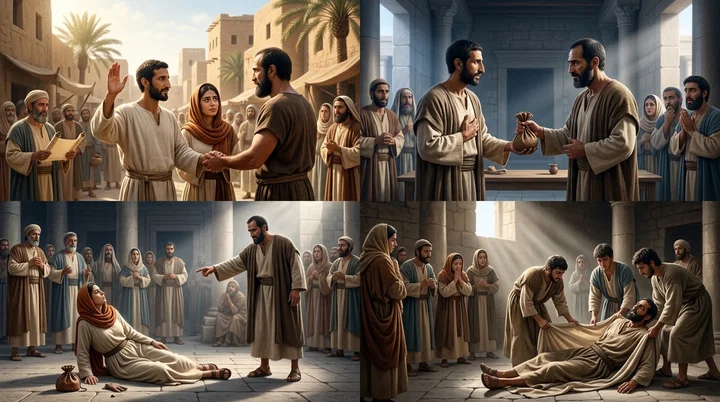
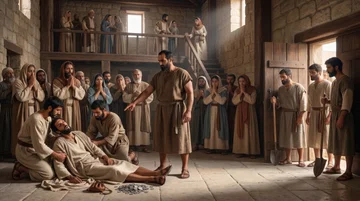
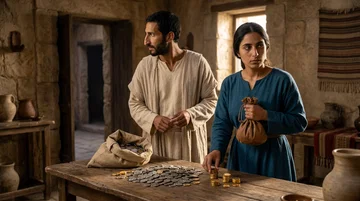
And kept back part of the price, his wife also being privy to it, and brought a certain part, and laid it at the apostles’ feet.
Translations
American King James Version, King James Version
And kept back part of the price, his wife also being privy to it, and brought a certain part, and laid it at the apostles’ feet.
KJV Cambridge Paragraph Bible, Revised Version, American Standard Version
and kept back part of the price, his wife also being privy to it, and brought a certain part, and laid it at the apostles’ feet.
And kept back part of the price, (his wife also being privy to it) and brought a certain part, and laid it at the apostles' feet.
and did keep back of the price — his wife also knowing — and having brought a certain part, at the feet of the apostles he laid [it].
and put aside for himself part of the price, [ his] wife also being privy to it; and having brought a certain part, laid it at the feet of the apostles.
And kept back part of the price, his wife also being privy to it; and, bringing a certain part, at the feet of the Apostles, he laid it.
Berean Standard Bible, Majority Standard Bible
With his wife’s full knowledge, he kept back some of the proceeds for himself, but brought a portion and laid it at the apostles’ feet.
and kept back part of the price, his wife also being aware of it, then brought a certain part and laid it at the apostles’ feet.
And kept back part of the price, his wife having knowledge of it, and took the rest and put it at the feet of the Apostles.
And kept away part of the price, his wife also being of counsell, and brought a certaine part, and layde it downe at the Apostles feete.
Douay-Rheims (Challoner revision)
And by fraud kept back part of the price of the land, his wife being privy thereunto: and bringing a certain part of it, laid it at the feet of the apostles.
Pictures


Cross-references
- Acts 4:34-35
Neither was there any among them that lacked: for as many as were possessors of lands or houses sold them, and brought the prices of the things that were sold,
Believers brought proceeds from sold property to the apostles for distribution to those in need.
- Acts 5:7-10
And it was about the space of three hours after, when his wife, not knowing what was done, came in.
Sapphira shares the deception and its judgment brings fear upon the church.
- Acts 4:37
Having land, sold it, and brought the money, and laid it at the apostles’ feet.
Barnabas gives all the proceeds, unlike Ananias and Sapphira, who conceal part.
- Malachi 3:8
Will a man rob God? Yet ye have robbed me. But ye say, Wherein have we robbed thee? In tithes and offerings.
Withholding what belongs to God is called robbing God.
- Acts 5:11
And great fear came upon all the church, and upon as many as heard these things.
The deaths of Ananias and Sapphira brought great fear on the church.
- Deuteronomy 23:23
That which is gone out of thy lips thou shalt keep and perform; even a freewill offering, according as thou hast vowed unto the LORD thy God, which thou hast promised with thy mouth.
A promised offering to God must be kept and performed.
- Joshua 7:11
Israel hath sinned, and they have also transgressed my covenant which I commanded them: for they have even taken of the accursed thing, and have also stolen, and dissembled also, and they have put it even among their own stuff.
Both accounts show hidden theft and deceit judged by God.
- Acts 4:32
And the multitude of them that believed were of one heart and of one soul: neither said any of them that ought of the things which he possessed was his own; but they had all things common.
Contrasts keeping back possessions with the believers’ shared goods and unity.
- Acts 5:8
And Peter answered unto her, Tell me whether ye sold the land for so much? And she said, Yea, for so much.
Sapphira confirms the false sale price.
- Ecclesiastes 12:14
For God shall bring every work into judgment, with every secret thing, whether it be good, or whether it be evil.
God will judge every work, including secret acts.
- Ephesians 4:25
Wherefore putting away lying, speak every man truth with his neighbour: for we are members one of another.
Ananias and Sapphira’s deceit illustrates the command to put away lying and speak truth.
- Acts 2:44-45
And all that believed were together, and had all things common;
Both describe believers sharing possessions and resources.
- Hebrews 4:13
Neither is there any creature that is not manifest in his sight: but all things are naked and opened unto the eyes of him with whom we have to do.
Nothing is hidden from God, whom Ananias and Sapphira could not deceive.
- Malachi 1:14
But cursed be the deceiver, which hath in his flock a male, and voweth, and sacrificeth unto the Lord a corrupt thing: for I am a great King, saith the LORD of hosts, and my name is dreadful among the heathen.
Condemns deceitful offerings made while withholding what was vowed.
- Exodus 20:15
Thou shalt not steal.
Ananias’s withholding of the money is presented as stealing in business dealings.
- Proverbs 11:24
There is that scattereth, and yet increaseth; and there is that withholdeth more than is meet, but it tendeth to poverty.
Withholding more than is right tends to poverty.
- Acts 5:13
And of the rest durst no man join himself to them: but the people magnified them.
The judgment on Ananias and Sapphira made people afraid to join the believers.
- Exodus 20:16
Thou shalt not bear false witness against thy neighbour.
The ninth commandment forbids false witness, which the account illustrates.
- Joshua 7:20-26
And Achan answered Joshua, and said, Indeed I have sinned against the LORD God of Israel, and thus and thus have I done:
Achan’s disobedience is another example of disregarding God’s command.
Commentary
Each commentary is drawn from primary sources: the writings of Ellen G. White and Adventist pioneers and periodicals. Each commentary is separate. Its own words are not a quotation; follow the references to read the source passages.
Ellen G. White
45 sources
Ananias and Sapphira sold a possession together with full mutual agreement, kept back part of the price, and brought only a certain part to the apostles as if it were the whole.7RED 21.1–2AC1 21.1–22.2 Their property was their own to keep or sell, and an honest smaller gift would have been accepted, so the guilt lay not in retaining means but in the deceitful pretense of giving all.3SP 284.2–285.24T 462.2–463.3 They wanted both to hold wealth and to gain the esteem given to wholehearted givers, rooted in cherished covetousness, selfishness, love of money, vainglory and hypocrisy.7RED 21.1–24T 462.2–463.3AA 71.2–73.3AC1 22.3–23.1 Having solemnly pledged the proceeds to God, their withholding was breaking a sacred vow, robbing and defrauding God, and lying not to men but to the Holy Ghost.7RED 21.1–23SP 284.2–285.24T 462.2–463.35T 148.3RH Feb 2, 1911 The Spirit revealed the hidden fraud, and both were struck dead, bringing great fear upon the church, checking pretense and guarding the young church from corruption.Lt 13, 1893, par. 24–26ST Jan 29, 18803SP 285.3–286.17RED 22.3–23.1RH Apr 13, 1905 Though such immediate punishment is not generally repeated now, the sin remains just as heinous and will as surely be visited in the final reckoning.5T 148.3RH Feb 2, 19115T 434.2
The Act Described
Ananias and Sapphira sold a possession or land and acted together with full mutual knowledge and agreement, he keeping back part of the price with his wife also privy to it, and bringing only a certain part and laying it at the apostles' feet while presenting it as if it were the whole proceeds.7RED 21.1–2AC1 21.1–22.23SP 284.2–285.2Lt 13, 1893, par. 24–26 They had agreed beforehand to give all yet secretly kept a large share for themselves, bringing the rest as the full amount into the common fund.7RED 21.1–2AC1 21.1–22.23SP 284.2–285.2Lt 13, 1893, par. 24–26 Their joint plan was underhanded and deceptive, dissembling with an appearance of innocence while embezzling what they pretended to dedicate.3SP 284.2–285.2Lt 13, 1893, par. 24–26Ms 151, 1906, par. 25–28 It was lying to the Holy Ghost, lying not unto men but unto God, and tempting the Spirit of the Lord, standing in the same line as Achan in coveting and taking the accursed thing and stealing.7RED 21.1–2Lt 13, 1893, par. 24–26
The property and its proceeds were their own to control, and no one compelled them to sell or to give all.3SP 284.2–285.24T 462.2–463.3AA 71.2–73.3AC1 22.3–23.1 God would have accepted an honest part faithfully given after a free choice to keep or give, and they were responsible only to fulfill faithfully what they had pledged.4T 462.2–463.3AA 71.2–73.3AC1 22.3–23.1 The sin was therefore not in retaining something for themselves but in the deceitful pretense that what they brought was all, deceiving others while seeking praise for generosity, liberality, self-denial and sacrifice although unwilling to give all.3SP 284.2–285.2AA 71.2–73.3AC1 22.3–23.1RH Apr 13, 1905
The act took place in the early church when believers pooled means for the poorer believers and those who parted with possessions were held in high esteem, amid a rapid increase of professed Christians.3SP 284.2–285.23SP 285.3–286.1RH Feb 2, 1911 Ananias and Sapphira wanted that esteem and also to draw their living from the common stock rated higher than true, and their bringing a certain part as if it were all was hypocrisy and falsehood, a dark stain in contrast to honest benevolence.3SP 284.2–285.23SP 285.3–286.1RH Feb 2, 1911 The swift and terrible manifestation of divine judgment in their deaths was noticed by the Jewish leaders and increased their fear and hatred of the movement.Lt 13, 1893, par. 24–26SLP 12.17RED 24.3 The priests and rulers in council falsely accused the apostles of murdering Ananias and Sapphira, joining it to a charge of insurrection and of conspiring to deprive the priests of their authority and put them to death, hoping the mob would be excited to deal with the apostles as they had dealt with Jesus and that anger would turn from themselves for the murder of Christ.7RED 24.3
Motives and Inner Roots
Ananias and Sapphira agreed together to sell a possession and pretend to lay the whole price at the apostles' feet for the poorer believers while secretly keeping back a large share for themselves.7RED 21.1–2AC1 21.1–22.23SP 284.2–285.2 They had seen that those who parted with possessions were held in high esteem, and they wanted that commendation and reputation for generosity, liberality, self-denial, sacrifice and devotion while unwilling to give all.7RED 21.1–2AC1 21.1–22.23SP 284.2–285.2 They hoped to be thought liberal and to be rated higher than true so as to draw their living from the common stock, gaining honor from believers while securing themselves.7RED 21.1–23SP 284.2–285.2AA 71.2–73.3 Their property and its proceeds were their own to control with no compulsion to sell or to give, so the wrong was not in retaining something but in bringing a certain part as if it were all.3SP 284.2–285.2AA 71.2–73.3AC1 22.3–23.1
The inward root was covetousness first cherished, which led to fraud and hypocrisy in breaking their pledge and lying to the Holy Spirit about their gift.4T 462.2–463.3AA 71.2–73.3RH Feb 2, 1911AA 73.4–74.1 It was selfishness, love of money, worship of mammon while professing to serve God, vainglory, hypocrisy, and a desire to deceive others while seeking praise.AA 71.2–73.3AC1 22.3–23.1RH Feb 2, 19113SP 285.3–286.1 Hereditary and cultivated traits not yet cleansed remained even while the Holy Spirit was working with grace and power, and selfishness warped the character until they grudged what had been solemnly dedicated.ST Jan 29, 18803SP 285.3–286.1 Their shared deception was not forced giving but deliberate dissembling driven by love of money and covetous desire to keep what had been promised to God.4T 462.2–463.3AC1 22.3–23.1RH Feb 2, 1911AA 73.4–74.1
While under the direct influence and deep conviction of the Spirit through apostolic preaching they pledged certain lands to the Lord and released selfish hold on earthly possessions.ST Jan 29, 1880RH Feb 2, 1911 When out from that heavenly influence they questioned, drew back, thought they had been too hasty, wished to reconsider, and regretted the promise.ST Jan 29, 1880RH Feb 2, 1911 Ashamed to have brethren know their selfish souls grudged what they had solemnly dedicated, they talked it over together and deliberately decided to withhold part of the price while bringing a certain part.ST Jan 29, 1880RH Feb 2, 1911 In that parley they opened the door for Satan to enter and control their minds, and Satan led them to lie to the Holy Spirit.ST Jan 29, 18805T 103.3
They illustrate a class always found in any great religious movement who are carried away by the current of feeling yet soon reveal selfishness and vainglory and can never be an honor to the cause they advocate.3SP 285.3–286.1 They professed godliness while secretly cherishing iniquity, pretending to make an entire sacrifice for God when they covetously withheld a portion for themselves.3SP 285.3–286.14SP 44.1–45.1 People not wholly consecrated to God can thus be led to do Satan's work while believing they serve Christ.5T 103.3 Their presence among the early disciples as false brethren shows that unworthy members may be counted among followers, which the church must bear patiently rather than assume every character is fully revealed, yet it is no reason to doubt Christianity or become disheartened.COL 72.3ST Feb 9, 1915
Nature of the Sin
Keeping back part of the price while bringing a certain part and laying it at the apostles' feet as if it were the whole was hypocrisy, dissembling, prevarication, falsehood, fraud and acting a lie.7RED 21.1–23SP 284.2–285.21T 221.2AA 71.2–73.3AC1 22.3–23.1 It was lying to the Holy Ghost, lying not unto men but unto God, and tempting the Spirit of the Lord.7RED 21.1–2Lt 13, 1893, par. 24–261T 221.2AA 71.2–73.3ST Jan 29, 1880 The husband acted with the wife fully knowing and agreeing together, selling a possession or land for more than was reported and secretly retaining a large share while claiming to offer all to the common fund for the poorer believers.7RED 21.1–23SP 284.2–285.2Lt 13, 1893, par. 24–261T 221.2AA 71.2–73.3 No compulsion rested on them to sell or to give all, and the deception was chosen to gain the esteem given to wholehearted givers and to draw a living from the common stock on a false rating.3SP 284.2–285.2AA 71.2–73.3AC1 22.3–23.1 That pretense checked by swift judgment stands as a dark stain against honest benevolence and a call to reverence, caution and self-examination of motives.3SP 284.2–285.21T 221.2AC1 22.3–23.1
Because the proceeds had been pledged or vowed to God, withholding part while claiming to fulfill the vow was breaking a sacred vow, defrauding the Lord, robbing God, embezzling what belongs to Him, and sacrilege in taking for personal use what was consecrated to advance His work.4T 462.2–463.35T 148.3RH Feb 2, 1911ST Jan 29, 1880ST Jan 29, 1880 The land and its proceeds were their own to control before the pledge, but after pledging under deep conviction of the Spirit through apostolic preaching they were bound to fulfill it faithfully.4T 462.2–463.35T 148.3ST Jan 29, 1880AA 74.2–75.2 When out from that heavenly influence they questioned, thought they had been too hasty, wished to reconsider, grudged what had been solemnly dedicated, were ashamed to have brethren know their selfishness, talked it over together, opened the door for Satan to enter and control their minds, and deliberately decided to withhold part.4T 462.2–463.3RH Feb 2, 1911ST Jan 29, 1880 Covetousness first cherished warped the character into selfishness, fraud and hypocrisy, and the instant death that followed was retributive justice guarding the rapidly increasing young church from demoralization and warning all who profess Christ to fear repeating such sins and to guard against the first approach of Satan.4T 462.2–463.35T 148.3RH Feb 2, 1911ST Jan 29, 1880 The same selfishness and fraud in withholding from God what He claims and robbing Him is still practiced, and a freely made vow to give a specified amount binds the giver to the consecrated portion so that withholding it while claiming fulfillment is fraud and hypocrisy rather than treating God's gifts as one's own with only a token offering.ST Jan 29, 18804T 469.1AA 74.2–75.2
A pledge to the cause, whether verbal or written before brethren, is a vow and contract with God, not with man, as binding as a written note or any legal bond for money and still more binding because made to God the giver of all favors.ST Jan 29, 1880 It is not less valid because it cannot be tried in courts of justice, it must be sacredly kept by one professing to be saved by the blood of Jesus Christ, and vows and actions are weighed in the balance of justice in the heavenly courts.ST Jan 29, 1880
The sin is no slight evil but an enormity which a holy God hates and regards with abhorrence.3SP 284.2–285.2Lt 13, 1893, par. 24–265T 148.3 God searches the heart, knows hidden motives and purposes and the exact truth, sees hidden sin, and cannot be deceived or mocked.Lt 13, 1893, par. 24–26AA 73.4–74.14T 469.1ST Jan 29, 1880 False witness and concealment in complicity, even when done in belief that brethren will never know it, are accountable to Him, including withholding a portion of what God claims in the tithing system while appearing to give fully.AA 73.4–74.14T 469.1ST Jan 29, 1880 Serving a religious cause does not make the deception acceptable, and the guilty couple are given as a warning to Christians of all ages to beware this sin to which human hearts are continually inclined.5T 148.3AA 73.4–74.1ST Jan 29, 1880
God has not changed but is the same God in the gospel as in the time of ancient Israel.Lt 13, 1893, par. 24–26Ms 67, 1894, par. 18–20 He showed His displeasure at dishonest practice by swift judgment in death upon both offenders, and the case is recorded that the whole world may have a testimony of how He regards coveting, stealing, embezzling what belongs to God, and dissembling with an appearance of innocence as in the sin of Achan.Lt 13, 1893, par. 24–26Ms 67, 1894, par. 18–20 That responsibility bears especially on those in high positions of trust not to pass by sin and transgression in their midst but to guard righteousness and judgment and to separate hidden deception, falsehood and moral corruption from the camp, lest they be held equally responsible with open transgressors and lose the favor of God.Ms 67, 1894, par. 18–20
Exposure and Divine Judgment
The Spirit of truth made their real character and hidden wrongdoing known to the apostles, and Peter's stern dealing with them was directed by the Lord.3SP 285.3–286.1RH Apr 13, 19054SP 44.1–45.1Lt 15, 1905, par. 6GC88 44.1 Both husband and wife were struck dead in sudden, swift judgment as retributive justice for daring to sin against the Holy Spirit at the first departure from truthful dealing.Lt 13, 1893, par. 24–26ST Jan 29, 1880RH Apr 13, 19054SP 44.1–45.1Lt 15, 1905, par. 6 Their sin was detected by the evidence of the Spirit of God, exposing hypocrisy driven by love of money and falsely professed devotion while the money had been entrusted for advancing God's cause.3SP 285.3–286.17RED 22.3–23.1RH Apr 13, 1905Lt 15, 1905, par. 6
Their deaths brought great fear and reverential awe upon all the church and upon as many as heard these things, and the case stands recorded that the whole world may have a testimony of how God regards dishonest practice.Lt 13, 1893, par. 24–26AC1 22.3–23.13SP 285.3–286.17RED 22.3–23.1 That signal manifestation of wrath was what Infinite Wisdom knew was needed as a check to keep the church from disgrace and to guard the rapidly increasing young church from becoming demoralized.AC1 22.3–23.1ST Jan 29, 18803SP 285.3–286.1 From that time it produced greater caution and more thorough self-examination testing the motives of actions among the new converts and all believers.Lt 13, 1893, par. 24–26AC1 22.3–23.13SP 285.3–286.17RED 22.3–23.1 The judgments of God removed this foul blot and dark stain upon its purity to rid the church of hypocrites and evil-doers, leaving the church comparatively pure.ST Jan 29, 18804SP 44.1–45.1GC88 44.1 This signal evidence of the discerning Spirit of Christ in the church was a terror to hypocrites, so that while trial and persecution continued only those willing to forsake all for truth desired to be disciples.4SP 44.1–45.1
Such conspicuous immediate punishment is not generally repeated now, and repeating that sin now brings no visible stroke of displeasure.5T 148.3RH Feb 2, 19114T 469.2–470.2ST Jan 29, 1880 Yet fraud against God in withholding what has been pledged while pretending to fulfill obligations is no less serious when it brings no visible punishment, but remains just as heinous in the sight of God.5T 148.3RH Feb 2, 19114T 469.2–470.21T 529.1–2ST Jan 29, 1880 It will as surely be visited on the transgressor in the day of judgment and final reckoning, and many feel the curse of God for it even in this life.1T 529.1–2ST Jan 29, 1880 Without repentance and reformation it costs both the life that now is and the life to come and excludes from heaven, while heeding the Holy Spirit's light and reproof would bring strength, growth in Christian experience, and a different record in heaven.5T 434.21T 529.1–2ST Jan 29, 1880 A promise and pledge made to God is sacred and binding, and to take for personal use what was once pledged to advance His sacred work is sacrilege.RH Feb 2, 19114T 469.2–470.2ST Jan 29, 1880
Links to Other Scripture
The keeping back of part of the price stands in the same line as the sin of Achan in coveting and taking the accursed thing, stealing and embezzling what belongs to God while dissembling with an appearance of innocence.Lt 13, 1893, par. 24–26ST May 5, 1881ST Sep 1, 1909 Both cases show covetousness with fearful consequences, hidden wrongdoing exposed by God, dishonest practice as lying to the Holy Ghost, lying not unto men but unto God, and tempting the Spirit of the Lord.Lt 13, 1893, par. 24–26ST May 5, 1881ST Sep 1, 1909 Their swift judgment in death was to give the whole world a testimony of how God regards dishonest practice and to bring great fear upon all the church and upon as many as heard these things.Lt 13, 1893, par. 24–26ST May 5, 1881 The judgment warns the church in every age that sins which brought God's wrath on ancient Israel can bring wrath on the church, and that Christian love does not replace faithful, patient correction of sin.Lt 13, 1893, par. 24–26ST May 5, 1881
The same self-serving principle that kept back part of the price moved Judas to steal from the Lord's treasury while carrying the bag and to justify paying himself.Ms 142, 1903, par. 105–10713MR 189.2–190.1 The verse means covetousness expressing itself in unfaithful stewardship, appropriating money that belonged to God to supply a fancied deficiency in wages on the reasoning that labor for God was not sufficiently appreciated and it was right to pay oneself according to one's own ideas.Ms 142, 1903, par. 105–10713MR 189.2–190.1 Peter's stern dealing with this first departure from truthful dealing in the Christian church was directed by the Lord to prevent untold evil from this kind of self-justified taking.Ms 142, 1903, par. 105–107 Concealed misuse of money entrusted to God's work, even when presented as though it were the whole gift by mutual agreement to deceive, is still known to God and corrupts character, while control by the Holy Spirit would have preserved integrity.Ms 142, 1903, par. 105–10713MR 189.2–190.1
The verse defines the sin of withholding a portion of what God claims in the tithing system while appearing to give fully and thinking the brethren will never know it.ST Jan 29, 1880 Motives and purposes cannot be hidden from God, for God searches the heart, and the guilty couple are given as a warning to Christians of all ages to beware of this sin to which the hearts of men are continually inclined.ST Jan 29, 1880 More broadly, keeping back thought, devotion, talents, and influence from God while professing to give to Him is robbing Him.5T 434.2 Neglecting the light and reproof given by the Holy Spirit leaves a person weak in faith and Christian experience and, without repentance and reformation, excludes that person from heaven, while heeding the reproof would bring strength in God, growth in Christian experience, and a different record in heaven.5T 434.2
Warnings for Today
The account stands as a warning to the early church and to Christians in every age against fraud and unfaithfulness in vows.4T 462.2–463.3AC1 22.3–23.15T 148.3RH Feb 2, 1911 It condemns withholding consecrated means while pretending to fulfill obligations, and withholding means entrusted for God's work by various plans and excuses.AC1 22.3–23.1RH Feb 2, 19113SP 285.3–286.1 The land and its proceeds were their own to control before the pledge, but once pledged they were bound to fulfill it faithfully, and presenting part as though it were the whole was a lie to God.4T 462.2–463.35T 148.3RH Feb 2, 1911 While under the direct influence of the Spirit through preaching they pledged lands and released selfish hold on possessions, but when out from that heavenly influence they questioned, thought they had been too hasty, wished to reconsider, grudged what they had solemnly dedicated, were ashamed to have brethren know their selfishness, talked it over together, opened the door for Satan to enter and control their minds, and deliberately decided to withhold part.ST Jan 29, 1880 Their instant death was retributive justice and a special example necessary to guard the rapidly increasing young church from becoming demoralized, checking similar pretense, producing greater caution and thorough self-examination of motives, and calling all afterward to fear, guard against the first approach of Satan, revere God, and test motives, for the same selfishness and fraud in robbing God is still practiced and remains just as serious when it brings no visible stroke.AC1 22.3–23.15T 148.3RH Feb 2, 1911ST Jan 29, 18803SP 285.3–286.1 If the same punishment fell now there would be many dead bodies in churches requiring burial.3SP 285.3–286.1
The same deceptive work now includes dealings in the Lord's work that are not straightforward but oppressive and unjust.Ms 151, 1906, par. 25–28 It includes using lawyers to take advantage of circumstances, doing things that savor of injustice, exacting exorbitant prices, conniving in fraud, hindering God's work, and diverting His means into a wrong channel.Ms 151, 1906, par. 25–28 It includes appropriating money or goods belonging to God to supply a fancied deficiency in wages on the reasoning that labor for God was not sufficiently appreciated and it was right to pay oneself according to one's own ideas, the same self-serving principle that moved Judas to steal from the Lord's treasury while carrying the bag.13MR 188.3–189.1Ms 142, 1903, par. 105–10713MR 189.2–190.1 It includes giving customers the impression that profits are used to aid benevolent enterprises while in reality they are used for personal interests, and institutions misrepresenting Christ through unjust dealings and bearing a reputation like theirs.Ms 92, 1902, par. 57–61Ms 169a, 1899, par. 3–6 God will just as surely punish those who act deceptively now as He did then, bringing punishment and judgment upon the actors for every hindrance, exorbitant exaction, and connivance of fraud, and they will surely meet the same fate in the day of final reckoning, for all unjust, selfish actions are known to God, every hidden evil however secret will be searched out and punished, and control by the Holy Spirit alone preserves integrity.Ms 151, 1906, par. 25–2813MR 188.3–189.1Ms 92, 1902, par. 57–6113MR 189.2–190.1
Those who handle sacred things and carry the burden of responsibility must not bring their own peculiar traits of character and selfishness into the service, making God to serve with their sins and marring the sacred cause.Lt 20a, 1893, par. 50 They must be faithful stewards who exemplify the mind of Christ and maintain strict integrity in every transaction.Lt 20a, 1893, par. 50 Those in high positions of trust must not pass by sin and transgression in their midst, but must guard righteousness and judgment and separate hidden deception, falsehood and moral corruption from the camp, lest they be held equally responsible with open transgressors and lose the favor of God.Ms 67, 1894, par. 18–20 Ministering angels take note of such neglect of duty, and the deception cost both husband and wife the life that now is and the life to come.Lt 20a, 1893, par. 50
God did not accept their offering because they intended to rob Him, and likewise He does not accept even a small offering given while a person withholds what is due to Him and spends freely on self-gratification.2T 127.2–128.1TBC1868 16.1–17.1 Their wrong was not simply retaining part of their property, but deceiving others while seeking praise for generosity, liberality, self-denial and sacrifice although unwilling to give all to God, which is underhand dealing and selfish meanness that the same Spirit still condemns and requires to be put away from the character.RH Apr 13, 1905Lt 15, 1905, par. 6 Keeping back thought, devotion, talents, and influence from God is likewise robbing Him.5T 434.2 Neglecting the light and reproof given by the Holy Spirit leaves a person weak in faith and Christian experience and, without repentance and reformation, excludes that person from heaven and corrupts many others, while heeding the reproof brings strength in God, growth in Christian experience, and a different record in heaven, for no one can defraud Him and prosper.5T 434.2Ms 95, 1902, par. 17–19
Ananias and Sapphira were among the early disciples as false brethren, showing that unworthy and false believers may be counted among followers.COL 72.3ST Feb 9, 1915 Their presence is not a reason to doubt Christianity or become disheartened, and the church must bear patiently with such people rather than assume every person's character is fully revealed.COL 72.3ST Feb 9, 1915 Their united prevarication and falsehood in keeping back part while bringing part as if it were the whole is not a slight evil but an enormity that God regards with abhorrence, proved by His immediately striking both dead.Lt 20, 1882, par. 10–12 Christian fathers must press that enormity on the minds of children who lie, praying with them and treating falsehood as deadly serious rather than excusing it.Lt 20, 1882, par. 10–12
Sources
Pioneers and periodicals
126 sources
Ananias kept back part of the sale price with his wife's knowledge, then brought only a portion and laid it at the apostles' feet while representing it as the whole price.ST May 20, 1889RH Jul 22, 1909 The property before sale and the money afterward remained theirs to keep or give, for giving in the early church's sharing of goods was voluntary and not compelled.ST May 20, 1889ST Aug 5, 1889 The sin was not merely keeping part of the money but lying to Peter, to the Holy Spirit, and to God by pretending to make a complete gift.ST Sep 6, 1883RH Jun 20, 1871ST Feb 5, 1902 Its root was covetousness, love of money and desire to appear generous and self-denying without its cost, seeking the honor given to sacrificial givers while secretly keeping security.RH Feb 2, 1911RH Feb 2, 1911ST May 10, 1883ST Jul 7, 1914ST Feb 5, 1902 They had pledged the proceeds to the Lord under deep conviction, then deliberately decided together to withhold part, breaking a sacred vow that made the promised portion consecrated to God.ST Oct 14, 1880ST Oct 13, 1881 God manifested displeasure by immediate judgment, and the resulting great fear guarded the young church from hypocrisy and kept it pure.ST Sep 6, 1883ST Apr 4, 1900ST Feb 5, 1880ST Oct 16, 1893RH May 12, 1868
Act Described in Verse
Acts 5:2 describes Ananias keeping back part of the price of sold land with his wife Sapphira's knowledge, then bringing only a certain portion and laying it at the apostles' feet while by act and word representing it as the whole proceeds.ST May 20, 1889RH Jul 22, 1909ST May 10, 1883ST Aug 5, 1889 The land before sale and the money afterward remained theirs to keep or give, so they were not compelled to give all, and the wrong was not merely retaining money but secretly keeping a large part while presenting the rest as the full amount.ST May 20, 1889ST Aug 5, 1889ST Jul 7, 1914 Their agreed deception was hypocrisy and deliberate pretense, wanting the reputation of generosity and the esteem given to sacrificial givers without its cost, seeking honor, credit, fellowship and support while retaining wealth and security.ST May 10, 1883ST Jul 7, 1914 The portion brought went into a common fund laid at the apostles' feet, used to support the gospel work and distributed according to need, and the account stands as a warning against lying to Peter, to the Holy Spirit, and to God.ST May 20, 1889RH Jul 22, 1909ST May 10, 1883ST Aug 5, 1889ST Jul 7, 1914
The phrase kept back means unlawfully retaining, secreting, and embezzling part of the sale price.ST May 10, 1883 It is the same Greek word elsewhere translated purloining, as in Titus 2:10, here describing Ananias bringing only part to the apostles.RH May 5, 1863 The sale was understood as a gift devoted for God's cause, so deciding to devote its proceeds made what was promised belong to God, and keeping some for personal use was therefore stealing and failure to pay what was vowed.ST May 10, 1883
The deception was shared, for Sapphira knew of the plan to withhold and joined in presenting a portion as the whole, and together with Ananias's lie her sin tempted the Holy Spirit.RH May 15, 1913ST Feb 5, 1902 Their falsehood was planned together and introduced serious deception into the first church under the new order, the choice to deceive coming before the spoken lie or the presented offering.ST Feb 5, 1902ST Nov 14, 1895 When Peter asked Sapphira whether the land was sold for so much, she affirmed the lie, and then fell at his feet after his rebuke; Ananias's death had not been quickly reported to her, so she faced the test of truthfulness on her own responsibility.ST Feb 5, 1902 Peter's question gave her opportunity to express publicly the lie in her heart, making the justice of punishment clear, yet Peter did not pronounce the sentence but the Lord struck after guilt was exposed by the Holy Ghost's power.ST Feb 5, 1902ST Feb 5, 1902ST Nov 14, 1895
The deaths afterward drew false charges, with the rulers falsely accusing the apostles of having murdered Ananias and Sapphira on the basis of this deceit over the withheld price. An outside accuser, Porphyry, likewise charged Peter with killing them in connection with this same account.RH Dec 11, 1860
Early Church Setting
The withholding happened inside the early church's voluntary sharing of property, where no one was compelled to give by force.ST May 18, 1904ST Mar 16, 1904ST Jul 29, 1913 The land before it was sold belonged to its owners to keep or dispose of as they chose, and after the sale the money likewise remained theirs to keep or give.ST May 20, 1889ST Aug 5, 1889 Ananias with his wife's full knowledge kept back part of that price and brought only a portion while presenting it as the whole, and the wrong lay in that deceitful pretense of having given all.ST May 20, 1889ST Aug 5, 1889ST May 18, 1904ST Jul 29, 1913 Their plan showed selfishness and hypocrisy, seeking the honor and credit and fellowship and support of the common fund while secretly holding back the rest as security in case the church failed.ST Mar 16, 1904ST Jul 29, 1913
Believers were selling lands and houses and laying the whole price at the apostles' feet, and that money went into a common fund used to support the gospel work and distributed according to need.RH Jul 22, 1909ST Jan 21, 1897RH Sep 30, 1902 Ananias was an exception to that practice of bringing the proceeds for those in need, keeping part by agreement while presenting what he brought as his contribution.RH Jul 22, 1909ST Jan 21, 1897RH Sep 30, 1902 The standard had been set high because Jesus gave Himself for them, so the attempt to gain the reputation for entire consecration without the experience was a tempting of the Spirit of the Lord.RH Feb 2, 1911RH Sep 30, 1902ST Feb 4, 1886 The disciples' shared giving remains an early expression of abundant generosity and a lesson for Christians, not a rule that every covetous person will be punished in the same visible way.RH Sep 30, 1902ST Feb 4, 1886
The gift of Barnabas was free and voluntary, looked up to by all, and he was blessed as one separated from sin.ST Jan 29, 1908ST Jul 29, 1913ST Jan 21, 1897 By contrast Ananias and Sapphira identified themselves with unrighteousness and with sin, and God's presence that blessed Barnabas brought judgment on them.ST Jan 29, 1908ST Oct 9, 1901ST Jan 21, 1897 They were tempted to seek the same human praise and popularity given to sacrificial givers, and between that motive and God's acceptance there is an impassable gulf.RH Feb 2, 1911ST Jul 29, 1913ST Jan 21, 1897
The setting is the apostolic age after the Holy Spirit was given, the first century and Ephesus church period when the church went forth conquering and to conquer.RH Feb 10, 1916RH Oct 16, 1900 It was a time when the sick were healed and the apostles preached with spiritual power, and God was separating the precious from the vile while honoring zeal for His glory.RH Feb 10, 1916RH Oct 16, 1900 The apostles acted as the Lord's representatives, so that when directed by the Holy Spirit their words carried the force of God's command, given as an example of power promised to Christ's followers.ST Jan 22, 1902RH Jun 11, 1901 Peter's dealing with Ananias and Sapphira was a practical illustration of the power to remit or retain sins imparted when Christ breathed on them and said Receive ye the Holy Ghost, a specific endowment conferred only on that occasion that could not be transferred to associates or successors and is possessed by no church or individual now, distinct from the promise of the Father and power from on high for which they were to wait at Jerusalem as another gift and operation of the Spirit.ST Jan 22, 1902RH Jun 11, 1901
The visible church then included people who were not true subjects of the kingdom, so that belonging to the church did not make its membership roll a measure of inward righteousness.ST Feb 9, 1915ST Jul 7, 1914 Ananias and Sapphira were counted among the early disciples and among the thousands counted as converts in the church that began at Pentecost, though they were false professors whose character was not fully revealed.ST Feb 9, 1915RH Sep 9, 1858 Their case shows that self-deception and false profession could exist even where care was taken to admit only those giving credible evidence of repentance and faith, and that the church must bear patiently with such people.ST Feb 9, 1915RH Sep 9, 1858 Even the apostolic church had its Ananias, yet the presence of an individual wrongdoer did not mean the church as a whole had fallen.RH Sep 9, 1858ST Jul 21, 1898
Nature of the Sin
The wrong was not simply holding on to some of the money, for the property before sale and the proceeds after sale remained theirs to keep or to give, and they were under no requirement to part with their possessions.RH Jun 20, 1871ST Feb 5, 1902ST Jul 29, 1897 What condemned them was bringing only a portion while presenting it as the whole price, with husband and wife agreed together in the plan, and thereby concealing covetousness under profession of giving all.ST Sep 6, 1883RH Jun 20, 1871RH Oct 20, 1874 That partial disclosure to gain the reputation of full generosity was deceit, and Peter named it a lie not merely to men but to the Holy Ghost and to God.ST Feb 5, 1902ST Jul 29, 1897RH Oct 20, 1874 The dishonest act was not made acceptable by the partial gift that accompanied it, and the death that followed showed divine displeasure with their course.ST Sep 6, 1883ST Sep 16, 1875
The deeper character of the act was hypocrisy, the wish to be thought as generous, self-denying, and moved by the Spirit to make a complete gift without paying its full cost.ST May 10, 1883ST Feb 5, 1902ST May 10, 1883 They wanted the esteem given to sacrificial givers and the honor, credit, fellowship and support belonging to the common fund, while secretly retaining money for emergency and security in case the church should fail.RH Apr 13, 1905ST May 10, 1883ST Feb 5, 1902 Even handing over the money without speech would still have been lying to the Holy Spirit, because the desire to seem better, more benevolent and more devoted than they were was itself the deception.ST May 10, 1883ST May 10, 1883 Persisted in amid solemn prayer, that pretense insulted the Spirit, and though such hypocrisy does not always bring immediate punishment, God takes notice of it and hidden motives will be revealed at the last day.ST May 10, 1883ST Jan 6, 1888ST Feb 5, 1902 The same Spirit that exposed them condemns underhand dealing now, and selfish meanness must be put out of the character.RH Apr 13, 1905ST Jan 6, 1888
At the root lay covetousness, love of money, selfishness and avarice cherished in the heart.RH Feb 2, 1911ST Jul 7, 1914RH May 17, 1870 They grudged what they had solemnly dedicated and pledged to God, yet were ashamed to have brethren know their selfishness, so they schemed to gain honor while securing their own living from the common store.RH Feb 2, 1911RH Feb 2, 1911 In this they worshiped Mammon while professing to serve God, placing affection on this world in opposition to God as truly as the worship of a pagan idol.RH Feb 2, 1911RH May 17, 1870 The love of money moved them to lie to the Holy Ghost, and their covetous withholding brought a signal display of vengeance as a warning against withholding consecrated means while pretending to fulfill obligation.RH Feb 2, 1911RH May 17, 1870RH Mar 10, 1859 In a later time covetous persons would seek church membership for political and business influence and be welcomed, unlike that hour when such motives dared not join.RH Mar 10, 1859ST May 31, 1905
The withholding broke a sacred vow made while under deep conviction and the direct influence of the Spirit, when preaching came with power and selfish hold on earthly possessions was released.ST Jan 29, 1880RH Feb 2, 1911RH Jun 30, 1903 Out from that heavenly influence they questioned, drew back, thought the promise too hasty, wished to reconsider, and opened the door for Satan to enter and control the mind.ST Jan 29, 1880RH Feb 2, 1911 Covetousness first cherished warped the character, then ashamed selfishness led them to talk it over together and deliberately decide to withhold part while bringing a certain part.ST Jan 29, 1880RH Feb 2, 1911ST Jul 7, 1914 That keeping back was lying to the Holy Ghost, defrauding the Lord, lying not unto men but unto God, and it brought weakness and the frown of God when such pledges are treated as unimportant.ST Jan 29, 1880ST Oct 14, 1880 Faithfully keeping one's word with sincere integrity brings blessing to person and family, and God requires faithfulness in vows including pledges to His work and an honest tithe.ST Oct 13, 1881RH Jun 30, 1903
A pledge so made is a contract with God, not with man, as binding as a written note or any legal bond for money, and still more binding because made to God the giver of all favors.ST Jan 29, 1880RH May 22, 1913 It is not less valid because it cannot be tried in courts of justice, and one professing to be saved by the blood of Christ must not rob God.ST Jan 29, 1880RH Jul 23, 1872 The promised portion is consecrated and no longer theirs to withhold for self-use; to take it back for personal use is sacrilege, stealing from God worse than stealing from man, as breaking into a temple to take what was dedicated to Him.ST Jan 29, 1880RH May 22, 1913RH Jul 22, 1873 Vows and actions are weighed in the balance of justice in the heavenly courts, and though repetition of the sin now brings no visible stroke it is just as heinous in His sight and will surely be visited in the day of judgment, with many feeling the curse even in this life.ST Jan 29, 1880RH Apr 16, 1901 Such robbery done in God's open presence in the day while His eyes were upon them deserved unavoidable punishment, and though recompense may seem to linger it will come soon unless there is repentance, forsaking of iniquity, sacrifice, payment of vows, and laying by in store what belongs to Him.RH Jul 22, 1873RH Jul 23, 1872
The act broke His law, violating the command not to lie, the command not to covet, and the command not to steal by keeping back part of the truth to advantage themselves.ST Sep 9, 1913RH May 15, 1856RH Sep 17, 1872 Untruthfulness in buying and selling, speaking too highly of what is sold and undervaluing what is bought, concealing facts to gain advantage even when excused by custom within the church, is stealing.RH Sep 17, 1872RH Jul 30, 1872 Their sudden deaths show the death penalty for transgression still applied under the new covenant after the old had passed away, with the law remaining the rule of conduct under both covenants.ST Sep 9, 1913ST Jan 24, 1906 The Bible already forbade their sin, but exposing them required the gift of the Spirit to point out fault, reprove sin, and say Thou art the man, since Scripture cannot minutely detail every age and calling though God originates every moral principle.RH May 15, 1856RH Sep 17, 1872
Keeping back part of the price meant keeping back the whole heart, for money can be divided but the heart cannot be divided.RH Sep 30, 1902RH Aug 15, 1871 Some of the money was given but none of the heart, so partial consecration is no consecration at all, an attempt at the reputation for entire consecration without the experience.RH Sep 30, 1902RH Jun 20, 1871 Their hearts were not right with God; they cherished sin inwardly while professing faith and appearing like other members, until great temptation exposed what had grown within.RH Jan 20, 1916RH Aug 15, 1871 The choice to deceive came before the spoken lie or the presented offering, and Peter's question to Sapphira only gave public expression to the lie already in the heart, making the justice of punishment clear.RH May 22, 1900ST Nov 14, 1895 The single dishonest act therefore revealed a longer pattern of deliberate choices against God, a divided surrender yielding only part while claiming to have given all, clinging to earth and worldly gains of small worth instead of giving up all for Christ.RH Aug 15, 1871RH Jun 20, 1871RH May 22, 1900
Motives and purposes cannot be hidden from God, for He searches the heart and secret thoughts are open to Him as the pages of an open book.ST Jan 29, 1880RH Oct 31, 1865 People may deceive one another, but they cannot hide anything from Him, and to plan defrauding Him while professing love shows avarice holding a conspicuous place where love of God should fill the heart.RH Oct 31, 1865ST Feb 5, 1902 The land and proceeds were theirs to keep or give, and keeping part honestly would not have been sinful; the sin was voluntarily claiming to give everything while withholding part, coveting honor and credit for what was not done.ST Feb 5, 1902ST Feb 5, 1902 By offering it publicly as though moved by the Spirit to make a complete gift, the deception was public, and because it was public it was reproved publicly so others could see the seriousness of sinning against the Holy Spirit.ST Jan 29, 1880ST Feb 5, 1902
Judgment Purifies Church
Ananias with his wife's knowledge withheld part of the land's price while presenting the gift as though it were the whole, and they brought this lie into God's specially manifest presence, and God destroyed them with the lie.STST Sep 3, 1894ST Nov 14, 1900 They perished because they identified themselves with sin, for God's presence consumes sin and those who cling to it.ST Jul 29, 1913ST Aug 24, 1904ST Jul 30, 1902 Whether that presence cleanses a person or consumes that person depends on attitude toward sin.ST Aug 24, 1904 The Spirit's power upon the sinner brings death, while to the believer the Spirit is life because of righteousness.ST Nov 14, 1900 Choosing sin means choosing its destructive power, and sin cannot be committed with impunity in that presence.ST Jul 30, 1902
God in some instances manifested displeasure at sin by inflicting judgment at the moment of transgression, as in the case of Ananias and Sapphira.ST Sep 6, 1883ST Feb 5, 1880 Such immediate punishment is exceptional, for wicked men are generally permitted to prosper in this life and go down to the grave in peace, while the just have tribulation, so this life is not the time of recompense according to deeds.ST Feb 5, 1880 Their deaths showed how sinful it is to break a vow, in that dispensation and now, and the absence of immediate punishment does not make the act less sinful, since every work will be brought into judgment.ST Sep 6, 1883RH Jan 24, 1865 God does not now strike dead everyone who tells a lie, and if He did no one would be left, because everyone lies.RH May 12, 1868ST Mar 24, 1887 Their being struck dead for lying does not mean those who commit the same sin must always die immediately, and continuing to lie without falling dead does not prove lying is no sin, for just retribution will come though judgment for an evil work may not come quickly.RH Jul 30, 1908RH Jan 24, 1865
The Holy Spirit's presence gave Peter spiritual discernment to see through hidden thoughts, know their thoughts by power given him, strip hypocrisy and call it by its right name.RH Dec 1, 1910RH Sep 28, 1916RH Apr 7, 1868 Peter acted as Christ's representative in reproving them, and the exposure was a divine miraculous proof and manifestation accompanying the apostles that made church discipline effective and guarded the infant church from hypocrites.RH Apr 7, 1868RH Mar 18, 1915RH Jul 16, 1872 Their hidden sin, in which husband and wife acted together to conceal part of the sale price while presenting a portion, threatened the church's work as Achan's sin had brought defeat on Israel.RH Dec 1, 1910RH Sep 28, 1916 The Spirit exposed the sin and put it away before the church undertook a great work, allowing revival and many people joining the Lord where otherwise there might have been defeat.RH Dec 1, 1910RH Sep 28, 1916 The incident is an example of hypocrites being exposed by the Holy Spirit and swiftly punished.ST Sep 24, 1896
The judgment brought great fear upon all the church and all who heard, so hypocritical, evil-disposed and insincere people dared not join themselves to the believers.ST Apr 4, 1900ST Sep 3, 1894ST Jul 29, 1913RH Dec 4, 1913 The church was thereby marked by sincerity and kept pure from corrupting influence, guarded from demoralization, and cleansed of deceit, love of money and hypocrisy.ST May 10, 1883ST Apr 4, 1900ST Oct 16, 1893RH Jul 22, 1909 It served as a needed check that protected the growing church from those who professed to serve God while worshiping wealth and seeking honor, credit, fellowship and support from the common fund while secretly keeping security in case the church failed.ST May 10, 1883ST Jul 29, 1913 The account makes the church a solemn place to join, not a safe refuge for hypocrites, liars or deceivers, but a holy faithful community where worldly motives have no place.ST Jul 14, 1881 While no insincere person dared join, honest-hearted believers and those truly seeking God still yielded themselves and were added to the Lord in multitudes of men and women in great numbers.ST Apr 4, 1900ST Jul 29, 1913RH Dec 4, 1913
The same state will return before the work closes, when the Spirit comes in fullness and the divine presence purges sin from the church so hypocrites and sinners will not remain or dare to unite with it.RH Dec 4, 1913RH Mar 26, 1901 Ananias is an example of the uncleanness that must be removed from the church before it can receive the fullness of apostolic power and the Holy Spirit and the latter rain.ST Nov 15, 1899 His act is cited as an example of people falling under the power of the latter rain and not rising again.RH Mar 30, 1905 The record has been handed down as a striking example of the Spirit's work in separating the true from the false, a warning till the end of time, showing how quickly the camp is cleansed when God in His Spirit's power walks among His people, leaving a pure people who drink into one Spirit.RH Mar 26, 1901 The same discernment and separation from unworthy members will mark the church when its restoration is complete, with those who do not love the truth leaving while believers are added in great numbers.RH Nov 12, 1901
The awful judgment on Ananias and Sapphira after the crucifixion matching the burning of Nadab and Abihu before it proves God has not changed and is not more merciful now than under the theocracy.ST Sep 3, 1894RH Mar 26, 1901ST Jan 2, 1901 It witnesses that sin is death and righteousness is life, that sin in this age will as surely be punished as sin in that age was punished, and that the changeless Creator and Redeemer longs to save men to righteousness and is mighty to save.ST Jan 2, 1901 Ananias stands among examples showing God's laws are impartial and that sin brings death, teaching that God's standards cannot be evaded by outward appearances or substitutes.ST Ananias and Sapphira were struck down for transgression, showing God can and will execute the penalty of His law.RH Mar 17, 1863
Ties to Other Scriptures
Their hidden withholding threatened the work of the church as Achan's coveting and dissembling had brought defeat on Israel, for Ananias and his wife acted together to conceal part of the sale price while presenting a portion as if it were the whole offering.ST May 5, 1881RH Dec 1, 1910RH Sep 28, 1916RH Dec 2, 1858 Such covetousness among God's people had to be exposed and dealt with, and the presence of the Holy Spirit gave Peter spiritual discernment to strip away the concealment and put the sin away before the church undertook a great work.ST May 5, 1881RH Dec 1, 1910RH Sep 28, 1916 Otherwise the record might have told of defeat instead of revival, but because the sin was removed the chapter records revival with many people joining the Lord and being added in multitudes.RH Dec 1, 1910RH Sep 28, 1916 The swift exposure and judgment warn the church in every age that sins which brought God's wrath on ancient Israel can bring wrath on the church, and that Christian love does not replace faithful, patient correction of sin.ST May 5, 1881
As Nadab and Abihu died for offering strange fire before the Lord, so Ananias and Sapphira perished on account of the divine presence in the pure early church, like those who offered strange fire when God led His people in the wilderness.ST Sep 3, 1894RH Mar 26, 1901ST Jan 2, 1901 They kept back part of the price while bringing part as if all, and so lied not unto men but unto God, and their quick perishing from the earth shows God as a consuming fire.RH Mar 26, 1901 God thereby demonstrated His awful yet loving presence, so that false-hearted and evil-disposed persons dared not join while honest-hearted multitudes were added.ST Sep 3, 1894 The record has been handed down as a striking example of the Spirit's work in separating the true from the false, a warning till the end of time, showing how quickly the camp is cleansed when God in His Spirit's power walks up and down among His people, leaving a pure people who drink into one Spirit.RH Mar 26, 1901
The awful judgment on Ananias and Sapphira after the crucifixion matching the burning of Nadab and Abihu before it proves that God has not changed and is not more merciful now than under the theocracy.ST Jan 2, 1901 It witnesses that sin is death and righteousness is life, that sin in this age will as surely be punished as sin in that age was punished, and that the changeless Creator and Redeemer longs to save men to righteousness and is mighty to save.ST Jan 2, 1901 The account of apostolic teaching and church discipline gives no evidence that the apostles had authority to change the Sabbath or any part of God's moral law.RH Nov 14, 1871 Treating what belongs to God as though it were common is serious disobedience, for God is jealous of His word, and failing to distinguish the holy from the profane makes it easier to disobey Him, a principle applying to the seventh day which God sanctified and claimed, so that it matters which day is offered to Him.RH Oct 28, 1873
The episode stands as an example of an individual's sin delaying the progress of God's people, warning each person to live carefully so as not to be counted among those whose sin brings such delay.RH Dec 2, 1858RH Jun 12, 1913
Warnings for Today
A promise made to God and accepted by Him is sacred and binding both then and now, and treating a pledge for His work as unimportant brings weakness and His frown and curse.RH Feb 2, 1911ST Oct 14, 1880 Vowing and forgetting to pay, or withholding payment, is evil and a snare, and though no visible stroke may fall it is just as heinous in His sight and will as surely be visited in the day of judgment, while faithfully keeping one's word with sincere integrity brings blessing to the person and family.RH Feb 2, 1911ST Jan 29, 1880RH Oct 31, 1865RH Mar 19, 1867 Every resolve to amend life and break off besetting sin is such a promise, and every failure to perform it is a lie to the Holy Ghost, so that broken vows pave the road to ruin with good resolutions because judgment for an evil deed is not speedily executed.RH Oct 31, 1865 A verbal or written pledge made before brethren is a contract with God, not with man, as binding as a written note or any legal bond for money and still more binding because made to God the giver of all favors, and it is not less valid because it cannot be tried in courts of justice.ST Jan 29, 1880 To take for personal use what was once pledged to advance His sacred work is sacrilege and robbing God, and vows and actions are weighed in the balance of justice in the heavenly courts, so one professing to be saved by the blood of Jesus Christ must not rob God and must act from principle and not hold back from a pledge made for the Lord's work.ST Jan 29, 1880RH Mar 19, 1867
Claiming to pay a full, honest tithe or offering while knowingly keeping back part of the increase repeats their lie to the Holy Spirit and robs God.RH Sep 17, 1908RH Jun 30, 1903RH Jul 22, 1909RH Jul 22, 1909 It is very dangerous to take the holy Sabbath or the holy tithe to use for oneself, and no one should claim to be a tithe-payer while being dishonest with God, for people may deceive others but they cannot deceive God.RH Sep 17, 1908RH Jun 30, 1903 The sin was not simply giving less, but withholding what was vowed and pretending to give the whole amount, and withholding from a vow one is able to fulfill is serious to God in every age.RH Jun 30, 1903RH Jul 22, 1909 Such conduct imperils salvation for part of a farm's price, and wealthy people who spend freely on luxury and self-indulgence but give only a token amount to God's work and claim it is all they can spare are no better than Ananias.ST Nov 28, 1892 God requires faithfulness in keeping vows, including pledges to support His work and commitments to pay an honest tithe.RH Jun 30, 1903
Keeping back part of the price means professing entire consecration and wholehearted surrender while holding back self, time, talents, influence, property, family and heart.RH Jun 20, 1871RH Sep 30, 1902 They were condemned not simply for keeping part of the sale price, since they were not required to give away their possessions, but for concealing covetousness through deception after professing to give all.RH Jun 20, 1871 Money can be divided but the heart cannot be divided; some of the money was given but none of the heart, so keeping back part of the price was keeping back the whole heart, and partial consecration is no consecration at all.RH Sep 30, 1902 God demands the whole heart on the altar and will not accept a partial gift or half-way, half-converted service, for time, talents, influence, reputation, relationships, property, prospects, hopes and fears are to be devoted to Him.RH Jun 20, 1871RH Nov 20, 1856 Each person is a steward of a sacred trust of which God keeps account, and a small gift given faithfully is worth more to God than a great gift given with show because He judges the giver's motive, so each must ask whether anything dear is hidden in the casket of the heart and who is doing the same thing now, for he who gives all receives all.RH Sep 30, 1902RH Apr 20, 1869ST Apr 8, 1875
Hiding part of the truth is lying even when people think they are serving God, and apparent safety from immediate punishment does not remove the certainty of God's judgment.RH Oct 20, 1874 Untruthfulness in buying and selling — speaking too highly of what is sold and undervaluing what is bought to gain advantage — is stealing and violates the command not to steal, and keeping back part of the truth to advantage oneself is grievous sin even when done within the church and excused by custom.RH Sep 17, 1872 God shows displeasure when people are untruthful in business matters, profess poverty while secretly keeping a share, or conceal compromise with sin and yield to popular opinion.RH Dec 10, 1903RH Oct 20, 1874ST Apr 20, 1882 True religion hates sin and reproves it plainly as Jesus did instead of tolerating, excusing or plastering it over, stripping hypocrisy and deceit and calling it by its right name regardless of consequences and wounded feelings.RH Jul 22, 1873 The organized apostolic church could cleanse itself of hypocritical members by such honest discipline made effective by God's intervention, and this action struck fear into outsiders.ST Jun 27, 1900RH Jul 22, 1873RH Jul 2, 1861
The same warning rebukes those who shrink from or try to evade the duty of giving from their abundance to meet human and religious needs and who misrepresent those who uphold that duty.RH Dec 2, 1858 Believers are too apt to hold back their witness and service instead of shining fully, and light that is not let shine will grow dim, so faithfulness requires working diligently in the Lord's vineyard by God's grace.RH Dec 17, 1857 Christians absorbed in self-seeking may claim to be Christ's soldiers while withholding devotion from the Master's call, which is holding back from full service to God, and giving only partial effort in school work is the same keeping back.ST Sep 8, 1881 Their sin is light compared with oppressing, deceiving and gouging the honest poor and the orphan while professing to receive the testimony of the True Witness and after faithful reproof, and those guilty of such oppression will have a worse lot in the resurrection than Ananias and Sapphira.RH Apr 15, 1858 Riches are deceitful and will make a sober man drunk, a sane man insane and an honest man deceitful, and selfish meanness that gives God only a stinted offering while spending lavishly on pleasure hardens the heart and will require an account of how His goods have been used.RH Apr 15, 1858RH Apr 15, 1858RH Nov 12, 1914
The account stands as historic truth and a lesson for later generations that God's laws are impartial and sin brings death, and His standards cannot be evaded by outward appearances or substitutes.ST Even when the gospel is preached in its purity with demonstration of the Spirit and of power, some can lie to the Holy Spirit to save worldly wealth while having the name of giving it all, showing that purity of preaching does not prevent covetous hypocrisy and that grave sin and self-deception can appear within the church.RH Feb 28, 1856 Their love of a lie could not stand in the presence of the Spirit of God, warning that sin deceives and brings death and that God requires faithfulness in His service.ST Aug 13, 1896 Presumption uses profession for selfish ends, and disobedience and treating obedience as of little difference bring consequences, for breaking through the hedge of conscience and knowledge of right invites the serpent's bite, and the same love of the world will be found among professors of present truth, to be fully made known only in the judgment.RH Feb 26, 1857ST Jan 9, 1912ST May 19, 1881RH Feb 28, 1856
Sources