Acts 9:39
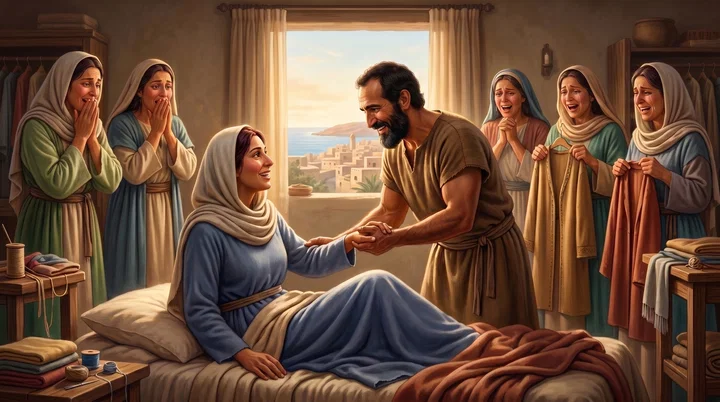
Then Peter arose and went with them. When he was come, they brought him into the upper chamber: and all the widows stood by him weeping, and shewing the coats and garments which Dorcas made, while she was with them.
Translations
Then Peter arose and went with them. When he was come, they brought him into the upper chamber: and all the widows stood by him weeping, and showing the coats and garments which Dorcas made, while she was with them.
King James Version, KJV Cambridge Paragraph Bible
Then Peter arose and went with them. When he was come, they brought him into the upper chamber: and all the widows stood by him weeping, and shewing the coats and garments which Dorcas made, while she was with them.
Then Peter arose, and went with them. When he had come, they brought him into the upper chamber: and all the widows stood by him weeping, and showing the coats and garments which Dorcas made, while she was with them.
And Peter arose and went with them. And when he was come, they brought him into the upper chamber: and all the widows stood by him weeping, and shewing the coats and garments which Dorcas made, while she was with them.
And Peter arose and went with them. And when he was come, they brought him into the upper chamber: and all the widows stood by him weeping, and showing the coats and garments which Dorcas made, while she was with them.
And Peter having risen, went with them, whom having come, they brought into the upper chamber, and all the widows stood by him weeping, and shewing coats and garments, as many as Dorcas was making while she was with them.
And Peter rising up went with them, whom, when arrived, they brought up into the upper chamber; and all the widows stood by him weeping and shewing him the body-coats and garments which Dorcas had made while she was with them.
And Peter, arising, went with them,—whom, when he arrived, they brought up into the upper room; and there stood by him all the widows, weeping, and showing the tunics and mantles—whatsoever things Dorcas was making while she was with them.
Berean Standard Bible, Majority Standard Bible
So Peter got up and went with them. On his arrival, they took him to the upper room. All the widows stood around him, weeping and showing him the tunics and other clothing that Dorcas had made while she was still with them.
Peter got up and went with them. When he had come, they brought him into the upper room. All the widows stood by him weeping, and showing the tunics and other garments which Dorcas had made while she was with them.
And Peter went with them. And when he had come, they took him into the room: and all the widows were there, weeping and putting before him the coats and clothing which Dorcas had made while she was with them.
Then Peter arose and came with them: and when hee was come, they brought him into the vpper chamber, where all the widowes stoode by him weeping, and shewing the coates and garments, which Dorcas made, while she was with them.
Douay-Rheims (Challoner revision)
And Peter rising up, went with them. And when he was come, they brought him into the upper chamber. And all the widows stood about him weeping, and shewing him the coats and garments which Dorcas made them.
Pictures
Cross-references
- Mark 5:41-42
And he took the damsel by the hand, and said unto her, Talitha cumi; which is, being interpreted, Damsel, I say unto thee, arise.
Peter follows Jesus’ example in raising a dead girl.
- Luke 7:14-15
And he came and touched the bier: and they that bare him stood still. And he said, Young man, I say unto thee, Arise.
Jesus raises the widow’s son from the dead.
- John 11:43-44
And when he thus had spoken, he cried with a loud voice, Lazarus, come forth.
Jesus raises Lazarus from the dead, an example of literal resurrection.
- Jonah 1:3
But Jonah rose up to flee unto Tarshish from the presence of the LORD, and went down to Joppa; and he found a ship going to Tarshish: so he paid the fare thereof, and went down into it, to go with them unto Tarshish from the presence of the LORD.
Jonah sailed from Joppa
- Luke 8:51-55
And when he came into the house, he suffered no man to go in, save Peter, and James, and John, and the father and the mother of the maiden.
Both scenes place mourners in an upper chamber where a dead woman is raised.
- 1 Kings 17:17-24
And it came to pass after these things, that the son of the woman, the mistress of the house, fell sick; and his sickness was so sore, that there was no breath left in him.
Elijah was also an instrument in raising the dead.
- Acts 10:9-23
On the morrow, as they went on their journey, and drew nigh unto the city, Peter went up upon the housetop to pray about the sixth hour:
Peter receives his vision at Joppa before going to Cornelius.
- 2 Kings 4:32-37
And when Elisha was come into the house, behold, the child was dead, and laid upon his bed.
Elisha, like Peter, was an instrument in raising the dead.
- Acts 10:5-6
And now send men to Joppa, and call for one Simon, whose surname is Peter:
An angel directs Cornelius to send for Peter.
- 2 Chronicles 2:16
And we will cut wood out of Lebanon, as much as thou shalt need: and we will bring it to thee in floats by sea to Joppa; and thou shalt carry it up to Jerusalem.
cedars sent to Joppa
- Proverbs 31:31
Give her of the fruit of her hands; and let her own works praise her in the gates.
Her works are praised and receive their due honor.
- Acts 2:14-41
But Peter, standing up with the eleven, lifted up his voice, and said unto them, Ye men of Judæa, and all ye that dwell at Jerusalem, be this known unto you, and hearken to my words:
Peter preaches to the gathered people at Pentecost.
- James 1:27
Pure religion and undefiled before God and the Father is this, To visit the fatherless and widows in their affliction, and to keep himself unspotted from the world.
Dorcas’s garments exemplify pure religion through care for widows.
- Proverbs 31:13
She seeketh wool, and flax, and worketh willingly with her hands.
Both portray a woman’s willing handiwork and care for others.
Commentary
Each commentary is drawn from primary sources: the writings of Ellen G. White and Adventist pioneers and periodicals. Each commentary is separate. Its own words are not a quotation; follow the references to read the source passages.
Ellen G. White
11 sources
Peter left Lydda for nearby Joppa after believers there heard of his cures at Lydda and sent messengers asking him to come because Tabitha lay dead, and when he arrived he was brought into the upper chamber.3SP 323.3–324.1AA 131.2 Tabitha, which by interpretation is Dorcas, lived at Joppa as a greatly beloved and worthy disciple of Jesus whose life was filled with charity and kindness to the poor and sorrowful and with zeal for the truth.3SP 323.3–324.1AA 131.2 Her skillful fingers were more active than her tongue, and she freely ministered to the wants of both body and heart, knowing who needed comfortable clothing and who needed sympathy.AA 131.25T 303.4–304.3
After her death all the widows stood by Peter weeping and showing the coats and garments Dorcas had made while she was with them and living among them.7RED 55.3–56.13SP 323.3–324.1AA 131.3–132.1ST May 15, 1879AC1 56.1 Those displayed garments were the work of her free ministry to the poor and sorrowful and stood as visible evidence of her noble and practical care.3SP 323.3–324.1AA 131.3–132.1ST May 15, 1879AC1 56.1AA 131.2 Their grief and the clothing she had made showed how her charitable work had benefited the community and how deeply her death was felt.7RED 55.3–56.1AA 131.3–132.1RH Apr 6, 1911
Her death was a great loss that the infant church could hardly spare, and the weeping and tears over her testified to how deeply she was loved and valued.3SP 323.3–324.1AA 131.3–132.15T 303.4–304.3RH Apr 6, 1911 Peter sent the mourners out of the chamber, prayed, and called her to rise, and she returned to life.ST May 15, 1879 She was of so great value that by the power of God she was brought back from the land of the enemy, that her skill and energy might still be a blessing to others and she could continue making garments for the poor.5T 303.4–304.3ED 217.1–2 Her restoration led many in Joppa to believe in Jesus.ST May 15, 1879
Her patient, prayerful, and persevering fidelity and everyday sewing work remain the pattern for the Dorcas line of practical charity in supplying clothing and relief to the needy.5T 303.4–304.3ED 217.1–2Lt 89, 1895, par. 2–3TSSW 109.4–5 That work of supplying clothing and relief can be continued as long as time shall last, for there will always be work to be done without end and very little to show for it.Lt 89, 1895, par. 2–3 God honors such everyday labor, and her faithful example is needed in the church, the Sabbath school, and society.ED 217.1–2TSSW 109.4–5
Sources
Pioneers and periodicals
59 sources
Peter went from Lydda to Joppa with the messengers sent after Dorcas died, and was brought into the upper chamber where her body lay prepared for burial.ST Jun 17, 1897ST Mar 18, 1897ST Apr 2, 1902ST Nov 24, 1898 All the widows stood by him weeping and showing the coats and garments she had made while she was with them, bearing witness to her practical kindness and care for the poor.ST May 15, 1879ST Oct 7, 1897ST Oct 7, 1897ST Apr 2, 1902ST Mar 20, 1884 Peter put the mourners out, prayed, called her to rise, and presented her alive to the saints and widows.ST May 15, 1879RH Nov 21, 1912ST Apr 2, 1902 Her restoration was a sign of God's directing power that led many in Joppa to believe in Jesus.ST May 15, 1879ST Nov 18, 1903ST Apr 2, 1902 Her needlework for the needy remains the pattern for Christian help work for the poor and for organizing it to continue her loving service.RH Mar 9, 1911ST Mar 20, 1884RH Jul 22, 1909RH Mar 10, 1903ST Jul 8, 1913
Journey to Upper Chamber
Peter arose and went with the messengers from Lydda to Joppa after Dorcas died, the disciples having sent asking him to come without delay, and when he arrived they brought him into the upper chamber where her body lay prepared for burial.ST Jun 17, 1897ST Mar 18, 1897ST Apr 2, 1902ST Nov 24, 1898 This took place about A.D. 40 while he was traveling from place to place preaching the gospel and confirming the churches raised up by those scattered by persecution, immediately after he had healed Aeneas at Lydda of eight years of palsy when the disciples at Joppa heard he was there.ST Jun 17, 1897ST Nov 24, 1898 Lydda was nigh to Joppa, ten miles away on the principal caravan route between Syria and Egypt.ST Nov 24, 1898
The call is also reckoned as carried twelve miles from Joppa by humble lay brethren after the death of Dorcas, which Peter answered on foot as a Spirit-led call.ST Nov 18, 1903 Going with the messengers to the upper chamber was an entirely different phase from what he had encountered at Lydda, designed to meet the needs of that locality.ST Apr 9, 1902 It belonged to his tarrying at Joppa while God was preparing a further experience that would meet the needs of the people to whom he would go next and enlarge his own view of the scope of the gospel.ST Apr 9, 1902
The chamber scene was marked by public grief and customary mourning practices, with mourning women gathered where Dorcas lay.ST Mar 27, 1907 The words of the verse, taken apart from their story and treated as a sign directing a decision, cannot establish a biblical principle or provide reliable guidance about whether someone should go to a particular place.ST Mar 6, 1893
Widows and Garments
When Peter entered the upper chamber, all the widows stood beside him weeping and holding up the coats and garments Dorcas had made while she was with them, bearing witness to her practical kindness, care for the poor, and loving service.ST May 15, 1879RH Apr 6, 1911ST Oct 7, 1897ST Oct 7, 1897ST Dec 7, 1915 Their grief displayed both the loss her death brought and the depth of affection her life of service had created, and her death was felt as deeply affecting those she had clothed while alive.RH Apr 6, 1911ST Oct 7, 1897RH Aug 3, 1905 Some of the widows were wearing the very coats and garments she had made for them, showing her customary care for the poor and the lasting value of her good works.ST Mar 18, 1897 Dorcas had been one of the principal missionaries at Joppa, giving much of her time to visiting the sick and making garments for the poor and suffering with her needle.ST Apr 2, 1902ST Mar 20, 1884
She was a seamstress who made coats and garments for widows and others around her, and such plain sewing for the poor was a lasting work of kindness whose effects kept her memory alive.ST Jan 18, 1916ST Apr 19, 1883 She was called back from death that she might continue that everyday toil, which shows how God honors faithful labor in common duties.ST Jan 18, 1916 She served quietly out of her own poverty with only hope and trust in God, and the same Spirit who empowered Samson moved her to such humble faithful work.RH Dec 30, 1915RH Apr 7, 1903 This humble faithful work with the needle for others is of boundless blessing to the world.RH Apr 7, 1903 She was a quiet, useful believer whose good works and care for others were remembered without her becoming a prominent leader such as an apostle.RH Aug 19, 1862
Her death was deeply felt as a great loss to the church, for her work had made her deeply loved and beloved for her good works.RH Apr 6, 1911RH Nov 16, 1911 A life spent in practical love for souls leaves a better memorial than banks of funeral flowers or a costly monument.ST Aug 31, 1915ST Mar 20, 1893 It is worth more to have poor souls stand around a coffin telling how need was met with coal on a cold day, flour for hunger, and a coat for lack of clothing.ST Aug 31, 1915 She did not wait to be loved but went about loving souls, so when she lay cold in death a great flood of tears flowed for her.ST Aug 31, 1915ST Aug 31, 1915
Raising and Its Results
The weeping in the upper chamber ends with Tabitha raised from the dead in answer to prayer, when Peter puts the mourners out, prays, calls her to rise, and presents her alive to the saints and widows.ST May 15, 1879RH Nov 21, 1912ST Apr 2, 1902 Her return to life is an act of God's Spirit, who is the source of life, and stands as an example of the Spirit's power to raise the dead.ST Oct 10, 1906 The same word that raised her carries power to heal.ST Jul 29, 1913
Peter in this work is an instrument through whom God's power works.ST Jan 22, 1902RH Aug 7, 1913 He stands as the Lord's representative, sent even as the Father sent Christ.ST Jan 22, 1902 The raising is wrought by the Spirit of God through Peter as apostle and chosen servant, the same Spirit by which Jesus of Nazareth worked, so it stands on the same ground as Jesus raising Jairus's daughter and must not be ranked as lesser.ST Feb 21, 1906 It fulfills Christ's promise that he who believes on Him will do the works He did and a larger number because He went to the Father.ST Jan 22, 1902 Having received the Holy Ghost, which never errs in judgment, Peter's word spoken by the Spirit's direction is the word of God through him and carries the power of God's command, demonstrating in action the contrast between the kingdom of heaven and the kingdoms of earth and creating desire in sufferers from sin to become subjects of a better kingdom that promises relief from every earthly ailment and from sin and its results.ST Jan 22, 1902
God does not leave angels to do the work alone but sends people to minister to the need, so God's army above always cooperates with God's children below.ST Sep 30, 1908 Not one soul is born into His kingdom without travail on the part of some other soul, and in the great day sower and reaper will rejoice together, so that neither any one man nor any one angel will say a soul was saved because of his labor alone.ST Sep 30, 1908 The widows' grief at that time bewailed the loss of a temporal benefactor, showing that as the extent of their appreciation, and her laying down her life was necessary to tender their hearts more effectually, so that a more striking manifestation of God's goodness would show them the real Source of all their blessings.ST Nov 18, 1903 Her restoration was a sign that the Lord was directing the gospel work.ST Apr 2, 1902ST Jun 26, 1901 It led many in Joppa to believe in Jesus and to glorify God for saving power.ST May 15, 1879ST Nov 18, 1903ST Apr 2, 1902 She was called back from death that she might continue her everyday work as a seamstress making garments for the poor, showing how God honors faithful labor in common, everyday duties.ST Jan 18, 1916
Prophecy Doctrine and Proof
Acts 9:39 stands in the time of the giving of the gospel to the Gentiles in A.D. 34, the year that closes the 490 years cut off from the 2,300 years and marks the cutting off of the Jewish nation as God's special people.ST Nov 28, 1895 It belongs with Peter's vision and ministry at Joppa as evidence that God continued to communicate with the church through visions after Christ's ascension.RH Jun 26, 1855 The account of the resurrection in the upper room where Peter stood with the mourning widows showing the garments Tabitha had made mentions nothing of the sanctification of the first day of the week.ST Jun 1, 1882 Peter's coming to the upper room and raising her from the dead was a resurrection miracle, yet the miracle by itself did not prove Jesus was the Messiah, since other people were also raised from the dead.ST Jan 30, 1912
Like Lazarus and others raised by Christ and the apostles, Dorcas left no report of conscious experience in death, supporting the conclusion that the dead are totally unconscious.RH Aug 24, 1905 Her resurrection, like that of Lazarus, was literal though reckoned as occurring before Christ's resurrection, depending on Christ's promised death and resurrection made as certain as if already accomplished by God's promise, and Christ is first-fruits not as the first raised in time but as the chief whose resurrection made the resurrection of all possible and could therefore be called first.ST Nov 29, 1883 Her living again was an exception to the general rule of resurrection occurring since the first advent of Christ, coming only by a resurrection from the dead through the power of Christ, without which even those fallen asleep in Christ would have utterly perished.ST Jan 28, 1889
When she lay dead after making coats and garments in charitable work, Peter did not tell her to do more charitable work and sew more garments in order to live, but in the name of Jesus restored her to life in order that she might pursue her good works.ST Jul 23, 1896 Life must necessarily precede action, so righteousness on the principle of doing something in order to live is impossible and an empty dream.ST Jul 23, 1896 Christ gives the eternal and righteous life of God, which then works righteousness in the soul it has quickened.ST Jul 23, 1896
Pattern for Christian Service
The coats and garments shown by the widows are evidence of Dorcas's labors, proving that a woman's practical care for the needy can bless others and be remembered after her death.RH Dec 14, 1911ST Apr 14, 1881 That care through making clothes is an example of thoughtful, useful work connected with domestic care for others to follow.ST May 28, 1912ST Apr 14, 1881 It is missionary service for God and fellow people, testified to by the grief of the widows and their display of what she had made.ST Apr 14, 1881RH Oct 3, 1907
Her needlework shows the proper use of the hands to serve the poor and needy rather than spending time on personal adornment.RH Apr 7, 1903RH May 16, 1871 It is the pattern of active service in the apostolic church, visible in the handiwork displayed by the mourning widows.RH Jul 15, 1862RH Mar 21, 1871 Such humble faithful work done with only hope and trust in God, as everyday work done for Christ, is of boundless blessing to the world.RH Apr 7, 1903RH Jul 15, 1862
Her clothing made for widows is the example for Christians who prepare clothing and other necessities for people in need.RH Jul 22, 1909RH Mar 10, 1903 That model includes repairing and remaking clothing for the poor as practical care belonging to deaconesses' work.RH Jul 22, 1909RH Mar 10, 1903
Filling the earth with God's glory requires messengers including laywomen who serve with practical needlework with needle and thread.RH Jan 16, 1900 They are called like preachers and other workers to go to Africa, China, India, Cuba, Porto Rico and every needy field and help.RH Jan 16, 1900
Her care is the biblical example behind Dorcas work as Christian help work for the poor through practical acts of care.ST Mar 3, 1881RH Dec 18, 1913 Her loving service in making clothing for the poor and suffering inspired continuing work to help the poor through Dorcas societies.RH Mar 9, 1911ST Mar 20, 1884 The account is therefore the model for organizing a Dorcas Society to care for the poor and continue her service, as seen where widows mourned and displayed the coats and garments she had made.RH Mar 9, 1911ST Jul 8, 1913ST Mar 3, 1881
Those who do such Christian help work for the poor are necessary helps in the great cause of Christ, manifesting the gift of helps as the Spirit gives as He wills.CO 35.1 Yet they are not, Biblically speaking, officers of the church.CO 35.1
Women who out of their own poverty make coats and garments for the poor, distribute gifts at the mission, comfort sorrow, and give without speaking of their own trouble or seeking notice and praise are genuine Dorcases following her pattern.ST Jul 21, 1898 Their life is holy and blessed, mourned by widows and the poor who show her work and testify how she worked for them.ST Jul 21, 1898 Though they rest in death, they will arise out of the dust in the resurrection and be crowned by angels.ST Jul 21, 1898 Their reward is the people whose knowledge of Christ came through their sacrifice and faithfulness.ST Jul 21, 1898RH Apr 2, 1914
A life spent in practical love for souls leaves a better memorial than banks of funeral flowers, for it is worth more to have poor souls stand around telling how need was met with coal on a cold day, flour for hunger, and a coat for lack of clothing.ST Aug 31, 1915 She did not wait to be loved but went about loving souls, so a great flood of tears flowed when she lay cold in death.ST Aug 31, 1915ST Aug 31, 1915 That same active, loving life is what is needed today in the church of God.ST Aug 31, 1915ST Aug 31, 1915 She was a seamstress who made garments for the poor and was called back from death that she might continue that work, and God thus honored her everyday toil to teach children and youth how He honors faithful labor in common, everyday duties.ST Jan 18, 1916
In one case the example was invoked when women established a Dorcas Society and seamstresses contributed their labor.RH Jun 30, 1863 But its proceeds were directed to supporting ministers and educating promising young men rather than simply continuing charitable work.RH Jun 30, 1863
Sources