Daniel 8:3
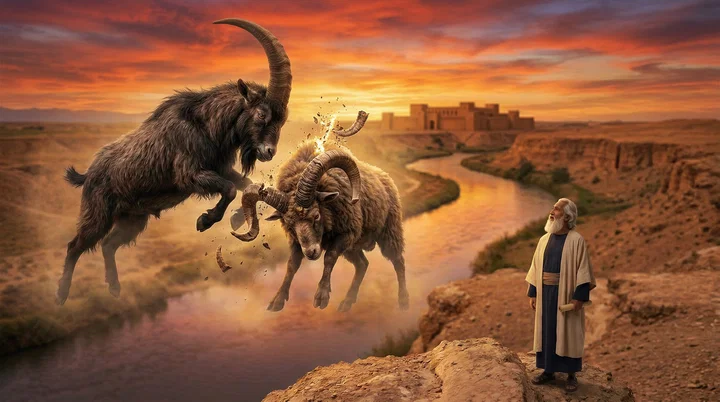
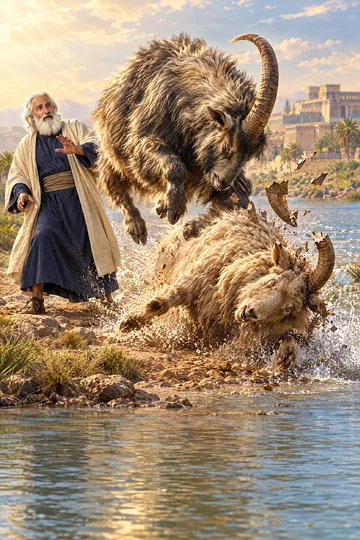
Then I lifted up mine eyes, and saw, and, behold, there stood before the river a ram which had two horns: and the two horns were high; but one was higher than the other, and the higher came up last.
Translations
Then I lifted up my eyes, and saw, and, behold, there stood before the river a ram which had two horns: and the two horns were high; but one was higher than the other, and the higher came up last.
King James Version, Revised Version, American Standard Version
Then I lifted up mine eyes, and saw, and, behold, there stood before the river a ram which had two horns: and the two horns were high; but one was higher than the other, and the higher came up last.
Then I lifted up mine eyes, and saw, and behold, there stood before the river a ram which had two horns: and the two horns were high; but one was higher than the other, and the higher came up last.
Then I lifted up my eyes, and saw, and behold, there stood before the river a ram which had two horns: and the two horns were high; but one was higher than the other, and the higher came up last.
And I lift up mine eyes, and look, and lo, a certain ram is standing before the stream, and it hath two horns, and the two horns [are] high; and the one [is] higher than the other, and the high one is coming up last.
And I lifted up mine eyes and saw, and behold, there stood before the river a ram which had two horns; and the two horns were high; and one was higher than the other, and the higher came up last.
So then I lifted up mine eyes, and looked, and lo! a ram, standing before the river, and, it, had two horns,—and, the two horns, were high, but, the one, was higher than the other, and, the higher, had come up, last.
Berean Standard Bible, Majority Standard Bible
Then I lifted up my eyes and saw a ram with two horns standing beside the canal. The horns were long, but one was longer than the other, and the longer one grew up later.
Then I lifted up my eyes and saw, and behold, a ram which had two horns stood before the river. The two horns were high, but one was higher than the other, and the higher came up last.
And lifting up my eyes, I saw, there before the stream, a male sheep with two horns: and the two horns were high, but one was higher than the other, the higher one coming up last.
Then I looked vp and sawe, and beholde, there stoode before the riuer a ramme, which had two hornes: and these two hornes were hie: but one was hier then another, and the hyest came vp last.
Douay-Rheims (Challoner revision)
And I lifted up my eyes, and saw: and behold a ram stood before the water, having two high horns, and one higher than the other, and growing up. Afterward
Pictures
Cross-references 20 of 26
- Daniel 8:20
The ram which thou sawest having two horns are the kings of Media and Persia.
Identifies the two-horned ram as the kings of Media and Persia.
- Daniel 8:14
And he said unto me, Unto two thousand and three hundred days; then shall the sanctuary be cleansed.
The ram vision’s 2,300-day timeline ends with the sanctuary’s cleansing.
- Daniel 8:21
And the rough goat is the king of Grecia: and the great horn that is between his eyes is the first king.
Identifies the goat as Grecia, the empire following the ram.
- Daniel 9:21-23
Yea, whiles I was speaking in prayer, even the man Gabriel, whom I had seen in the vision at the beginning, being caused to fly swiftly, touched me about the time of the evening oblation.
Gabriel comes to explain the vision of Daniel 8.
- Daniel 8:16
And I heard a man’s voice between the banks of Ulai, which called, and said, Gabriel, make this man to understand the vision.
Gabriel is commanded to help Daniel understand the vision.
- Daniel 8:9-12
And out of one of them came forth a little horn, which waxed exceeding great, toward the south, and toward the east, and toward the pleasant land.
The little horn follows the earlier kingdoms and opposes God’s people and truth.
- Daniel 9:24-27
Seventy weeks are determined upon thy people and upon thy holy city, to finish the transgression, and to make an end of sins, and to make reconciliation for iniquity, and to bring in everlasting righteousness, and to seal up the vision and prophecy, and to anoint the most Holy.
Daniel 9 explains the time left unresolved in Daniel 8 through the seventy weeks.
- Daniel 2:39
And after thee shall arise another kingdom inferior to thee, and another third kingdom of brass, which shall bear rule over all the earth.
The silver kingdom following Babylon corresponds to the two-horned ram’s empire.
- Daniel 8:8
Therefore the he goat waxed very great: and when he was strong, the great horn was broken; and for it came up four notable ones toward the four winds of heaven.
The ram and goat symbolize successive empires, with Alexander’s empire divided after his fall.
- Daniel 11
Also I in the first year of Darius the Mede, even I, stood to confirm and to strengthen him.
Daniel 11 continues and explains the vision of Daniel 8.
- Daniel 7:2-8
Daniel spake and said, I saw in my vision by night, and, behold, the four winds of the heaven strove upon the great sea.
The beasts of chapter 7 parallel the kingdoms represented in the chapter 8 symbols.
- Daniel 8:22
Now that being broken, whereas four stood up for it, four kingdoms shall stand up out of the nation, but not in his power.
Four kingdoms divide Greece after its first king.
- Daniel 8:23-25
And in the latter time of their kingdom, when the transgressors are come to the full, a king of fierce countenance, and understanding dark sentences, shall stand up.
The angel explains the later power in the vision.
- Daniel 9:21
Yea, whiles I was speaking in prayer, even the man Gabriel, whom I had seen in the vision at the beginning, being caused to fly swiftly, touched me about the time of the evening oblation.
Gabriel returns to explain the vision Daniel saw earlier.
- Daniel 8:11-13
Yea, he magnified himself even to the prince of the host, and by him the daily sacrifice was taken away, and the place of his sanctuary was cast down.
A power exalts itself and takes away the daily sacrifice, leaving the sanctuary and host trodden down.
- Daniel 8:26-27
And the vision of the evening and the morning which was told is true: wherefore shut thou up the vision; for it shall be for many days.
The vision’s evening-and-morning period is affirmed, while Daniel remains astonished and unable to understand it.
- Daniel 10:4
And in the four and twentieth day of the first month, as I was by the side of the great river, which is Hiddekel;
Both visions are set beside a river, identified here as Hiddekel.
- Daniel 8:7
And I saw him come close unto the ram, and he was moved with choler against him, and smote the ram, and brake his two horns: and there was no power in the ram to stand before him, but he cast him down to the ground, and stamped upon him: and there was none that could deliver the ram out of his hand.
The goat smashes and stamps the ram.
- Daniel 8:25
And through his policy also he shall cause craft to prosper in his hand; and he shall magnify himself in his heart, and by peace shall destroy many: he shall also stand up against the Prince of princes; but he shall be broken without hand.
The ram-and-goat vision promises that evil power will be broken without human hand.
- Daniel 7:5
And behold another beast, a second, like to a bear, and it raised up itself on one side, and it had three ribs in the mouth of it between the teeth of it: and they said thus unto it, Arise, devour much flesh.
The ram and the bear both symbolize the Medo-Persian empire.
Commentary
Each commentary is drawn from primary sources: the writings of Ellen G. White and Adventist pioneers and periodicals. Each commentary is separate. Its own words are not a quotation; follow the references to read the source passages.
Ellen G. White
3 sources
The ram standing before the river was shown to Daniel directly by God by the Ulai in the third year of Belshazzar, in 553 B.C., fifty-three years after Jerusalem was taken and the seventy-year captivity began.LS 45.2–3Ms 142, 1901, par. 6 It belongs to the prophecies of events to come recorded in Daniel chapters 7-12.PK 547.1 The chapter 8 vision forms the setting for Daniel's later concern about the 2,300 days, while this verse itself gives no further explanation of the ram.LS 45.2–3 The revelation was not fully understood in Daniel's lifetime but was sealed until the time of the end, its light given especially for the last days.PK 547.1Ms 142, 1901, par. 6 Its foretold events are now being fulfilled and will soon come to pass.Ms 142, 1901, par. 6
Sources
Pioneers and periodicals
161 sources
The ram is the kings of Media and Persia, the Medo-Persian kingdom explained so plainly that no conjecture remains.RH Jun 21, 1870ST Nov 19, 1885RH Dec 23, 1852 Its two horns are the Medes and the Persians united in one government under one beast, both high but one higher than the other because the higher came up last.RH Jun 21, 1870RH Dec 30, 1915ST Nov 17, 1881 The Medes first held the ascendancy and regal power, then the Persians rose later to greater power and became the leading and controlling division.RH Jun 21, 1870RH Dec 30, 1915ST Nov 17, 1881 It is the second temporal kingdom after Babylon, succeeding Babylon as world empire in 538 B.C. and reigning supreme until overthrown by Grecia.STST Dec 24, 1894ST Dec 24, 1894 It corresponds to the breast and arms of silver in Daniel 2 and the bear in Daniel 7, pushing westward and northward and southward in conquest until no beast could stand before it, doing according to its will and becoming great.RH Jun 21, 1870RH Jul 14, 1863RH Nov 21, 1854ST Sep 21, 1882RH Feb 17, 1853
Vision Setting and Picture
Daniel lifted up his eyes and saw standing before the river a ram with two high horns, both high but one higher than the other, and the higher came up last.RH Jun 21, 1870ST Feb 20, 1912ST The two horns were high and unequal, the taller rising later than the other.RH Jun 21, 1870RH Dec 30, 1915ST In the vision he was in Shushan the palace in Elam by the river Ulai, beside the river, seeing the ram before the river.ST Feb 20, 1912ST Dec 24, 1894ST Dec 24, 1894ST Jul 27, 1915 Prophets in vision are often placed amid the scenes of the future events being shown to them. The first symbol presented to the eye in the vision is this ram standing before the river.RH Dec 23, 1852
The vision was given in the third year of Belshazzar, two years after the vision of chapter 7, in the last year of Babylon.ST Feb 20, 1912RH May 12, 1910ST Mar 11, 1889RH Nov 25, 1902 That was about 538 B.C., when Babylon was about to fall to Medo-Persia and the Medo-Persian power was just at hand.ST Dec 24, 1894ST Dec 24, 1894RH May 12, 1910ST Jul 27, 1915 Daniel was then eighty-six years old, shut inside the doomed city, seeing himself in Shushan by the river Ulai.ST Jul 27, 1915 The vision of chapter 9 followed only weeks or months later in the first year of Darius, less than two years apart and probably in the same year, so the timing in relation to Daniel 9 is not essential to interpreting the prophecy.RH May 12, 1910ST Mar 11, 1889RH May 12, 1910 One reckoning dates the third year of Belshazzar to 553 B.C., fifty-three years after Jerusalem was taken and the seventy-year captivity began.LS 45.2–3
The verse stands in the Hebrew portion of Daniel running from chapter 8 to the close, after the Aramaic section from Daniel 2:4 to the end of chapter 7.RH Nov 25, 1873 Hebrew is used here because the subject is the restoration of the Jews and God's future dealings with them.RH Nov 25, 1873 The narrative begins in native Hebrew, uses Aramaic for speeches and proceedings at the Babylonian court because that language was spoken at court and understood by the Jews generally, continues Aramaic through chapter 7 because of the great similarity in subject between chapters 2 and 7, then returns to native Hebrew.RH Nov 25, 1873 This mingling of Hebrew and Aramaic, as in Ezra and Jeremiah, could only occur when both languages were currently spoken by the Jews, and shows the account was written for the common people during the Babylonian captivity.RH Nov 25, 1873
The vision concerns earthly kingdoms and the people of God, and this verse belongs to the part about kingdoms as kingdoms.ST Feb 20, 1912ST Sep 9, 1913ST Jul 10, 1901 It views nations in relation to religion and as enemies of the gospel, revealing God's work where days stand for years.ST Aug 9, 1910 Beasts represent governments, and the ram with the other beasts depicts their work in connection with God's people, not every act of those governments.ST Aug 9, 1910RH Jun 25, 1857 This line of prophecy covers the same ground and powers as the other lines and points to Christ's second coming and the everlasting kingdom.ST Aug 9, 1910
Ram Means Medo-Persia
The ram is the kings of Media and Persia, the kingdom of Media and Persia, the Medo-Persian Empire, as Gabriel explained by divine command in language that cannot be misunderstood and leaves no room for conjecture.RH Jun 21, 1870ST Nov 19, 1885RH Dec 23, 1852RH Oct 3, 1912ST Nov 17, 1881 The vision begins when Medo-Persia is at the height of its power, and the ram is one of the powers that preceded the little horn in the prophecy.ST Nov 19, 1885RH Dec 23, 1852 The ram represents the kings of Media and Persia in the vision of world history from the end of Babylon until the end of earthly kingdoms.RH Oct 3, 1912 The ram with two high horns represents the Medes and Persians, the two peoples making up the empire.RH Jun 21, 1870ST Nov 17, 1881
The ram is the second temporal kingdom after Babylon, succeeding Babylon as world empire in 538 B.C. and reigning supreme until overthrown by Grecia.STST Dec 24, 1894ST Dec 24, 1912ST Sep 21, 1882RH Feb 17, 1853 Media and Persia were ascending to world supremacy as Babylon's rule ended in 538 B.C., with the ram as the first power in this vision's sequence rising as Babylon's supremacy ended.ST Dec 24, 1894ST Dec 24, 1894 The ram is Media and Persia following Babylon and preceding Greece and Rome, the silver of the statue after the gold and the bear that takes the domain from the defeated lion.ST Dec 24, 1912ST Sep 21, 1882RH Feb 17, 1853 It takes power by shedding the blood of Babylon's monarch and nobles, then is softened by ease and weakened by plenty until it falls beneath the sword of the forcible Greek, the same power as the bear in Daniel 7 and the breast and arms of silver in Daniel 2.ST Sep 21, 1882RH Feb 17, 1853
The ram was a familiar national emblem of Persia, and Persian kings wore a gold diadem shaped like a ram's head.RH Nov 26, 1857RH Sep 13, 1915ST Jan 22, 1880 Ram figures with unequal horns were found at Persepolis, and depictions of a ram's head with two unequal horns match the prophecy with the higher horn coming up later.RH Sep 13, 1915RH Nov 19, 1901 Rams' horns also adorned the empire's golden diadem, and the gold ram's head was the diadem of the Persian king identifying the symbol.RH Sep 13, 1915RH Nov 19, 1901 The ram emblem was also used on Persian kings' golden diadems, and the ram was a known emblem of the Medes and Persians.ST Jan 22, 1880
In symbolic prophecy living creatures represent mighty nations and governments, with beasts representing governments and earthly powers and strange prophetic creatures symbolizing kingdoms that rise and fall.RH Jun 25, 1857RH Apr 29, 1909ST Sep 9, 1913 This ram is an ordinary beast symbol in contrast to the fierce, cruel beasts of Daniel 7 that represent persecuting governments where church and state are united. Its ram and other beasts depict their work in connection with God's people, not every act of those governments.RH Jun 25, 1857 Its application is clear and definite and has no reference to the United States.
A horn in prophecy symbolizes a ruler, kingdom, nation, and power itself, the entire power of the beast civil and religious and ecclesiastical, strength and power and glory and honor, not civil power alone.RH Mar 21, 1854ST Jan 6, 1887RH May 8, 1916RH Jul 2, 1857ST Dec 11, 1879 The ram's two horns denote the kings of Media and Persia and prove that a horn symbolizes a ruler, either civil or ecclesiastical.RH Mar 21, 1854RH Jul 2, 1857RH May 19, 1851 Horns used symbolically in Daniel 7 and 8 represent kingdoms or nations, with kingdoms represented by beasts and horns and days standing for years.ST Jan 6, 1887RH May 8, 1916 Two horns can belong to one beast and represent elements united within it rather than a division, and a horn can also represent civil or ecclesiastical power.ST Dec 11, 1879 Horns in prophetic symbols can signify the civil powers of a kingdom, whether civil or ecclesiastical rulers.RH Jul 2, 1857RH May 19, 1851
Meaning of Two Horns
The two horns are the two nationalities, divisions, branches and elements of which the empire consisted, the Medes and Persians, the kings of Media and Persia, united in one government and pictured by one beast rather than as a divided power.RH Jun 21, 1870ST Nov 17, 1881RH Mar 29, 1864ST Jan 22, 1880 Both horns were high, but one was higher than the other and the higher came up last, meaning the Medes first held ascendancy and regal power and then the Persians rose later to greater power and became the leading division and controlling power.RH Jun 21, 1870RH Dec 30, 1915ST Nov 17, 1881ST Dec 24, 1894 The higher horn that came up last is the Persian element, which from being at first simply an ally of the Medes came to be the leading division of the empire.RH Jun 21, 1870ST Nov 17, 1881 Like the two arms of the image in Daniel 2, the two horns denote the two divisions of the empire, the Medes and the Persians.ST Jan 22, 1880RH Nov 26, 1857
At first the regal power was vested solely in Darius king of the Medes while Cyrus the Persian served as commander-in-chief of the combined armies, so Darius the Median took the kingdom when Babylon fell though Cyrus had done the work of subjugation.ST Jan 22, 1880RH Nov 26, 1857 Cyrus then married the daughter of Darius and received Media in reversion after her father's death, and having already succeeded his own father in Persia, he added Media to his dominions about two years after the taking of Babylon and became absolute monarch of the whole.ST Jan 22, 1880RH Nov 26, 1857 The Median took the kingdom on the death of Belshazzar, and after Darius's death Cyrus succeeded to Media and became ruler of the combined empire.RH Nov 26, 1857RH Jan 31, 1856 The two peoples thus united into one empire, with its ruling house in the Persian line and Darius the Median succeeded to Media's throne while Cyrus ruled Persia and became the leader of both armies.ST May 10, 1877RH Nov 26, 1857
The same inequality and later Persian eminence is shown by the bear raising itself up on one side.ST Sep 29, 1881ST Apr 5, 1877RH Jan 31, 1856 The two horns mark this twofold character, matching the two arms of silver in the image of Daniel 2 and the bear of Daniel 7.ST Mar 1, 1877RH Feb 23, 1869 This twofold character is distinctly marked in the ram, as in the bear, while the two legs of the fourth kingdom do not denote such a division.RH Feb 23, 1869 The taller horn growing up afterward means the Persian element rose last but reached the higher eminence and became the leading division of the kingdom.ST Sep 29, 1881ST Apr 5, 1877
The two horns signify its two elements or divisions, present from the beginning of the kingdom rather than arising later, and represent the Medes and Persians throughout the empire's existence, not Cyrus and Darius as individuals.RH Mar 16, 1869RH Dec 29, 1863 The vision shows the ram already at the height of its power, with its conquests extending westward, northward, and southward, so the prophetic period need not begin in its earliest years.RH Dec 29, 1863
Conquests and Greatness
The pushing westward and northward and southward denotes the directions in which the Medes and Persians carried their conquests, prevailing so that no beast could stand before the ram and none could deliver out of its hand.RH Jun 21, 1870RH Jul 14, 1863RH Feb 15, 1870RH Sep 13, 1915ST Oct 13, 1909 No earthly powers could stand before them while they were marching up to the exalted position to which the providence of God had pointed them, doing according to his will and becoming great.RH Jun 21, 1870RH Feb 15, 1870ST Dec 22, 1881 Its pushing in every direction except eastward was irresistible, and the beast of Revelation 13 afterward inherits in succession the strength and extent of power once held by Babylon, Persia, Greece, and Rome, though not on their several seats of empire.RH Jul 14, 1863ST Oct 13, 1909ST Dec 22, 1881
Westward Cyrus subdued Lydia and Babylon to the bounds of Asia in the west, northward against the Armenians, Cappadocians and others, and southward over Egypt by Cambyses.RH Sep 13, 1915RH Jan 31, 1856 The ram's pushing westward, northward, and southward was to Babylon, Libya and Egypt.RH Sep 13, 1915RH Jan 31, 1856 After taking the whole government Cyrus reigned from 536 B.C. and issued a decree allowing the Jews to return and rebuild the temple, ending the seventy-year captivity.ST Jan 22, 1880
Their conquests were so successfully prosecuted that in the days of Ahasuerus the Medo-Persian kingdom extended from India to Ethiopia, the extremities of the then known world, over one hundred and twenty-seven provinces.RH Jun 21, 1870 Persia the ram power reigning over 127 provinces is only called great, while Grecia after it is called very great and the Roman power after Grecia, pagan and papal, waxes exceeding great.RH Jun 21, 1870ST Feb 12, 1880RH Apr 30, 1857 The Syrian kingdom was only one division of Grecia, made up of twenty-six kings of whom Antiochus Epiphanes was the eighth, and therefore distinct from and far smaller than the ram and the powers that follow it.ST Feb 12, 1880
Place in Prophetic Sequence
The ram stands first in this vision's sequence, which leaves out Babylon altogether because Babylon was to be overthrown in Daniel's own day and its career was finished.RH Apr 30, 1857RH Nov 21, 1854RH May 12, 1910 Unlike the visions in Daniel 2 and Daniel 7, which begin with Babylon, this vision begins with Media and Persia already at the height of its power.RH Dec 23, 1852RH Apr 30, 1857RH Nov 21, 1854ST Jan 8, 1880 The omission is fitting because the vision was given in the third year of Belshazzar, his last year, in 538, the year Babylon fell and the first year of Darius the Median, when Medo-Persia was just at hand.RH May 12, 1910 It opens a third prophetic line and another view of the future history of the world bringing to view only the three remaining universal kingdoms, whose principal burden begun here is the sanctuary and its cleansing covering the solemn scenes of the great day of atonement and judgment belonging to the appointed time of the end.ST Jan 8, 1880 Its time feature of the 2300 days reaching to the cleansing of the sanctuary was not explained in chapter 8 so that none understood it, to be explained by the angel a little later in the first year of Darius.RH May 12, 1910
The ram is the second temporal kingdom after Babylon, the same power as the bear in Daniel 7 and the breast and arms of silver in the image of Daniel 2.RH Nov 21, 1854ST Sep 21, 1882RH Feb 17, 1853ST Jul 15, 1913ST Jun 3, 1897 It is the silver after the gold and the bear that takes the domain from the defeated lion.ST Sep 21, 1882 The identification is certain because the ram is expressly explained as the kings of Media and Persia, with the vision given when Babylon had practically passed away.ST Jul 15, 1913 It takes power by shedding the blood of Babylon's monarch and nobles, then is softened by ease and weakened by plenty until it falls beneath the sword of the forcible Greek.ST Sep 21, 1882 It is parallel to the bear, identifying Medo-Persia as beginning to take control of Babylon near the end of its rule, with its two horns signifying its two constituent powers with the Persian element becoming dominant.ST Jun 3, 1897ST Oct 10, 1906
A he-goat from the west with a notable horn, which is Grecia and its first king Alexander, runs upon the ram, overthrows and tramples it and stamps it underfoot, succeeding Medo-Persia as ruling world power.ST Jul 7, 1887ST Sep 17, 1885ST Oct 29, 1885ST Nov 28, 1895 This identifies Greece as the kingdom that succeeded Medo-Persia, corresponding to the brass kingdom in Daniel's image and proving the second of three overturnings of earthly dominion after Babylon, in which Grecia received dominion of the whole earth.ST Jul 7, 1887ST Jan 1, 1894 The prophecy foretells Grecia's later conquest and rise as a world empire, showing the Medo-Persian kingdom that Grecia later overpowered and succeeded.ST Sep 17, 1885ST Nov 28, 1895 It belongs to the testimony of Jesus spoken by the spirit of prophecy foretelling Alexander the Great's conquest of the world, in conquering the world at an early age in a manner little short of miraculous Alexander was cooperating with that prophecy, and because he fought in harmony with it he could easily conquer the world.ST Feb 13, 1912 The overthrow was shown by Granicus and Issus two hundred years later.ST Jul 7, 1887
The vision then continues through the little horn that waxes exceeding great, identified as Rome in pagan and papal phases, changing from Paganism to Papacy as the two desolating powers that oppress the church.RH Oct 6, 1863RH Dec 11, 1856RH Jan 28, 1858 The field of vision in Daniel 8 includes Rome putting saints to death, Rome standing up against the Prince of princes, and the fate of this power to be destroyed without hand at an appointed time, facts which together give conclusive proof of the scope and meaning of the chapter.RH Oct 6, 1863 Its 2300-day period ends in 1844, but the vision itself extends beyond that date to the destruction of earthly powers, with the little horn identified here with the fourth earthly kingdom not yet broken and its destruction distinct from the end of the 2300 days.RH Jun 4, 1857 Its symbols are described as fulfilled and its predicted events fulfilled in history, with the only event still awaited being the breaking of the exceedingly great horn without human hand and without human agency.RH Dec 11, 1856ST Sep 14, 1882RH Dec 13, 1853
One position applies the vision to Antiochus Epiphanes, his persecution of the Jews and his desecration of the temple around 160 B.C., presenting it as having a historical subject rather than being about Christ's coming or the setting up of God's everlasting kingdom.RH May 15, 1856 In that reckoning the vision of the ram, the he-goat with its great horn, the he-goat's four horns, and the little horn was claimed to have been fulfilled by Antiochus in three years, while the related 2300 days were explained as 1150 literal days fulfilled within about 55 days.RH May 1, 1856 The other position holds the chapter does not apply to Antiochus Epiphanes, and the little horn of that same fulfilled prophecy proving the book of Daniel is not Antiochus.ST Dec 27, 1905RH Dec 23, 1852 Antiochus Epiphanes was a Syrian king who could not resist the mandates of Rome, and applying the prophecy to him hides the Roman church's share in its fulfillment.RH Dec 23, 1852 Persia the ram power reigning over 127 provinces is only called great, standing first in a rising sequence in which Grecia after it is called very great and the Roman power after Grecia, pagan and papal, waxes exceeding great, while the Syrian kingdom was only one division of Grecia made up of 26 kings of whom Antiochus Epiphanes was the eighth, and therefore distinct from and far smaller than the ram and the powers that follow it.ST Feb 12, 1880 Those who held a differing teaching made the little horn of this vision Mahometanism, distinct from the little horn of Daniel 7 which is the Roman Catholic hierarchy, the difference proved by their respective places of origin and spheres of influence, and made its cleansing of the sanctuary have reference to affairs on earth at the destruction of Mahometanism.RH Apr 15, 1873
The vision includes a ram, a goat with a notable horn, four later horns, and a little horn, with a question about how long it would extend answered with 2,300 days and the cleansing of the sanctuary.ST Feb 18, 1886 Its transgression of desolation is the same power as the little horn of Daniel 7 and the man of sin of 2 Thessalonians 2.ST Jun 20, 1900 That power rises at the same time as the others, taking the place of the daily only after the daily has stood up against the Prince of princes and has cast down some of the host, which is the church, and of the stars, which are the apostles, and only after the time of the apostles when the one that restrains still held back the man of sin.ST Jun 20, 1900 The vision moves from Persia to Grecia and Alexander after a leap of centuries.ST Apr 23, 1912 Xerxes is identified as the richest Persian king, and his defeat by Grecia ends Persia's power as a world empire, with Alexander as the next king in the prophecy.ST Apr 23, 1912
Connection to Daniel 9 to 12
The voice from between the banks of Ulai commanded Gabriel to make Daniel understand the vision of the ram, the he-goat, the little horn and the 2,300 days, and Gabriel explained the ram with its two horns together with the goat and the little horn as the universal kingdoms of Medo-Persia, Grecia and Rome.RH May 26, 1853RH Aug 23, 1870RH Mar 17, 1853 Daniel understood this part of the vision, as he understood the he-goat as Greece and the little horn as Rome, and his difficulty was not with these kingdoms but with the cleansing of the sanctuary at the end of the 2,300 days, which he was applying to the close of the seventy years captivity and the repairing of the desolations of the sanctuary in ruins.RH Dec 31, 1857RH Aug 23, 1870ST Oct 18, 1877 What none understood at the close of the chapter was not the ram but the time, the 2,300 days, for which no starting point and no rule that prophetic days are years had yet been given.RH May 26, 1853RH Mar 17, 1853ST Jul 28, 1909 Daniel's later prayer sought understanding of what remained after he fainted with only the question of its time unexplained, and Gabriel returned to explain the time period.RH Dec 31, 1857RH Aug 23, 1870ST Jul 28, 1909 The 2,300 days belong to that vision, and the seventy weeks of years, that is 490 years, were cut off from those 2,300 days, so the two periods date from the same time and the longer extends 1,810 years after the shorter ends.RH May 26, 1853SMV 25.1
Daniel 9 is an appendix to Daniel 8 that completes the unfinished explanation, for Daniel did not understand the vision when Gabriel first appeared and Gabriel returned in Daniel 9 to complete that explanation.RH Aug 4, 1868RH Dec 23, 1852RH Aug 23, 1870 The seventy weeks are cut off from the 2,300 days as its first 490 years, beginning together, so wherever the seventy weeks begin the 2,300 days begin.RH Dec 23, 1852RH May 26, 1853SMV 25.1 The connection between the two chapters and between that period and the seventy weeks of Daniel 9 is a foundational interpretation and a main pillar of prophetic chronology, and denying it would shake that system.RH Aug 4, 1868RH Dec 23, 1852RH May 29, 1856 The vision's exposition identifies the sanctuary and explains its cleansing, the beginning and end of the 2,300 days, and the Advent people's disappointment about the time.RH May 29, 1856SMV 25.1
Daniel set his heart with prayer and fasting for three weeks to understand the former revelations, particularly the ram and he-goat which had left him sad and perplexed with only a far-fetched implication of the eventual triumph of the Prince and the host from the promise that the great apostate power would be broken without hand, and the vision of Daniel 10-12 was given to unfold those mysteries with more minute information.ST Apr 9, 1912ST Apr 9, 1912 Chapters 10-12 are one vision developing and filling up the outline of chapters 8 and 9, including the third monarchy and the little horn, so the prophecy covers the same ground, deals with the same powers, and reaches the same end as the vision of chapter 8.ST Apr 9, 1912RH Jan 17, 1856ST Apr 9, 1912 The vision, as continued and explained in those chapters, contains four prophetic periods, 2,300, 1,260, 1,290, and 1,335 days, of which the 2,300 days are the principal and longest period and the others are intermediate periods or subdivisions.RH Jul 18, 1871RH Jan 17, 1856ST Jul 27, 1882 The prophecy extending from Daniel 8:15 through Daniel 12:13, apart from Daniel's prayer and Gabriel's introductory remarks, explains the vision recorded in Daniel 8:1-14, and the prophetic periods in that explanation, including the seventy weeks, are parts of the great period represented in the vision and form connected links in one prophetic chain.RH Jul 18, 1871RH Jan 17, 1856 The opening ram with two horns begins the third line of prophecy, which begins with Medo-Persia after Babylon passed as a world power and continues through Grecia, the little-horn power, and the 2,300 days to the reign of Michael, covering the same ground and closing at the same time as the metallic image of Daniel 2, the four beasts and little horn of Daniel 7, and the kings of the north and south of Daniel 10-12.ST Apr 9, 1912ST Apr 9, 1912 It was given for the latter days and belongs to the time of the end, has to do with the indignation, ends with the final apostate power broken without hand with no human help, and its many days are the 2,300 days.ST Apr 9, 1912ST Apr 9, 1912
Daniel 11 is given mostly in plain language rather than figures and symbols and is a comment and explanation of the symbolic vision of Daniel 8, which is clothed in figures and symbols like the visions of Daniel 2 and Daniel 7.ST Jan 10, 1878RH Dec 28, 1911 Persia's kings there are followed by conflict with Grecia, and then by Alexander and the division of his empire, and the passage does not explain the ram or its horns specifically.ST Jan 10, 1878ST Apr 6, 1882 Daniel 11 is a literal prophecy that uses no symbols and for that reason is in some respects easier to understand.RH Dec 28, 1911 It gives the same prophecy of Grecia divided into four as the leopard with four heads, the rough goat having four horns answering to the four heads and to the kingdom broken into four divisions.ST Sep 29, 1881ST Apr 6, 1882
The 2,300-year period of the vision, connected with Daniel 9, provides the prophetic basis for the two great time messages concerning Christ's first and second coming.ST Sep 7, 1915 The question about how long the host would be trodden under foot is not answered in chapters 8 or 9, which also do not yet reveal what will happen to Daniel's people at the last end of the indignation.RH Jan 10, 1856
Time Period and Sanctuary
The 2,300 days belonging to the vision are not solar days of twenty-four hours but prophetic years, each day for a year.ST Feb 7, 1884RH Jan 7, 1858ST Aug 8, 1878RH Dec 27, 1870 They cannot be literal days, since that span would not cover even one of the empires of Persia, Greece and Rome embraced in the vision, and would amount to less than seven years, only a small part of an empire's duration.RH Jan 7, 1858ST Aug 8, 1878 The symbols of world empires are set forth on a compressed scale, so the prophetic time must use a corresponding scale, for the empires continued for thousands of years and their symbolic duration is represented as days rather than as beasts living a thousand years apiece.ST Aug 8, 1878 The vision foretells long ages of oppression and suffering for God's people and reaches into the latter days, so its days are years and not literal days.RH Dec 27, 1870 That the days are year-days is proved because the seventy weeks connected with the vision are weeks of years marking the manifestation of the Messiah at His baptism, and because those seventy weeks are part of the 2,300 days.ST Feb 7, 1884
The 2,300 prophetic years begin in 457 B.C. and extend to the autumn of 1844, ending October 22, 1844.RH Nov 24, 1910RH May 20, 1909ST Oct 4, 1899RH Oct 2, 1856ST Oct 28, 1908 The beginning is in the seventh year of Artaxerxes Longimanus, son and successor of Xerxes, with the going forth of the commandment to restore and build Jerusalem met in its full fulfillment in the decree recorded in Ezra 7.SMV 25.1RH Nov 24, 1910ST Oct 4, 1899 Seventy weeks of years are cut off from the 2,300 years, running to the fall of A.D. 34 and leaving 1,810 years to the fall of A.D. 1844, when the sanctuary shall be cleansed.RH Nov 24, 1910RH Feb 17, 1853 The period begins while the earthly sanctuary and the first covenant were in effect, then extends beyond the Saviour's earthly ministry and the confirmation of the new covenant to the time when the sanctuary would be cleansed.RH Oct 2, 1856 Those who used the prophecy in the great 1844 movement were mistaken about the event to take place at the end, though the days began in 457 B.C. and ended in 1844 A.D.ST Oct 28, 1908 One reckoning linked the 2,300 days as years to the seventy weeks cut off from the vision and calculated that the vision ends in 1843, when the sanctuary is cleansed and God's people are justified.SMV 25.1
The seventy weeks reach in sections to the finishing of the wall in 408 B.C., to the baptism of Christ in A.D. 27, to His crucifixion in A.D. 31, and to the giving of the gospel to the Gentiles in A.D. 34.RH Nov 24, 1910 Sixty-nine weeks or 483 years run to the coming of the Messiah, ending in the fall of A.D. 27 when Jesus was baptized at about thirty years of age and preached that the time is fulfilled, with 1,817 years remaining to the fall of 1844 for the whole 2,300 days, which cannot extend beyond the fall of 1844 where the loud cry of the first angel ended.RH Feb 17, 1853
The principal burden of this line of prophecy is the sanctuary and its cleansing, covering the solemn scenes of the great day of atonement and judgment and belonging to the appointed time of the end. At the termination of the 2,300 days the sanctuary is cleansed, which is not the earth cleansed by fire but the heavenly sanctuary, where Christ entered the most holy place in 1844 to begin the investigative judgment.ST Jun 20, 1916RH Nov 24, 1910RH May 20, 1909 Compared with Daniel 9 and with Revelation 10 and 14 concerning a judgment that had come to be proclaimed to the whole world, the prophecy pointed to the close of the 2,300 days in 1844.ST Jun 20, 1916 With supplemental information in Daniel 9 the prophecy gives a time-table whose close marks the beginning of the cleansing of the heavenly sanctuary above and of the last gospel message of Jesus' coming to every nation and kindred and tongue and people.RH May 20, 1909 The dating set forth for 1843 to 1844 was correct as to time but mistaken as to the event, for the cleansing is the cleansing of the heavenly sanctuary and the beginning of the investigative judgment in 1844, culminating the sections reaching to 408 B.C., A.D. 27, A.D. 31 and A.D. 34.SMV 25.1RH Nov 24, 1910ST Oct 28, 1908
The cleansing is cleansing with blood, meaning the removing of sin and iniquity and not the removing of physical uncleanness, and it is the same cleansing taught in Hebrews 9.RH Feb 21, 1856 The work commences at once when the 2,300 days end, with no long period inserted after them, just as Christ's ministry commenced at the termination of the sixty-nine weeks, His death at the termination of the sixty-nine and a half weeks, and the turning of the apostles to the Gentiles at the expiration of the seventy weeks.RH Feb 21, 1856
The ram with its two unequal horns is the opening symbol of the prophecy of the ram, he-goat and little horn, and that symbol is fully developed and has been passed through in prophetic fulfillment as a matter of history, belonging to fulfilled prophecy behind the present position in the chain of prophetic events rather than to the scenes now developing.RH Dec 15, 1863 The symbols are described as fulfilled, while the little horn remains to be broken without human agency.ST Sep 14, 1882 The vision's climax is the cleansing of the sanctuary, which is the investigative judgment immediately before Christ's coming. The chapter is a prophecy of the three last universal powers, of the persecution of the people of God and the work of Christ as prophet and sacrifice and priest, and of the prophetic period of 2,300 days or years reaching to 1844, and the last and next event in this line with all the other great prophecies is the coronation of Jesus Christ as coming King.ST Jul 8, 1897 Its study, teaching the judgment, the cleansing of the sanctuary and other prominent features of present truth, is timely in view of the rapid advance of Roman Catholicism.RH Sep 23, 1902
The 2,300 days do not cover the whole vision; they end in 1844, but the little horn's breaking does not occur at their end.RH Jun 4, 1857
The sanctuary trodden under foot is the heavenly sanctuary where Christ ministers as High Priest, and the host means the worshipers. The worshipers were never admitted into the sanctuary in the past dispensation and are not admitted in this, but worship outside while the Priest alone goes inside in their behalf. Treading the sanctuary and host under foot does not require wicked men or angels to be present in heaven, because earthly rejection and dishonor of the heavenly minister reaches the heavenly sanctuary where He ministers in the presence of His Father.
The entire force of the prophecy applies to the heavenly sanctuary.ST Oct 13, 1909 There are two sanctuaries revealed in Scripture, an earthly and a heavenly, the former with all its services a type or figure of the latter, and the latter the pattern of the former.ST Oct 13, 1909 Before the first advent, after the sanctuary in the wilderness was established, nothing pertaining to sin and its cleansing failed to meet its solution in and through the sanctuary.ST Oct 13, 1909 The continual comprehended the entire service of the earthly sanctuary as ordained of God, the morning and evening sacrifices offered for the whole congregation every day of the year and never omitted, called about sixteen times in Numbers 28 and 29 the continual burnt offering, and likewise the continual showbread, the lamps burning continually, the perpetual incense, and the high priest bearing the judgment of the children of Israel upon his heart before the Lord continually.ST Oct 13, 1909 This in turn being but a figure in all its appointments and services of the heavenly sanctuary, the term continual applies with equal force to the sanctuary above, because the earthly sanctuary with its priesthood had ended its operations before the power under consideration had begun its operations.ST Oct 13, 1909
Fulfillment and Second Coming
The prophecy to which the ram belongs is definite and plain, given hundreds of years before the Christian era after the first of the four world monarchies had passed, telling of the three to follow and naming the Medo-Persians and Greeks.ST Nov 24, 1914ST Jun 30, 1914 It can be depended upon, runs parallel with and fortifies Daniel 2 and Daniel 7 which show four world monarchies with the last divided until the end, and its descriptions of the rise and fall of the great nations have been fulfilled in history in every specification to date with minute accuracy.ST Nov 24, 1914ST Jun 30, 1914ST Jun 27, 1878ST Mar 1, 1905 That fulfillment, seen across centuries, gives absolute certainty about the outcome of the world and the future of the race, confirms the reliability of divine prediction and foreknowledge, and proves that making known the coming of the Lord Jesus Christ is not following cunningly devised fables.ST Nov 24, 1914ST Jun 30, 1914RH Mar 8, 1915 Only the breaking of the exceeding great horn without human hand remained still awaited.RH Dec 13, 1853
With Daniel 2 and Daniel 7 and Revelation it traces the course of empires through the succession of Babylon, Medo-Persia, Grecia, and Rome, which have successively arisen and passed away as foretold, reaching to the end of this dispensation fulfilled except the very closing specifications.ST Aug 2, 1877RH Nov 24, 1910 It includes the division of Rome into ten parts in the first centuries of the Christian era and the rise of the Papacy with its warfare against God and truth and its time of great authority from 538 to 1798 A.D.RH Nov 24, 1910 Continuing from Daniel 8 it reaches the seventy weeks of Daniel 9 as part of the 2300-day period beginning in 457 B.C. at the commandment to restore and rebuild Jerusalem, reaching in sections to the finishing of the wall in 408 B.C., the baptism of Christ in A.D. 27 after sixty-nine weeks, His crucifixion in A.D. 31 in the midst of the week, and the giving of the gospel to the Gentiles in A.D. 34, culminating with the cleansing of the sanctuary or beginning of the investigative judgment in 1844.RH Nov 24, 1910 Its exposition thus shows through the course of empires that the God of heaven is about to establish His kingdom, that all that remains is the fifth universal empire, God's everlasting kingdom immediately impending, and that Christ's coming is near.ST Aug 2, 1877RH Mar 5, 1867RH Jan 15, 1867RH Apr 23, 1867
Its historical span reaches from ancient Babylon through successive empires to Rome in its various phases, explained in the following chapters of Daniel, and onward in Daniel 11 and 12 in continuous history from the Medo-Persian kingdom down to the dismemberment of the Turkish empire and the standing up of Michael.RH Nov 24, 1910ST Apr 30, 1912 It is one of the great highways of prophecy leading up to the coming of Christ and His eternal kingdom, a highway showing the nearness of the Lord's coming as a prophecy of the three last universal powers, of persecution of God's people and the work of Christ as prophet and sacrifice and priest, and of the 2300 days or years reaching to 1844.ST Jul 8, 1897ST Nov 8, 1905 Joined with Daniel 9 it predicts the very time of the Lord's first coming as Messiah, the length of His ministry, the time of His death, and the time of the beginning of the judgment at the end of the 2300 days, and the last and next event in this line with all the other great prophecies is the coronation of Jesus Christ as coming King.ST Jul 8, 1897ST Nov 8, 1905 Babylon is left out of this beginning because it was on the verge of disappearing when Daniel at eighty-six, shut inside the doomed city in 538 B.C. in the third year of Belshazzar, saw the ram as the second world empire, the twofold power of Medes and Persians; yet the vision belongs to the whole succession down to the time when the last power is broken without hand to make room for the everlasting kingdom of God on earth, with no suggestion of world conversion but destruction of the powers.ST Aug 2, 1877ST Jul 27, 1915
The vision left Daniel sad and perplexed, with only a far-fetched implication of the eventual triumph of the Prince and the host from the promise that the great apostate power would be broken without hand, so that after three weeks of prayer and fasting further unfolding was given to develop and fill up its outline.ST Apr 9, 1912 It was given not for the prophet himself, who from the nature of the case could not understand it, but for the benefit of those living near the fulfillment of its important events, relating with distinctness to the first advent of Christ to suffer for sins and to His second advent in power and great glory.ST Apr 15, 1875 It remained sealed until the time of the end, when it is opened by the fulfillment of its own specifications, and it begins with Medo-Persia after Babylon passed as a world power and continues through Grecia, the little-horn power, and the 2300 days to the reign of Michael, covering the same ground and closing at the same time as Daniel 2, Daniel 7, and Daniel 10-12, having to do with the latter days, the indignation, and the final apostate power broken without human help.ST Apr 9, 1912ST Apr 15, 1875 It is designed as a light shining in a dark place with increasing light as time fulfills and unfolds it, meeting with all lines of prophecy in the grand focal point at the time of the end, and Daniel and Revelation are companion books for present-day study whose focal point is the second coming of Christ and the setting up of the everlasting kingdom, so that study of the judgment, the cleansing of the sanctuary, and other prominent features of present truth taught in Daniel 7 and 8 is timely and of the highest importance.RH Sep 23, 1902RH Jan 20, 1910ST Apr 15, 1875
Its application helped stir worldwide preaching, and its truths formed the central message that made a distinct people.RH Oct 27, 1904 Its prophetic outlines of world history were shown to be fulfilled in the present generation, and its prophetic periods harmonized with and supported the proclamation that the hour of God's judgment had come, attesting that the worldwide proclamation of Christ's coming kingdom and the hour of judgment belonging to the final work of the gospel before the end has been made.RH Feb 6, 1855RH Aug 14, 1856 That work belongs to the threefold message which restores what the lawless power took away, for the continual means continuance, salvation as continuance brought in Jesus Christ made flesh and ministering as High Priest His own presence in the Holy Spirit through the sanctuary service, and to take away the continual is to leave out that connection with heaven by putting leader and temple and priest on earth.RH Oct 29, 1903 The continual covers the permanent essence of the whole sanctuary service, a present Christ as the living sacrifice whereby the believer in union with Him becomes priest and temple and offering, and to take it away is to have temple and priesthood and sacrifice and church without Christ, changing the worship of God into idolatry under Christian names and forms, which is what the little horn, the Papacy, has done. The eighth chapter foretells that this power, with the Pope continuing the pagan Pontifex Maximus, would take away the mediation of Christ and substitute a system of human mediation, whose paganism of Babylon, Medo-Persia, Greece, and Rome disguised under Christian forms survives in the composite beast from the sea combining their symbols and enforced by the Papacy, and the third angel's message restores the true sanctuary idea giving Christ and God in Christ His true place and man his true place.RH Oct 29, 1903RH Apr 10, 1916
Its periods point to the time of expectation and preparation near the end, but not to the definite time of Christ's second coming.ST Jun 4, 1874 It belongs with the prophecies describing tribulation upon the righteous, the persecution foretold in Matthew 24:21-22, and not the final time of trouble upon the wicked.ST May 7, 1912
Principles for Interpretation
Daniel 8 belongs to the vision of the eighth chapter which uses some new and some familiar symbols with a combination of literal and figurative language, and its interpretation immediately follows, making it one of five prophecies in Daniel given in symbols and afterward fully interpreted which together furnish the basis and key for general prophetic interpretation and for unlocking other prophecies.RH Sep 2, 1909RH Jun 12, 1855 Its symbols are understood by studying the same prophecy first, then related visions and history, comparing Daniel 2, 7, 8 and 12 and tracing figures through Scripture.RH Sep 2, 1909 It belongs to the third of four prophetic lines tracing the rise and fall of earthly kingdoms down to the end, using the symbols of a ram, a goat, and a little horn that grows exceedingly great, the four lines together covering Babylon, Persia, Greece, and Rome.ST Apr 15, 1875 It belongs to the lines of prophecy in Daniel 7 to 12 that expand and fill out in detail what Daniel 2 presents in brief under the symbol of a great metallic image, bringing out many new and characteristic features, spanning the history of the great world-empires to the everlasting and universal reign of Christ.ST Apr 29, 1903 It is complemented by Revelation, especially chapters 12 to 22 with symbols largely in chapters 12, 13, 17, and 18, which fills up what was left incomplete in Daniel, Ezekiel, and Zechariah after the coming of the Messiah whom Daniel predicted.ST Apr 29, 1903 It belongs to the line of prophecy in Daniel 8, one of the lines in Daniel 2, 7, 8, and 12 that are amplified and explained in the intervening chapters, with Daniel and Revelation as companion books for present-day study that reveal and make plain present-day occurrences.RH Jan 20, 1910
Daniel was a latter-day prophet, and the prophecy has as its focal point the second coming of Christ and the setting up of the everlasting kingdom of God in this world.RH Jan 20, 1910 The vision's message is conveyed through symbols rather than stated directly in words.RH Jun 12, 1855 The same prophetic powers can be introduced more than once, and each later introduction adds features or information rather than merely repeating what was already shown.RH Oct 30, 1866
The ram with two horns stands as a symbol within a vision of empires, representing Persia, and its symbols are understood alongside the empires shown in Daniel 2 and 7. The prophecy was given after the first of the four world monarchies had passed off the stage of action and tells of the three that were to follow, mentioning the Medo-Persians and the Greeks by name.ST Jun 30, 1914 It runs parallel with and fortifies the prophecies of the second and the seventh chapters, which show four world monarchies with the last one divided and remaining in that divided state until the end of time.ST Jun 30, 1914 It is definite and plain, and proves that making known the coming of the Lord Jesus Christ is not following cunningly devised fables.ST Jun 30, 1914 It belongs to a prophetic line that is parallel in its main features to Daniel 2, Daniel 7, and Daniel 9, with its 2300 days spanning nearly the whole vision, so that this prophetic line extends through the Christian era to the end rather than ending at Christ's ascension.ST Aug 12, 1875
The prophecy reviews the same historical period covered in Daniel 2 and 7, and introduces a great time period extending from 457 B.C. to A.D. 1844, whose dates are confirmed by history. The same coming things are revealed again and again by different visions in different figures in figures by which God reveals things to come, and Daniel 8 must be combined with Daniel 2 and Daniel 7 into one in order to be understood.RH Feb 18, 1873
The two horns on one ram represent a united government formed by the union of the Medes and Persians, not a divided power, so that two horns on one beast can mean two distinct principles joined together in one single united government.ST Aug 7, 1879 Two horns can belong to one beast and represent elements united within it rather than a division, and a horn can also represent civil or ecclesiastical power.ST Dec 11, 1879 The ram with two unequal horns, the higher one appearing later, represents Media and Persia joined in one government, where horns can symbolize a nation or a feature of its power and need not signify division.ST Dec 4, 1879 A plurality of horns is not always the symbol of a power divided, and horns symbolize power itself and the entire power of the beast, civil and religious, not civil power alone, which throws light on the meaning of the two lamb-like horns of the last beast of Revelation 13.RH Apr 3, 1855 Two horns belonging to one ram proves that two horns on one beast can denote two powers united in one government instead of division into separate powers.RH Nov 21, 1871RH Nov 21, 1871
This pattern is applied to the two-horned beast as Republicanism and Protestantism united in one government.ST Dec 11, 1879 The ram with two horns represents Medo-Persia, and its application is clear and definite and has no reference to the United States. The kingdom power is so strong that no beast might stand before him, and the beast of Revelation 13 inherits the power once held in succession by Babylon, Persia, Greece, and the Roman empire, and holds that same strength and extent of power, though not on their several seats of empire.ST Dec 22, 1881
The great subject of the vision of Daniel 7 and Daniel 8 is Rome, which comes upon the stage of action to establish the vision, and Rome is the great subject in the last half of the book of Daniel, as Babylon is the great subject in the first half.RH May 29, 1900 The same history is given in detail in Daniel 11 from Daniel's day unto the end of the world, first Medo-Persia sketched up to the invasion of Grecia, then Grecia sketched until the rise of Rome, with the Roman Republic in its place in the fourteenth verse.RH May 29, 1900 More space is given to Rome than to the ram and he-goat together, and Daniel 8 stands with Daniel 7 to expose the mystery of iniquity, which is the Papacy, and to put the church on guard against all deceivableness of unrighteousness.RH Sep 13, 1915 The little horn in Daniel 8 connects with the little horn in Daniel 7 and identifies that power as ecclesiastical Rome, or the papacy, which exercised greater influence than Rome as a civil power.RH Jul 31, 1900 The line of events set forth in Daniel 2, 7, and 8 and continued in Revelation 12, 13, and 14 concerning the kingdoms and powers of the earth together identify the papal hierarchy as the beast power of Revelation 13:1-10.RH Mar 24, 1874
The chapter teaches the continual to be taken away is organized paganism, taken away in A.D. 508 to make room for the abomination that makes desolate.ST Sep 21, 1915 The divine prophecy portrays the coming ruin of the American republic and the failure of its government.ST Jul 4, 1911 It belongs to a divine prophetic portrayal of political developments, including the threatened ruin of the republic, where much of the prophecy has been fulfilled, more is unfolding, and its climax is still ahead.ST Jul 4, 1900
Whenever horns denote divisions or kingdoms to grow out of a symbolic beast, all acts ascribed to that beast are accomplished before the division takes place, before the notable horn is broken and the empire is divided, as illustrated by the he-goat being the same power as the Daniel 7 leopard.RH Mar 18, 1862 The prophecy of Daniel 8 shows the great controversy between good and evil.ST Sep 8, 1909 Daniel 8 belongs to connected study with Daniel 1 and Daniel 2, which record the captivity of Judah and the experiences of Daniel and his companions.RH Jul 1, 1902
Sources