Daniel 8:21
And the rough goat is the king of Grecia: and the great horn that is between his eyes is the first king.
Translations
American King James Version, King James Version, KJV Cambridge Paragraph Bible, Webster Bible
And the rough goat is the king of Grecia: and the great horn that is between his eyes is the first king.
Revised Version, American Standard Version
And the rough he-goat is the king of Greece: and the great horn that is between his eyes is the first king.
And the young he-goat, the hairy one, [is] the king of Javan; and the great horn that [is] between its eyes is the first king;
And the rough goat is the king of Greece; and the great horn that was between his eyes is the first king.
and, the he-goat, is the king of Greece,—and, the great horn which was between his eyes, the same, is the first king.
Berean Standard Bible, Majority Standard Bible
The shaggy goat represents the king of Greece, and the large horn between his eyes is the first king.
The rough male goat is the king of Greece. The great horn that is between his eyes is the first king.
And the he-goat is the king of Greece: and the great horn between his eyes is the first king.
And the goate is the King of Grecia, and the great horne that is betweene his eyes, is the first King.
Douay-Rheims (Challoner revision)
And the he goat, is the king of the Greeks, and the great horn that was between his eyes, the same is the first king.
Pictures
Cross-references 20 of 25
- Daniel 8:5-8
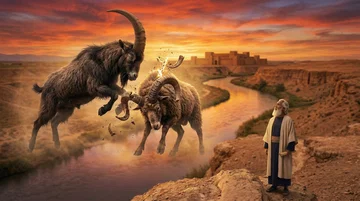
And as I was considering, behold, an he goat came from the west on the face of the whole earth, and touched not the ground: and the goat had a notable horn between his eyes.
The goat’s attack depicts Grecia conquering Medo-Persia, and its great horn breaking.
- Daniel 11:3-4
And a mighty king shall stand up, that shall rule with great dominion, and do according to his will.
Also describes Grecia’s king and the division of his kingdom.
- Daniel 8:8
Therefore the he goat waxed very great: and when he was strong, the great horn was broken; and for it came up four notable ones toward the four winds of heaven.
The great horn breaks and four horns arise, depicting Greece’s division after Alexander.
- Daniel 8:16-17
And I heard a man’s voice between the banks of Ulai, which called, and said, Gabriel, make this man to understand the vision.
Gabriel is commanded to explain the vision and says it concerns the time of the end.
- Daniel 7:6
After this I beheld, and lo another, like a leopard, which had upon the back of it four wings of a fowl; the beast had also four heads; and dominion was given to it.
The leopard represents Grecia, whose kingdom is divided among four rulers.
- Daniel 8:9
And out of one of them came forth a little horn, which waxed exceeding great, toward the south, and toward the east, and toward the pleasant land.
The little horn follows Greece in the vision and is identified as Rome.
- Daniel 9:21-23
Yea, whiles I was speaking in prayer, even the man Gabriel, whom I had seen in the vision at the beginning, being caused to fly swiftly, touched me about the time of the evening oblation.
Gabriel returns to give Daniel understanding of the earlier vision.
- Daniel 8:3-4
Then I lifted up mine eyes, and saw, and, behold, there stood before the river a ram which had two horns: and the two horns were high; but one was higher than the other, and the higher came up last.
The two-horned ram represents Medo-Persia, which the goat conquers.
- Daniel 2:39
And after thee shall arise another kingdom inferior to thee, and another third kingdom of brass, which shall bear rule over all the earth.
The brass kingdom in the sequence is Greece, succeeding Medo-Persia.
- Daniel 8:25
And through his policy also he shall cause craft to prosper in his hand; and he shall magnify himself in his heart, and by peace shall destroy many: he shall also stand up against the Prince of princes; but he shall be broken without hand.
The horn stands against the Prince of princes and is broken without human agency.
- Daniel 11:2
And now will I shew thee the truth. Behold, there shall stand up yet three kings in Persia; and the fourth shall be far richer than they all: and by his strength through his riches he shall stir up all against the realm of Grecia.
It describes Persia’s conflict with Grecia, explaining Daniel 8’s prophecy.
- Daniel 8:14
And he said unto me, Unto two thousand and three hundred days; then shall the sanctuary be cleansed.
It gives the vision’s 2300-day period and its end, when the sanctuary is cleansed.
- Daniel 8:7
And I saw him come close unto the ram, and he was moved with choler against him, and smote the ram, and brake his two horns: and there was no power in the ram to stand before him, but he cast him down to the ground, and stamped upon him: and there was none that could deliver the ram out of his hand.
The goat’s victory portrays Grecia’s defeat of Medo-Persia.
- Daniel 10:20
Then said he, Knowest thou wherefore I come unto thee? and now will I return to fight with the prince of Persia: and when I am gone forth, lo, the prince of Grecia shall come.
It also speaks of the coming prince of Grecia.
- Daniel 8:26-27
And the vision of the evening and the morning which was told is true: wherefore shut thou up the vision; for it shall be for many days.
Daniel’s response follows the explanation of the vision’s symbols.
- Daniel 10:1-11
In the third year of Cyrus king of Persia a thing was revealed unto Daniel, whose name was called Belteshazzar; and the thing was true, but the time appointed was long: and he understood the thing, and had understanding of the vision.
The visions and explanations here further unfold Daniel’s earlier prophecy.
- Genesis 10:2
The sons of Japheth; Gomer, and Magog, and Madai, and Javan, and Tubal, and Meshech, and Tiras.
Javan is named among Japheth’s sons; Daniel identifies Greece with Javan.
- Daniel 9:22-23
And he informed me, and talked with me, and said, O Daniel, I am now come forth to give thee skill and understanding.
Gabriel comes to Daniel to give understanding and explain the vision.
- Isaiah 66:19
And I will set a sign among them, and I will send those that escape of them unto the nations, to Tarshish, Pul, and Lud, that draw the bow, to Tubal, and Javan, to the isles afar off, that have not heard my fame, neither have seen my glory; and they shall declare my glory among the Gentiles.
Both use the old name Javan.
- Daniel 8:1-2
In the third year of the reign of king Belshazzar a vision appeared unto me, even unto me Daniel, after that which appeared unto me at the first.
gives time and place of same vision
Commentary
Each commentary is drawn from primary sources: the writings of Ellen G. White and Adventist pioneers and periodicals. Each commentary is separate. Its own words are not a quotation; follow the references to read the source passages.
Ellen G. White
4 sources
The rough goat is the kingdom of Greece, and the great horn between its eyes is its first king.LS 42.2–44.1 That first king is Alexander, who defeated Persia at the Battle of Arbela in 331 B.C. and died in 323 B.C. at age 33.LS 42.2–44.1 The prophecy containing this identification applies to historical Rome rather than to Antiochus Epiphanes, apart from any particular explanation of the goat or its great horn.LS 67.3–69.3
The verse belongs to the revelations in Daniel 7 to 12 of the mysteries of ages to come.PK 547.1 Even Daniel did not fully understand it, for it was not given to him to understand all that God had revealed of the divine purpose.PK 547.1 Its words were to be shut up and the book sealed until the time of the end, with the assurance that at the end of the days, in the closing period of this world's history, Daniel would rest and then stand again in his lot and place.PK 547.1
The vision to which the verse belongs was given especially for the last days, and the events it foretells, including the history represented by its symbols, are now being fulfilled and will soon come to pass.Ms 142, 1901, par. 6
Sources
Pioneers and periodicals
199 sources
The rough goat is the kingdom of Grecia, and the great horn between its eyes is its first king, Alexander the Great.ST Sep 21, 1882ST May 10, 1877 He came swiftly from the west and overthrew Medo-Persia in 331 B.C., making Grecia the third universal empire ruling the world for a time.RH Sep 22, 1874RH Jun 27, 1878ST May 20, 1913 When he died at the height of his power in 323 B.C. the great horn was broken, and four kingdoms arose from the nation without his power, Macedon, Thrace, Syria and Egypt under his leading generals.ST Sep 21, 1882ST May 10, 1877 This meaning is fixed by Gabriel's explanation given by divine command in plain language that cannot be misunderstood.RH Mar 21, 1854RH Dec 23, 1852RH Jul 14, 1863 After Grecia comes Rome, the little horn exceeding great, and the vision reaches through the 2300 years to the cleansing of the heavenly sanctuary in 1844.RH Jun 4, 1857ST Oct 22, 1874RH Aug 27, 1857ST Nov 19, 1885
Identity of Goat and Horn
The rough goat is the kingdom or empire of Grecia or Greece, the he-goat Grecia, with a clear and agreed application.ST Sep 21, 1882ST May 10, 1877ST Dec 24, 1894ST Jul 18, 1911 It succeeds Medo-Persia in world rule, with brass replacing silver as the goat takes the field from the two-horned sheep with leopard-like swiftness.ST Sep 21, 1882ST May 10, 1877 The great horn between its eyes is its first king, Alexander the Great, the notable horn and youthful possessor of every land.ST Sep 21, 1882ST May 10, 1877ST Dec 24, 1894ST Dec 22, 1881 He defeated the Persian king Darius Codomannus at Arbela in 331 B.C. and became master of the world, then died in his prime from the cup amid laughter and mirth, showing the weakness of earth's mightiest hero.ST Sep 21, 1882ST May 10, 1877 His death while the goat was still strong is the breaking of the horn at the height of Grecia's power, after which four kingdoms — Macedon, Syria, Egypt, and Thrace — arose in his place under his leading generals, none with the strength of the original kingdom.ST Sep 21, 1882ST May 10, 1877ST Dec 24, 1894ST Jul 18, 1911ST Dec 22, 1881
Grecia attained its greatest glory as a unit under Alexander in its first phase with one notable horn.ST Dec 22, 1881ST Oct 4, 1877RH Aug 9, 1870 The first phase of the goat with the one notable horn symbolizes this part of Grecian history under Alexander, given in plain language and not parable.ST Oct 4, 1877RH Aug 9, 1870 Under him Greece became the third world power in 331 B.C.ST May 31, 1905 He was as vile a man and as great a king as the world has ever seen.ST Oct 4, 1877RH Aug 9, 1870
Grecia or Javan included Macedonia as well as Greece. Greece and Grecia are the same, the modern name for what the Hebrews called Javan, fourth son of Japheth.RH Nov 12, 1861 English Bibles sometimes keep the old name Javan and sometimes use the modern name Greece, and this verse is an instance of the modern name.RH Nov 12, 1861 Alexander was son of Philip of Macedon, at twenty years of age in B.C. 336 succeeding Philip as king of Macedon and head of Greece.ST Sep 21, 1882ST May 10, 1877 Going forth from Macedon as prince of Grecia, he conquered Medo-Persia.ST Sep 21, 1882ST May 10, 1877
The verse also stands as part of Daniel 8 without separate exposition of the rough goat or great horn when the subject in hand is the 2300 days, the seventy weeks, the little horn, or Rome.RH Jun 4, 1857RH Dec 31, 1857RH Dec 11, 1856ST Jun 20, 1916RH Jun 4, 1857 In that connection the goat belongs to the prophecy's sequence of earthly empires following the ram of Media and Persia.ST May 11, 1876 The 2300 days do not cover every event in the vision, so the days can end in 1844 without the little horn being broken at that time, and the vision extends beyond that date to the destruction of earthly powers.RH Jun 4, 1857RH Jun 4, 1857 The symbols of the ram and he-goat were already explained in Daniel 8, while Gabriel's explanation in Daniel 9 addresses the point left unexplained, the vision's time.RH Dec 31, 1857 Rome is the third prophetic symbol in Daniel 8, a little horn growing exceedingly great whose final fulfillment awaits its being broken without human agency, and Daniel 8 with Daniel 9 and Revelation 10 and 14 points to 1844 when Christ entered the most holy place in the heavenly sanctuary to begin the investigative judgment.RH Dec 11, 1856ST Jun 20, 1916
Language of Prophetic Symbols
The word king means kingdom, so the rough goat is the kingdom of Grecia succeeding Medo-Persia in world rule, and its great horn is its first king and ruler, showing that vision symbols represent a kingdom and its ruler and that a symbolic beast can represent a nation or government.ST Sep 21, 1882ST May 10, 1877ST Dec 24, 1894ST Jul 18, 1911ST Dec 22, 1881 Symbolic beasts are to be understood by comparing related visions and Scripture, with brass replacing silver and the goat taking the field from the two-horned sheep with leopard-like swiftness.ST Sep 21, 1882ST May 27, 1908RH Sep 2, 1909RH May 8, 1916ST Nov 30, 1882 The great horn between its eyes is Alexander the Great, the first king, who defeated the Persian king Darius Codomannus at Arbela in 331 B.C. and became master of the world, and whose breaking with four kingdoms — Macedon, Syria, Egypt and Thrace — arising in his place shows Grecia united under Alexander in its first phase brought to greatest glory and then broken into four divisions without the strength of the original.ST Sep 21, 1882ST May 10, 1877ST Jul 18, 1911ST Dec 22, 1881
The horn is a symbol of strength and power and glory and honor, and here it denotes not the Grecian nation as a whole but a particular feature of its government, the civil power alone as centered in Alexander.RH May 19, 1851ST Dec 11, 1879RH Apr 3, 1855RH Nov 21, 1871ST Dec 4, 1879 When that civil power was broken the goat remained, and four governments arose in its place.RH May 19, 1851ST Dec 11, 1879RH Apr 3, 1855ST Dec 4, 1879 Together with the ram with two horns for Media and Persia and the four horns for four kingdoms, the verse fixes the prophetic meaning of horns as kings, kingdoms, civil powers, governments and rulers, and in Daniel 7 and 8 horns represent kingdoms or nations while prophetic beasts can represent earthly governments.RH Jul 23, 1861ST May 27, 1908ST Jan 6, 1887RH May 8, 1916ST Nov 30, 1882
This use fixes the standard for interpreting horns elsewhere, raising whether the two horns of the beast in Revelation 13 must be civil governmental powers, such as a north and south division constituting two powers in one nation, and whether anything less than a civil power or government can be called a horn.RH Jul 23, 1861 Prophecy was given to disclose future events not to hide them through history in advance by symbols in which kingdoms are represented by beasts and horns, and the key to symbolic prophecy is found in the Bible itself by comparing scripture with scripture rather than human imagination.RH Sep 2, 1909RH May 8, 1916ST Nov 30, 1882 Daniel 8 is one of five symbol prophecies in Daniel that are fully interpreted immediately by inspiration and together with other divinely interpreted prophecies furnish the basis and key for correctly interpreting symbolic prophecy generally, using object lessons through which God makes future events easier to understand, fittingly as nations today are still spoken of as the lion, the bear, the crescent and the eagle.ST May 27, 1908RH Sep 2, 1909RH May 8, 1916
The goat is a fitting symbol for the Grecian or Macedonian people because about two hundred years before Daniel they were called Aegeadae, the goats' people, from aix, aigos, a goat.RH Jun 21, 1870ST Nov 17, 1881 Caranus, their first king, going with Greeks to seek a new home in Macedonia, was advised by an oracle to take goats for his guide, and seeing a herd of goats fleeing a violent storm he followed them to Edessa and fixed his empire there, made goats his ensigns or standards, and called the place Aege or Aegea, the goats' town, and the people Aegeadae, the goats' people.RH Jun 21, 1870ST Nov 17, 1881 The city of Aege or Aegea was the burying-place of the Macedonian kings, and Alexander called his son by Roxana Alexander Aegus, Alexander the goat.RH Jun 21, 1870ST Nov 17, 1881 The phrase first king implies that other kings would follow, and after Alexander's horn was broken the four horns represented divisions of the still-Grecian empire rather than a new kingdom replacing it, dividing after confusion and struggles for power into four dynasties among them.ST May 27, 1875ST Oct 29, 1885
Alexander's Conquest of Persia
The vision was given in the third year of Belshazzar, about 538 B.C. in the last days of Babylon when Medo-Persia was about to take world empire, more than two hundred years before its fulfillment in Grecia.RH Mar 21, 1912ST Feb 20, 1912STRH May 12, 1910 It was written down declaring beforehand that world dominion would pass from Asia into European hands, with Babylon left out because its career was run.RH Mar 21, 1912STRH May 12, 1910 That vision and the explanation in Daniel 9 belong in the same year, only weeks or months apart, rather than fifteen years apart with Daniel 8 in 553 B.C., though the interval is not materially essential to interpretation.RH May 12, 1910RH May 12, 1910 Under Alexander, Greece attacked and defeated Medo-Persia, fulfilling the goat overcoming the ram roughly two hundred years before Alexander's time.ST Feb 20, 1912RH Dec 30, 1915
Grecia came from the west over the whole earth with swiftness so that it touched not the ground, ran into the ram in fury, smote him, cast him down and stamped upon him.ST Oct 29, 1885ST Feb 5, 1880 In so doing it erected the Grecian empire on the ruins of the Persian monarchy as a third universal kingdom more extensive than any before it, bearing rule over all the earth.ST Feb 5, 1880RH Apr 9, 1857RH Jan 31, 1856 Its rule, especially under Alexander the Great, extended over the earth, and the four wings of the corresponding leopard picture the exceptional speed of Alexander's movements.ST Oct 29, 1885RH Apr 25, 1912 Under Alexander Grecia overthrew Medo-Persia in 331 B.C. and became a universal kingdom, conquering the world in eight years.ST Jun 11, 1896RH Sep 22, 1874
Grecia conquered Medo-Persia in 331 B.C., about 330 years before Christ, overthrew the supreme Medo-Persian kingdom that reigned before it, and for a time ruled the world as the third of the four great kingdoms after Babylon and Medo-Persia.RH Sep 22, 1874RH Jun 27, 1878ST Jun 25, 1874 Its universal dominion is represented by the brass, the third division of Daniel 2's image, the trunk and thighs of brass succeeding Medo-Persia.RH Sep 22, 1874ST May 20, 1913ST Apr 9, 1896 Though Greece had greater physical power, its kingdom was represented as inferior in quality to Medo-Persia, like brass compared with silver.ST Aug 17, 1904 Its soldiers from brass armor were called the brazen-coated, and at first the goat had one notable horn representing Alexander, afterward four horns symbolizing the four divisions into which Grecia was afterward divided.RH Apr 9, 1857ST Apr 9, 1896
The first king was Alexander the Great, who defeated the Persian king Darius Codomannus at Arbela in 331 B.C. and became master of the world.ST May 10, 1877ST Jul 27, 1915 He met Darius at the river Granicus in B.C. 334 with 30,000 infantry and 5,000 horse against 600,000 foot and 20,000 horse and utterly defeated them.RH Mar 21, 1912ST Feb 20, 1912 He defeated Darius again at Issos in Cilicia where Darius had 400,000 foot and 100,000 horse, and won the final battle October 31, 331 at Arbela with 40,000 foot and 7,000 horse against 1,000,000 foot and 40,000 cavalry, after which the rest of the empire yielded and could not be resisted.ST Feb 20, 1912ST The goat's swift conquest of the ram represents Alexander's overthrow of the Medo-Persian Empire, and he reigned gloriously for eight years until his death in B.C. 323.ST Jul 27, 1915ST
Alexander was born in 356 B.C. in Macedonia, defeated Persia at Arbela in 331 B.C., and died in 323 B.C. eight years later aged thirty-two or thirty-three.LS 42.2–44.1ST Jan 24, 1878 He reigned twelve years and a half from his father's death with a run of success none ever exceeded, subjecting all nations from the Adriatic Sea to the Ganges, the greater part of the known world.ST Jun 11, 1896ST Feb 5, 1880 By speed of march he came upon enemies before they were aware and conquered them before they could resist, once pursuing with horse day and night and marching near forty miles a day for eleven days together in pursuit of Darius.ST Feb 5, 1880 He passed the Granicus with only thirty-five thousand men against more than five times as many and thereby struck panic through the Persian empire so that afterward no army though twenty times his number as at Arbela would stand before him.ST Feb 5, 1880 Grecia ruled 170 years until 161 B.C. when Rome took its place.ST May 3, 1877
Vain glory was his predominant folly steering all his actions, his few virtues obscured by greater vices, acting with furious and extravagant rashness yet without failure and flying with victory swifter than others can travel, impetuous and fierce as if on a double pair of wings.ST Feb 5, 1880 At thirty-three years of age in the midst of the grandest designs ever formed and flushed with surest hopes, he died before settling his affairs on a solid foundation, leaving a weak brother and very young children incapable of supporting such power.ST Feb 5, 1880 He taught his surviving generals to breathe nothing but ambition and war, not daring to name a successor or guardian and foretelling only that his friends would solemnize his obsequies with bloody battles.ST Feb 5, 1880 Thus fell the haughty monarch who rose like a colossus and bestrode the world, to be beheld again in the resurrection of the unjust.ST Feb 5, 1880
The historical setting includes Persia's earlier conflict with Grecia in which Xerxes led a vast campaign against Grecia, explaining the setting of the symbol of Persia's conflict with Grecia and the later rise of Alexander. Greece and Persia stand as two ancient nations whose diplomatic intercourse ended in 491 B.C. when Darius sent heralds to Athens to demand Greek submission to his sovereignty, with none from that time until resumed after 2,393 years.ST Dec 10, 1902
The prophecy that a Greek would destroy the Persian empire gave Alexander confidence to advance into Asia, and the prophecy Alexander heard in Jerusalem referred to him, and he acknowledged that he was the one it foretold.RH Mar 21, 1912ST Jun 25, 1902 After the Jews refused to help him against their Persian ruler he threatened the city, while the people appealed to God and prepared to meet him.RH Mar 21, 1912 Brought to Jerusalem, he was shown Daniel, stood at the temple and heard the Hebrew Scriptures testify concerning him, recognized himself as the Greek foretold to destroy the Persian Empire, and won the decisive victories of Granicus and Issus and trampled Persian power to the earth.RH Mar 21, 1912
Its plain language, unlike blind enigmatic oracles, shows God declaring the course of history beforehand and bearing witness to kings and conquerors as fulfillment unfolds before men.RH Mar 21, 1912 God identifies prophetic nations by name before they fulfill their role: the ram represents the kings of Media and Persia, and the rough goat represents the king of Grecia, with its great horn representing the first king.RH Dec 30, 1915RH Dec 25, 1900 Spoken more than 200 years before Grecia came to world empire, it shows God declaring history beforehand.ST Feb 20, 1912
The breaking of the great horn while the goat was still strong represents Alexander's death at the height of Grecia's power and worldly greatness.ST Dec 24, 1894ST Dec 24, 1894ST Feb 7, 1884 The great and notable horn was broken in its strength when Alexander died of fever after a prolonged debauch at Babylon in B.C. 323 at age thirty-two, a youthful possessor of every land who died in his prime from the cup amid laughter and mirth, showing the weakness of earth's mightiest hero.ST Sep 21, 1882ST Feb 20, 1912 After his death four kingdoms — Macedon, Syria, Egypt, and Thrace — arose in his place like the notable horns, which did not have his power.ST Sep 21, 1882ST Dec 24, 1894ST Feb 7, 1884
Division into Four Kingdoms
The great horn had no single successor like itself, and no single crown continued its rule, for the Grecian empire which began as a single monarchy was divided after Alexander's death among his successors, four of his leading generals, toward the four directions.ST Jun 3, 1897ST Feb 5, 1880RH Apr 10, 1900ST Nov 28, 1895ST Oct 10, 1906 That fourfold division is the same as the four heads of the four-winged, four-headed beast, which represent the four parts into which Alexander's kingdom was divided a few years after his death.ST Nov 28, 1895ST Oct 10, 1906ST Nov 29, 1905 When the horn was broken four horns and four kingdoms arose from the nation to divide the empire, but without his power or strength.ST Sep 21, 1882ST May 10, 1877ST Jul 18, 1911ST Dec 22, 1881RH Aug 27, 1857 They were Macedon, Syria, Egypt and Thrace, ruled by his leading generals after years of conflict and after a brief claim by his brother and sons.ST Sep 21, 1882ST May 10, 1877ST Dec 22, 1881RH Aug 27, 1857
Within twenty-two years after his death the empire split into Macedon, Asia Minor, Syria and Egypt, completed in 301 B.C. when his house had perished.ST Sep 21, 1882ST May 10, 1877ST Jul 18, 1911ST Dec 22, 1881 Cassander held the west in Macedon and Greece, Lysimachus the north in Thrace, Bithynia and the smaller provinces of Asia Minor, Seleucus the east in Syria to the Indus, and Ptolemy the south in Egypt, Libya, Arabia and Palestine.ST Sep 21, 1882ST May 10, 1877ST Jul 18, 1911ST Dec 22, 1881 After his death his generals warred for dominion for about twenty years, none calling themselves kings until 306, until in 301 B.C. the kingdom stood divided into just four parts. Then Seleucus held Babylonia from Palestine and the Mediterranean Sea to India, Lysimachus held Asia Minor and Thrace, Cassander held Macedon, and Ptolemy held Egypt, after which Rome stepped in and conquered the Macedonian-Greek division, passed over to Syria and brought her into subjection, and thence conquered Egypt, until the whole world fell under the iron dynasty of Rome.
Grecia first ruled as a unit and later was divided into four parts before yielding supremacy to Rome in 168 B.C.ST Oct 29, 1885RH Apr 25, 1912ST Feb 5, 1880ST Jun 11, 1896RH Apr 9, 1857 Its dominion continued till B.C. 161, having conquered the world in eight years and ruled 170 years until Rome took its place.ST Oct 29, 1885RH Apr 25, 1912ST Feb 5, 1880ST Jun 11, 1896RH Jan 31, 1856 Together with verse 22, the four horns represent the four parts and four kingdoms into which the empire was divided after his death, pictured also by the leopard's four heads, among four leading generals including Macedonia, Thrace, Syria and Egypt.ST Feb 18, 1886RH Dec 23, 1852ST Mar 30, 1915ST Nov 29, 1905ST Sep 29, 1881 The chapter describes the horn being broken and four arising in its place, and the symbol of the goat gives in fuller detail the fourfold division elsewhere pictured by the leopard's four heads and its rapidity by the leopard's four wings.ST Feb 18, 1886ST Mar 30, 1915ST Nov 29, 1905ST Sep 29, 1881ST May 3, 1877
The division of that Grecian kingdom into four, shown by the four horns of the goat, dates to within eight years of Grecia's entrance into prophecy, proving that a division marked in a prophetic symbol belongs to the beginning of the kingdom.RH Mar 16, 1869 Because Grecia was divided at its start, Rome would have had to be divided from its start if its two legs of iron meant division, instead of remaining a unit for nearly six hundred years before its eastern and western separation.RH Mar 16, 1869
Date and Angel Explanation
The vision was received at Shushan in the third and last year of King Belshazzar at the beginning of Darius the Median, before the events of Daniel 6 in chronological order.RH May 12, 1910RH Nov 25, 1902 It came about two years after the vision of chapter 7 when Babylon was still a great empire, and only weeks or months before Daniel 9 so that the two chapters belong in the same year.RH May 12, 1910RH May 12, 1910RH Jun 27, 1878 That third year was 538 B.C., not 553 B.C., when Belshazzar ruled jointly with his father Nabonadius rather than as sole king, though the interval is not material to the interpretation.RH May 12, 1910ST Mar 11, 1889 Babylon is left out of this vision altogether because it was in its last days and soon to pass away, and the vision begins with Medo-Persia just at hand with Grecia following as the next power upon the stage of world dominion.RH May 12, 1910RH Mar 28, 1912RH Jun 27, 1878
Christ commanded His special angel Gabriel to make Daniel understand the vision, and Gabriel obeyed at once with no parleying or quibbling over the plain command.ST Apr 2, 1894 He was caused to fly swiftly to earth while Daniel was speaking in prayer, declaring that at the beginning of the supplications the commandment came forth and he had come to inform Daniel and help him understand the matter and consider the vision.ST Apr 2, 1894 This immediate obedience shows how the will of God is done in heaven and how it is to be done on earth.ST Apr 2, 1894
The identification belongs to Gabriel's explanation given by divine command of the ram, goat and little horn as symbols of earthly powers, given in plain language not parable.RH Mar 21, 1854RH Dec 23, 1852ST Jun 26, 1907 It states the meaning positively in language that cannot be misunderstood and fixes the symbol to Grecia with no room for human conjecture, unlike the little horn, for without it men would have applied the ram and he-goat to anything but the right objects.RH Mar 21, 1854ST Jun 26, 1907 The angel explained the beasts and horns as powers rather than literal animals or horns, while leaving the 2300 days and the sanctuary unexplained in this vision.RH Mar 21, 1854RH Dec 23, 1852RH Jul 14, 1863 Daniel 9 is joined to Daniel 8 as its explanation, addressing the point left unexplained, namely the vision's time.RH Aug 4, 1868RH Dec 31, 1857RH May 26, 1853
The angelic explanation has divine authority like Jesus' explanation of the tares and wheat and needs no further human explanation to be of use.RH Sep 2, 1909RH May 8, 1916 It is an object lesson using fitting symbols, as nations are still spoken of as lion, bear, crescent and eagle, teaching through pictures because sight conveys more and makes deeper and more lasting impressions.ST May 27, 1908RH May 8, 1916ST Jan 17, 1884 In Daniel 7 and 8 horns represent kingdoms or nations, and prophetic beasts can represent earthly governments, so the rough goat and its great horn are symbols not literal animals, with the horn denoting civil or ecclesiastical power.ST Jan 6, 1887ST Nov 30, 1882RH Mar 19, 1857 Prophecy was thus given to disclose future events not to hide them, and the key to symbolic prophecy is found in the Bible itself by comparing scripture with scripture rather than human imagination.RH Sep 2, 1909RH May 8, 1916
The verse gives the second step in the explanation, coming after the ram and before the four horns and little horn, keeping the order in which the symbols were seen.STST Jun 26, 1907 Gabriel began interpreting the goat and notable horn before the interpretation was interrupted, later calling Daniel to recall and consider the vision as he resumes explaining the 2300 days.ST Feb 18, 1886RH Dec 8, 1915 Its meaning was made known to Daniel, leaving only the time of the vision unexplained, which is why Daniel fainted, was sick certain days, and was astonished without understanding.STST May 30, 1895RH Dec 8, 1915
Time was the only point omitted, leaving Daniel astonished with none understanding.RH Mar 21, 1854RH Dec 23, 1852 Daniel understood the goat as Greece like the ram as Medo-Persia and little horn as Rome without difficulty, while his trouble was over the sanctuary cleansing at the end of the 2300 days, which he joined to the seventy years' captivity and repairing of desolations.RH Mar 21, 1854RH May 12, 1910 He fainted, was sick certain days, and was astonished without understanding, requiring Gabriel to return to give skill and understanding and explain time as seventy weeks cut off from the 2300 days.RH Mar 21, 1854ST Without the time the other portions were of no avail.RH Dec 31, 1857RH May 26, 1853
The symbols of ram, he-goat and little horn had already been explained, while the 2300 days were left unexplained.RH Dec 23, 1852RH Dec 31, 1857 Daniel's not understanding refers to the 2300 days, and Gabriel's commission was left unfulfilled until he returned in Daniel 9 to give skill and understanding.RH Mar 21, 1854RH Dec 31, 1857 That return places both periods at the same starting point, with the seventy weeks or 490 years cut off from the longer period and the 2300 days extending 1810 years beyond the end of the seventy weeks.RH Mar 21, 1854RH May 26, 1853 Daniel 10-12 further develop the outline.ST Apr 23, 1912ST Apr 9, 1912
Daniel 8 is a symbolic prophecy contained only in symbols, of the same kind as Daniel 2 and 7 and the principal visions of Revelation.ST Jan 10, 1878RH Jun 12, 1855 With the ram and the little horn it forms one of the clearest prophetic chains in Scripture, illustrating the rise, character, acts and fall of future kingdoms, carried through the four kingdoms down past the trouble, advent and resurrection.ST Jan 17, 1884ST Apr 15, 1875 Daniel 8 is clothed in figures unlike Daniel 11 given mostly in plain language as its comment and explanation.ST Jan 10, 1878ST Apr 15, 1875
Daniel 8 is one of five symbol prophecies in Daniel that are fully interpreted immediately by inspiration, and together with other divinely interpreted prophecies they furnish the basis and key for correctly interpreting symbolic prophecy generally.RH Sep 2, 1909RH May 8, 1916 Its explanation concerns the kingdoms themselves as kingdoms, one of three historic powers, apart from the spiritual aspect affecting God's people.ST May 27, 1908RH Sep 2, 1909 In these same visions days stand for years.ST Jan 6, 1887RH May 8, 1916
The vision of chapters 8 and 9 Daniel did not yet fully understand, and after that vision he was solicitous for his people, pleading in prayer for their return to the homeland and the fulfilment of Jeremiah's prediction of that return.ST Apr 23, 1912ST Apr 9, 1912 The explanation in Daniel 9:24-27 had not left him hopeful, with the holy city destroyed and the Prince of the host cut off, so God sent comfort by the angel in the vision of chapters 10 to 12 given in the third year of Cyrus.ST Apr 9, 1912 Its explanation in Daniel 9 does not mention their apostasy and persecution, while Daniel 10 addresses what would come upon them in wider significance.ST Apr 23, 1912ST Apr 9, 1912
Place Among World Empires
The rough goat belongs to a sequence of earthly empires represented by beasts, with the ram as Media and Persia before it which the goat overthrows and succeeds in world dominion in B.C. 331, brass replacing silver with leopard-like swiftness, and the little horn after it as Rome, the prophetic line passing over Persia, Greece and pagan Rome before Christ's coming kingdom.ST Sep 21, 1882RH Dec 30, 1915RH Dec 23, 1852ST Oct 22, 1874RH Mar 10, 1874 The vision presents the three universal kingdoms remaining after Babylon, with the sanctuary and its cleansing as its main concern reaching to the appointed time of the end.RH Dec 30, 1915RH Mar 10, 1874 The symbols portray the succession of earthly empires beginning with Media and Persia, and the horn that becomes exceedingly great is Roman power because it destroys God's people and puts the Prince of princes to death.RH Dec 23, 1852ST Oct 22, 1874RH Mar 10, 1874
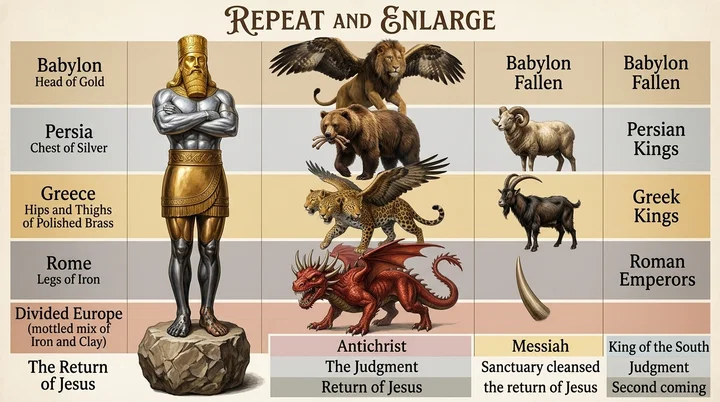
Grecia is the third of four universal empires after Babylon and Medo-Persia and before Rome, corresponding to the brass belly and sides in Daniel 2 and the leopard in Daniel 7.ST Sep 21, 1882RH Dec 30, 1915RH Dec 23, 1852ST Oct 22, 1874RH Mar 10, 1874 Babylon is omitted because its career was run and it was already history just as it was passing away when the vision was given, leaving only the three remaining universal kingdoms in this line.ST Sep 21, 1882RH Dec 30, 1915RH Dec 23, 1852RH Mar 10, 1874
In order Greece follows Medo-Persia as the third kingdom after Babylon and Medo-Persia, succeeding Persia under Alexander and preceding Rome by conquering the Medo-Persian kingdom.RH Apr 4, 1912RH Apr 4, 1912RH Jun 27, 1878ST Aug 26, 1889ST Dec 23, 1903 After Grecia there has been only one universal empire, Rome, the fourth great universal empire followed by the great apostasy.RH Apr 4, 1912RH Jun 27, 1878RH May 29, 1900 Gabriel gave this succession as the clearly explained outline of coming events in obedience to the command to make Daniel understand, while the matter of the time of the 2300 days was left unexplained at that time, and its history is given only as a brief sketch until the rise of Rome because Rome is the great subject of Daniel 7 and 8 just as Babylon is the great subject of the first half of Daniel.RH Apr 4, 1912RH May 29, 1900ST Aug 26, 1889
The he-goat is the same empire as the leopard in Daniel 7 and the brass division of the image, the third universal monarchy succeeding Medo-Persia with rule over all the earth.RH Mar 18, 1862RH Apr 9, 1857ST Nov 29, 1905RH Jan 31, 1856ST Jul 15, 1913 The four wings added to the leopard picture the exceptional speed of Alexander's movements, with feet seeming not to touch the ground coming swiftly from the west.RH Apr 25, 1912RH Mar 18, 1862RH Apr 9, 1857RH Jan 31, 1856ST Jul 15, 1913 Its four heads represent the four parts into which Alexander's kingdom was divided a few years after his death, and the actions attributed to that empire take place before its notable horn is broken and the empire is divided.RH Apr 25, 1912RH Mar 18, 1862ST Nov 29, 1905
With verse 22 the verse shows that the kingdoms succeeding Alexander were weaker than the Babylonian, Medo-Persian, and Macedonian empires, and this comparison supports identifying Rome, rather than Alexander's divided kingdoms, as the stronger fourth empire in Daniel's other prophecies.ST May 29, 1884
The prophecy leaps over centuries from Xerxes, the richest Persian king, directly to Alexander, then continues down through the Syrian kings of the north to Antiochus III and IV, when Rome becomes the molding power of earth and Syria is set aside.ST Apr 16, 1912ST Apr 23, 1912ST Apr 6, 1882 Daniel 11 continues the explanation of Daniel 8, describing the rise of a mighty king who rules as he wills and whose kingdom is divided after death.ST Apr 16, 1912ST Apr 23, 1912ST Apr 6, 1882
The prophecies of Daniel 7-12 expand and fill out in detail what is told in outline in Daniel 2 under the symbol of the great metallic image, which begins with the history of the great world empires and reaches to the everlasting and universal reign of Christ, bringing out many new and characteristic features.ST Apr 29, 1903ST Jul 1, 1908ST Nov 28, 1895 They cover the same history as Daniel 9-11 and end with violence and the reign of Michael, not the conversion of the world, tracing the rise and fall of world empires as fierce beasts, symbols of ruling powers that shape the world's religion and civilization.ST Apr 29, 1903ST Jul 1, 1908ST Nov 28, 1895 What was left incomplete in Daniel is filled up by the complement given in Revelation, especially chapters 12, 13, 17 and 18.ST Apr 29, 1903
The verse names Grecia and its first king as part of the prophecy of the four kingdoms given in Daniel 2, 7, and 8, connected with the sanctuary and the 2300 days.ST Aug 12, 1875RH Mar 26, 1867ST Apr 15, 1875 It is the third of four distinct lines of prophecy that carry prophetic history down through Babylon, Persia, Greece, and Rome to the end, with main features running parallel as the third line carrying history through Medo-Persia, Grecia, the little-horn Rome and the 2300 days to the end of the Christian age, trouble, second coming, resurrection and eternal kingdom.ST Aug 12, 1875ST Apr 15, 1875ST Apr 9, 1912 It covers the same ground as the great image of Daniel 2, the four beasts of Daniel 7, and the kings of the north and south of Daniel 10-12, given for the latter days and the time of the end and closing at the second coming of Christ and the resurrection, with Daniel 9 and 10-12 and Revelation 12-14 tracing empire to show that the God of heaven is about to set up His kingdom at the second advent.ST Aug 12, 1875RH Mar 26, 1867ST Apr 15, 1875ST Apr 9, 1912 Daniel 8's 2300-day period spans nearly the whole prophetic vision, so the chapter's timeline reaches through the Christian era toward the end rather than ending at Christ's ascension.ST Aug 12, 1875ST Apr 15, 1875ST Apr 9, 1912
The verse applies to Greece's rise as the second overturning of earthly dominion, when Grecia gained rule over the whole earth.ST Jan 1, 1894RH Sep 11, 1900 This matches the order in the image of Daniel 2 where another kingdom follows Persia, with Persia destroyed after rejecting light and the angel's work continuing with Grecia.ST Jan 1, 1894RH Sep 11, 1900
On a prophetic chart the verse belongs chronologically alongside the prophecies of Daniel 2 and Daniel 7, but the chart leaves out a symbol for Babylon in Daniel 8 and fills that space with the symbol of the Apostate Church, placing that added symbol out of chronological order.RH Oct 8, 1908RH Jan 1, 1861RH Mar 22, 1906 The voyage imagery says that the prophetic sequence has passed Babylon, Medo-Persia, and Grecia, and that voyagers are now sailing along Rome's shore, with the chart pointing to the nearing port.RH Oct 8, 1908RH Jan 1, 1861RH Mar 22, 1906 That Grecian part of the voyage is finished and left far behind, and God's people have since been sailing through the long Roman age for eighteen hundred years toward the port they shall soon find.RH Oct 8, 1908RH Jan 1, 1861RH Mar 22, 1906
Grecia is one of the old dominions of Babylon, Persia, Grecia, and Rome that are combined in the first beast of Revelation 13, which belongs to the line of events concerning the kingdoms and powers of the earth set forth in Daniel 2, 7, and 8 and continued in Revelation 12, 13, and 14, so the lamb-like beast coming up later in another locality outside those dominions must be the United States.RH Mar 24, 1874ST Nov 5, 1885 After Alexander's death his empire was divided into four parts represented by the four horns that followed the broken great horn, and Rome later rose from the Macedonian division of Grecia.RH Mar 24, 1874ST Nov 5, 1885
Prophetic Time and Sanctuary
The vision belongs to symbolic prophecy reaching far into the future through long ages of oppression even to the latter days and the appointed time of the end, so its prophetic time is symbolic with each day standing for a year.RH Oct 6, 1863ST Aug 2, 1877ST Aug 14, 1893RH Dec 29, 1863 Literal days could not span the duration of the empires shown, Persia, Greece and Rome, and empires presented on a visible scale require time on a corresponding scale rather than literal days.RH Dec 29, 1863ST Aug 12, 1875RH Feb 25, 1873 Its field includes the power that puts saints to death, stands against the Prince of princes and is destroyed, and its main concern is the sanctuary and its cleansing.RH Oct 6, 1863ST Aug 14, 1893 The portrayal runs through the three universal kingdoms remaining after Babylon, Grecia having arisen and passed away as foreshown, until earthly empire is broken without hand, with all fulfilled except the very closing specifications before God's everlasting kingdom.RH Oct 6, 1863ST Aug 2, 1877ST Aug 14, 1893
Its 2300 days are 2300 years, the principal and longest prophetic period, spanning nearly the whole vision through Persia, Greece and Rome toward the end rather than ending at Christ's ascension.ST Aug 12, 1875ST Jul 27, 1882RH Feb 25, 1873 The 1260, 1290 and 1335 days are intermediate periods or subdivisions of it, and when Daniel is told he will stand in his lot at the end of the days the days are the 2300 days.ST Jul 27, 1882 The symbols of Persia, Greece and Rome in succession cover those 2300 years, and the chapter's timeline with its main features running parallel to Daniel 2, 7 and 9 reaches through the Christian era toward the end.ST Aug 12, 1875RH Feb 25, 1873 Read with Daniel 9 it points out distinctly the commencement and termination of the 2300 days, what the sanctuary is and the nature of its cleansing, and explains the disappointment about time and the position of those waiting for the Lord.RH Jun 19, 1856
Time was the only point omitted from Gabriel's plain explanation of ram, goat and little horn, leaving Daniel astonished with none understanding, so Gabriel returned to give skill and understanding.RH Mar 21, 1854RH Dec 23, 1852RH Dec 31, 1857 Daniel 9 is joined to Daniel 8 as its explanation and appendix, supplying the starting point: the seventy weeks are cut off as the first 490 days or years of the 2300, commencing together at the going forth of the commandment to restore Jerusalem.RH Mar 21, 1854RH Aug 4, 1868RH Dec 31, 1857RH May 26, 1853 That commandment was met in the decree in Ezra 7 in the seventh year of Artaxerxes Longimanus in B.C. 457, with 1810 years extending beyond the end of the seventy weeks.RH Jul 14, 1863RH May 26, 1853 Together they point out commencement and termination, the sanctuary and the nature of its cleansing.RH Jun 19, 1856
Daniel 8 and 9 give the longest definite period in the Bible, beginning in 457 B.C. and ending in A.D. 1844, reaching to the cleansing or justifying of the heavenly sanctuary.ST Aug 2, 1877ST Aug 14, 1893ST Jul 8, 1897RH Nov 23, 1905 In autumn 1844 Christ entered the most holy place to begin the closing work of His priesthood, the investigative judgment determining worthiness or unworthiness of those who once entered God's service, when books are opened and cases of the righteous pass in review before the Judge and before God's law in preparation for immortality at the first resurrection.ST Aug 14, 1893RH Nov 23, 1905 It is a comparatively brief work soon to be finished, after which Christ will come, and the last and next event is the coronation of Jesus as coming King.ST Aug 14, 1893ST Jul 8, 1897 The 2300 days do not cover every event in the vision, so they can end in 1844 without the little horn being broken at that time, the vision extending beyond to the destruction of earthly powers.RH Jun 4, 1857
The revelation decides the new covenant has its sanctuary with priestly ministration, of which only 400 years of the 2300 belonged to the first covenant, earthly sanctuary and Jewish church until the Saviour finished His earthly ministry and confirmed the covenant.RH Oct 2, 1856 From that point 1810 years reach to the cleansing of its successor, the sanctuary to which the earthly gave place when its services finished and the old covenant was succeeded by the new, where Christ ministers as High Priest before the Father.RH Oct 2, 1856 The host are the worshipers belonging to that sanctuary, worshiping outside while only the Priest goes inside in their behalf, and sanctuary and host can be trodden under foot from earth without wicked men entering heaven, just as the heavenly minister Himself is trodden under foot.RH Nov 25, 1902 For a time the continual service would cease, the shekinah depart and the house be desolate.RH Nov 25, 1902
The continual comprehends the entire earthly sanctuary service ordained by God including morning and evening sacrifices, showbread, lamps, incense and the high priest's bearing of judgment, applying with equal force to the heavenly sanctuary of which the earthly was only type and figure.ST Oct 13, 1909 Its entire force applies there because the earthly priesthood had ended before the later power began its operations.ST Oct 13, 1909 It is not sacrifice but continuance itself, the unbroken ministering of eternal life through the Son, removed by putting earthly leader, temple and priest in place of Christ's priesthood, which the threefold message restores.RH Oct 29, 1903 Daniel 8 contains long periods sealed until the time of the end, including the period ending with the cleansing in 1844 and the later breaking of the little horn, and points out the beginning of the time of the end before Christ's coming when special signs appear.RH Jun 4, 1857RH Jun 19, 1856ST Dec 24, 1912
The chapter is one of the great highways leading to Christ's coming, predicting His manifestation as Messiah, length of ministry, time of death, beginning of priesthood, persecution, and work as prophet, sacrifice and priest, with the beginning of judgment at the end of the 2300 days.ST Nov 8, 1905ST Jul 8, 1897 It belongs with chains terminating within a few years of 1864 and giving periods pointing to about the second coming and expectation near the end and an event connected with the sanctuary, though not giving the definite day and hour, but indicating the generation.RH Aug 28, 1913RH Apr 26, 1864RH Mar 27, 1866 It stands connected with the four kingdoms in Daniel 2, 7, 8 and 9, with the sanctuary and 2300 days, unfolding salvation and demonstrating fulfilled prophecy.RH Mar 10, 1868RH Feb 26, 1867RH Jun 11, 1857RH Sep 10, 1857 Jerusalem represents the sanctuary and the Lord's people are affected when her appointed time is accomplished and iniquity pardoned, and the sanctuary and its cleansing give peace, life, light and salvation, helping embrace and remain faithful to the Sabbath.RH Oct 14, 1852
Following Power and Final Meaning
The rough goat and its kingdom are followed by the little horn that takes away the daily, arising in the latter time of the four horns that succeeded Grecia as the king of fierce countenance who stands against the Prince of princes and is broken without hand.RH Jan 28, 1858ST Jun 20, 1900ST Feb 7, 1906RH Apr 10, 1900ST Mar 5, 1912 That naming fixes the succession after Medo-Persia, Babylon being omitted because the vision came just as Babylon was passing away, so the power following Greece in history is Rome.RH May 29, 1913ST Feb 7, 1906 The identification belongs to the continuous sequence from Medo-Persia through Grecia to that latter-time king, supplying the scriptures about the falling away and the man of sin who magnifies himself even to the Prince of the host.RH Apr 10, 1900 The goat's four horns are the powers from which the little horn arose, and the whole forms Gabriel's explanation of its character and work.ST Mar 5, 1912
The power following Grecia is Rome, small at first but becoming exceeding great, greater than Grecia which was very great and than Medo-Persia which was only great, stronger than all before it.ST Oct 22, 1874ST Nov 19, 1885ST Nov 19, 1885RH Dec 11, 1856RH Apr 10, 1900 It magnifies itself to the prince of the host, destroys God's people and puts the Prince of princes to death, and is finally broken without human agency.ST Oct 22, 1874RH Dec 11, 1856 It is traced from its ancient form to its modern papal form through to the end of the world, with emphasis on the Papacy.RH Apr 10, 1900 When the great horn was broken the four horns that arose lacked his power and divided the empire, representing the division of Grecia itself and not rulers of Rome.RH Aug 27, 1857
In the vision the goat defeats the ram, its notable horn is broken and four take its place, then a little horn arises from one of them and becomes exceedingly great toward the east and south and the pleasant land.RH Nov 25, 1902RH Mar 28, 1912RH Oct 27, 1904ST Mar 4, 1889ST Sep 2, 1913 That little horn puts Christ and the saints to death and takes away the continual service, so that the service ceases, the glory departs and the house is left desolate.RH Nov 25, 1902RH Oct 27, 1904ST Mar 4, 1889 The kingdoms appear in succession like moving pictures, one doing its work then giving place to the next, with Rome following Grecia to take the pleasant Holy Land.RH Mar 28, 1912 The divided Grecian kingdom ran its course until transgressors came to the full, when Rome followed; though appearing to come from one Greek horn, Rome was greater than Greece and its divisions, conquering Macedon in 168 B.C. for prestige and coming into direct contact with God's people in 161 B.C.ST Oct 13, 1909ST Sep 2, 1913
In the explanation Grecia is followed by the little horn representing Rome, the power that stood against Christ and put Him to death.ST Mar 31, 1909ST Jun 26, 1879 In the latter time of the four kingdoms arises the king of fierce countenance, which is Rome succeeding Alexander's four kingdoms. The two desolating powers are the daily as Rome in pagan form and the transgression of desolation as Rome in papal form, paganism first withholding the manifestation of the papacy until taken out of the way.RH Feb 15, 1870 That little horn is the same as the little horn of Daniel 7 and the woman of Revelation 17, namely ecclesiastical and papal Rome arising among the ten kingdoms into which the fourth universal kingdom was divided, holding sovereignty over earthly sovereigns.RH Jul 31, 1900 The paganism of Greece with that of Babylon, Medo-Persia and Rome is combined in the leopard-bear-lion beast from the sea and enforced by the Papacy disguised under Christian forms, continued through the priesthood headed by the Pope as Pontifex Maximus when Christ's mediation is taken away and human mediation substituted.RH Apr 10, 1916
The teaching held by the weight of testimony is that the he-goat and great horn do not represent Antiochus Epiphanes, nor are the 2300 days half-days fulfilled in 1150 literal days, nor is the little horn Napoleon III; its application was settled by thorough study and is not to be unsettled for the Franco-Prussian conflict.RH May 1, 1856RH Jan 31, 1871RH Jul 19, 1864RH Jan 10, 1871RH Dec 10, 1857 The little horn is the Roman power pagan and papal rather than Antiochus, and Daniel 8 does not bring Antiochus into view.RH Jul 19, 1864RH Dec 10, 1857 Another teaching held that the vision refers to Antiochus Epiphanes, whose persecution and temple desecration about 160 years before Christ it concerns, rather than Christ's coming or God's everlasting kingdom.RH May 15, 1856
Antiochus cannot be the little horn because Grecia is called very great compared with Persia called great, while the next power is called exceeding great.ST Feb 12, 1880RH Oct 6, 1863 Antiochus was only the eighth of twenty-six Syrian kings in the divided Syrian horn and therefore cannot at the same time be another remarkable horn; he was not illustrious but vile and mad, paid tribute and yielded territory and hostages to Rome, abandoned Egypt at Rome's command, and died 164 years before Christ was born.ST Feb 12, 1880 He was not exceeding great compared with Alexander nor compared with the Romans to whom he paid tribute, did not enlarge dominion, and did not stand up against the Prince of princes, whereas the exceeding-great power waxing toward the east, south and pleasant land and standing against the Prince of princes is Rome.ST Feb 12, 1880RH Oct 6, 1863 Still another teaching held that with origin and sphere fixed in Grecia the little horn of Daniel 8 is not the same as that of Daniel 7, which is the Roman Catholic hierarchy from Rome, but is Mahometanism, with the cleansing as affairs on earth at Mahometanism's destruction.RH Apr 15, 1873RH Jan 10, 1871
Rome is historically linked to Grecia by origin among Graeco-Italic peoples and by conquest of Macedon, a division of Alexander's empire, defeating Macedon giving Rome the prestige and power that helped make it a world power.ST Mar 5, 1912 This application is correct and sustained by Protestant expositors generally, and the first king is the same mighty king ruling with great dominion in Daniel 11:3.RH Jan 16, 1913RH Mar 11, 1875 The coming Greek prince arrived as Gabriel left the corrupt Persian court and Persia fell.ST Jun 25, 1902 The kingdom before Grecia comprised two nationalities, Medes and Persians, with Persia coming last but attaining higher eminence as leading division, the same fact shown by the bear raised on one side and by inferior silver after gold.ST Sep 29, 1881
God's time had come for a change in world empire, and when Persia could no longer further His gospel He set it aside and brought Macedonia to dominion, for the Most High rules and gives it to whom He will.ST Feb 20, 1912 Dominion was given to Grecia by God who controls earth and raises one power and sets aside another when His purpose requires. Alexander served His purpose by overthrowing a power that could no longer promote truth, conquering in harmony with the word spoken by Jesus through prophecy in a manner little short of miraculous, while fighting against it he failed, as when he tried to resurrect Babylon and could not build a single city.ST Feb 13, 1912ST Aug 3, 1904 Under later Greek rulers Greece further served God's cause by translating the Scriptures into Greek, then the world's most widely used language; later Greek factions oppressed God's people in Egypt and Palestine and God withdrew protection.ST Aug 3, 1904
Alexander's conquests spread the Greek language throughout the eastern world, which was then used to witness salvation through Christ's death and resurrection.ST Mar 20, 1907 The nations of the earlier symbols strongly affected the fate of Daniel's people.ST Jul 10, 1901 Grecia stands among nations that rose and prospered but declined through luxury, indolence, intemperance and degeneracy.ST Jul 16, 1896
The definite literal fulfillment with great accuracy fortifies the parallel prophecies of Daniel 2 and Daniel 7, which foretell four world monarchies with the last divided until the end, making certain Christ's coming and not a fable.ST Jun 30, 1914 Grecia as one of the four successive universal empires of Babylon, Medo-Persia, Grecia and Rome has arisen and passed away as foreshown, with all fulfilled except the very closing specifications, leaving God's everlasting kingdom as the fifth universal empire immediately impending.ST Aug 2, 1877 History has fulfilled what was foretold including the king of Grecia and first king, with only final consummation remaining when Michael who stands for God's people stands up and every one written in the book is delivered.ST Oct 10, 1878RH Nov 17, 1910 The course of empires in Daniel 2, 7 and 8 shows God is about to set up His kingdom.RH Jan 15, 1867RH Mar 12, 1867
The verse stands in the plain and thrilling prophecy with Daniel 2 and 7 tracing empires to show God is about to set His kingdom at the second advent.RH May 5, 1868RH Jan 22, 1867RH Mar 10, 1868RH Jun 18, 1867RH Mar 26, 1867 The ram, he-goat and little horn are fulfilled and nearly all of Daniel 7 and 8 strikingly fulfilled, presenting gospel and present truth about judgment and cleansing, timely because of rapid Roman Catholic advance, marking the present as near when the stone smites the image and destroys earthly governments for God's everlasting righteous kingdom.RH Mar 12, 1867RH May 5, 1868 Daniel 8 is one of the great highways leading to Christ's coming, predicting His first advent as Messiah, ministry length, death time, and judgment beginning at the end of the 2300 days.ST Nov 8, 1905 It foretells persecution, Christ's work as prophet and sacrifice and priest, and the 2300 days reaching to 1844, with the last and next event the coronation of Jesus as coming King.ST Jul 8, 1897
Its lines converge with Daniel, Revelation, Matthew 24, Mark 13 and Luke 21, beginning in the past but gathering terminals in the time of the end, proving earthly dominion transitory and focalizing at the second coming, which must be fulfilled before He comes as preceding testimony.ST Nov 28, 1900 Much is fulfilled, more fulfilling, with climax ruin and destruction of all earthly kingdoms; the definite day and hour are unrevealed but prophecy indicates the generation, evidencing the last generation is reached.RH Aug 28, 1913ST Jul 4, 1900 The prophecy locates autumn 1844 at the end of the 2300 years when Christ entered the most holy place, including judgment of the dead before God's law.RH Nov 23, 1905
The prophecy was given not for Daniel's instruction but for those living near fulfillment, relating to Christ's first advent to suffer for sin and second advent in power and glory, to light God's path with ever-increasing light as fulfillment unfolds.ST Apr 15, 1875 It is history in advance sealed until the time of the end, opened by fulfillment of its specifications when earthly kingdoms' allotted period has passed so students compare prophecy with history and learn the end is near, carried through the four kingdoms past trouble, advent and resurrection.ST Apr 15, 1875 In the latter days it is unsealed and made plain upon tables so he who reads may run, where before sealed to learned and unlearned, and to scorn its light endangers salvation.RH Dec 9, 1873 Its delineations have been fulfilled in every specification so far with only closing events remaining, describing persecutions of the righteous in contrast to later trouble on the wicked.ST Jun 27, 1878ST Mar 1, 1905ST May 7, 1912
The he-goat Grecia has no reference to the United States, its application being clear and agreed upon with Babylon, Medo-Persia, Greece and Rome shown under other forms. The divine portrayal is applied to the coming ruin of the American republic, largely fulfilled with more and a climax ahead.ST Jul 4, 1911
Sources