Daniel 9:24
Seventy weeks are determined upon thy people and upon thy holy city, to finish the transgression, and to make an end of sins, and to make reconciliation for iniquity, and to bring in everlasting righteousness, and to seal up the vision and prophecy, and to anoint the most Holy.
Translations
Seventy weeks are determined on your people and on your holy city, to finish the transgression, and to make an end of sins, and to make reconciliation for iniquity, and to bring in everlasting righteousness, and to seal up the vision and prophecy, and to anoint the most Holy.
King James Version, KJV Cambridge Paragraph Bible
Seventy weeks are determined upon thy people and upon thy holy city, to finish the transgression, and to make an end of sins, and to make reconciliation for iniquity, and to bring in everlasting righteousness, and to seal up the vision and prophecy, and to anoint the most Holy.
Seventy weeks are determined upon thy people and upon thy holy city to finish the transgression, and to make an end of sins, and to make reconciliation for iniquity, and to bring in everlasting righteousness, and to seal up the vision and prophecy, and to anoint the most Holy.
Revised Version, American Standard Version
Seventy weeks are decreed upon thy people and upon thy holy city, to finish transgression, and to make an end of sins, and to make reconciliation for iniquity, and to bring in everlasting righteousness, and to seal up vision and prophecy, and to anoint the most holy.
'Seventy weeks are determined for thy people, and for thy holy city, to shut up the transgression, and to seal up sins, and to cover iniquity, and to bring in righteousness age-during, and to seal up vision and prophet, and to anoint the holy of holies.
Seventy weeks are apportioned out upon thy people and upon thy holy city, to close the transgression, and to make an end of sins, and to make expiation for iniquity, and to bring in the righteousness of the ages, and to seal the vision and prophet, and to anoint the holy of holies.
Seventy weeks, have been divided concerning thy people and concerning thy holy city—to put an end to the transgression, and fill up the measure of sin, and put a propitiatory-covering over iniquity, and bring in the righteousness of ages, and affix a seal the vision and prophecy, and anoint the holy of holies.
Berean Standard Bible, Majority Standard Bible
Seventy weeks are decreed for your people and your holy city to stop their transgression, to put an end to sin, to make atonement for iniquity, to bring in everlasting righteousness, to seal up vision and prophecy, and to anoint the Most Holy Place.
“ Seventy weeks are decreed on your people and on your holy city, to finish disobedience, to make an end of sins, to make reconciliation for iniquity, to bring in everlasting righteousness, to seal up vision and prophecy, and to anoint the most holy.
Seventy weeks have been fixed for your people and your holy town, to let wrongdoing be complete and sin come to its full limit, and for the clearing away of evil-doing and the coming in of eternal righteousness: so that the vision and the word of the prophet may be stamped as true, and to put the holy oil on a most holy place.
Seuentie weekes are determined vpon thy people and vpon thine holy citie, to finish the wickednes, and to seale vp the sinnes, and to reconcile the inquitie, and to bring in euerlasting righteousnesse, and to seale vp the vision and prophecie, and to anoynt the most Holy.
Douay-Rheims (Challoner revision)
Seventy weeks are shortened upon thy people, and upon thy holy city, that transgression may be finished, and sin may have an end, and iniquity may be abolished; and everlasting justice may be brought; and vision and prophecy may be fulfilled; and the saint of saints may be anointed.
Pictures
Cross-references 20 of 93
- Daniel 8:14
And he said unto me, Unto two thousand and three hundred days; then shall the sanctuary be cleansed.
The seventy weeks are cut off from the 2,300-day period.
- Ezra 7:11-26
Now this is the copy of the letter that the king Artaxerxes gave unto Ezra the priest, the scribe, even a scribe of the words of the commandments of the LORD, and of his statutes to Israel.
Artaxerxes’ decree to Ezra supplies the starting date for the seventy weeks.
- Ezekiel 4:6
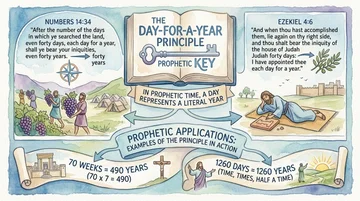
And when thou hast accomplished them, lie again on thy right side, and thou shalt bear the iniquity of the house of Judah forty days: I have appointed thee each day for a year.
Each appointed day represents a year in symbolic prophecy.
- Numbers 14:34
After the number of the days in which ye searched the land, even forty days, each day for a year, shall ye bear your iniquities, even forty years, and ye shall know my breach of promise.
A prophetic day is counted as a year.
- Mark 1:15
And saying, The time is fulfilled, and the kingdom of God is at hand: repent ye, and believe the gospel.
Jesus declares the appointed time fulfilled as the seventy weeks reach fulfillment.
- Daniel 8:16
And I heard a man’s voice between the banks of Ulai, which called, and said, Gabriel, make this man to understand the vision.
Gabriel is commissioned to explain the vision later clarified by the seventy weeks.
- Exodus 40:9-11
And thou shalt take the anointing oil, and anoint the tabernacle, and all that is therein, and shalt hallow it, and all the vessels thereof: and it shall be holy.
The earthly sanctuary and its furnishings were anointed before service began.
- Ezra 7:7
And there went up some of the children of Israel, and of the priests, and the Levites, and the singers, and the porters, and the Nethinims, unto Jerusalem, in the seventh year of Artaxerxes the king.
Dates the decree that starts the period.
- Acts 10:38
How God anointed Jesus of Nazareth with the Holy Ghost and with power: who went about doing good, and healing all that were oppressed of the devil; for God was with him.
God anoints Jesus with the Holy Spirit and power, identifying him as the Messiah.
- Leviticus 8:10-11
And Moses took the anointing oil, and anointed the tabernacle and all that was therein, and sanctified them.
The sanctuary and altar are anointed and consecrated before their service begins.
- Daniel 9:2
In the first year of his reign I Daniel understood by books the number of the years, whereof the word of the LORD came to Jeremiah the prophet, that he would accomplish seventy years in the desolations of Jerusalem.
Daniel studies Jeremiah’s prophecy of Jerusalem’s seventy years of desolation.
- Hebrews 9:11-12
But Christ being come an high priest of good things to come, by a greater and more perfect tabernacle, not made with hands, that is to say, not of this building;
Christ enters the heavenly sanctuary with his own blood, obtaining eternal redemption.
- Luke 3:21-22
Now when all the people were baptized, it came to pass, that Jesus also being baptized, and praying, the heaven was opened,
Jesus’ baptism marks his anointing with the Holy Ghost at the end of the sixty-nine weeks.
- Jeremiah 25:11-12
And this whole land shall be a desolation, and an astonishment; and these nations shall serve the king of Babylon seventy years.
Jeremiah foretold the seventy-year captivity that Daniel studied and understood.
- Isaiah 53:5-12
But he was wounded for our transgressions, he was bruised for our iniquities: the chastisement of our peace was upon him; and with his stripes we are healed.
The servant bears others’ sins and offers himself as a sacrifice for sin.
- 2 Corinthians 5:21
For he hath made him to be sin for us, who knew no sin; that we might be made the righteousness of God in him.
Christ bears sin so people may become God’s righteousness in him.
- Leviticus 16:15-19
Then shall he kill the goat of the sin offering, that is for the people, and bring his blood within the vail, and do with that blood as he did with the blood of the bullock, and sprinkle it upon the mercy seat, and before the mercy seat:
Sacrificial blood cleanses the sanctuary, foreshadowing the prophecy’s cleansing work.
- Hebrews 10:1-14
For the law having a shadow of good things to come, and not the very image of the things, can never with those sacrifices which they offered year by year continually make the comers thereunto perfect.
Christ’s once-for-all sacrifice fulfills and replaces the repeated offerings that could not take away sins.
- Exodus 30:25-30
And thou shalt make it an oil of holy ointment, an ointment compound after the art of the apothecary: it shall be an holy anointing oil.
The earthly sanctuary’s anointing rites serve as a pattern for the heavenly sanctuary.
- Luke 4:18
The Spirit of the Lord is upon me, because he hath anointed me to preach the gospel to the poor; he hath sent me to heal the brokenhearted, to preach deliverance to the captives, and recovering of sight to the blind, to set at liberty them that are bruised,
Jesus identifies his Spirit-anointed ministry as fulfilling the prophecy of the Anointed One.
Commentary part 1 of 2
Each commentary is drawn from primary sources: the writings of Ellen G. White and Adventist pioneers and periodicals. Each commentary is separate. Its own words are not a quotation; follow the references to read the source passages.
Ellen G. White
62 sources
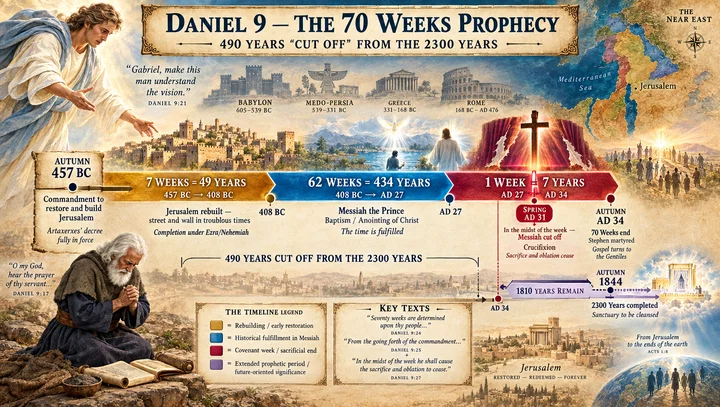
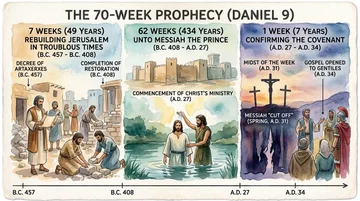
Seventy weeks are set apart upon the Jews and Jerusalem as 490 years cut off from the 2300 days, beginning with the decree to restore Jerusalem in autumn 457 B.C.PK 698.1DA 232.5–233.2CET 48.14SP 493.1LS 47.2–48.3 Sixty-nine weeks or 483 years reach to autumn A.D. 27, when Jesus was anointed by the Holy Spirit at baptism as the Messiah.PK 698.1DA 232.5–233.2GC 327.1–328.2 The last week from A.D. 27 to 34 was given especially to the Jews, with Christ dying as the true sacrifice in the midst of the week in spring A.D. 31 to end the ceremonial offerings, and with the stoning of Stephen in A.D. 34 marking rejection of the gospel and the turn to the Gentiles.DA 232.5–233.2CET 48.1LS 47.2–48.3GC 327.1–328.2GC88 681.1–682.1 The seventy weeks are the first part of the 2300 years from the same starting point, leaving 1810 years from A.D. 34 to 1844 for the cleansing of the sanctuary.CET 48.1GC 327.1–328.2GC88 328.3 The work foretold is Christ's work to finish transgression, make an end of sins, make reconciliation for iniquity, and bring in everlasting righteousness by His obedient death, which righteousness clothes by faith all who accept Him and cease from sin.Ms 112, 1894, par. 2ST Mar 20, 1893Ms 89, 1886, par. 718MR 340.7–341.3Ms 21, 1896, par. 6–8
Prayer and Revelation Setting
The seventy weeks were made known through Gabriel while Daniel was still praying, in answer to fervent intercession for skill and understanding.Ms 93, 1900, par. 27Ms 138, 1899, par. 26–31RH Mar 21, 1907Lt 201, 1899, par. 12–14 Daniel had fasted and afflicted his soul, and prayed most earnestly in tears with confession and humiliation, and his prayer was heard.Ms 93, 1900, par. 27Ms 138, 1899, par. 26–31 The communication came by ministering angels as God's answer to his plea for the restoration of Jerusalem and the captive exiles at the end of the seventy years of desolation.Ms 93, 1900, par. 27Ms 138, 1899, par. 26–31RH Mar 21, 1907 It set apart the period upon his people and upon the holy city to finish transgression and complete the work named in it.Ms 138, 1899, par. 26–31 This showed God heard his plea for His own honor, had mercy again upon His rebellious people, took them back into favor, built a second temple, and gave Jerusalem another probation.Ms 138, 1899, par. 26–31
It was given while Israel was in Babylonian captivity with the Temple destroyed and its service suspended.4MR 122.1–123.1 Religion had centered in the ceremonies of the sacrificial system, outward forms had been made all-important while the spirit of true worship was lost, the services had been corrupted with heathen traditions, and in the sacrificial rites the people did not look beyond the shadow to the substance nor discern Christ the true offering for the sins of men.4MR 122.1–123.1 God brought the captivity and suspension of the ritual service to keep outward ceremonies from becoming the sum-total of religion, to purge principles and practice from heathenism, to revive heart service, and to reveal the spiritual when the outward glory was removed.4MR 122.1–123.1 In captivity, as the people turned to the Lord with repentance, He manifested Himself to them and gave visions to His prophets unfolding the overthrow of the oppressors of God's people, the coming of the Redeemer, and the establishment of the everlasting kingdom.4MR 122.1–123.1
Daniel himself was accepted as a consecrated agent, filled with the Holy Spirit and grace.ST Nov 7, 1895Ms 54, 1894, par. 5 Through Daniel and his companions God was represented in Babylon and made His majesty known to heathen kingdoms.ST Nov 7, 1895Ms 54, 1894, par. 5 The chapter belongs to Daniel seeking God with humility, prayer, fasting, confession, and earnest supplication.Ms 38, 1905, par. 15–16 It is offered as a pattern for seeking God and praying for oneself and others, asking for forgiveness and help.Ms 38, 1905, par. 15–16 Like the rest of Daniel's prophecies about future events, it was not fully understood even by Daniel and was to remain sealed until the time of the end.PK 547.1
Words and Time Meaning
Seventy weeks are set apart upon Daniel's people, the Jews, and upon the holy city, Jerusalem.PK 698.1DA 232.5–233.2GC 327.1–328.2GC88 326.1GC 325.2–326.3 They are 490 years assigned specifically to them and their city as a special period of probation.GC88 326.1GC 325.2–326.3GC88 328.2
Determined literally means cut off or divided.4SP 493.1GC 325.2–326.3LS 46.1–47.1 The seventy weeks are cut off from the 2300 days or years in Daniel 8, the only other time period mentioned in that vision.CET 48.14SP 493.1GC 325.2–326.3LS 46.1–47.1 They are specially pertaining to the Jews as part of that larger period, and the two periods begin together.CET 48.14SP 493.1LS 47.2–48.3GC88 326.1GC 325.2–326.3 The passage begins Gabriel's further explanation of the vision in Daniel 8 by supplying the time period left unexplained there.4SP 493.1LS 46.1–47.1GC88 325.1–2 The angel's explanation focuses on time and connects the seventy weeks with the 2300 days.4SP 493.1GC88 325.1–2
Seventy prophetic weeks are 490 prophetic days representing 490 years, on the principle that a day in the period stands for a year.PK 698.1DA 232.5–233.2GC88 681.1–682.1GC 688.4–5GC88 328.3 The seventy-week prophetic period is made up of seven weeks, sixty-two weeks, and one week.GC88 323.2
The period dates from the going forth of the commandment to restore and rebuild Jerusalem.PK 698.1DA 232.5–233.24SP 493.1LS 47.2–48.3GC 325.2–326.3 That commandment was fulfilled by Artaxerxes' decree taking effect in autumn 457 B.C.PK 698.1DA 232.5–233.2GC88 681.1–682.1 The decree completed the work begun by Cyrus and continued by Darius so the three kings' actions count as one decree.4SP 494.2–3 Historical and chronological facts point unmistakably to 457 B.C. as the proper starting point.GC 687.4GC88 326.2
Timeline and Fulfillment Dates
The first sixty-nine weeks, or 483 years, reach to autumn A.D. 27, when Jesus was anointed by the Holy Spirit at His baptism and began His ministry, identifying Him as the Messiah, since Messiah means the Anointed One, and thus fulfilling the promise of anointing the Most Holy.PK 698.1DA 232.5–233.2GC 327.1–328.2 The final seven years, the final week running from A.D. 27 to 34, were especially allotted to preaching the gospel to the Jews, with Christ preaching for three and a half years and the apostles continuing afterward.DA 232.5–233.2GC 327.1–328.2 In the midst of the final week, in spring A.D. 31, Christ's death as the true sacrifice brought the ceremonial sacrifices and offerings to an end and marked the end of the earthly sacrificial service.DA 232.5–233.2GC 327.1–328.2GC88 681.1–682.14SP 494.2–3 The full span ends in A.D. 34, when Stephen's stoning confirmed the Jews' rejection of the gospel, the apostles turned to the Gentiles and the scattered disciples carried the message outward, the Jews lost their status as God's chosen people, and the complete confirmation of the covenant with Daniel's people was marked.DA 232.5–233.2CET 48.1LS 47.2–48.3GC 327.1–328.2GC88 681.1–682.1
The seventy weeks extending to A.D. 34 are the first portion cut off from the 2300 years dating from the same B.C. 457 starting point and extending to A.D. 1844, with the remaining 1810 years running from A.D. 34 to 1844 when the sanctuary was to be cleansed.CET 48.1GC 327.1–328.2GC88 328.3 Using 457 B.C. as that starting year, subtracting 457 from 2300 gives A.D. 1843.4SP 495.1 The events assigned to this period were once predictions and were fulfilled in accordance with the prophecy, fulfilling its specifications.GC 323.2–324.2GC88 323.24SP 494.2–3GC88 326.2 The prophecy makes known the exact time of Christ's first coming, the definite hour determined in heaven's council for Christ to come to redeem those under the law.PK 699.3–700.2 It was given to keep alive hope in His appearing and to hold the Hebrews in constant expectancy, yet even after the time was made known not all rightly interpreted the message, and as centuries passed faith grew dim and the word was left uncomprehended by many.PK 699.3–700.2
The prophecy definitely marks the time of Christ's coming, His anointing, His death, and the gospel's extension to the Gentiles, revealing the time appointed for His coming so that His birth in Bethlehem came at the determined hour and the events Jesus explained occurred when the appointed time had arrived.DA 31.2–3DA 233.3–234.2ST Apr 11, 1878 As its end drew near, Zacharias prayed for the Messiah's advent and Gabriel, the messenger who had given the prophecy to Daniel, came to announce its fulfillment.DA 98.4 The pious Jews looked to the prophets' predictions and believed the time had arrived, and by the time John began preaching the seventy weeks were nearly ended with people expecting the Messiah's era to bring national glory.DA 133.2–32SP 41.2 The seventy-week prophecy provided the disciples' basis for proclaiming at Christ's first advent that the appointed time was fulfilled and God's kingdom was at hand concerning the fulfillment of a portion of the same great period that included the 2300 days.GC 351.1GC88 351.1–352.3 In announcing the time they gave the right message at the right time and fulfilled God's will, but adherence to popular errors blinded them to the same prophecy's foretelling of the Messiah's death so they expected an earthly kingdom to be set up at the end of the seventy weeks, and through misapprehension they suffered disappointment paralleling the later disappointment over the expiration of the 2300 days.GC88 351.1–352.3GC 352.3 The prophecy pointed unmistakably to the time of Messiah's coming and directly foretold His death, yet the Jewish leaders discouraged study of it and the rabbis pronounced a curse on attempts to calculate its time, so Israel's rejection of this light left the people ignorant of Messiah's advent.GC88 377.3–378.2
Messiah's Redemptive Work
The verse describes the work of Christ, who came not to preserve sin but to finish transgression, to make an end of sins, to make reconciliation for iniquity, to bring in everlasting righteousness, and to fulfill or seal up the vision and prophecy.Ms 112, 1894, par. 2Ms 89, 1886, par. 7 His work answers whether people can be saved while continuing to transgress God's law, showing that it does not perpetuate continual transgression.Ms 112, 1894, par. 2Ms 89, 1886, par. 7
Reconciliation for iniquity and everlasting righteousness are brought in by the Messiah through His sacrifice, with the cross of Calvary as the great center.11MR 101.2–37T 149.2STB 180.2Lt 201, 1899, par. 12–14Lt 58, 1902, par. 16–18 Everlasting righteousness was brought in when Christ by His obedience unto death poured out His blood as an atonement for sin.18MR 340.7–341.3Lt 46, 1879, par. 6–88MR 127.2 In doing so He satisfied the claims of the law, bore its curse for humanity, offered His life, saved people from perdition, and brought them pardon and peace.18MR 340.7–341.3STB 846.28MR 127.2
Christ came to bear the penalty for human transgression, to uphold the unchanging law of God and vindicate the justice of His government, and to make an end of sin.21MR 112.3–4 By lifting sinners from their low estate He magnifies God's law.21MR 112.3–4 The verse identifies Him as the Anointed One and Holy One of God who makes reconciliation and brings righteousness.ST Nov 7, 1895ST Nov 7, 1895Ms 54, 1894, par. 5 He is the Anointed Priest who lives to intercede for every person and is the only hope and source of help.ST Nov 7, 1895
This redemption was what Christ talked of with Moses and Elijah at His transfiguration.11MR 101.2–3Lt 201, 1899, par. 12–14
Righteousness Received by Faith
Everlasting righteousness is Christ's own righteousness, received by faith rather than achieved through one's own works.18MR 340.7–341.3 He is the light of the world so that those who follow Him do not walk in darkness, and trusting in Him and holding fast to Him by faith leads to growth in grace and obedience.18MR 340.7–341.3Ms 31, 1911, par. 52 By His perfect obedience Christ satisfies the claims of the law, and as substitute and surety He obeys the law for the believer.ST Mar 20, 1893Lt 91, 1895, par. 8 Faith in His merits frees the believer from condemnation, and Christ clothes those who accept pardon with His righteousness, which meets every demand of the law.ST Mar 20, 1893Ms 21, 1896, par. 6–8Lt 91, 1895, par. 8
In Christ the believer is complete and is presented to God in a spotless garment made entirely by Christ, to whom all glory belongs.ST Mar 20, 1893 He bears the sinner's guilt, and through Him access to God is secured and pardon takes away sin.Ms 21, 1896, par. 6–8 His atonement is complete and His sacrifice offers the gift of salvation, assuring that those who give themselves to God are accepted in Him.Ms 24, 1889, par. 50–52Lt 4, 1903, par. 2 That sacrifice makes it possible to cease from sin and accept His righteousness.Ms 24, 1889, par. 50–52
His sufferings make an end of sin so believers need not continue in it.Lt 91, 1895, par. 8 They are called to obey the law and form a character like His rather than continue in sin, and this gift does not cancel the law's call to obedience or perpetuate continual transgression.Ms 24, 1889, par. 50–52Ms 21, 1896, par. 6–8Lt 91, 1895, par. 8 This gives reason for joy and means full reliance on Christ alone for eternal interests, since He does not save because a person is perfect but because a needy, imperfect person has trusted in Him.8MR 127.2 He lives now at the Father's right hand as Prince of life and Saviour.8MR 127.2
By the humiliation of the cross He brings everlasting deliverance to all who walk after Him with positive evidence of separation from the world.11MR 101.2–3Lt 201, 1899, par. 12–14 All who endure to the end will be saved, and all who hold the beginning of their confidence firm unto the end will have eternal righteousness.11MR 101.2–3Lt 201, 1899, par. 12–14 Those who depart from its principles need converting as verily as the hardened sinner.11MR 101.2–3Lt 201, 1899, par. 12–14 These truths awaken conviction of sin and a hunger for righteousness, lead people to share the liberty of God's children, and prepare them to stand with God's people to welcome Christ's soon return in power and glory.7T 149.2STB 180.2
Study and Gospel Witness
Daniel 9:24 belongs among the great prophetic time periods that were given to be studied so that their beginning and ending dates could be determined.GC 688.4–5 In that period a day stands for a year, and the period reaches its expiration about the middle of the eighteen-hundreds, in this age of the world.GC 688.4–5 Giving time to its chronology is reverent obedience rather than presumptuous folly.GC 688.4–5 The mistake connected with it lay not in the dates but in misunderstanding the nature of the events to occur at its expiration.GC 688.4–5
Studied with earnestness, humility, and humble hearts, the prophecy gave the time of Christ's first appearing.Ms 41a, 1896, par. 3320MR 241.5–242.2 That same humble study would also have helped people recognize the manner of His appearing and would have shown that Christ answered every specification of the Messiah.Ms 41a, 1896, par. 3320MR 241.5–242.2 The Jews misread the Scriptures by assigning to His first advent the glories belonging to His second appearing.Ms 41a, 1896, par. 33 They therefore failed to recognize the time of their visitation.Ms 41a, 1896, par. 33
Its first beams of light are given to the pure and simple who are willing to receive light and are waiting to catch the first gleams of knowledge about the Messiah's coming.Ms 27, 1898, par. 1 It is searched earnestly by high-minded, spiritually minded souls.Ms 27, 1898, par. 1 Priests and rulers who are lofty in their own estimation and occupied and hurried with their own interests are not prepared to recognize God in it or to understand it.Ms 27, 1898, par. 1
Christ's work set forth here is to make an end of sins and to bring in everlasting righteousness, and those who believe in Jesus join that work by yoking up with Christ in reform and putting an end to sin.Ms 25, 1892, par. 25–27 No human science or philosophy can establish a people in the way of virtue.Ms 25, 1892, par. 25–27 Finishing sin and bringing in righteousness demands divine agency and the wisdom that is from above.Ms 25, 1892, par. 25–27
Christ the Anointed One is the one who makes reconciliation for sin and brings in everlasting righteousness, the Anointed Priest who lives to intercede for every person and who is the only hope and source of help.ST Nov 7, 1895 Those who accept Him are to show by their words and lives that He has reconciled them to God.ST Nov 7, 1895 They are to share His love and goodness with the world.ST Nov 7, 1895
The reconciliation for iniquity and the everlasting righteousness are brought in by the Messiah through His sacrifice, with the cross of Calvary as the great center.11MR 101.2–3Lt 201, 1899, par. 12–14 This truth, acted upon, makes His sacrifice effectual.11MR 101.2–3Lt 201, 1899, par. 12–14
Sources
Pioneers and periodicals
250 sources
Seventy weeks are cut off and set apart upon Daniel's people the Jews and upon Jerusalem, meaning 490 prophetic days reckoned as 490 literal years on the day-for-a-year principle.RH Feb 13, 1900RH May 1, 1900RH Jun 29, 1911RH Feb 27, 1908RH Oct 11, 1915
They are the first 490 years of the 2,300 days of Daniel 8, beginning together with them at the going forth of the command to restore Jerusalem in Artaxerxes' decree of 457 B.C.RH Mar 30, 1876RH Jan 21, 1858RH Dec 23, 1852RH Apr 18, 1912ST Jan 24, 1906
Sixty-nine weeks or 483 years reach to Messiah the Prince at His baptism and anointing in autumn A.D. 27, and in the midst of the seventieth week after three and a half years He is cut off by crucifixion in spring A.D. 31, causing sacrifice to cease in God's purpose.RH May 1, 1900RH Feb 27, 1908ST Feb 18, 1913RH Apr 30, 1901RH Mar 1851
The 490 years end in autumn A.D. 34 with Stephen's stoning and Israel's rejection, when the gospel turns from Jews alone to Gentiles and all nations equally.RH Nov 13, 1856RH Apr 18, 1912ST Jan 24, 1906RH Feb 7, 1856ST Feb 22, 1883
Within the period the sixfold work is fulfilled in Christ, finishing transgression by Israel's rejection of Him, ending sin offerings and making reconciliation by His death, bringing in everlasting righteousness by His life and blood, confirming vision and prophecy by exact fulfillment, and anointing the true heavenly sanctuary for His priestly ministry, with the remaining 1,810 years reaching to its cleansing and the investigative judgment in 1844.RH Feb 13, 1900RH May 1, 1900ST Oct 25, 1877ST Feb 16, 1882ST Feb 18, 1886
Words and Year Day
The word rendered determined literally means cut off, divided, marked off, decreed, fixed or appointed, so the sentence reads seventy weeks are cut off upon thy people.RH Jun 29, 1911RH Oct 11, 1915ST Oct 25, 1877ST Feb 16, 1882 The Hebrew is chathak in one form and nechtak in another, properly to cut off, to divide, and so to determine or decree, with the single signification of cutting off, rendered were cut off and have been shortened.RH Oct 11, 1915ST Oct 25, 1877 The seventy weeks, or 490 years, are thus set apart as specially pertaining to the Jews and are cut off from the 2300 days of Daniel 8.RH Jun 29, 1911RH Oct 11, 1915ST Feb 16, 1882ST Oct 22, 1874 Because the 2300 days are the only other time period mentioned, the two periods begin together, the shorter period being part of the longer one and briefly summarizing the work to be accomplished during those 490 years allotted to the Jewish people and to Jerusalem.RH Jun 29, 1911RH Oct 11, 1915ST Oct 22, 1874
The seventy weeks are 490 prophetic days reckoned as 490 literal years on the day-for-a-year principle, as weeks of years.RH May 1, 1900RH Feb 27, 1908RH Oct 11, 1915RH Apr 18, 1912ST Feb 18, 1913 Without the year-day reading the prophecy has no meaningful fulfillment, for seventy ordinary days would not reach Messiah.RH May 1, 1900RH Feb 27, 1908RH Oct 11, 1915ST Feb 18, 1913RH Jan 20, 1916 The 69 weeks, or 483 years, reach from the command to restore Jerusalem to Christ's manifestation to Israel, marked by the heavenly declaration that He is God's beloved Son.RH May 1, 1900RH Feb 27, 1908RH Apr 18, 1912ST Feb 18, 1913RH Jan 20, 1916 He cried It is finished after 486 1/2 years, not 486 1/2 days, reaching Christ's death, and their fulfillment reached the time when the disciples went out preaching, sealing the vision by confirming the 2300-day period.RH May 1, 1900RH Feb 27, 1908RH Apr 18, 1912 The period ended in A.D. 34, at the close of the years associated with Christ's public ministry and crucifixion and with the apostles turning to the Gentiles.RH May 1, 1900RH Apr 18, 1912ST Feb 18, 1913
The word week denotes a group of seven, corresponding to the Hebrew Shabua and Greek Hebdomos.RH Jun 4, 1908ST May 31, 1910RH Dec 20, 1870RH Jan 21, 1873RH Apr 9, 1908 This supports the ordinary sense of week as seven days, while related passages also use Sabbath to mean a week or a group of seven.RH Jun 4, 1908RH Dec 20, 1870 The seventy weeks of years are distinct from the three weeks of days in Daniel 10, and are treated as a period of 490 consecutive years, each day standing for a year.ST May 31, 1910RH Dec 20, 1870RH Jan 21, 1873RH Apr 9, 1908 Counting those years from any of the four Persian royal edicts concerning the rebuilding of Jerusalem does not bring the period's end near Jerusalem's destruction by the Romans in A.D. 70, and a proposed chronology extending them from 458 B.C. to A.D. 39 contains a minor error.RH Apr 9, 1908 Four hundred sixty-five years from the threefold command made by Cyrus and Cambyses and completed by Artaxerxes had passed, leaving scarce twenty years of the sixty-nine weeks of years until the Anointed One, Shiloh, the Star of Jacob, comes.ST May 31, 1910
The word finish means cause to cease, not perform the final part of something.RH Oct 7, 1873 The Messiah finishes transgression by bringing it to an end.RH Oct 7, 1873RH Mar 12, 1901 The expression in the midst of the week means the exact middle, not any time during the week.RH Mar 12, 1901 Christ's baptism in autumn A.D. 27 began the final week; its exact midpoint fell three and a half years later, in spring A.D. 31, when Christ was crucified, and the end of the seventy weeks was impressively signaled by Stephen's death and the soon-following conversion of Paul and his dedication to taking the gospel to the Gentiles.RH Mar 12, 1901
A differing reading identifies the Most Holy as the Saint of saints.RH Oct 11, 1915 The sixfold close of the 70 weeks is to finish the transgression, and to make an end of sins, and to make reconciliation for iniquity, and to bring in everlasting righteousness, and to seal up the vision and prophecy, and to anoint the Most Holy.RH Oct 11, 1915ST May 31, 1910 The phrase most holy gives no proof about degrees of holiness of the Sabbath compared with sacrifices and offerings.RH Jun 10, 1862 The verse is brought in with many other texts on the question whether the seventh-day Sabbath has less holiness, spirituality, or sanctity because it is called holy and my holy day and never most holy while sacrifices, meat offerings, and trespass offerings are called most holy, and it gives no comparison of the Sabbath with offerings and proves nothing that the Sabbath is less holy.RH Jun 10, 1862 Holy in the positive and most holy in the superlative have no force here because the two are not compared with each other, and the Sabbath stands as the one day God blessed and sanctified with a command to keep it holy, not one among many Sabbaths admitting degrees, and in that sense much more holy than things called most holy.RH Jun 10, 1862
Vision Setting and Prayer
Daniel 9:24 opens Gabriel's renewed explanation of the vision of Daniel 8 whose duration had been left unexplained.RH Dec 31, 1857ST Jan 27, 1890RH Nov 8, 1853ST Oct 25, 1877 Gabriel had been commanded to make Daniel understand that vision but had explained only its symbols, and he now returns to give skill and understanding, to bid Daniel consider the vision, and to answer prayer concerning his people, the holy city and the sanctuary.ST Oct 22, 1874RH May 26, 1853ST Jan 24, 1878RH Dec 31, 1857ST Apr 1, 1880 The seventy weeks are thus set forth as time cut off upon Daniel's people and Jerusalem, supplying the unexplained time element and the key for reckoning the longer period to which they belong.ST Jan 27, 1890RH Nov 8, 1853ST Oct 25, 1877ST Oct 22, 1874
Full understanding was not given at first because Daniel fainted, was sick certain days, and remained astonished without understanding, so that he could bear only what was then revealed.RH May 26, 1853ST Jan 24, 1878RH Dec 31, 1857ST Apr 1, 1880RH Dec 20, 1870 For that reason Gabriel does not again explain the ram, the goat and the little horn, because those had already been made plain, but explains the very point omitted in Daniel 8, namely time.ST Jan 24, 1878RH Dec 31, 1857RH Jul 14, 1863ST Apr 1, 1880ST Jul 17, 1901 Some points still remained unexplained after this resumption, and those Daniel again sought with fasting and supplication in Daniel 10.RH Dec 20, 1870
The revelation came while Daniel was praying during the captivity with the Jews still captive and the temple in Jerusalem in ruins.ST Jan 27, 1890ST Oct 22, 1874RH May 26, 1853ST Apr 1, 1880 He was studying Jeremiah's seventy years in connection with Jerusalem's desolation and the time for cleansing the sanctuary, confessing sin and pleading for the desolate sanctuary at the time of the evening oblation, when Gabriel touched him to give skill and understanding.ST Oct 22, 1874RH May 26, 1853ST Apr 1, 1880 It was given in the first year of Darius in 538 B.C., only a few months to less than two years after Daniel 8 in the third year of Belshazzar, and its close timing supports that Daniel 9 explains the time presented in Daniel 8.RH May 26, 1853ST Dec 24, 1894RH May 12, 1910 It corrected connecting the cleansing of the 2,300 days with the end of the seventy-year captivity over which Daniel was praying.ST Oct 22, 1874RH May 26, 1853
The verse belongs with the symbolic prophecies of Daniel 2, 7, 8 and 9, which present Babylon, Medo-Persia, Grecia and Rome and lead to Christ's second coming and everlasting kingdom.ST Aug 9, 1910ST Aug 5, 1913ST Jul 1, 1908RH Jul 24, 1866 Those prophecies are parallel and supplementary, expanding in detail the outline first given in Daniel 2 under the great metallic image from world empires to the everlasting and universal reign of Christ.ST Oct 8, 1896 What was left incomplete in Daniel is filled up by Revelation, especially Revelation 12-22 given this side of Messiah's coming.ST Oct 8, 1896 Like the other great lines it begins in the past and carries its outline forward to the glorious completion of Christ's kingdom in the present generation, warning of coming judgments and dangers.ST Nov 1, 1910ST Aug 5, 1913
The Daniel 8-9 chain reaches back ages before Christ and spans the Christian dispensation to the second advent, shining light on the period of Christ's coming to punish the ungodly, reward the saints, and bring peace and restitution.RH Mar 11, 1875 Together with ten or eleven other long chains in Daniel, Revelation, the Gospels and Paul, its concurrent agreement and fulfillment places the present in the last link on the verge of the day of God.RH Mar 11, 1875ST Sep 10, 1894 Compared with the history of the human family and present conditions it proclaims that the closing days of earth's history have been reached, calling for proclaiming the judgment and preparing to meet Christ in peace.RH Mar 11, 1875ST Sep 10, 1894 In harmony with Daniel 8 it locates the beginning of the investigative judgment in 1844, when the heavenly books are opened and the cases of the righteous are reviewed before the first resurrection and Christ's second appearing.ST Aug 25, 1914
The revelation in chapter 9 does not complete the explanation of Daniel's vision in chapter 7, for it does not answer how long the host would be trodden underfoot.RH Jan 10, 1856 Nor does it mention the apostasy when God's worship sank very low and was almost lost, nor the worst persecution in Israel's history that came as God's chastisement for that apostasy.ST Apr 23, 1912 Showing what would befall Daniel's people at the end of the indignation and what would come to his own people was left for Daniel 10-12.RH Jan 10, 1856ST Apr 23, 1912
Cut Off From 2300 Days
The seventy weeks are cut off from the 2,300 days of Daniel 8, forming its first 490 days or years allotted to Daniel's people the Jews and to Jerusalem.RH Mar 30, 1876ST May 13, 1880RH Oct 11, 1915 Both periods begin together, because the shorter period is part of the longer one and no other starting point is named.RH Jan 21, 1858RH Jun 29, 1911RH Oct 11, 1915 The seventy weeks thus explain the chronology of the 2,300 days, supply its unexplained starting point, and are the key to reckoning the longer period.ST May 11, 1876RH Jul 21, 1863RH Jul 21, 1863
The reference to sealing up the vision connects the seventy weeks to the preceding vision, especially its chronological part left unexplained in Daniel 8:13-14.RH Jul 21, 1863RH Jul 21, 1863ST Feb 18, 1886 It is therefore natural to understand the seventy weeks in relation to that long period, and their date establishes the date of the 2,300 days.ST May 11, 1876RH Jul 21, 1863RH Jul 21, 1863 Daniel 9 is an appendix to Daniel 8, interpreting the part of the earlier vision that remained unexplained.RH Jan 21, 1858RH Jan 21, 1858ST Feb 18, 1886
This connection is the grand principle, scale, fixed rule, foundation and main pillar involved in interpreting the 2,300 days.RH Dec 23, 1852ST May 13, 1880RH Jan 21, 1858RH Apr 28, 1853 If the connection holds the whole prophetic system stands, and if it does not the whole system is shaken to its foundation.RH Mar 30, 1876RH Dec 23, 1852RH Jan 21, 1858 To deny it is an act of fearful character and a serious defection from the original Advent faith, and separating the periods leaves the longer period without revealed start or purpose.RH Dec 23, 1852RH Aug 4, 1868 Those who held otherwise concluded from the non-occurrence of the event expected in 1843-1844 that the periods were not connected and that the seventy weeks were not cut off from the 2,300 days.RH Feb 17, 1853RH Jan 10, 1854
The connection remained sealed until 1798, when the appointed time came and God removed the seal so the vision could be understood, believed, preached, and used to warn the world.RH Mar 1851LDT 42.2GSAM 84.3 It was then discovered independently in at least twenty different countries with agreement that the period would terminate in 1844.RH Jul 16, 1914 The seventy weeks terminate in A.D. 34, so the 2,300 days terminate 1,810 years later in 1844, with Christ's public ministry and death occurring in exact harmony with the date and confirming Him as the true Messiah.LDT 42.2RH Jul 16, 1914GSAM 84.2 The 2,300 days are the principal and longest period, while the seventy weeks and the 1,260, 1,290, and 1,335 years are intermediate parts and subdivisions falling within them.RH Jul 2, 1867RH Feb 27, 1866ST Jul 27, 1882 These are the prophetic periods that define the times of the Gentiles, which are those given in the word of God and not periods fixed up by man such as 2,520 years from B.C. 606 to A.D. 1915, with further days allotted to the Gentiles beyond 1844 known definitely only to God until Christ comes.ST Jan 28, 1897RH Apr 18, 1854RH Jul 20, 1876
People City Starting Decree
The seventy weeks are set apart and allotted exclusively to Daniel's people the Jews and to Jerusalem, the holy city and place of the earthly sanctuary and first covenant, as their restored polity, final probationary period and time of exclusive gospel work.RH May 1, 1900RH Jun 29, 1911RH Oct 11, 1915RH Nov 13, 1856RH Apr 18, 1912 The period is a set time given to that people and their iniquities, ending their distinctive standing as Messiah's people, after which the privileges of the kingdom extend equally to all nations.RH May 1, 1900RH Nov 13, 1856RH Apr 18, 1912 The six events named are to be consummated during those 490 years allotted to the Jewish people.RH Feb 13, 1900RH Oct 11, 1915
Both periods begin together with the going forth of the command to restore and build Jerusalem, which fixes the beginning of the 2,300 days as well as the seventy weeks.RH Apr 18, 1912RH Nov 21, 1854ST Dec 19, 1892ST Feb 18, 1913RH Nov 15, 1853 That command is identified as the decree of Artaxerxes Longimanus in his seventh year recorded in Ezra 7:11-26, dated to 457 B.C. in autumn when Ezra arrived in the fifth month, rather than Daniel's prayer or Jeremiah's prophecy.RH Apr 18, 1912ST Jan 24, 1906ST Feb 18, 1913RH Nov 15, 1853 The seventy weeks are thus the first 490 years of the longer period, cut off from it and beginning at the same time as an explanation of that vision.RH Nov 21, 1854ST Dec 19, 1892RH Nov 15, 1853
The complete command comprises the successive Persian decrees of Cyrus in 536 B.C., Darius in 519 or 518 B.C., and Artaxerxes to Ezra in 457 B.C. and to Nehemiah in 444 B.C., reckoned from the last effective one in 457 B.C.RH Dec 1, 1863RH Nov 24, 1910ST Feb 7, 1884ST Jan 20, 1904RH Nov 7, 1907 The decree to Ezra alone fully restores city, worship, law, justice and government, with treasure, sacrifices, exemption for priests and power to appoint judges and magistrates with power of life and death, banishment, confiscation and imprisonment.RH Nov 7, 1907RH Jan 21, 1858RH Dec 24, 1861ST Sep 20, 1910RH Feb 27, 1908 It sent Ezra to inquire concerning Judah and Jerusalem, to settle church and state by the law of God, and brought a colony that rebuilt the city, a work continued and perfected by Nehemiah.RH Nov 7, 1907RH Jul 23, 1857ST Apr 22, 1880
Cyrus' and Darius' decrees alone do not satisfy the command because they authorized only return and temple, the second concerning the temple alone and the first not carried out effectively.RH Jan 21, 1858RH Dec 24, 1861ST Sep 20, 1910RH Feb 27, 1908RH Sep 13, 1870 Reckoned as 483 years, the period from 536 B.C. ends 53 years before Jesus' birth and from 519 B.C. ends 36 years before His birth, failing to reach Messiah.RH Dec 24, 1861 Nehemiah's twentieth-year commission was only verbal permission continuing Ezra's work already begun thirteen years earlier, not a new starting point, though Ezra understood his own written royal decree to authorize rebuilding the city and its wall.ST Apr 22, 1880RH Jan 21, 1858RH Dec 24, 1861RH Feb 27, 1908RH Sep 13, 1870
The period begins when restoration work actually started after Ezra's arrival, not when finished, so work from Artaxerxes' seventh to twentieth year does not shift the endpoint.RH Jul 23, 1857RH May 6, 1852 Ezra arrived in the fifth month, and preparations brought the start of the work to autumn, with the crucifixion at Passover in spring A.D. 31 requiring three and a half years backward and forward to place the ministry's beginning and the week's end in autumn.RH Jan 7, 1858RH May 6, 1852 Because the command went forth partway through 457 B.C. that fraction places the end in autumn A.D. 34 rather than spring, marked by Stephen's martyrdom, persecution scattering the church, and the turn to the Gentiles.RH Jan 7, 1858RH May 6, 1852
The 457 B.C. date is supported by Ptolemy's canon agreeing with more than twenty eclipses and regnal records, with Artaxerxes reckoned from 464-463 B.C.ST Mar 2, 1882RH Sep 20, 1870RH Feb 17, 1853 His Nabonassarean year from December 17, 465 B.C. does not alone fix his accession and chronology must be tested by events and Luke on Jesus' age.ST Mar 2, 1882RH Sep 20, 1870RH Feb 17, 1853 The exact end of the time depends entirely on the accuracy of chronology.RH Apr 28, 1910RH Jan 21, 1873
Dating from Nehemiah's twentieth year in 444 B.C., or from 454 or 446 B.C., is rejected because the reckoning then misses baptism in A.D. 27, crucifixion in the midst, and any marked close.RH Dec 23, 1852ST Apr 22, 1880RH Dec 24, 1861RH Dec 23, 1852RH Oct 30, 1855 Reckoned from 444 B.C., 483 years end in A.D. 39-40 with midpoint and end in A.D. 44 and A.D. 46-47, rather than at the crucifixion or a prophetic conclusion, and no event in A.D. 47 marks the period's end.RH Dec 23, 1852ST Apr 22, 1880RH Dec 23, 1852 The alternative carries the 2,300 days to 1856-1857, and moving the weeks thirteen years forward disrupts Messiahship and chronology.RH Dec 24, 1861RH Oct 30, 1855RH Dec 15, 1868 If begun with the seventh-year decree the 490 years cannot end later than A.D. 34, while if begun with the twentieth-year decree they cannot end earlier than A.D. 46-47.RH Dec 23, 1852ST Apr 22, 1880RH Dec 23, 1852
The holy sanctuary is Jehovah's habitation, the house built for God's name and dwelling, distinct from the land of Canaan where it stood and from the people who lived there.RH Jan 6, 1853RH Feb 15, 1870 Canaan was only the place where God's sanctuary stood.RH Jan 6, 1853RH Feb 15, 1870
Sources