Daniel 6:10
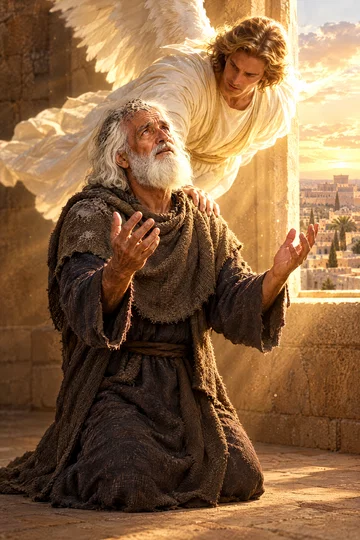
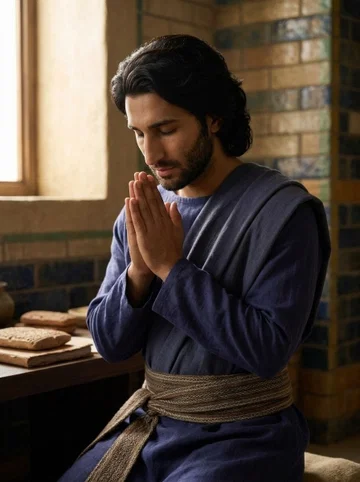
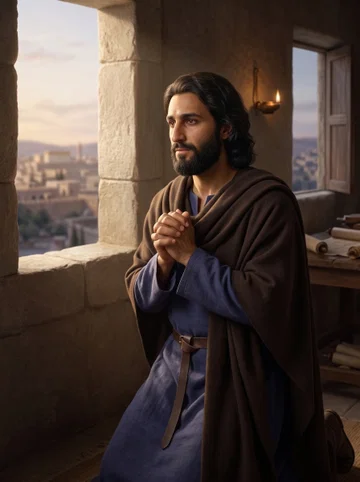
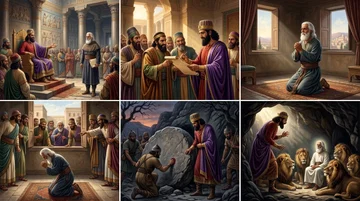
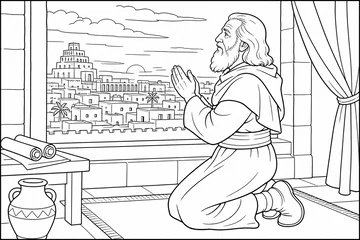
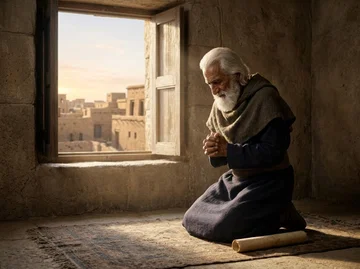
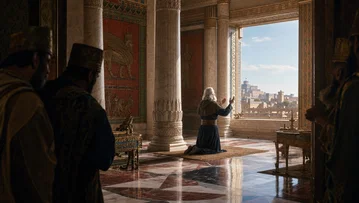
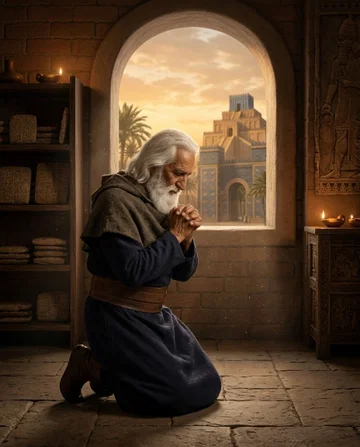
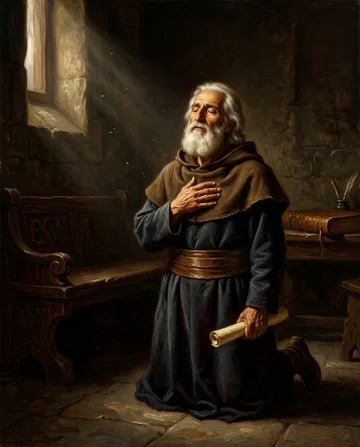
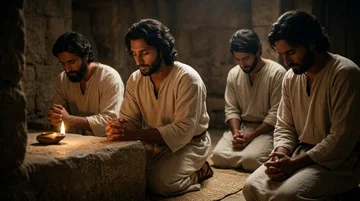
Now when Daniel knew that the writing was signed, he went into his house; and his windows being open in his chamber toward Jerusalem, he kneeled upon his knees three times a day, and prayed, and gave thanks before his God, as he did aforetime.
Translations
Now when Daniel knew that the writing was signed, he went into his house; and his windows being open in his chamber toward Jerusalem, he kneeled on his knees three times a day, and prayed, and gave thanks before his God, as he did aforetime.
King James Version, KJV Cambridge Paragraph Bible
Now when Daniel knew that the writing was signed, he went into his house; and his windows being open in his chamber toward Jerusalem, he kneeled upon his knees three times a day, and prayed, and gave thanks before his God, as he did aforetime.
Now when Daniel knew that the writing was signed, he went into his house; and his windows being open in his chamber towards Jerusalem, he kneeled upon his knees three times a day, and prayed, and gave thanks before his God, as he did before.
And when Daniel knew that the writing was signed, he went into his house; ( now his windows were open in his chamber toward Jerusalem;) and he kneeled upon his knees three times a day, and prayed, and gave thanks before his God, as he did aforetime.
And when Daniel knew that the writing was signed, he went into his house ( now his windows were open in his chamber toward Jerusalem); and he kneeled upon his knees three times a day, and prayed, and gave thanks before his God, as he did aforetime.
And Daniel, when he hath known that the writing is signed, hath gone up to his house, and the window being opened for him, in his upper chamber, over-against Jerusalem, three times in a day he is kneeling on his knees, and praying, and confessing before his God, because that he was doing [it] before this.
And when Daniel knew that the writing was signed, he went into his house; and, his windows being open in his upper chamber toward Jerusalem, he kneeled on his knees three times a day, and prayed and gave thanks before his God, as he did aforetime.
But, Daniel, when he knew that the writing, was signed, went to his own house, and, the windows being opened to him, in his chamber, toward Jerusalem, three times a day, was he kneeling upon his knees, and praying and giving thanks before his God, in like manner as he had been doing aforetime.
Berean Standard Bible, Majority Standard Bible
Now when Daniel learned that the document had been signed, he went into his house, where the windows of his upper room opened toward Jerusalem, and three times a day he got down on his knees, prayed, and gave thanks to his God, just as he had done before.
When Daniel knew that the writing was signed, he went into his house ( now his windows were open in his room toward Jerusalem) and he kneeled on his knees three times a day, and prayed, and gave thanks before his God, as he did before.
And Daniel, on hearing that the writing had been signed, went into his house; ( now he had windows in his room on the roof opening in the direction of Jerusalem;) and three times a day he went down on his knees in prayer and praise before his God, as he had done before.
Now when Daniel vnderstood that he had sealed the writing, hee went into his house, and his window being open in his chamber toward Ierusalem, he kneeled vpon his knees three times a day, and prayed and praysed his God, as he did aforetime.
Douay-Rheims (Challoner revision)
Now when Daniel knew this, that is to say, that the law was made, he went into his house: and opening the windows in his upper chamber towards Jerusalem, he knelt down three times a day, and adored, and gave thanks before his God, as he had been accustomed to do before.
Pictures






Cross-references 20 of 65
- Daniel 3:16-18
Shadrach, Meshach, and Abed-nego, answered and said to the king, O Nebuchadnezzar, we are not careful to answer thee in this matter.
Both accounts show faithful believers refusing royal commands that conflict with obedience to God, despite death threats.
- Daniel 6:22
My God hath sent his angel, and hath shut the lions’ mouths, that they have not hurt me: forasmuch as before him innocency was found in me; and also before thee, O king, have I done no hurt.
God delivered Daniel from the lions after he kept praying.
- Acts 5:29
Then Peter and the other apostles answered and said, We ought to obey God rather than men.
Both concern obeying God when rulers command otherwise.
- Acts 4:19
But Peter and John answered and said unto them, Whether it be right in the sight of God to hearken unto you more than unto God, judge ye.
Both require choosing obedience to God when human authorities command otherwise.
- Psalms 55:17
Evening, and morning, and at noon, will I pray, and cry aloud: and he shall hear my voice.
both describe praying three times daily
- Daniel 6:3
Then this Daniel was preferred above the presidents and princes, because an excellent spirit was in him; and the king thought to set him over the whole realm.
Daniel’s excellent spirit brought his promotion and provoked envy.
- Daniel 6:5
Then said these men, We shall not find any occasion against this Daniel, except we find it against him concerning the law of his God.
His enemies could find no fault except in his devotion to God’s law.
- Daniel 6:16
Then the king commanded, and they brought Daniel, and cast him into the den of lions. Now the king spake and said unto Daniel, Thy God whom thou servest continually, he will deliver thee.
Daniel is cast into the lions’ den for remaining faithful in prayer.
- Daniel 1:8
But Daniel purposed in his heart that he would not defile himself with the portion of the king’s meat, nor with the wine which he drank: therefore he requested of the prince of the eunuchs that he might not defile himself.
Daniel’s early refusal to compromise prepared him for his later trial.
- Luke 22:41
And he was withdrawn from them about a stone’s cast, and kneeled down, and prayed,
Both describe kneeling in prayer.
- Ezra 9:5
And at the evening sacrifice I arose up from my heaviness; and having rent my garment and my mantle, I fell upon my knees, and spread out my hands unto the LORD my God,
Both depict kneeling in prayer before God.
- Hebrews 11:33
Who through faith subdued kingdoms, wrought righteousness, obtained promises, stopped the mouths of lions,
By faith, Daniel’s integrity overcame danger as God shut the lions’ mouths.
- Daniel 3:5-6
That at what time ye hear the sound of the cornet, flute, harp, sackbut, psaltery, dulcimer, and all kinds of musick, ye fall down and worship the golden image that Nebuchadnezzar the king hath set up:
Both accounts show faithful refusal to obey a state command that violates worship of God, under threat of death.
- Ephesians 3:14
For this cause I bow my knees unto the Father of our Lord Jesus Christ,
Both describe bowing the knees to God in prayer.
- 1 Kings 8:46-49
If they sin against thee, (for there is no man that sinneth not,) and thou be angry with them, and deliver them to the enemy, so that they carry them away captives unto the land of the enemy, far or near;
Captives turn toward Jerusalem in prayer, seeking God’s hearing and deliverance.
- Daniel 9:3
And I set my face unto the Lord God, to seek by prayer and supplications, with fasting, and sackcloth, and ashes:
Daniel seeks God in earnest prayer concerning Jerusalem, continuing his regular practice despite the decree.
- Matthew 6:6
But thou, when thou prayest, enter into thy closet, and when thou hast shut thy door, pray to thy Father which is in secret; and thy Father which seeth in secret shall reward thee openly.
Jesus teaches prayer in a secluded place, away from seeking human attention.
- Daniel 6:20
And when he came to the den, he cried with a lamentable voice unto Daniel: and the king spake and said to Daniel, O Daniel, servant of the living God, is thy God, whom thou servest continually, able to deliver thee from the lions?
Darius asks whether God delivered Daniel, who served him continually.
- Psalms 95:6
O come, let us worship and bow down: let us kneel before the LORD our maker.
Both describe kneeling before God in worship and prayer.
- Philippians 4:6
Be careful for nothing; but in every thing by prayer and supplication with thanksgiving let your requests be made known unto God.
Daniel’s prayer with thanksgiving expresses requests to God.
Commentary part 1 of 2
Each commentary is drawn from primary sources: the writings of Ellen G. White and Adventist pioneers and periodicals. Each commentary is separate. Its own words are not a quotation; follow the references to read the source passages.
Ellen G. White
103 sources
When Daniel learned that Darius had signed the decree forbidding petition to any God or man but the king for thirty days on pain of the lions' den, he went to his house as usual.PK 539.1PK 539.3ST Nov 18, 1886 He kneeled in his chamber with windows open toward Jerusalem three times a day, morning, noon and night, praying aloud and giving thanks to his God as he had always done.PK 47.4–48.1ST Aug 14, 188410MR 90.1–91.2ST Feb 15, 1905Ms 12, 1862, par. 4–6 With full knowledge that death threatened, he did not change his course in a single particular, conceal his act, or pray in secret to save his life, but openly kept his loyalty to God above obedience to any earthly power coming between conscience and God.ST Apr 11, 1911PK 540.4–542.1STBk 122.1Ms 61, 1890, par. 42ST2 13.2 His unbroken life of prayer and thanksgiving was the source of his wisdom, clearness of mind, firmness of purpose and power to resist temptation, sustaining him amid heavy cares of state and keeping him in communion with God.HPMMW 15.1RH Mar 20, 1900RH Mar 24, 1904MYP 242.2Ms 129, 1908, par. 12–15 His dauntless faithfulness under pressure became a bright testimony to the living God among idolaters and remains the pattern for believers now to pray three times a day, stand alone for God, and trust Him for protection and deliverance.ST Apr 11, 19115T 453.1–4ST Nov 4, 1886Lt 2, 1901, par. 12–14Lt 31, 1888, par. 23–25
Historical Setting and Background
Daniel 6:10 takes place after Darius the Mede took the throne formerly occupied by the Babylonian rulers and reorganized the government, setting 120 princes over the kingdom and three presidents over them, with Daniel first because an excellent spirit was in him and with the king intending to set him over the whole realm.PK 539.1 The honors bestowed upon him excited the jealousy of the leading men of the kingdom, the presidents and princes, who sought occasion of complaint against him but could find none, for he was faithful and neither error nor fault was found in him.PK 539.3PK 539.2 His blameless conduct left his enemies no ground for complaint except his faithfulness to God's law, and they could find no fault in him to trap him except by a decree against praying.PK 539.3Ms 14, 1894, par. 24–25 His conduct and official duties were so faithful under day after day of hateful watching that no error or fault could be found in his moral character to condemn.ST Oct 26, 1882
His enemies therefore devised a decree, which Darius signed, that for thirty days no one could ask a petition of any God or man except the king on pain of being cast into the lions' den, and Daniel knew the writing was signed.ST Nov 18, 1886 His regular prayer to the God of heaven three times a day was the only charge they could bring against him, for his daily prayer under the law of his God became the only accusation possible against his moral character.BS 36.3ST Oct 26, 1882 That settled practice of true sanctification made no claim for itself but lived a life of faithfulness and consecration.ST Oct 26, 1882
As a Hebrew captive made prime minister in a heathen realm he faced great obstacles to fidelity to God, but from the very beginning of his career he determined to make the law of God his rule of action whatever opposed. By maintaining steadfastness amid the lesser trials he daily met in the court of a heathen king, his faith, courage and firmness grew stronger, so that with the den of lions open before him he was able to stand true to principle and to God.SLP 297.3 His faithfulness under earlier, lesser trials had strengthened his courage and firmness and enabled him to remain true when the lions' den threatened him.SLP 297.3
Because he had not yielded in the first test over the king's table, he did not yield in this second test over worship.10MR 90.1–91.2 His exceptional call to withstand the temptations and dangers of worldly honor and high station does not make seeking such positions a model for those whose duty lies elsewhere.STSE 113.2–3TBC1882 68.2–3
Words and Actions Described
He went into his house, into his chamber, and kneeled upon his knees three times a day to pray and give thanks before his God as he had done before.PK 47.4–48.1GW 178.2MYP 251.1RH Nov 30, 1905 Bowing on the knees is the privileged attitude for offering petitions to God in both public and private worship.GW 178.2MYP 251.1RH Nov 30, 1905 It is a humble and reverent way to approach Him with humility, reverence and awe.PK 47.4–48.1RH Nov 30, 1905 Knees were given to bow three times a day in heartfelt prayer as part of faithful stewardship of the body and talents lent by God.6T 297.4Ms 110, 1898, par. 13–14 That stewardship joins mind to understand how to work, eyes to discern God-given opportunities, ears to listen for His commands, knees to bow in prayer, and feet to run in the way of His commandments, putting thought, effort and talent into exercise to be prepared for the heavenly kingdom and not be judged unfit for it.6T 297.4Ms 110, 1898, par. 13–14 Receiving from God and rendering back to Him what was entrusted for His name's glory is cooperating with God and making the most for the Master, and His blessing rests on those who do it.6T 297.4Ms 110, 1898, par. 13–14
Praying three times a day was his settled, established practice as he did aforetime, continued even after the decree against prayer was signed.ST Feb 15, 1905Ms 12, 1862, par. 4–6RH Feb 27, 1866 It was regular prayer in the morning at the commencement of the day, at noon, and at night.Ms 12, 1862, par. 4–6ST Nov 22, 1910 Seeking God at those set times to draw strength from the living Source of power is a living principle, not governed by mere feeling, and feeling must never be allowed to come between Heaven and the soul.ST Nov 22, 1910 With his windows open toward Jerusalem he prayed openly toward Jerusalem as was his custom, refusing to pray in secret or to accommodate the decree for convenience or to save life.10MR 90.1–91.2 He stood firm to principle whatever the result, choosing to lose life rather than dishonor God and letting no man come between him and God.10MR 90.1–91.2
Turning toward Jerusalem while captive in a distant land continued the sacred hours of morning and evening sacrifice and incense.PP 353.3 At those hours worshipers faced the holy place with earnest searching of heart and confession of sin, uniting in silent prayer ascending with the incense while faith laid hold on the merits of the promised Saviour.PP 353.3 Those hours became the set time for worship throughout the Jewish nation, and the captive custom gives Christians an example for morning and evening prayer.PP 353.3 God condemns a mere round of ceremonies without the spirit of worship but looks with great pleasure on those who love Him bowing morning and evening to seek pardon for sins committed and to present requests for needed blessings.PP 353.3 He prayed and gave thanks before his God with earnest intercession, praying aloud and vocally in his chamber with windows open so his words could be heard.ST Aug 14, 1884BS 38.1–2PK 542.2–4Ms 41, 1900, par. 18–21Ms 129, 1908, par. 12–15 His prayer to God was in the Lord's keeping even before he was cast into the den.Ms 129, 1908, par. 12–15
Faithfulness Under Death Decree
Daniel knew the writing was signed and that prayer to anyone but the king for thirty days was punishable by death in the lions' den, yet he did not change his course in a single particular.STBk 122.1ST Nov 4, 1889BS 37.2ST Nov 4, 1886ST Oct 26, 1882 With calmness he performed his accustomed duties, and at the hour of prayer he went to his chamber and with windows open toward Jerusalem offered his petitions to God three times that day as he did aforetime.STBk 122.1ST Nov 4, 1889BS 37.2ST Nov 4, 1886ST Oct 26, 1882 He continued his regular practice openly after knowing the decree, refusing to let it sever his connection with God.ST Apr 11, 1911PK 540.4–542.1ST Nov 4, 1889BS 37.2ST Nov 4, 1886
He did not seek to conceal his act, hide his purpose, weaken his loyalty to duty, or accommodate himself to circumstances to save his own life.ST Apr 11, 1911Ms 61, 1890, par. 42ST2 13.2Ms 40a, 1890, par. 101–102Ms 40, 1890, par. 92–94 Before those plotting his ruin he would not allow even the appearance that his bond with Heaven was broken, but openly let his enemies see that he was no coward.ST Apr 11, 1911ST Nov 4, 1886ST2 13.2Ms 40a, 1890, par. 101–1023MR 91.1–2 He stood alone without yielding to the influence around him, making no effort to turn aside to preserve life.Ms 61, 1890, par. 42Ms 40a, 1890, par. 101–102Ms 40, 1890, par. 92–94Ms 43, 1886, par. 9–103MR 91.1–2
In all cases where the king had a right to command he would obey so far as consistent with truth and righteousness, but kings and decrees could not make him swerve from allegiance to the King of kings.ST Apr 11, 1911PK 540.4–542.1ST Nov 4, 1886 By his open prayer he fearlessly declared that no earthly power has the right to come between conscience and God and tell him to whom he should or should not pray.ST Apr 11, 1911PK 540.4–542.1BS 37.2ST Nov 4, 1886ST Oct 26, 1882 No man, not even his king, has a right to interfere with the worship due the Maker.ST Apr 11, 1911BS 37.2ST Nov 4, 1886
His public prayer was not excessive righteousness but steadfast allegiance to God.Ms 10, 1885, par. 115T 527.1 Placed under a choice between his life and his worship, with death in the lions' den before him, he did not hesitate but counted it better to lose this present life than to lose eternal life.Ms 10, 1885, par. 115T 527.1 He refused to barter heaven for the things of this world.Ms 10, 1885, par. 11
He knew the value of communion with God, saw the dangers that beset his path, and knew full well the consequences of fidelity, yet his steps did not falter.ST Apr 11, 1911 His courage rested on dependence upon God and his strength came from God, upholding God's honor when he refused to hide his prayer.ST Apr 11, 1911Ms 7, 1886, par. 4–6Ms 43, 1886, par. 9–10 His course required the strict integrity that would rather face death than dishonor God.ST Apr 11, 1911Ms 7, 1886, par. 4–6Ms 43, 1886, par. 9–10
He was as true as steel to principle, full of reverence and zeal for God and full of noble purposes and aspirations, and would not fail nor be discouraged.RH Mar 10, 1903 Though as weak and helpless in himself as any worker now, he put his whole trust in God and put on the whole armor of God to stand against trial.RH Mar 10, 1903 His true wealth was mind and soul culture gained by making God first and last and best in everything.RH Mar 10, 1903 Firm religious principle kept him faithful to his daily prayers even when the lions' den threatened, so that loyalty to God withstood fear of death.5T 42.2–43.2Ms 83, 1886, par. 12–14 His faithful integrity in bowing before God three times a day and refusing to let anyone separate him from God, openly confessing faith even in the king's court and valuing God's favor above the praise of princes, became an example for later generations.5T 42.2–43.2Ms 83, 1886, par. 12–14MYP 27.4–28.1
Prayer and Thanksgiving Exemplified
Prayer refreshed his soul, and he would not surrender that privilege even when prayer was made punishable by death in the lions' den.ST Apr 18, 19114T 569.1–570.1ST Nov 18, 1886 After he knew the writing was signed that for thirty days no petition could be asked of any God or man except the king, he still kneeled with windows open toward Jerusalem three times a day just as he had done aforetime, giving thanks and not letting threat interrupt communion.ST Apr 18, 19114T 569.1–570.1ST Nov 18, 1886LSEGW 170.1 Because he served God continually, God delivered him out of the power of the lions, proving the value of unbroken prayer.4T 569.1–570.1ST Nov 18, 1886
His life of prayer, in connection with plainness of diet, gave him clearness of mind and firmness of purpose.MYP 242.2GW92 82.2 That same life gave power in acquiring knowledge and strength of intellect, and power to resist temptation.MYP 242.2GW92 82.2 Three times a day of earnest prayer brought precious seasons of nearness and communion with God.SG2 198.1 Those who labor together with God are therefore to seek the Lord for guidance when in perplexity, seeking unerring counsel from inspiration and bringing needs and perplexities directly to God rather than depending on distant human advisers.Lt 42, 1907, par. 13STMW8 9.1
He sought God as the source of wisdom and power, seeking wisdom, strength and courage to represent the only true God in wicked Babylon.RH Mar 20, 1900Ms 82, 1899, par. 11–12Ms 17, 1896, par. 15 That unbroken prayer life was the source of his wisdom, for he did not confine himself to the king's business but kept communion with the King of kings, praying aloud most earnestly as he did aforetime, and his prayer was in the Lord's keeping even before he was cast into the den.Ms 129, 1908, par. 12–15Ms 82, 1899, par. 11–12 Approaching God as he did brings help in prayer and the clear understanding, softened heart, discernment, steadfast mind, knowledge and faith that God alone can give.RH Mar 24, 1904 People facing uncertainty should seek guidance and help directly from God, who is near and can give grace to go forward.Ms 17, 1896, par. 15
Prayer of faith gives strength to resist the devices and temptations of evil, and prayer with adherence to right principle enabled him to stand firm in trial.ST Nov 4, 1886 Thrice-daily prayer gave power to stand against surrounding corruption in the king's court.Ms 12, 1862, par. 20–22 A living connection with Heaven must be maintained by seeking God three times a day for divine grace to resist appetite and passion, because wrestling with appetite and passion unaided by divine power will fail, but with Christ as the stronghold there is conquering power.18MR 298.1–2Ms 4a, 1885, par. 73–74 Steadfast trust in God honors Him and can help lead others to salvation.ST Nov 4, 1886
God hears prayer offered in faith, as He heard Daniel's prayer.RH Mar 24, 1904 Daniel and his companions consecrated themselves daily to God and sought Him in prayer three times a day in faith for the things they asked, and God heard them.4MR 129.2–3Ms 76, 1898, par. 11–13 That daily prayer placed them in right position under most trying temptations in wicked Babylon and under the supervision of Heaven, keeping senses sharp to distinguish right from wrong amid idolatry and religious corruption.4MR 129.2–3Ms 76, 1898, par. 11–13 Because of it God gave them the purest and most complete education, cooperating with them as they cooperated with Him in mutual work, which qualified them to work for God and calls students and teachers to place themselves in the same right position of disciplined, faithful prayer.4MR 129.2–3Ms 76, 1898, par. 11–13 The Lord surely hears the prayer of all who call upon Him in sincerity and answers, pardoning and accepting, near to answer and bless and giving power in that assurance, preserving a living connection, giving wisdom and understanding and knowledge, and making the life humble, true to principle and hid with Christ in God so that it draws others to Christ and to truth.Lt 144, 1901, par. 144MR 47.4–49.2Lt 26, 1891, par. 3–9
Despite heavy cares of state that taxed him to the utmost, standing next to the king in the highest position, he sought God constantly and earnestly.19MR 256.2–3CTBH 22.3–23.1 He knew he must have help from God to do his work well and that amid trials and persecutions he could not walk apart from God one hour.CTBH 22.3–23.1 He held fast by Infinite Strength and grew strong in conflict with difficulties and would not be overcome, clinging to Jesus in self-control and strict temperance in all things and enjoying His perpetual presence.19MR 256.2–3CTBH 22.3–23.1 Because he placed himself on God's side to keep His ways, God answered his prayers and placed Himself on Daniel's side to keep him.CTBH 22.3–23.1 Maintaining that regular practice despite heavy responsibilities of public service was accompanied by the Lord's gift of the Holy Spirit, showing that men carrying manifold daily responsibilities in positions of trust must seek God just as constantly and earnestly, and that even a noble statesman with pressing demands kept seasons of meditation and prayer.HPMMW 15.119MR 256.2–3CH 453.2Ms 25, 1892, par. 1–3Ms 24, 1891, par. 81
The way to God's throne stays always open, so Christians are not limited to kneeling but may ask while engaged in active labor with the promise that they shall receive.20MR 390.1–3 Allowing the rush of work to drive away daily seeking shuts the door to God and brings mistakes and losses, while praying even when the hands are employed keeps the Saviour's ear open.20MR 390.1–3 Staying determined not to be separated from the Source of strength brings Jesus to the right hand to help, supplies grace to accomplish what human effort cannot, gathers holy angels around workers, and makes them missionaries in the highest sense who train for the society of pure and holy intelligences.19MR 256.2–320MR 390.1–3 All who really desire it can find a private place for communion where no ear hears but God, who hears the helpless, distressed and needy, and God cares for people where duty places them, yet they should go as often as possible where prayer is customarily made.20MR 390.1–3
Through silent communion his mind stayed lifted to God by God's power amid the corruptions and temptations of the court.Ms 88, 1894, par. 3–4 His example shows believers can keep praying even when duties place them among scenes of revelry, intemperance and idolatry.Ms 88, 1894, par. 3–4 His love of private prayer, continued even when it could expose him to danger, shows public prayer need not be offered to attract attention or be praised by people.ST Aug 14, 1884
His regular kneeling before God three times a day is an example of devoted prayer for ministers.4T 373.2 Making petitions to God daily with earnest seeking and no strange gods is the pattern for those engaged in sacred work, bringing the same assurance and power given to Daniel, with angels communicating strength and wisdom even when faithfulness leads to the den where heavenly messengers restrain ferocious beasts from harm.Lt 46, 1907, par. 2–4 His earnest prayer is linked with careful words and conduct, humility rather than self-exaltation, reverence for God, respect for others, and faithfulness free from selfishness.Lt 208, 1899, par. 1
His course is an example of faithful, steadfast prayer continued despite the king's decree.SG2 80.1–81.1 Prayer is to be three times a day, alone with God, and constant, meaning confessing every sin committed and every mistake made, and if fellow students have been injured in any way, confessing also to them and praying for one another for healing.Lt 144, 1901, par. 14Lt 134, 1901, par. 164MR 171.1–172.1 This builds barriers between the soul and sin and keeps life walking in harmony with God.Lt 144, 1901, par. 14Lt 134, 1901, par. 164MR 171.1–172.1 God has avouched Himself as One who will hear and answer sincere, fervent prayer, pardoning and accepting, near to all who call upon Him to answer and bless, and giving power in that assurance, so that a life so lived walls instructors in by the prayers of faithful, loving disciples.Lt 144, 1901, par. 14Lt 134, 1901, par. 164MR 171.1–172.1
Divine Protection and Deliverance
Because he continued his customary open prayer to God with full knowledge of the king's decree forbidding it, his faithfulness was made the cause of his destruction and he was cast into the lions' den.1T 295.1–2 He kept praying even there. Jesus, the mighty Commander of the host of heaven, sent His angel to close the mouths of the hungry lions so they did not hurt him, leaving peace in the terrible den, and the king brought him out with honor while the agents who plotted his death were doomed to perish in the same terrible manner.1T 295.1–2
His established practice was praying three times a day openly in his chamber with the window facing Jerusalem even after the decree made this a threat to his life, and he knowingly chose faithfulness to God over preserving his life.STBk 122.1STA 122.1SG4 241.1Ms 61, 1890, par. 42ST2 13.2 He did not conceal his faith or purpose, abandon his duty, hide his purpose, or weaken his loyalty to God when threatened with death.STA 122.1Ms 61, 1890, par. 42ST2 13.2 His faithfulness to God and duty did not waver in the face of death, and God delivered him from the lions.STBk 122.1STA 122.1Ms 61, 1890, par. 42ST2 13.2 Fervent, effectual prayer enrages Satan because he knows he will suffer loss, and the prayer of faith is the great strength of the Christian that will assuredly prevail against him, which is why he insinuates that prayer is useless and his host is alarmed when help is earnestly sought in the name of Jesus the advocate.SG4 241.1
His steady prayer reflects courage and faithfulness to God, offered aloud three times a day with windows open even after prayer to anyone but the king was made punishable by death.ST Aug 14, 1884 God gave him wisdom and firmness to resist influences toward intemperance, and sent angels to guard him in the lions' den.ST Aug 14, 1884 His enemies could find no fault in his conduct, so they devised the decree to trap him, and when he was thrown into the den God's angels were present with him.Ms 14, 1894, par. 24–25
When trial comes in the course of duty God will protect those who serve Him continually, as Daniel was brought into trial in the king's court while in the way of duty with God's protection sure for him.GC 509.1 This is unlike placing oneself under temptation, which leads to falling sooner or later.GC 509.1
Witness to Unbelievers
Daniel kept kneeling in prayer three times a day with his windows open toward Jerusalem with full knowledge that the king's decree had been signed, knowing the value of communion with God, seeing the dangers that beset his path, and knowing full well the consequences of fidelity, yet his steps did not falter and he did not seek to conceal his act.ST Apr 11, 1911 Before those plotting his ruin he would not allow even the appearance that his connection with Heaven was severed, and in all cases where the king had a right to command he would obey so far as consistent with truth and righteousness, but kings and decrees could not make him swerve from allegiance to the King of kings, because no man, not even his king, has a right to come between conscience and God and interfere with the worship due the Maker.ST Apr 11, 1911 His open prayer was a testimony for the true God among proud idolaters, presenting why He alone should receive worship and praise and homage, and his dauntless adherence to a right course was a bright light amid the moral darkness of that heathen court.ST Apr 11, 1911
His faithfulness in continuing his customary prayer to God three times a day despite a decree forbidding it brought the rulers' attention to his case and gave him an opportunity to testify that the God of Heaven alone is the true God and worthy of worship, praise, and homage.5T 453.1–4 His established practice of prayer and thanksgiving to God despite a royal decree that put him in danger made his faithfulness under persecution part of the witness through which rulers proclaimed God's supremacy.DA 28.3 His deliverance from the lions' den further showed that the God he worshiped was living and true.5T 453.1–4
Prayer and adherence to right principles enabled him to stand firm in trial and temptation, and prayer of faith gives strength to resist the devices and temptations of evil.ST Nov 4, 1886 Steadfast trust in God honors Him and can help lead others to salvation.ST Nov 4, 1886 His faithful integrity would not let an earthly command turn him from honoring God, and he and his companions openly confessed their faith even in the king's court, valuing God's favor above the praise of princes, so their steadfastness honored God and God honored them before people and protected them.MYP 27.4–28.1 Remaining loyal to God despite a royal requirement that threatened his life brought the true God's knowledge throughout Babylon, and God vindicated His steadfast servants, teaching that loyalty to God must not be surrendered even under threat of death.Ms 2b, 1895, par. 25–26 Continuing to pray and give thanks openly three times a day as aforetime after knowing the writing was signed is faithfulness under pressure that pleases God, while yielding to pressure to receive and publish matter that unsettles faith in Christianity, sows doubt and unbelief and questioning of Scripture, gives a wrong tendency to youth, dishonors the Redeemer, and lets in Satan is work God condemns.6MR 268.1–269.3
Pattern for Believers Today
Praying three times a day is just as convenient and just as essential now as it was for Daniel. Giving God that time honors Him and opens the way for His protecting care, aid, mercy, blessing, comfort, peace, joy, and the outpouring of His Spirit, even preserving strength in daily labor.Lt 31, 1888, par. 23–25 Prayer is the life of the soul and the very foundation of spiritual growth, so the example is to be set at home before family and workmen, with communication kept open between God and the soul and with heart and voice finding expression in prayer.Lt 31, 1888, par. 23–25
Families are urged to follow this three-times-a-day pattern in preparing hearts and homes for worship.5T 164.3–4ST Aug 7, 1884 The preparation is to be made at home by praying and giving the heart to God before coming to a holy gathering, so that Jesus is found beforehand and taken to the meeting and its hours are made precious.ST Aug 2, 1883ST May 28, 1885 Outward preparation in eating and dressing is secondary, and without this individual home preparation with importunate heart-searching, God's presence and displayed power cannot be expected.ST May 28, 1885 That prayer is to be earnest and persistent, like Jacob's.ST Aug 2, 1883
When children leave a God-fearing home for school they meet ten temptations to one at home, amid many temptations and contaminating influence among youth, so prayer must remain first and not become secondary to study.Ms 2, 1871, par. 3–4 Kneeling prayer and thanksgiving before God is to be continued as before even when surroundings become unfavorable, with prayer in faith to the heavenly Father for grace to be kept from temptation.Ms 2, 1871, par. 3–4 Greater exposure requires praying much more earnestly and constantly, as Daniel did three times a day, to form Christian character, gain strength to resist temptation, become settled, rooted and grounded in the truth, keep interest in heavenly things, and meet the approval of God who weighs moral worth.Ms 2, 1871, par. 3–4
Believers now are to watch and pray three times a day as Daniel did, because the enemy is watching constantly to find them off guard, and daily vigilant prayer guards against being caught unready.Ms 122, 1905, par. 20–21 This belongs to returning to first love, surrendering the will and way to God as the first work of each day, and watching and waiting and praying so as to endure unto the end and be saved.Ms 122, 1905, par. 20–21 God's people should covenant to pray three times a day, making the restoration to health of an afflicted brother a special subject of prayer, while cultivating deep piety in their own hearts so they grow strong in faith and are prepared for the time of trouble just before them.Lt 1, 1854, par. 2–3
The same pattern is followed in going alone before God to pray earnestly for recovery from illness, with earnest requests that God graciously hears.LSEGW 158.1–3CET 151.2–3 Three times a day of earnest prayer brings precious seasons of nearness and communion with God and accompanies petitions for recovery and strength to do His will.SG2 198.1 Prayer offered three times daily for many months brings sacred nearness to God and sweet communion with Him.ST Oct 3, 1878
Daniel prayed three times a day to have strength to resist the corrupting influence of the king's court, for thrice-daily prayer gives power to stand against surrounding corruption.Ms 12, 1862, par. 20–22 Fathers and mothers need to pray even more than Daniel to be preserved from the corrupting influence of this evil age, never neglecting to pray with and for their children morning and night.Ms 12, 1862, par. 20–22 They are to bring them to God in the morning to entreat His mercy and care over them through the day, and to gather them at night to make confession to God and plead for forgiveness of the sins and wrongs committed against Him through the day.Ms 12, 1862, par. 20–22
Daring to stand alone for God by continuing to pray openly after the writing was signed is open to all through daring to be a Daniel by standing alone in Jesus Christ.Lt 2, 1901, par. 12–14 Those who so stand become channels through which God imparts His grace, so the golden oil of His love is poured into the heart and ministering angels communicate heavenly treasures through them.Lt 2, 1901, par. 12–14 In enriching poverty-stricken souls they are themselves enriched to the highest mental and moral development.Lt 2, 1901, par. 12–14
Refusing to pray in secret or to accommodate the king's decree for convenience or to save life, Daniel went to his house with windows open toward Jerusalem and kneeled in prayer three times a day after the writing was signed.10MR 90.1–91.2 He stood firm to principle whatever the result, choosing to lose life rather than dishonor God, letting no man come between him and God, and using the danger as an opportunity to exalt the living God as the source of his wisdom and strength.10MR 90.1–91.2 Because he had not yielded in the first test over the king's table, he did not yield in this second test over worship, so God let His blessing rest on him in remarkable degree, honored him with wisdom and understanding above all the astrologers and magicians, and worked for his deliverance from the lions' den.10MR 90.1–91.2 His course requires the same strict integrity in Sabbathkeeping now and foreshadows the test coming to all who would enter the city of God over whether they will keep God's commandments and keep His honor before them rather than serve the powers that be.10MR 90.1–91.2
Sources