2 Chronicles 36:17
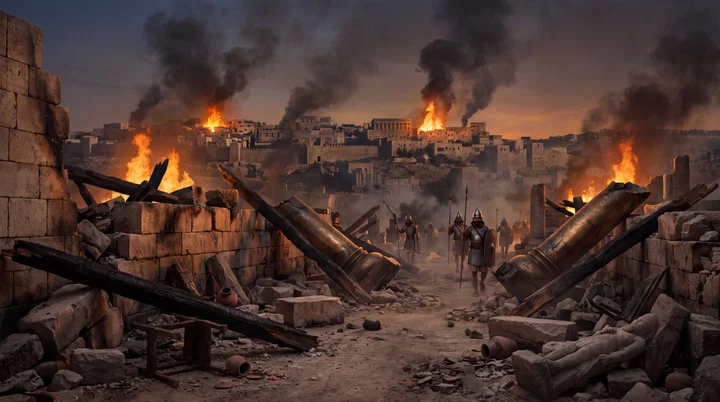
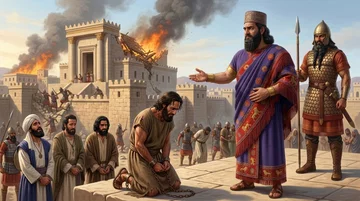
Therefore he brought upon them the king of the Chaldees, who slew their young men with the sword in the house of their sanctuary, and had no compassion upon young man or maiden, old man, or him that stooped for age: he gave them all into his hand.
Translations
Therefore he brought on them the king of the Chaldees, who slew their young men with the sword in the house of their sanctuary, and had no compassion on young man or maiden, old man, or him that stooped for age: he gave them all into his hand.
King James Version, KJV Cambridge Paragraph Bible, Webster Bible
Therefore he brought upon them the king of the Chaldees, who slew their young men with the sword in the house of their sanctuary, and had no compassion upon young man or maiden, old man, or him that stooped for age: he gave them all into his hand.
Therefore he brought upon them the king of the Chaldeans, who slew their young men with the sword in the house of their sanctuary, and had no compassion upon young man or maiden, old man or ancient: he gave them all into his hand.
Therefore he brought upon them the king of the Chaldeans, who slew their young men with the sword in the house of their sanctuary, and had no compassion upon young man or virgin, old man or hoary-headed: he gave them all into his hand.
And He causeth to go up against them the king of the Chaldeans, and he slayeth their chosen ones by the sword in the house of their sanctuary, and hath had no pity on young man and virgin, old man and very aged — the whole He hath given into his hand.
And he brought up [ against] them the king of the Chaldees, and slew their young men with the sword in the house of their sanctuary, and spared not young man nor maiden, old man nor him of hoary head: he gave [ them] all into his hand.
So he brought up against them the king of the Chaldeans, who slew their young men with the sword, in the house of their sanctuary, and had no compassion upon young man or virgin, elder or ancient,-all, delivered he into his hand.
Berean Standard Bible, Majority Standard Bible
So He brought up against them the king of the Chaldeans, who put their young men to the sword in the sanctuary, sparing neither young men nor young women, neither elderly nor infirm. God gave them all into the hand of Nebuchadnezzar,
Therefore he brought on them the king of the Chaldeans, who killed their young men with the sword in the house of their sanctuary, and had no compassion on young man or virgin, old man or infirm. He gave them all into his hand.
So he sent against them the king of the Chaldaeans, who put their young men to death with the sword in the house of their holy place, and had no pity for any, young man or virgin, old man or white-haired: God gave them all into his hands.
For he brought vpon them the King of the Caldeans, who slewe their yong men with the sworde in the house of their Sanctuarie, and spared neither yong man, nor virgin, ancient, nor aged. God gaue all into his hande,
Douay-Rheims (Challoner revision)
For he brought upon them the king of the Chaldeans, and he slew their young men with the sword in the house of his sanctuary, he had no compassion on young man, or maiden, old man or even him that stooped for age, but he delivered them all into his hands.
Pictures
Cross-references 20 of 56
- Jeremiah 25:8-11
Therefore thus saith the LORD of hosts; Because ye have not heard my words,
Judah’s refusal to heed God brings Babylonian conquest and seventy years of desolation.
- Ezra 1:1-3
Now in the first year of Cyrus king of Persia, that the word of the LORD by the mouth of Jeremiah might be fulfilled, the LORD stirred up the spirit of Cyrus king of Persia, that he made a proclamation throughout all his kingdom, and put it also in writing, saying,
Cyrus’s decree begins the exiles’ return after Judah’s captivity.
- Isaiah 63:18
The people of thy holiness have possessed it but a little while: our adversaries have trodden down thy sanctuary.
The sanctuary’s predicted treading down is fulfilled in its destruction during the exile.
- 2 Kings 24:1-2
In his days Nebuchadnezzar king of Babylon came up, and Jehoiakim became his servant three years: then he turned and rebelled against him.
Jehoiakim rebels, and the LORD sends Chaldean forces against Judah.
- 2 Kings 25:1-21
And it came to pass in the ninth year of his reign, in the tenth month, in the tenth day of the month, that Nebuchadnezzar king of Babylon came, he, and all his host, against Jerusalem, and pitched against it; and they built forts against it round about.
Kings gives the parallel account of Judah’s defeat and removal.
- Daniel 1:1-2
In the third year of the reign of Jehoiakim king of Judah came Nebuchadnezzar king of Babylon unto Jerusalem, and besieged it.
Both describe Nebuchadnezzar’s conquest and Judah given into his hand.
- Leviticus 26:34-35
Then shall the land enjoy her sabbaths, as long as it lieth desolate, and ye be in your enemies’ land; even then shall the land rest, and enjoy her sabbaths.
The land rests during desolation for neglected Sabbaths.
- Jeremiah 29:10
For thus saith the LORD, That after seventy years be accomplished at Babylon I will visit you, and perform my good word toward you, in causing you to return to this place.
Foretells the seventy-year exile and the return that follows.
- Psalms 137:1-4
By the rivers of Babylon, there we sat down, yea, we wept, when we remembered Zion.
Captives mourn in Babylon and long for Zion.
- 2 Chronicles 36:21
To fulfil the word of the LORD by the mouth of Jeremiah, until the land had enjoyed her sabbaths: for as long as she lay desolate she kept sabbath, to fulfil threescore and ten years.
The captivity fulfilled Jeremiah’s word until the land enjoyed its Sabbaths for seventy years.
- Daniel 9:2
In the first year of his reign I Daniel understood by books the number of the years, whereof the word of the LORD came to Jeremiah the prophet, that he would accomplish seventy years in the desolations of Jerusalem.
Daniel recognizes that Jerusalem’s foretold seventy-year desolation is nearing its end.
- Micah 4:10
Be in pain, and labour to bring forth, O daughter of Zion, like a woman in travail: for now shalt thou go forth out of the city, and thou shalt dwell in the field, and thou shalt go even to Babylon; there shalt thou be delivered; there the LORD shall redeem thee from the hand of thine enemies.
Zion suffers and goes into captivity in Babylon.
- Psalms 79:1
O God, the heathen are come into thine inheritance; thy holy temple have they defiled; they have laid Jerusalem on heaps.
describes same defiling of the sanctuary
- Psalms 74:3-7
Lift up thy feet unto the perpetual desolations; even all that the enemy hath done wickedly in the sanctuary.
Describes the same destruction of the sanctuary.
- Isaiah 64:10-11
Thy holy cities are a wilderness, Zion is a wilderness, Jerusalem a desolation.
describes same destruction of the sanctuary
- Jeremiah 44:20-23
Then Jeremiah said unto all the people, to the men, and to the women, and to all the people which had given him that answer, saying,
Judah’s idolatry and disobedience brought desolation upon the land.
- Habakkuk 1:6-8
For, lo, I raise up the Chaldeans, that bitter and hasty nation, which shall march through the breadth of the land, to possess the dwellingplaces that are not theirs.
Identifies the nation that God raises against Judah.
- 2 Kings 24:10-17
At that time the servants of Nebuchadnezzar king of Babylon came up against Jerusalem, and the city was besieged.
Describes Jerusalem’s siege and Jehoiachin’s removal before Zedekiah became king.
- Jeremiah 27:6
And now have I given all these lands into the hand of Nebuchadnezzar the king of Babylon, my servant; and the beasts of the field have I given him also to serve him.
God gives the lands into Nebuchadnezzar’s hand.
- Jeremiah 39:1-10
In the ninth year of Zedekiah king of Judah, in the tenth month, came Nebuchadrezzar king of Babylon and all his army against Jerusalem, and they besieged it.
Recounts Jerusalem’s capture and the deportation of its people.
Commentary
Each commentary is drawn from primary sources: the writings of Ellen G. White and Adventist pioneers and periodicals. Each commentary is separate. Its own words are not a quotation; follow the references to read the source passages.
Ellen G. White
4 sources
God brought upon them the king of the Chaldees and allowed him to carry the Jews into captivity to a heathen nation as punishment for their transgressions, wicked acts, and internal corruption.2SP 124.2–31SP 414.2–34RED 8.2–9.112MR 321.2 The sin so punished was refusal to be reproved of iniquity, slighting of His warnings, and holding fast to sin and folding it still closer to the heart.2SP 124.2–34RED 8.2–9.1 Before that judgment He had sent many messages to Israel by the mouths of prophets.4RED 8.2–9.1 Yet some of these holy men were slain through the instigation of the leaders in Israel because they denounced the sins of those in authority.4RED 8.2–9.1
The calamity, including slaughter and destruction connected with the house of the sanctuary, fulfilled the warning that the temple would be destroyed if Israel departed from God.1SP 414.2–3 Jerusalem's internal corruption thus brought God's denunciation and the city's destruction.12MR 321.2 Its denunciation and destruction warn that God's people are not protected from judgment when they forsake Him.12MR 321.2
Sources
Pioneers and periodicals
57 sources
God brought the king of the Chaldees upon Judah, whose forces slew young men with the sword even in the house of the sanctuary, showing no compassion to young or old, and God gave them all into his hand.RH Jul 11, 1912ST Jul 30, 1885ST Dec 7, 1904ST Jun 17, 1886 This came because the chief priests and people rebelled, transgressed after heathen abominations and polluted the Lord's house, mocking His messengers and despising His words until there was no remedy.ST Sep 29, 1914ST Sep 13, 1905ST Jul 30, 1885ST Sep 24, 1902RH Feb 11, 1904 Refusal to keep the Sabbath holy was a chief cause, and after 490 years of disregard the land lay desolate seventy years in captivity to enjoy her Sabbaths and fulfil Jeremiah's word.ST Sep 29, 1914RH Jul 11, 1912ST Jun 17, 1886ST Sep 24, 1902ST Sep 26, 1911 The conquest brought slaughter without mercy, burning of the house of God and palaces, breaking down of Jerusalem's wall, and carrying of all vessels and survivors to Babylon as servants until the reign of Persia.ST Sep 29, 1914RH Jan 20, 1853ST Sep 24, 1902ST Jul 23, 1885 The sanctuary thus ruined was the distinct temple building in the land, not the land itself, which lay desolate until the Lord moved Cyrus to decree its restoration.ST Sep 24, 1902RH Feb 18, 1858ST May 27, 1880RH Aug 11, 1863
Words and Historical Setting
God brought the king of the Chaldees upon Judah in judgment after rebellion, pollution of the temple, and rejection of His messengers until there was no remedy, and that king slew the young men with the sword in the house of the sanctuary and had no compassion upon young man or maiden, old man or him stooped for age, for God gave them all into his hand.ST Jul 30, 1885ST Dec 7, 1904RH Jan 20, 1853RH Jul 14, 1903 The slaughter reached people of every age and sex, even within the sanctuary, so that none were spared and all were delivered into the king's power.RH Jul 11, 1912ST Dec 7, 1904ST Jun 17, 1886 The conquest carried away all the vessels of the house of God great and small with its treasures to Babylon, while the house of God was burned, the wall of Jerusalem broken down, the palaces burned, and all the goodly vessels destroyed, and the survivors were taken into exile.ST Jul 30, 1885RH Jan 20, 1853RH Jul 14, 1903 Sin thus brought a common ruin upon young and old alike, and old age did not shield anyone from its consequences.RH Jul 11, 1912RH May 27, 1873
The word sanctuary means the temple building with its courts, vessels and ministry where the killing in the house of the sanctuary took place.RH Sep 2, 1852 It is one of about fifty uses before the Psalms that all apply the word to the tabernacle or temple, and not one applies it to Palestine or any land.RH Sep 2, 1852 The verse belongs to the account of Judah's swift decline under its last kings, ending when Jerusalem was laid waste and its holy house was burned, after the kingdom grew worse until the Lord removed it with no remedy.ST May 7, 1912ST Jun 2, 1909
The final capture came after Zedekiah rebelled against Nebuchadnezzar and against Babylon's appointed governor, and in the eleventh year of Zedekiah, about 588 B.C., the king and the people who remained were taken to Babylon and Jerusalem's walls and palaces were burned, completing the overthrow of the Jewish nation.ST Jan 28, 1886ST Jan 13, 1888 That stroke marked the end of the Jerusalem temple as Israel's central place of worship, when the king of the Chaldeans captured Jerusalem and destroyed the sanctuary.ST Jan 28, 1886 The complete destruction of Jerusalem was Nebuchadnezzar's third captivity of Judah in B.C. 586, when Jerusalem was completely destroyed, following earlier captivities by the same king in B.C. 606 and B.C. 598, and ending the kingdom of Judah after its final rulers.ST Jul 4, 1911ST Aug 9, 1899
The first great captivity to Babylon in B.C. 606 began the seventy years captivity and stood 602 years before the birth of Christ four years before the common era.ST Jan 4, 1905 Jerusalem was taken twice more after the first captivity, and the last of its treasures were taken in those later attacks, culminating in the destruction and removal to Babylon in B.C. 586.ST Jan 4, 1905ST Nov 28, 1911 In the reign of Jehoiakim king of Judah Nebuchadnezzar king of Babylon came against Jerusalem and took it and carried away some of the chief men of the city to Babylon, among them Daniel and his three companions. The account of killing without distinction of age or sex and handing the people over to the Chaldean king is sufficient evidence for the siege of Jerusalem even though 2 Kings 24:1 does not use the word siege.ST Jan 11, 1916
Rebellion and Rejected Warnings
The Lord had compassion on His people and on His dwelling place, and He sent to them by His messengers, rising up early and sending again and again with patient entreaty.ST Sep 29, 1914ST Jul 30, 1885RH Jan 20, 1853ST Sep 24, 1902RH Feb 11, 1904 They mocked the messengers of God, despised His words, misused His prophets and scoffed at them, the chief of the priests joining with the people in contempt for His words and abuse of His prophets.ST Sep 29, 1914ST Sep 13, 1905RH Jan 20, 1853RH Jul 14, 1903RH Feb 11, 1904 This rebellion continued until the wrath of the Lord arose against His people till there was no remedy, and then as its fearful result He brought upon them the king of the Chaldees.ST Sep 29, 1914ST Sep 13, 1905RH Jul 11, 1912RH Jan 20, 1853RH Jul 14, 1903
All the chief of the priests and the people transgressed very greatly after all the abominations of the heathen and of the nations round them.ST Sep 24, 1902RH Feb 11, 1904 Zedekiah and the people rebelled, refused to hearken to the instruction of His word and to cooperate with His purpose that they should be witnesses for the true God in all the earth, and polluted the house of the Lord which He had hallowed in Jerusalem.ST Jul 30, 1885ST Sep 24, 1902RH Feb 11, 1904 Their persistent wickedness, apostasy and disobedience to God's commandments, law and instruction caused Him to withdraw His protection and give them into the hand of the Chaldean king.ST Apr 29, 1903ST Oct 8, 1896ST May 16, 1911
Judah was carried away captive to Babylon for its transgression, and its refusal of God's instruction ended in seventy years of bondage.ST Jun 13, 1906RH Feb 11, 1904 That captivity came because of idolatry and related unfaithfulness, and God punished that idolatry by bringing the idolatrous foreign ruler and his forces as His instruments against them.ST Jun 13, 1906ST Jan 30, 1896RH Dec 1, 1874 The Hebrews had been repeatedly warned of judgment if they continued in sin, including warning through Jeremiah and instruction about keeping the Sabbath, and the fall of Jerusalem with destruction upon the unfaithful people came after those warnings as the judgment God had foretold.ST Sep 13, 1905ST Aug 14, 1893ST Sep 8, 1909
Sabbath Breaking and Land Rest
Utter refusal to keep the Sabbath holy was a chief cause of the captivity, for the people would not remember God's creative works, rest from work on the Sabbath day, hallow the day, or refrain from transacting business and bringing burdens on it, but persisted in idolatry and Sabbath profanation.ST Sep 29, 1914RH Jul 11, 1912ST Jun 17, 1886RH Jan 21, 1862RH Oct 29, 1914 After the people and priests transgressed greatly, mocked the messengers of God, despised His words and misused His prophets until there was no remedy, God in judgment brought the king of the Chaldees upon Judah and gave them all into his hand.ST Sep 29, 1914RH Jul 11, 1912RH Jan 21, 1862ST Jun 13, 1906 The Chaldean forces slew without compassion, killing young men with the sword in the house of the sanctuary and showing no mercy to young man or maiden, old man or one stooped for age, without distinction of age or sex even in the sanctuary.ST Sep 29, 1914RH Jul 11, 1912RH Jan 21, 1862RH Oct 29, 1914ST Jun 13, 1906 That overthrow destroyed Jerusalem, burned the house of God, broke down its wall, destroyed the vessels, and carried the survivors to Babylon as servants until the reign of Persia.ST Sep 29, 1914RH Oct 29, 1914ST Jun 13, 1906
Disregard of God's Sabbath for 490 years was followed by seventy years of desolation in captivity, so that the land rested from tillage and enjoyed her Sabbaths to fulfil the word of the Lord given through Jeremiah, until the land had received its rest.ST Sep 29, 1914ST Sep 26, 1911ST Jun 13, 1906ST Jul 23, 1885ST Jun 28, 1877 The removal from the land for threescore and ten years fulfilled Jeremiah's word, with the house of God burned, the wall of Jerusalem broken down, the palaces burned, the vessels destroyed, and those who escaped the sword carried to Babylon as servants until the reign of Persia, when after seventy years they were permitted to return.ST Sep 29, 1914ST Sep 24, 1902ST Jul 23, 1885 Jerusalem then lay in ruins for seventy years, until the Lord moved Cyrus to decree restoration of the temple and return.ST Sep 24, 1902ST Jul 23, 1885 Nehemiah later recalled that God had brought this calamity upon the people and city for profaning the Sabbath, and warned that continued Sabbath profanation would bring further wrath.ST Jun 28, 1877
The calamity fulfilled Jeremiah's warning that if they profaned the Sabbath and brought burdens upon it, fire would be kindled in the gates of Jerusalem and devour its palaces.ST Jun 28, 1877RH Apr 8, 1875RH Jan 21, 1862 By that disobedience they forfeited the promise that if they kept the Sabbath, kings and princes sitting on the throne of David would enter the gates of the city and the city would remain forever.RH Apr 8, 1875 The destruction of Jerusalem and the captivity in Babylon thus came as the threatened judgment against the city for disregarding the Sabbath and refusing to hearken to hallow the Sabbath day.RH Oct 29, 1914RH Apr 8, 1875RH Jan 21, 1862
The judgment shows how important the Sabbath is in God's estimation as a test of loyalty, since one who conscientiously and sacredly observes it will not have a heart to commit any other crime.RH Apr 8, 1875 Keeping the Sabbath would have witnessed that Jehovah was the living Creator and sanctifier.ST May 21, 1896 This history forms part of the evidence that the Sabbath was a binding duty and that Christ came to live in harmony with the Father's will.ST May 21, 1896ST Oct 29, 1902
The removal of Israel from the land so the land rested from tillage and enjoyed her Sabbaths points to a coming time when on account of wickedness the earth will rest from tillage for a thousand years, sinners will be destroyed out of it, and after that rest there will be no more Sabbath-breaking.ST Sep 29, 1914
Destruction Exile and Aftermath
The Chaldean conquest brought slaughter without compassion, the burning of the house of God, the breaking down of the wall of Jerusalem, the burning of the palaces and of all the goodly vessels, and the carrying of all the vessels of the house of God great and small with the treasures of the house and of the king and princes to Babylon.ST Sep 29, 1914RH Jan 20, 1853ST Sep 24, 1902RH Nov 10, 1863ST Aug 20, 1885 The siege ended with the city captured, the temple and the houses of the leaders burned, the walls broken down, and many of the people brought under Babylonian control.ST Sep 26, 1906RH Nov 10, 1863ST Aug 20, 1885 In this plundering and burning the splendor of Solomon's temple came to an end.RH Jan 20, 1853ST Sep 24, 1902RH Nov 10, 1863
Those who escaped the sword and survived the siege were carried to Babylon as servants until the reign of Persia.ST Sep 29, 1914ST Sep 24, 1902ST Jul 23, 1885 After seventy years the captivity ended and they were permitted to return.ST Sep 29, 1914ST Jul 23, 1885 Jerusalem then lay in ruins for seventy years with broken tombs, demolished walls, ruined temple, and Ichabod upon it all, until the Lord moved Cyrus to decree restoration of the temple and return.ST Sep 24, 1902 After that decree only few returned with little faith, laid an inferior foundation, wept and rejoiced at its laying, and needed Haggai and Zechariah to encourage them that the Desire of all Nations would come and the glory of the latter house would exceed the former.ST Sep 24, 1902
After the captivity the Jews never again became an independent nation, and Jerusalem was finally destroyed by the Romans in A.D. 70.ST Jul 23, 1885 Its future kingdom belongs to the one who has the right to rule, over the children of the promise.ST Jan 13, 1888 The Babylonian destruction of Jerusalem began Israel's scattering, though the scattering may not have been complete until the later Roman destruction.ST Jul 23, 1885ST Jan 13, 1888RH Oct 22, 1861
The burning and destruction fulfilled the warning of unquenchable fire. The fire was unquenchable in that it could not be stopped before it consumed what it was sent to destroy, not because it burned forever. The destruction did not prevent God from later commanding the temple to be rebuilt, and the ruined city and temple were also the setting in which God punished the peoples who mocked Jerusalem.ST Sep 26, 1906
Sanctuary Distinct From Land
When God's people were driven out of Canaan they were dispossessed of their inheritance and the sanctuary of God built in that land was laid in ruins and given into the enemy's hand by the king of the Chaldees who slew many of them.RH Feb 18, 1858ST May 27, 1880RH Aug 11, 1863RH Jan 6, 1853RH Feb 15, 1870 The land of Canaan is not the sanctuary itself but only its border and place, for the sanctuary was a distinct building, the house of God, located in that land.ST May 27, 1880RH Aug 11, 1863RH Jan 6, 1853RH Feb 15, 1870RH Apr 4, 1854 This ruin of the temple building is the fact foretold where it is said that adversaries have trodden down thy sanctuary in Isaiah 63:18, where the past tense is used for the future, and not a calling of the land of Canaan itself the sanctuary.RH Feb 18, 1858RH Aug 11, 1863RH Jan 6, 1853RH Feb 15, 1870
The stone temple at Jerusalem whose buildings the disciples showed to Jesus and whose throwing down He foretold was their Sanctuary, the Sanctuary of the first or typical covenant now pronounced desolate and doomed to destruction.RH Sep 2, 1852 It stands in contrast to the Sanctuary of the new covenant in heaven in the Father's house.RH Sep 2, 1852 The typical sanctuary built by Solomon shared in the seventy years desolations of Jerusalem and lay desolate, which is the desolate sanctuary Daniel prayed about, and it was rebuilt after the captivity.RH Sep 2, 1852
Prophecy Pattern and Application
The bringing of the king of the Chaldees, the seventy-year bondage in Babylon, and the deliverance together covered only one generation, with God's prophetic word and God's prophet prominent in the deliverance.RH May 11, 1916 This history stands written for learning for those upon whom the ends of the world are come, as a pattern for the last generation: as disobedience to the Sabbath brought fleshly Israel into Babylon, so obedience to God's Sabbath brings God's children out of spiritual Babylon, and those who come out will live in the generation that witnesses Babylon's doom at Christ's second advent.RH May 11, 1916
The captivity marks Judah's growing wickedness and God's withdrawal of protection, and it began the church's travail, its anguish over what it had lost and its longing for the Deliverer.ST Apr 29, 1903ST Oct 8, 1896ST May 16, 1911 That time of anguish, longing and travail continued until Jesus was born in Bethlehem.ST Apr 29, 1903ST May 16, 1911 The Babylonian captivity was the consequence of rejecting God's power in Christ, the promised Seed and the only protection from sin; captivity to sin led to captivity in Babylon, and slavery of soul meant slavery of body.RH Jan 21, 1904 Sin leads to death, and deliverance is found only in the coming of the promised Seed, so the judgment that killed people of every age without mercy, even in the sanctuary, was necessary because of the people's course and served as the Lord's final appeal then and now.RH Jan 21, 1904
Jerusalem was handed over to Babylon because of the church's transgression, and the same cause applies to the church under the little horn: transgression brings it under oppressive power.RH Oct 14, 1902 Babylon was the agent that brought Judah into captivity, overthrew its kingdom, and scattered its people.ST Apr 12, 1883ST Nov 7, 1906 Its success marked the culmination of repeated efforts by hostile nations to destroy the people through whom the promise would come, and Jerusalem was destroyed because the people persisted in the sins that caused the Lord to depart from them.ST Jun 21, 1883ST Nov 7, 1906 In that scattering Judah stands as one of the kingdoms represented by Zechariah's four horns.ST Apr 12, 1883
The period of defeat and captivity, when young and old alike were killed without mercy even in the sanctuary and the people were handed over to the king, marks the end of the reign associated with keeping the Lord's commandments and the cessation of Israel's years of release and jubilee.SMV 22.1–24.1 Sin brought a common ruin upon people of every age through the Chaldean king's forces, with no compassion, and old age did not shield people from its consequences.RH May 27, 1873
Sources