Deuteronomy 34:1
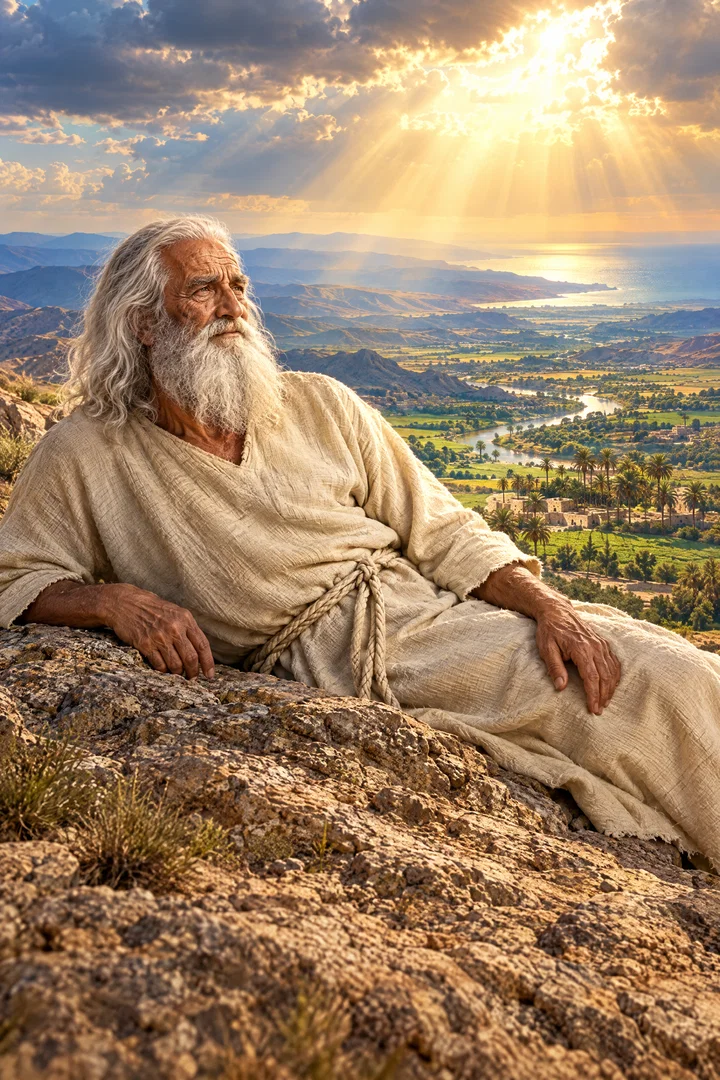
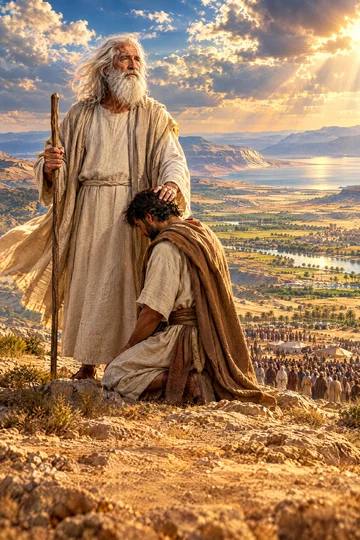
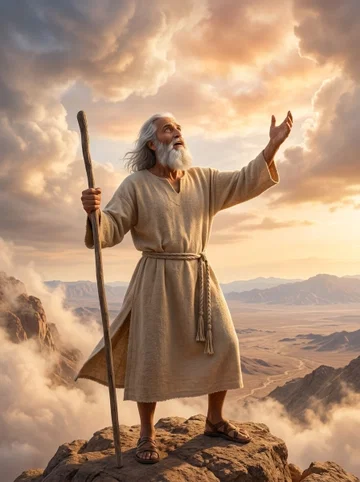
And Moses went up from the plains of Moab unto the mountain of Nebo, to the top of Pisgah, that is over against Jericho. And the LORD shewed him all the land of Gilead, unto Dan,
Translations
And Moses went up from the plains of Moab to the mountain of Nebo, to the top of Pisgah, that is over against Jericho. And the LORD showed him all the land of Gilead, to Dan,
And Moses went up from the plains of Moab unto the mountain of Nebo, to the top of Pisgah, that is over against Jericho. And the LORD shewed him all the land of Gilead, unto Dan,
And Moses went up from the plains of Moab unto the mountain of Nebo, to the top of Pisgah, that is over against Jericho. And the Lord shewed him all the land of Gilead, unto Dan,
And Moses went up from the plains of Moab, upon the mountain of Nebo, to the top of Pisgah, that is over against Jericho: and the LORD showed him all the land of Gilead, to Dan,
And Moses went up from the plains of Moab unto mount Nebo, to the top of Pisgah, that is over against Jericho. And the LORD shewed him all the land of Gilead, unto Dan;
And Moses went up from the plains of Moab unto mount Nebo, to the top of Pisgah, that is over against Jericho. And Jehovah showed him all the land of Gilead, unto Dan,
And Moses goeth up from the plains of Moab unto mount Nebo, the top of Pisgah, which [is] on the front of Jericho, and Jehovah sheweth him all the land — Gilead unto Dan,
And Moses went up from the plains of Moab to mount Nebo, to the top of Pisgah, which is opposite Jericho. And Jehovah shewed him the whole land, Gilead to Dan,
So then Moses went up, from the waste plains of Moab into Mount Nebo, the head of Pisgah, which is over against Jericho,—and Yahweh showed him all the land—even Gilead as far as Dan;
Berean Standard Bible, Majority Standard Bible
Then Moses went up from the plains of Moab to Mount Nebo, to the top of Pisgah, which faces Jericho. And the LORD showed him the whole land— from Gilead as far as Dan,
Moses went up from the plains of Moab to Mount Nebo, to the top of Pisgah, that is opposite Jericho. The LORD showed him all the land of Gilead to Dan,
And Moses went up from the table-lands of Moab to Mount Nebo, to the top of Pisgah which is facing Jericho. And the Lord let him see all the land, the land of Gilead as far as Dan;
Then Moses went from the plaine of Moab vp into mount Nebo vnto the top of Pisgah that is ouer against Iericho: and the Lord shewed him all the land of Gilead, vnto Dan,
Douay-Rheims (Challoner revision)
Then Moses went up from the plains of Moab upon mount Nebo, to the top of Phasga over against Jericho: and the Lord shewed him all the land of Galaad as far as Dan.
Pictures
Cross-references 20 of 24
- Numbers 20:12
And the LORD spake unto Moses and Aaron, Because ye believed me not, to sanctify me in the eyes of the children of Israel, therefore ye shall not bring this congregation into the land which I have given them.
Moses’ disobedience at Meribah led to God barring him from the land.
- Deuteronomy 32:49
Get thee up into this mountain Abarim, unto mount Nebo, which is in the land of Moab, that is over against Jericho; and behold the land of Canaan, which I give unto the children of Israel for a possession:
God directs Moses to Mount Nebo to view the land before his death.
- Matthew 17:3
And, behold, there appeared unto them Moses and Elias talking with him.
Moses appears with Jesus in glory on the mountain.
- Deuteronomy 34:5
So Moses the servant of the LORD died there in the land of Moab, according to the word of the LORD.
Moses dies in the Abarim region.
- Jude 1:9
Yet Michael the archangel, when contending with the devil he disputed about the body of Moses, durst not bring against him a railing accusation, but said, The Lord rebuke thee.
Michael disputes with the devil over Moses’ body.
- Deuteronomy 34:7
And Moses was an hundred and twenty years old when he died: his eye was not dim, nor his natural force abated.
Moses retained clear sight and full strength at the end of his life.
- Joshua 1:2
Moses my servant is dead; now therefore arise, go over this Jordan, thou, and all this people, unto the land which I do give to them, even to the children of Israel.
God says Moses is dead.
- Deuteronomy 34:6
And he buried him in a valley in the land of Moab, over against Beth-peor: but no man knoweth of his sepulchre unto this day.
It records Moses’ burial in Moab and the unknown location of his grave.
- Genesis 15:18
In the same day the LORD made a covenant with Abram, saying, Unto thy seed have I given this land, from the river of Egypt unto the great river, the river Euphrates:
Defines the wider boundaries of the land shown to Moses.
- Deuteronomy 3:27
Get thee up into the top of Pisgah, and lift up thine eyes westward, and northward, and southward, and eastward, and behold it with thine eyes: for thou shalt not go over this Jordan.
Moses is told to view the land from Pisgah but not enter it.
- Hebrews 11:13
These all died in faith, not having received the promises, but having seen them afar off, and were persuaded of them, and embraced them, and confessed that they were strangers and pilgrims on the earth.
Moses viewed the promised land from afar without entering it, anticipating the better country.
- Numbers 27:12-13
And the LORD said unto Moses, Get thee up into this mount Abarim, and see the land which I have given unto the children of Israel.
God tells Moses to ascend the mountain and says he will die there.
- Joshua 1:3
Every place that the sole of your foot shall tread upon, that have I given unto you, as I said unto Moses.
God’s gift of the land still had to be claimed and possessed.
- Numbers 32:1-5
Now the children of Reuben and the children of Gad had a very great multitude of cattle: and when they saw the land of Jazer, and the land of Gilead, that, behold, the place was a place for cattle;
Reuben and Gad seek land east of the Jordan, including Gilead, for their cattle.
- Exodus 6:8
And I will bring you in unto the land, concerning the which I did swear to give it to Abraham, to Isaac, and to Jacob; and I will give it you for an heritage: I am the LORD.
Both describe the land God swore to give as an inheritance.
- Genesis 13:14-15
And the LORD said unto Abram, after that Lot was separated from him, Lift up now thine eyes, and look from the place where thou art northward, and southward, and eastward, and westward:
Both describe God showing the land and promising it to Abraham and his seed.
- Luke 9:30
And, behold, there talked with him two men, which were Moses and Elias:
The glorified Moses appears and speaks with Jesus.
- Genesis 17:8
And I will give unto thee, and to thy seed after thee, the land wherein thou art a stranger, all the land of Canaan, for an everlasting possession; and I will be their God.
God’s promise of the land to Abraham supports the promised earthly inheritance.
- Genesis 28:13
And, behold, the LORD stood above it, and said, I am the LORD God of Abraham thy father, and the God of Isaac: the land whereon thou liest, to thee will I give it, and to thy seed;
Both texts identify the land promised to Jacob and his descendants.
- Exodus 3:8
And I am come down to deliver them out of the hand of the Egyptians, and to bring them up out of that land unto a good land and a large, unto a land flowing with milk and honey; unto the place of the Canaanites, and the Hittites, and the Amorites, and the Perizzites, and the Hivites, and the Jebusites.
describes the land Moses viewed
Commentary
Each commentary is drawn from primary sources: the writings of Ellen G. White and Adventist pioneers and periodicals. Each commentary is separate. Its own words are not a quotation; follow the references to read the source passages.
Ellen G. White
13 sources
Moses, after giving his final words to Israel, went up alone from the plains of Moab to the top of Pisgah on Mount Nebo opposite Jericho, the highest ridge and highest point he could reach.1SP 335.2PP 471.21SP 341.2–31SP 336.1SG4 56.2–57.2 Though old, his eyes were clear and undimmed and his strength was firm and unabated as he stood in God's presence to look his fill upon the land he was not allowed to enter and there to die.1SP 341.2–31SP 336.1SG4 56.2–57.2ST Mar 31, 18811T 658.3–659.2 The Lord spread before him a clear panoramic view of the whole of Canaan, from Gilead unto Dan, west to the Great Sea, north to Hermon, east across Moab to Bashan, and south to the desert, magnificent in richness and beauty like a second Eden, fertile and well-watered.1SP 335.2PP 471.2SG4 56.2–57.210MR 151.1–2Ms 69, 1912, par. 22–23 Angels pointed out its regions and where the tribes would settle, and he saw the people he had led standing in their inheritance, learning that God watched over the land throughout the year and that keeping its home and rich blessings depended on faithful obedience to His commandments.1SP 335.21SP 336.1SG4 56.2–57.2 The panorama reached beyond the land to Christ's appearing at His first advent, His rejection and death on the cross, then to His second advent and the resurrection of the just, and to the meeting of the first Adam and Christ the second Adam when Eden shall bloom on earth again, after which he died and the Son of God raised him and took him to Heaven.1T 658.3–659.2 His calling to the top of Pisgah to have the glory of the promised land spread before him as he laid down his life with his burden for Israel was communion with God in the mount granted before death, one of God's calls to come up into the mount before every great trial, important work, and decisive moment, giving spiritual refreshing and preparation for what follows.ST Aug 31, 1915MH 508.2
Ascent to Pisgah Summit
Moses went up from the plains of Moab to Mount Nebo, to the top of Pisgah opposite Jericho.1SP 335.2SG4 56.2–57.2 That Pisgah was the highest ridge, and Nebo its highest point, the highest point he could reach.1SP 336.1ST Mar 31, 1881 The ascent came after he had given his final words to Israel.ST Mar 31, 1881 He stood there alone in God's presence.PP 471.21SP 341.2–3
Though old, his eyes were clear and undimmed.1SP 336.1SG4 56.2–57.2 His strength was firm and unabated, his eye not dimmed through age.1T 658.3–659.2 He was upon that mount to die.1SP 341.2–31T 658.3–659.2 He saw the land to his satisfaction even though he was not allowed to enter it.1SP 341.2–3ST Mar 31, 18811T 658.3–659.210MR 151.1–2Ms 69, 1912, par. 22–23
Panorama of Promise Revealed
The Lord opened the whole land of Canaan to view in a clear panorama, including Gilead as far as Dan.1SP 335.2SG4 56.2–57.2 The sight stretched west to the Great Sea, north to Mount Hermon, east across the table-land of Moab to Bashan where Israel had triumphed, and south to the desert of the long wanderings.PP 471.2ST Mar 31, 1881 It was the home Israel would possess, with its blessings shown on condition of faithful obedience to God's commandments.1SP 335.21SP 336.1
The land lay spread out in richness and beauty, magnificent and fertile under God's blessing upon it, as it were a second Eden.1T 658.3–659.21SP 339.1 Its soil was fertile and well-watered, bearing grain fields and fruit trees, with vineyards, flowers, cities, water, and other produce.10MR 151.1–2Ms 69, 1912, par. 22–231SP 339.1 Angels pointed out its regions and the places where the tribes would settle.10MR 151.1–2Ms 69, 1912, par. 22–23 He saw the people he had led standing in the land of their inheritance, and learned that God watched over the land throughout the year and that its home and rich blessings depended on faithful obedience.1SP 335.21SP 336.1SG4 56.2–57.210MR 151.1–2Ms 69, 1912, par. 22–23
After the view he died, angels buried him, but the Son of God soon came down, raised him from the dead, and took him to Heaven.1T 658.3–659.2 The view passed before him as a panorama and reached beyond the land to the appearing of Christ at His first advent.1T 658.3–659.2 It showed His rejection by the Jewish nation and His death upon the cross, then Christ's second advent and the resurrection of the just, and the meeting of the two Adams — Adam the first, and Christ the second Adam — when Eden shall bloom on earth again.1T 658.3–659.2
God's calling of Moses to the top of Pisgah to spread the glory of the promised land before him as he laid down his life with his burden for Israel was communion with God in the mount granted before death.ST Aug 31, 1915MH 508.2ST Jul 27, 1915 It fulfills God's bidding to come up into the mount before every great trial and important work.MH 508.2 It is one of God's calls to come up into the mount for communion before a decisive moment, giving spiritual refreshing and preparation for what follows.ST Jul 27, 1915
Sources
Pioneers and periodicals
76 sources
Moses goes up from Israel's camp in the plains of Moab to Mount Nebo, the top of Pisgah east of the Jordan opposite Jericho, where the Lord shows him Gilead toward Dan and the land beyond.ST Apr 27, 1904ST Sep 10, 1902ST Sep 10, 1902 What he is shown is more than the natural eye could see from that height, a heaven-aided prophetic view embracing all the land sworn to Abraham, Isaac and Jacob.ST Sep 10, 1902ST Oct 31, 1906ST Sep 10, 1902 Though he led the people forty years to the border, he is permitted only to see and not to cross into it, because at the waters of strife he failed to give God glory and took the glory to himself.ST Sep 17, 1902ST Sep 29, 1881 He dies there and is buried by the Lord with no one knowing his grave, yet he is raised from the dead and appears in glory talking with Jesus, proving his interest in the greater inheritance.ST Mar 12, 1912ST Mar 20, 1879ST Jan 15, 1880ST May 19, 1914ST Sep 10, 1902 Pisgah thus becomes the viewpoint of faith from which believers nearing home glimpse the heavenly kingdom while still facing trial, until faith gives way to sight.RH Dec 24, 1861RH May 30, 1854
Mountain Ascent and Setting
The verse opens the account of Moses' final moments, as he goes up to be shown the land before he dies.ST Apr 27, 1904ST Sep 10, 1902 He goes up from Israel's camp in the plains of Moab to Mount Nebo, the top of Pisgah in the Abarim range east of the Jordan and opposite Jericho, from which the Lord shows him Gilead and the land beyond.ST Sep 10, 1902ST Sep 10, 1902
Nebo is the highest summit of Pisgah, its highest point and ridge, a spur about 3,586 feet high commanding an extensive view, and the highest peak of the Abarim mountains opposite Jericho where he surveyed Palestine before his death.ST Sep 10, 1902ST Oct 7, 1897ST Sep 10, 1902 It is not a towering peak but a knoll on a ridge in Moab a little over nine miles from the head of the Dead Sea, whose western end may have been called Pisgah.RH Mar 2, 1916 It stands among the mountains of Moab beyond the Dead Sea in view from the Mount of Olives.ST Nov 3, 1898
The setting is the eastern side of the Jordan in the land of Moab in 1451 before Christ, in the final year of Moses' life, the fortieth year after Israel's exit from Egypt and the thirty-eighth of their journeying from Sinai, with about three millions of men, women and children encamped waiting to be led across to their promised land.ST May 23, 1911 It is near the close of forty years of wandering, at the end of the third forty-year period of his life which began with the exodus.ST Apr 26, 1905ST Nov 7, 1878 Moses goes up shortly before his death as God decreed, after giving his final words and rehearsing to Israel the system of statutes, laws and mandates as their constitutional textbook.ST Mar 31, 1881ST Mar 10, 1881ST May 23, 1911 He knows beforehand his career will end there, standing as a mighty and complete leader through long face-to-face communion with Jehovah, with clear grasp of dangers ahead and foreknowledge of quick apostasy, and after leading Israel to Canaan's border he is shown the land to its utmost borders.RH Aug 3, 1916ST May 23, 1911
The immediate land shown stretches from Gilead toward Dan, and the outlook takes in Palestine with its regions around it, including the Great Sea, Hermon, Moab, Bashan and the southern desert.ST Mar 31, 1881ST Sep 28, 1882 That view included Mount Hermon as a lofty pale-blue snow-capped peak closing the northern horizon, visible in clear Syrian air from Moab, Gilead, Bashan and nearly every prominent point in Palestine.ST Jun 26, 1901 The setting connects with Israel's approach to Canaan, where the people encamped north of the Dead Sea and east of the Jordan must cross opposite Jericho and take possession of the land God has given them and Moses overlooks as their inheritance.ST Sep 10, 1902RH May 19, 1910
Breadth of Promised View
What the Lord showed from that height was more than the natural eye could see, a broad prophetic view embracing all the land sworn to Abraham, Isaac and Jacob from the river of Egypt to the great river Euphrates.ST Sep 10, 1902ST Sep 10, 1902 It was a clear, heaven-aided sight of the promised inheritance, given to be seen but not entered.ST Sep 10, 1902ST Oct 31, 1906 The immediate Canaan sought under his command was the land he was forbidden to enter, while he nevertheless retains interest in the greater inheritance promised to Abraham and his spiritual seed.ST Sep 10, 1902
The view was comprehensive yet distant and dim, discerning only the outline of beautiful hills, lakes, rivers, plains, forests, orchards and fields.ST Jun 15, 1904 The land spread before him was the glory of all lands, flowing with milk and honey and yielding mammoth clusters of grapes.ST Jun 15, 1904 He longed to go over the narrow stream that separated him from it to examine its objects of interest closely and to live on its delicious productions, but he was not allowed to go over and had to be content to view the land and its contents from afar.ST Jun 15, 1904
From Nebo as an observatory he surveyed both the destination and the journey behind him, looking into the promised land and back over the path of Israel's forty years of wandering.RH Nov 5, 1861 He saw its beauty and his people's coming triumph and glory and the future of his people.ST Aug 27, 1896 Looking back he could see the places where rebellion, murmuring and testing God had brought judgment, and the bones of thousands who died in the wilderness.RH Nov 5, 1861 His prophetic view of the land also took in the cross, showing that reaching the promised land involves sacrifice.
Barred from Entering Land
Though he had led the people forty years through the wilderness and brought them to the border of the promised land, Moses was permitted only to see it and not to cross the Jordan into it.ST Sep 17, 1902ST Jan 15, 1880RH May 17, 1860 He went up to view Canaan from across the Jordan near Jericho, seeing it only from afar at the age of 120 after more than forty years of leading toward it.ST Jan 15, 1880RH May 17, 1860 The land was shown to him, but entrance was denied.ST Jan 15, 1880RH May 17, 1860
He was barred because at the rock, at the waters of strife, he once failed to give God glory as the provider of water.ST Oct 7, 1880ST Sep 17, 1902RH Sep 13, 1906 There he took the glory to himself, failed to trust God, spoke rashly and grew impatient in an imprudent act.ST Oct 7, 1880ST Sep 29, 1881RH Sep 13, 1906 This was a serious sin even though people might not regard it as a great crime.ST Oct 7, 1880
His long record of faithful service did not remove the consequence, for even Moses was not exempt.ST Oct 7, 1880ST Sep 17, 1902 His exclusion showed that the people's welfare required them to recognize their dependence on God in everything.ST Sep 17, 1902 One wrong act marred his record, one transgression into which the people's sin had led him, and it cost him entrance to the earthly Canaan though he had seen its beauty and his people's coming triumph and glory.RH Jun 16, 1904 He viewed the land before he was laid to rest on Mount Nebo, to lie down there soon to awaken to a far more glorious inheritance.RH Jun 16, 1904
Giving him the view was God's tender correction, both kindness to a faithful servant and reminder of the mistake.RH Sep 13, 1906 It shows God keeps the correction of His prophets in His own hands instead of leaving it to the people, and does not take the gift of prophecy away when he errs but still uses him to point out Joshua to lead Israel after him.RH Sep 13, 1906 This tender dealing stands in marked contrast to His dealing with Korah, Dathan and Abiram, who criticized instead of repenting.RH Sep 13, 1906 Being forbidden to enter was a real chastisement, and his labor to climb and his desire to see show the loss was real, proving dying is not presented as immediate entry into heavenly glory as reward.ST Sep 29, 1881
He stands alone on the mountain with hope of entering unanswered, a disappointed man taking a lonely journey to die in sorrow.ST Dec 22, 1881ST May 19, 1914 With tear-dimmed eyes he turned toward the towering heights of Nebo and looked sorrowfully toward the far west, where beyond the turbulent waters of the sinuous Jordan rushing from the distant north stretched the inheritance of Israel.ST May 19, 1914ST Apr 25, 1906 He had talked with Jehovah as a man talks with his friend, and his dark eyes, still piercing and bright as an eagle's after looking unflinchingly upon the glory-mantled summit of Sinai, now turned toward the goodly land that for forty weary years had been the center of all his hopes and the goal of his ambition.ST May 19, 1914ST May 19, 1914 He faced death alone with no hand of brother or wife to minister to him as he struggled with the grim monster, ending his wonderful life in silent grief in a cloud-wrapped chamber of death.ST May 19, 1914ST May 19, 1914 Yet he died not decrepit and bent and weary of life but in the full strength of manhood, with eye not dim and great unselfish loyal heart beating strong and vigorous as when nearly a century before he was heir to the proud throne of Egypt.ST May 19, 1914RH Jan 8, 1875 His unselfish prayers had often prevailed for the life of his ungrateful nation, but his prayer for his own life availed nothing.ST May 19, 1914 His sorrowful looking over the land he may not enter because of disobedience warns that disobedience can cost a person the heavenly Canaan.ST Apr 25, 1906
Death Burial and Vindication
The ascent to Nebo brings to its close the life of one of the greatest men of all history and closes the story of his leadership of Israel.ST Mar 12, 1912ST Apr 27, 1904ST Mar 25, 1913 He dies there on Nebo and is buried by the Lord Himself, with no one knowing his grave.ST Mar 12, 1912ST Apr 27, 1904RH Apr 28, 1904 His is a lonely grave in a vale in Moab, with no human digging or witnessing, where the sons of God lay him and heavenly angels alone attend as the silent funeral procession descends the mountain.ST Mar 12, 1912ST Apr 5, 1905 The chapter beginning here is thus the sublime account of his death and burial.ST Apr 27, 1904RH Apr 28, 1904
The Moses who appears alive in heavenly glory on the mount of transfiguration talking with Jesus about the trials He must pass through is the same Moses who died, so his living appearance means he was raised from the dead.ST Mar 12, 1912ST Mar 20, 1879ST Jan 15, 1880 From Pisgah, also called Nebo, across the Jordan near Jericho, he was shown Canaan but was not to cross into it, and that last sight of old on the lone and cold mountain was with eye not dim.ST Mar 20, 1879ST Jan 15, 1880RH Jan 8, 1875 He winged his way with angels from Nebo to his celestial Canaan far away, passing from Pisgah's summit into heaven to the heavenly hills, wearing a crown of light brighter than Egypt's crown and standing again in that glory beside Jesus.RH Aug 29, 1871RH Jan 8, 1875 His life ended on Nebo before entering earthly Canaan because one wrong act marred his record, yet he lay down there soon to awaken to a far more glorious inheritance.RH Jun 16, 1904RH Jan 8, 1875
His undisputed interest in the greater inheritance promised to Abraham and his spiritual seed is proved by that resurrection.ST Sep 10, 1902 Though disappointed in seeing the land beyond Jordan without entering it, he was honored afterward as no other was ever honored, for God had something better for His faithful servant than that heritage beyond Jordan, since the heavenly Canaan is better than the earthly Canaan and God wanted Moses for Himself.ST Mar 12, 1912ST May 19, 1914 His spirit was placed upon his successor Joshua.ST Mar 12, 1912 As the bearer of God's brightness to Israel, greatest of all prophets and more than a prophet, permitted to talk with God mouth to mouth and face to face as a man speaks to his friend with God's splendor shining in his face, he was about to drop from sight on Nebo, so provision was made for the symbol of God's presence and the light of His glory to remain with the people in the portable tabernacle for His indwelling and in the pillar of His presence directing their wilderness journeys night and day.ST Mar 12, 1912RH Feb 3, 1910
His viewing of the promised land from afar before death without entering it shows that faithful people may likewise die before seeing the triumph they hope for.RH Jan 1, 1867 Faithful servants may rest before the promised inheritance is received, and like Moses seeing the Promised Land from Nebo they await the coming of Christ and the gathering of the harvest.RH Jan 1, 1867 God honors mountains above all other conformations of nature, and from Nebo's height Moses beheld the goodly prospect of the Promised Land and the future of his people before he died and the Lord buried him.ST Aug 27, 1896 Nebo thus stands with Ararat, Moriah, Sinai, Carmel, Zion, Calvary and Olivet as a place marked by the footsteps of God's presence.ST Aug 27, 1896
Authorship of Final Chapter
The verse stands in the last chapter of Deuteronomy, which is the last chapter of the last of the first five books of the Bible written by Moses, and that chapter records the death and burial of Moses.ST Mar 24, 1898ST Mar 8, 1910 That closing account of his death was added by Joshua the son of Nun, or by some other servant of the Lord.ST Mar 24, 1898ST Mar 8, 1910
Its presence there does not rule out Moses as author of the Pentateuch, for an appendix or added material may follow an author's work.ST Jan 24, 1900 God could also have inspired Moses himself to write prophetically about his own death and burial.ST Jan 24, 1900
It records his death in the final chapter of the history that begins with creation.ST Oct 14, 1880 The period from creation to his death spans more than twenty centuries, yet is recounted in only a few pages, showing that the selection of what to include was directed by God.ST Oct 14, 1880
Covenant Sanctuary and Timing
The Lord showed Moses the literal land of Canaan promised to Abraham, Isaac and Jacob, and that showing proves the second blessing included in the promissory Abrahamic covenant was the gift of the literal land of Canaan to Abraham's natural seed, not the gift of the New Earth.RH Feb 7, 1854 Moses saw that land only once, from the top of Pisgah, and it was not shown to him for a pattern for the sanctuary.RH Oct 2, 1856 The land bears no resemblance to the building Moses erected, thirty cubits long and ten broad, and it cannot be the antitypical sanctuary because it has nothing answering to its two apartments, its golden candlestick, its altar of incense, its ark of the covenant, and its earthly priesthood with their continual service.RH Oct 2, 1856
Moses died at least several days after telling Israel they would pass over Jordan this day, for the people mourned for him thirty days after his death.RH May 26, 1874 Further days then passed for Joshua to assume command and to send spies and receive their report before the people crossed the Jordan, likely two months in all.RH May 26, 1874 The crossing therefore did not happen on the day he spoke, but only after his death and their mourning for him.RH May 26, 1874 This proves that this day did not mean on that same day, paralleling the to-day of Christ's promise of Paradise.RH May 26, 1874
His standing on Pisgah and seeing the promised land points to the earth as the future home of the faithful, a tangible place of future bliss.RH Jan 23, 1872 The mountain where he climbed and saw the heritage God gave His people is Mount Nebo, which bears the name of the Babylonian god of literature.ST Dec 23, 1889ST Apr 8, 1889 It is also the mountain associated with the place where Jeremiah is said to have hidden the ark, the tabernacle, and the altar of incense.ST Apr 8, 1889
Type and Contrast with Christ
Moses failed in one instance and therefore could not be a perfect type of Jesus Christ, who carries His people safely through without failure.ST Mar 12, 1912 His going up Mount Nebo as he approached death is set alongside Christ going up to Calvary to die.RH Feb 19, 1861
After years of preparation and faithful service through the wilderness journey, his standing on Pisgah and seeing the land of promise from God's viewpoint pictures restored paradise as the reward reached through patient toil and hardship.RH Feb 4, 1904 It is not a throne gained without sacrifice.RH Feb 4, 1904 After eighty years herding sheep and leading men, having refused a throne with its wealth and glory to cast his lot with a race of slaves, he stands just on the border of the goal of his hopes on a lonely mountain outside the land while another leader takes his place and he is called to the grave.ST Sep 9, 1930 By the worldly measure of success this is stupendous failure, but heaven does not ask if a man is successful, it asks if he is faithful.ST Sep 9, 1930 Moses was faithful in all his house, for in the lexicon of heaven success is faithfulness.ST Sep 9, 1930
Pisgah as Believers View
Pisgah's view is the image of nearing home, where faith gives way to sight and fainting hopes are renewed when the promised home appears.RH Dec 24, 1861 By faith believers likewise look toward the promised land as their everlasting home, glimpsing the heavenly kingdom while still facing valleys of trial and much tribulation before entering it.RH Jul 10, 1860RH Jan 19, 1864 The eye of faith sees dimly a redeeming spot on which to feast the soul during pilgrimage, and that land of promise will be possessed together with Abraham's seed, willed by Abraham's God and ratified by the New Testament of Christ His Son.RH May 30, 1854 That sight gives firm confidence and strength out of weakness against visible and invisible enemies.RH May 30, 1854
Pisgah is the viewpoint of faith, from which alone the promised land and the worth of eternal things can be seen.ST Jan 2, 1893 The hope of heaven, pictured by the crown and white robe, can renew weary travelers' resolve and let them taste in anticipation the joys awaiting them while still on the journey.RH Nov 14, 1854 The Sabbath is such a mount, a place from which to look toward the promised home.RH Jan 12, 1864 Standing near life's end longing to cross into Canaan is like Moses standing on Nebo looking toward the land he would not enter.RH Oct 23, 1900 The aged believer near the end of life may be favored with wonderful views of the heavenly Canaan and its metropolis, the New Jerusalem, and the beautiful mansions Jesus has gone to prepare for the redeemed, giving joy in the knowledge that Jesus is very soon coming to gather His saints and take them to that glorious kingdom.
Pisgah's summit is the point at which faithful servants may see the promised reward before their labor is finished.ST Feb 15, 1905 It is the image of labor that offers a glimpse of its hoped-for outcome, and of catching a glimpse of the promised land of heaven amid weakness.RH Feb 3, 1863ST Aug 19, 1875 Faithful people near death may be given such a vision of the heavenly Canaan as personal spiritual comfort, not as Christ's second coming.RH Apr 24, 1913 Like Moses they may rest before the inheritance is received.RH Feb 19, 1867RH Apr 24, 1913
God calls to the top of Pisgah before laying down life with its burden, spreading out the glory of the promised land.ST Aug 31, 1915 It is communion with God in the mount granted before death, fulfilling the bidding to come up into the mount before every great trial and important work.ST Jul 27, 1915 Pisgah's heights are a place of communion with God above the dark valley of death, giving spiritual refreshing and preparation for what follows.ST Jul 27, 1915RH Dec 19, 1912 As Moses returned with shining face, so those who draw near to God in private prayer return less attached to the world and sin, more spiritual in temper, and more like the One they worship.RH Apr 16, 1857 True worship of God and obedience to His law lift the mind out of the dark fogs of the valley of death and bring the soul up onto those heights to commune with the Eternal One.ST Jun 1, 1904 Living with Christ as one's portion there, with the promised land in full view, brings continual renewal of youth.RH Apr 16, 1901
The height of Nebo is spiritual elevation from which a congregation may look toward the promised land. Reaching Pisgah is attaining complete submission to God's will, a height open to the whole church.ST Jan 15, 1885 Pisgah is a high place of distant vision where what was still future was viewed beforehand, but those living on time's high pinnacle see the real fulfillment of what was predicted and no longer need that kind of Pisgah, for to live now is vision and reality itself stands as witness that the consummation is here.ST Nov 9, 1915 Faith still has such a Pisgah for every afflicted person, where God displays the gloryland. Though close sorrow looks like a great mountain and distant glory looks small, with surrounding trial like woods blocking the broader view, through faith there is a vista that makes today's grievous sorrow only a cloudy moment in God's eternal plan, so sorrow dwells with hope and the afflicted need not grieve.RH Feb 19, 1867 Pisgah's gleaming peak above the clouds is hope and the approach of the heavenly Canaan, glimpsed in moments when people view the land beyond and breathe its hope and strength through life's trials unto final rest.RH Feb 19, 1867RH Nov 29, 1870
Sources