Deuteronomy 5:24
And ye said, Behold, the LORD our God hath shewed us his glory and his greatness, and we have heard his voice out of the midst of the fire: we have seen this day that God doth talk with man, and he liveth.
Translations
And you said, Behold, the LORD our God has showed us his glory and his greatness, and we have heard his voice out of the middle of the fire: we have seen this day that God does talk with man, and he lives.
And ye said, Behold, the LORD our God hath shewed us his glory and his greatness, and we have heard his voice out of the midst of the fire: we have seen this day that God doth talk with man, and he liveth.
and ye said, Behold, the Lord our God hath shewed us his glory and his greatness, and we have heard his voice out of the midst of the fire: we have seen this day that God doth talk with man, and he liveth.
And ye said, Behold, the LORD our God hath shown us his glory and his greatness, and we have heard his voice from the midst of the fire: we have seen this day that God doth talk with man, and he liveth.
and ye said, Behold, the LORD our God hath shewed us his glory and his greatness, and we have heard his voice out of the midst of the fire: we have seen this day that God doth speak with man, and he liveth.
and ye said, Behold, Jehovah our God hath showed us his glory and his greatness, and we have heard his voice out of the midst of the fire: we have seen this day that God doth speak with man, and he liveth.
and say, Lo, Jehovah our God hath shewed us His honour, and His greatness; and His voice we have heard out of the midst of the fire; this day we have seen that God doth speak with man — and he hath lived.
and ye said, Behold, Jehovah our God has shewn us his glory and his greatness, and we have heard his voice from the midst of the fire: we have seen this day that God talks with man, and he lives.
and ye said—Lo! Yahweh our God hath let us see his glory and his greatness, his voice also, have we heard out of the midst of the fire,—this day, have we seen, that God may speak with man who yet may live.
Berean Standard Bible, Majority Standard Bible
and you said, “ Behold, the LORD our God has shown us His glory and greatness, and we have heard His voice out of the fire. Today we have seen that a man can live even if God speaks with him.
and you said, “ Behold, the LORD our God has shown us his glory and his greatness, and we have heard his voice out of the middle of the fire. We have seen today that God does speak with man, and he lives.
And said, The Lord has let us see his glory and his power, and his voice has come to us out of the fire: today we have seen that a man may go on living even after hearing the voice of God.
And ye sayd, Beholde, the Lord our God hath shewed vs his glory and his greatnes, and we haue heard his voyce out of the middes of the fire: we haue seene this day that God doeth talke with man, and he liueth.
Douay-Rheims (Challoner revision)
Behold the Lord our God hath shewn us his majesty and his greatness, we have heard his voice out of the midst of the fire, and have proved this day that God speaking with man, man hath lived.
Pictures
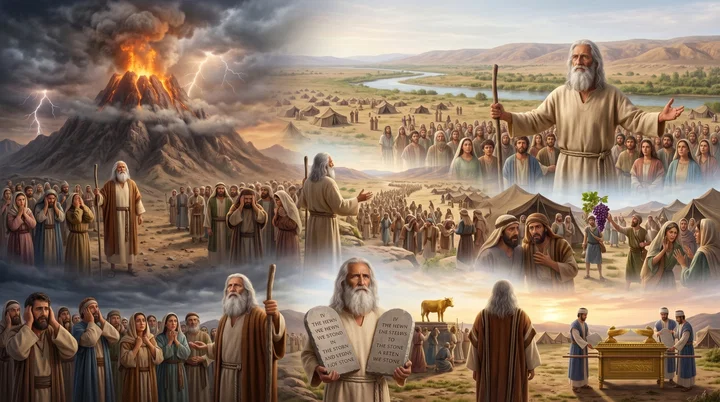
Cross-references 20 of 29
- Exodus 20:1-17
And God spake all these words, saying,
God speaks the commandments from the fire; this is the original proclamation later rehearsed in Deuteronomy.
- Exodus 20:19
And they said unto Moses, Speak thou with us, and we will hear: but let not God speak with us, lest we die.
Israel fears hearing God’s voice and asks Moses to speak for them.
- Deuteronomy 4:12-13
And the LORD spake unto you out of the midst of the fire: ye heard the voice of the words, but saw no similitude; only ye heard a voice.
God speaks from the fire and declares his covenant in the commandments.
- Exodus 24:12
And the LORD said unto Moses, Come up to me into the mount, and be there: and I will give thee tables of stone, and a law, and commandments which I have written; that thou mayest teach them.
God gives Moses the written law and commandments on stone.
- Deuteronomy 5:4-5
The LORD talked with you face to face in the mount out of the midst of the fire,
Moses recalls God speaking to Israel from the fire, with Moses mediating.
- Exodus 19:16-20
And it came to pass on the third day in the morning, that there were thunders and lightnings, and a thick cloud upon the mount, and the voice of the trumpet exceeding loud; so that all the people that was in the camp trembled.
God speaks at Sinai amid fire, and the people hear his voice.
- Hebrews 12:19
And the sound of a trumpet, and the voice of words; which voice they that heard intreated that the word should not be spoken to them any more:
The people heard God’s voice at the mountain and pleaded that it speak no more.
- Deuteronomy 5:28-29
And the LORD heard the voice of your words, when ye spake unto me; and the LORD said unto me, I have heard the voice of the words of this people, which they have spoken unto thee: they have well said all that they have spoken.
God approves their words and desires their lasting obedience.
- Exodus 20:22
And the LORD said unto Moses, Thus thou shalt say unto the children of Israel, Ye have seen that I have talked with you from heaven.
God speaks directly to Israel, who hear his voice.
- Exodus 20:1
And God spake all these words, saying,
Introduces the commandments as words spoken by God.
- Deuteronomy 4:36
Out of heaven he made thee to hear his voice, that he might instruct thee: and upon earth he shewed thee his great fire; and thou heardest his words out of the midst of the fire.
God makes his voice heard from heaven and speaks from the midst of the fire.
- Exodus 34:28
And he was there with the LORD forty days and forty nights; he did neither eat bread, nor drink water. And he wrote upon the tables the words of the covenant, the ten commandments.
The stone tablets bear the words of the covenant God spoke.
- Nehemiah 9:14
And madest known unto them thy holy sabbath, and commandedst them precepts, statutes, and laws, by the hand of Moses thy servant:
God made his holy Sabbath known to Israel.
- Exodus 34:29-35
And it came to pass, when Moses came down from mount Sinai with the two tables of testimony in Moses’ hand, when he came down from the mount, that Moses wist not that the skin of his face shone while he talked with him.
Moses’ shining face contrasts with Israel’s fearful experience of God’s glory.
- Exodus 19:16-19
And it came to pass on the third day in the morning, that there were thunders and lightnings, and a thick cloud upon the mount, and the voice of the trumpet exceeding loud; so that all the people that was in the camp trembled.
Both describe God’s glory revealed amid thunder, lightning, smoke, and the trumpet.
- Deuteronomy 4:11
And ye came near and stood under the mountain; and the mountain burned with fire unto the midst of heaven, with darkness, clouds, and thick darkness.
describes same burning mount, darkness, cloud
- Deuteronomy 4:12
And the LORD spake unto you out of the midst of the fire: ye heard the voice of the words, but saw no similitude; only ye heard a voice.
Israel heard God's voice from the fire.
- Acts 7:38
This is he, that was in the church in the wilderness with the angel which spake to him in the mount Sina, and with our fathers: who received the lively oracles to give unto us:
Both describe God speaking at Sinai.
- Deuteronomy 9:10
And the LORD delivered unto me two tables of stone written with the finger of God; and on them was written according to all the words, which the LORD spake with you in the mount out of the midst of the fire in the day of the assembly.
God speaks from the fire and gives the covenant tablets.
- Exodus 20:20
And Moses said unto the people, Fear not: for God is come to prove you, and that his fear may be before your faces, that ye sin not.
God tests the people so they will fear him and not sin.
Commentary
Each commentary is drawn from primary sources: the writings of Ellen G. White and Adventist pioneers and periodicals. Each commentary is separate. Its own words are not a quotation; follow the references to read the source passages.
Ellen G. White
18 sources
After God repeated His commandments from the burning mountain out of the midst of the darkness, the heads of the tribes and elders told Moses that God had shown them His glory and greatness, that they had heard His voice from the fire, and that they had learned that day that God can speak with man and man still live.Ms 133, 1899, par. 1–5Ms 12, 1904, par. 20–251SP 248.2–249.1Ms 79, 1901, par. 1–2Ms 141, 1906, par. 34–37 Thrilled at hearing Him yet fearing the great consuming fire would consume them if they heard His voice again, they asked Moses to go near, hear all God would say and speak it to them, promising to hear and do it.Ms 75, 1898, par. 11–12SG3 279.2–281.11SP 248.2–249.1 God heard their words and approved them as well said, adding His longing that they would always have such a reverent heart to fear Him and keep all His commandments, so that it might be well with them and their children forever.Ms 75, 1898, par. 11–121SP 248.2–249.1Ms 151, 1901, par. 29–31 This sets forth what He required of His people in the wilderness that they might be holy unto Him in mind, soul, and body, calling for perfect obedience to His will and holy commandments at home and in business, with no excuse for disobedience.7MR 309.1–3Lt 112, 1909, par. 22–24Lt 292, 1908, par. 13Ms 71, 1896, par. 3 These words are to be read, studied carefully, and obeyed now with profit, for prosperity depends on obedience to His requirements, and the day of God's great final review is near when all must stand before the Judge and every character will have been investigated and every case decided for eternity.7MR 309.1–3Lt 42, 1910, par. 6Lt 112, 1909, par. 22–24ST May 20, 1880
Sinai Encounter and Response
Moses was rehearsing the Lord's declaration of the holy commandments to Israel before they entered Canaan, after their wilderness journeys and the Lord's deliverances and victories on their behalf.21MR 408.1–2 The words of the verse were spoken to Moses by all the heads of the tribes and the elders of Israel after the commandment of God was repeated, when they heard His voice out of the midst of the darkness while the mountain burned with fire.Ms 12, 1904, par. 20–251SP 248.2–249.1Ms 141, 1906, par. 34–37ST May 20, 1880 They declared that the Lord God had showed them His glory and His greatness, that they had heard His voice out of the midst of the fire, and that they had seen that day that God talks with man and man lives.Ms 133, 1899, par. 1–5Ms 12, 1904, par. 20–25Ms 79, 1901, par. 1–2Ms 93, 1908, par. 50–53Lt 31, 1898, par. 22–25
The verse shows that the living God can speak directly with human beings in a revelation of His presence and power without their dying.Ms 133, 1899, par. 1–5Ms 131, 1907, par. 29–33Ms 79, 1901, par. 1–2Ms 93, 1908, par. 50–53Lt 31, 1898, par. 22–25 They had recognized His glory, greatness, and power in hearing Him speak from the fire, yet they had survived, and this encounter stands as evidence of God's presence and power.Ms 75, 1898, par. 11–12SG3 279.2–281.1Ms 151, 1901, par. 29–31Ms 93, 1908, par. 50–53 Thrilled by hearing, they feared that the great consuming fire would consume them and they would die if they heard God's voice again, since no flesh had heard the living God speaking from fire and lived.Ms 75, 1898, par. 11–12SG3 279.2–281.11SP 248.2–249.1Ms 151, 1901, par. 29–31Ms 141, 1906, par. 34–37 Therefore they asked Moses to go near, hear all God would say, and speak it to them, promising to hear and do it.Ms 75, 1898, par. 11–121SP 248.2–249.1Ms 151, 1901, par. 29–31ST May 20, 1880
God heard their words and approved them as well said, adding His longing that they would always have such a heart to fear Him and keep all His commandments, so that it might be well with them and their children forever.Ms 75, 1898, par. 11–121SP 248.2–249.1Ms 151, 1901, par. 29–31ST May 20, 1880 Their fear of hearing again is identified as unbelief, since God wanted them to hear His voice.Ms 131, 1907, par. 29–33Ms 141, 1906, par. 34–37 It is also understood as reverent awe before God.1SP 248.2–249.1
Holy Requirement and Obedience
This verse belongs to the instruction in Deuteronomy 4 through 8, and to Deuteronomy 5 in particular, that sets forth what God required of His ancient people in the wilderness that they might be a holy people unto Himself.7MR 309.1–3Lt 112, 1909, par. 22–24 That requirement was sanctification in mind, soul, and body, demanded of them then and demanded of every person today.Lt 292, 1908, par. 13 That instruction reveals that God takes no pleasure in punishing the transgressor but must maintain the honor of His throne when His righteous laws are trampled upon, and that He delights to bestow His blessings upon all who will value them.ST May 20, 1880
His longing that they would fear Him and keep all His commandments always, so that it might be well with them and their children forever, covers all who live on earth till the close of time, all who come under the mediation of Jesus Christ.ST May 20, 1880 The prosperity of all depends upon obedience to His requirements, with the steadfast heart treasuring the law more as the masses disregard and despise it.ST May 20, 1880 Their memory of this display of divine power, in glory and greatness and voice from the fire, exposed the worthlessness of the calf they later worshiped.SG3 279.2–281.11SP 248.2–249.1 The broken tables of stone showed they broke the covenant they had just made with the living God by giving devotion to a handmade object.SG3 279.2–281.11SP 248.2–249.1
The verse calls for perfect obedience to God's will and gives no excuse for disobedience to His holy commandments.Lt 292, 1908, par. 13 God's law and instructions given at Mount Sinai were to govern conduct at home and in business.Ms 71, 1896, par. 3 Obedience to those precepts fits people to regain Paradise, while human teachings that oppose God's law lead people to honor a false Sabbath under threat of punishment.Ms 71, 1896, par. 3
It carries a solemn charge calling for full surrender at the start and continuing simplicity of obedience to all the Lord's commandments according to His special directions, with none of the important things in His Word neglected.Lt 42, 1910, par. 6 It requires every soul to search the Scriptures for himself, to make the Word his study book, to take special interest in doing what is commanded, to avoid rebellion, and to sanctify himself daily so the Lord is glorified.Lt 42, 1910, par. 6 The words recorded in these chapters are to be read to the people and studied carefully and obeyed now with profit.7MR 309.1–3Lt 42, 1910, par. 6Lt 112, 1909, par. 22–24 The reason is that the day of God's great final review is near when all must stand before the Judge of all the earth to answer for their deeds, and the present is the time of investigation when every character will have been investigated and every case decided for eternity.7MR 309.1–3Lt 112, 1909, par. 22–24
Sources
Pioneers and periodicals
51 sources
Israel acknowledged that God had shown them His glory and greatness and spoken to them out of the fire, and that they had learned that God can speak with man and man still live.RH Aug 21, 1855ST Apr 8, 1886RH Feb 1851 Yet fearing that hearing that great voice and fire further would consume them, they asked Moses to draw near and bring God's words to them, which God approved, ceasing to speak audibly to the whole assembly and writing what He had spoken on tables of stone for Moses to teach without alteration.RH Aug 21, 1855ST Apr 8, 1886ST Jan 16, 1907RH Mar 6, 1900 The law so given in Deuteronomy 5 is the same law spoken face to face at Sinai in Exodus 20, and its Sabbath is the same Sabbath, instituted for God's rest after creating heaven and earth in six days in Exodus 20:11, with the deliverance from Egypt added only as a special motive to keep it holy.RH May 1, 1879RH Aug 20, 1872ST May 31, 1905ST Oct 26, 1904 God Himself spoke and wrote those Ten Commandments with His own voice from the fire, adding no more, as His declared covenant and complete moral code.ST Mar 6, 1884RH Jul 18, 1854ST Those great moral principles remain binding now, to be obeyed, treasured, taught to children, and kept as His seal upon His people.ST Feb 27, 1912ST Mar 6, 1884RH Aug 15, 1854
Setting in Deuteronomy
Deuteronomy 5:24 belongs to Moses' oral repetition of the law at the end of forty years, forty years after it was first given at Sinai. ST May 24, 1905ST Jun 24, 1875ST Aug 22, 1916RH Jun 30, 1859RH Mar 31, 1859 That repetition was given just before his death as Israel was about to enter the promised land, to impress the lasting obligation of the law, including additional reasons for the redeemed people's special obligation to observe it. ST May 24, 1905ST Aug 22, 1916 It is a later rehearsal of the law and of Israel's history, given forty years after the deliverance from Egypt and after the Lord had spoken the law at Sinai and written it on stone. ST Jun 24, 1875RH Jun 30, 1859RH Mar 31, 1859RH Jun 30, 1859 The chapter's later account does not establish the Sabbath on the basis of Israel's deliverance from Egypt, but presents that deliverance as a special motive for Israel to be faithful in keeping it. ST May 24, 1905RH Jun 30, 1859RH Jun 30, 1859 The fact that this rehearsal states that purpose in Deuteronomy 5:15, while the original proclamation at Sinai came earlier, raises the question whether the Sabbath was first given as a memorial of that deliverance. RH Mar 31, 1859
It stands in the second of Moses' three addresses before his death, in the section from chapters 5 to 26 that reviews the law for the new generation. RH Feb 24, 1916 That section gives the book its name meaning second law or duplicate of the law. RH Feb 24, 1916 There Moses repeats the law again to the children of Israel and recounts God's wonderful deliverances by the way, adding appeals for Israel to obey it out of gratitude for God's guidance and gracious promises. ST Feb 27, 1912ST Mar 3, 1909 The repetition was rehearsed and emphasized just before his death as Israel was about to enter the promised land, and it gives practical religious instruction.
The rehearsal is not verbatim, but it does not conflict with the original law. ST Jun 24, 1875 Moses does not always give the exact words of the laws God had before given, because those laws had been written; he calls attention to those laws and sometimes gives additional reasons why they should be kept. ST Feb 27, 1912 It is not a new giving of the Decalogue but a recalling in substance of the commandments Israel already had, preserved in the sacred ark, and a rehearsal of the words spoken at Sinai rather than their original utterance. RH May 27, 1852ST Mar 1, 1910ST Mar 1, 1910 In this setting the verse recalls Israel's experience of God's glory and greatness, hearing His voice from the fire and living after God spoke with them. ST Mar 1, 1910 The seventh day had already become the Sabbath when God rested, blessed, and sanctified it at creation; Deuteronomy 5:15 gives Israel's deliverance from Egypt as a reason for commanding its observance, not as the time when the Sabbath began. RH May 27, 1852
Israel's Encounter with God
Israel acknowledged that the Lord had displayed His glory and His greatness to them and had spoken to them out of the midst of the fire, and they confessed that they had seen on that day that God speaks with man and man remains alive.RH Aug 21, 1855ST Apr 8, 1886RH Feb 1851ST Jan 16, 1907RH Jul 18, 1854 Hearing His voice had not brought immediate death, and the testimony shows that God is able to speak directly with people in human language in a display of divine majesty.RH Aug 21, 1855ST Apr 8, 1886RH Feb 1851ST Jan 16, 1907ST Jan 11, 1905 What He spoke with His own voice was the Ten Commandments, the covenant He declared to which He added no more.RH Aug 21, 1855RH Jul 18, 1854 That word was meant to bring life and grace and power, but by asking for Moses to speak instead they received it as condemning precept rather than as a living message.ST Jan 11, 1905
Though they knew a person could hear God and live, they dreaded that further exposure to the great fire and to His terrible voice would consume them and bring death.ST May 20, 1880RH Aug 21, 1855ST Apr 8, 1886ST Jan 16, 1907ST Apr 15, 1886 They therefore asked that they not hear His voice directly again, but that Moses go near, hear all that God would say, and speak it to them, promising to hear and do it.ST May 20, 1880ST Apr 8, 1886ST Jan 16, 1907ST Jun 8, 1904ST Apr 15, 1886 God answered that they had well said all that they had spoken.ST May 20, 1880 Their fear explains why He ceased speaking audibly to the whole assembly.RH Aug 21, 1855
He then wrote the words He had spoken, with His hand of fire on two tables of stone, together with the remaining instruction, and gave them to Moses to teach the people, so that not one word would be altered.RH Aug 21, 1855RH Mar 6, 1900 The Sinaitic covenant thus had a mediator, with the people requesting Moses to stand between God and them to hear and convey what God says.RH Apr 12, 1860ST Jun 8, 1904 While Israel turned away from hearing God's voice directly, Moses drew near to God to receive His word and His law.RH Apr 12, 1860ST Jun 8, 1904
The majesty and glory of that giving is the true measure of its importance.RH Mar 6, 1900 It came from the midst of thunders and lightnings, thick cloud, an exceeding loud trumpet, smoke as a furnace, a quaking mount, darkness and clouds and thick darkness, with all the people in the camp trembling and entreating that no further word be spoken to them.RH Mar 6, 1900 The glorious Lord, the Mediator Jesus, spoke surrounded by the heavenly host of angels disposed in orderly array around the people, making a living tabernacle from which every evil angel was excluded so that no doubt or evil would be suggested.RH Mar 6, 1900
Sabbath Origin and Motive
The Decalogue recorded in Deuteronomy 5 is the same law Jehovah spoke face to face in the mount out of the midst of the fire at Sinai, beginning I am Jehovah thy God, first given by voice and engraved on stone in Exodus 20, so no different Sabbath from the Sabbath of Exodus 20:8-11 is commanded there.RH May 1, 1879ST Oct 26, 1904 The great primary reason for the institution and blessing of the Sabbath is God's rest from creation after making heaven and earth in six days, as stated in Exodus 20:11.RH May 1, 1879RH Aug 20, 1872ST May 31, 1905RH Sep 2, 1852 Israel's deliverance from Egyptian bondage is only an additional and special motive to keep the Sabbath day to sanctify it as already commanded, not its memorial; distinct motives are not inconsistent, so the variation between Deuteronomy 5 and Exodus 20 is no contradiction.RH May 1, 1879ST May 31, 1905
The weight of the passages holds that the appeal to deliverance does not make the Sabbath a memorial of that deliverance, while those who held the other teaching held that the Sabbath commandment also makes the Sabbath a memorial of God's redemption in delivering Israel from bondage as well as of creation.ST May 31, 1905ST Aug 22, 1916 Deuteronomy 5 gives no intimation that the Sabbath was made after the departure from Egypt and gives not a word that it commemorated that departure.RH Feb 3, 1852 It does not institute it for Israel on the ground of that deliverance, and says nothing about when or how the Sabbath originated.RH Nov 13, 1860RH May 27, 1852 The Sabbath day spoken of there is the Sabbath day of the original commandment to remember the Sabbath day, which is the day on which Jehovah rested from His work of creation.RH Feb 3, 1852 The seventh day had already become the Sabbath when God rested, blessed, and sanctified it at creation, and Deuteronomy 5:15 gives Israel's deliverance as a reason for commanding its observance, not as the time when the Sabbath began.RH May 27, 1852
The appeal to the deliverance does not make the Sabbath begin at Sinai or binding only on Jews or only on those who came out of Egypt.RH May 1, 1879RH Jul 24, 1866 The Sabbath was already known before the covenant at Sinai, had already become the Sabbath when God rested, blessed, and sanctified the seventh day at creation, and was later made known to the Hebrews, with deliverance serving as a special motive for faithfulness.RH Jun 30, 1859RH Jul 24, 1866RH May 27, 1852RH Jun 30, 1859 The chapter's later account does not establish the Sabbath on the basis of deliverance, and its law is perpetual and not done away with the Jewish dispensation, continuing from patriarchal time into Christian time with the fourth commandment still binding.RH Jun 30, 1859RH Jun 30, 1859RH Jul 24, 1866 Deuteronomy 5 is a later rehearsal given forty years after the deliverance, and its statement of purpose in verse 15, compared with the earlier proclamation at Sinai, raises the question whether the Sabbath was first given as a memorial of that deliverance.RH Mar 31, 1859 Deuteronomy 5 gives a statement of why the Sabbath was commanded to be kept but not the great primary reason for its institution, and it cannot rightly be used to prove the Sabbath was made for the Hebrews in the wilderness of Sin.RH Sep 2, 1852
The deliverance from Egypt enforced all the moral precepts rehearsed with the Sabbath by the same special reason, and it did not create the obligation to obey, which already existed.RH Sep 24, 1872 Deliverance was given that they might serve Him when bond-service had hindered keeping the Sabbath and every other precept, so using it to prove the Sabbath was first binding at the exodus and only on Jews would equally prove all righteousness and commandments were first binding then and only on Jews.RH Sep 24, 1872 Moses' rehearsal insists that the words spoken, including the Sabbath command grounded on deliverance from Egypt, were written on the two tables of stone, and testifies that Exodus 20:3-17 is defective and not the original copy.RH Oct 29, 1872
Covenant and Moral Law
God himself spoke the moral law with his own voice heard out of the midst of the fire at Sinai, and with his hand of fire wrote it on two tables of stone and delivered it to Moses so that not one word would be altered.RH Jul 18, 1854STRH Mar 6, 1900 These Ten Commandments were the covenant he declared to Israel, to which he added no more, forming a complete moral code.RH Jul 18, 1854STRH Jun 23, 1868 The majesty of that giving measured its importance, for from the midst of thunders and lightnings, thick cloud, exceeding loud trumpet, smoke as a furnace, quaking mount, darkness, clouds and thick darkness, the Lord spoke the ten commandments with a great voice while all the people trembled and entreated that no further word be spoken to them.RH Mar 6, 1900 The glorious Mediator Jesus spoke surrounded by the heavenly host disposed in orderly array as a living tabernacle from which every evil angel was excluded so that no doubt or evil would be suggested.RH Mar 6, 1900
The commandments were communicated through Moses, but their divine authority and lasting force did not depend on human contribution.ST Mar 6, 1901 They were not devised or composed by human skill, and their authoritative wording is recorded in Exodus 20.ST Mar 6, 1901ST Mar 6, 1901 Jesus spoke that moral law from Sinai with his own voice, the voice that everyone of the truth hears, and that law remains binding until heaven and earth pass away.ST Mar 6, 1884 The law given there is perpetual and was not done away with the Jewish dispensation, continuing from patriarchal time into Christian time with the second and fourth commandments still binding.RH Jul 24, 1866
The chapter shows a covenant made with Israel but not with the fathers, consisting of a mutual agreement in which God promised to make Israel a peculiar people if they would obey his voice and Israel agreed to obey.RH Jun 30, 1859 After that agreement God spoke the Ten Commandments in their hearing as the basis or conditions they were to fulfill on their part, so that the commandments are sometimes put for the covenant itself.RH Jun 30, 1859 Israel broke this covenant by not keeping the commandments, and God therefore promised a new covenant in which the same law would be put in inward parts and written in hearts.RH Jun 30, 1859 The God-spoken covenant commanded forever is distinct from the first covenant God made with Israel through Moses.RH Sep 11, 1866 Israel in assenting to the first covenant promised to keep this God-spoken covenant, but violated the terms of both covenants.RH Sep 11, 1866 The first covenant was faulty because it could not take away sin, so because of that transgression a law was added and a typical system was instituted pointing to Christ, that the penitent sinner might receive pardon by faith in the coming Messiah.RH Sep 11, 1866
The old covenant that was done away is all these words — the Ten Commandments together with their amplification in the three following chapters — as ratified in Exodus 24:3-8.RH Mar 25, 1873 The standing between the Lord and the people from being afraid by reason of the fire belongs to Exodus 20:19 and Exodus 24:3-8, not to the preliminary interview in Exodus 19 to see whether a covenant would be kept if made.RH Mar 25, 1873 The changed order of the clauses against coveting in Deuteronomy 5 from Exodus 20:17 proves that coveting is a single tenth commandment and cannot be divided into two commandments. The verse stands within the law of Moses commanded in Horeb for all Israel, with its statutes and judgments, which is to be remembered.RH Jun 23, 1853
God made his covenant, the ten precepts, with Israel as the stock of the church under that dispensation, the people he made covenant with and committed his oracles to, yet then as now it was the duty of the world to be proselyted and joined to the church.ST Jan 22, 1880RH Dec 30, 1873 The law is not pled as it stood with the old obligation to do and live nor with the Levitical priesthood, but as the law of Christ established by himself and his apostles.ST Jan 22, 1880RH Dec 30, 1873 The chapter is also cited to prove the ten precepts were given only to the Jews and Gentiles have nothing to do with them.RH Dec 30, 1873
Obedience and Present Application
The moral principles set forth in the rehearsal of the law are applicable in the present day, for the laws had already been written and are here called to attention with added reasons why they should be kept.ST Feb 27, 1912 The commandments heard at Horeb are to be obeyed, treasured, taught to children, and kept continually.RH Aug 15, 1854 They are God's sign and seal upon His people, a protective mark in the forehead and in the hand that shields them in the coming time of judgment.RH Aug 15, 1854
To hear His voice is to keep that moral law spoken from Sinai, which remains binding until heaven and earth pass away.ST Mar 6, 1884 Churches that pervert or ignore it do not hear His voice, while the true organization that resists the mark of the beast is known by keeping the commandments of God and the faith of Jesus.ST Mar 6, 1884 God's word at Sinai was meant to bring life, grace, and power, yet Israel asked for Moses to speak instead and received it as condemning precept rather than as a living message.ST Jan 11, 1905 The law so spoken was glorious, but its glory condemned those who would not receive it in faith.ST Aug 23, 1910 The plea that God stop speaking showed unbelief and a choice to stand apart from Him, a separation represented by the veil over the heart, while beyond that condemning glory lies the greater glory that justifies and writes the law in the heart.ST Aug 23, 1910
The confession that God showed His glory and greatness, spoke from the fire, and talked with man and man still lived shows that God can speak directly with people in a display of divine majesty.RH Feb 1851RH Jan 21, 1904 It presents God as personal and able to speak to people in human language.RH Jan 21, 1904 By presenting God Himself as the speaker of the commandments, it distinguishes them from ceremonial laws and supports their continuing authority.RH Feb 1851
The same encounter reveals that God takes no pleasure in punishing the transgressor but must maintain the honor of His throne when His righteous laws are trampled upon, and that He delights to bestow His blessings upon all who will value them.ST May 20, 1880 His longing that they had such a heart in them to fear Him and keep all His commandments always, that it might be well with them and with their children forever, covers all who live on earth till the close of time, all who come under the mediation of Jesus Christ.ST May 20, 1880 The prosperity of all depends upon obedience to His requirements, with the steadfast heart treasuring the law more as the masses disregard and despise it.ST May 20, 1880 The book containing this rehearsal, given as practical religious instruction just before entrance into the promised land, is upheld by the reverence of Christ, who in His threefold temptation met the devil successfully each time by a quotation from Deuteronomy quoted without question.
Sources