Deuteronomy 5:23
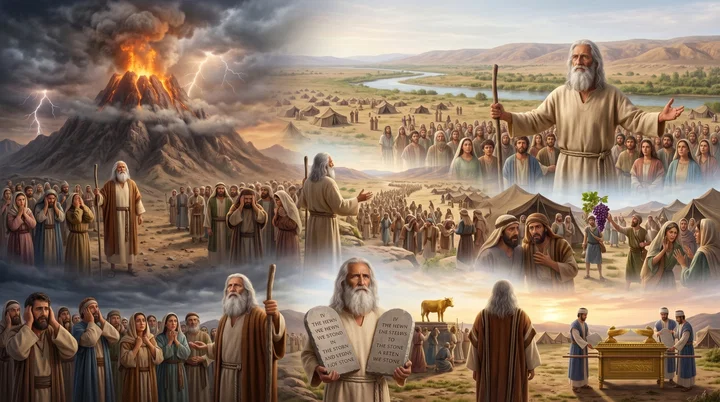
And it came to pass, when ye heard the voice out of the midst of the darkness, (for the mountain did burn with fire,) that ye came near unto me, even all the heads of your tribes, and your elders;
Translations
And it came to pass, when you heard the voice out of the middle of the darkness, (for the mountain did burn with fire,) that you came near to me, even all the heads of your tribes, and your elders;
King James Version, KJV Cambridge Paragraph Bible
And it came to pass, when ye heard the voice out of the midst of the darkness, (for the mountain did burn with fire,) that ye came near unto me, even all the heads of your tribes, and your elders;
And it came to pass, when ye heard the voice from the midst of the darkness, (for the mountain did burn with fire,) that ye came near to me, even all the heads of your tribes, and your elders;
And it came to pass, when ye heard the voice out of the midst of the darkness, while the mountain did burn with fire, that ye came near unto me, even all the heads of your tribes, and your elders;
And it came to pass, when ye heard the voice out of the midst of the darkness, while the mountain was burning with fire, that ye came near unto me, even all the heads of your tribes, and your elders;
'And it cometh to pass as ye hear the voice out of the midst of the darkness, and of the mountain burning with fire, that ye come near unto me, all the heads of your tribes, and your elders,
And it came to pass, when ye heard the voice from the midst of the darkness, and the mountain burned with fire, that ye came near to me, all the heads of your tribes, and your elders;
And it came to pass, when ye heard the voice out of the midst of the darkness, the mountain also burning with fire, then drew ye near unto me, even all the heads of your tribes and your elders,
Berean Standard Bible, Majority Standard Bible
And when you heard the voice out of the darkness while the mountain was blazing with fire, all the heads of your tribes and your elders approached me,
When you heard the voice out of the middle of the darkness, while the mountain was burning with fire, you came near to me, even all the heads of your tribes, and your elders;
And after hearing the voice which came out of the dark while the mountain was burning with fire, all the heads of your tribes and your chiefs came to me,
And when ye heard the voyce out of the middes of the darkenes, (for the mountaine did burne with fire) then ye came to me, all the chiefe of your tribes, and your Elders:
Douay-Rheims (Challoner revision)
But you, after you heard the voice out of the midst of the darkness, and saw the mountain burn, came to me, all the princes of the tribes and the elders, and you said:
Pictures
Cross-references 20 of 28
- Exodus 20:1-17
And God spake all these words, saying,
God first speaks the commandments at Sinai, which Moses later rehearses in Deuteronomy 5.
- Exodus 20:18-21
And all the people saw the thunderings, and the lightnings, and the noise of the trumpet, and the mountain smoking: and when the people saw it, they removed, and stood afar off.
Israel fears God’s voice at Sinai, draws back, and asks Moses to speak for them.
- Deuteronomy 4:10-13
Specially the day that thou stoodest before the LORD thy God in Horeb, when the LORD said unto me, Gather me the people together, and I will make them hear my words, that they may learn to fear me all the days that they shall live upon the earth, and that they may teach their children.
Israel heard God speak at Horeb and received his covenant commandments.
- Exodus 19:16-19
And it came to pass on the third day in the morning, that there were thunders and lightnings, and a thick cloud upon the mount, and the voice of the trumpet exceeding loud; so that all the people that was in the camp trembled.
Both describe God speaking at Sinai amid fire, with the people hearing his voice.
- Deuteronomy 5:4-5
The LORD talked with you face to face in the mount out of the midst of the fire,
Moses stood between God and Israel as God spoke the commandments from the fire.
- Exodus 24:12
And the LORD said unto Moses, Come up to me into the mount, and be there: and I will give thee tables of stone, and a law, and commandments which I have written; that thou mayest teach them.
God gives Moses stone tablets bearing the law and commandments he wrote.
- Exodus 20:1
And God spake all these words, saying,
God speaks the commandments to Israel.
- Galatians 3:19
Wherefore then serveth the law? It was added because of transgressions, till the seed should come to whom the promise was made; and it was ordained by angels in the hand of a mediator.
Both describe the law given at Sinai through a mediator.
- Deuteronomy 4:36
Out of heaven he made thee to hear his voice, that he might instruct thee: and upon earth he shewed thee his great fire; and thou heardest his words out of the midst of the fire.
God’s voice came from heaven amid the fire at Sinai.
- Exodus 20:22
And the LORD said unto Moses, Thus thou shalt say unto the children of Israel, Ye have seen that I have talked with you from heaven.
God spoke the commandments from heaven and through Moses.
- Exodus 20:2
I am the LORD thy God, which have brought thee out of the land of Egypt, out of the house of bondage.
The law’s introduction recalls God bringing Israel out of Egypt.
- Nehemiah 9:14
And madest known unto them thy holy sabbath, and commandedst them precepts, statutes, and laws, by the hand of Moses thy servant:
God made the Sabbath known to Israel.
- Exodus 34:28
And he was there with the LORD forty days and forty nights; he did neither eat bread, nor drink water. And he wrote upon the tables the words of the covenant, the ten commandments.
The covenant words written on the tablets are identified as the Ten Commandments.
- Exodus 19:18
And mount Sinai was altogether on a smoke, because the LORD descended upon it in fire: and the smoke thereof ascended as the smoke of a furnace, and the whole mount quaked greatly.
same smoke fire quaking mount
- Deuteronomy 4:11
And ye came near and stood under the mountain; and the mountain burned with fire unto the midst of heaven, with darkness, clouds, and thick darkness.
same burning mountain with darkness
- Exodus 20:21
And the people stood afar off, and Moses drew near unto the thick darkness where God was.
Moses approaches God on Israel’s behalf.
- Deuteronomy 9:10
And the LORD delivered unto me two tables of stone written with the finger of God; and on them was written according to all the words, which the LORD spake with you in the mount out of the midst of the fire in the day of the assembly.
The stone tablets bear the words God spoke from the fire at the assembly.
- Hebrews 12:19
And the sound of a trumpet, and the voice of words; which voice they that heard intreated that the word should not be spoken to them any more:
Both describe the people’s plea for no more direct speech from God.
- Hebrews 12:22-26
But ye are come unto mount Sion, and unto the city of the living God, the heavenly Jerusalem, and to an innumerable company of angels,
same voice shaking the earth
- Psalms 68:17
The chariots of God are twenty thousand, even thousands of angels: the Lord is among them, as in Sinai, in the holy place.
Places the angelic host at Sinai.
Commentary
Each commentary is drawn from primary sources: the writings of Ellen G. White and Adventist pioneers and periodicals. Each commentary is separate. Its own words are not a quotation; follow the references to read the source passages.
Ellen G. White
13 sources
Moses is rehearsing how the Lord declared His holy commandments to the whole assembly from the mount out of fire, cloud and thick darkness with a great voice and wrote them on two tables of stone, when the people heard the voice out of the midst of the darkness while the mountain burned with fire and all the heads of the tribes and the elders came near to him.21MR 408.1–2Ms 12, 1904, par. 20–251SP 248.2–249.1Ms 141, 1906, par. 34–37 They confessed that God had shown His glory and greatness in talking with man and man still living, yet they feared death from the great fire if they heard His voice again, so they asked not to hear Him directly but for Moses to go near, hear all God would say and speak it to them, promising to hear and do it.Ms 12, 1904, par. 20–251SP 248.2–249.1SG3 279.2–281.1Ms 151, 1901, par. 29–31 God approved their words as well said and longed that they would always have such a heart to fear Him and keep all His commandments that it might be well with them and their children forever, though it is also taught that their request revealed unbelief.1SP 248.2–249.1Ms 151, 1901, par. 29–31Ms 141, 1906, par. 34–37ST May 20, 1880 The instruction in Deuteronomy 4-8 sets forth what God required that they might be a holy people unto Himself, the standard of full surrender and continuing simplicity of obedience to all His commandments with sanctification of mind, soul and body, which applies to every person today with no excuse accepted for disobedience.7MR 309.1–3Lt 42, 1910, par. 6Lt 112, 1909, par. 22–248MR 427.1Lt 292, 1908, par. 13 That wish for an obedient heart covers all who live on earth till the close of time under the mediation of Jesus Christ, for prosperity depends upon obedience to God's requirements, and those chapters are to be studied now because the world is nearing God's great final review when every character will have been investigated and every case decided for eternity.7MR 309.1–3Lt 112, 1909, par. 22–24ST May 20, 1880
Sinai Setting and Request
Moses is rehearsing how the Lord declared His holy commandments to the people, speaking to the whole assembly from the mount out of fire and cloud and thick darkness with a great voice and writing His words on two tables of stone, at the time when the commandment was being repeated.21MR 408.1–2Ms 12, 1904, par. 20–25Ms 141, 1906, par. 34–37 When the people heard the voice out of the midst of the darkness, for the mountain did burn with fire, all the heads of the tribes and the elders came near to Moses.21MR 408.1–2Ms 12, 1904, par. 20–251SP 248.2–249.1SG3 279.2–281.1Ms 151, 1901, par. 29–31 They came as leaders of Israel after hearing God's voice from the fiery darkness on the mountain.SG3 279.2–281.1Ms 151, 1901, par. 29–318MR 427.1
They confessed that God had shown His glory and His greatness, and that God had talked with man and man still lived.1SP 248.2–249.1Ms 151, 1901, par. 29–31ST May 20, 1880 That experience proved that the living God speaks with people.1SP 248.2–249.1SG3 279.2–281.1 Yet they feared they would die by the great fire if they heard God's voice again.1SP 248.2–249.1SG3 279.2–281.1Ms 151, 1901, par. 29–31ST May 20, 1880
They asked not to hear God's words spoken directly because the voice thrilled them.Ms 12, 1904, par. 20–25Ms 141, 1906, par. 34–37 They asked Moses to go near, hear all that God would say, and speak it to them, promising to hear it and do it.Ms 12, 1904, par. 20–251SP 248.2–249.1Ms 151, 1901, par. 29–31ST May 20, 1880 God approved their words as well said.1SP 248.2–249.1Ms 151, 1901, par. 29–31ST May 20, 1880 He expressed the wish that they would always have such a heart to fear Him and keep all His commandments, so that it would be well with them and with their children forever.1SP 248.2–249.1Ms 151, 1901, par. 29–31ST May 20, 1880
Their request for Moses to hear God for them reveals unbelief.Ms 141, 1906, par. 34–37 Moses recalled this revelation to expose the folly of worshiping the powerless, man-made calf and to point Israel back to the living God.1SP 248.2–249.1SG3 279.2–281.1 That worship broke the recently made covenant, as represented by the broken tables of stone, for which Moses was not reproved.1SP 248.2–249.1 God was very angry with Aaron and would have destroyed him without Moses' special intercession, and Moses confronted Aaron over bringing so great a sin upon the people.1SP 248.2–249.1
Law's Call to Obedience
Deuteronomy 5:23 stands within Deuteronomy 4-8, which set forth what God required of His ancient people that they might be a holy people unto Himself, and which teach why God's people are identified as His people.7MR 309.1–3Lt 112, 1909, par. 22–248MR 427.1 That instruction gives the standard for full surrender and continuing simplicity of obedience to all His commandments, with none of the important things specified neglected.Lt 42, 1910, par. 6 It requires sanctification of mind, soul, and body and perfect obedience to God's will.Lt 292, 1908, par. 13 The same requirement applies to every person today, and no excuse is accepted for disobedience to God's commandments.Lt 292, 1908, par. 13
Those chapters are to be studied and read with profit now because the world is nearing God's great final review, when all must stand before the Judge of all the earth to answer for deeds.7MR 309.1–3Lt 112, 1909, par. 22–24 The present is the time of investigation when every character will have been investigated and every case decided for eternity.7MR 309.1–3 The verse is to be read to the people and read carefully with chapters four, six, seven, and eight, with the special lesson being interest to do them.Lt 42, 1910, par. 6 Every soul is to search the Scriptures for himself and make the Word the study book and sanctify himself daily according to the Word, lest he be found in rebellion, so the Lord will be glorified.Lt 42, 1910, par. 6
The verse shows that God takes no pleasure in punishing the transgressor but must maintain the honor of His throne when His righteous laws are trampled upon, and He delights to bestow His blessings upon all who will value them.ST May 20, 1880 God's wish for an obedient heart covers all who live on earth till the close of time and all who come under the mediation of Jesus Christ, teaching that the prosperity of all depends upon obedience to God's requirements.ST May 20, 1880 The heart fixed upon the Lord will treasure His law more highly in proportion as the masses disregard and despise it.ST May 20, 1880 The words spoken there are God's law, whose instruction, kept before children and followed in home life and business, would form a people fit to regain Paradise lost through disobedience.Ms 71, 1896, par. 3
Sources
Pioneers and periodicals
44 sources
The verse recalls the moment when Israel heard God's voice out of the darkness while the mountain burned with fire, and all the heads of the tribes and the elders came near to Moses.RH Aug 21, 1855RH Feb 1851RH Jul 24, 1866 That voice was God Himself, even Jesus Christ, declaring the Ten Commandments to the assembled nation in His own voice and adding no more.RH Aug 21, 1855RH Feb 1851ST Mar 6, 1884ST May 31, 1905RH Jul 18, 1854 It is not the original speaking at Sinai but Moses' rehearsal about forty years afterward at the close of the wandering, calling the new generation to lasting obligation under laws already written and preserved in the ark.ST May 24, 1905ST Jun 24, 1875ST Aug 22, 1916RH Jul 24, 1866RH Mar 31, 1859 The Sabbath there commanded is the creation Sabbath, instituted because God made the world in six days and rested the seventh, while the deliverance from Egypt is urged only as an added motive for redeemed Israel to keep it and show mercy to servants.RH Feb 3, 1852RH May 1, 1879RH Jul 24, 1866ST Nov 16, 1876ST Mar 1, 1910 The law so spoken remains binding and is put in the heart under the new covenant, and because the people could not endure God's voice Moses stood as mediator to receive and teach the rest.RH Aug 21, 1855ST Mar 6, 1884ST Mar 1, 1910RH Jun 30, 1859RH Apr 12, 1860
Repetition Of The Law
Deuteronomy 5:23 stands in the second law, the repetition of the law, where Moses rehearsed the law and recounted God's dealings with His children and His wonderful deliverances by the way at the close of the forty years of wandering, just before his death and before Israel passed over the Jordan into the promised land.ST Mar 11, 1913ST Feb 27, 1912ST Mar 1, 1910 It belongs to Moses' rehearsal of the law and of the lessons God had taught Israel during their wilderness years, recalling the law already given to Israel rather than giving it for the first time.ST Mar 1, 1910 It stands in Moses' second address given just before his death, in chapters 5 to 26 reviewing the law for the new generation, the section from which Deuteronomy takes its name meaning second law, or duplicate of the law.RH Feb 24, 1916 The book to which it belongs is the last of the five books of Moses and abounds in practical religious instruction, carrying the reverence of Jesus, who in His threefold temptation met the devil successfully each time by a quotation from Deuteronomy quoted without question.
The passage is not God's original speaking of the law from heaven at Sinai but Moses' later rehearsal about forty years afterward, recalling that Israel heard God's voice from the fire and darkness at the mountain and came near with all the heads of the tribes and the elders.ST May 24, 1905RH Jul 24, 1866RH Mar 31, 1859RH Jun 30, 1859 It is not a new giving of the Decalogue, for Israel already had the commandments, preserved in the sacred ark.ST Mar 1, 1910 In this rehearsal the Sabbath is urged in view of Israel's deliverance from Egypt, and that historical reason with additional reasons why that redeemed people were under special obligation to observe it does not make the Sabbath exclusively Jewish or limit its obligation to Israel.ST May 24, 1905RH Jul 24, 1866RH Jun 30, 1859 The law sets duties for all people because God is ruler of the universe, and Israel was especially bound to keep it because God had redeemed them from Egypt.ST Mar 1, 1910
The rehearsal does not always or even often reproduce the original word for word and does not confine itself to the exact words of the historical record in Exodus 20, for those laws had been written, yet it does not conflict with it.ST Jun 24, 1875RH May 1, 1879ST Feb 27, 1912 Its object is to call the attention of Israel to those laws already written, to impress lasting obligation by earnest exhortation, and sometimes to give additional reasons why they should keep them as a redeemed people under special obligation.ST May 24, 1905ST Aug 22, 1916RH May 1, 1879ST Feb 27, 1912 The commandments' authoritative text remains the words Jehovah spoke, recorded in Exodus 20, and their summary and delivery through Moses does not lessen their divine authority or lasting value.ST Mar 6, 1901 All the great moral principles set forth there are applicable in the present day, and the chapter gives the Sabbath a reason not stated in Exodus 20 by connecting it with Israel's deliverance from Egypt.ST Feb 27, 1912ST Aug 22, 1916
Voice From Burning Mountain
When the people heard the voice out of the midst of the darkness while the mountain burned with fire, all the heads of the tribes and the elders came near to Moses.RH Aug 21, 1855RH Feb 1851RH Jul 24, 1866RH Mar 31, 1859ST Nov 16, 1876 This belongs to Moses' later rehearsal recalling that Israel heard God's voice from the fire and darkness at the mountain, in which the Sabbath is urged in view of deliverance from Egypt without making it exclusively Jewish or limiting its obligation, and whose origin still rests on God's rest after creation rather than on that deliverance establishing it.RH Jul 24, 1866RH Mar 31, 1859ST Nov 16, 1876 Because the people could not endure God's terrifying voice, God stopped speaking directly to the assembly, wrote the words He had spoken on the stone tablets, and Moses taught the people the rest of the law.RH Aug 21, 1855RH Feb 1851 Their refusal to hear God directly and receive His law through Moses meant receiving through a mediator what, had they gladly received God's word, would have been a message of life, grace, and truth rather than a condemning set of precepts.ST Jan 11, 1905
The voice they heard was God Himself declaring the Ten Commandments to the assembled nation in His own voice after they had agreed to obey.RH Aug 21, 1855RH Feb 1851RH Jul 18, 1854 He spoke the commandments to the people and added no more, and wrote them on stone for Moses to receive.RH Feb 1851RH Jul 18, 1854ST That voice out of the darkness while the mountain burned spoke the Ten Commandments and nothing else, so the charge to obey His voice and keep His covenant because He had brought them out of Egypt meant obeying the Ten Commandments.ST Jul 2, 1902 These are the moral law that exposes sin but cannot justify sinners or save them, and these details distinguish the Ten Commandments from ceremonial laws and show their enduring authority.RH Feb 1851ST
The giving was glorious and terrible, with the mountain burning with fire unto the midst of heaven amid clouds and thick darkness.RH Mar 6, 1900 There were thunders and lightnings, a thick cloud, smoke as a furnace, the quaking mount and trembling earth, and the exceeding loud trumpet sounding long and growing louder, and all the people in the camp trembled and entreated that the word should not be spoken to them any more.RH Mar 6, 1900 From that midst the Lord spoke with a great voice the Ten Commandments and added no more, and with His hand of fire wrote them on two tables of stone and delivered them to Moses.RH Mar 6, 1900 It took place surrounded by the heavenly host disposed in orderly array, twenty thousand chariots, ten thousand times ten thousand angels above the assembly as a great living tabernacle from which every evil angel was excluded so that not one word from the voice of Jesus the Mediator would be altered or doubt suggested, measuring the majesty and importance of the only law ever given by the hand of the Mediator and ordained by angels.RH Mar 6, 1900
The Decalogue repeated in Deuteronomy 5 is the same law spoken face to face in the mount out of the midst of the fire beginning I am Jehovah thy God, identical to Exodus 20, so no different Sabbath is commanded there, only the same creation Sabbath of Exodus 20:8-11.ST Oct 26, 1904 The only textual variation noted is a different order of the clauses about coveting from the first giving. By contrast, those who held the other teaching held that the setting immediately after Moses states that God spoke the words and wrote them on two tables of stone shows that the Deuteronomy 5 wording, including the Sabbath command to remember deliverance from Egypt in Deuteronomy 5:15 and the command of rest on the seventh day in Deuteronomy 5:12-15, was what was written on stone, while Exodus 20:3-17 is not the original copy but is defective by comparison.RH Oct 29, 1872
Sabbath Creation Not Exodus
The Sabbath spoken of is not a day connected with the flight from Egypt but the day on which Jehovah rested from His work of creation.RH Feb 3, 1852RH May 1, 1879ST Nov 16, 1876RH Aug 20, 1872 Israel's release from Egyptian bondage did not make God rest, bless, or sanctify that day, and its blessing and sanctification rest on God's rest from creation.RH May 1, 1879ST Nov 16, 1876RH Aug 20, 1872 Deuteronomy 5 gives no intimation that the Sabbath was made after the departure from Egypt and says not a word that the Sabbath commemorated that departure.RH Feb 3, 1852 The rest promised to Israel after the exodus was the peaceable possession of Canaan, which they received only when they gained their inheritance.RH Aug 20, 1872
The creation of the world in six days and rest on the seventh is the reason for instituting the Sabbath, while the gracious deliverance from Egyptian bondage is urged only as an additional motive and special reason for Israel to sanctify it as already commanded in Exodus 20.RH May 1, 1879RH Jul 24, 1866ST Mar 1, 1910RH Jun 30, 1859 Obligation to Jehovah as Redeemer and humanity due to bond-servants is another important reason for hallowing it, and distinct motives are not inconsistent.RH May 1, 1879 The law sets duties for all people because God is ruler of the universe, and Israel was especially bound to keep it because God had redeemed them from Egypt.ST Mar 1, 1910 That historical reason does not make the Sabbath exclusively Jewish or limit its obligation to Israel or to only those delivered from Egypt, so the Sabbath existed from creation and is not only obligatory upon the Jews.RH May 1, 1879RH Jul 24, 1866RH Jun 30, 1859
The appeal in Deuteronomy 5 to God delivering Israel from servitude in Egypt does not make the Sabbath a memorial of that flight and deliverance.RH Feb 3, 1852ST May 31, 1905 The same appeal does not make justice and mercy to servants, orphans, widows and the poor, or keeping all the commandments, memorials of that deliverance, since all those duties existed before.ST May 31, 1905 A memorial must answer by analogy to the event it recalls, and there is no analogy between rest and flight.ST May 31, 1905 The Passover was appointed as the memorial of the deliverance from Egypt.ST May 31, 1905
The chapter is indefinite on when the seventh day was made the Sabbath and why, gives no fact or reason for the institution, and does not explain the origin, which is located at creation.ST Mar 23, 1915RH May 27, 1852ST Mar 6, 1884 It must be explained by the definite passage in Exodus 20 that tells both the time and the reason.ST Mar 6, 1884 The chapter stands with the statement giving Israel's deliverance from bondage in Egypt as the reason to keep the Sabbath.
Covenant And Lasting Obligation
The chapter records the covenant made with Israel but not with the fathers as a mutual agreement in which God would make them a peculiar people if they obeyed His voice and they agreed to do it.RH Jun 30, 1859 God then spoke the Ten Commandments in their hearing as the basis and conditions they were to fulfill on their part, and because the commandments are that basis they are sometimes put for the covenant itself.RH Jun 30, 1859 Israel did not keep those commandments so the covenant was broken, and God promised a new covenant in which He would put His law in their inward parts and write it in their hearts.RH Jun 30, 1859 That new covenant was made at the first advent and leaves the law written in the hearts of believers rather than blotted out and abolished.RH Jun 30, 1859
The details distinguish the Ten Commandments from ceremonial laws and show their enduring divine authority, for God spoke them to the people, added no more, and wrote them on stone for Moses to receive.RH Feb 1851STST Though summarized and delivered through Moses, their authoritative text is the words Jehovah spoke, and their delivery through Moses does not lessen their divine authority or lasting value.RH Feb 1851ST Mar 6, 1901 They came from God and not from human invention, having been spoken by God Himself to the assembled nation and not delivered through human agency.STRH Jun 23, 1868ST Mar 6, 1901 They are the moral law that exposes sin but cannot justify sinners or save them.ST
The law has not passed away but remains binding till heaven and earth pass, for it sets duties for all people because God is ruler of the universe, and Israel was especially bound to keep it because God had redeemed them from Egypt.ST Mar 6, 1884ST Mar 1, 1910 The voice Israel heard out of the darkness while the mountain burned with fire spoke the Ten Commandments and nothing else, so obeying that voice meant obeying His law.ST Jul 2, 1902 The charge to obey His voice and keep His covenant given because He had brought them out of Egypt meant to obey the Ten Commandments.
The Sinaitic covenant had a mediator, for when Israel heard the voice out of the midst of the darkness while the mountain burned with fire all the heads of the tribes and the elders came near to Moses so he would stand between God and them and speak to them in God's place.RH Aug 21, 1855RH Apr 12, 1860 The people could not endure God's terrifying voice, so God stopped speaking directly to the assembly, wrote the words He had spoken on the stone tablets, and Moses taught the people the rest of the law.RH Aug 21, 1855 The people feared hearing God speak directly and asked Moses to receive the words from God and relay them to them.ST Jun 8, 1904
The ten precepts in their Jewish-dispensation form are brought forward to prove they were given only to the Jews with whom God made the covenant and committed His oracles, and that Gentiles have nothing to do with them.ST Jan 22, 1880RH Dec 30, 1873 That same Jewish setting is used to argue that part of God's law was done away and that the fourth commandment in particular never carries into the New Testament.RH Jul 24, 1866 That limit is false because the law is perpetual and binds in the patriarchal, Jewish, and Christian dispensations alike, with the second commandment no more found in the New Testament than the fourth.RH Jul 24, 1866 It was then the duty of the world to be proselyted and joined to the church as much as it is now to believe and be baptized.ST Jan 22, 1880 The ten precepts are not pleaded as standing with the old obligation to do and live, nor with the Levitical priesthood, but as the law of Christ established by Himself and His apostles.ST Jan 22, 1880
By contrast, those who held it to be abolished taught that the old covenant that was abolished was the Ten Commandments together with their amplification in the three following chapters, sealed with blood.RH Mar 25, 1873 On that reckoning Moses standing between the Lord and Israel in fear by reason of the fire belongs not to the preliminary interview in Exodus 19 to see whether a covenant would be kept if made, but to the giving of the law when Israel feared the fire and to the blood covenant in Exodus 24:3-8.RH Mar 25, 1873
Voice Of Jesus Christ
The voice heard out of the midst of the darkness while the mountain burned with fire was the voice of Jesus Christ proclaiming the law with a voice that shook the earth.ST Mar 6, 1884ST May 31, 1905RH Mar 6, 1900 It was the voice of the Mediator speaking the moral law from Sinai, and the voice of truth that everyone who is of the truth hears.ST Mar 6, 1884RH Mar 6, 1900 That speaking was glorious and terrible, with the mountain burning with fire unto the midst of heaven amid clouds and thick darkness, thunders and lightnings, a thick cloud, smoke as of a furnace, the quaking mount and trembling earth, and the exceeding loud trumpet sounding long and growing louder, so that all the people in the camp trembled.RH Mar 6, 1900 From that midst the Lord spoke with a great voice the Ten Commandments and added no more, and with His hand of fire wrote them on two tables of stone and delivered them to Moses.RH Mar 6, 1900 The giving took place surrounded by the heavenly host disposed in orderly array, twenty thousand chariots, ten thousand times ten thousand angels above the assembly as a great living tabernacle from which every evil angel was excluded, so that not one word would be altered nor doubt suggested, measuring the majesty and importance of the only law ever given by the hand of the Mediator and ordained by angels.RH Mar 6, 1900
That law has not passed away but remains binding till heaven and earth pass.ST Mar 6, 1884 Hearing His voice means keeping that moral law, and keeping the commandments of God identifies the true organized church.ST Mar 6, 1884 The divided churches of Babylon have perverted or ignored this law and do not hear His voice.ST Mar 6, 1884
Receiving Law In Faith
The leaders and elders came near after hearing the voice from the darkness while the mountain burned because they refused to hear God speak to them directly, and that refusal was unbelief and separation from Him.ST Jan 11, 1905ST Aug 23, 1910 Had they gladly received His word, it would have come to them as life and grace and truth instead of standing before them as a condemning code of precepts.ST Jan 11, 1905 The law spoken from the fire was glorious, yet its glory condemned all who would not receive it in faith.ST Aug 23, 1910 It was given because God loved the people and desired to do them good, and His purpose is that people receive it into their hearts and love it.ST Aug 23, 1910 Moses looked beyond its condemning glory to the greater glory that justifies.ST Aug 23, 1910
After hearing the voice they confessed that God had shown His glory and greatness and had spoken with man, yet they feared they would die if they heard that voice again.ST May 20, 1880 They therefore asked Moses to go near, hear all that God would say, and speak it to them, promising to hear and do it.ST May 20, 1880 God approved their words and expressed the wish that they always had such a heart to fear Him and keep all His commandments, for their lasting good and the good of their children.ST May 20, 1880 That wish shows He takes no pleasure in punishing the transgressor, though He must maintain the honor of His throne when righteous laws are trampled, and that He delights to bestow blessing on all who value His blessings.ST May 20, 1880 It reaches to all who live on earth till the close of time and to all who come under the mediation of Jesus Christ, teaching that the prosperity of all depends on obedience to His requirements.ST May 20, 1880 The heart fixed upon the Lord will therefore treasure His law more highly in proportion as the masses disregard and despise it.ST May 20, 1880
The book in which this stands abounds in practical religious instruction and carries the reverence of Jesus. In His threefold temptation He met the devil successfully each time by a quotation from Deuteronomy, quoted without question.
Sources