Exodus 16:31
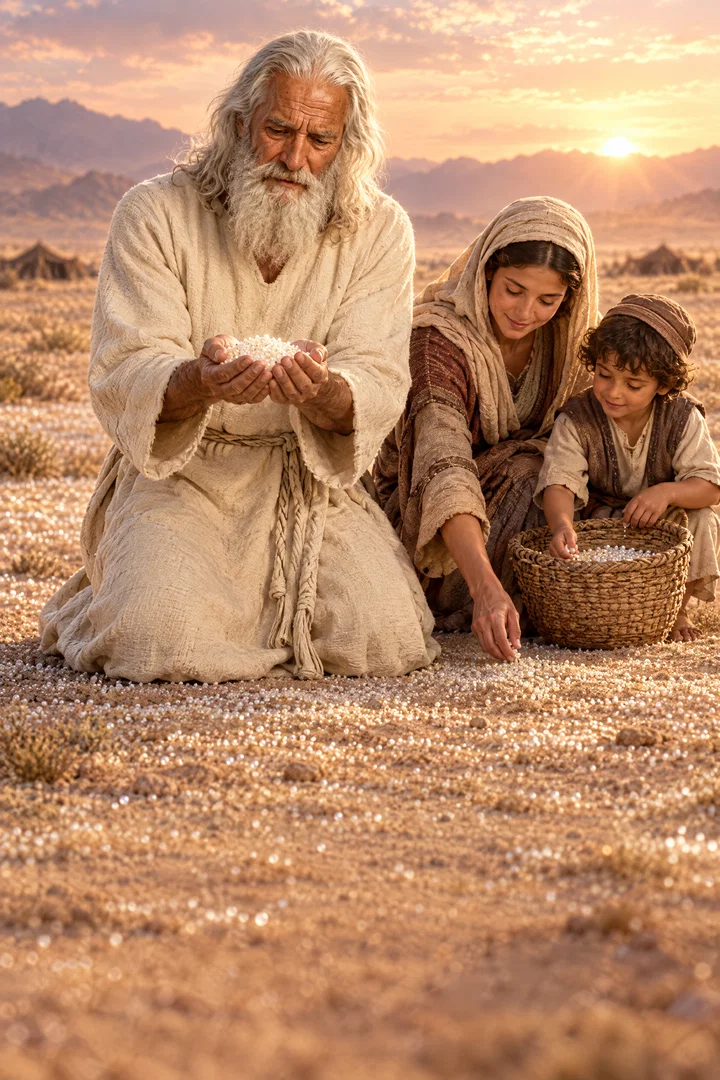
And the house of Israel called the name thereof Manna: and it was like coriander seed, white; and the taste of it was like wafers made with honey.
Translations
American King James Version, King James Version, KJV Cambridge Paragraph Bible, Revised Version, American Standard Version
And the house of Israel called the name thereof Manna: and it was like coriander seed, white; and the taste of it was like wafers made with honey.
And the house of Israel called its name Manna: and it was like coriander-seed, white; and the taste of it was like wafers made with honey.
and the house of Israel call its name Manna, and it [is] as coriander seed, white; and its taste [is] as a cake with honey.
And the house of Israel called its name Manna; and it was like coriander-seed, white; and the taste of it was like cake with honey.
And the house of Israel called the name thereof Manna,—and the same, was like coriander seed white, and the taste thereof, like flat-cake with honey,
Berean Standard Bible, Majority Standard Bible
Now the house of Israel called the bread manna. It was white like coriander seed and tasted like wafers made with honey.
The house of Israel called its name “ Manna”, and it was like coriander seed, white; and its taste was like wafers with honey.
And this bread was named manna by Israel: it was white, like a grain seed, and its taste was like cakes made with honey.
And the house of Israel called the name of it, MAN. and it was like to coriander seede, but white: and the taste of it was like vnto wafers made with hony.
Douay-Rheims (Challoner revision)
And the house of Israel called the name thereof Manna: and it was like coriander seed white, and the taste thereof like to flour with honey.
Pictures
Cross-references 20 of 26
- Exodus 16:4-5
Then said the LORD unto Moses, Behold, I will rain bread from heaven for you; and the people shall go out and gather a certain rate every day, that I may prove them, whether they will walk in my law, or no.
Manna’s daily and sixth-day gathering instructions test Israel’s obedience and mark the Sabbath.
- Exodus 16:26
Six days ye shall gather it; but on the seventh day, which is the sabbath, in it there shall be none.
It identifies the seventh day as the Sabbath, when no manna was gathered.
- Exodus 16:22-23
And it came to pass, that on the sixth day they gathered twice as much bread, two omers for one man: and all the rulers of the congregation came and told Moses.
The sixth-day double gathering leads to Moses’ announcement of the Sabbath.
- Numbers 11:7-8
And the manna was as coriander seed, and the colour thereof as the colour of bdellium.
Both describe manna’s appearance and taste; Numbers adds how it was prepared.
- Exodus 16:35
And the children of Israel did eat manna forty years, until they came to a land inhabited; they did eat manna, until they came unto the borders of the land of Canaan.
Manna sustained Israel through forty years in the wilderness.
- Exodus 16:5
And it shall come to pass, that on the sixth day they shall prepare that which they bring in; and it shall be twice as much as they gather daily.
The sixth-day double portion of manna accommodates Sabbath observance.
- Exodus 16:14-15
And when the dew that lay was gone up, behold, upon the face of the wilderness there lay a small round thing, as small as the hoar frost on the ground.
Describes the manna given to Israel.
- Exodus 16:25
And Moses said, Eat that to day; for to day is a sabbath unto the LORD: to day ye shall not find it in the field.
Moses identifies the day of rest during the manna gathering as the Sabbath.
- Exodus 16:1
And they took their journey from Elim, and all the congregation of the children of Israel came unto the wilderness of Sin, which is between Elim and Sinai, on the fifteenth day of the second month after their departing out of the land of Egypt.
Dates Israel’s wilderness journey shortly before the manna and its Sabbath instructions.
- Exodus 16:8
And Moses said, This shall be, when the LORD shall give you in the evening flesh to eat, and in the morning bread to the full; for that the LORD heareth your murmurings which ye murmur against him: and what are we? your murmurings are not against us, but against the LORD.
Promises the manna and quail provided to Israel in the wilderness.
- Exodus 16:2-3
And the whole congregation of the children of Israel murmured against Moses and Aaron in the wilderness:
Israel grumbled over hunger before God provided manna.
- Exodus 16:23
And he said unto them, This is that which the LORD hath said, To morrow is the rest of the holy sabbath unto the LORD: bake that which ye will bake to day, and seethe that ye will seethe; and that which remaineth over lay up for you to be kept until the morning.
Manna was prepared beforehand for the seventh-day Sabbath.
- John 6:32-35
Then Jesus said unto them, Verily, verily, I say unto you, Moses gave you not that bread from heaven; but my Father giveth you the true bread from heaven.
Jesus is the true bread from heaven, fulfilling the manna’s provision of life.
- Psalms 78:24
And had rained down manna upon them to eat, and had given them of the corn of heaven.
God sent manna from heaven for Israel to eat.
- Exodus 16:21
And they gathered it every morning, every man according to his eating: and when the sun waxed hot, it melted.
describes the same angels' food
- Numbers 11:6
But now our soul is dried away: there is nothing at all, beside this manna, before our eyes.
Israel later disparaged the manna they had received.
- 1 Corinthians 10:11
Now all these things happened unto them for ensamples: and they are written for our admonition, upon whom the ends of the world are come.
Israel’s wilderness experience serves as an example and warning for later generations.
- Exodus 16:15
And when the children of Israel saw it, they said one to another, It is manna: for they wist not what it was. And Moses said unto them, This is the bread which the LORD hath given you to eat.
gives question that named it
- Deuteronomy 8:3
And he humbled thee, and suffered thee to hunger, and fed thee with manna, which thou knewest not, neither did thy fathers know; that he might make thee know that man doth not live by bread only, but by every word that proceedeth out of the mouth of the LORD doth man live.
God fed Israel manna to teach dependence on his word and test obedience.
- Joshua 5:12
And the manna ceased on the morrow after they had eaten of the old corn of the land; neither had the children of Israel manna any more; but they did eat of the fruit of the land of Canaan that year.
It marks the end of the manna’s provision after Israel entered the land.
Commentary
Each commentary is drawn from primary sources: the writings of Ellen G. White and Adventist pioneers and periodicals. Each commentary is separate. Its own words are not a quotation; follow the references to read the source passages.
Ellen G. White
5 sources
The substance given to Israel was white and resembled coriander seed, and its flavor was like that of flat cakes prepared with honey.PP 294.3–295.1 The household of Israel itself bestowed upon it the name manna.PP 294.3–295.1 It was gathered as a daily provision from God, and for eating it was ground or beaten and then baked into cakes.PP 294.3–295.1
It was the food of angels, bread from heaven bestowed upon Israel.Ms 125, 1909, par. 17–18 Its miraculous supply in the wilderness was an act of mercy, demonstrating that God was able to meet their needs.4T 469.1 The diet sustained physical, mental, and moral strength, so that in spite of the hardships of wilderness life there was not one feeble person among any of the tribes.ST Nov 2, 1915
Yet even this heavenly provision failed to satisfy Israel.Ms 125, 1909, par. 17–18 The God who furnished manna to the children of Israel in the wilderness remains the same God still.18MR 186.3 He stands ready to impart light and knowledge to all who desire to glorify Him, including skill and wisdom for preparing wholesome and palatable foods for hygienic restaurants in the cities.18MR 186.3
Sources
Pioneers and periodicals
130 sources
The house of Israel called the bread from heaven manna because when they first saw it they asked what it was, the Hebrew meaning what is this.RH Dec 17, 1861RH Sep 8, 1874ST Jul 18, 1878 It was white, like coriander seed in form and size, lying as small round grains, and its taste was sweet and delicious like wafers made with honey, like honey cakes with a rich flavor as of fresh oil.RH Dec 17, 1861ST Feb 26, 1894ST Aug 18, 1909ST Aug 30, 1905 It was given fresh each morning before the sun melted it, every man gathering an omer according to his eating and preparing it by grinding, beating, and baking, while what was kept overnight against command bred worms.ST Jul 1, 1908ST Apr 19, 1877 The chapter recognizes and enforces the Sabbath before the law was proclaimed at Sinai, speaking of the seventh day as already well known, holy, and existing, and making it the test whether Israel would walk in His law and keep His commandments.RH Apr 11, 1854RH May 7, 1857ST Jun 10, 1880ST Jun 10, 1880ST Jun 10, 1880 God performed a weekly miracle to identify a particular day, giving a double portion on the sixth day, none on the seventh, and preserving over the Sabbath what spoiled at other times, proving the Sabbath is a definite seventh day and not merely a seventh part of time, though those who held it was then instituted taught the double portion was ordered without prior knowledge and the morrow was announced as rest of a holy Sabbath.RH Apr 11, 1854RH Aug 19, 1915RH Jun 2, 1851ST Jul 22, 1880RH Sep 24, 1872
Manna's Name and Appearance
The house of Israel gave the bread from heaven the name manna because when they first saw it lying on the ground they asked what it was.RH Dec 17, 1861RH Sep 8, 1874ST Jul 18, 1878ST Oct 29, 1902 The Hebrew inquiry man hu means what is this, with man itself being the interrogative pronoun what.RH Sep 8, 1874 The name therefore preserves their first question, given because they did not know what it was.RH Dec 17, 1861RH Sep 8, 1874
It was white, like coriander seed in form, size and appearance.RH Dec 17, 1861ST Feb 26, 1894ST Aug 30, 1905 It lay on the ground as small hard white grains the size of coriander seed, small and round rather than loaves.ST Feb 26, 1894ST Aug 18, 1909ST Aug 30, 1905RH Sep 30, 1915 At one place it is described as transparent like dew and as lying in the early morning like a covering of small whitish blossoms, gathered carefully into baskets.ST Feb 26, 1894ST Aug 18, 1909ST Aug 30, 1905
Its taste was like wafers made with honey, sweet and delicious like honey cakes.ST Feb 26, 1894ST Aug 18, 1909ST Aug 30, 1905 It was pleasant to eat, with a sweet flavor like honey cakes and a rich flavor like fresh oil.RH Dec 17, 1861ST Feb 26, 1894ST Aug 18, 1909ST Jun 5, 1879 Its reference to honey identifies it as delicious food.ST Feb 26, 1894ST Aug 30, 1905ST Jun 5, 1879
It was given fresh each morning before the sun melted it, every man gathering according to his eating, an omer of about five pints for each person.ST Jul 1, 1908ST Apr 19, 1877 The people ground it in mills or beat it in a mortar and baked it into cakes.ST Jul 1, 1908ST Apr 19, 1877 What was kept overnight against command bred worms and became offensive.ST Jul 1, 1908ST Apr 19, 1877
The description of manna as sweet food from God for hungry people serves as an image for God's life-giving word.RH Sep 30, 1915RH Mar 18, 1902ST Jun 18, 1894 That word should be finely broken and made accessible to children to lead them to Christ, coming each day as a repeated miracle at God's command.RH Sep 30, 1915 With it the Lord feeds His worker so the worker can feed God's hungering, erring, lost and wandering ones.RH Mar 18, 1902 The bread given to a hungry stranger tastes like manna to the giver, with a sweetness beyond ordinary bread.ST Jun 18, 1894
Wilderness Setting and Chronology
Exodus 16:31 belongs to God's provision for sustenance in the wilderness on the journey from Egypt to Sinai, where after Israel traveled by divine direction from Elim to the wilderness of Sin in one day their food brought from Egypt was exhausted and God rained manna from heaven.RH May 7, 1857ST Feb 11, 1913ST Jan 20, 1909 The fall of the manna the day after that journey was also a moral test of whether the people regarded God, with six days of falling followed by cessation on the seventh day named the Sabbath to point out the rest day to be observed.RH May 7, 1857RH Nov 15, 1864ST Feb 11, 1913 The sixth day on which twice as much was gathered is the sixth day of the week, not merely the sixth day counted from the first fall of the manna.RH Nov 15, 1864 Thirty days before the covenant made in Horeb the people gathered an omer each day until the sixth day when they gathered two omers, and on the seventh day heaven gave no manna, guarding the manna to prove the seventh day the rest of the holy Sabbath unto the Lord.RH Dec 9, 1851
Israel came into the wilderness of Sin on the fifteenth day of the second month, thirty days after departing Egypt on the fifteenth day of the first month and thirty days before coming to the desert of Sinai in the third month by way of Rephidim.RH Apr 11, 1854ST Apr 24, 1879 There they murmured for food, receiving quails that night and manna from the next morning, the sixteenth day, for six successive days, with the seventh day, the twenty-second day, marked by no manna and commanded to be kept as the Sabbath.RH Apr 11, 1854ST Apr 24, 1879ST Apr 22, 1889 The quail came in the evening before the manna fell the next morning, the first giving of quail in the Wilderness of Sin.ST Apr 22, 1889 The day of travel from Elim to Sin before the manna fell was not the Sabbath, for God would not command travel on a day on which He would soon forbid work on pain of death, and He did not cause the camp to move on the Sabbath during the wilderness sojourn.RH May 7, 1857
This was about a month before Israel came to Sinai, thirty to thirty-three days before the law was spoken and the covenant made in Horeb in the third month, reckoned as one month and three days, thirty days, thirty-two days, or thirty-three days before Sinai.RH Apr 11, 1854RH Jul 14, 1874ST Oct 31, 1906ST Apr 25, 1906RH May 8, 1900 About a month beforehand, in the camp between Elim and Sinai, Israel observed the seventh-day Sabbath, and from that time the seventh day was specially marked by the withholding of the manna on that day.ST Oct 31, 1906 The weekly miracle then begun continued for forty years throughout the wilderness experience, from B.C. 1491 to 1451.RH Jun 2, 1851 There is no proof that the 15th day of the second month when they came to the wilderness of Sin was itself a Sabbath, and no proof that the 22nd was a Sabbath even by counting back seven days from the 22nd.RH Jun 10, 1862
The setting is Israel's first outbreak of murmuring after leaving Egypt, when provisions were gone and they had no bread to satisfy hunger.RH Jun 2, 1851ST Nov 7, 1895 Their complaint against Moses and Aaron was in fact directed against Christ who was leading them, and their failure to trust Him showed unbelief.ST Nov 7, 1895 Murmurings fill a larger space in the account than the supply itself, yet the supply of manna was a benefit given even amid murmuring, calling for thankfulness stable and independent of circumstances, staying open in difficulty rather than shutting like flowers under a cloud.ST Jul 30, 1902 Discontent tricks memory into painting the past without shadows, remembering the fleshpots and forgetting the bondage because present trials are viewed unwisely, and the manna's regular provision became so ordinary that the people murmured against the bread sent from heaven.ST Jul 30, 1902RH Jan 7, 1862 The verse stands in the history part of Exodus, chapters 1 to 18, which tells how Israel grown more and mightier than the Egyptians fell into bitter bondage and oppression and was greatly delivered to become a nation with thorough organization, efficient leadership, a complete code of laws, and an established form of worship under Moses as chosen leader.RH Jan 20, 1916
Sabbath Known Before Sinai
The chapter recognizes, enforces and tests the Sabbath before the law was proclaimed at Sinai, and contains no institution of a new Sabbath, no sentence instituting one, and no facts, reasons, enactment or characteristics on which such an institution could be based.ST Jun 10, 1880ST Jun 10, 1880ST Jun 10, 1880RH Nov 15, 1864 Every time it calls the day the seventh day without explanation, speaking of it as already well known, generally observed, holy and existing, the same seventh day sanctified from creation.ST Jun 10, 1880ST Jun 10, 1880RH Aug 6, 1872 No reason is given there why the seventh day is the Sabbath, and no act is recorded there of sanctifying a day or erecting a new institution.ST Jun 10, 1880RH Aug 6, 1872RH Nov 15, 1864 The manna was withheld on the seventh day not to make it the Sabbath but because it already was the Sabbath, having been constituted a Sabbath long before, and Moses identified the next day as the holy Sabbath because none would be found on the seventh.ST Jun 10, 1880ST Jun 10, 1880ST May 1, 1884 The Sabbath was therefore not newly made the rest day at Sinai, but was already holy by God's earlier blessing and appointment.RH Aug 6, 1872ST May 1, 1884
God made the Sabbath the test of obedience to His law in the manna-gathering, asking how long they refused to keep His commandments and laws and saying the Lord had given them the Sabbath.RH Apr 11, 1854RH May 7, 1857RH Jul 14, 1874ST Jun 14, 1877RH May 8, 1900 Resting on the seventh day was keeping His commandments and going out to gather was refusing them, proving His commandments, statutes and laws already existed and were understood before Exodus 20.RH Apr 11, 1854RH May 7, 1857RH May 8, 1900 The manna was given to prove whether they would walk in God's law, leaving them without direction to provide for the seventh day so regard for the law was shown voluntarily on the sixth day, while those who gathered on the seventh were rebuked though not expressly forbidden before, with miracles honoring a known law rather than appointing a special day.RH May 7, 1857ST Jun 14, 1877 The statement that the morrow is the holy Sabbath is not a new commandment but a reminder of the old Sabbath commandment made in the beginning that had long been neglected, and coming before Sinai with no record of repeal of the original law it proves the Sabbath law continued in force from Eden to Sinai.RH Jul 14, 1874ST Apr 25, 1906RH May 8, 1900 This record stands one month and three days before Israel came to Sinai and shows the people already well understood the Sabbath, expressly mentioned as the Lord's Sabbath.RH Jul 14, 1874RH May 8, 1900
This proves the Sabbath did not originate at Sinai at the giving of the law for the Jews alone, but was called to the attention of Israel only thirty days after leaving the house of bondage where they could not observe it.RH Apr 11, 1854RH Apr 11, 1854 It did not owe its existence to the old covenant made at Sinai and could continue after that covenant was dissolved, since Sabbath observance is placed before that covenant was made.RH Apr 11, 1854ST Aug 13, 1885RH Jul 24, 1866 It was observed before the distinction between Jew and Gentile existed, was a gift for all humanity, was not a Jewish memorial of the flight from Egypt, and answers the claim it was for Israel alone.RH Apr 11, 1854RH Aug 6, 1872ST Jul 27, 1882 The lack of direct mention of the Sabbath in the brief record of the first 2500 years, which touches only great events, does not mean it did not exist during that time.RH Apr 11, 1854 Claims about the chapter's Hebrew text must be tested against the events in Exodus 16 and the following chapters and against the fourth commandment.ST Jul 27, 1882
Israel's habitual Sabbath-breaking at that time is reasonable because they had just come from bondage and idolatrous customs in Egypt where they could not observe it and had learned to neglect it.RH Jun 10, 1862RH May 27, 1852 God brought them out of the house of bondage and placed them where everything was adjusted with reference to the Sabbath, that He might prove them whether they would walk in His law or not.RH Jun 10, 1862RH May 27, 1852 The Sabbath there is the same rest-day instituted when God finished creation, now renewed in the wilderness lest Israel suppose their unsettled state exempted them from keeping it, and strictly enforced after bringing them out of Egypt.ST May 17, 1883 The Sabbath was ordained by God in the garden of Eden and had been handed down from family to family and from generation to generation, so knowledge of the Sabbath and knowledge of the true God had been kept alive in the hearts and experience of His people, with the manna as evidence that the Sabbath already existed near the close of the patriarchal age before it was placed in the Decalogue.RH Jun 27, 1912RH Sep 8, 1910 The chapter is thus presented as restoring the Sabbath after slavery, not as a new institution but as one already known and practiced.ST May 17, 1883
Those who held the other teaching held that the Sabbath was then instituted and first made known to Israel in the wilderness of Sin as a new and arbitrary test commandment, where the obligation to keep the weekly Sabbath began.RH Sep 24, 1872RH Oct 29, 1872ST Jul 30, 1885RH May 27, 1852 By that teaching the ordinances about manna were given as arbitrarily as possible as tentative preparation for the giving of the law, an omer for every man with the quantity miraculously decreased for the greedy and enlarged for the indolent so all had alike, and a double portion to be gathered on the sixth day by order without telling beforehand of a Sabbath to follow or that no manna would fall on that day, even though all earlier attempts to keep manna from one day to another had failed.RH Sep 24, 1872RH Oct 29, 1872 When the Sabbath was then introduced it was just as arbitrary, simply as a rest sacred to God, with no reference to creation or to deliverance from Egyptian bondage, and permanent legislation on the Sabbath with its proper reasons was reserved for Sinai when Israel became a holy nation.RH Sep 24, 1872RH Oct 29, 1872 The rulers were ignorant that a Sabbath was to follow until Moses explained the morrow as rest of a holy Sabbath without the definite article, with the definite article appearing only in the later word about abiding in place on the seventh day, and the people were informed on the seventh day itself since the day begins with the evening and orders for the day are given when the day begins.RH Oct 29, 1872ST Jul 30, 1885 In that view the reproof for refusing to keep the commandments does not mean a continued desecration of the Sabbath, for the Sabbath is one of many commandments that had long been broken.RH Oct 29, 1872
In support of that position it is argued that the Hebrew has no definite article before Sabbath where the English version wrongly supplies the, and that first mention of an institution always lacks the article, so the indefinite form proves the Sabbath was instituted then and did not exist before.RH Nov 12, 1872 Other absences of the article do not overturn this, because poetry omits it, some phrases need none in translation, some are definite by construction, and enumeration may use it or omit it at will.RH Nov 12, 1872 Related questions are raised whether the rulers were surprised by the double portion, whether they already knew the order to gather a double rate, and whether they came to tell Moses or to let him know the order had been obeyed.RH Jun 10, 1862RH Oct 29, 1872 There is no proof that the 15th day of the second month when they came to the wilderness of Sin was a Sabbath, and no proof that the 22nd was a Sabbath, even by counting back seven days from the 22nd.RH Jun 10, 1862
Weekly Miracle Identifying Sabbath
God marked out one particular day by a threefold weekly miracle in the manna: a double portion fell on the sixth day, none fell on the seventh, and what was gathered on the sixth kept good over the Sabbath though manna kept overnight at other times bred worms and became offensive.RH Apr 11, 1854RH Jun 2, 1851ST Jul 22, 1880RH Apr 28, 1874ST Oct 23, 1893 This pattern of sending bread for six days, sending none on the seventh, and preserving the sixth day's supply for food on the seventh drew special attention to the Sabbath and showed that the seventh day, not another day, was the Sabbath.ST Jul 22, 1880RH Nov 28, 1871ST Oct 23, 1893 Some count four notable miracles in this arrangement.RH Apr 11, 1854
The three miracles were repeated every week for forty years throughout the wilderness experience, so that whether reckoning had been lost or not God Himself made the day known and left no uncertainty about which day of the weekly cycle was the Sabbath when the commandments were given.RH Aug 19, 1915RH Jun 2, 1851ST Aug 7, 1879ST Nov 12, 1912 From that time the knowledge of the true seventh day was preserved through the Old Testament, and some among Israel have kept it ever since with no dispute among their scholars over the day.RH Jun 2, 1851ST Apr 30, 1896 The account shows Israel gathering and preparing on the sixth day and resting on the seventh, the Sabbath.ST Aug 7, 1879
The manna plainly declared which day was the Sabbath and that the other six days were not, proving He requires the observance of a definite day and not merely a seventh part of time.RH Aug 19, 1915RH Apr 28, 1874 It fixed the Sabbath as the definite seventh day by the Lord Himself and left no room for the idea that the day is indefinite or to be settled by the caprice or custom of men.RH Aug 19, 1915ST Oct 23, 1893 Sixth and seventh mark order in the week as much as first through fifth do in Genesis 1, and as Sunday and Monday designate particular days.
The sixth day on which twice as much was gathered is the sixth day of the week immediately followed by the seventh-day Sabbath, not merely the sixth day on which manna had fallen nor an unnamed day in a separate cycle.RH May 7, 1857RH Nov 15, 1864ST Jul 12, 1883 The manna account identifies the day before the Sabbath as the sixth day and the Sabbath as the seventh, showing consecutive days in the ordered weekly cycle.RH Nov 28, 1871RH May 7, 1857 The six days of manna and its cessation on the seventh point out the rest day to be observed.RH May 7, 1857
The language seventh day without any qualifying term, or the Sabbath by itself, meant the last day of the week. At that time the days of the week were known only by their numbers and had no names except the seventh, which was named the Sabbath, or the day of the rest. Any other seventh had to be specified, such as the seventh day of the month.
The day so made known is the true seventh day later given in the law at Sinai, so there is no need to go back earlier to know God's will about the day.RH Aug 19, 1915 It is the same seventh day Jews continue to observe as Saturday, the Sabbath of Eden and Sinai, not Sunday the first day, coming just before the first day of the week and kept at Christ's death.ST Jun 5, 1879ST Sep 14, 1882ST Feb 17, 1909ST May 1, 1884 The reckoning fixed there was endorsed by Jesus by His practice and teaching and has continued without variation in the order of the days of the week to the present, confirmed by the united testimony of the Jews supported by the agreement of all the rest of the nations.RH Aug 19, 1915 That Sabbath begins Friday evening at sundown and ends the following day at sundown.ST Apr 30, 1896
The chapter gives instruction about preparing food for the Sabbath: food to be boiled or baked was prepared on the sixth day, in the warm climate of Arabia, so no work was done on the seventh.ST Jul 1, 1908ST Apr 19, 1877 The general principle still applies, with necessary warming of food done with as little work as possible and with Sabbath food and other work prepared beforehand.ST Apr 19, 1877 Every day in the instruction to gather means each day on which ordinary work was lawful, that is each lawful working day excluding the Sabbath, on which the manna did not fall and those going out to gather found none.ST Jul 1, 1908RH Jun 18, 1901ST Dec 8, 1881 The sixth day is thus set apart by the order to prepare food in advance as the preparation day for the coming Sabbath, the only weekly Sabbath ever given to man.ST May 1, 1884
Creation Origin and Continuity
The Sabbath kept at the manna is the same rest-day instituted when God finished creation, when He rested on the seventh day and blessed and sanctified it, setting it apart to sacred use and making it happy for man, and creation is the reason it was blessed and made holy, a reason as good twenty-five hundred years afterward as then.RH May 7, 1857ST Jun 10, 1880RH Aug 6, 1872ST Jun 10, 1875 The chapter gives no institution of a new Sabbath and contains no sentence instituting one, but every time calls it the seventh day without explanation, and no reason is given there why the seventh day is the Sabbath and no act is recorded there of sanctifying a day or erecting a new institution.ST Jun 10, 1880RH Aug 6, 1872RH Nov 15, 1864ST Nov 16, 1876ST May 18, 1882 The manna was withheld on the seventh day not to make it the Sabbath but because it already was the Sabbath, having been constituted a Sabbath long before, and it is spoken of as already well known and generally observed, the very day on which God rested at creation and the Sabbath of the fourth commandment.RH May 7, 1857ST Jun 10, 1880RH Jul 21, 1853 Gathering the double portion on the sixth day without direction proves previous knowledge of the Sabbath, and calling tomorrow the rest of the holy Sabbath before it arrived proves the day had been hallowed, blessed, and kept in regular order since creation.RH May 7, 1857 The manna was given to prove whether they would walk in God's law, leaving them without direction to provide for the seventh day so regard for the law was shown voluntarily on the sixth day, while those who gathered on the seventh were rebuked for refusing God's commandments and laws though not expressly forbidden, with miracles honoring a known law rather than appointing a special day.RH May 7, 1857
God did not bless and sanctify the seventh day in the time of Moses, since everything in the chapter indicates it was already an institution in existence from some previous time, proving the blessing and sanctification were done at creation when God's rest was complete and were not deferred till Moses.ST Jun 10, 1875RH Jan 21, 1875RH Apr 28, 1874 To sanctify means to set apart or appoint to sacred or religious use, to be sacredly observed by man, and the obligation was fully established when the day was appointed to be sacredly observed at the close of creation week.ST Jun 10, 1875RH Jan 21, 1875 This proves Sabbath obligation did not begin at Sinai or at the Exodus, for God already had a law requiring observance of the Sabbath before that law was spoken on Sinai, and even before the manna was given, with reason and origin pointing back to the work of creation.ST Jun 10, 1875RH Jan 21, 1875
The weekly period had been carefully preserved from the beginning, with the sixth and seventh days at the manna synchronizing with the sixth and seventh days of the original creation week, and the sixth day on which a double portion was gathered is the sixth day of the week, not merely the sixth day on which manna had fallen.RH May 7, 1857RH May 6, 1852 Whether knowledge had been preserved or not, God Himself made it known by a weekly miracle that fixed the Sabbath day and preserved the order of the week from creation to the Exodus, marking the seventh day by a threefold miracle in the falling of the manna continued for forty years so that Israel certainly knew which day was the seventh day and the Sabbath.ST Aug 30, 1905ST Jun 3, 1908ST Apr 4, 1906 From that time knowledge of the true seventh day was preserved through the Old Testament, Moses announcing on the sixth day that the next day is the holy Sabbath rest to the Lord, which proves the reckoning of the week was rightly kept, with the origin of the week in Genesis 1 and 2 alone and the last day of the week the sanctified rest-day of the Creator.ST Apr 4, 1906RH May 6, 1852 The fall of the manna confirmed that the days in the instruction given to Israel were ordinary twenty-four-hour days and that the Sabbath commandment was in harmony with the Sabbath institution.ST Nov 19, 1912
There was no change of the Sabbath there from the original rest-day to a Jewish Sabbath or from the seventh day back to the sixth, and no setting back of the week, and nothing in the record makes the manna bear testimony for a new Jewish Sabbath against the ancient Sabbath of the Lord.RH Jun 2, 1851ST Nov 15, 1883ST Jul 24, 1879 The Sabbath made known by the manna is the very Sabbath given to Adam and afterward enjoined from Sinai, proving the original seventh day has been the only weekly Sabbath in every age and came just before the first day of the week, not a temporary or makeshift arrangement.ST Jun 26, 1893 The sixth-day announcement that tomorrow is the rest shows continuity with the only seventh day ever blessed and sanctified, and God gave the manna day by day for forty years as a daily miracle to impress the sacredness of His own rest day and preserve it from desecration.ST Nov 15, 1883 If no change of the Sabbath can be proved at the fall of the manna, the Jews still have the true seventh day, and the argument for changing it again at the resurrection fails.ST Jul 24, 1879 The cessation of the manna does not prove that Israel's Sabbath differed from the seventh day hallowed at creation, since the day could have coincided with it, and the proposed chronology is unreliable because Israel left Rameses on the fifteenth not the fourteenth and the time spent at each encampment cannot be assumed to have been one day.RH Oct 31, 1871
The chapter recognizes and enforces the Sabbath and establishes that the seventh day is the Sabbath and enjoins abstaining from ordinary labor and secular work, but it does not explain why the seventh day is the Sabbath or describe an act that instituted it.RH Aug 6, 1872ST Nov 16, 1876RH Sep 24, 1872 It contains no institution of the Sabbath, gives no facts on which such an institution is based, expresses no meaning and intent of it, and assigns no reason why it should be observed, with the sixth day on which twice as much was gathered being the sixth day of the week, not the sixth day counted from the first fall of the manna.RH Nov 15, 1864 It gives no reason for the consecration of the Sabbath and no reason why the seventh day was chosen in preference to any other day of the week, and it does not explain how, why, or when the seventh day became holy.ST May 18, 1882RH Sep 24, 1872 Its institution and reason are given in the account of creation where God rested on the seventh day, then blessed and sanctified it, so its origin and obligation rest on creation, not on the exodus, and must be learned from other scriptures.RH Aug 6, 1872ST May 18, 1882RH Sep 24, 1872
The seventh-day Sabbath existed before it was proclaimed at Sinai and people were already obligated to keep it holy, yet this alone does not by itself prove that people had been obligated to keep it from creation, and Exodus 16 and Genesis 2 also refer to the same day of the week.RH Aug 6, 1872 Set beside this, the Sabbath in Exodus was the seventh day, not a temporary or changed day, and it stands with Genesis 2:2-3 and Exodus 20 as proof that the seventh day is the day God sanctified and blessed to be kept, presenting the seventh-day Sabbath as binding before the law was given in its present form on Mount Sinai in the Ten Commandments.RH Oct 18, 1870ST Jun 5, 1879
The chapter furnishes a commentary on the seventh day called the Sabbath, given thirty-three days before Israel stood at Sinai, so that whatever the sixth day and the seventh day meant at the time of the manna applies equally when the Sabbath law was given. With three mentions of the sixth day and four mentions of the seventh day it settles whether seventh day means a definite day of the week or any seventh part of time. The chapter gives the Bible's first reference to the Sabbath and states when it was to be kept: the seventh day.RH Sep 2, 1852
The Sabbath was ordained by God in the garden of Eden and had been handed down from family to family and from generation to generation, so the knowledge of the Sabbath and the knowledge of the true God had been kept alive in the hearts and experience of His people.RH Jun 27, 1912 The verse's chapter marks the point at which after its setting apart at creation and a long gap in the narrative it again becomes a subject of legislation.RH Apr 11, 1854ST Jun 28, 1883 The lack of direct mention of the Sabbath in the brief record of the first 2500 years, which touches only great events, does not mean it did not exist during that time.RH Apr 11, 1854 The absence of a Sabbath command in that chapter does not mean the Sabbath was not kept, for its observance thirty-two days before the Ten Commandments were spoken shows that the Sabbath may also have been kept long before the recorded events, and the extended account serves as positive evidence about the Sabbath during Israel's wilderness sojourn, countering the claim that Scripture is silent about the Sabbath between Genesis and that time, showing that the children of Israel received a reminder of the Sabbath before they came to Sinai when manna was given.RH Sep 19, 1854RH Dec 11, 1856ST Mar 11, 1897
Testing Covenant and Doctrine
After deliverance from bondage God first proved Israel whether they would walk in His law by calling attention to the Sabbath as an existing institution and imposing the strongest obligations to keep it.RH Dec 5, 1871RH May 12, 1863RH May 28, 1867RH May 27, 1852 The test concerned the seventh-day Sabbath after Israel was brought out of Egypt where they could not keep it and placed where everything was adjusted with reference to it.RH Dec 5, 1871RH May 12, 1863RH May 27, 1852 The Sabbath there is inseparably connected with the rest of the law and cannot be urged too strongly, being the key to the law of God, the golden link uniting man to his Creator and joining duties owed to God with duties owed to fellow man.RH May 12, 1863RH May 28, 1867 It was designed to have them recognize Him as the only living and true God and the One who sanctifies them.RH May 28, 1867
The Sabbath of the fourth commandment designates the Author of the moral law of ten commandments as Creator of heaven and earth and sea and all things in them, and thus distinguishes Him from all false gods and from the beast and his image.RH May 28, 1867 It is the opposite of the mark of the beast, and is the sign or seal of the living God, or the Father's name, which the one hundred and forty-four thousand sealed in their foreheads will have written in their foreheads.RH May 28, 1867 It is the great sanctifying truth by which the remnant church keeping the commandments of God and the faith of Jesus will be prepared for translation at Christ's appearing, a golden link uniting God and His worshipers, the bond of the covenant uniting the duties to God in the first four commandments with the duties to fellow men in the last six.RH May 28, 1867 As Israel was then proved by the Sabbath, so after the first and second messages proclaimed to the fall of 1844 and the entrance of the High Priest upon the closing sanctuary work at the close of the twenty-three hundred days in 1844, God by proclamation of the third angel's message calling attention to the ark containing the law of God in heaven first proved His people by the Sabbath commandment.RH May 28, 1867
The Sabbath was enforced upon Israel nearly a month before Sinai, which proves it was not unknown before Sinai and first brought to knowledge there.RH Jun 30, 1859RH Dec 15, 1874 Making it known at Sinai means its public proclamation and writing of the law, setting forth its true moral character by placing it in the very bosom of the Ten Commandments, guarded before and behind by immutable moral precepts.RH Jun 30, 1859ST Jun 17, 1889 It is therefore as binding as the first or sixth or any other commandment and not ceremonial, and the law of God's rest-day like all the rest of that law is immutable and eternal.ST Jun 17, 1889ST The earliest recognition of the Sabbath commandment as God's law is before the stone tables, when Israel already knew it in connection with the manna though inclined to treat it as a matter of convenience.ST Jun 17, 1889ST
The Sabbath was already in existence before the covenant made at Horeb, so that covenant only embodied the moral duties of God's holy law without creating them.RH May 27, 1852RH Feb 3, 1852RH Jan 30, 1866 It therefore existed before the old covenant and independent of it, so doing away with the old covenant does not do away with the Sabbath.RH Mar 21, 1865RH Aug 7, 1860RH Jan 30, 1866 The Sabbath is a moral law, commanded because it is binding, unlike ceremonial laws which are binding only because they are commanded, and it was not made at Sinai for the Hebrews only, having been instituted at Creation.RH Feb 3, 1852RH Aug 7, 1860RH Jan 30, 1866
Israel gathered twice as much on the sixth day because none would be found on the seventh, Moses identified the next day as the holy Sabbath, and those who went out to gather were rebuked by God.ST May 17, 1883ST May 1, 1884 Some violated it thirty days before Sinai and were reproved, showing it was already enforced at least fifteen days before Sinai.RH Mar 31, 1859ST Mar 11, 1875 Israel kept a definite, rigidly observed Sabbath for forty years while God supplied manna, proving God's Sabbath requirement is never physically impossible because God commanded it, despite the varying of days east, west, north, and south.RH Dec 9, 1851ST Nov 3, 1881 The chapter gives no reasons on which an institution is based, no account of how the day became the Sabbath, no enactment for its observance, and none of its general requirements and characteristics, showing it was not then instituted.RH Mar 31, 1859
The day of travel by divine direction from Elim to Sin in one day before manna fell was not the Sabbath, because God would not command travel on a day on which He would soon forbid work on pain of death, and He did not cause the camp to move on the Sabbath during the wilderness sojourn.RH May 7, 1857 The six days of manna and its cessation on the seventh point out the rest day to be observed, and the sixth day and Sabbath are the regular days of the week, not days counted from the beginning of the fall of manna, the same seventh day commanded one month later at Sinai.RH May 7, 1857RH Dec 20, 1864 There is no proof Israel traveled on the Sabbath, and traveling or marching at God's direct command is not doing own work forbidden on the Sabbath, just as marching around Jericho for seven days in succession forty years later, including a Sabbath, was not a violation.RH Dec 20, 1864
The laws about manna were given for the wilderness journey and were peculiar and temporary to that setting, like the prohibition of fires on the Sabbath.RH Mar 21, 1865 The gathering of manna does not establish that religious worship or days of praise and rest began then, since formal social worship is associated with the much earlier days of Enos.RH Dec 2, 1862 The cessation of manna is proposed as a point at which a change in the Sabbath might have been completed, but this does not prove the Israelites' Sabbath differed from the seventh day hallowed at creation since the day could have coincided.RH Oct 31, 1871 The proposed chronology for such a change is unreliable, because Israel left Rameses on the fifteenth, not the fourteenth, and the time spent at each encampment cannot be assumed to have been one day.RH Oct 31, 1871
In furnishing manna God made Himself known as Creator and Redeemer by creative power in furnishing it and by redeeming His people, the greatest manifestation of creative power since the earth came from His hand, thereby making Himself a glorious name.ST Sep 10, 1902ST Apr 28, 1909 In that setting it was supremely fitting for Him to make known His Sabbath as the memorial of creation and the sign of redemption and sanctification, His weekly constant pledge of His everlasting covenant to redeem.ST Sep 10, 1902 The manna was provided on the six days before the Sabbath but not on the seventh, when the people were to rest.ST Apr 28, 1909 The chapter in which God gave the Sabbath to Israel comes in order before the chapter in which God gave Himself to Israel by espousing them as a holy nation and the chapter in which God gave His law to Israel.RH Dec 24, 1861
Provision Diet and Application
God fed Israel with manna from heaven after bringing them out of Egypt to prepare them to enter Canaan, supplying it on working days for forty years as a miraculous daily care for those who trust Him.RH Jan 6, 1910ST Dec 17, 1912ST Jun 6, 1900ST Mar 18, 1889RH Apr 17, 1900 The account of the long-continued miracle stands as a biblical example of God providing food even in a barren wilderness place.ST Dec 17, 1912ST Jun 6, 1900ST Mar 18, 1889 Having food and clothing on the journey, Israel had reason to be content and to trust Him to lead them toward the promised land.ST Mar 18, 1889
This provision belonged to His original plan without animal food, in contrast with flesh later permitted after murmuring.ST May 4, 1904RH Jun 25, 1914 When the manna fell there was no animal food in connection with it, which proves flesh is not necessary and that vegetables, grains, fruits and nuts are better than all flesh food.ST May 4, 1904ST Aug 13, 1912 God gave manna instead of flesh foods as food for His children and as the ideal non-flesh diet for His people.ST Jan 2, 1912RH Dec 21, 1905ST Aug 11, 1909 One who learns this from God's Word ought to leave flesh and live by the highest law of eating and drinking to the glory of God.ST Aug 13, 1912
God began that preparation for Canaan with health reform and diet and law, using the simple pure manna diet to wean them from the flesh-pots of Egypt.RH Jan 6, 1910 The divine choice of food was what was best for them, because bodies are made of what is eaten and the purest food makes the purest blood.RH Jan 6, 1910 By this diet He sought to purify their blood and make them a holy, happy people, leading them away from flesh toward a healthy, holy life and righteous character.RH Jan 6, 1910RH Dec 21, 1905 The principles of this diet did not come from the science of that day but originated in the mind of God.RH Jan 6, 1910 The example shows that a plain, unstimulating diet is best for people.ST Jul 27, 1882 The manna promoted physical, mental and moral strength, so that despite the hardships of wilderness life there was not a feeble person in any tribe.ST Nov 2, 1915
Its provision tested faith and loyalty, and together with the Sabbath it tested whether Israel would keep His commandments.ST Oct 11, 1899ST Mar 18, 1889 The manna was a life-giving gift by which He prepared Israel for the promised land.ST Oct 11, 1899 The supply was a benefit given even while murmurings filled a larger space than the supply itself.ST Jul 30, 1902 Thankfulness for such benefits should therefore be stable and independent of circumstances, staying open in difficulty rather than shutting like flowers under a cloud.ST Jul 30, 1902 Discontent tricks memory into painting the past without shadows, remembering the fleshpots and forgetting the bondage because present trials are viewed unwisely.ST Jul 30, 1902
Claims about the chapter's Hebrew text must be tested against the events in Exodus 16 and the following chapters and against the fourth commandment.ST Jul 27, 1882 Its original Hebrew correctly read supports the seventh-day Sabbath of the fourth commandment and gives no ground against it.ST Jul 27, 1882ST Apr 5, 1883 The Sabbath truth there is strongly and plainly taught, giving full assurance of faith.ST Apr 5, 1883 God used a weekly miracle for forty years to make clear that one day alone was the Sabbath, and His law there was intended to bring blessing and reveal His love.ST Jan 25, 1910 That Sabbath stands with the creation Sabbath and the Sabbath of the fourth commandment as unabolished by Christ and continuing through the New Testament, calling for Friday preparation for Saturday keeping that brings blessing.ST Jan 25, 1910ST Nov 19, 1902
Sources