Exodus 16:15
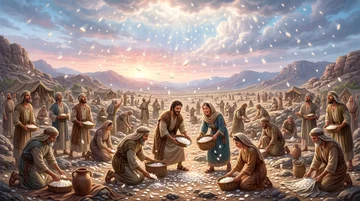
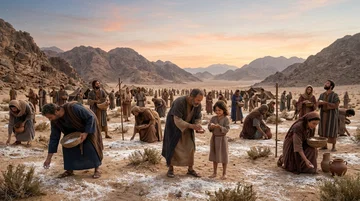
And when the children of Israel saw it, they said one to another, It is manna: for they wist not what it was. And Moses said unto them, This is the bread which the LORD hath given you to eat.
Translations
And when the children of Israel saw it, they said one to another, It is manna: for they knew not what it was. And Moses said to them, This is the bread which the LORD has given you to eat.
And when the children of Israel saw it, they said one to another, It is manna: for they wist not what it was. And Moses said unto them, This is the bread which the LORD hath given you to eat.
And when the children of Israel saw it, they said one to another, It is manna: for they wist not what it was. And Moses said unto them, This is the bread which the Lord hath given you to eat.
And when the children of Israel saw it, they said one to another, It is manna: for they knew not what it was. And Moses said to them, This is the bread which the LORD hath given you to eat.
And when the children of Israel saw it, they said one to another, What is it? for they wist not what it was. And Moses said unto them, It is the bread which the LORD hath given you to eat.
And when the children of Israel saw it, they said one to another, What is it? for they knew not what it was. And Moses said unto them, It is the bread which Jehovah hath given you to eat.
And the sons of Israel see, and say one unto another, 'What [is] it?' for they have not known what it [is]; and Moses saith unto them, 'It [is] the bread which Jehovah hath given to you for food.
And the children of Israel saw [ it], and said one to another, What is it? for they did not know what it was. And Moses said to them, This is the bread which Jehovah has given you to eat.
And when the sons of Israel saw it they said one to another—What is that? For they knew not what "that" was. Then said Moses unto them, "That" is the bread which Yahweh hath given you to eat.
Berean Standard Bible, Majority Standard Bible
When the Israelites saw it, they asked one another, “ What is it?” For they did not know what it was.So Moses told them, “ It is the bread that the LORD has given you to eat.
When the children of Israel saw it, they said to one another, “ What is it?” For they didn’t know what it was. Moses said to them, “ It is the bread which the LORD has given you to eat.
And when the children of Israel saw it, they said to one another, What is it? for they had no idea what it was. And Moses said to them, It is the bread which the Lord has given you for your food.
And when the children of Israel sawe it, they sayde one to another, It is MAN, for they wist not what it was. And Moses sayd vnto them, This is the breade which the Lord hath giuen you to eate.
Douay-Rheims (Challoner revision)
And when the children of Israel saw it, they said one to another: Manhu! which signifieth: What is this! for they knew not what it was. And Moses said to them: This is the bread, which the Lord hath given you to eat.
Pictures
Cross-references 20 of 61
- Exodus 16:22-26
And it came to pass, that on the sixth day they gathered twice as much bread, two omers for one man: and all the rulers of the congregation came and told Moses.
The sixth-day double portion and preparation for the Sabbath are followed by a day without manna.
- Exodus 16:4-5
Then said the LORD unto Moses, Behold, I will rain bread from heaven for you; and the people shall go out and gather a certain rate every day, that I may prove them, whether they will walk in my law, or no.
God promises bread from heaven and tests Israel’s obedience through daily gathering and sixth-day preparation.
- John 6:32-35
Then Jesus said unto them, Verily, verily, I say unto you, Moses gave you not that bread from heaven; but my Father giveth you the true bread from heaven.
Jesus identifies himself as the true bread from heaven, fulfilling the manna’s symbol.
- Exodus 16:29
See, for that the LORD hath given you the sabbath, therefore he giveth you on the sixth day the bread of two days; abide ye every man in his place, let no man go out of his place on the seventh day.
gives Moses saying tomorrow is Sabbath seventh day
- Numbers 11:4-6
And the mixt multitude that was among them fell a lusting: and the children of Israel also wept again, and said, Who shall give us flesh to eat?
Israel tires of manna and craves meat.
- Psalms 78:24-25
And had rained down manna upon them to eat, and had given them of the corn of heaven.
Calls the manna food from heaven and angels’ food, given by God.
- 1 Corinthians 10:3-4
And did all eat the same spiritual meat;
Israel’s manna and water from the rock are presented as spiritual provision from Christ.
- John 6:48-51
I am that bread of life.
Jesus identifies himself as the living bread from heaven.
- Exodus 16:26-28
Six days ye shall gather it; but on the seventh day, which is the sabbath, in it there shall be none.
Manna was gathered for six days, absent on the seventh-day Sabbath, and the people were reproved for seeking it.
- Exodus 16:3
And the children of Israel said unto them, Would to God we had died by the hand of the LORD in the land of Egypt, when we sat by the flesh pots, and when we did eat bread to the full; for ye have brought us forth into this wilderness, to kill this whole assembly with hunger.
Israel’s hunger and complaint set the context for God’s provision of manna.
- Exodus 20:8-11
Remember the sabbath day, to keep it holy.
The commandment enjoins the Sabbath day shown in the manna account.
- Exodus 16:1
And they took their journey from Elim, and all the congregation of the children of Israel came unto the wilderness of Sin, which is between Elim and Sinai, on the fifteenth day of the second month after their departing out of the land of Egypt.
Dates the Israelites’ arrival before the first manna and its Sabbath pattern.
- Exodus 16:19-21
And Moses said, Let no man leave of it till the morning.
Manna kept overnight spoiled, while fresh manna was gathered each morning.
- John 6:9-13
There is a lad here, which hath five barley loaves, and two small fishes: but what are they among so many?
Manna and the loaves show God miraculously providing food for the hungry.
- Exodus 16:5
And it shall come to pass, that on the sixth day they shall prepare that which they bring in; and it shall be twice as much as they gather daily.
The sixth-day double portion of manna supports Sabbath observance and the weekly cycle.
- Isaiah 33:16
He shall dwell on high: his place of defence shall be the munitions of rocks: bread shall be given him; his waters shall be sure.
Both promise secure bread and water, fulfilled for Israel through manna and water.
- Deuteronomy 8:3
And he humbled thee, and suffered thee to hunger, and fed thee with manna, which thou knewest not, neither did thy fathers know; that he might make thee know that man doth not live by bread only, but by every word that proceedeth out of the mouth of the LORD doth man live.
Manna taught Israel that life depends on what God provides and on his word.
- Exodus 16:35
And the children of Israel did eat manna forty years, until they came to a land inhabited; they did eat manna, until they came unto the borders of the land of Canaan.
It records Israel eating manna throughout their forty years in the wilderness.
- Matthew 6:11
Give us this day our daily bread.
Daily bread echoes manna as God’s provision for each day.
- 1 Corinthians 10:11
Now all these things happened unto them for ensamples: and they are written for our admonition, upon whom the ends of the world are come.
Israel’s wilderness experiences were recorded as examples and admonition for later believers.
Commentary part 1 of 2
Each commentary is drawn from primary sources: the writings of Ellen G. White and Adventist pioneers and periodicals. Each commentary is separate. Its own words are not a quotation; follow the references to read the source passages.
Ellen G. White
52 sources
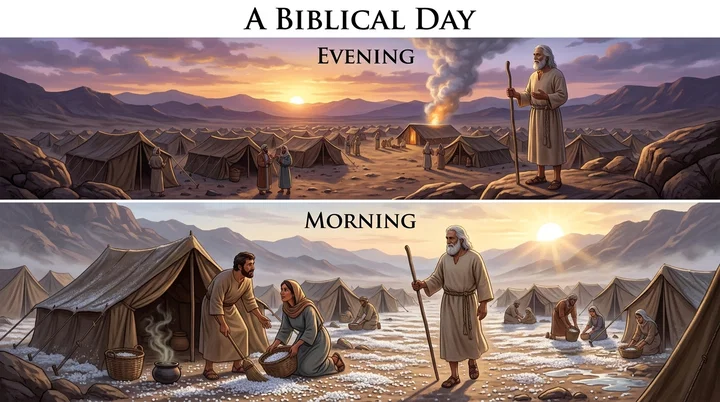
When Israel saw the small substance lying fresh with the dew around their tents each morning they did not know what it was, and Moses told them it was the bread the Lord had given them to eat, to be gathered daily according to each person's need.SG3 252.1–253.1Ms 77, 1899, par. 15–17Ms 156, 1901, par. 23–27ST Oct 28, 1880ST Mar 31, 1881 It was food from heaven supplied by divine power alone and not by any human agent, as a token of God's mindful care for bodily wants and the means by which He tested whether they would walk in His law.Ms 77, 1899, par. 15–17Ms 156, 1901, par. 23–27Ms 21, 1897, par. 12–15ST Oct 28, 1880DA 377.1 Its double portion on the sixth day and preservation over the Sabbath showed the seventh-day Sabbath hallowed at creation was still binding before it was proclaimed at Sinai.Ms 77, 1899, par. 15–17Ms 19, 1894, par. 10–12Ms 14, 1901, par. 6–12Ms 63, 1897, par. 1–3 Though it sweetly nourished body and soul for forty years, it was only temporal bread and those who ate it still died, pointing beyond itself to Christ the true living bread from the Father who gives eternal life.2SP 280.2–281.2STE 83.1PP 354.1Ms 73, 1896, par. 617MR 252.4–254.2 In withholding flesh and feeding them with angels' food God appointed a healthful, heaven-chosen diet to discipline them into correct habits of physical, mental, and moral strength.UTFF 5.1SG4 121.3–122.1Lt 112, 1909, par. 18–19CTBH 118.1–119.1Lt 26, 1908, par. 7 That daily gathering of fresh manna is the pattern for seeking fresh spiritual nourishment from Christ and His Word morning and evening rather than living on past blessings.5T 486.2Lt 332, 1907, par. 321MR 177.4–5Lt 279, 1904, par. 21–23Lt 61, 1893, par. 9–10
Meaning and Wilderness Setting
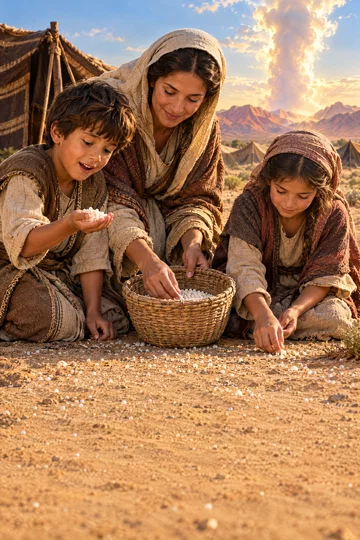
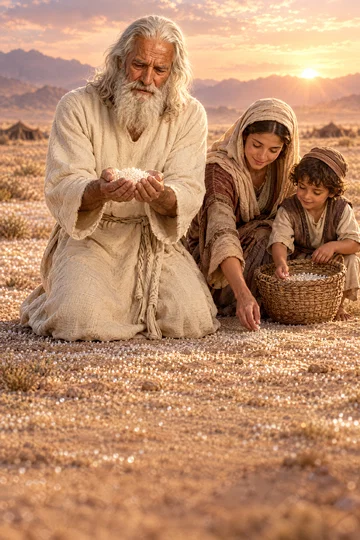
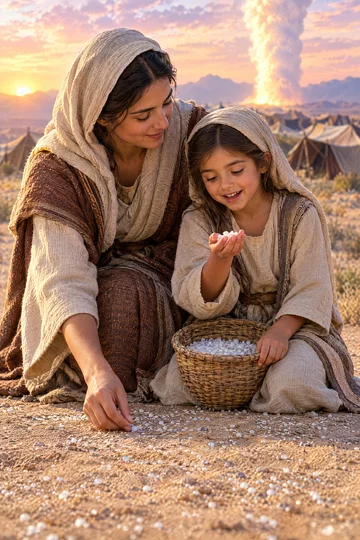
When the children of Israel saw the small unfamiliar substance lying on the ground they did not know what it was.SG3 252.1–253.1Ms 77, 1899, par. 15–17Ms 156, 1901, par. 23–27PP 294.3–295.1 Moses identified it for them as the bread which the Lord had given them to eat, God's provision for their daily food in the wilderness journey.SG3 252.1–253.1Ms 77, 1899, par. 15–17Ms 156, 1901, par. 23–27PP 294.3–295.17MR 307.3–308.2 They were told to gather it up and prepare it to be eaten, gathering an amount suited to each person's eating.SG3 252.1–253.1Ms 42, 1902, par. 1–5 That work of preparation involved labor which was to be done on the day before the Sabbath rather than on the Sabbath.Ms 57, 1897, par. 1–3
The bread descended with the dew and was laid fresh upon the ground every morning around their tents by miracle as God's daily provision.ST Oct 28, 1880ST Mar 31, 18811SP 337.1 It fell from heaven around their tents in fulfillment of His sure promises, showing His goodness and power toward Israel.ST Mar 31, 18811SP 337.1 The manna continued to fall while Moses was away, and Israel was fed morning and evening by God's hand, so that His presence and care did not depend on Moses being with them.3T 340.1 It fed them through forty years of guidance through the wilderness, and the generation who crossed the Jordan were accustomed to eating that bread from heaven, including Joshua and the old faithful sentinels whose lives of steadfast integrity then closed as a new generation came upon the stage of action.Lt 112, 1909, par. 18–19Lt 112, 1895, par. 11–12
The standing provision was given through Moses from the pillar of cloud as a lesson and was never to be forgotten but to be preserved as a memorial.Lt 8a, 1896, par. 8–9 Parents were to repeat it to their children when they inquired, as an exhibition of God's power.Lt 8a, 1896, par. 8–9 That exhibition stands together with the deliverance from Egyptian bondage that they might serve Him and keep His Sabbaths, the water provided from the rock, the capture of Jericho without human plan or hand, and the commandments of God.Lt 8a, 1896, par. 8–9
Miraculous Provision and Testing
The bread was food from heaven laid fresh upon the ground every morning around the tents by a miracle of divine mercy alone, not obtainable from any human agent and not provided by Moses, as a token of God's love, merciful care, goodness and power toward Israel.Ms 21, 1897, par. 12–15ST Oct 28, 1880DA 377.1ST Mar 31, 18811SP 337.1 In giving it He fulfilled His sure promises and showed that He is mindful of physical wants.Ms 21, 1897, par. 12–151SP 337.1Lt 180, 1901, par. 17–18 Its giving illustrates His provision and work for the benefit of His people.Lt 180, 1901, par. 17–18
God is the giver of food and the source of provision for temporal needs, who gave the children of Israel manna from heaven when they needed it and who still lives and reigns.Ms 156, 1901, par. 23–277T 61.2PP 354.1MH 200.2Lt 180, 1901, par. 17–18 He guides His people and gives them skill and understanding for the work they are called to do and supplies what they need for that work.7T 61.2MH 200.2 The manna was the means by which He tested whether the people would walk in His law during the wilderness journey.Ms 77, 1899, par. 15–17
When accepted, the portion was enough, sweet and nourishing for body and soul, but dissatisfaction brought worms in the manna, so that contentment with God's provision is a blessing while discontent is a curse.Lt 121, 1904, par. 14–16 The food He designed for them was healthy and could be eaten freely, yet their dissatisfaction and desire for meat showed appetite controlling them, a course that displeased Him.SG4 121.3–122.1 In ingratitude, unbelief and distrust they hardened their hearts, loathed the heaven-sent bread, dwelt on imaginary evils, and accused Moses of killing them with hunger.ST Oct 28, 1880 Because they failed to trust after so many evidences of care and despised this provision, the Lord withdrew His protecting hand that had shielded them from surrounding dangers and permitted death to come upon them, to bring them to realize their ingratitude and to lead them to repentance and humiliation.ST Oct 28, 1880
God could have supplied everything needed for religious service as He supplied the bread, but in His infinite wisdom He chose a plan requiring His people to cooperate with Him, with everyone doing something.4T 469.1ST Jan 29, 1880 Moral discipline depends on that cooperation, so as long as truth is progressive He claims a portion of what He has entrusted to men for that very purpose, laying the work equally on all according to their several abilities, with everyone to be his own assessor and to give as purposed in the heart.ST Jan 29, 1880 In this way each person shares in the work.4T 469.1
The verse assures that God can provide for His people in a time of trouble even by sending food from heaven, so they can trust wholly in Him for their needs.ExVEGW 44.1 It proves He miraculously supplies food when it can be obtained from no other source.RH Dec 24, 1872 So the same God who fed Israel fed His prophet Elijah by miracle on a long journey, and provided a way for Joseph to preserve his own life and the lives of Jesus and Mary by fleeing into Egypt, meeting the necessities of their journey and sojourn there through the valuable offerings He moved the wise men of the East to bring to the infant Saviour.RH Dec 24, 1872 As Christ led Israel in the cloud and supplied heaven's bounty to meet bodily needs, His people are to care for both body and soul by sharing temporal necessities and spiritual food with others who have less.Ms 101, 1906, par. 42–43
Sabbath Law Confirmed
The unfamiliar substance Israel found lying on the ground was the bread the Lord had given them to eat, provided from heaven during the wilderness journey as the means of testing whether they would walk in His law.Ms 77, 1899, par. 15–17Ms 14, 1901, par. 6–12 On the sixth day a double portion was given, and its preservation for the Sabbath demonstrated that the Sabbath law was kept before them throughout their forty years of wandering.Ms 77, 1899, par. 15–17 Strangers who honored His Sabbath were also to share in that provision.Ms 14, 1901, par. 6–12
The miracle in the manna sustains the validity of the seventh-day Sabbath.Ms 19, 1894, par. 10–12 That seventh day had been hallowed and sanctified by God at creation, and the miracle proved it still binding before its sacredness was proclaimed in the giving of the commandments on Mount Sinai in the very bosom of the Decalogue.Ms 19, 1894, par. 10–12 The continuing manna was a sign of the Sabbath commandment, which had been given in Eden before it was proclaimed at Sinai.Ms 63, 1897, par. 1–3
Christ the Living Bread
The bread from heaven given in the wilderness sustained the body, but it was only a temporal gift.2SP 280.2–281.2 Those who ate it still died, and it did not secure immortal life.2SP 280.2–281.2 It therefore stands in contrast to Christ, the bread of life, who offers eternal life and will ultimately give immortal life to the body.2SP 280.2–281.2 Like the showbread, that wilderness bread pointed to Christ, the living bread who is in God's presence for humanity.PP 354.1 Through Him both temporal food and spiritual blessings are received, as temporal and spiritual blessing poured upon God's people through Jesus Christ.PP 354.1Ms 73, 1896, par. 6
The manna pictures the heavenly food received in Christ.STE 83.1 His words come home to the soul as bread from heaven, His flesh given for the life of the world, the living bread come down from heaven that a man may eat and not die but live forever.STE 83.1Ms 73, 1896, par. 6 It is to be eaten daily for spiritual necessities just as food meets physical needs, and to be fed upon continually.STE 83.1Lt 332, 1907, par. 3 Drinking of the Spiritual Rock and eating this manna daily brings conversion anew and a changed experience, with Christ formed within the soul as a well of water springing up unto everlasting life.Lt 332, 1907, par. 3 As Israel was set free from the bondage of Egypt, so believers are set free from spiritual bondage, with chains of oppression broken and Red Seas of impossibilities opened before them, and God's people now are fed with this same heavenly manna and are to feast upon it continually with praise upon their lips.Ms 73, 1896, par. 6
That manna was bread from heaven given by God the Father, not by Moses and not obtainable from any human agent.17MR 252.4–254.2 It was a standing miracle of palatable food to satisfy bodily necessity, proving He is mindful of physical wants, yet it points beyond temporal, perishable bread to the true bread from heaven, the living bread that endures to eternal life, which God gives through the gift of Christ.17MR 252.4–254.2 The lesson is to have far more anxiety to secure that spiritual food by believing on Him whom God sent and coming to Christ than to secure physical sustenance.17MR 252.4–254.2 Feeding Israel with manna in the desert was a work only divine power could perform, and Christ did the same work when He made five barley loaves and two small fishes into food sufficient for thousands of hungry people, with all sharing in its benefit.DA 377.1 The miracle proves Christ is divine and is the prophet Moses foretold who should come into the world.DA 377.1
Healthful Diet Appointed
When God brought Israel out of Egypt He did not give them flesh meat but fed them with the bread of heaven, angels' food, as their heaven-appointed food.UTFF 5.1Lt 112, 1909, par. 18–19Lt 26, 1908, par. 7Ms 38, 1898, par. 11 He led them into the wilderness where they could not get a flesh diet in order to make them a separate people and reform their habits of eating, rather than miraculously providing the flesh diet they had known in Egypt.UTFF 5.1Lt 112, 1909, par. 18–19Ms 38, 1898, par. 11 The gift was meant to educate and discipline and train them into correct habits, leading them away from their former diet to accept His restrictions because He knew what was best for them.UTFF 5.1CTBH 118.1–119.1Lt 47a, 1874, par. 21–22 Flesh was withheld as not essential for health and because of its harmful influence upon the human system, although He had permitted earlier generations to eat the flesh of dead animals knowing it would shorten life.UTFF 5.1Lt 26, 1908, par. 7
The food He designed for them was healthy and could be eaten freely, suited to their needs and better for them than the food they had craved in Egypt, with resistance to His restrictions helping to restore health.SG4 121.3–122.1CTBH 118.1–119.1 It was of a nature to promote physical, mental, and moral strength as part of an all-embracing education covering all habits of life and everything concerning their well-being under divine solicitude and law.ST Nov 2, 1915 It was given with the promise that bread and water would be sure and all sickness would be removed if they were obedient, to bring them back to live upon simple fruits, vegetables, and grains and to carry them into Canaan and establish them there a pure, holy, happy people.UTFF 5.1Lt 47a, 1874, par. 21–22 So it was that notwithstanding the hardships of wilderness life there was not a feeble one in all their tribes, and even after their long journey their physical appearance would bear the divine credentials with sickness taken away from among them.UTFF 5.1ST Nov 2, 1915
The light God has given and will continue to give on the food question is to His people today what that manna was to Israel, which they were told to gather up and prepare to be eaten.Ms 42, 1902, par. 1–5 It teaches diet reform and simplicity of living without flesh meats from simple, less expensive fruits and grains, with lessons in hygienic cookery as part of education.Ms 96, 1905, par. 3–4 In the different countries of the world health foods suited to those countries are to be prepared, so those who cannot obtain expensive preparations need not live on an impoverished diet.Ms 42, 1902, par. 1–5Ms 96, 1905, par. 3–4
Israel craved the flesh-pots of Egypt and longed for Egypt's food, and mourned and wept and murmured and complained for flesh with appetite controlling them, a course that displeased God.UTFF 5.1SG4 121.3–122.17MR 307.3–308.2 They loathed the bread sent from heaven and took their case into their own hands as though they knew better than God what was best, and would not limit their diet to His chosen restriction.Lt 47a, 1874, par. 21–22 Because they were determined to have the flesh of dead animals He gave them the very diet He had withheld and sent quails, and murmuring against His chosen healthful diet and asking for flesh was rebellion speedily punished.UTFF 5.1Lt 26, 1908, par. 7 Many died from eating meat to excess while the flesh was still between their teeth, and letting them have their desires brought instead of health and happiness dissension, sickness, and death.Lt 26, 1908, par. 7Lt 47a, 1874, par. 21–22 That experience is to be studied and obeyed now by giving up flesh meats, teaching that turning from God's light on health to self-chosen ways brings suffering, sickness, and premature death.Lt 26, 1908, par. 7Lt 47a, 1874, par. 21–22
Daily Spiritual Nourishment
Israel was to gather fresh manna day by day, morning and evening, and that daily gathering sets the pattern for seeking fresh spiritual nourishment and divine enlightenment rather than resting satisfied with past blessings.5T 486.2 The heavenly manna is to be partaken daily for spiritual necessities just as food meets physical needs, and drinking of the Spiritual Rock and eating this manna daily brings conversion anew and a changed experience, with Christ formed within the soul as a well of water springing up unto everlasting life.Lt 332, 1907, par. 3
As Israel received food from God, people are to be given fresh spiritual truth suited to their needs, with truth presented freshly and according to need.21MR 300.3–4Ms 18, 1885, par. 3 That manna is the fresh spiritual food God offers for the present time, and it must be eaten as He gives it and the same given to the people.Lt 61, 1893, par. 9–10
The manna God gave Israel is the Word and truth from a source above humanity that He still supplies by His own hand as nourishment for His flock.21MR 177.4–5Lt 279, 1904, par. 21–23 Those who teach must therefore study those truths and eat and drink them, put away fanciful human theories, empty the heart to receive light from God's throne, and feed the flock with that heaven-given food in its original power and glory.Lt 279, 1904, par. 21–23 So given, it brings higher enjoyment and power, shows heavenly certainty against sophistry, causes capabilities to increase as the indwelling life expands, and teaches the church, enfeebled and defective though it is, as the object of His supreme regard under His guardianship.Lt 279, 1904, par. 21–23
To feed upon the heavenly manna as the sacred Word of God brought to the lips means to love the truth and practice its principles, receiving and treasuring it as spiritual food and not merely speaking about it.17MR 233.3Ms 66, 1898, par. 40 It means not treating the sacred as common while handling divine interests, not doing things deceitfully, and not merely talking pointed truth without loving and practicing it.17MR 233.3 The sermon is likened to this manna when it is received as a message from God, though its nature may not be recognized, and listeners who dismiss or criticize it fail to feed their souls on the spiritual nourishment they need.5T 298.2 Eating it means receiving God's Word so that hungry souls are fed, with sustaining power in speaking, peace of God abiding in the heart, and a thankful heart full of praise, finding it more than meat and drink to speak the words God gives, an eating that fills the blessed Sabbath from early morning hours all through the day and continues constantly day and night.Lt 43a, 1890, par. 1–2 Such eating brings the education and instruction that is their right for the present time, while eating only what one chooses and holding to old set, stereotyped discourses instead of coming to the school of Christ to learn as a little child leaves labor empty rather than full of marrow and fatness, and shuts out the flooding light, power, love, grace and joy that come with the quickening influence of the Spirit of God and the life-giving power from on high.Lt 61, 1893, par. 9–10
Sources
Pioneers and periodicals
306 sources
When Israel saw the unfamiliar food lying on the wilderness in the morning they asked what it was, and Moses told them it was the bread the Lord had given them to eat, fulfilling His promise to rain bread from heaven.RH Dec 17, 1861ST Jun 10, 1880ST Apr 24, 1879ST Apr 22, 1889 Its name comes from that first question, for the Hebrew word asks What is this.RH Sep 8, 1874RH Mar 26, 1914ST Feb 27, 1901 It was a real supernatural miracle rained from heaven every morning, not a natural secretion, feeding millions daily for forty years until they ate the produce of Canaan.RH Dec 17, 1861RH Mar 3, 1863ST Jun 27, 1900RH Oct 15, 1857RH Sep 3, 1908 God made it a threefold weekly miracle, falling every working day but the Sabbath, with a double portion on the sixth day that kept fresh through the seventh while none was found on the seventh, thereby marking the true seventh day and showing the Sabbath already known, binding and observed from creation more than a month before Sinai.RH Aug 19, 1915ST Mar 7, 1906RH Apr 11, 1854RH Jun 2, 1851RH Jul 14, 1874 It points to Christ as the true bread from heaven giving life to the world, and illustrates daily spiritual nourishment through fresh continuing contact with God and His word, to be gathered early each day and not lived on from yesterday.ST Jun 27, 1900ST Apr 1, 1889ST Nov 21, 1911ST Sep 1, 1881RH Nov 4, 1902
Words and Wilderness Setting
The verse belongs to the provision of bread between Elim and Sinai, in the wilderness of Sin in the month after Israel passed through the Red Sea and about a month before coming to Sinai.ST Oct 31, 1906RH Dec 17, 1861 It stands in the first, mainly historical division of Exodus in chapters 1-18, concerning God's guidance and sustenance of Israel on the journey toward Sinai and toward Canaan as deliverance from bitter bondage in Egypt.RH Jan 20, 1916ST There Israel was already observing the seventh-day Sabbath in camp, specially marked from that time by God withholding the manna on the seventh day, showing the Sabbath existed and had been known before Sinai.ST Oct 31, 1906RH May 6, 1852 The book itself means the going out, the departure from Egypt into Canaan typifying the deliverance of God's people from the dark Egypt of earth, telling how they became a nation with organization, leadership, laws, and worship under Moses.RH Jan 20, 1916ST
Israel left Egypt on the fifteenth day of the first month, came into the wilderness of Sin on the fifteenth day of the second month thirty days later when manna was first given, and came to the desert of Sinai on the fifteenth day of the third month thirty days after that.RH Apr 11, 1854RH Mar 1851 The manna account thus occurred a month before the giving of the law, and Israel kept the Sabbath there thirty days before seeing Mount Sinai and thirty-two days before hearing the Ten Commandments proclaimed.RH Nov 13, 1856RH Mar 1851ST Jan 28, 1886 The Sabbath was already called the holy Sabbath and enforced nearly a month before Mount Sinai, so the later making known at Sinai was public proclamation and writing of an already known and binding law, not its first introduction.RH Nov 13, 1856RH Jun 30, 1859RH Apr 21, 1868 Israel had been out of the house of bondage where the Sabbath could not be observed only thirty days when God called attention back to it and guarded it by a threefold miracle, proving it did not originate at Sinai for the Jews alone but was an old institution already given by God.RH Apr 11, 1854RH Mar 1851
After the journey from Elim the whole congregation murmured for hunger against Moses and Aaron, though Christ was directing them, so complaint against human leaders was doubt against God.RH Jun 19, 1856ST Nov 7, 1895ST Jul 30, 1902 The glory of Jehovah appeared in the cloud, with promise to rain bread from heaven to prove whether they would walk in His law and to give flesh at evening and bread to the full in the morning, since their murmurings were against Jehovah.RH Dec 17, 1861RH Jun 19, 1856 At evening the quails came up and covered the camp, the first giving of quail coming before manna fell the next morning.ST Apr 22, 1889RH Jun 19, 1856 In the morning after dew lay round the camp and lifted, a small round thing as small as hoar frost lay on the face of the wilderness.RH Dec 17, 1861RH Jun 19, 1856 The miracle bore public testimony to the Sabbath every week for forty years, yet the people grew accustomed to it until it became ordinary, hardened through sin, murmured against the bread from heaven, and had little regard for its testimony.ST Jul 30, 1902RH Jan 7, 1862
When Israel saw the unfamiliar food they did not know what it was and said one to another What is it, rendered It is manna.RH Dec 17, 1861ST Jun 25, 1902 Moses told them this is the bread which the LORD or Jehovah has given to eat, fulfilling the promise to rain bread from heaven and to give bread to the full in the morning, set forth as God's gift of daily bread.RH Dec 17, 1861ST Jun 25, 1902RH Sep 19, 1854 The giving of a day's portion every day was to prove whether they would walk in God's law, showing God already had a law containing the Sabbath, because it was over the Sabbath that He proved them.RH Sep 19, 1854 At its first appearance he directed each to gather by household need, beginning the events that directed special attention to the seventh-day Sabbath, with the manna withheld on the seventh because it was already the Sabbath, not to establish a new one.ST Jun 10, 1880ST Jul 22, 1880
The name manna comes from the question asked at first sight, for the Hebrew man is the interrogative What, so man hu means What is this.RH Sep 8, 1874RH Mar 26, 1914ST Feb 27, 1901 Scripture also calls it heaven's grain and angels' food, bread from heaven already promised by God.RH Jun 19, 1856ST Feb 27, 1901 Calling it heavenly bread rather than by its source would keep them mindful it came from God, and recognizing God as source helps people stay close to Him; likewise unfamiliar grain elsewhere was called manna because people did not know what it was and regarded it as provision from Heaven.RH Mar 26, 1914ST Feb 27, 1901
The later reference to storing manna before the Testimony describes what eventually became of it after the stone tablets were given at Sinai more than a month after the manna account began, not that the tablets already existed at first manna.RH Dec 23, 1851RH Jun 10, 1852 Exodus 16 was written after the events it recounts, not as contemporaneous evidence that the Testimony was already familiar in the wilderness.RH Dec 23, 1851RH Jun 10, 1852 The tables of stone not then in existence are spoken of at the same time even more familiarly than the Sabbath, in contrast to the speaking of the Sabbath in the wilderness of Sin.RH Dec 23, 1851RH May 6, 1852
The Hebrew wording matters for Sabbath history, for this is the chapter where the word Sabbath first occurs in the Bible, after twenty-five hundred years with no Sabbath command to the patriarchs.RH Nov 12, 1872ST Oct 11, 1883RH Jan 30, 1866 One argument holds that when an institution is instituted or mentioned for the first time the definite article is always wanting, and its absence here marks first giving of the Sabbath, with the English version mistranslating by supplying the article.RH Nov 12, 1872ST Oct 11, 1883 The counter holds insertion or omission of the article is not settled by fixed rules but often depends on euphony and rhythm and fine distinctions of thought, with insertion promoting perspicuity and omission vivacity, use greater in prose than poetry and in philosophical than rhetorical composition, and manuscripts differing greatly especially with proper names, so such a rule cannot overturn the meaning that God blessed and sanctified the seventh day.RH Sep 24, 1872 Parallel first mentions of a holy convocation and attending sabbaths and memorials without the article prove nothing about first institution, because those things were never mentioned in any other manner.RH Sep 24, 1872
Its substance, color, taste, time of falling, and preservation are set forth in Exodus 16:14-36 and Numbers 11:7-9.RH Sep 8, 1874 Exodus 16:4-30 does not say the Sabbath succession was interrupted in Egypt or in Babylon, nor that Israel began a new Sabbath week on the day manna began and then kept every seventh day counted from the bread from heaven.RH Sep 8, 1874RH Apr 13, 1869
The unfamiliar bread the Lord gave Israel which they did not know belongs to instructions to ancient Israel serving as an example of cleansing truths God's people must not abandon.RH Nov 3, 1868
Nature of Heavenly Provision
The unfamiliar food that appeared with the dew is the bread the Lord gave Israel to eat in the wilderness, a real supernatural miracle rained from heaven, not a natural tamarisk secretion or resin from sweating trees.RH Oct 15, 1857RH Sep 3, 1908RH Apr 17, 1900RH Dec 31, 1861RH Jul 25, 1854 To explain it away as natural empties it of the supernatural and denies revelation, for the people called it manna because they did not know what it was and Moses explained its source as God's gift.ST Jun 27, 1900RH Apr 17, 1900RH Jul 25, 1854 It is recalled as bread from heaven in the wilderness and serves as the setting for Jesus' teaching that the Father gives the true bread from heaven which gives life to the world.ST Jun 27, 1900
It appeared as strange small white hard grains like coriander, pleasant to taste, melting in sun heat, to be gathered each morning an omer per person with none left till morning, and could be boiled or baked.ST Jul 1, 1908RH Nov 21, 1907ST Jan 20, 1898RH Apr 17, 1900 It was a new food unlike anything they had known, coming down from heaven to sustain Israel in the wilderness.RH Apr 17, 1900 It fell fresh every morning for six days in sufficient quantities without failing, with food for the Sabbath prepared the day before, and ceased after entering Canaan and eating its produce when food could be obtained by their own efforts.ST Jul 1, 1908ST Feb 11, 1913RH Apr 17, 1900
It was daily provision for forty years, feeding millions through changing seasons, about three million souls who left Egypt with only two or three days' food, with about six hundred thousand witnesses to the Sabbath miracle.RH Dec 17, 1861RH Mar 3, 1863ST Aug 18, 1909ST Aug 31, 1888 This came alongside miraculous water, quails, parted sea, streams from rocks, and overthrow of enemies.ST Jun 14, 1877RH May 8, 1900ST Aug 31, 1888 After provisions from Egypt were exhausted and food could not be secured by labor or natural sources in barren country, God rained bread from heaven every morning for immediate use contrary to natural order.ST Mar 31, 1881ST Jul 1, 1908ST Feb 11, 1913RH Nov 9, 1916RH Jan 28, 1902 Their journey through barren country could not have been sustained by food from natural sources, so the daily miracle showed mindfulness, presence, protection, creative power and goodness, giving reason to trust rather than fear.ST Mar 31, 1881RH Nov 9, 1916RH Jan 28, 1902
After the call out of Egypt God used this simple heaven-born food to begin health reform and prepare a people not ready for the land flowing with milk and honey, training them to part with the flesh-pots of Egypt.RH Jan 6, 1910 Since bodies are made of what is eaten, this purest food made purest blood to make them holy, happy, and physically, mentally and morally strong, so there was not a feeble one in the tribes.ST Nov 2, 1915RH Jan 6, 1910 It was wholesome and nutritious provision for needs, meant to teach a lesson they should have remembered, and part of an all-embracing education covering all habits of life and everything concerning well-being under divine solicitude and law.ST Nov 2, 1915ST Feb 25, 1886RH Apr 3, 1879
The provision purposely withheld flesh on the way to the land to be conquered and was abundantly adapted to need without animal foods, seafood, tea, coffee, or tobacco.ST Nov 29, 1883ST Apr 22, 1875ST Jun 10, 1875 God would have sent cattle, sheep, swine, lobsters, oysters, clams, eels, tea, coffee, or tobacco if necessary to life and health, for He could have done so and made necessity His opportunity to send supplies in abundance lying round about the camp.ST Jun 10, 1875 But flesh eating hinders spiritual advancement, so God gave a special bill of fare with careful restrictions to make them holy representatives to the world, a wise provision for physical and spiritual good and for health and happiness, presented as an example of providing food instead of flesh foods.RH Mar 21, 1907RH Jul 11, 1907ST Jan 2, 1912
It proves vegetables, grains, fruits and nuts are better than all flesh food, as at the beginning God gave no animal food.ST Aug 13, 1912 Manna was one simple kind given because it was best and preferred even to clean animals, though God could as easily have rained hams, pork, beef, turkeys, chickens and ducks.RH Apr 9, 1867 The quails later given were not best but to prove God right and Israel wrong in lusting for something besides manna.RH Apr 9, 1867 Shedding blood and eating meat result from sin while Eden's design was fruits and vegetables.RH Apr 9, 1867 Manna with the primitive fleshless diet teaches there is better food than flesh, commending a vegetarian diet as better, cleaner and purer though not a matter of Scripture command, and craving meat showed rejection of what God provided.RH Apr 9, 1867RH Mar 19, 1867ST Jul 15, 1908
God took away Egyptian foods and drinks and gave manna and water to fulfill His promise to put none of the Egyptian diseases upon them and enable long healthy life.ST May 4, 1915 He supplied conditions for physical regeneration with outdoor life and pure water and return to natural simplicity, but He could not do all He desired because they failed to cooperate.ST May 4, 1915 Simple non-irritating food with water from the rock aids overcoming desire for alcohol and tobacco, for simple foods call for no drink stronger than water.ST Oct 31, 1911 Later flesh-craving brought disease, spiritual loss, and corruption, even that simplest wild flesh corrupting in teeth and souring in stomachs made healthy by manna, showing how little enfeebled people can endure flesh meats with spices.RH Apr 9, 1867RH Dec 21, 1905
Those most faithful to that diet with no animal food were remarkable for physical strength, mental power and longevity, so it glorifies God for His children to return to the vegetarian bill of fare now that He gathers His people a second time.ST Oct 21, 1908 The same special separate diet is required today to make them holy representatives showing His virtues and preventing fatigue and leanness of soul, and its record stands as example and admonition for last-day people prepared for heavenly Canaan.RH Mar 21, 1907 The daily feeding for about sixteen months toward the promised inheritance manifested both His ability and willingness to do all He promised so distrust had no excuse.ST Aug 31, 1888 It belongs with miraculous feedings such as Jesus feeding the five thousand, Elijah fed by ravens, the widow's meal and oil, and Elisha feeding one hundred with twenty loaves, and proves obedient people will have bread and water secured even miraculously when pressed.ST Jun 6, 1900ST Aug 31, 1888RH Mar 21, 1871
Their fretfulness, sin and cowardice did not withdraw provision, showing God's gifts and purpose do not depend on human faithfulness and His long-suffering brings salvation.RH Oct 26, 1911 Yet in ingratitude they loathed it, dwelt on imaginary evils, accused Moses of killing them with hunger, though thus fed every day by miracle of divine mercy as token of love and merciful care.ST Oct 28, 1880 Because they despised it the Lord withdrew His shielding hand and permitted death to bring repentance and humiliation.ST Oct 28, 1880 Though they ate the heaven-sent provision in the trackless desert, they did not understand their Deliverer's nature or recognize obligation to Him, and with hardened hearts had little regard for its testimony.RH Jan 7, 1862ST Jan 16, 1912 Most valuable blessings are seldom appreciated until withheld, as Israel complained and rebelled while eating it.ST Oct 7, 1880
At first it caused surprise, wonder and gratitude for bread from heaven, when Israel had never seen the like and hearts were considerably affected with astonishment.RH Mar 25, 1902RH Aug 3, 1869 Weeks and months made it common until familiarity aided backsliding into murmuring that it was unsuited to wants, showing repeated mercy can lose force and an unusual provision first met with wonder can later be taken for granted.RH Jan 7, 1862RH Mar 25, 1902RH Aug 3, 1869 This teaches that ordinary food is God's gift to be received with reverence and gratitude.RH Mar 25, 1902 Manna fell long before Christ as daily food gathered each day in gentle showers because God loved His children and would not let them starve, with quails also brought near.RH Oct 20, 1874 In contrast God watched His Son faint with hunger after forty days and let no manna fall so Christ might know hunger and best help and pity the poor who pray to Him, a withholding permitted for human sake out of love.RH Oct 20, 1874
Weekly Miracle Sabbath Pattern
For forty years God worked a threefold weekly miracle to identify and enforce a particular day, in 6,240 weekly occurrences, by causing manna to fall every working day but the Sabbath, giving a double portion on the sixth day, and causing what was gathered on the sixth to keep good over the Sabbath while what was kept over any other day bred worms and became foul, with none to be found in the field on the seventh day when the regular order was suspended.RH Aug 19, 1915RH Apr 11, 1854RH Jun 2, 1851ST Feb 26, 1894 Each week manna fell six days with a double portion on the sixth preserved through the seventh and none on the seventh, witnessed only before the Sabbath, and the sixth-day double gathering and Sabbath no-gathering were addressed separately from the daily omer-per-person instruction, which gave no license to gather on the Sabbath God hallowed and reserved.RH Aug 5, 1852ST May 9, 1878RH Mar 19, 1872RH Dec 9, 1851ST Feb 25, 1889 The pattern was a special wilderness provision in miraculous amount marking the Sabbath by none falling on it, double the day before, and preservation fresh through the Sabbath, attesting sanctity dated from creation not Sinai and distinguishing the Sabbath for forty years.ST Nov 17, 1909RH Apr 16, 1872ST Aug 1, 1911RH Aug 14, 1868ST Mar 8, 1883
The pattern fixed the identity of the true seventh day so there could be no mistaking it even if the count had been lost since creation, and the day so identified is the day in the law at Sinai, indorsed by Jesus by practice and teaching, continued by Jews, Christians and Muslims without variation to the present, now commonly called Saturday, still kept by the Jews without change.RH Aug 19, 1915RH Jun 2, 1851ST Feb 26, 1894ST Aug 30, 1905RH Apr 28, 1874 God made the true seventh day known and preserved knowledge of it through this miracle so Israel knew which day was the seventh and the Sabbath and the day has not been lost, and if lost it was made known, with Moses and God knowing it before Sinai and marking it weekly to impress its sacredness so the people could keep no other day.RH Dec 1850ST Jun 28, 1905ST Apr 4, 1906RH Aug 31, 1905 Since Sabbath means rest, remembering it means remembering God's rest day, for God rested on one day, blessed one day and set apart one day, the seventh, and the forty-year miracle showed no other day could be His Sabbath and that it mattered which day was kept, proving beyond dispute what day the true seventh day is and that God requires that day and no other.ST Jul 23, 1894RH Oct 10, 1871ST Jul 30, 1912
God proved by direct miracle that the seventh day in particular is His Sabbath before about six hundred thousand witnesses, meaning the Sabbath is the seventh day in order from creation, not merely one seventh of time people may choose, with God appointing both the day and its beginning and ending from sunset to sunset.RH Jun 23, 1853ST Dec 19, 1892 The sixth day for double gathering comes immediately before the seventh-day Sabbath when Israel rests, and sixth and seventh are ordinal terms marking fixed position in the week, not proportional terms for a sixth or seventh part of time nor intervals counted independently, otherwise the commands to gather double and gather none could coincide, and the day cannot be transferred to Sunday or broadened to yearly sabbaths.RH Nov 28, 1871ST Jan 30, 1879ST Aug 7, 1879ST Jul 12, 1883 The manna instructions established six days for gathering and a seventh of rest, and if the reckoning had been wrong God would have corrected it, supporting that the true seventh day from creation was being kept in Christ's time, with the week manna was first given synchronized with the original creation week, proving the period unbroken from the beginning, not a week beginning with God's seventh.ST May 1, 1879RH Mar 27, 1856
Food that can be baked or boiled should be prepared beforehand on the preparation day before the seventh-day Sabbath so unnecessary work is minimized, for gathering was labor violating the Sabbath, the daily-portion order applied only to lawful working days, and those gathering on the Sabbath found none and were reproved for profaning the sanctified day.ST May 24, 1910ST Apr 19, 1877ST Dec 8, 1881 The instruction to remain in one's place concerned not going out to gather manna and does not require staying in houses all Sabbath, and the manna's evening fall and absence on Sabbath morning taught when the Sabbath began and ended, supporting that it fell after the Sabbath for gathering on the first day.RH Dec 9, 1852 The record of God giving bread during forty years in which they kept a definite rigidly observed Sabbath proves keeping the same definite Sabbath time is physically possible, and the Hebrews' understanding it in ordinary twenty-four-hour days confirms the day-length in the Sabbath command and literal creation days, with the fifth and sixth days fixing duration before the Sabbath.ST Nov 3, 1881ST Nov 19, 1912ST Jun 28, 1905
Sources