Exodus 20:18
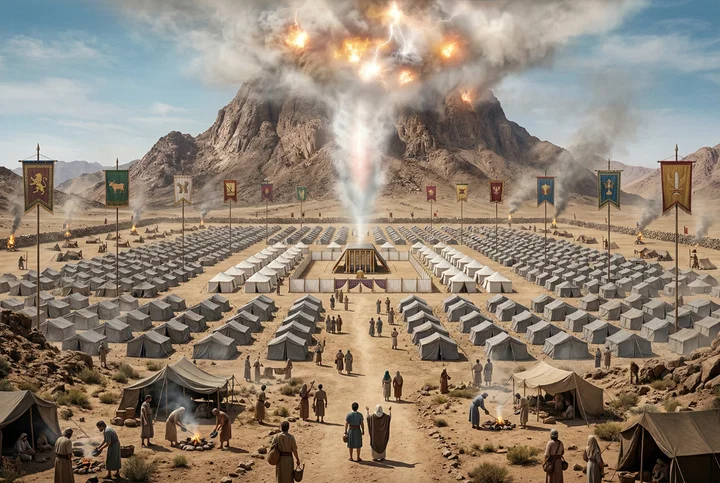
And all the people saw the thunderings, and the lightnings, and the noise of the trumpet, and the mountain smoking: and when the people saw it, they removed, and stood afar off.
Translations
And all the people saw the thunder, and the lightning, and the noise of the trumpet, and the mountain smoking: and when the people saw it, they removed, and stood afar off.
King James Version, KJV Cambridge Paragraph Bible, Webster Bible
And all the people saw the thunderings, and the lightnings, and the noise of the trumpet, and the mountain smoking: and when the people saw it, they removed, and stood afar off.
And all the people saw the thunderings, and the lightnings, and the voice of the trumpet, and the mountain smoking: and when the people saw it, they trembled, and stood afar off.
And all the people perceived the thunderings, and the lightnings, and the voice of the trumpet, and the mountain smoking: and when the people saw it, they trembled, and stood afar off.
And all the people are seeing the voices, and the flames, and the sound of the trumpet, and the mount smoking; and the people see, and move, and stand afar off,
And all the people saw the thunderings, and the flames, and the sound of the trumpet, and the mountain smoking; and when the people saw [ it], they trembled, and stood afar off,
And, all the people, were witnessing the voices and the torches, and the sound of the horn, and the mountain smoking,—so then the people were struck with awe and shrank back, and stood afar off.
Berean Standard Bible, Majority Standard Bible
When all the people witnessed the thunder and lightning, the sounding of the ram’s horn, and the mountain enveloped in smoke, they trembled and stood at a distance.
All the people perceived the thunderings, the lightnings, the sound of the trumpet, and the mountain smoking. When the people saw it, they trembled, and stayed at a distance.
And all the people were watching the thunderings and the flames and the sound of the horn and the mountain smoking; and when they saw it, they kept far off, shaking with fear.
And all the people sawe the thunders, and the lightnings, and the sound of the trumpet, and the mountaine smoking and when the people saw it they fled and stoode afare off,
Douay-Rheims (Challoner revision)
And all the people saw the voices and the flames, and the sound of the trumpet, and the mount smoking: and being terrified and struck with fear, they stood afar off,
Pictures
Cross-references 20 of 54
- Exodus 19:16-19
And it came to pass on the third day in the morning, that there were thunders and lightnings, and a thick cloud upon the mount, and the voice of the trumpet exceeding loud; so that all the people that was in the camp trembled.
Describes the thunder, lightning, cloud, and trumpet at Sinai.
- Exodus 19:5-8
Now therefore, if ye will obey my voice indeed, and keep my covenant, then ye shall be a peculiar treasure unto me above all people: for all the earth is mine:
Israel agrees to the Sinai covenant before hearing the commandments.
- Deuteronomy 5:22
These words the LORD spake unto all your assembly in the mount out of the midst of the fire, of the cloud, and of the thick darkness, with a great voice: and he added no more. And he wrote them in two tables of stone, and delivered them unto me.
Describes God speaking the commandments to the assembly amid fire, cloud, and thick darkness.
- Deuteronomy 4:12-13
And the LORD spake unto you out of the midst of the fire: ye heard the voice of the words, but saw no similitude; only ye heard a voice.
God speaks from the fire and identifies the covenant as the Ten Commandments written on stone.
- Hebrews 12:18-21
For ye are not come unto the mount that might be touched, and that burned with fire, nor unto blackness, and darkness, and tempest,
Describes the terrifying sights and sound at Sinai and the people’s fear.
- Deuteronomy 5:1-21
And Moses called all Israel, and said unto them, Hear, O Israel, the statutes and judgments which I speak in your ears this day, that ye may learn them, and keep, and do them.
Moses rehearses the commandments given at Sinai.
- Exodus 24:3
And Moses came and told the people all the words of the LORD, and all the judgments: and all the people answered with one voice, and said, All the words which the LORD hath said will we do.
The people affirm the covenant after hearing God’s words.
- Exodus 31:18
And he gave unto Moses, when he had made an end of communing with him upon mount Sinai, two tables of testimony, tables of stone, written with the finger of God.
God gives Moses the stone tablets of the commandments, written by God’s finger.
- 2 Corinthians 3:7
But if the ministration of death, written and engraven in stones, was glorious, so that the children of Israel could not stedfastly behold the face of Moses for the glory of his countenance; which glory was to be done away:
Both describe the glory of the law engraved on stone and Israel’s inability to behold it.
- Deuteronomy 5:23-27
And it came to pass, when ye heard the voice out of the midst of the darkness, (for the mountain did burn with fire,) that ye came near unto me, even all the heads of your tribes, and your elders;
The people fear God’s presence at Sinai and ask Moses to hear and relay God’s words.
- Hebrews 12:26
Whose voice then shook the earth: but now he hath promised, saying, Yet once more I shake not the earth only, but also heaven.
God’s voice at Sinai shook the earth.
- Exodus 24:17
And the sight of the glory of the LORD was like devouring fire on the top of the mount in the eyes of the children of Israel.
Sinai’s visible manifestation of God’s glory appears like devouring fire.
- Deuteronomy 18:15-18
The LORD thy God will raise up unto thee a Prophet from the midst of thee, of thy brethren, like unto me; unto him ye shall hearken;
God promises a Prophet in response to the people’s request for a human speaker.
- Exodus 24:12
And the LORD said unto Moses, Come up to me into the mount, and be there: and I will give thee tables of stone, and a law, and commandments which I have written; that thou mayest teach them.
God calls Moses to receive the law and commandments written on stone tablets.
- Exodus 19:16
And it came to pass on the third day in the morning, that there were thunders and lightnings, and a thick cloud upon the mount, and the voice of the trumpet exceeding loud; so that all the people that was in the camp trembled.
Both describe thunder, lightning, and the trumpet as God speaks at Sinai.
- Nehemiah 9:13
Thou camest down also upon mount Sinai, and spakest with them from heaven, and gavest them right judgments, and true laws, good statutes and commandments:
God spoke from Sinai and gave Israel his commandments.
- Deuteronomy 10:4
And he wrote on the tables, according to the first writing, the ten commandments, which the LORD spake unto you in the mount out of the midst of the fire in the day of the assembly: and the LORD gave them unto me.
Identifies the commandments as those spoken from the fire at Sinai.
- Exodus 19:12-13
And thou shalt set bounds unto the people round about, saying, Take heed to yourselves, that ye go not up into the mount, or touch the border of it: whosoever toucheth the mount shall be surely put to death:
Bounds kept the people from approaching the mountain when God appeared.
- Hebrews 12:19
And the sound of a trumpet, and the voice of words; which voice they that heard intreated that the word should not be spoken to them any more:
The trumpet and voice prompted the people to plead that the words stop.
- Psalms 68:17
The chariots of God are twenty thousand, even thousands of angels: the Lord is among them, as in Sinai, in the holy place.
God was present at Sinai amid a great angelic host.
Commentary
Each commentary is drawn from primary sources: the writings of Ellen G. White and Adventist pioneers and periodicals. Each commentary is separate. Its own words are not a quotation; follow the references to read the source passages.
Ellen G. White
39 sources
All the people beheld the thunderings and lightnings and trumpet sound and smoking mountain, with fire and cloud and tempest and thick darkness and quaking, and overcome with fear and awe they drew back and stood afar off trembling lest they die before God's glory.1SP 237.2–310MR 330.2–331.1Lt 308, 1903, par. 4–6SG3 267.2ST May 6, 1880
On the morning of the third day God stood upon the mount enshrouded in thick darkness with angels, and above the warring elements His voice spoke the Ten Commandments in the hearing of all Israel while Moses drew near where God was.9T 211.4Lt 21, 1905, par. 6–9Ms 93, 1908, par. 26–27Ms 176, 1903, par. 3FE 506.5–7
He joined the proclamation with solemn grandeur and power to impress profound veneration for Himself as Creator and only true God and to show the sacredness and permanence and authority of His law.Lt 21, 1905, par. 6–9Ms 93, 1908, par. 26–27Lt 308, 1903, par. 4–6Lt 164, 1910, par. 5–7
He came to test the people and set His fear before them so they would not sin, for the law as His great mirror revealed their guilt and the offensive character of sin before a pure and holy God.Ms 84, 1910, par. 32–34Ms 84, 1910, par. 23–25Ms 93, 1908, par. 26–27SPBC 155.3ST Mar 3, 1881
In terror they pleaded for Moses to speak with them instead of God lest they die, not understanding that Christ was their appointed Mediator without whom they would have been consumed, and because they could not grasp the full reach of the commandments further precepts were given privately through Moses.Ms 58, 1900, par. 18–1910MR 330.2–331.1RH Apr 22, 1902RH Aug 16, 1906
Signs at Sinai
All the people saw the thunderings and the lightnings and the sound of the trumpet and the mountain smoking, with fire and smoke and cloud and tempest and thick darkness and the shaking of the mountain beneath the divine presence.Lt 308, 1903, par. 4–6SG3 267.2ST May 6, 1880ST Apr 8, 1875 Lightning flashed and illuminated the stern heights, peals of thunder reverberated from every mountainside, the trumpet tones waxed louder and more terrible, and on the summit amid cloud and tempest and thick darkness the glory of God's presence appeared like devouring fire.ST May 6, 1880ST Apr 8, 1875SPBC 155.3ST Mar 3, 1881 The scene was the solemn grandeur in which the law was spoken in awful majesty in the hearing of all Israel, showing the majestic presence and upheaval that accompanied it.Lt 308, 1903, par. 4–6SG3 267.2SPBC 155.3
The sight filled all the people with fear and awe and terror and reverence, so they removed and drew back and stood afar off, falling on their faces and trembling and quaking.1SP 237.2–3SG3 267.2SPBC 155.3ST Mar 3, 1881 They feared they could not endure His glory and would be consumed, and that they would die if He spoke directly to them more.1SP 237.2–310MR 330.2–331.1SG3 267.2RH Apr 22, 1902SPBC 155.3 They remained at a distance while Moses approached the thick darkness where God was.Ms 93, 1908, par. 26–27ST May 6, 1880
The display came on the morning of the third day, when God stood upon the mount enshrouded in thick darkness and surrounded by angels, with both the Father and the Son upon the holy mount.Ms 176, 1903, par. 3FE 506.5–7 Above the warring elements His voice then spoke the ten precepts, after He had rescued Israel from Egypt and shown them special favors.FE 506.5–7ST Mar 3, 1881ST Jul 29, 1897 While the people stood afar off, Moses drew near the thick darkness where God was, and even Moses exceedingly feared and quaked.Ms 93, 1908, par. 26–27ST May 6, 1880ST Mar 3, 1881
Purpose of the Display
God joined the speaking of the law to displays of power and glory in solemn grandeur to press deep veneration for its Author as Creator of heaven and earth and the only true and living God.Lt 21, 1905, par. 6–9Lt 308, 1903, par. 4–6Lt 164, 1910, par. 5–7ST May 6, 1880FE 506.5–7 The thunder, lightning, trumpet sound, smoking and shaking mountain, fire, cloud, tempest, and thick darkness showed to all people the sacredness, importance, permanence, solemnity, exalted character, and sacred authority of His law.Lt 21, 1905, par. 6–9Lt 308, 1903, par. 4–6FE 506.5–7ST Apr 8, 1875ST Dec 11, 1879 The law thus given was instruction from the highest source, and obedience to it is the highest education.Lt 164, 1910, par. 5–7FE 506.5–7 The scene taught reverence for everything connected with God.ST Apr 8, 1875
God came in this manner to test and prove the people and to keep reverence and His fear before their faces so they would not sin.Ms 84, 1910, par. 32–34Ms 84, 1910, par. 23–25Ms 93, 1908, par. 26–27 The fear of God is given to keep people from sin.Ms 84, 1910, par. 32–34Ms 84, 1910, par. 23–25Ms 93, 1908, par. 26–27 Their drawing back and standing afar off in fear frames their plea for Moses to speak to them, and Moses answered that they should not fear with slavish dread because God had come for this proving purpose.Ms 84, 1910, par. 32–34Ms 84, 1910, par. 23–25Ms 93, 1908, par. 26–27
As God's great mirror the law laid open to the people their true condition.SPBC 155.3ST Mar 3, 1881 Overwhelmed with a sense of guilt and terror at the awful power of His utterances, they realized as never before the offensive character of sin and their own guilt before a pure and holy God, even fearing they would be consumed.SPBC 155.3ST Mar 3, 1881 That conviction moved them to fall on their faces, to enter into covenant, and to entreat that Moses speak with them and be heard instead of God speaking directly lest they die.SPBC 155.3ST Mar 3, 1881
The grandeur and terrible majesty of the scene was made necessary by lives long spent among Egypt's symbols and ceremonies.ST May 6, 1880ST Dec 11, 1879 Its lightning, thunder, shaking mountain, and tokens of Jehovah's presence made even the careless tremble and made the hearts of Israel fail with fear.ST May 6, 1880ST Mar 3, 1881ST Dec 11, 1879 In this way the solemnity of the law was impressed upon a people who needed such a display to feel its weight.ST May 6, 1880ST Dec 11, 1879
Plea for a Mediator
The thunder and lightning and trumpet and smoking mountain filled the people with fear so that they withdrew and stood at a distance, falling on their faces and trembling and quaking. Ms 58, 1900, par. 18–1910MR 330.2–331.1Ms 93, 1908, par. 26–27RH Apr 22, 1902SPBC 155.3 Overwhelmed with guilt and afraid they could not endure the glory and would be consumed if God spoke directly to them more, they entreated that Moses speak with them and be heard instead of God, lest they die. Ms 58, 1900, par. 18–19Ms 84, 1910, par. 32–34Ms 93, 1908, par. 26–27RH Apr 22, 1902SPBC 155.3 In that fear they entered into covenant with God, while God called Moses up into the mount to communicate the laws for Israel, and while the people stood afar off Moses drew near the thick darkness where God was. Ms 93, 1908, par. 26–27SPBC 155.3 Moses answered them to fear not, for God had come to prove them and to put reverence and His fear before them so they would not sin. Ms 84, 1910, par. 32–34Ms 93, 1908, par. 26–27
They wanted Moses as mediator, yet they did not understand that Christ was their appointed Mediator. Ms 58, 1900, par. 18–1910MR 330.2–331.1RH Apr 22, 1902 Without His mediation they would have been consumed by God's presence. Ms 58, 1900, par. 18–1910MR 330.2–331.1RH Apr 22, 1902
Because the people were not prepared to grasp the full reach of the Ten Commandments, additional precepts explaining and applying them were delivered privately to Moses for him to pass on to the people. RH Aug 16, 1906 The manifestations accompanying the law were meant to impress reverence for its Author and to show the law's sacredness, importance, and permanence. RH Aug 16, 1906
Since the people could not endure God speaking to them directly amid the awesome display, they asked to receive His words through Moses. Ms 170, 1904, par. 9 That display of God's power was reason for them to reflect humbly and remember past experiences as evidence that God was leading them through Moses, so they would continue to trust him. Ms 170, 1904, par. 9
Nature of the Law
Exodus 20 is the chapter in which God spoke the Ten Commandments aloud in the hearing of all Israel at Sinai, amid awful majesty and awe-inspiring grandeur that underscored the sacred authority of His law.Lt 21, 1905, par. 6–9Ms 61, 1910, par. 9Ms 131, 1907, par. 13–14SPBC 155.3ST Mar 3, 1881 That same law was engraved by God's own finger on tablets of stone, and later written by His own finger on stone as His standard of right-doing.Ms 61, 1910, par. 9Ms 131, 1907, par. 13–14 The thunderings, lightnings, trumpet, smoking mountain, and glory of God's presence overwhelmed the people with guilt and fear of being consumed, so that falling on their faces they exceedingly feared and quaked and entered into covenant with God.SPBC 155.3ST Mar 3, 1881 Above the warring elements the voice of Jehovah spoke the ten precepts of His law after Israel had been taken into covenant as a peculiar treasure, a holy nation to be united with a holy God.SPBC 155.3ST Mar 3, 1881
The law proclaimed there was already in existence and was not first instituted at Sinai, for God spoke aloud at Sinai what He had already given rather than giving a new law.ST Apr 8, 1875ST Jul 29, 1897 Those commandments were first given in Eden and were repeated when the Lord came down on Mount Sinai.Ms 176, 1903, par. 3 Both the Father and the Son were upon Sinai's holy mount when the thunder, fire, trumpet-like voice, smoke, and shaking mountain made the people fear and keep their distance.Ms 176, 1903, par. 3ST Apr 8, 1875 The scene impressed the sacredness and exalted character of the law and taught reverence for what was connected with God.ST Apr 8, 1875 Sinai marks the place where God proclaimed His law after rescuing Israel from Egypt, and their retreat there led them to ask Moses to speak with them instead of God, lest they die.ST Jul 29, 1897
The law revealed there endures forever and cannot be abolished.Lt 202, 1907, par. 8–12 Its laws guard against injustice and guide people in their dealings with one another, with Christ as the Teacher who gave those directions.Lt 160, 1906, par. 3–9 The commandments were given to preserve humanity in integrity and to bring people into harmony with God, so that obedience brings blessing, keeping, and protection.Ms 141, 1906, par. 14–16 That law is the word entrusted from the beginning, spoken from Sinai in majesty and glory, and its keeping remains essential.Lt 80, 1898, par. 16–1811MR 373.1 Its keeping is summed up in loving God with all heart, soul, strength, and mind and loving neighbor as self, in a life of love for God and neighbor.Lt 80, 1898, par. 16–1811MR 373.1
The chapter specifies the seventh day as the Sabbath and cites it as the source of the command to keep the seventh day as a memorial of creation.Ms 43, 1906, par. 5–7Ms 117, 1909, par. 1–6 It commands remembering the Sabbath day to keep it holy, laboring six days but resting the seventh day as the Sabbath of the Lord, because God made heaven and earth and the sea and all in them in six days and rested the seventh day and blessed and hallowed the Sabbath day.Ms 110, 1893, par. 1 God clearly specified the seventh day as the Sabbath and requires obedience to His commandments.Ms 117, 1909, par. 1–6 Its Sabbath commandment is not replaced by observance of the first day.Lt 202, 1907, par. 8–12
The first four commandments define duty to the Maker.9T 211.4 Loyalty to God is bound up with love for neighbor, while pride makes a person a god to himself, and Christ's gospel expels self-love.9T 211.4 The commandments in God's Word, including the Sabbath, reveal His will that must be believed just as it reads and done as the Lord directed, so that no person can be saved while refusing to keep the Sabbath but must search the Scriptures with prayer for opened understanding and a willing mind to follow every ray of light even against past belief.Lt 131, 1903, par. 6–9 God's law thus given with awesome grandeur at Mount Sinai is instruction from the highest source, and obedience to it is the highest education.Lt 164, 1910, par. 5–7
To set aside one of these commandments given by God as Ruler of the world and to present in its place the observance of a day that bears no sanctity usurps an authority that infringes upon His divine prerogatives and will be dealt with by Jehovah.21MR 88.2 The Sunday sabbath set forth to be observed as the Lord's Sabbath is such a human law, and to obey it compels men to transgress the laws of Jehovah.21MR 88.2 Human enactments that conflict with the laws of God bear not the stamp of divine approval.21MR 88.2
Response and Warning
The people saw the thunderings and the lightnings and the sound of the trumpet and the smoking mountain, and withdrew to stand afar off in fear, asking that Moses speak with them and that God not speak directly with them lest they die.Ms 93, 1908, par. 26–27 Moses told them not to fear, for God had come to prove them and to put His fear before them so that they would not sin, while the people stood afar off and Moses drew near the thick darkness where God was.Ms 93, 1908, par. 26–27 The fear of God is given to keep people from sin, and the lesson is to fear to sin and to fear placing oneself where God cannot approve the course of action.Ms 93, 1908, par. 26–27
The commandments were given to preserve humanity in integrity and to bring people into harmony with God, and obedience to them brings blessing, keeping, and protection.Ms 141, 1906, par. 14–16 God spoke to impress the importance of keeping His commandments as verity and truth, in contrast to mocking God and selling the soul for gold and silver, and keeping them is the way to receive an eternity of bliss.Ms 125, 1909, par. 34–35 Keeping them is how people become partakers of the divine nature, having escaped the corruption in the world through lust.Ms 125, 1909, par. 34–35 To make this possible God gave His only begotten Son to come to this world to give humanity an example of sinless humanity, so humanity may grasp the divinity in Christ Jesus, and every sinner coming to God through Christ may believe His arm will encircle, care for, and protect them through trials and difficulties, driving them closer to the Saviour instead of separating from God to relieve difficulty.Ms 125, 1909, par. 34–35
God spoke the precepts of His law in awful majesty in the hearing of all Israel, and the thunderings, lightnings, trumpet, smoking mountain, and glory of His presence overwhelmed the people with a sense of guilt and fear of being consumed, so that falling on their faces they exceedingly feared and quaked and entered into covenant with God while entreating Moses to speak with them lest God speak with them and they die.SPBC 155.3 God then called Moses up into the mount to communicate the laws for Israel.SPBC 155.3 Though they had just vowed allegiance to Him, soon after the thunder, trumpet, and divine voice ceased they turned to idolatry.GW92 81.3–4 The solemn impression made by this manifestation of God's presence passed away quickly like smoke, even from the leaders, and when Moses' presence was withdrawn old habits of thought and feeling asserted power until the people wearied of waiting for his return and clamored for a visible representation of God, though the glory of God was still like devouring fire on the top of the mount.SPBC 155.3
Israel heard God's own voice speaking the ten commandments in awful grandeur after He had shown them special favors, and the thunderings, lightnings, trumpet, and smoking mountain made them exceedingly fear and tremble and plead with Moses that the great Jehovah should not speak to them any more, but that Moses should receive the words and speak to them.Ms 1, 1865, par. 8 Despite that fear, while Moses was gone only forty days they committed one of the greatest apostasies, making a calf and turning from God to the lowest idolatry of worshiping the work of their own hands.Ms 1, 1865, par. 8 The people witnessed the terrifying signs including thunder and lightning, yet these signs alone could not move people who refused to be moved by the plain truths of God's word.ExVEGW 32.2
Sources
Pioneers and periodicals
128 sources
All the people saw the thunderings and the lightnings and the sound of the trumpet and the smoking mountain, and in fear they drew back and stood at a distance.RH Jan 27, 1916RH Mar 4, 1862ST Mar 7, 1906 The Lord had come down amid fire and smoke and cloud and thick darkness, with peal upon peal of thunder, flashing lightning, a trumpet sounding long and growing louder, the mountain shaking and the earth trembling while His own voice spoke above the storm.ST Jun 12, 1907 God Himself spoke the Ten Commandments aloud in the hearing of all the people, and Moses did not stand between to relay those words.RH Dec 1850ST Jul 8, 1875ST Mar 4, 1886 Fearing death if God kept speaking directly, the people begged that God not speak to them but that Moses speak and they would hear, and their need for Moses as mediator pointed to the true Mediator without whom sinners would be consumed.ST Feb 6, 1879ST Nov 29, 1905ST Feb 11, 1913ST Aug 27, 1902ST Nov 29, 1905 The ten words so spoken are the complete and everlasting moral law, with the seventh-day Sabbath at its heart, given to impress its sacredness and divine authority, to reveal sin and God's holiness, and to test the people so reverence would keep them from sinning.ST Dec 7, 1882ST Jan 27, 1881ST Sep 12, 1916ST Nov 11, 1908ST Aug 25, 1887
Sinai Signs and Setting
All the people saw the thunderings and the lightnings and the noise of the trumpet and the smoking mountain, and in fear they removed and stood afar off.RH Jan 27, 1916RH Mar 4, 1862ST Mar 7, 1906ST Mar 4, 1889ST Aug 13, 1885 While those sights and sounds were still before their eyes as soon as God finished speaking the ten commandments and nothing more, all drew back in terror from the mount because they feared to die if God continued speaking directly to them.ST Mar 4, 1889ST Aug 13, 1885ST Jun 26, 1901 They had gathered after three days of waiting in expectation with a heavy cloud resting over the mount, when the loud long blast sounded and the mountain shook and sent out fire and smoke and thunder rolled peal after peal, and above all God's very loud voice spoke the words.ST May 30, 1906ST Aug 13, 1885ST Jun 26, 1901 The display of divine power and glory in fire, smoke, clouds, darkness, and shaking earth was unparalleled.ST Jun 12, 1907ST Mar 4, 1889ST Mar 7, 1906
The Lord descended amid fire and smoke and cloud and thick darkness, His glory appearing like a devouring fire veiling His presence because sinful Israel could not endure it unveiled.ST Mar 20, 1901RH Mar 6, 1900 The mountain burned with fire unto the midst of heaven, altogether on a smoke because the Lord descended upon it in fire, the smoke ascending as the smoke of a furnace, and the whole mount shook and quaked greatly.ST May 30, 1906ST Jun 26, 1901RH Mar 6, 1900 Thunder rolled through heaven peal after peal, lightning flashed, the trumpet sounded long and waxed louder and louder, and the earth trembled violently when the Lord came down.ST May 30, 1906ST Jun 26, 1901RH Mar 6, 1900 From the midst of that glorious and terrible scene of fire and cloud and thick darkness, God spoke with a great voice above the storm, and the law was solemnly proclaimed to the assembled people from the mountain.ST Jun 12, 1907RH Mar 6, 1900 The heavenly host surrounded the Lord and the people as a great living tabernacle from which every evil angel was excluded, with cherubim and seraphim and bright angels in glittering golden chariots accompanying the Majesty of heaven as the fiery law of love went forth from His hand.RH Mar 6, 1900
This was at Mount Sinai, also called Horeb, where God personally descended with His angels to give His law to Israel.RH Dec 24, 1861ST Feb 25, 1913 It was in the third month after the departure from Egypt, following His coming down as described in Exodus 19, with God speaking the words recorded in verses 2-17, rehearsed forty years afterward in Deuteronomy 5:1-5.RH May 27, 1852ST Feb 25, 1913 It followed the giving of the Sabbath in Exodus 16 and the giving of Himself to Israel as a holy nation in Exodus 19.RH Dec 9, 1851RH Dec 24, 1861 It came at another place than the wilderness of Sin, thirty-two days afterward and about thirty days after Israel first saw Sinai, showing the Sabbath already observed in the wilderness of Sin and miraculously guarded in the manna before Sinai.RH Dec 9, 1851 When God's voice ceased the people drew back, while Moses by contrast drew near to the thick darkness where God was to receive further precepts, the Sabbath being among them, an interview immediately after the commandments that is taken to support that the commandments were given on the Sabbath, the day before Moses went up to receive the stone tablets.RH Dec 31, 1861RH Dec 31, 1861
The law thus given was intended not only for Israel but as a sacred trust for the whole world, given to Israel for the world and through the Hebrews to all the world.RH Jan 27, 1916ST Oct 8, 1896 Its ten precepts govern duty to God and fellow humans and rest on love, requiring more than outward observance and to be kept only with a right heart.RH Jan 27, 1916ST Oct 8, 1896 All the people who saw and stood afar off included not only Israel but the mixed multitude from Egypt and Moses' Midianite relatives, to whom the law was spoken as them of old time.ST Oct 8, 1896 Spoken personally to the Hebrew people and committed to them in ten oracles, its precepts were certainly obligatory upon them whether upon any others or not.ST Aug 7, 1879
The giving took place amid extraordinary grandeur, power, glory, and deeply impressive circumstances showing the impressive manner of promulgation.ST Jun 12, 1907ST Mar 4, 1889ST May 20, 1908 That majesty and glory are the true measure of the importance of the event.RH Mar 6, 1900 There has been no more majestic scene since the creation of the world.RH Mar 6, 1900 Its solemnity is surpassed only by the scenes attending the Crucifixion, and its sublimity only by the Lord's future descent in unveiled glory with the holy angels.ST Mar 7, 1906ST May 20, 1908
Public Giving of Law
God Himself spoke the Ten Commandments aloud in the hearing of all the people from amid the fire at Sinai, and Moses did not stand between God and the people to relay these words.ST Jul 8, 1875ST Mar 4, 1886RH Mar 25, 1875ST Mar 7, 1906RH Dec 25, 1860 This direct speaking is distinct from the earlier making of the covenant, when Moses carried God's terms and promises to the people and returned their response to God as mediator.ST Jul 8, 1875RH Mar 25, 1875 The law thus given includes the fourth commandment, which enforces the Sabbath and gives its reason in God's creation of the world and rest on the seventh day.RH Dec 1850 The commandments heard at Sinai were the ten words spoken with His own voice on the day of the assembly.ST Mar 4, 1886RH Dec 25, 1860
The words spoken were the ten words, a complete code of ten moral precepts to which God added no more.RH Nov 8, 1870RH Nov 8, 1853ST Mar 6, 1901 God first spoke the commandments amid thunder, lightning, trumpet sound, and smoking mountain, and then wrote them on two tables of stone.ST Sep 25, 1893ST Aug 22, 1916RH Nov 8, 1870 He wrote them with His own finger and delivered them to Moses, and they were placed in the ark.RH Dec 25, 1860RH Mar 26, 1861 Their public delivery and distinct form and place show they are not to be combined with the temporary ceremonial and civil statutes.ST Mar 7, 1906 Exodus 20 is the real text of the commandments as God spoke it and as it was written on the stone tablets, with no human element in their composition.ST Aug 22, 1916ST Mar 6, 1901
After all the people heard God's voice speak the ten words and saw the awful display, they removed and stood afar off in fear and asked Moses to stand between them and God.RH Aug 16, 1906ST Feb 6, 1879RH Dec 31, 1861 The people remained at a distance while Moses alone drew near unto the thick darkness where God was.ST Feb 6, 1879RH Dec 31, 1861 The remainder of Exodus 20 and Exodus 21, 22, and 23 are statutes and judgments spoken to Moses only in the immediate presence of God.ST Feb 6, 1879 They were delivered privately to Moses for him to pass on to the people, because the people were not prepared to grasp the full reach of the Ten Commandments, and were given to explain and apply them.RH Aug 16, 1906ST Jan 16, 1912 They define duty toward God in part but principally duty toward fellow men, largely principles of justice among men with some ceremonial precepts.ST Feb 6, 1879
The Ten Commandments were received before the Levitical priesthood was appointed, distinguishing them from the later law relating to the priesthood.ST Mar 22, 1883ST Mar 22, 1883 They are distinct from the laws concerning the Levitical priesthood, sacrifices, and offerings, and from priesthood, tithes, and offerings.RHST Mar 22, 1883ST Mar 22, 1883 They are distinct also from the handwriting of ordinances Moses wrote in a book, while remaining holy, just, and good and binding, with the new covenant placing God's law in the heart rather than abolishing it.RHRH Aug 20, 1872 Exodus 20 to 40 and Leviticus together also contain civil regulations, laws of conduct between man and man, health laws, ceremonial laws, and laws of sacrifices and offerings as types and shadows that reveal the substance of the new dispensation.
Exodus 20 is the original copy of the law spoken by the Lord on Mount Sinai in the third month after the departure from Egypt, following His coming down as described in Exodus 19, with God speaking the words recorded in verses 2-17.ST Jun 24, 1875RH May 27, 1852 It was uttered by Jehovah Himself and written by the finger of God forty years before Moses repeated the commandments, and it carries greater authority than that rehearsal.ST Jun 24, 1875RH May 16, 1854 Moses rehearsed it in Deuteronomy 5 forty years afterward, where the commandments' central meaning is brought out rather than the wording on the stone tablets being repeated exactly.RH May 27, 1852ST Mar 11, 1913 Moses' later words to keep the Sabbath as the Lord commanded point back to this giving, and his as the Lord thy God hath commanded thee refers back to Sinai.RH May 16, 1854RH Jan 7, 1862 Its fourth commandment grounds keeping the Sabbath in the six days of creation and God's rest on the seventh day, with nothing about manna or crossing the Red Sea or commemorating the deliverance from Egypt, showing the origin of the Sabbath in God's rest at creation and His blessing and hallowing of the day.RH May 16, 1854ST Oct 26, 1904RH Jan 7, 1862
The Sabbath's institution rests on events at the close of creation's first week, not on Israel's later deliverance from Egypt, and Sinai gave the same reasons for the Sabbath as when it was instituted at creation.RH Jun 30, 1859ST Dec 18, 1907 The giving of the law at Sinai was the repeating of the whole law with great solemnity, not a new commandment or the first command to keep the Sabbath, but a repetition of the old Sabbath law made in Eden for man when God rested the seventh day and blessed and sanctified it.ST Apr 25, 1906 That law was never repealed, was kept by Abraham, was long neglected, and was recalled to Israel some weeks before Sinai with three weekly miracles in the giving of the manna to guard against further desecration.ST Apr 25, 1906 The facts recorded in Exodus 16-20 show the Sabbath was already observed by Israel in the wilderness of Sin and miraculously guarded by God in the manna before the law was given at Sinai, at another place than the wilderness of Sin, thirty-two days afterward and thirty days after Israel saw Sinai.RH Dec 9, 1851RH Sep 19, 1854 The Sabbath precept is the only one of the ten that traces itself back to creation, showing the Sabbath was made for man in Eden in his innocency and is distinct from the Levitical law, so its later proclamation does not show that observance began then.RH Sep 19, 1854
Fear Request and Mediator
While the thunderings and lightnings, the noise of the trumpet, and the smoking mountain were still before their eyes, all the people drew back in terror and stood afar off from the mount.ST Feb 6, 1879ST Nov 29, 1905ST Mar 4, 1889 Terrified by hearing God speak directly, fearing they would die if He continued, they begged that He not speak to them but that Moses speak and they would hear.ST Nov 29, 1905ST Feb 11, 1913RHST Jan 24, 1911ST Mar 4, 1889 In this way they received the law from Moses rather than directly from God, missing the power by which faith could have written it in their hearts as enabling righteousness rather than condemnatory prohibition.ST Feb 11, 1913ST Jan 24, 1911 Their fear arose from unremoved sin; had they listened willingly and put those things away, God would have written His law in their hearts as He did in Moses'.ST Feb 11, 1913
Moses, by contrast, drew near to the thick darkness where God was and went toward the dark mountain into God's presence to speak face to face, sustained by divine strength.ST Feb 6, 1879RH Dec 31, 1861RH Jan 7, 1909 Even Moses exceedingly feared and quaked because of the terrible sight, as trumpet tones waxed louder, thunder reverberated, lightning illuminated the heights, and glory appeared as devouring fire amid cloud and tempest.ST Mar 3, 1881ST Aug 27, 1902 The people trembled and dared not look, their hearts failing and their souls overwhelmed with terror at the awful power of the utterances.ST Mar 3, 1881RH Jan 7, 1909RH
The Ten Commandments came as the middle step after the people's pledge to obey: the Lord publicly proclaimed them in awful grandeur after Israel accepted the covenant and prepared to hear its terms, and before the covenant was finally confirmed.ST Feb 6, 1879ST Mar 8, 1883 They heard God's voice in ten precepts before the final contract, which was not yet counted as closed, then renewed their promise and the old covenant was sealed.ST Aug 13, 1885ST Feb 6, 1879 The commandments were the words the later covenant was made concerning, not the covenant itself, but the covenant law on which the first agreement of Exodus 19 was based.ST Aug 13, 1885RH Apr 29, 1873 From the withdrawal onward Moses stood between the Lord and the people in all matters of that agreement, including its rites and offerings, while the remainder of Exodus 20 and Exodus 21, 22, and 23 were statutes and judgments spoken to Moses only in God's immediate presence, largely principles of justice between men with some ceremonial precepts.ST Feb 6, 1879
What God declared directly to all Israel without Moses as mediator was His covenant which He commanded them to perform, even the ten commandments forbidding idolatry, profanity, murder and guarding the Sabbath and marriage.RH Mar 25, 1873 This is distinct from the covenant made with Israel in Exodus 19, which was a mutual agreement conveyed through Moses to obey His voice and keep His covenant, with the people's agreement to obey and God's agreement to bless.ST Jan 3, 1878RH May 2, 1854RH Mar 25, 1873 The law declared in Exodus 20 was the condition and moral terms of that agreement, binding whether Israel agreed to keep it or not, neither gaining force from their promise nor losing morality, authority, or perpetuity from their failure.RH Feb 3, 1852RH Mar 25, 1873 The Horeb covenant embodied moral duties but did not create them, since those duties were already binding before this revelation, and the first covenant required perfect obedience yet lacked the clear promises of pardon and grace needed by fallen people.RH Feb 3, 1852RH Feb 1851 One position holds it expired by limitation as a legal dispensation rather than merely by Israel's failure, without abolishing the law itself.RH Feb 3, 1852
In their sinful condition the people could not approach God directly, and their desire for Moses to speak was an acknowledgment of their need for a mediator.ST Aug 27, 1902 Moses was a type of the true Mediator, and God's answer calling their request well spoken promised a Prophet like Moses who would speak God's words, which was the comforting answer to their fear.ST Nov 29, 1905ST Aug 27, 1902 That promise was fulfilled when Christ came as a man and taught the same precepts God had spoken at Sinai, not abolishing them, so the law He obeyed and exemplified is the Ten Commandments.ST Nov 29, 1905ST Nov 29, 1905ST Dec 20, 1905 They wanted Moses as mediator but did not understand that Christ was their appointed mediator, without whose mediation they would have been consumed.RH Apr 22, 1902
God's trumpet was literally heard on earth when He spoke the Ten Commandments.RH Dec 22, 1868ST Aug 26, 1875 This earlier sounding is distinct from the trumpet heard when the Son of God descends in the Father's glory, making that future sounding the last trumpet.RH Dec 22, 1868ST Aug 26, 1875
Sabbath Moral Law Endures
Exodus 20 contains the Ten Commandments, the moral law the Lord Himself spoke amid the solemn revelation at Sinai.ST Dec 7, 1882ST Jan 27, 1881ST Sep 12, 1916RH Jun 24, 1852 They form a complete code of ten moral precepts, Israel's moral constitution and the basis and standard for interpreting its other laws and regulations.ST Dec 7, 1882ST Apr 15, 1886 They are wholly moral rather than ceremonial and therefore of everlasting obligation, unchanged and unannulled in the teachings of Christ and the apostles.ST Jan 27, 1881ST Nov 29, 1883 The chapter includes the fourth commandment, which establishes the Sabbath as part of God's enduring law.RH Jun 24, 1852
The fourth commandment in that chapter is the expression of the Sabbath law, enforcing the Sabbath and giving its reason in God's creation of the world and rest on the seventh day.RH Dec 1850 It identifies the seventh day, Saturday, as the Sabbath of the Lord thy God, the same Sabbath of Eden blessed and sanctified by Jehovah as His own rest and holy day, not Sunday the first day and not the Sabbath of the Jews.RH Aug 31, 1905ST Sep 14, 1882 It is distinct from the Jews' festival sabbaths and the land's seventh-year sabbath, makes no mention of and never commands the annual sabbaths, and stands alongside prohibitions of murder, theft, adultery and the same acts.RH Aug 31, 1905 The Sabbath precept is the only one of the ten that traces itself back to creation, showing the Sabbath was made for man in Eden in his innocency and is distinct from the Levitical law. The seventh-day Sabbath existed before the ceremonial ordinances and remained in force when those ordinances ceased.RH Aug 31, 1905
The Decalogue law of Exodus 20, which commands the weekly rest-day, was not done away at the cross to be replaced after the resurrection by another law. The commandments are God's covenant which He commanded, while the covenant made with Israel was their agreement to keep these commandments and God's agreement to bless them, and under the new covenant the contract is new but the law is the same, written in the heart.ST Sep 25, 1893RH Aug 27, 1857 The law remains in force and shines with greater glory, for what was done away was the Jewish priestly ministration, not the law itself.ST Sep 25, 1893 It remains holy, just, and good, binding as a rule of obedience for life and as a guide for God's people, confirmed by Christ's teaching that the law is not abolished.RHRH Apr 2, 1872RH Apr 14, 1853 Disobedience to the commandments of God is sin and brings shame, while obedience is linked to eternal life.RH Dec 4, 1860
The Sabbath commandment was spoken at the same time and under the same circumstances as the commandments against adultery and murder.RH Jun 2, 1851 The Decalogue is the royal law of liberty by which people are judged, and failing in even one precept makes a person a transgressor of the law and guilty of all, so that keeping nine while violating the fourth makes one a transgressor.RH Jun 2, 1851 Exodus 20 remains unrepealed and is the only prohibition against any kind of Sabbath-breaking.
There is no authority in the chapter for transferring Sabbath holiness to Sunday, the first day.RH Mar 28, 1854 No State enforces that Sabbath law, while all so-called sabbath laws pertain entirely to Sunday, the first day of the week. The commandments in the chapter are the standard against which altered religious commands are measured: the Catholic catechism omits the second commandment against images, divides the tenth to retain a total of ten with different numbering, identifies the Sabbath commandment as the third, and substitutes Sunday for the seventh-day Sabbath.RH Mar 28, 1854ST Oct 29, 1902 That change is an alteration of God's law and a rejection of His sovereignty, yet God's commandment remains binding.RH Mar 28, 1854ST Oct 29, 1902
The fourth commandment shared the chapter's highest honors: it was proclaimed by God's own voice amid awe-inspiring signs with the same divine authority and sanctions as the other commandments, written by God's own finger on stone and placed in the ark, and stands within the law as God's seal and memorial.RH Oct 18, 1870RH Jul 4, 1912 These honors show that the Sabbath was not merely a Jewish ritual belonging to a temporary covenant.RH Jul 4, 1912 The twentieth chapter of Exodus gives facts revealed in the Word of truth by the mind of the Spirit about the Sabbath, and that chapter must be read to settle whether Colossians 2:14 refers to the ordinary holy days of the Jews, or at most to the seventh day only, and not at all to the first day of the week called the Lord's day.RH Jan 31, 1856
The law reveals the righteousness of God, the righteousness God is pleased with, the same righteousness Adam was clothed with before disobedience and forfeited for himself and all his posterity so completely that it was no longer attainable by them.RH Mar 26, 1861 The law is holy, just and good, an image of God that like God makes no allowance for sin.RHRH Mar 26, 1861 Its use is first to show the sinner the righteous and holy Being he has to do with, and second to show him by comparison that he comes far short of that righteousness, stands condemned, and is unable of himself to attain it, so that though pronounced guilty he is caused to seek refuge in the rent veil of Emanuel's flesh, the atonement.RH Mar 26, 1861 By the moral law is the knowledge of sin, distinct from the ceremonial law given to Israel until the Messiah that reveals expiation for sin, and distinct from the laws of Moses concerning the Levitical priesthood, sacrifices, and offerings.RHRH Mar 26, 1861 Its inability to give life came from humanity's transgression, not from any defect in the law, and the new covenant provides pardon and strength to obey.RH
Because people had wandered so far from God, the law had to be written on stone and accompanied by a broad system of symbolic instruction to teach its sacredness and the meaning of true obedience, and the law had to precede the gospel to prepare for the coming of the Messiah.RH Mar 26, 1861ST Sep 16, 1913 The law written on the heart under the new covenant is the same law, not a law of opposite qualities.RH Aug 27, 1857 One position treats Exodus 20-23 as material Moses did say or write, against claims of later attribution.ST Jun 28, 1883 Another notes higher criticism rejects the Decalogue's account and authority when it treats the Bible as late tradition and legend rather than credible history.ST At Sinai Israel became a nation under a complete code of laws.RH Jan 20, 1916
Faith Gospel and Warning
The display at Sinai tested the people so that reverence for God would keep them from sinning, awakening reverence rather than merely frightening them.ST Apr 8, 1875ST Nov 11, 1908ST Aug 25, 1887 The smoke, shaking mountain, thunder, fire, trumpet-like voice, lightning, and overwhelming sights and sounds made them retreat and ask Moses to speak lest they die, yet Moses told them not to fear in that testing sense.RH Aug 16, 1906ST Nov 11, 1908ST Aug 25, 1887 The scene impressed on minds the sacredness, exalted character, importance, permanence, divine authority, and unmistakable presence of the law, bringing conviction and laying the foundation for faith and covenant promises to obey.ST Apr 8, 1875RH Aug 16, 1906RH Jul 18, 1907RH Aug 3, 1869 The law was not newly made there but already in existence, spoken aloud and then written so they would believe, remember, and obey rather than merely be informed of duty, with further precepts added privately through Moses because they were not prepared to grasp the full reach of the Ten Commandments.ST Apr 8, 1875RH Aug 16, 1906RH Aug 3, 1869 After lives among symbols and ceremonies, these tokens distinguished Jehovah the Creator from Egypt's powerless gods.RH Jul 18, 1907
The thunderings, trumpet, smoke, and withdrawal taught that God is holy and sin cannot exist in His presence, giving a realizing sense of His character, holiness, and righteousness.ST Jan 24, 1911ST Mar 3, 1881RH Nov 17, 1904 As God's great rule of right and mirror, the law revealed their true condition, and as its awful power was presented above the storm their trembling hearts were overwhelmed with terror at His utterances.ST Jan 24, 1911ST Mar 3, 1881RH Nov 17, 1904 They realized as never before the offensive character of sin and their own guilt before a pure and holy God, feeling the force of the law and their need of forgiveness before redeeming love could be meaningful.ST Jan 24, 1911ST Mar 3, 1881ST Aug 14, 1884 Their fear that hearing God would bring death came from sin in their hearts, and the experience was meant to give hatred of sin affecting heart, head, and body, spiritually, mentally, and physically, including physical cleanliness.ST Mar 3, 1881RH Nov 17, 1904 In this they were taken into covenant as a peculiar treasure, a holy nation to be united with a holy God, prepared to build the sanctuary to perfect holiness so the Lord might dwell among them.ST Mar 3, 1881RH Nov 17, 1904
The verse sets two ways: stand afar off like unbelieving, sin-loving Israel, or draw near like Moses.ST Jun 8, 1904ST Mar 18, 1897ST Aug 23, 1910 To stand afar off and beg that God's voice be spoken no more is to fail to learn God and come into harmony with Him, putting man in God's place through unbelief and unwillingness to receive the law in the heart by faith.ST Jun 8, 1904ST Aug 23, 1910ST Aug 23, 1910 Because Israel refused to hear further, the display of glory that revealed sin brought them condemnation and only condemnation, leaving them under condemnation instead of receiving life and power.ST Mar 18, 1897ST Aug 23, 1910 God's purpose was not to condemn only but to save, not that the law be remembered only as law but received by faith as life, not that glory only expose sin outwardly but shine into the heart to shine away darkness and sin.ST Mar 18, 1897 To Moses the same law revealed glory and stirred desire for more, for welcoming the glory within sweeps condemnation away in the light of righteousness, proving God's speaking brings righteousness and life to whoever receives His Word, puts away sin, and comes into complete harmony with God.ST Jun 8, 1904ST Mar 18, 1897ST Nov 21, 1900 The law is therefore terror to the unbelieving heart but a blessed expression of glory to the heart of faith, glorious yet condemning to those who do not trust that God gave it in love to do them good and write it within.ST Aug 23, 1910ST Nov 21, 1900
Because they would not open their hearts, what could have been life-giving grace and truth came through Moses as cold, condemning precept kept only in outward form.ST Feb 11, 1913ST Jan 24, 1911ST Jan 11, 1905 Their fear arose from what brought God's terror upon them, and had they listened willingly and put those things away, God would have written His law in their hearts as He did in Moses'.ST Feb 11, 1913ST Jan 24, 1911 Instead they received it from Moses rather than directly from God and missed the power by which faith could have made its commands enabling acts of righteousness rather than condemnatory prohibitions.ST Jan 24, 1911ST Jan 27, 1909 The law was given in love to bring close fellowship and write itself on the heart, not to drive away, yet to Israel without faith it was glorious only as the ministration of condemnation written on stone.ST Jan 27, 1909ST May 28, 1912ST Sep 6, 1910 Moses looked beyond the mere letter to the Spirit's power to change the heart and write the law there, so condemnation was swept away into righteousness and justification and shone from his face; what was done away was the condemnation, not the law.ST May 28, 1912ST Sep 6, 1910
Without love anchoring them, the people thought obedience would be easy, but their zeal faded when terror passed.RH Aug 3, 1869ST Nov 29, 1883RH Mar 7, 1871 Their fear did not prevent them from claiming they would obey all God commanded, yet familiarity dulled the signs while Moses was on the mountain.RH Aug 3, 1869RH Jun 12, 1900RH Mar 7, 1871 Before forty days had passed they made a golden calf, trembling before the awe-inspiring signs and daring not to look yet soon forgetting God's claims and dancing before the calf, an astonishing change from faith and obedience to rebellion and idolatry.RH Jan 7, 1862RH Aug 3, 1869RH This shows how unbelief makes people careless toward even solemn manifestations and robs warnings of force.RH Aug 3, 1869ST Nov 29, 1883
These signs connect with the overwhelming glory of God's presence that will consume sin at the final judgment, when sinless people remain unharmed within that glory while the wicked perish.ST Jun 27, 1911ST Feb 3, 1904ST Aug 9, 1899 The first encounter with the law in fear and distance contrasts with the future gathering when the same law will shine as love to God and humanity, represented by the cross.ST Jun 27, 1911ST Oct 7, 1897 Its dictates echo through all time, teaching in many ways that he shall prosper who obeys.ST Oct 7, 1897ST Aug 2, 1899 The thunder makes the guilty soul afraid, awakening examination of hidden depths, and the proper response is to seek refuge in Jesus the Rock and ask the Holy Spirit to impress Scripture on the soul, rather than seeking God only in fire that fuses rock, whirlwind, and earthquake and missing His gracious, pitiful, patient, tender care seen in the lilies.RH Jun 30, 1859ST Feb 3, 1904ST Aug 9, 1899
The same voice that spoke at Sinai carries the same power when warnings reach people through human messengers.ST Mar 27, 1901 The Ten Commandments proclaimed amid Sinai's thunders are kept together with the faith of Jesus by those giving the third angel's message, as the complete statement still needed even when the Spirit writes the law in the believer's heart at conversion.RH Dec 8, 1874ST May 21, 1902RH Oct 14, 1873 Hearing Jesus' Sinai voice marks those of the truth, for He as Creator is Author of the law governing moral nature together with the Father, and the law does not pass away till heaven and earth pass.ST Mar 6, 1884ST Mar 27, 1901 Perverting or ignoring it shows refusal to hear and marks Babylon's division and confusion, while keeping God's commandments marks the true organized church resisting the mark of the beast, with Exodus 20 teaching reverence for God and love for fellow men as the Christian plan of character testing whether life in Christ's Spirit brings happiness, bliss, and life rather than misery, debauchery, and death.RH Jun 9, 1903ST Mar 6, 1884
Sources