Translations
American King James Version, King James Version, KJV Cambridge Paragraph Bible, Webster Bible
And the second row shall be an emerald, a sapphire, and a diamond.
Revised Version, American Standard Version
and the second row an emerald, a sapphire, and a diamond;
and the second row [is] emerald, sapphire, and diamond;
and the second row, a carbuncle, a sapphire, and a diamond;
and the second row a carbuncle a sapphire and a diamond;
Berean Standard Bible, Majority Standard Bible
in the second row a turquoise, a sapphire, and a diamond;
and the second row a turquoise, a sapphire, and an emerald;
The second, a ruby, a sapphire, and an onyx;
And in the seconde rowe thou shalt set an emeraude, a saphir, and a diamonde.
Douay-Rheims (Challoner revision)
In the second a carbuncle, a sapphire and a jasper.
Pictures
Cross-references
- Revelation 21:19-20
And the foundations of the wall of the city were garnished with all manner of precious stones. The first foundation was jasper; the second, sapphire; the third, a chalcedony; the fourth, an emerald;
The city’s foundations use precious stones also found in the high priest’s breastplate.
- Exodus 28:29
And Aaron shall bear the names of the children of Israel in the breastplate of judgment upon his heart, when he goeth in unto the holy place, for a memorial before the LORD continually.
The high priest bears Israel’s names over his heart before the Lord.
- Hebrews 8:5
Who serve unto the example and shadow of heavenly things, as Moses was admonished of God when he was about to make the tabernacle: for, See, saith he, that thou make all things according to the pattern shewed to thee in the mount.
The sanctuary’s construction follows the pattern shown to Moses in the mount.
- Exodus 28:4
And these are the garments which they shall make; a breastplate, and an ephod, and a robe, and a broidered coat, a mitre, and a girdle: and they shall make holy garments for Aaron thy brother, and his sons, that he may minister unto me in the priest’s office.
The chapter describes the high priest’s garments and breastplate.
- Revelation 4:3
And he that sat was to look upon like a jasper and a sardine stone: and there was a rainbow round about the throne, in sight like unto an emerald.
The breastplate’s stones symbolize qualities shown around God’s throne.
- Ezekiel 28:13
Thou hast been in Eden the garden of God; every precious stone was thy covering, the sardius, topaz, and the diamond, the beryl, the onyx, and the jasper, the sapphire, the emerald, and the carbuncle, and gold: the workmanship of thy tabrets and of thy pipes was prepared in thee in the day that thou wast created.
Jasper is included among the stones adorning the king of Tyre.
- Exodus 28:30
And thou shalt put in the breastplate of judgment the Urim and the Thummim; and they shall be upon Aaron’s heart, when he goeth in before the LORD: and Aaron shall bear the judgment of the children of Israel upon his heart before the LORD continually.
The breastplate is borne on Aaron’s heart continually before the LORD.
Commentary
Each commentary is drawn from primary sources: the writings of Ellen G. White and Adventist pioneers and periodicals. Each commentary is separate. Its own words are not a quotation; follow the references to read the source passages.
Ellen G. White
15 sources
Exodus 28:18 specifies three precious jewels for the second row of the high priest's breastplate as part of God's detailed directions to Moses for Aaron's priestly garments and service before Him.GW92 162.2SG4 101.1GW92 161.1EW 213.11SP 398.2–399.1 The breastplate was a rich and beautiful covering bordered with precious stones bearing the names of Israel's twelve tribes engraved on stones set in gold, of the same kinds as those used for the twelve foundations of the city of God.SG4 101.11SP 398.1 Its stones conveyed messages from Jehovah, shining with light in approval and shadowed with cloud in disapproval as a reflection of the glory of God's presence, a manifestation that ceased over the earthly mercy seat when Christ died and the temple veil was torn.1SP 398.2–399.1ST Feb 21, 1911ST Oct 7, 18863SP 166.2–167.1 The exact requirements of style, order and cleanliness were to teach reverence, since the apparel of those officiating before God can honor or dishonor Him, and costly materials alone could not make Gideon's imitation ephod and breastplate sacred, for sacredness came from God's appointed use by the authorized high priest, while Christ's followers likewise are to dress to represent Christ.GW92 162.2GW92 161.12T 610.3–612.1ST Jul 28, 1881Ms 56, 1900, par. 11–12 Each stone with its own distinct light and significance contributed to the beauty of the one breastplate, illustrating how members with different characteristics form one church family, an imagery reflected in Jesus entering the inner apartment of the heavenly sanctuary in priestly garments wearing a glittering breastplate bearing engraved names.EW 213.1SG1 158.1Ms 105, 1900, par. 6Lt 53, 1900, par. 9–12
Stones and Breastplate Description
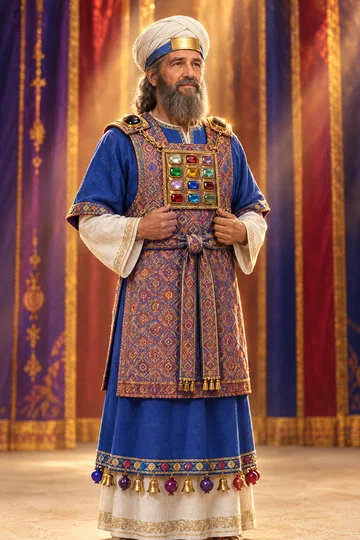
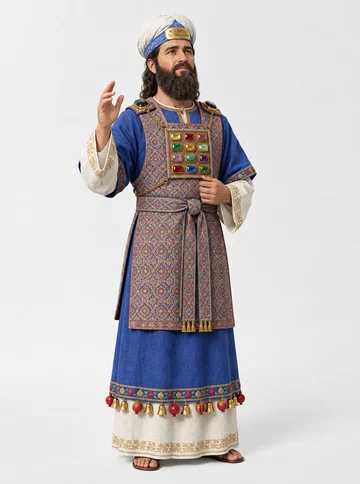
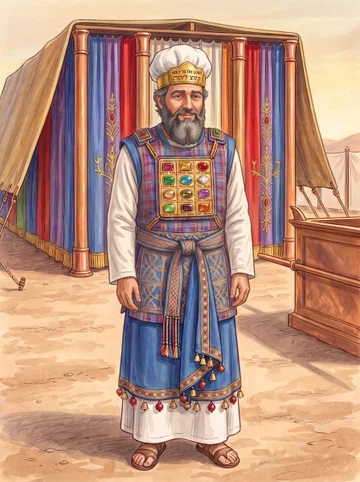
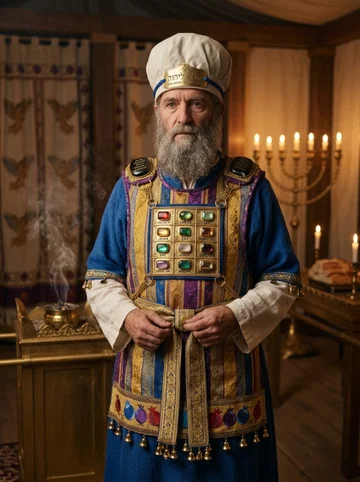
The second row of the high priest's breastplate holds an emerald, a sapphire, and a diamond.SG4 101.1EW 213.11SP 398.2–399.1SG1 158.1ST Jul 28, 1881 That row belongs to the breastplate connected with receiving messages from Jehovah.1SP 398.2–399.1ST Feb 21, 1911 The breastplate itself was a rich and beautiful covering for the breast, bordered with precious stones, with the names of Israel's twelve tribes engraved on precious stones set in gold within its border.SG4 101.11SP 398.1 Its stones were of the same kinds as those used for the twelve foundations of the city of God.SG4 101.11SP 398.1
Each stone had its own distinct light and significance bearing an important message from God.Ms 105, 1900, par. 6Lt 53, 1900, par. 9–12 Distinct as they were, together they contributed to the beauty and meaning of the one breastplate.Ms 105, 1900, par. 6Lt 53, 1900, par. 9–12
Divine Guidance and Presence
The breastplate was connected with receiving messages from Jehovah.1SP 398.2–399.1ST Feb 21, 1911 Light resting on the right-hand stone showed approval and success, while a cloud resting on the left-hand stone showed disapproval and refusal.1SP 398.2–399.1 In the earthly sanctuary its precious stones were associated with the glory of God's presence, which shone upon them in approval and shadowed them in disapproval.ST Oct 7, 18863SP 166.2–167.1
When Christ died and the temple veil was torn, the stones were exposed, and God's presence no longer overshadowed the earthly mercy seat.ST Oct 7, 18863SP 166.2–167.1 From that time that glory and shadow no longer appeared on the breastplate.ST Oct 7, 18863SP 166.2–167.1 The breastplate and ephod Gideon made imitated the high priest's garments, but their costly materials did not make them sacred.ST Jul 28, 1881 Sacredness came from use in the worship God had directed, and only the high priest was authorized to wear them when appearing before the Lord.ST Jul 28, 1881
Its imagery is reflected in Jesus wearing a glittering breastplate as, clothed in priestly garments, He enters the inner apartment of the heavenly sanctuary.EW 213.1SG1 158.1 Names are engraved upon that breastplate, and it glitters like diamonds.EW 213.1SG1 158.1
Sacred Dress and Reverence
The verse belongs to God's special, detailed directions to Moses about everything connected with His service, including Aaron's priestly garments.GW92 162.2GW92 161.12T 610.3–612.1Ms 56, 1900, par. 11–12 Those directions distinctly specified what those ministering in the priest's office before Him in the holy place were to wear.GW92 162.2GW92 161.12T 610.3–612.1 They required garments in a particular style in accordance with their work.GW92 162.2 Everything connected with sacred service was to be orderly and clean, with order maintained in everything and cleanliness especially preserved.GW92 161.12T 610.3–612.1
The apparel of those who officiate before God can honor or dishonor Him.GW92 161.1 The requirement of order and cleanliness was to teach the people reverence for God and to regard His work as holy.GW92 161.12T 610.3–612.1 Aaron's robes were symbolic, and as this naming of emerald, sapphire, and diamond in the second row belongs to those specifications, the dress of Christ's followers should likewise represent Christ.Ms 56, 1900, par. 11–12
Each stone had its own light and significance bearing an important message from God.Ms 105, 1900, par. 6 The stones were distinct, yet together they formed one breastplate.Ms 105, 1900, par. 6 In this they illustrate how members with different characteristics form one church family.Ms 105, 1900, par. 6
Sources
Pioneers and periodicals
48 sources
The second row of the breastplate was an emerald, a sapphire, and a diamond, set as part of four rows of three stones making twelve stones altogether bearing the engraved names of the children of Israel and the twelve tribes.ST May 13, 1897ST May 13, 1908ST Feb 17, 1890RH Dec 15, 1910 It was a span-square breastplate set in gold and worn over the high priest's heart as the crowning feature of his splendid garments for glory and beauty, made to support the Urim and Thummim.RH Sep 16, 1852RH Feb 2, 1911ST Dec 17, 1912RH Dec 8, 1910ST Dec 17, 1912 The verse stands within the minute instructions God gave Moses in the mount for the tabernacle and priestly garments, exactly according to the pattern, so that He might dwell among His people.ST Oct 29, 1894ST Mar 25, 1889RH Dec 31, 1861 It gives part of the breastplate of judgment worn as the high priest bore the judgment of Israel before the Lord continually in the work typifying atonement and judgment.ST Dec 17, 1912RH Apr 8, 1858RH Sep 16, 1852 As Aaron bore Israel upon his heart, so Christ the Great High Priest bears upon His heart before the Father in the heavenly sanctuary the names of true Israel and every repentant, believing soul.RH Aug 19, 1851RH Feb 2, 1911ST Dec 10, 1912
Breastplate Wording and Form
The second row of the breastplate holds an emerald, a sapphire, and a diamond.ST May 13, 1897ST Feb 17, 1890RH Dec 15, 1910RH Feb 2, 1911RH Oct 10, 1912 That three-stone grouping stands as the second of four rows of three stones.ST May 13, 1908RH Dec 15, 1910
The breastplate is worn before the high priest's chest and bears the names of the children of Israel and the twelve tribes, arranged and engraved upon twelve stones altogether.ST May 13, 1908RH Apr 8, 1858ST Dec 17, 1912ST Jun 12, 1884 It is the breastplate of judgment, borne upon Aaron's breast over his heart when going in before the Lord to bear the judgment of the children of Israel continually and to make atonement for the sanctuary and the people on entering the most holy place.RH Apr 8, 1858RH Sep 16, 1852ST Sep 6, 1910 Its continued carrying of every tribe shows each tribe represented in the service for the common interest of all Israel and the tribes remaining recognized as Israel.ST Jun 12, 1884ST Sep 6, 1910
The breastplate is a square measuring a span, set in gold and made of the same material as the ephod, worn over the heart and over the blue robe and embroidered ephod.RH Feb 2, 1911ST Dec 17, 1912 It is the crowning feature of a gorgeous robe for work in the holy of holies before the Lord, part of splendid, costly jeweled attire with bright, costly jewels made for glory and beauty.RH Sep 16, 1852ST Dec 17, 1912RH Jul 5, 1864 That equipment distinguishes the high priest from the other priests and supports the Urim and Thummim, while the priestly robe is multicolored.RH Jul 5, 1864RH Dec 8, 1910ST Oct 4, 1899
The exact identities and colors of the second-row stones cannot be stated with certainty, since their colors can vary widely and include many shades and mixtures.ST May 13, 1897ST Jan 24, 1911 The term rendered diamond may refer to the emerald.ST Sep 15, 1887 Carbuncle is a better rendering than emerald, and its red color represents blood and the mercy reaching the needy through Christ's blood.ST Jan 24, 1911 Jasper is the last stone of the twelve, described as clear or crystal-like, brilliant and transparent, which the familiar jasper does not match well when considered alongside Revelation's description of a precious, brilliant, transparent stone.ST Sep 15, 1887ST Sep 15, 1887
Sanctuary Instruction and History
Exodus 28:18 falls within the detailed, minute instructions God gave Moses for the construction of the tabernacle, its furniture, dimensions, materials, and priestly garments in Exodus 25 to 31 and continuing to the end of Exodus.ST Oct 29, 1894ST Jun 26, 1907ST Mar 10, 1898 It belongs to the very minute description in Exodus 25 to 40 of the sanctuary built in the days of Moses, which he was instructed to make exactly according to the pattern shown him in the mount.ST Oct 29, 1894ST Jun 26, 1907 It is part of the explicit directions given on Sinai for dimensions, material, furnishings, and all of the sanctuary, and of the full description beginning with chapter 25 and continuing to the end of the book that sets out the sanctuary and its furnishings and shows the exact pattern of the priestly work in its two apartments for the errors of the people.ST Jun 26, 1907ST Mar 10, 1898 That instruction concerned the building of the sanctuary and the preparation for its services.
The instructions were given during Moses' forty days and nights on Sinai in Horeb after Israel's covenant was ratified and after deliverance from Egyptian bondage.ST Mar 25, 1889RH Dec 31, 1861ST Dec 10, 1896 They included directions concerning the sanctuary and the priesthood that served before the ark.RH Dec 31, 1861 The sanctuary was afterward built and set up by specially endowed workmen from the children's free-will offerings so God might dwell among them.ST Jun 26, 1907ST Dec 10, 1896 Slavery had unfitted Israel to comprehend God's salvation and required character, and the structure described was marvelously beautiful, wrought and fashioned in the wilderness according to the divine pattern given to Moses in the mount.ST Jun 26, 1907
The sanctuary described belonged first to the wilderness tabernacle and afterward to the temple, where God was worshiped and where sacrificial offerings were presented before Him.ST Jun 3, 1886 The wonderfully itemized text of Exodus 25 to 31 uses extreme exactness and minute detail about the profuse use of gold, silver, costly gems, and fine linen in the structure of the tabernacle and in the priestly attire for Aaron and his sons.ST Jun 10, 1908 The depths of its meaning cannot be fully seen, the reasons for its exactness and detail cannot be fully fathomed, and the complete motive for its use of precious materials cannot be fully appreciated.ST Jun 10, 1908 Those instructions show how particular God was about matters of worship, and the specification of the priests' sanctuary clothing, including the second row of stones on the breastplate as an emerald, a sapphire, and a diamond, shows that even small details of sacred work mattered.ST Mar 25, 1889ST Mar 15, 1883
The instruction set down upon earth an object-lesson setting forth God's plan of government and how He deals with sin and with those who have sought to dethrone Him. It makes clear that as Priest upon the throne, still King, He deals with sinners by a plan devised from eternity for salvation from sin. The sanctuary was a great, multiple object-lesson teaching the plan of salvation by various forms and rites. God made this purpose known in the word, Let them make Me a sanctuary that I may dwell among them, because His people are so intimately related to the sanctuary that they cooperate with God in His work through Christ in the sanctuary, with the divine and the human cooperating at every step.ST Jun 26, 1907
Type of Christ and Judgment
The second row belongs to the breastplate of judgment, which held the names of the twelve tribes of Israel and was worn over the high priest's heart as he did the work that typified the judgment work.ST Dec 17, 1912RH Apr 8, 1858RH Sep 16, 1852 He wore it bearing the judgment of the people before the Lord continually, and he wore it when entering the most holy place, the second apartment, on the Day of Atonement to make atonement for the sanctuary and the people.RH Apr 8, 1858RH Sep 16, 1852RH Oct 10, 1912 The three stones of that row were the emerald, the sapphire, and the diamond.RH Apr 8, 1858RH Oct 10, 1912
As Aaron bore the judgment of the children of Israel upon his heart when he went in before the Lord, so Christ the great High Priest, ascended into heaven to appear in the presence of God for His people, bears upon His heart before the Father the names of true Israel and of every repentant, believing soul.RH Aug 19, 1851RH Feb 2, 1911ST Sep 6, 1910 The twelve stones set in gold and engraved with the tribal names represented God's people before Him, and they show Christ mindful of each person, confessing their names before God and bearing their sins continually.RH Feb 2, 1911ST Dec 10, 1912ST Sep 6, 1910 The precious stones are also of the same kind as those forming the foundations of the wall of the city of God.RH Feb 2, 1911
The ancient tabernacle was constructed for the ministration of sacrifices and offerings, and with its service in its two holy places it was the example and shadow of the heavenly temple and of Christ's more excellent ministry in the true tabernacle, where Jesus now ministers.ST Jan 24, 1911RH Mar 8, 1870 The Levitical order was appointed to perform that ministration in the earthly sanctuary in garments made for glory and beauty.RH Sep 16, 1852RH Mar 8, 1870 Exodus prescribes the splendid dress the high priest wore in his ordinary ministry, but on the Day of Atonement when entering the most holy place he laid that splendid dress aside and put on the plainest and humblest dress, showing that he was high priest only in a typical sense and not in reality.RH Jan 11, 1870ST Jun 6, 1878
The four rows of three stones signify light and truth assured to all the tribes of Israel.RH Dec 15, 1910 The stones represent God's merciful remembrance of His people and the blending of justice and mercy, truth and love, righteousness and peace.ST Jan 24, 1911 Carbuncle is a better rendering than emerald, and its red color represents Christ's blood, through which God's mercy reaches the needy, although the exact identities and colors of the second-row stones cannot be stated with certainty.ST Jan 24, 1911 Because the high priest wore every tribe in the sanctuary service, including on the Day of Atonement, for the common interest of all Israel, the continued presence of all twelve tribal names supports that the tribes remained recognized as Israel, including those who continued in the worship of the true God.ST Jun 12, 1884
The breastplate with Israel's names, presented by Christ before the Father, signifies that each person's standing is considered in judgment.RH Dec 1850 When Christ's advocacy ends, the last plagues and judgments fall, so its setting urges obedience to God's commandments while there is still time.RH Dec 1850
Law and Priesthood Distinction
The verse belongs to the law of Moses commanded through Moses in Horeb with statutes and judgments, set forth in Exodus 20 to 40 and Leviticus to be remembered in the last days. It does not belong to the Ten-Commandment moral rule of conduct alone but to the laws revealing offerings, sacrifices, and types, whose shadows trace the substance of the new dispensation.
It is part of the additional instruction given by the hand of Moses after God Himself spoke the Ten Commandments directly from Sinai and wrote them on stone, to which He added no more.ST Apr 15, 1886ST Jul 8, 1886 When those commandments were spoken the people stood afar off while Moses drew near to the thick darkness and remained forty days in the mount receiving instruction for them.ST Apr 15, 1886 That Moses-mediated instruction is recorded chiefly in Exodus 25 to 30 and in Leviticus.ST Apr 15, 1886ST Jul 8, 1886 It includes many burdensome ceremonies, including required pilgrimages of every male to Jerusalem three times yearly, circumcision, diverse washings, and carnal ordinances imposed until the time of reformation, a yoke which neither the fathers nor their children were able to bear.ST Apr 15, 1886
The chapter records the appointment of the Levitical priesthood, which came after the giving of the Ten Commandments in Exodus 20.ST Mar 22, 1883ST Mar 22, 1883ST Feb 20, 1879 This proves the law received under that Levitical priesthood is not the Ten Commandments.ST Feb 20, 1879 It therefore distinguishes the later priestly and Levitical law and first covenant from the moral law.ST Mar 22, 1883ST Mar 22, 1883ST Feb 20, 1879
The instructions set apart the Levitical order to minister before the ark in the typical sanctuary.RH Dec 12, 1854 That order performed the ministration in the two holy places of the earthly sanctuary, which was the example and shadow of Christ's more excellent ministry in the true tabernacle.RH Mar 8, 1870 That priestly service continued while the sanctuary stood.RH Dec 12, 1854
Sanctification sometimes consists in setting apart or consecrating to a sacred or religious use, and in this sense the priests and the sanctuary and its utensils described there were sanctified.RH Jul 26, 1864 Yet costly materials alone did not make sacred the breastplate and ephod that Gideon made in imitation of the high priest's garments, though the verse gives the gemstones of the second row of the true breastplate.ST Jul 28, 1881 Sacredness came from use in the worship God had directed, and only the high priest was authorized to wear those garments when appearing before the Lord.ST Jul 28, 1881
Scriptural Links and Antitypes
The twelve stones of the breastplate, set in gold and engraved with the names of the tribes of Israel, are of the same varieties as those forming the foundations of the wall of the city of God and New Jerusalem.RH Feb 2, 1911ST Dec 17, 1912RH May 7, 1901 The emerald, sapphire, and diamond of the second row are thus among the stones created for the earthly sanctuary that are used in the heavenly city brought down for humanity.RH Feb 2, 1911ST Dec 17, 1912RH May 7, 1901 The breastplate that holds them shows Christ the great High Priest bearing on His heart the names of every repentant, believing soul.RH Feb 2, 1911
The breastplate holding the stones also held the two brilliant stones called Urim and Thummim, which supported and distinguished the high priest's garments from those of the other priests.RH Dec 8, 1910ST Dec 17, 1912 By them the mind of the Lord was made known through the high priest, with light encircling the stone at the right giving an affirmative answer and light encircling the stone at the left giving a negative answer.ST Dec 17, 1912 The breastplate was attached to the ephod, which explains why David when undecided about his course called for the priest to bring the ephod so he could learn the mind of the Lord.ST Dec 17, 1912 It belonged to the high priest and to the sanctuary, first the tabernacle in the wilderness and afterward the temple where God was worshiped and sacrificial offerings were presented before Him.ST Jun 3, 1886 From the breastplate messages from Jehovah were received, showing that in the Jewish age all the revealings of God to His people and everything relating to His worship was closely connected with the sanctuary.ST Jun 3, 1886ST Feb 21, 1911
The breastplate of judgment did not pass away without an antitype following it in the New Testament dispensation.RH Jul 16, 1872 Its antitype is divine discernment, special revelation, and miraculous proof and direction continuing with Christianity, as when Simeon and Anna and John the Baptist endorsed the child Jesus, when Peter decided the fate of Ananias and Sapphira, and when John and Paul received special revelations from God.RH Jul 16, 1872 Miracles and miraculous proofs attested every step of the apostles as they proclaimed the truth, giving them divine aid and direction in seasons of difficulty and danger, intimidating or winning enemies and encouraging disciples.RH Jul 16, 1872 Wonderful manifestations of divine power still accompany the work of God in every age to prove God is unchanged and still near to deliver His people.RH Jul 16, 1872 When the temple veil was torn at Christ's death the precious stones of the high priest's breastplate were exposed.ST Oct 7, 1886 God's glory had shone upon the stones and His disapproval had shadowed them in the earthly sanctuary, but after the veil was rent His presence no longer overshadowed the earthly mercy seat, and that glory and shadow no longer appeared on the breastplate.ST Oct 7, 1886
Reverence and Spiritual Lessons
Exodus 28:18 stands within the wonderfully itemized text of Exodus 25 to 31 that gives extreme exactness and minute detail about the profuse use of gold, silver, costly gems, and fine linen in the structure of the tabernacle and in the priestly attire for Aaron and his sons.ST Jun 10, 1908 The depths of its meaning cannot be fully seen, the reasons for its exactness and detail cannot be fully fathomed, and the complete motive for its use of precious materials cannot be fully appreciated.ST Jun 10, 1908 Careful, slow, thoughtful study of it brings to the surface a multitude of invigorating and instructive ideas, suggestions, and lessons.ST Jun 10, 1908 That study gives vitalizing food to strengthen the famishing heart and water of life to refresh the worn spirit through long days.ST Jun 10, 1908
The verse belongs to the detailed instructions for the priests' garments, which God Himself specified for service in the holy place.RH Oct 30, 1913 The care and reverence required in those garments taught the people that God is holy and His service sacred.RH Oct 30, 1913
Sources