Exodus 30:34
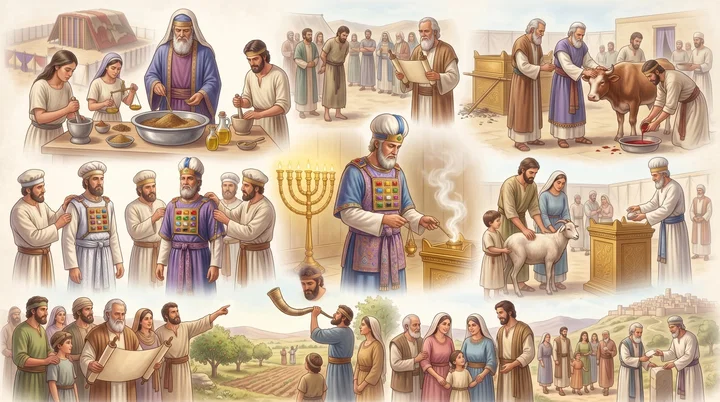
And the LORD said unto Moses, Take unto thee sweet spices, stacte, and onycha, and galbanum; these sweet spices with pure frankincense: of each shall there be a like weight:
Translations
And the LORD said to Moses, Take to you sweet spices, stacte, and onycha, and galbanum; these sweet spices with pure frankincense: of each shall there be a like weight:
And the LORD said unto Moses, Take unto thee sweet spices, stacte, and onycha, and galbanum; these sweet spices with pure frankincense: of each shall there be a like weight:
And the Lord said unto Moses, Take unto thee sweet spices, stacte, and onycha, and galbanum; these sweet spices with pure frankincense: of each shall there be a like weight:
And the LORD said to Moses, Take to thee sweet spices, stacte, and onycha, and galbanum; these sweet spices with pure frankincense: of each shall there be a like weight:
And the LORD said unto Moses, Take unto thee sweet spices, stacte, and onycha, and galbanum; sweet spices with pure frankincense: of each shall there be a like weight;
And Jehovah said unto Moses, Take unto thee sweet spices, stacte, and onycha, and galbanum; sweet spices with pure frankincense: of each shall there be a like weight;
And Jehovah saith unto Moses, 'Take to thee spices, stacte, and onycha, and galbanum, spices and pure frankincense; they are part for part;
And Jehovah said to Moses, Take fragrant drugs — stacte, and onycha, and galbanum — fragrant drugs and pure frankincense; in like proportions shall it be.
Then said Yahweh unto Moses—Take to thee aromatic spices stacte and onycha, and galbanum,—aromatic spices, and pure frankincense,—weight for weight, shall it be.
Berean Standard Bible, Majority Standard Bible
The LORD also said to Moses, “ Take fragrant spices— gum resin, onycha, galbanum, and pure frankincense— in equal measures,
The LORD said to Moses, “ Take to yourself sweet spices, gum resin, onycha, and galbanum: sweet spices with pure frankincense. There shall be an equal weight of each.
And the Lord said to Moses, Take sweet spices, stacte and onycha and galbanum, with the best frankincense, in equal weights;
And the Lord sayd vnto Moses, Take vnto thee these spices, pure myrrhe and cleare gumme and galbanum, these odours with pure frankincense, of eche like weight:
Douay-Rheims (Challoner revision)
And the Lord said to Moses: Take unto thee spices, stacte, and onycha, galbanum of sweet savour, and the clearest frankincense, all shall be of equal weight.
Pictures
Cross-references
- Exodus 30:7-8
And Aaron shall burn thereon sweet incense every morning: when he dresseth the lamps, he shall burn incense upon it.
Incense is burned morning and evening on the altar.
- Exodus 31:11
And the anointing oil, and sweet incense for the holy place: according to all that I have commanded thee shall they do.
The commanded incense is included among the sanctuary’s sacred preparations.
- Exodus 40:27
And he burnt sweet incense thereon; as the LORD commanded Moses.
Sweet incense is burned on the golden altar as commanded.
- Revelation 8:3-4
And another angel came and stood at the altar, having a golden censer; and there was given unto him much incense, that he should offer it with the prayers of all saints upon the golden altar which was before the throne.
Incense is offered with the prayers of the saints before God.
- 2 Chronicles 2:4
Behold, I build an house to the name of the LORD my God, to dedicate it to him, and to burn before him sweet incense, and for the continual shewbread, and for the burnt offerings morning and evening, on the sabbaths, and on the new moons, and on the solemn feasts of the LORD our God. This is an ordinance for ever to Israel.
Temple worship included continual offerings of incense.
- Exodus 30:1-4
And thou shalt make an altar to burn incense upon: of shittim wood shalt thou make it.
Describes the altar for the incense.
- Mark 16:1
And when the sabbath was past, Mary Magdalene, and Mary the mother of James, and Salome, had bought sweet spices, that they might come and anoint him.
The women prepared spices to anoint Jesus.
- Psalms 141:2
Let my prayer be set forth before thee as incense; and the lifting up of my hands as the evening sacrifice.
Compares prayer to incense offered to God.
- Leviticus 16
And the LORD spake unto Moses after the death of the two sons of Aaron, when they offered before the LORD, and died;
Describes principal ordinances of divine service.
- Exodus 40:5
And thou shalt set the altar of gold for the incense before the ark of the testimony, and put the hanging of the door to the tabernacle.
Places the incense altar before the ark.
- Luke 23:56
And they returned, and prepared spices and ointments; and rested the sabbath day according to the commandment.
The women prepared spices before the Sabbath.
- 2 Chronicles 29:7
Also they have shut up the doors of the porch, and put out the lamps, and have not burned incense nor offered burnt offerings in the holy place unto the God of Israel.
Both concern incense as part of the temple’s sacred worship.
- Hebrews 9:4
Which had the golden censer, and the ark of the covenant overlaid round about with gold, where in was the golden pot that had manna, and Aaron’s rod that budded, and the tables of the covenant;
The golden censer was among the sanctuary furnishings.
Commentary
Each commentary is drawn from primary sources: the writings of Ellen G. White and Adventist pioneers and periodicals. Each commentary is separate. Its own words are not a quotation; follow the references to read the source passages.
Ellen G. White
1 source
The Lord gave a special recipe for tabernacle use built around sweet spices.Lt 53, 1901, par. 5 It called for stacte and onycha and galbanum, these sweet spices together with pure frankincense.Lt 53, 1901, par. 5 Each was to be taken in like weight, in equal proportion with the others.Lt 53, 1901, par. 5 The spices with frankincense so combined formed a sacred preparation that was not to be treated as common.Lt 53, 1901, par. 5 God’s people were to strictly observe the distinction between what is common and what is sacred.Lt 53, 1901, par. 5
Sources
Pioneers and periodicals
27 sources
The Lord gave Moses on the mountain at Sinai detailed directions for the portable sanctuary in the wilderness, specifying its pattern, materials and service so that He might dwell among His people.ST Mar 25, 1889ST Feb 17, 1890RH Dec 31, 1861ST Mar 11, 1886 The verse prescribes the holy incense as a compound of sweet spices, stacte, onycha and galbanum with pure frankincense, mixed in equal weight.ST May 20, 1880ST Apr 22, 1889ST Nov 26, 1912 It was a sacred blend made by God's direction and reserved for holy service, never to be made in the same form for ordinary or personal use, even as the anointing oil set apart the priests and the sanctuary furnishings.RH Nov 17, 1910ST Apr 22, 1889ST Nov 26, 1912 It was burned every morning and evening on the golden altar before the veil in the holy place as part of the daily ministration with the burnt offering.ST May 20, 1880RH Aug 4, 1863 The sanctuary and its rites were an object lesson of God's plan for dealing with sin, a type of the heavenly sanctuary pointing to Christ, whose ministry there the priests' daily offering of incense patterned.ST Jun 26, 1907RH Mar 28, 1854
Tabernacle Instructions and Incense
The command belongs to the detailed instructions for building the sanctuary and serving in it that the Lord gave to Moses on Mount Sinai during his forty days' stay there, together with the tables of stone, before the sanctuary was built and set up, showing that even its worship was laid out with care.ST Mar 25, 1889RH Dec 31, 1861ST Jan 31, 1911ST Dec 10, 1896 Those instructions are minutely described in Exodus 25-31 and told in Exodus 25-40.RH Feb 11, 1858ST Jun 19, 1907ST Jan 27, 1909 They concern the inner portable tabernacle erected by Israel in the wilderness at God's command, the building generally meant by the word sanctuary.RH Feb 11, 1858ST Jun 19, 1907 Solomon's temple afterward took the place of that portable tabernacle, and in both buildings all earthly worship and service centered on and revolved around the holy of holies where God's law rested with the mercy-seat over it.ST Jun 19, 1907
The sanctuary was to be made from offerings of gold, silver, brass, acacia wood, fine linen, goat's hair and other materials so that God might dwell among them, with its framework, coverings, divisions, furniture and vessels included.ST Mar 11, 1886 Its materials and their preparation, like its furnishings and rites, were specified by God according to the pattern shown on the mount rather than left to human choice.ST Feb 17, 1890ST Jun 26, 1907 It was built by workmen specially endowed by God from Israel's free-will offerings, forming a marvelously beautiful structure.
The verse prescribes the holy incense as a particular compound of sweet spices — stacte, and onycha, and galbanum — these sweet spices with pure frankincense, combined in like or equal weight.ST May 20, 1880ST Nov 26, 1912ST Jun 26, 1907RH Feb 10, 1910 It was a sacred blend made according to God's direction for the sanctuary, including the preparation of its sacred incense.ST Apr 22, 1889ST Nov 26, 1912ST Jan 27, 1909 The exact ingredients are now uncertain, so it would probably be impossible to reproduce it.ST Apr 23, 1894
The incense and the anointing oil are sacred things reserved for holy service and not to be made in the same form for ordinary, personal, common, or worldly use or gain.RH Nov 17, 1910ST Apr 22, 1889ST Nov 26, 1912ST Apr 23, 1894RH Feb 10, 1910 The oil was made from costly, choice, fragrant spices and set apart the priests, the sanctuary and its furnishings for God's work, and was not to be applied to ordinary persons or used for common purposes.RH Nov 17, 1910RH Dec 1, 1868 The sweet incense was burned on the golden altar of incense before the veil in the holy place, or first apartment.ST May 20, 1880RH Aug 4, 1863 That burning was done every morning when the high priest dressed the lamps and every evening when he lighted them, as part of the daily ministration and regular Levitical service alongside the morning and evening burnt-offering and the appointed work for Sabbaths, annual sabbaths, new moons, and feasts.RH Feb 25, 1858
Type and Spiritual Application
The sanctuary and its services were an earthly object-lesson of God's plan for dealing with sin and saving sinners, given by divine pattern to Moses on the mount and built from Israel's free-will offerings by specially endowed workmen to teach a people unfitted by slavery to comprehend His great salvation and required character, that He might dwell among them.ST Jun 26, 1907 Its furnishings and rites in Exodus 25-40 were made according to the pattern shown on the mount, including the sacred incense of sweet spices and pure frankincense in equal weights, and as a type of the heavenly sanctuary they pointed to Christ and His work.ST Jun 26, 1907 The marvelously beautiful structure described in those chapters thus forms a great multiple object-lesson by various forms and rites of the plan of salvation.
The verse belongs to the laws given through Moses, including ceremonial laws revealing offerings, sacrifices, and types, among the statutes and judgments Malachi calls God's people to remember. As part of the worldly sanctuary connected with the first covenant and its ordinances of divine service, its old-dispensation shadows help trace the substance of the new dispensation.ST Aug 5, 1889 It stands within the directions associated with the priesthood committed to Aaron and his sons for Israel's sanctuary service.ST Mar 3, 1914 It is part of the additional instruction, in the body of precepts, statutes and laws in Exodus 25-30, that God gave through Moses rather than speaking directly to the people after speaking the Ten Commandments at Sinai, including burdensome ceremonies imposed until the time of reformation.ST Apr 15, 1886ST Jul 8, 1886
The sweet incense burned on the golden altar each morning and evening as the lamps were tended belonged to the daily service and regular ministration of the earthly priesthood, which served as a pattern of Christ's ministry in the heavenly sanctuary.RH Mar 28, 1854 The anointing oil and sanctuary incense in Exodus 30:23-38 were sacred things made according to God's direction and reserved for holy service, and the oil that set apart the priests, sanctuary and its furnishings was not to be applied to ordinary persons or used for common purposes or worldly gain.RH Nov 17, 1910 That pattern applies to the Holy Spirit's anointing, which is given to prepare people for God's service and not as a reward for ordinary pursuits or personal advantage, while the setting apart of the sanctuary and its utensils illustrates sanctification as consecration.RH Nov 17, 1910RH Jul 26, 1864
The sacred incense was a particular compound for daily use at the altar, of stacte, onycha, and galbanum with pure frankincense, not to be made in the same form for any other purpose, and its fragrant offering symbolized the people's desire to please God.RH Feb 10, 1910 Its spices of stacte, onycha, galbanum and pure frankincense released their fragrance when beaten very small and exposed to holy fire, rising as a sweet savor, illustrating that an offering to God becomes a sweet-smelling sacrifice through breaking and suffering.RH Dec 3, 1901 The sweet incense compounded by God's direction for Moses likewise illustrates with its fragrance the distinctive beauty of humility, a grace that comes from God and is prized in heaven.ST May 15, 1901
Sources