Translations
American King James Version, King James Version
And he burnt sweet incense thereon; as the LORD commanded Moses.
and he burnt sweet incense thereon; as the Lord commanded Moses.
And he burnt sweet incense on it; as the LORD commanded Moses.
and he burnt thereon incense of sweet spices; as the LORD commanded Moses.
and he burnt thereon incense of sweet spices; as Jehovah commanded Moses.
and maketh perfume on it — spice-perfume — as Jehovah hath commanded Moses.
And he burnt on it fragrant incense; as Jehovah had commanded Moses.
and burned thereupon the fragrant incense,—As Yahweh commanded Moses.
Berean Standard Bible, Majority Standard Bible
and he burned fragrant incense on it, just as the LORD had commanded him.
and he burned incense of sweet spices on it, as the LORD commanded Moses.
Burning sweet perfumes on it, as the Lord had given him orders.
And burnt sweete incense thereon, as the Lord had commanded Moses.
Douay-Rheims (Challoner revision)
And burnt upon it the incense of spices, as the Lord had commanded Moses.
Pictures
Cross-references
- Hebrews 9:1-5
Then verily the first covenant had also ordinances of divine service, and a worldly sanctuary.
Describes the tabernacle and its furnishings, including the altar of incense.
- Hebrews 8:5
Who serve unto the example and shadow of heavenly things, as Moses was admonished of God when he was about to make the tabernacle: for, See, saith he, that thou make all things according to the pattern shewed to thee in the mount.
The earthly sanctuary service was made according to the divinely shown pattern of heavenly things.
- Exodus 30:1-10
And thou shalt make an altar to burn incense upon: of shittim wood shalt thou make it.
Gives instructions for the golden incense altar and its use.
- Exodus 40:34-35
Then a cloud covered the tent of the congregation, and the glory of the LORD filled the tabernacle.
The glory filled the tabernacle after its setup and obedience.
- Revelation 8:3
And another angel came and stood at the altar, having a golden censer; and there was given unto him much incense, that he should offer it with the prayers of all saints upon the golden altar which was before the throne.
golden altar seen as heavenly counterpart
- Revelation 5:8
And when he had taken the book, the four beasts and four and twenty elders fell down before the Lamb, having every one of them harps, and golden vials full of odours, which are the prayers of saints.
Golden vials of incense are identified with the prayers of the saints.
- Luke 1:9-10
According to the custom of the priest’s office, his lot was to burn incense when he went into the temple of the Lord.
Incense is offered at the altar while the people pray.
- Hebrews 9:23-24
It was therefore necessary that the patterns of things in the heavens should be purified with these; but the heavenly things themselves with better sacrifices than these.
The earthly sanctuary is linked to the heavenly sanctuary where Christ ministers.
- Exodus 25:8
And let them make me a sanctuary; that I may dwell among them.
sanctuary built for God to dwell
- Exodus 30:7-8
And Aaron shall burn thereon sweet incense every morning: when he dresseth the lamps, he shall burn incense upon it.
Incense was offered morning and evening on the altar.
- Exodus 37:25-28
And he made the incense altar of shittim wood: the length of it was a cubit, and the breadth of it a cubit; it was foursquare; and two cubits was the height of it; the horns thereof were of the same.
Describes the construction of the incense altar.
- Leviticus 16:13
And he shall put the incense upon the fire before the LORD, that the cloud of the incense may cover the mercy seat that is upon the testimony, that he die not:
Incense veiled God’s glory in the most holy place.
- Leviticus 10:1-3
And Nadab and Abihu, the sons of Aaron, took either of them his censer, and put fire therein, and put incense thereon, and offered strange fire before the LORD, which he commanded them not.
Aaron’s sons profaned holy incense by offering what the LORD had not commanded.
- Psalms 141:2
Let my prayer be set forth before thee as incense; and the lifting up of my hands as the evening sacrifice.
Prayer is compared to incense offered before God.
- Hebrews 9:8-9
The Holy Ghost this signifying, that the way into the holiest of all was not yet made manifest, while as the first tabernacle was yet standing:
The earthly sanctuary service is presented as a type.
- Exodus 29:42
This shall be a continual burnt offering throughout your generations at the door of the tabernacle of the congregation before the LORD: where I will meet you, to speak there unto thee.
The continual burnt offering was connected with the incense service.
- Hebrews 9:11
But Christ being come an high priest of good things to come, by a greater and more perfect tabernacle, not made with hands, that is to say, not of this building;
Contrasts the earthly tabernacle with the greater, true tabernacle.
- 1 Kings 8:11
So that the priests could not stand to minister because of the cloud: for the glory of the LORD had filled the house of the LORD.
temple continued as God's dwelling-place
Commentary
Each commentary is drawn from primary sources: the writings of Ellen G. White and Adventist pioneers and periodicals. Each commentary is separate. Its own words are not a quotation; follow the references to read the source passages.
Ellen G. White
1 source
Moses burned sweet incense in the tabernacle as part of the arrangements the Lord commanded him to establish.GW92 308.2 Those arrangements were designed to display divine majesty and holiness and to set forth the purity required of all who serve in God's presence.GW92 308.2 Their order and harmony were a revelation of God's character to the nations round about.GW92 308.2 The same principles of reverence, purity, and order apply to God's work at the present time.GW92 308.2
Sources
Pioneers and periodicals
35 sources
Moses burned sweet incense on the altar in the completed sanctuary exactly as the Lord commanded him, as part of setting up the tabernacle and its worship with its furnishings according to God's directions.ST Oct 29, 1894RH Apr 13, 1876ST May 20, 1880 This belonged to rearing up the tabernacle on the first day of the first month in the second year after Israel left Egypt, after which the cloud covered the tent and the glory of the Lord filled the tabernacle so He might dwell among them.RH Aug 21, 1856ST Oct 25, 1905 The golden altar stood before the veil in the first apartment or holy place with the table of showbread and the seven-lamped candlestick, made as a pattern of God's heavenly sanctuary and an object lesson of His way and Christ's priestly work.RH Feb 11, 1858RH Jan 6, 1853ST Aug 8, 1878ST Nov 20, 1879ST Jun 19, 1907 As the pattern of things in the heavens, the golden altar and seven lamps place John's vision of fire before the throne and ministration at the golden altar in the first apartment of the heavenly sanctuary where Jesus began His ministration as High Priest.RH Mar 15, 1870RH Feb 3, 1853 The sweet incense means how pleasant and pleasing to God is the penitent prayer of a reconciled sinner, and burning it exactly as commanded reveals how particular God is to have all things just right and how jealous He is for obedience in all things.ST Mar 10, 1898ST Mar 10, 1898RH Dec 31, 1857
Tabernacle Erection and Timing
Moses burned sweet incense on the altar in the completed sanctuary as the Lord commanded Moses, as part of setting up the tabernacle and its worship with its furnishings and worship carried out according to God's directions.ST Oct 29, 1894RH Apr 13, 1876RH Aug 4, 1863ST Jan 27, 1909 When Moses set up the tabernacle he placed the golden altar of incense before the veil in the holy place and burned sweet incense upon it in obedience to the Lord's command.RH Apr 13, 1876ST May 20, 1880ST Apr 22, 1889RH Aug 4, 1863 This act belongs to the rearing up of the tabernacle, prepared, fitted, and set up on the first day of the first month in the second year after Israel departed from Egypt.RH Aug 21, 1856 Together with it came putting the testimony into the ark, setting up the veil, placing the table of showbread, setting the candlestick and lighting its lamps, and offering the burnt offering and meat offering on the altar before the door of the tabernacle, after which the cloud covered the tent of the congregation and the glory of the Lord filled the tabernacle.RH Aug 21, 1856 So Moses in burning sweet incense on the altar of incense in the holy place as commanded completed the sanctuary God told Israel to build so He might dwell among them, with its holy and most holy places and their furniture made exactly according to the pattern shown to Moses on the mount.ST Oct 25, 1905
The verse stands in the worship division of Exodus from chapter 25 onward, which gives delivered Israel an established form of worship.ST Dec 10, 1896RH Jan 20, 1916 Exodus means the going out, referring to the departure of Israel from Egypt, and tells how the family settled in Egypt, grown more and mightier than the Egyptians and brought into bitter bondage, was delivered and made a nation with thorough organization, efficient leadership under Moses, a complete code of laws, and an established worship.RH Jan 20, 1916 That worship division gives the directions for building in Exodus 25-31 and their execution in Exodus 35-40, summarized in Hebrews 9:1-5.ST Jun 4, 1885ST Dec 10, 1896 That sanctuary was made so God could dwell among Israel, and it was His dwelling-place among the people in the wilderness and through the time of the judges, Samuel, Saul, and David until Solomon built the temple after the same pattern, which from the day the glory of the Lord filled it was the dwelling-place of the Lord among Israel.ST Jun 4, 1885
After redeeming Israel from Egyptian bondage with a mighty hand, God gave this multiple object-lesson by various forms and rites to teach the great plan of salvation and the character He required, because hundreds of years of slavery had unfitted Israel to comprehend them. God asked free-will offerings of the children of Israel for the building so He might dwell among them.ST Oct 25, 1905 The workmen who built it were specially endowed by God, and the pattern was divine, given by God to Moses in the mount. Its dimensions, material, furnishings, and all were exactly according to the directions given to Moses in the mount, as a movable dwelling built in the wilderness far from enemies where God would be with men after He brought Israel out from Pharaoh across the Red Sea to Sinai and commanded Moses, Let them make Me a sanctuary that I may dwell among them, and when finished the cloud covered the tent of the congregation and the glory of the Lord filled the tabernacle.ST Oct 25, 1905ST Jun 26, 1907
The setting up of the tabernacle and the placing of the showbread on Abib 1 does not prove that day was a weekly Sabbath.ST Jul 17, 1879ST Jul 17, 1879 The command to set out the showbread every Sabbath was given later in Leviticus 24, so it cannot establish the day on which the tabernacle was first set up.ST Jul 17, 1879ST Jul 17, 1879 The account in Exodus 40 describes the tabernacle being set up before that later commandment, and therefore does not prove that the day the tabernacle was set up was a Sabbath.ST Jul 17, 1879ST Jul 17, 1879
Altar Place and Furnishings
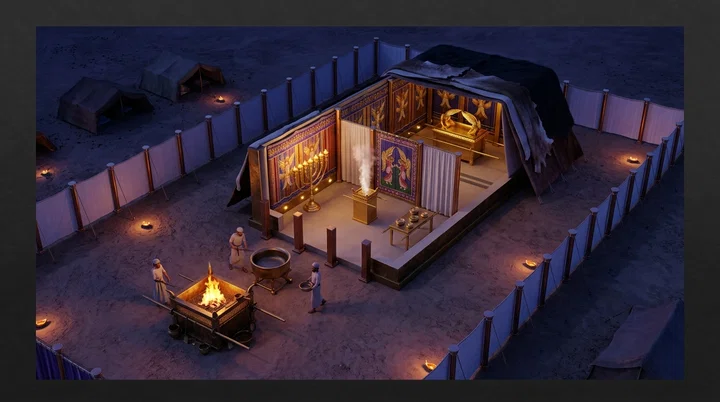
The golden altar of incense stood before the veil in the tent of meeting, in the first apartment or holy place of the earthly sanctuary, where sweet incense was burned upon it as the Lord commanded Moses.RH Feb 11, 1858RH Jan 6, 1853ST Aug 8, 1878STST May 8, 1901 When the tabernacle was set up, the altar was placed in that first apartment and the burning of sweet incense upon it belonged to the service of the Holy place.RH Feb 11, 1858RH Jan 6, 1853ST May 11, 1876ST May 8, 1901 The altar of incense therefore belonged to the first holy place and not beyond the veil.ST Aug 8, 1878ST May 11, 1876ST
That first holy place also held the table of showbread and the candlestick with seven lamps or seven-branched lampstand, alongside the golden altar for burning sweet incense.RH Mar 10, 1874ST Jan 18, 1883ST Nov 20, 1879ST Mar 10, 1898 The second holy place was separate from the first and held the ark of God's testament with the tables of the ten commandments written by the finger of God, the mercy-seat, and the cherubim of glory overshadowing it.RH Mar 10, 1874ST Jan 18, 1883 In that earthly sanctuary worship centered on the holy of holies, where God's law rested beneath the mercy seat.RH Mar 10, 1874ST Jun 19, 1907
The earthly sanctuary erected by Moses was made as a pattern of God's heavenly sanctuary.ST Nov 20, 1879ST Jun 19, 1907 Its sanctuary and service were an object lesson of God's way and of Christ's priestly work.ST Nov 20, 1879ST Jun 19, 1907 That sanctuary was made so God could dwell among Israel, and it was His dwelling-place among the people in the wilderness and through the time of the judges, Samuel, Saul, and David until Solomon built the temple after the same pattern, which from the day the glory of the Lord filled it was the dwelling-place of the Lord among Israel.ST Jun 4, 1885 The sanctuary was set apart as holy for God's use, so that priests could not treat it like their own homes, illustrating the distinction between what God has sanctified and what remains common.RH Jul 16, 1861
Heavenly Ministry and Doctrine
By express divine direction the golden candlestick with its seven lamps and the golden altar of incense were both placed in the first apartment of the earthly tabernacle, which was the pattern of things in the heavens.RH Mar 15, 1870RH Feb 3, 1853 Because John saw seven lamps of fire burning before the throne and saw ministration at the golden altar of incense, the scene of his vision is the first apartment of the heavenly sanctuary, where Jesus commenced His ministration as High Priest.RH Mar 15, 1870RH Feb 3, 1853 The earthly sanctuary was built in the wilderness far from enemies as a movable dwelling where God would be with men after He brought Israel out from Pharaoh across the Red Sea to Sinai with the command to make Him a sanctuary that He might dwell among them, with its dimensions, material, furnishings and all exactly according to the directions given in the mount, and when finished the cloud covered the tent of the congregation and the glory of the Lord filled the tabernacle.ST Jun 26, 1907 That earthly worldly sanctuary answered its purpose as typical of and foreshadowing the true tabernacle which the Lord pitched and not man, serving unto the shadow of heavenly things with all its rites pointing to the coming Messiah and His power to forgive sin, transform character, and deliver from burdens, until with the death of Christ and the rending of the veil its typical shadowy service passed away entirely and forever.ST Jun 26, 1907
The ark containing the law of God was placed in the most holy place of the earthly sanctuary, and the ceremonial system of the sanctuary provided for atonement for transgressors of that law. The ministration begun when Moses brought down the ten commandments was carried forward through the entire Old Testament period by placing the two tables in the ark and placing the ark in the Most Holy Place of the typical sanctuary and setting apart the Levitical order of priesthood to minister before that ark while the typical sanctuary should continue.RH Dec 12, 1854 That ministration could only exhibit guilt, condemnation and death to a sinful rebellious people, showing them exposed to the just penalty of the holy law with no promise of pardon in itself.RH Dec 12, 1854
The verse belongs to the law of Moses commanded through Moses in Horeb, included with the statutes and judgments that embrace the Ten Commandments and all the other precepts, civil, moral, health, and ceremonial. It stands among the laws revealing offerings, sacrifices, and types by which the substance of the new dispensation is traced from the shadows of the old, not as the moral rule of conduct alone, to be remembered in the last days especially as set forth in Exodus 20 to 40 and Leviticus. It belongs to the set of laws God gave for the regulation of worship, separate in nature and in those who execute them from the laws He gave for civil government in Exodus 21-23.ST Sep 3, 1896 Civil government is a temporary arrangement of force made necessary by sin to control men and regulate their relations toward each other in this probationary life only, and even when administered by God Himself it is impotent to turn hearts to Him, as when Israel sank to idolatry and rejected His rule, while true gospel religion is designed to persuade men to be reconciled to God and bring them back to Him for the eventual kingdom of love, so the two systems go side by side with essentially different purposes and entirely separate lines of operation, and any commingling produces discordant clashing detrimental to both.ST Sep 3, 1896 The manifestation of God's glory at the sanctuary's building and inauguration showed that He accepted the people's repentance.ST Jan 31, 1911
Incense Symbol and Obedience
The sweet incense was burned on the altar in the holy place as commanded, ministering before the holy presence of the sanctuary.ST Oct 8, 1885 In the most holy place incense veiled the glory of God above the ark and mercy seat, for that uncovered glory would have caused death.ST Oct 8, 1885 The altar of incense stood in the first apartment of the tabernacle together with the table and the seven-branched golden candlestick.ST Mar 10, 1898 The sweet-smelling incense sent up from that altar means how pleasant and pleasing to God is the penitent prayer of a reconciled sinner, given as a reminder of that truth.ST Mar 10, 1898ST Mar 10, 1898
The exactness required in erecting the tabernacle and in burning the sweet incense exactly as commanded reveals how particular God is to have all things just right and how jealous He is for obedience in all things.RH Dec 31, 1857 At Sinai Israel had to wait until the commandments were given, the tabernacle was erected with the incense burnt as commanded, and all were marshalled in perfect order before going up to subdue enemies and possess the goodly land.RH Dec 31, 1857 That waiting was a type of the present time just before entering the heavenly Canaan, which requires even greater particularity and advancement in the divine life by obeying God in all things.RH Dec 31, 1857 It requires acceptance of a strait testimony, moving just right with wisdom from above, and consecration that does not count life dear in order to overcome.RH Dec 31, 1857
Sources