Hebrews 9:4
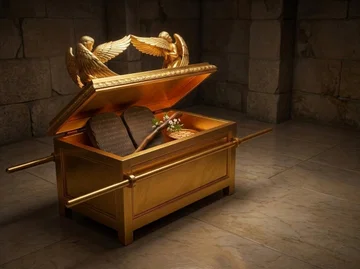
Which had the golden censer, and the ark of the covenant overlaid round about with gold, where in was the golden pot that had manna, and Aaron’s rod that budded, and the tables of the covenant;
Translations
Which had the golden censer, and the ark of the covenant overlaid round about with gold, wherein was the golden pot that had manna, and Aaron’s rod that budded, and the tables of the covenant;
Which had the golden censer, and the ark of the covenant overlaid round about with gold, where in was the golden pot that had manna, and Aaron’s rod that budded, and the tables of the covenant;
which had the golden censer, and the ark of the covenant overlaid round about with gold, wherein was the golden pot that had manna, and Aaron’s rod that budded, and the tables of the covenant;
Which had the golden censer, and the ark of the covenant overlaid around with gold, in which was the golden pot that had manna, and Aaron's rod that budded, and the tables of the covenant;
having a golden censer, and the ark of the covenant overlaid round about with gold, wherein was a golden pot holding the manna, and Aaron’ s rod that budded, and the tables of the covenant;
having a golden altar of incense, and the ark of the covenant overlaid round about with gold, wherein was a golden pot holding the manna, and Aaron’ s rod that budded, and the tables of the covenant;
having a golden censer, and the ark of the covenant overlaid all round about with gold, in which [is] the golden pot having the manna, and the rod of Aaron that budded, and the tables of the covenant,
having a golden censer, and the ark of the covenant, covered round in every part with gold, in which [ were] the golden pot that had the manna, and the rod of Aaron that had sprouted, and the tables of the covenant;
Having a golden altar of incense, and the ark of the covenant covered around on every side with gold, in which was a golden jar holding the manna, and the rod of Aaron that sprouted, and the tables of the covenant;
Berean Standard Bible, Majority Standard Bible
containing the golden altar of incense and the gold-covered ark of the covenant. Inside the ark were the gold jar of manna, Aaron’ s staff that had budded, and the stone tablets of the covenant.
having a golden altar of incense and the ark of the covenant overlaid on all sides with gold, in which was a golden pot holding the manna, Aaron’ s rod that budded, and the tablets of the covenant;
Having a vessel of gold in it for burning perfumes, and the ark of the agreement, which was covered with gold and which had in it a pot made of gold for the manna, and Aaron's rod which put out buds, and the stones with the writing of the agreement;
Which had the golden censer, and the Arke of the Testament ouerlayde rounde about with golde, wherein the golden pot, which had Manna, was, and Aarons rod that had budded, and the tables of the Testament.
Douay-Rheims (Challoner revision)
Having a golden censer, and the ark of the testament covered about on every part with gold, in which was a golden pot that had manna, and the rod of Aaron, that had blossomed, and the tables of the testament.
Pictures
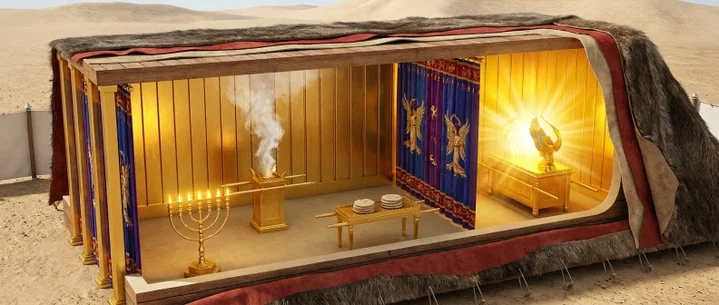
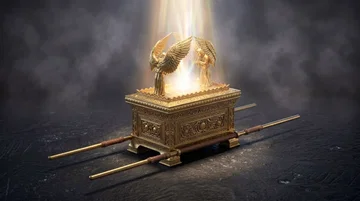
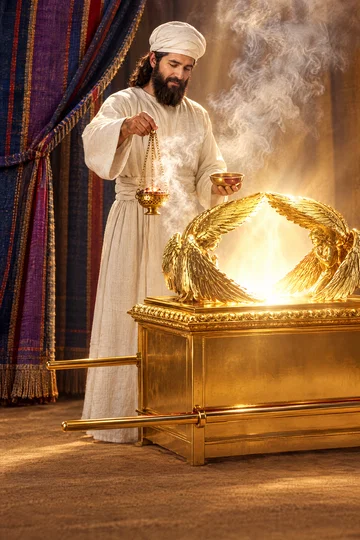
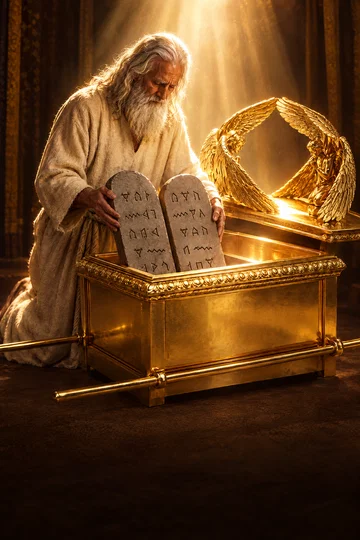
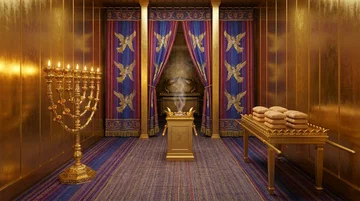
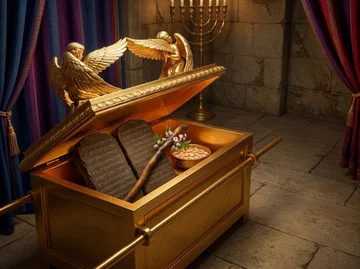
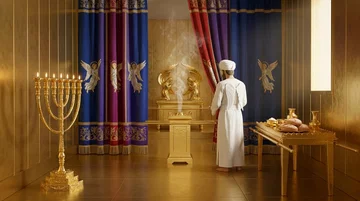
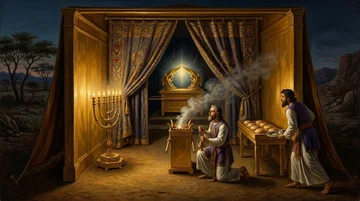
Cross-references 20 of 88
- Hebrews 8:1-2
Now of the things which we have spoken this is the sum: We have such an high priest, who is set on the right hand of the throne of the Majesty in the heavens;
contrasts pattern with true tabernacle
- Exodus 25:16
And thou shalt put into the ark the testimony which I shall give thee.
Commands that the covenant testimony be placed in the ark.
- Revelation 11:19
And the temple of God was opened in heaven, and there was seen in his temple the ark of his testament: and there were lightnings, and voices, and thunderings, and an earthquake, and great hail.
The opened heavenly temple reveals the ark of the covenant.
- Hebrews 9:23-24
It was therefore necessary that the patterns of things in the heavens should be purified with these; but the heavenly things themselves with better sacrifices than these.
The earthly sanctuary and its vessels are figures of the heavenly sanctuary Christ enters for us.
- Leviticus 16:14-15
And he shall take of the blood of the bullock, and sprinkle it with his finger upon the mercy seat eastward; and before the mercy seat shall he sprinkle of the blood with his finger seven times.
Sacrificial blood is sprinkled on the mercy seat before the ark.
- Deuteronomy 10:5
And I turned myself and came down from the mount, and put the tables in the ark which I had made; and there they be, as the LORD commanded me.
The covenant tablets are placed in the ark.
- Exodus 25:21-22
And thou shalt put the mercy seat above upon the ark; and in the ark thou shalt put the testimony that I shall give thee.
God places the testimony in the ark beneath the mercy seat and meets Israel above it.
- Hebrews 8:5
Who serve unto the example and shadow of heavenly things, as Moses was admonished of God when he was about to make the tabernacle: for, See, saith he, that thou make all things according to the pattern shewed to thee in the mount.
The earthly sanctuary and its service are a pattern and shadow of heavenly things.
- Exodus 31:18
And he gave unto Moses, when he had made an end of communing with him upon mount Sinai, two tables of testimony, tables of stone, written with the finger of God.
The stone covenant tablets are identified as the testimony written by God’s finger.
- Hebrews 9:11-12
But Christ being come an high priest of good things to come, by a greater and more perfect tabernacle, not made with hands, that is to say, not of this building;
Christ ministers as High Priest in the greater sanctuary and secures redemption.
- Exodus 25:8-9
And let them make me a sanctuary; that I may dwell among them.
God commands a sanctuary for his dwelling, made according to the pattern shown to Moses.
- Exodus 40:20
And he took and put the testimony into the ark, and set the staves on the ark, and put the mercy seat above upon the ark:
Moses places the covenant testimony inside the ark.
- 1 Kings 8:9
There was nothing in the ark save the two tables of stone, which Moses put there at Horeb, when the LORD made a covenant with the children of Israel, when they came out of the land of Egypt.
The ark contained the two stone covenant tablets, unlike the fuller contents described in Hebrews.
- Revelation 8:3-4
And another angel came and stood at the altar, having a golden censer; and there was given unto him much incense, that he should offer it with the prayers of all saints upon the golden altar which was before the throne.
Incense at the golden altar rises before God with the saints’ prayers.
- Exodus 25:40
And look that thou make them after their pattern, which was shewed thee in the mount.
The earthly sanctuary was made according to the heavenly pattern shown to Moses.
- Exodus 16:33-34
And Moses said unto Aaron, Take a pot, and put an omer full of manna therein, and lay it up before the LORD, to be kept for your generations.
Records the pot of manna laid before the Testimony and kept for later generations.
- Numbers 17:10
And the LORD said unto Moses, Bring Aaron’s rod again before the testimony, to be kept for a token against the rebels; and thou shalt quite take away their murmurings from me, that they die not.
Aaron’s budding rod was kept before the testimony as a sign.
- Hebrews 10:1
For the law having a shadow of good things to come, and not the very image of the things, can never with those sacrifices which they offered year by year continually make the comers thereunto perfect.
The law’s sacrifices were shadows, fulfilled by Christ’s effective offering for sin.
- Exodus 26:33-34
And thou shalt hang up the vail under the taches, that thou mayest bring in thither within the vail the ark of the testimony: and the vail shall divide unto you between the holy place and the most holy.
Places the ark and mercy seat in the most holy place behind the veil.
- Leviticus 16:2
And the LORD said unto Moses, Speak unto Aaron thy brother, that he come not at all times into the holy place within the vail before the mercy seat, which is upon the ark; that he die not: for I will appear in the cloud upon the mercy seat.
The high priest could not enter the inner sanctuary at will.
Commentary
Each commentary is drawn from primary sources: the writings of Ellen G. White and Adventist pioneers and periodicals. Each commentary is separate. Its own words are not a quotation; follow the references to read the source passages.
Ellen G. White
46 sources
The verse describes the inner room of the wilderness tabernacle behind the second veil, where the gold-covered ark stood beneath the cherubim and the cloud of God's presence.GC88 411.1–412.3GC 410.3–411.1RH Nov 8, 1915 Inside that ark were the golden pot of manna, Aaron's rod that budded, and the stone tables of the covenant written by the finger of God.GC88 411.1–412.3GC 410.3–411.1WLF 18.3–4 The same furniture is seen in the holy of holies of the heavenly temple, where the ark overlaid with purest gold stands beneath exceeding bright glory, with a cherub at each end and a golden censer between them.CET 91.2–3RH Jul 21, 1851ExVEGW 15.3–17.1 That law is the exact transcript kept in heaven as the foundation of God's government, and the fourth commandment shines above the rest with undiminished glory, still reading the seventh day and never changed to the first.WLF 18.3–4ExVEGW 15.3–17.1RH Jul 21, 1851SG2 82.1CET 91.4–93.1 The golden censer is the prayers of the saints offered through Jesus before the mercy seat, where since His passing within the second veil in 1844 He mediates for pardon and the shining commandments test His people on the Sabbath truth.CET 91.2–3RH Jul 21, 1851ExVEGW 25.3ExVEGW 24.2–25.1Lt 5, 1849, par. 7–9
Wilderness Sanctuary Described
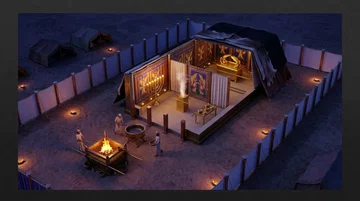
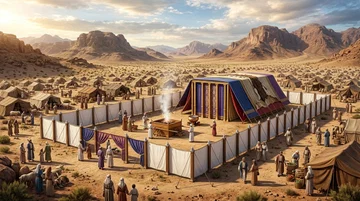
Hebrews 9:4 describes the most holy place of the wilderness tabernacle, the movable earthly sanctuary built at God's command and carried by Israel in its wilderness journey, with two rooms, the holy place and the most holy place, separated by a veil.GC88 411.1–412.3GC 410.3–411.1GC 411.2–412.3 It lists there the gold-covered ark of the covenant, which held the golden pot of manna, Aaron's rod that budded, and the stone tablets of the Ten Commandments.GC88 411.1–412.3GC 410.3–411.1RH Nov 8, 1915 Above the ark was the mercy seat with two cherubim of glory shadowing it, between whom God's presence appeared in the cloud of glory.GC88 411.1–412.3RH Nov 8, 1915GC 411.2–412.3
The most holy place lay behind the second veil and second curtain after the part called the holiest of all, where the symbolic service of atonement and intercession centered.RH Nov 8, 1915SG4 8.3RH Nov 9, 1905 The golden altar of incense stood before the ark but separated from it by the curtain, and the glory of God resting above the mercy seat could be seen from both sanctuary apartments, though less clearly from the first.SG4 8.31SP 273.3 Above the gold-covered ark was the golden mercy seat with two cherubim of glory shadowing it, and between the cherubim God's presence appeared in a cloud of glory from which He made His will known.GC88 411.1–412.3RH Nov 8, 1915RH Nov 9, 1905GC 411.2–412.3 The ark was a gold-covered chest made to hold the stone tablets bearing the Ten Commandments, called the ark of the covenant because those commandments were the basis of God's covenant with Israel.RH Nov 8, 1915RH Nov 9, 1905
The arrangement and furnishings of the tabernacle continued in Solomon's temple, which followed its proportions and furnishings.GC88 411.1–412.3GC 411.2–412.3 The sacred worship with censers for incense mingled with worshipers' prayers, animal blood pointing forward to Christ's blood, and God's glory manifested above the mercy seat continued for ages.4RED 125.2–127.1 Those rites and ceremonies ended with Jerusalem's destruction, the temple's destruction by the Romans in A.D. 70 because of Israel's disobedience.GC88 411.1–412.34RED 125.2–127.1
The earthly most holy place was the sacred dwelling-place of God's presence, guarded by a veil inwrought with cherubim to be lifted by only one hand.8T 284.3–285.1Lt 179, 1896, par. 34–35 To lift it and intrude unbidden into the sacred mystery was death, because above the mercy seat and the bowed, worshiping angels dwelt the glory of the Holiest upon which no man might look and live.8T 284.3–285.1 The ark stood beneath the cherubim as a symbol of God's presence among Israel and a pledge of victory in battle, demanding reverence so that idols could not stand before it and irreverent touch or curious looking brought death.ST Feb 21, 1911 Its holiness guarded it from intrusion.ST Feb 21, 1911Lt 179, 1896, par. 34–35
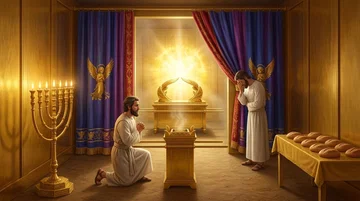
On the one day of the year appointed for ministry there the high priest with trembling entered God's presence while clouds of incense veiled the glory from his sight.8T 284.3–285.1 Every sound throughout the courts of the temple was hushed, no priests ministered at the altars, and the hosts of worshipers bowed in silent awe sent up their petitions for God's mercy.8T 284.3–285.1 These things happened by way of example and were written for admonition upon whom the ends of the ages are come.8T 284.3–285.1 Before the temple was destroyed because of Israel's disobedience, the tablets and ark were hidden in a cave, where they have remained undisturbed and have not been returned to Israel.SG4 114.3–4
Heavenly Most Holy Seen
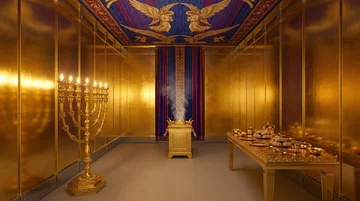
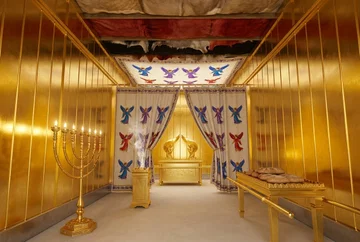
The verse reveals the furniture of the holy of holies in the temple in heaven in the Holy City.CET 91.2–3RH Jul 21, 1851 Beyond the door and the first veil lies the holy place with the altar of incense, the candlestick with seven lamps, and the table of showbread, and beyond the second veil lies the holy of holies.CET 91.2–3RH Jul 21, 1851
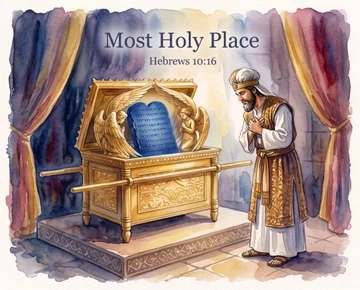
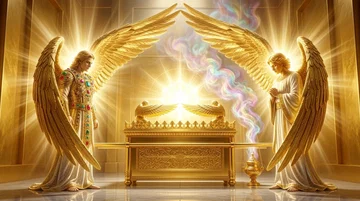
There stands the ark overlaid round about on top and sides with purest gold.CET 91.2–3RH Jul 21, 1851ExVEGW 15.3–17.1RH Jul 21, 1851SG1 158.1 A lovely cherub stands on each end spreading its wings over it, with their faces turned toward each other and looking downward.CET 91.2–3RH Jul 21, 1851ExVEGW 15.3–17.1RH Jul 21, 1851 A golden censer stands between the angels.CET 91.2–3RH Jul 21, 1851ExVEGW 15.3–17.1RH Jul 21, 1851SG1 158.1
Above the ark where the angels stand is an exceeding bright glory like a throne where God dwells.CET 91.2–3RH Jul 21, 1851ExVEGW 15.3–17.1RH Jul 21, 1851 Jesus stands by the ark.CET 91.2–3RH Jul 21, 1851ExVEGW 15.3–17.1RH Jul 21, 1851
The heavenly sanctuary has the corresponding ark of the testimony, with God's law beneath the mercy seat.RH Jun 29, 1911ST Mar 4, 1903GC 435.1Lt 253, 1903, par. 17 The earthly ark was made as the pattern of the true ark in heaven, so the law kept in the earthly ark was an exact transcript of the law kept in the heavenly ark.ST Mar 4, 1903GC 435.1 Living angels stand beside it in reverence and humility, looking reverently toward the golden mercy seat.ST Mar 4, 1903 The cover of the ark is the mercy seat with angels at either end, connected with the great day of atonement as part of the mysteries of heaven.Lt 253, 1903, par. 17
Ark Contents Identified
Inside the gold-covered ark are the golden pot that had manna, Aaron's rod that budded, and the tables of the covenant, which are the stone tablets of the Ten Commandments written with the finger of God.GC88 411.1–412.3GC 410.3–411.1WLF 18.3–4RH Nov 8, 1915LSEGW 100.1–3 The tables bear the Ten Commandments including the seventh-day Sabbath commandment, and their presence in the ark in the heavenly Most Holy Place shows the Sabbath remains part of God's law unchanged and kept in honor of His holy name.WLF 18.3–4LSEGW 100.1–3EW 26.1–2 The tablets hold the Ten Commandments written by God, with the Sabbath commandment shining above the others and the fourth commandment remaining unchanged in the heavenly ark.EW 26.1–2 The ark stands after the second veil in the holiest of all with the golden censer and with the cherubim of glory shadowing the mercy seat above it.RH Nov 8, 1915
In the heavenly ark the golden pot of manna and Aaron's rod are present, with the rod shown budding and blossoming and bearing fruit.WLF 14.3–16.1 Jesus identifies the rod as Aaron's and takes manna from the pot.WLF 14.3–16.1 Two angels look down upon the commandments and the golden pot of manna, and the commandments were Israel's covenant law.Ms 5, 1849, par. 13–15
The tables of stone fold together like a book, with the Ten Commandments written on them, four on one table and six on the other.RH Jul 21, 1851ExVEGW 15.3–17.1RH Jul 21, 1851LSEGW 100.4–101.1CET 91.4–93.1 Jesus opens the tables to show the Ten Commandments written with the finger of God, four on the first table and six on the second.RH Jul 21, 1851ExVEGW 15.3–17.1RH Jul 21, 1851CET 91.4–93.1 One view of the heavenly scene shows the law of God within the ark in the second apartment, with cherubim above it and a golden censer between them, but does not mention the manna or Aaron's rod.EW 213.2–214.1
The earthly ark was only the receptacle for the two stone tablets inscribed with God's law, and the divine precepts within it gave it its value and sacredness.GC88 433.2 The heavenly ark likewise enshrines that law spoken by God at Sinai amid thunder and written with His own finger on stone.GC88 433.2
Law and Sabbath Endure
The tables in the ark are God's covenant and the basis of His covenant with Israel, the stone tablets of the Ten Commandments written with His own finger and kept in the gold-covered chest in the most holy place where atonement and intercession centered.RH Nov 9, 1905ST Mar 4, 1903 The law kept in the earthly ark was an exact transcript of the law kept in the heavenly ark, made as its pattern, and those commandments are placed close to God and protected by His holiness.SG1 164.1EW 216.2GC 435.1 God's presence appeared above the gold cover, the mercy seat surmounted by cherubim, and from between the cherubim He made His will known.RH Nov 9, 1905 Living angels stand beside the true ark in heaven in reverence and humility.ST Mar 4, 1903
God's law in the ark is the rule by which all people are tested and remains the foundation of His government, which human efforts cannot abolish.4SP 261.3Ms 63, 1897, par. 35 Its light is now shining into the world's moral darkness, with special light directed to God's commandments.RH Jun 29, 1911 The cherubim looking reverently toward the mercy seat represent heavenly angels' reverence for God's law and the heavenly host's deep interest in redemption.ST Mar 4, 19034SP 261.3
The fourth commandment on those tablets is singled out as identifying the living God as the Maker of heaven and earth, with a halo of glory surrounding it.SG2 82.1 The ten are shown four on one table and six on the other, the four on the first shining brighter than the six, and the fourth, the Sabbath commandment, shining above them all with a halo of glory around it because it was set apart to be kept in honor of God's holy name.ExVEGW 15.3–17.1RH Jul 21, 1851CET 91.4–93.1EW 26.1–2 The Sabbath commandment in the heavenly ark still reads as written at Sinai, But the seventh day is the Sabbath of the Lord thy God, and nothing in the tables says it was abolished or changed to the first day.WLF 18.3–4ExVEGW 15.3–17.1LSEGW 100.1–3SG1 164.1EW 216.2 This proves God has not changed the Sabbath and it was not nailed to the cross, for if it were the other nine were also nailed and men would be at liberty to break them all.ExVEGW 15.3–17.1LSEGW 100.4–101.1CET 91.4–93.1
God never changes and has not changed the Sabbath from the seventh to the first day, for if He had He would have changed the writing on the heavenly tables to read the first day.RH Jul 21, 1851CET 91.4–93.1 The change from seventh to first was made by the Pope in fulfillment of the power to change times and laws.RH Jul 21, 1851CET 91.4–93.1 The holy Sabbath is and will be the separating wall between the true Israel of God and unbelievers and the great uniting question for God's waiting saints.RH Jul 21, 1851CET 91.4–93.1 It is within the Decalogue as the sign of loyalty, and its sanctity reaches into eternity when God's people will worship before Him on every Sabbath in the earth made new.Ms 63, 1897, par. 35 Had Israel kept the commandments of its covenant law, the nation would have been strong and Jerusalem would have continued to stand.Ms 5, 1849, par. 13–15
Mediation and Atonement Shown
The golden censer standing between the cherubim represents the prayers of the saints offered in faith.CET 91.2–3RH Jul 21, 1851EW 213.2–214.1EW 26.1–2 As their prayers come up to Jesus standing by the ark, the incense in the censer smokes.CET 91.2–3RH Jul 21, 1851RH Jul 21, 1851EW 26.1–2 He offers up their prayers with the smoke of the incense to His Father.CET 91.2–3RH Jul 21, 1851RH Jul 21, 1851SG1 158.1EW 213.2–214.1 Presented by Jesus with incense, the faithful prayers rise like sweet fragrance.SG1 158.1EW 26.1–2
The priest offering incense while directing his prayer by faith toward the unseen mercy seat represents God's people directing their prayers to Christ, their unseen Mediator before the mercy seat in the heavenly sanctuary.SG4 8.31SP 273.3 Though they cannot see Him, they may trust that He is there before the mercy seat.SG4 8.31SP 273.3 They may claim by faith the benefits of His mediation.SG4 8.31SP 273.3 As Jesus presents those prayers, glory from the Father's throne comes through Jesus and falls upon the mercy seat and upon those whose prayers have risen, so divine glory shines from the throne to Jesus and then upon the praying people.SG1 158.1EW 213.2–214.1
While Christ remains as High Priest in the heavenly sanctuary He accepts prayers, confessions, and sacrifices and grants pardon, so that sins may be blotted out before He leaves the most holy place.EW 39.2 Once He leaves there is no priestly ministry there to present further prayers or confessions, and people remain as they are, holy and righteous, or unjust and filthy, so the work of rescuing souls must be done before that ministry ends.EW 39.2 The ark containing the law with the mercy seat above it shows the union of justice and mercy in redemption, with God's law as the rule by which all are tested and the mercy seat representing Christ pleading His blood for sinners.4SP 261.3Lt 253, 1903, par. 17 God remains just while justifying the repentant sinner, restoring fellowship with fallen humanity and clothing the redeemed in Christ's righteousness so they may live in God's presence with the angels.4SP 261.3 Censers were used for incense mingled with the worshipers' prayers, animal blood pointed forward to Christ's blood, and God's glory was manifested above the mercy seat.4RED 125.2–127.1
1844 Test and Warning
In 1844 Jesus finished His mediation in the Holy Place and passed within the second veil into the Most Holy Place, where the ark holds the two tables of stone with the ten commandments written by the finger of Jehovah, together with the manna and Aaron's budding rod.ExVEGW 25.3ExVEGW 24.2–25.1Ms 1, 1849, par. 2–4 In that move He shut the door of the Holy Place so that no man can open it, and opened the door of the Most Holy Place so that no man can shut it, and He now stands by the ark where the faith of Israel reaches.ExVEGW 25.3ExVEGW 24.2–25.15MR 94.1–2 Enemies of present truth try to open the Holy Place door He shut and to close the Most Holy Place door He opened.ExVEGW 25.3 Since that door was opened the commandments in the ark have been shining out with all their importance, and God's people are being tested on the Sabbath truth.ExVEGW 24.2–25.1Lt 5, 1849, par. 7–95MR 94.1–2
The Sabbath test began only after Jesus finished His ministry in the Holy Place and passed within the second veil, and the light of the Sabbath reveals that God's law remains binding.EW 216.1Lt 5, 1849, par. 7–9Ms 1, 1849, par. 2–4 The ark in the most holy place which Jesus entered in 1844 makes its commandments central to sanctuary truth, and the holy Sabbath is the test by which God tests them.EW 35.2Ms 1, 1849, par. 2–45MR 94.1–2 Christians who died before the seventh month of 1844 without keeping the true Sabbath rest in hope, because they were not condemned before the Sabbath light came that made it a test.Lt 5, 1849, par. 7–9Ms 1, 1849, par. 2–4 By faith God's people find Jesus in the heavenly most holy place with renewed hope and joy, connected with the explanation of the 1844 disappointment.EW 216.1
The work of Jesus in the most holy place is nearly finished and the remaining time for this work is very short.EW 48.3–49.1 The ministration in the heavenly sanctuary is present truth that the Holy Spirit has endorsed over and over as a great pillar of faith, coming in answer to earnest seeking for light on the sanctuary question.4MR 249.1–2 A true understanding of what is described means much, yet for more than half a century new theories that are not truth have questioned and opposed it.4MR 249.1–2 Anyone presenting theories leading away from that light and denying those approved truths should not be accepted as a teacher.4MR 249.1–2
Sources
Pioneers and periodicals
104 sources
The verse describes the inner room beyond the second veil of the Moses-built worldly sanctuary, holding the golden censer and the gold-covered ark of the covenant with its golden pot of manna, Aaron's budded rod and tables of the covenant beneath the cherubim-shaded mercy-seat.RH Sep 2, 1852RH Feb 11, 1858ST May 20, 1880ST May 15, 1901 It reads golden censer as a small movable vessel of that second apartment, while others read golden altar of incense, and wherein can mean the Holiest itself so the pot and rod lay beside the ark with only the tables inside; all three were in the ark at first, and only the tables remained by Solomon's time after its capture and wanderings.ST Jun 20, 1911STST Jul 26, 1910ST Oct 28, 1897 The whole earthly tabernacle with its furniture and service is a figure and copy of the greater true tabernacle in heaven where Christ ministers by His own blood, and as ark and mercy-seat stood together below so a literal ark of God's testament with its mercy-seat stands in the heavenly temple.LDT 179.2ST Jan 27, 1890RH Feb 5, 1867RH Apr 6, 1869ST Jan 13, 1914 The tables inside are the Ten Commandments spoken at Sinai and written by God's finger, the moral and perpetual law distinct from the ceremonial law abolished at the cross, kept beneath the mercy-seat where God's presence dwells and atoning blood is sprinkled so mercy meets justice without removing the law.ST Dec 23, 1897RH Mar 4, 1862RH May 11, 1869RH Oct 18, 1853ST Aug 10, 1882 Only the first 490 years of the 2300 days belonged to that earthly house ending at the cross, and the rest reach to the cleansing of the heavenly sanctuary on October 22, 1844 when Christ passed within the second veil before the ark containing the law as the rule of judgment, where the Sabbath commandment still shines unchanged beneath the mercy-seat.RH Jul 21, 1851RH Jun 9, 1851ST May 27, 1880RH Sep 2, 1851ST Jan 23, 1893
Earthly Sanctuary Identified
Hebrews 9:4 belongs to the account of the worldly sanctuary of the first covenant with its ordinances of divine service, and it describes the tabernacle called the Holiest of all after the second veil.RH Sep 2, 1852RH Feb 11, 1858ST May 20, 1880RH Jan 6, 1853 That innermost room held the golden censer and the ark of the covenant overlaid round about with gold, containing the golden pot that had manna and Aaron's rod that budded and the tables of the covenant.RH Sep 2, 1852RH Feb 11, 1858ST May 20, 1880ST Jun 4, 1885 Above the ark were the cherubim of glory shadowing the mercy-seat, which is the cover of the ark and represents God's throne from which grace, favor and mercy are dispensed.RH Feb 11, 1858ST Jun 4, 1885ST Jan 27, 1890RH Jan 6, 1853 The verse is part of Paul's description of the earthly sanctuary as a figure of the heavenly sanctuary.RH Sep 2, 1852RH Feb 11, 1858
That first-covenant sanctuary was the definite building erected by Moses at God's express command in exact accordance with the pattern shown on the mount, pitched by man and not by the Lord.RH Jan 9, 1855RH Oct 30, 1855 It continued first as the movable tabernacle and then as the temple erected by Solomon which replaced it, and afterward as Zerubbabel's temple, remaining in use from Sinai and the days of Moses to the first advent of Christ and the cross.ST Oct 21, 1880RH Feb 15, 1870RH Jan 20, 1874 It was not Mount Zion, not the land of Canaan, not the earth or any part of the earth, not the church, and not meeting-houses.RH Jan 9, 1855RH Oct 30, 1855 When the Levitical priesthood gave way to Christ's priesthood after the order of Melchisedec, the earthly sanctuary of the first covenant passed away and was superseded by the true tabernacle which the Lord pitched, the greater and more perfect heavenly sanctuary of the new covenant where Christ ministers by His own blood to appear in the presence of God.RH Jan 9, 1855RH Feb 15, 1870
The sanctuary was longer than wide and was divided by a veil into two rooms with two distinct ministries.RH Sep 21, 1905RH Aug 31, 1916RH Jan 24, 1856 The first apartment held the candlestick and the table with the shewbread and the altar of incense, where the common or under priests ministered daily all the year, receiving sinners and their blood offerings for confessed sins.RH Sep 21, 1905RH Jan 9, 1855RH Aug 31, 1916RH Jan 24, 1856 The second apartment within the veil, the holy of holies or most holy place containing the ark of God's testament, was entered by the high priest alone only once each year with blood for the errors or ignorance of the people.RH Sep 21, 1905RH Sep 21, 1905RH Aug 31, 1916ST Oct 21, 1880RH Jan 20, 1874 That yearly entrance on the tenth day of the seventh month was the day of atonement or putting away of sin, when the high priest took up the sins brought into the sanctuary during the year, carried them before the ark of the Ten Commandments, met the symbol of God's presence above the ark on the mercy-seat, and so far completed atonement as to carry the sins out to confess them upon the head of the scapegoat to be borne into an uninhabited wilderness.RH Sep 21, 1905RH Jan 24, 1856ST Oct 21, 1880RH Jan 20, 1874 The whole system directed Israel's faith toward a permanent plan of salvation and foreshadowed Christ's priestly work for the world, while signifying that the way into the heavenly holiest was not yet clearly set forth until the better service was established by the gift of His life and blood.RH Aug 31, 1916 The holy of holies was twenty cubits square, and the Mosaic building is described as thirty cubits long and twelve wide.RH Jan 24, 1856
The ark itself was an oblong chest of acacia wood overlaid with gold within and without, three feet nine inches long and two feet three inches wide and high.ST May 15, 1901ST Nov 5, 1894 Its cover was the mercy-seat of pure gold, made from the same piece with a cherub at each end, and beneath it lay the stone tablets of God's law, with the Shekinah glory between the cherubim representing God in heaven.ST May 15, 1901RH Mar 4, 1902ST Nov 5, 1894 Because it held the law it was the most sacred object in the sanctuary, kept behind the second veil in the part called the Holiest of all, where ordinary priests serving in the first apartment could not enter and even the high priest could enter only at appointed times under penalty of death.ST May 15, 1901RH May 28, 1901RH Mar 4, 1902 The inner shrine was at times filled with the visible glory of God's presence so that the priests had to withdraw.RH Mar 4, 1902 The earthly tabernacle itself was made to be taken apart and carried with Israel in all their journeyings, a structure of extraordinary magnificence with walls of upright boards heavily plated with purest gold, with two apartments separated by a rich and beautiful curtain or veil and a similar veil closing the entrance of the first apartment, and with veils and ceiling curtains of various colors most beautifully arranged with cherubim inwrought in threads of gold and silver to represent the angelic host connected with the work of the heavenly sanctuary as ministering angels to the saints.ST Mar 21, 1911
Wording and Grammar
The common wording names a golden censer in connection with the most holy place, while the Revised and American Revisions read golden altar of incense and put censer in the margin, reflecting a difference among Greek copies.STST Jul 26, 1910 The censer was a small movable vessel in which a priest burned incense, able to be carried wherever the service took place and used chiefly in the second apartment.ST Jul 26, 1910RH Jun 18, 1901 Incense offered in the first apartment was placed on the stationary altar, and other clear sanctuary descriptions place that golden altar just before the veil separating the holy from the most holy.ST Jun 20, 1911STRH Jun 18, 1901 The first holy place instead contained the showbread table, the seven-lamp candlestick, and the golden incense altar, while beyond the veil stood the ark with the covenant tablets, covered by the mercy-seat with the cherubim of glory above it.ST Jun 20, 1911RH Mar 10, 1874ST Mar 11, 1886 The glory of God was present there so that the high priest entered only once a year, with incense concealing the ark, without which protection he would die.ST Mar 11, 1886
The word wherein may refer to the most holy place rather than to the ark itself, so the pot and rod were in that room rather than directly inside beneath the mercy-seat.STST Sep 16, 1913ST Feb 11, 1897 On this understanding they were kept beside the ark or in a pocket attached to it, laid before the testimony and before the Lord, while the tables alone are named separately as put inside the ark.ST Oct 28, 1897ST Sep 16, 1913 The phrase in which is thus taken to refer to the tabernacle, with the tables inside the ark named separately for emphasis, agreeing with 1 Kings 8:9 that at the temple dedication the ark contained only the stone tables. The testimony was the witness of God's character against sin in the stone tables of the covenant, and the book of the law containing the books of Moses was placed beside the ark as a witness and could therefore be spoken of as being in it.ST Oct 28, 1897ST Sep 16, 1913 Changes in what was kept in or beside the ark may have occurred during Israel's apostasies and reforms, and the verse confirms where the pot was eventually kept without showing that the ark or the Testimony existed when the manna first fell.ST Oct 28, 1897RH Feb 3, 1852
The description applies to the early history when the ark was first made ready for use in the tabernacle, when all three objects were placed in the ark together, though Moses does not directly state this.ST Jul 12, 1910RH Sep 4, 1856RH Oct 11, 1870 The tables were the ark's original contents with the pot and rod added later, in agreement with Exodus 16:33.ST Jul 12, 1910ST Mar 13, 1901 By the time described in 1 Kings 8:9 and 2 Chronicles 5:10 only the stone tables remained, the pot and rod having been removed, so there is no contradiction but a changing content across different periods.ST Jul 12, 1910RH Sep 4, 1856ST Mar 13, 1901 The removal happened while the ark was captured by enemies, carried from place to place in their land, opened with men struck down for looking into it, and kept for a long time separated from the sanctuary, perhaps while captive among the Philistines, though when and where is unknown.RH Oct 11, 1870RH Mar 17, 1910 At the ark's placement in Solomon's temple only the two stone tablets were found inside, the pot, censer, and rod being missing, with the covenant law remaining the most precious thing in the ark.RH Mar 17, 1910
Memorial Objects Meaning
The golden pot of manna kept in the ark memorializes God's daily provision of heavenly bread in the wilderness, given as He led His people out of bondage that they might serve Him and keep His statutes.RH Nov 27, 1913 Food in Egypt did not make bondage, affliction, sin and degradation an acceptable end of life, and dependence on God for food taught succeeding generations His love and care.RH Nov 27, 1913 The manna that sustained Israel, with the blossomed rod and the law kept with the ark, pictures covenant care, and looking back on that guidance and provision gives assurance that His care will continue in the future.ST May 19, 1909 These objects recall how God cared for ancient Israel by daily miracles, and they give confidence to those who trust God yet fear loss of job or support for obeying truth.RH May 13, 1915 The placing of the pot beside the tables of the covenant means that with the requirement is the provision, that God will provide a living for commandment-keepers and with the Sabbath will give the bread.RH Nov 27, 1913 The will of God on the tables and the promises of God in the pot belong together in the ark, with authority from Jehovah promising a living to all who obey from the heart, so that temporal affairs are never reason to fail to keep the commandments once duty is plain.RH Nov 27, 1913
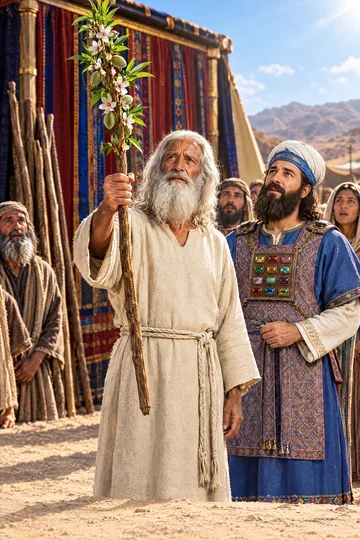
Aaron's blossoming almond rod was kept in the ark of the covenant as a witness that God had chosen him for the priestly office.ST Oct 7, 1897 It stands as reminder of delegated heavenly power, while the tables are stones inscribed by God's own hand resting beneath the mercy-seat as pillars of His government.ST Oct 7, 1897ST Oct 21, 1930ST Oct 21, 1930 The ark is the chief furnishing of the most holy place, and its chief purpose was to keep the covenant tablets safe.ST Oct 21, 1930ST Oct 21, 1930 Its sacredness came from the sacred law within it, which testified to God's will and character, His holiness, righteousness, unchangeableness and greatness.ST Oct 21, 1930ST Oct 21, 1930 God's throne was established upon the law, and above the law was the mercy-seat with golden cherubim at either end with wings stretched over it, the divine light of the Shekinah resting between them, so that the ark and its setting formed a miniature of God's throne.ST Oct 21, 1930
In the Holy of Holies of the temple in the Holy City in heaven the ark of the covenant is overlaid round about with purest gold on top and sides.RH Jul 21, 1851RH Jul 21, 1851 A lovely cherub stands on each end with wings spread over it, faces turned toward each other and looking downward, with a golden censer between the angels.RH Jul 21, 1851RH Jul 21, 1851 Above the ark is an exceeding bright glory like a throne where God dwells, with Jesus standing by the ark.RH Jul 21, 1851RH Jul 21, 1851 As the saints' prayers come up to Jesus the incense in the censer smokes, and He offers up their prayers with the smoke of the incense to His Father.RH Jul 21, 1851RH Jul 21, 1851 Inside the ark are the golden pot of manna, Aaron's rod that budded, and the tables of stone which fold together like a book, with the ten commandments written on them with the finger of God, four on one table and six on the other.RH Jul 21, 1851RH Jul 21, 1851
Type of Heavenly Sanctuary
The whole earthly tabernacle with its two holy places, furniture, vessels and yearly service is a figure, shadow, pattern and copy of the greater, more perfect and true tabernacle in heaven which the Lord pitched and not man.LDT 179.2RH Apr 6, 1869ST Feb 7, 1906ST Aug 15, 1878RH Sep 20, 1864 Hebrews 8 and 9 make this explicit, setting the sanctuary of the first covenant with its description in Hebrews 9:4 over against the real sanctuary of the new covenant where Christ ministers as great High Priest by His own blood shed at Calvary.LDT 179.2RH Apr 6, 1869ST Jan 13, 1914ST Feb 7, 1906ST Aug 15, 1878 That earthly sanctuary was temporary and passed away with the covenant it served, while its divinely ordained ceremonies foreshadowed the Redeemer as the true High Priest and the substance of good things to come.RH Apr 6, 1869ST Jan 13, 1914ST Feb 7, 1906ST Aug 15, 1878RH Sep 20, 1864 The order of His ministration in two apartments after entering by His own blood is indicated by the service in the two apartments of the earthly sanctuary, which is distinct from earthly meeting-houses and places of worship.ST Aug 15, 1878RH Sep 20, 1864
As the earthly ark and mercy-seat stood together in the holiest, with the mercy-seat resting upon the ark beneath the cherubim, so there is a literal ark of God's testament with its mercy-seat in the heavenly temple where Christ ministers.ST Jan 27, 1890RH Feb 5, 1867ST Oct 22, 1874RH May 27, 1852ST Oct 22, 1874 The ark's cover is the mercy-seat, representing God's throne from which He dispenses grace, favor and mercy, and the same close joining of ark holding the commandments as the rule of human life with the mercy-seat where pardon is found through Christ's blood exists in heaven.ST Jan 27, 1890RH Feb 5, 1867ST Oct 22, 1874RH May 27, 1852RH Aug 22, 1854 The earthly sanctuary and its contents correspond to heavenly things, so the ark, like the mercy-seat upon it, has a counterpart above, revealed when the temple is opened, though earthly things cannot fully portray heavenly things.RH Feb 5, 1867ST Oct 22, 1874RH May 27, 1852ST Oct 22, 1874 The earthly high priest entered with sacrificial blood because the law had been violated and pardon required an offering, not to erase the law or lessen obligation, and so Christ entered the true sanctuary by His own blood to serve as High Priest before the ark pleading for pardon for repentant sinners who obey God and keep His commandments.RH Feb 5, 1867ST Oct 22, 1874RH May 27, 1852RH Aug 22, 1854 Believing in the heavenly ark and keeping the commandments it contains does not mean rejecting Christ or the mercy-seat.ST Oct 22, 1874
The two earthly apartments represent two phases of Christ's ministry, first in the holy place and then in the most holy, not two dispensations or two parts of human nature.ST Aug 15, 1878ST Aug 8, 1878ST Mar 26, 1912RH Jan 1, 1867RH Nov 1850 He entered upon His work as Priest in the heavenly sanctuary at ascension, with Pentecost making it known, and the anointing of the most holy was the anointing of that heavenly sanctuary as He began that priestly work.ST Aug 15, 1878ST Mar 26, 1912 He ministered first in the first apartment until the end of the 2300 days, then closed the door of that daily ministration and opened the door into the holiest where the Ten Commandments are seen, passing within the second veil into the heavenly tabernacle of the testimony.RH Jan 1, 1867RH Nov 1850RH Dec 30, 1873RH Dec 23, 1851 The high priest's yearly move from the first apartment into the second to perform atonement or judgment illustrates Christ entering the second apartment when the judgment begins before His second coming, so the ark's appearance when the heavenly temple is opened signifies the opening of that apartment where the investigative judgment takes place and precedes the pouring out of the plagues.RH Jan 1, 1867RH Nov 1850RH Dec 30, 1873RH Dec 23, 1851
Law Kept in Ark
The tables of the covenant inside the ark are the two stone tablets bearing the Ten Commandments spoken at Sinai and written by God's finger, distinct from the book of the covenant kept beside the ark.ST Dec 23, 1897RH Sep 3, 1857RH Jan 10, 1916 The ark and the law within it were central to the first-covenant sanctuary and its priestly ministry, with the mercy-seat and cherubim above it where the glory of God was manifested.RH Mar 4, 1862RH May 11, 1869 That law is also called God's testament and testimony, giving the ark its names as ark of the covenant, of the testimony, and of the testament, and making it the central object and glory of the sanctuary.RH Feb 26, 1867RH Oct 18, 1853 The tables of the Ten Commandments were placed inside the ark along with the manna and Aaron's budding rod, while the book of the law was placed beside it to distinguish the enduring commandments from what passed away.RH Sep 3, 1857 The heavenly sanctuary's ark contains God's testament or law as the pattern for the Ten Commandments, whose fourth commandment identifies the seventh day and not the first as the Sabbath.RH Feb 26, 1867
The wording that the sanctuary had these objects distinguishes them from the sanctuary itself, and likewise the first covenant had ordinances and the covenant tables, but those things were not the covenant itself.ST Dec 23, 1897 The Ten Commandments were not yet in Israel's possession in written form when the first covenant was ratified with blood, so they were not the covenant itself but the basis to which the covenant related.RH Jun 26, 1900 The stone tables inside are the moral law placed inside the ark in the most holy place, unchanging, perpetual and for all humanity, while the ceremonial law and its sacrifices taught how atonement was to be made and foreshadowed the real atonement through Christ.ST Jan 6, 1881 The temple and its furnishings belonged to the typical law relating to the temple, and the ceremonial types meeting fulfillment at the cross are abolished by the gospel, whereas the perfect law is not abolished but has guilt removed through Christ.ST Mar 20, 1879 The singular use of law shows the law of God given through Moses is one law, yet the tables are distinct from the ceremonial and judicial laws spoken only to Moses.RH Aug 5, 1851
The law beneath the mercy-seat was the moral law that people had broken and that required atonement, exposing sin and requiring death.ST Aug 10, 1882ST Jan 6, 1881 Above the ark the mercy-seat forming its top is God's throne where His presence and Shekinah glory abide between the cherubim, as shown with Revelation 11:19 and 15:5 placing the testimony beneath the mercy-seat.RH May 11, 1869RH Oct 18, 1853 There atoning blood was sprinkled, as Aaron entered not by the blood in his own veins but by the blood of the sin offering slain outside, and as Christ as High Priest entered heaven itself by His own blood shed as a sacrifice upon the cross presented as a priestly offering.RH Aug 25, 1874 So the guilty could receive pardon and mercy through Christ's blood meeting justice above the ark without the law itself being removed or blotted out.ST Aug 10, 1882RH May 27, 1852ST Jan 6, 1881 The old covenant's sanctuary services were typical and could not make anything perfect or take away sins, but pointed forward to Christ in whom pardon restores the penitent while the impenitent are destroyed.ST Aug 10, 1882ST Oct 10, 1906ST Feb 27, 1879
Cleansing and Judgment
The sanctuary to be cleansed is the temple in heaven where Christ serves as High Priest, and its cleansing begun in 1844 is His concluding work for sinners that will end His sanctuary ministry and complete the plan of salvation.ST May 20, 1875RH Feb 21, 1856ST May 1, 1879 That cleansing is with blood, not with fire or water, meaning not the removal of physical uncleanness but the removal of sin and iniquity as foretold in Daniel 8:14.RH Feb 21, 1856ST Oct 25, 1883ST Apr 20, 1904 Penitents confessed their sins over the victim, and through its blood and the priest's ministry those sins were represented as entering the sanctuary and being borne by the priest as representative.RH Oct 15, 1901ST Oct 25, 1883 The tabernacle and all the vessels of ministry were then sprinkled with blood to purge and cleanse them, yearly by the high priest alone with the blood of the sin offering for himself and for the errors of the people, because without shedding of blood there is no remission.ST May 1, 1879ST Oct 25, 1883 This work was completed on the tenth day of the seventh month as atonement and putting away of sin in figure, before he came out to the scapegoat representing Satan.ST May 20, 1875RH Oct 15, 1901ST Apr 20, 1904
The earthly sanctuary with its ark and sacred items in the most holy place was the type, and Christ with His own blood cleanses the heavenly reality; the ark seen in the heavenly temple when the 2300 days expired marks the time for that cleansing and the beginning of the judgment.RH Jun 9, 1851ST May 1, 1879RH Sep 2, 1851 The first covenant had a worldly sanctuary with ordinances of divine service, which necessarily implies the second covenant also has a sanctuary with divine service.RH Jun 9, 1851ST May 27, 1880RH Feb 18, 1858 Only 490 years of the 2300 years were allotted to the first covenant, the worldly sanctuary and the Jewish church, after which the old covenant passed away, the new covenant was introduced, the services of the worldly sanctuary forever ceased with Christ's death, and Jewish pre-eminence ended.RH Jun 9, 1851ST May 27, 1880RH Feb 18, 1858 The remaining 1810 years therefore reach to the cleansing of the sanctuary of the second covenant at the termination of the 2300 days.RH Jun 9, 1851ST May 27, 1880RH Feb 18, 1858
That cleansing is the antitypical Day of Atonement prefigured by the earthly day of atonement, begun on October 22, 1844.RH Sep 2, 1851RH Aug 19, 1851ST Dec 21, 1915 Then Jesus as great High Priest, wearing His priestly garments and the breastplate of judgment bearing the names of all the true Israel of God, shut the door and passed within the second veil into the Holiest of all in a literal transaction in heaven to appear before the Ancient of days.RH Jun 9, 1851RH Sep 2, 1851RH Aug 19, 1851 There before the ark containing the law as the rule of judgment He confesses the names of overcomers before the Father and His angels, and the opening of that door is the basis of the third angel's message.ST May 1, 1879RH Aug 19, 1851ST Dec 21, 1915 The people of God are therefore now in the day of atonement and investigative judgment.ST May 20, 1875RH Sep 2, 1851ST Dec 21, 1915
Sabbath and Daily Life
The tables kept beneath the mercy-seat place the Sabbath commandment at the center of the religious system with the other nine, sharing their honor and permanence as the unchanging rule of life and of judgment.ST Jan 23, 1893ST Mar 14, 1878RH May 27, 1852RH Oct 20, 1859ST Jan 10, 1878 In the Most Holy of the heavenly temple the ark is overlaid with purest gold, with a cherub at each end with wings spread and faces turned toward each other looking downward, a golden censer between them, exceeding bright glory above like the throne where God dwells, and Jesus standing by to offer the saints' prayers with the smoke of the incense.RH Jul 21, 1851ST Mar 14, 1878RH Oct 20, 1859 Inside are the golden pot of manna, Aaron's rod that budded, and the tables of stone folding together like a book, opened to show the ten commandments written by God's finger, four on one table and six on the other, the four brighter than the six.RH Jul 21, 1851ST Mar 14, 1878RH May 27, 1852 The fourth, the Sabbath commandment, stands above them all and brightest with a halo of glory around it, still reading the seventh day as given at Sinai, proving God never changes, that He never changed the Sabbath to the first day and never nailed it to the cross, that the change to the first day was made by the Pope, and that the holy Sabbath is and will be the separating wall between the true Israel of God and unbelievers and the great uniting question for the waiting saints.RH Jul 21, 1851ST Mar 14, 1878RH May 27, 1852RH Oct 20, 1859ST Jan 10, 1878 Kept safe beneath the mercy-seat from the hostility of men and devils, with Christ as great High Priest pleading His own blood for lawbreakers, it remains the standard of righteousness through all ages, linked with victory, with refusing the beast's mark, and with entering the city of God.ST Mar 14, 1878RH May 27, 1852RH Oct 20, 1859ST Jan 10, 1878RH Mar 12, 1914
The sanctuary with its golden censer, ark, manna pot, budding rod and covenant tablets is a holy refuge even far from home, where bread satisfies, light guides, prayer and praise ascend as from the altar, and communion at the mercy-seat brings forgiveness and grace as burdens are received.RH Jun 24, 1902RH Apr 10, 1856RH Oct 4, 1864 Its earthly tabernacle and services were types of heavenly things, showing how sinners are forgiven through Christ's blood shed once for all, with His mediatorial work under the new covenant carried on in the heavenly holy places.RH Apr 10, 1856ST Jun 3, 1913RH Oct 4, 1864 The inner compartment was the special place of God's presence entered by the high priest once a year, not a figure of two parts of human nature or an indwelling presence in every heart.RH Apr 10, 1856RH Jul 21, 1904 By faith believers are called into the holiest to plead Christ's obedience, and the sanctuary's cleansing with the Sabbath reform directs attention to the ark and commandments in preparation for Christ's coming.RH Jun 24, 1902RH Mar 12, 1914RH Feb 5, 1857
The pot of manna and the rod beside the tables recall daily miracles and care for ancient Israel, giving confidence to those who fear loss of work or support for obeying truth.ST Jun 3, 1913RH May 13, 1915RH Nov 27, 1913 With the requirement goes the provision: with the Sabbath God gives bread, the will of God on the tables and the promises of God in the pot belonging together with authority from Jehovah promising a living to all who obey from the heart, so temporal affairs are never reason to delay keeping the commandments when duty is plain.RH May 13, 1915RH Nov 27, 1913 The ark overlaid with purest gold within and without, with cherubim above and angels looking down toward the commandments, shows heaven and earth's regard for a moral, everlasting law for all humanity, written on hearts from creation and later on stone because sin had obscured it, and teaches that those with the law written in the heart must be pure within and without.RH Nov 27, 1913RH Feb 5, 1857 As seat of God's presence and glory and center of worship, before which idols could not stand and which only the pure could approach without death, it was Israel's pledge of victory in battle, yet mere outward custody without a consecrated heart leaves one captive to sin.ST Jun 3, 1886RH May 27, 1852ST Aug 28, 1898
Sources